
After the scattering comes a promise of gathering. Moses does not require the exiled person to pretend the failure never happened. The blessings and curses must be remembered, and the heart must return. Then the Lord will heal what the sinner cannot heal alone. ‘Choose life’ stands within this mercy: a real human answer to the God who draws near, purifies, and restores.
Orientation
The horizon stretches from the nations of exile to the land promised to the fathers, and from that outward return to the inward cleansing of the heart. The covenant diagram sets rescue, command, failure, and return beside their Christian reception. Its lower arc is theological, not a second historical travel route. The command to choose life is completed by loving, hearing, and cleaving to the Lord.
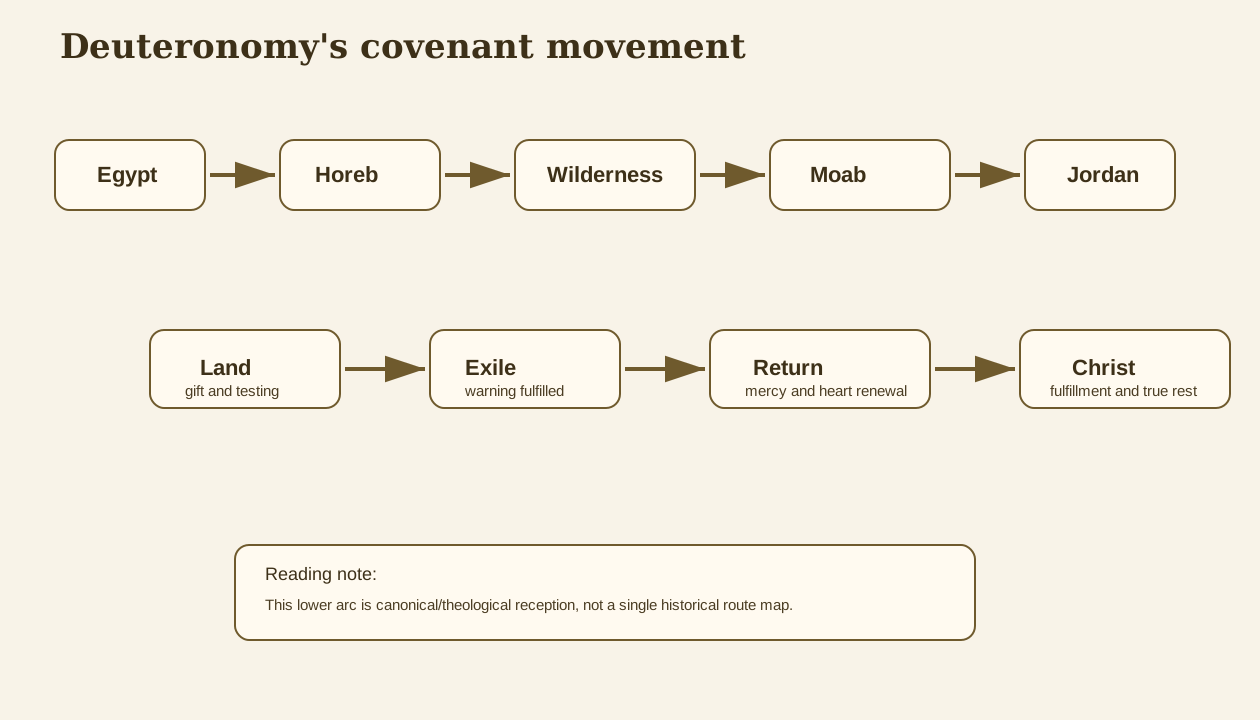 Source: Original project chart, 2026-06-19. The lower arc is canonical and theological reception, not one historical route map.
Mercy gathers the scattered (Deuteronomy 30:1–5)
Scripture: Brenton Septuagint
1 And it shall come to pass when all these things shall have come upon thee, the blessing and the curse, which I have set before thy face, and thou shalt call them to mind among all the nations, wherein the Lord shall have scattered thee, 2 and shalt return to the Lord thy God, and shalt hearken to his voice, according to all things which I charge thee this day, with all thy heart, and with all thy soul; 3 then the Lord shall heal thine iniquities, and shall pity thee, and shall again gather thee out from all the nations, among which the Lord has scattered thee. 4 If thy dispersion be from one end of heaven to the other, thence will the Lord thy God gather thee, and thence will the Lord thy God take thee. 5 And the Lord thy God shall bring thee in from thence into the land which thy fathers have inherited, and thou shalt inherit it; and he will do thee good, and multiply thee above thy fathers.
The first act is remembrance among the nations. The people call to mind the word they have resisted and turn to the Lord with heart and soul. Repentance faces the truth rather than replacing it with a more pleasant version of the past. The promise can meet them wherever that truthful return begins.
Brenton renders verse 3 with the Lord healing their iniquities before gathering them. The restoration reaches farther than a change of address. Distance has not made them unreachable, even at the ends of heaven. The God who judged the breach still wills to gather His people in mercy.
A scattered life can resemble this exile without being identical to Israel’s history. Old lies, broken relationships, and divided desires may seem too far apart to repair. Begin with a return to God, not a demand to repair everything in your own strength. Confession, a truthful apology, and acceptance of help can become the first gathered pieces of a life entrusted to Him.
A heart purified for love (Deuteronomy 30:6–10)
Scripture: Brenton Septuagint
6 And the Lord shall purge thy heart, and the heart of thy seed, to love the Lord thy God with all thy heart, and with all thy soul, that thou mayest live. 7 And the Lord thy God will put these curses upon thine enemies, and upon those that hate thee, who have persecuted thee. 8 And thou shalt return and hearken to the voice of the Lord thy God, and shall keep his commands, all that I charge thee this day. 9 And the Lord thy God shall bless thee in every work of thine hands, in the offspring of thy body, and in the offspring of thy cattle, and in the fruits of thy land, because the Lord thy God will again rejoice over thee for good, as he rejoiced over thy fathers: 10 if thou wilt hearken to the voice of the Lord thy God, to keep his commandments, and his ordinances, and his judgments written in the book of this law, if thou turn to the Lord thy God with all thine heart, and with all thy soul.
Verse 6 names the purpose of the Lord’s cleansing: love with the whole heart and soul, so that the people may live. The Lord does not merely remove the consequences of failure. He reaches the place where allegiance is formed and heals it for communion.
Deuteronomy 10:16 commanded Israel to circumcise the hardness of the heart. Here God promises to act upon that heart Himself. Command and gift belong together. We answer God’s call, yet we cannot manufacture the loving heart His command requires. Brenton’s ‘purge’ expresses the cleansing force of the promise, while the Hebrew-based image of circumcision names the inward removal of resistance.
Romans 2:29 speaks of circumcision of the heart in the Spirit. Colossians 2:11–12 joins circumcision made without hands to burial and resurrection with Christ in Baptism. In the Church, inward renewal is rooted in Christ’s saving act and the Holy Spirit’s work, not in a technique for becoming a better person. The baptized person continues to repent, hear, and do what grace makes possible.
Verses 8–10 return to obedience, blessing, and God’s joy over His people. The healed heart learns to love the voice it once avoided. Forgiveness is a beginning of renewed life, not a permission slip for the old refusal.
The word is near (Deuteronomy 30:11–14)
Scripture: Brenton Septuagint
11 For this command which I give thee this day is not grievous, neither is it far from thee. 12 It is not in heaven above, as if there were one saying, Who shall go up for us into heaven, and shall take it for us, and we will hear and do it? 13 Neither is it beyond the sea, saying, Who will go over for us to the other side of the sea, and take it for us, and make it audible to us, and we will do it? 14 The word is very near thee, in thy mouth, and in thine heart, and in thine hands to do it.
The command is neither hidden in heaven nor inaccessible beyond the sea. God has spoken within reach of His people. The imagined great journey could become a respectable reason for postponing the obedience already at hand. Moses removes that excuse.
Language insight: “mouth”, “heart”, and “hands”
Brenton and Swete’s Greek include ‘in thine hands to do it’ in verse 14; this phrase is absent from the Masoretic form reflected in NKJV. The Greek gathers speech, inward reception, and action into one answer. The hands keep nearness from becoming a merely admired idea.1
Romans 10:6–10 receives the passage through Christ. Paul explains ascent as an attempt to bring Christ down and descent into the abyss as bringing Him up from the dead. The Son has come, and God has raised Him; salvation does not await our impossible journey. Paul quotes the near word in mouth and heart without the hands, identifying it as the word of faith preached, then joins belief in the Resurrection to confession of Jesus as Lord.
The Apostle’s adaptation neither reproduces every Greek clause nor dismisses obedient action. It places the saving initiative in Christ and brings the hearer before the Gospel already proclaimed. We cannot descend into death to rescue ourselves. We can hear the risen Lord, confess Him, and answer His nearness in the next act of fidelity.
Choose life by cleaving to the Lord (Deuteronomy 30:15–20)
Scripture: Brenton Septuagint
15 Behold, I have set before thee this day life and death, good and evil. 16 If thou wilt hearken to the commands of the Lord thy God, which I command thee this day, to love the Lord thy God, to walk in all his ways, and to keep his ordinances, and his judgments; then ye shall live, and shall be many in number, and the Lord thy God shall bless thee in all the land into which thou goest to inherit it. 17 But if thy heart change, and thou wilt not hearken, and thou shalt go astray and worship other gods, and serve them, 18 I declare to you this day, that ye shall utterly perish, and ye shall by no means live long upon the land, into which ye go over Jordan to inherit it. 19 I call both heaven and earth to witness this day against you, I have set before you life and death, the blessing and the curse: choose thou life, that thou and thy seed may live; 20 to love the Lord thy God, to hearken to his voice, and cleave to him; for this is thy life, and the length of thy days, that thou shouldest dwell upon the land, which the Lord sware to thy fathers, Abraam, and Isaac, and Jacob, to give to them.
Heaven and earth witness the decision. Life and death are not abstract options detached from the people who will answer. Moses gives life its content: love the Lord, hear His voice, and cleave to Him. Choosing life means receiving and remaining in that bond.
Gems from the Fathers: grace and the willing answer
St. John Cassian’s Conference 13 records Abba Chaeremon’s teaching from the Egyptian desert on God’s protection and human freedom. This is a thematic witness to the conjunction of God’s cleansing and Israel’s answer, not a direct commentary on this chapter. At 13.11 Cassian says grace and free will ‘seem opposed to each other, but really are in harmony’. At 13.13 he explains that ‘the grace of God always co-operates with our will’. He concludes at 13.18 that God incites, protects, and strengthens without taking away the freedom He has given.2
His conclusion begins by confessing that human effort cannot reach perfection without God’s pity and protection. Synergy means this grace-enabled cooperation, not an equal partnership between two independent saviors. Ask for grace and make a real answer: pray before resisting temptation, confess instead of defending the wrong, and return again when you fall. Neither passivity nor spiritual self-reliance can perform the loving union Moses describes.
The Life we choose and the Life on the Cross
NKJV renders verse 20 ‘for He is your life’, where Brenton reads ‘for this is thy life’. Brenton accents the cleaving life just described; NKJV directly names the Lord as life. Through St. Athanasius’s reading of Deuteronomy 28:66 in On the Incarnation, 35.2 and 37.2, the Church can join the Life set before Israel to the Life hanging before our eyes upon the Cross. This is a Christian theological connection, not a claim that the two verses have identical immediate meanings. Christ says that He is the Resurrection and the Life in John 11:25 and the Way, Truth, and Life in John 14:6. To choose life is finally to cling to the living Savior who gives Himself freely and brings us through death into communion with God.3
Glossary
- Circumcision of heart: inward cleansing of resistance to God, so that love can become whole.
- Synergy: the real cooperation of human freedom with God’s saving grace.
- Cleave: remain closely attached in love and allegiance.
- Word of faith: Paul’s name for the Gospel proclaimed and received in faith.
Spiritual Fruit
Begin return where you actually are. Pray a truthful sentence about the sin or neglect that has scattered your life. Arrange confession or a needed conversation. Do not wait until every feeling agrees or every consequence has been repaired before you come to Christ.
Ask for the heart the command requires. When resentment interrupts prayer, ask the Lord to purify the place that resists love. Refuse the next act that feeds it: a cutting remark, a rehearsed accusation, or a private indulgence. Grace heals through a real answer made under God’s help.
Give the near word your hands. After hearing the Gospel, choose one act that belongs to it: repay what you owe, protect time for prayer, reconcile where safe, or help someone whose need you know. Let mouth, heart, and hands stop pulling in different directions.
The word is near, and the Lord is nearer than the excuse you are preparing. You do not have to climb into heaven to bring Him down. He has come to you, entered death freely, and risen. Choose the life of cleaving to Him, one truthful answer at a time.
Teaching Notes
Teacher guidance
Use the covenant diagram on this page to connect return with remembered judgment and mercy. Keep Cassian’s witness thematic and read his dependence upon God’s help alongside his account of freedom. The Cross connection is a Christian reception through Athanasius, not a substitute for explaining either verse’s covenant setting.
Mercy gathers the scattered (Deuteronomy 30:1–5)
- Ask: What must remembrance admit before return can become truthful?
- Watch for: Treating Israel’s concrete restoration as only an inward metaphor, or telling a penitent to repair everything before approaching God.
A heart purified for love (Deuteronomy 30:6–10)
- Ask: How do the command in chapter 10 and God’s promise here belong together?
- Watch for: Self-produced salvation, a merely external account of Baptism, or a promise that baptized people no longer need repentance.
The word is near (Deuteronomy 30:11–14)
- Ask: What changes when Paul identifies the near word through Christ’s coming and Resurrection?
- Watch for: Claiming Paul quotes the entire Greek verse unchanged, or using the omitted hands to make obedience irrelevant.
Choose life by cleaving to the Lord (Deuteronomy 30:15–20)
- Ask: What concrete answer would cleaving to the Lord require from me today?
- Watch for: Treating synergy as self-salvation, grace as coercion, or choosing life as generic optimism.
Sources
Embedded Scripture is from Brenton’s English Septuagint (LXX). New Testament comparisons follow NKJV.
St. John Cassian, Conference 13, 11, 13, and 18, Abba Chaeremon on God’s protection, direct text.
St. Athanasius, On the Incarnation, 35.2 and 37.2, direct text.
No appointed Coptic lectionary reading from this chapter is known in the references consulted.
Footnotes
-
Deuteronomy 30:14, Swete’s Greek text, compared with Romans 10:6–10. ↩
-
St. John Cassian, Conference 13, 11, 13, and 18, direct text. ↩
-
St. Athanasius, On the Incarnation, 35.2 and 37.2, direct text; Deuteronomy 30:20 in NKJV. ↩