


This narration is from a previous version of the study and may include a combined recording of multiple chapters.
Israel stands east of the Jordan with an inheritance before them and a wilderness behind them. Moses will not cross with the people he has led. Before he dies, he gives them something they will need more urgently than a map: the memory of who delivered them, the commandments that protect their life together, and the call to love the Lord with their whole being. Deuteronomy asks whether a people rescued from bondage can receive abundance without forgetting the Giver.

The words spoken at the threshold (Deuteronomy 1:1-5)
1 These are the words which Moses spoke to all Israel on this side Jordan in the desert towards the west near the Red Sea, between Pharan Tophol, and Lobon, and Aulon, and the gold works. 2 It is a journey of eleven days from Choreb to mount Seir as far as Cades Barne. 3 And it came to pass in the fortieth year, in the eleventh month, on the first day of the month, Moses spoke to all the children of Israel, according to all things which the Lord commanded him for them: 4 after he had smitten Seon king of the Amorites who dwelt in Esebon, and Og the king of Basan who dwelt in Astaroth and in Edrain; 5 beyond Jordan in the land of Moab, Moses began to declare this law, saying,
Deuteronomy presents Moses addressing Israel in Moab after the forty years of wandering and the victories over Sihon and Og. The distance from Horeb to Kadesh could have been crossed in eleven days; the people now hear Moses in the fortieth year (1:2-3). That contrast gives the opening its weight. The wilderness contains the cost of unbelief as well as the patience of God. Moses remembers both, so that their children will neither excuse the sin nor despair of mercy.
The book’s setting is a threshold, but its concerns reach far beyond the approaching crossing. Israel will need truthful judges, households that teach their children, worship free from idols, rulers who submit to the word, and open hands toward the poor. Moses also foresees exile and calls the people to return to the Lord. The promised land is a gift to inhabit faithfully, never a possession that makes obedience unnecessary.
Geographical Significance
Horeb is the mountain of the covenant. Kadesh-barnea recalls the refusal to enter. Edom, Moab, and Ammon teach Israel that the Lord has given inheritances to other peoples too: the ability to seize land is no permission to seize it. The Arnon marks the approach to Sihon’s territory, while Bashan recalls Og’s defeat. Nebo looks toward the land Moses will see without entering. Gerizim and Ebal will become the mountains of blessing and curse, beside the region where Abraham first received the promise in Genesis 12:6-7.
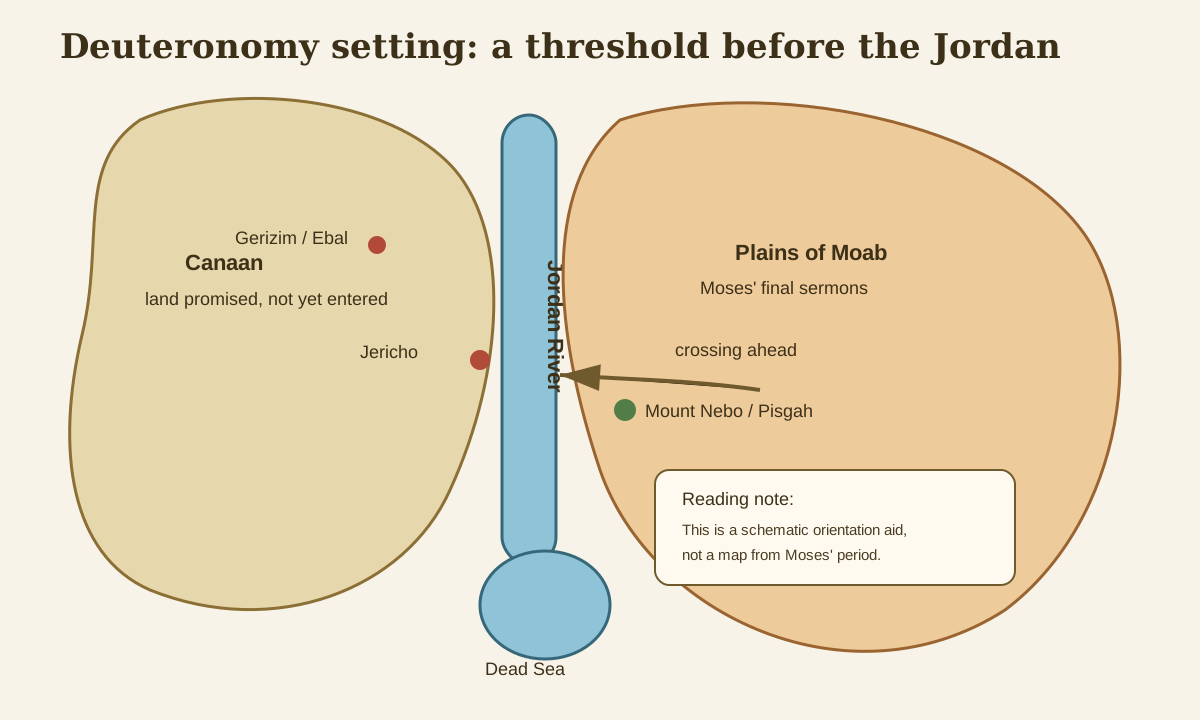 Original project schematic, 2026-06-19. An orientation aid for Moab, Jordan, Nebo, Jericho, Gerizim, Ebal, and Canaan; not an ancient map.
The Characters 👥
The Lord is the Redeemer before He is Israel’s Lawgiver: His commandments address people He has already brought out of bondage. Moses is prophet, intercessor, and servant, entrusted with a work that will continue beyond his own life. Joshua receives the charge to lead the people across the Jordan. Abraham, Isaac, and Jacob remain present in the promises God swore to them. Priests and Levites preserve and teach the covenant word; children, strangers, widows, and orphans repeatedly test whether the community has truly heard it.
Original project chart, 2026-06-19. Moses and Aaron belong to Levi; Joshua belongs to Ephraim. Arrows show descent and tribal affiliation; intervening generations are not all displayed.
One covenant proclaimed again (Deuteronomy 17:18-20)
18 And when he shall be established in his government, then shall he write for himself this repetition of the law into a book by the hands of the priests the Levites; 19 and it shall be with him, and he shall read in it all the days of his life, that he may learn to fear the Lord thy God, and to keep all these commandments, and to observe these ordinances: 20 that his heart be not lifted up above his brethren, that he depart not from the commandments on the right hand or on the left; that he and his sons may reign long in his dominion among the children of Israel.
The future king must receive the law, keep it near, and read it throughout his life. Authority is placed beneath the word it is tempted to manipulate. The purpose reaches the heart: he must not exalt himself above his brothers (17:20). The king’s reading is an education in humility, not merely preparation for issuing commands.
Language insight: “this repetition of the law”
At 17:18 the Hebrew asks for a copy of this law; the Greek phrase is “τὸ δευτερονόμιον τοῦτο” (to deuteronomion touto), rendered by Brenton as “this repetition of the law”.1 The Greek name of the book comes from this expression. Deuteronomy is not a second, competing law alongside Sinai. Moses proclaims the one covenant anew to people who must now live it in a new setting.
Repetition can be mercy. We may know the commandment well enough to explain it and still need to hear it again when envy, fear, or convenience makes us reluctant to obey. Moses returns to the same themes because memory must become conduct. The word has reached us when it changes how we treat the person who has less power than we do.
Gems from the Fathers: Freedom that grows in love
St. Irenaeus, in Against Heresies IV.13.1-2, explains that Christ fulfills and extends the commandments rather than opposing their divine Giver. He reaches beyond the forbidden act to the desire that prepares it. The freedom of sons brings greater confidence before God and willing obedience, not release from love’s demands. Irenaeus writes that Christ “extended and fulfilled them”.2 Reading Deuteronomy through Christ therefore leads inward: a truthful life requires a healed heart, not merely a successful outward performance.
Love with the whole being (Deuteronomy 6:4-5)
4 Hear, O Israel, The Lord our God is one Lord. 5 And thou shalt love the Lord thy God with all thy mind, and with all thy soul, and all thy strength.
The Shema, named from the Hebrew command “Hear”, belongs to the renewed covenant proclamation in chapters 5-11. Hearing means receiving God’s word in a life shaped by it. Moses places these words within the heart and the household: sitting, walking, lying down, rising, speaking with children. Love of God enters ordinary time rather than remaining a feeling reserved for worship.
Language insight: “mind” and “heart”
Brenton’s “mind” in 6:5 reflects the Greek “διάνοια” (dianoia), while the Hebrew speaks of the heart. In Matthew 22:37 Christ names heart, soul, and mind; in Mark 12:30 He names heart, soul, mind, and strength.3 The Gospel formulations let us hear the full reach of the command across the Hebrew and Greek expressions. They do not divide a person into sealed compartments. Thought, desire, life, and strength are to be given together to the Lord.
The book makes that love concrete. Sabbath rest must reach servants and animals. The stranger must receive food and clothing. Judges must hear small and great without favoritism. Tithes and feasts include those without secure inheritance. Worship and justice belong to the same obedience. A household that prays fervently while exploiting another person has missed the word it recites.
The wilderness answered by the Son (Deuteronomy 8:3; 6:13, 16)
3 And he afflicted thee and straitened thee with hunger, and fed thee with manna, which thy fathers knew not; that he might teach thee that man shall not live by bread alone, but by every word that proceeds out of the mouth of God shall man live.
13 Thou shalt fear the Lord thy God, and him only shalt thou serve; and thou shalt cleave to him, and by his name thou shalt swear. 16 Thou shalt not tempt the Lord thy God, as ye tempted him in the temptation.
Hunger exposes the question beneath Israel’s complaints: will the people receive life from the Lord, or demand that He justify Himself on their terms? Manna feeds the body while teaching dependence. Later, fullness will expose another danger: the person who no longer feels hunger may begin to imagine that he needs no Giver.
Christ answers the tempter from Deuteronomy three times in Matthew 4:1-11. He receives His life in obedience to the Father, refuses to demand a spectacular rescue, and refuses a kingdom obtained through false worship. His forty-day fast meets Israel’s wilderness history with the faithfulness Israel failed to offer. In Great Lent, the Church follows the obedient Son rather than making hunger itself a measure of holiness.
Language insight: “every word”, “the Temptation”, and “only”
The Hebrew of 8:3 speaks of everything proceeding from the Lord’s mouth; Brenton’s Greek-based translation names “every word”, the expression heard in Matthew 4:4. At 6:16 Brenton calls Massah “the Temptation”, translating the wilderness place-name as the testing it commemorates. Christ refuses to repeat that testing when He answers the devil in Matthew 4:7.
Brenton 6:13 reads “him only shalt thou serve”, matching the exclusivity of Christ’s answer in Matthew 4:10. The Hebrew does not contain the separate word “only”; neither does the Swete Greek text consulted for this verse. The precise comparison is therefore with Brenton’s rendering, not a claim that every Greek witness has the same wording.4 The spiritual force is clear: hunger, religious display, and political success cannot purchase our allegiance away from God.
The heart healed, the Life received (Deuteronomy 28:66; 30:19-20)
Two passages, two settings. Deuteronomy 28 describes the terror of covenant unfaithfulness; chapter 30 calls the people to turn and choose life. St. Athanasius reads the language of the first passage through Christ’s Cross without erasing its place among Moses’ warnings.
66 And thy life shall be in suspense before thine eyes; and thou shalt be afraid by day and by night, and thou shalt have no assurance of thy life.
19 I call both heaven and earth to witness this day against you, I have set before you life and death, the blessing and the curse: choose thou life, that thou and thy seed may live; 20 to love the Lord thy God, to hearken to his voice, and cleave to him; for this is thy life, and the length of thy days, that thou shouldest dwell upon the land, which the Lord sware to thy fathers, Abraam, and Isaac, and Jacob, to give to them.
Choosing life is explained by three verbs: love, hearken, cleave. The choice concerns communion with the Lord, not simply an effort to prolong existence. The same book that commands Israel to circumcise the heart promises that the Lord will purge the heart so that His people can love Him (10:16; 30:6). Repentance is our real response to His real grace.
Gems from the Fathers: The Life hanging before our eyes
St. Athanasius, On the Incarnation 35.2, quotes Moses as saying, “You shall see your Life hanging before your eyes, and shall not believe.”5 His quotation and Brenton’s “in suspense” render the Greek’s hanging image differently. In 37.2 Athanasius identifies the suffering One as “the Life of all”. The Church hears the warning with eyes turned toward the willing sacrifice of the Word made flesh. The Son gives His life sovereignly; He is never a helpless victim of the saving work He came to accomplish.
The Life offered to Israel comes to us personally in Christ, who is the Resurrection and the Life (John 11:25) and the Way, the Truth, and the Life (John 14:6). The Cross discloses the depth of His gift. To choose life is to receive Him and let His love heal the resistance that keeps us distant from Him.
Gems from the Fathers: No stopping place in goodness
St. Gregory of Nyssa’s The Life of Moses, I.5-10, reads Moses’ life as a pattern of growth toward the limitless goodness of God. This is a spiritual lens for the book, not direct commentary on every law. In I.10 he speaks of “growth in goodness”.6 Past grace is a reason to continue, not a possession that makes further repentance unnecessary. Moses’ final word leaves his hearers facing the obedience that is still before them.
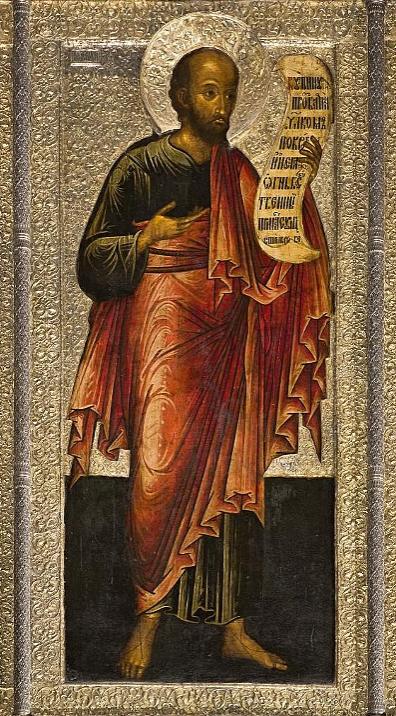 Pan-Orthodox Russian icon of Moses the Prophet. Wikimedia Commons, public domain; not a depiction of a particular Deuteronomy scene.
The Church’s Voice in Worship
At Matins on Thursday of the second week of Great Lent, the Coptic readings include Deuteronomy 5:15-22 alongside Isaiah 6:1-12. The following Friday’s reading is Deuteronomy 8:1-9:4, which includes the word about manna and life that Christ uses against the tempter.7 These readings place remembrance, obedience, and the heart within the Church’s preparation for Pascha. The connection with the Temptation is an interpretation of the scriptural pairing, not a claim that the rubric states its purpose.
Coptic Reader’s Pentecost Kneeling Prayers read Deuteronomy at all three prostrations: 5:22-6:3, 6:17-25, and 16:1-18. The consecration of monks and nuns reads 8:1-9. The First Hour of Good Friday reads 8:19-9:24, and the Third Hour of Holy Tuesday reads 8:11-20. At the Midnight Praises of Bright Saturday, the Second Praise of Moses extends through 32:43; the Resurrection Prophecies also include 32:39-43.8 These distinct service witnesses preserve their own English wording and must not be assumed identical to Brenton in every clause.
The Coptic Reader services for the Fridays of Great Lent in 2026 trace a sequence through Deuteronomy: 6:3-7:26 on February 20, 8:1-9:4 on February 27, 9:7-10:11 on March 6, 10:12-11:28 on March 13, and 11:29-12:27 on March 20.9 Read together, these passages join the covenant, the wilderness, repentance, and the worship of the one God. This describes the verified services for those dates, not an unrestricted annual calendar rule. The 2027 second-week Friday is displaced by the Feast of the Cross.
The Coptic Synaxarium remembers The Departure of Moses the Prophet on Tout 8.10 That is a date of remembrance, not an assertion that a particular Deuteronomy reading is appointed because of his commemoration. Moses’ service remains a witness to the Lord whom he loved and obeyed.
The book’s sequence
Chapters 1-4 remember the road, the rebellion, the victories, and the God who spoke from the fire. Chapters 5-11 proclaim the covenant anew, with the Shema at their center. Chapters 12-26 give worship, household conduct, justice, leadership, and mercy their concrete forms. Chapters 27-30 bring blessing, curse, return, and the near word before the people. Chapters 31-34 prepare for Moses’ departure through Joshua’s commission, the Song, the blessing, and the final ascent.
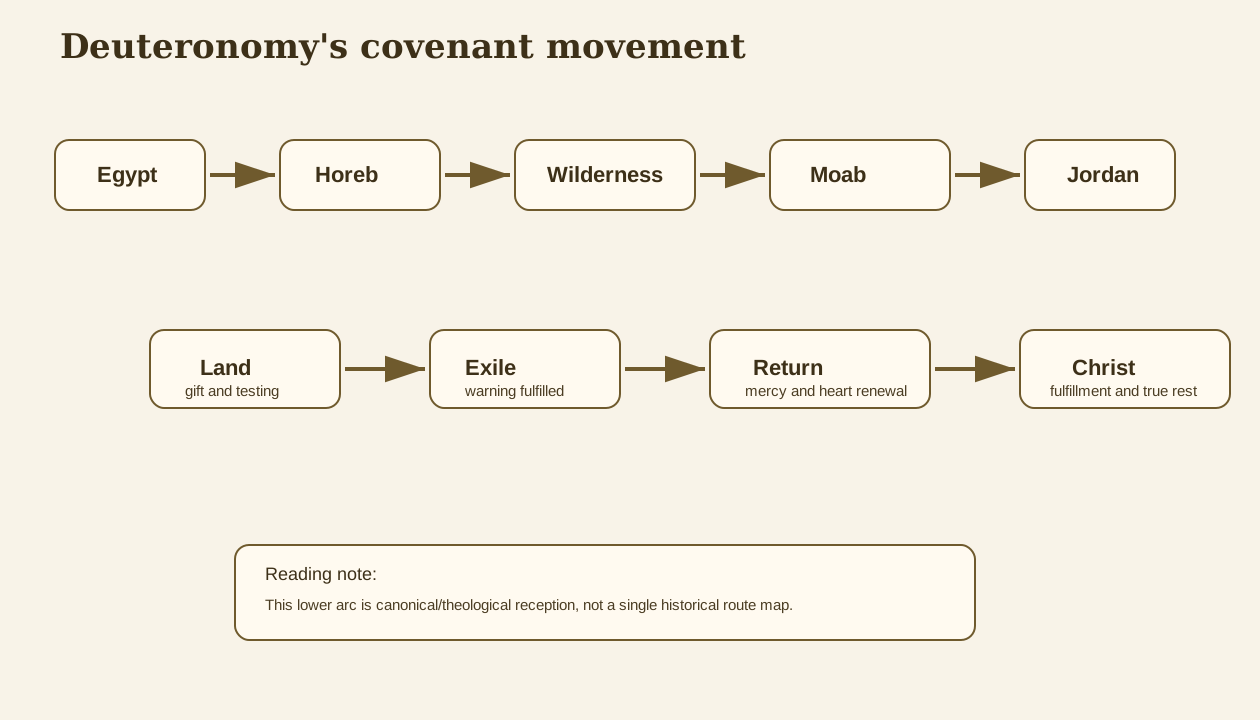 Original project chart, 2026-06-19. The lower arc shows theological reception, not one historical route.
The series consists of this Introduction and one study for each of the thirty-four chapters.
Glossary
- Covenant: the relationship God establishes with His people, carrying promise and the call to faithful obedience.
- Shema: “Hear”, the opening command of Deuteronomy 6:4; the name commonly given to this confession of the one Lord and the call to whole-hearted love.
- Septuagint (LXX): the ancient Greek scriptural tradition used widely by the apostles and the early Church; these studies print Brenton’s English translation.
- Circumcision of the heart: the cutting away of inward resistance to God; Deuteronomy joins the command to repent with the promise of divine renewal.
- Levite: a member of Levi, the tribe set apart for sacred service; priests descend from Aaron within Levi.
- Synergy: our free response working with God’s grace; the grace is His gift, and the response is genuinely ours.
Spiritual Fruit
Remember a mercy before defending an entitlement. Name one way the Lord has carried you, then look at the grievance through which you have been interpreting His care. Gratitude does not deny suffering. It keeps suffering from becoming the only witness allowed to speak about God.
Make love visible at home. Choose a dependable time for prayer, speak a word of Scripture with your children, or apologize for a failure your household already knows. The Shema belongs to rising, walking, sitting, and resting. A small faithful practice can teach more than a speech about the importance of faith.
Let abundance open the hand. Before a purchase made chiefly to confirm your own success, set aside something for a person in need. Moses repeatedly brings the widow, orphan, and stranger into the life of a thankful people. The gift is received well when someone besides the recipient benefits from it.
Receive the command as a call to communion. Identify one obedience you have postponed and take the first truthful step toward it. Ask Christ to heal the desire that resists Him. The goal is a heart that can love and cleave to the Lord, not a record that can be displayed to others.
Moses looks toward a land he will not enter. His work will continue through another servant, while the Lord remains faithful. Bring Christ the future you cannot control and the obedience that belongs to today. The Life set before you is not far away.
Teaching Notes
Teacher guidance
Keep remembrance, love, and the neighbor’s protection together. Explain the ancient covenant setting of warfare and penalties without converting them into Christian permission to harm. Distinguish exact readings from spiritual interpretation, and never use prosperity as evidence that a sufferer has less faith.
The threshold (Deuteronomy 1:1-5; 34:1-12)
- Ask: What does the contrast between eleven days and forty years reveal about Israel’s need to remember?
- Watch for: Treating the wilderness only as punishment and missing the care that preserved the people.
- Show: The geography schematic and relationship chart embedded above.
The king beneath the word (Deuteronomy 17:18-20)
- Ask: How does daily reading protect a ruler from exalting himself above his brothers?
- Emphasize: The name Deuteronomy points to renewed proclamation of one covenant, not a rival law.
Love with the whole being (Deuteronomy 6:4-5)
- Ask: Which ordinary household practice could make the command to love God more visible?
- Watch for: Prayer separated from truthfulness, shared rest, or care for a weaker neighbor.
The wilderness answered by the Son (Deuteronomy 8:3; 6:13, 16)
- Ask: How do Christ’s three answers expose different ways we demand security apart from obedience?
- Emphasize: Brenton and the consulted Swete witness differ over “only” at 6:13; do not overstate textual uniformity.
The heart and the Life (Deuteronomy 28:66; 30:19-20)
- Ask: What does choosing life require when Moses defines it as loving, hearing, and cleaving?
- Watch for: Presenting Athanasius’ Christological reading as a replacement for the covenant-warning context.
- Emphasize: Christ’s Passion is sovereign, willing obedience. Gregory’s account of growth is a spiritual lens, not direct exposition of every Deuteronomy statute.
- Show: The Moses icon and covenant sequence chart embedded in this Introduction.
Sources
Embedded Scripture is from Brenton’s English Septuagint (LXX). New Testament comparisons are read in NKJV.
Brenton, Deuteronomy, especially 6:4-5; 8:3; 17:18; 28:66; 30:19-20.
St. Irenaeus, Against Heresies, IV.13.1-2, translated by Alexander Roberts and William Rambaut, Ante-Nicene Fathers, vol. 1, direct text.
St. Athanasius, On the Incarnation, 35.2 and 37.2, translated by Archibald Robertson, Nicene and Post-Nicene Fathers, second series, vol. 4, direct text.
St. Gregory of Nyssa, The Life of Moses, I.5-10, translated by Abraham J. Malherbe and Everett Ferguson (Paulist Press, 1978), English edition. His teaching supplies a spiritual lens for growth in goodness.
Coptic Orthodox lectionary, Great Lent, second-week Thursday and Friday Matins; Coptic Synaxarium, Tout 8.
Footnotes
-
Deuteronomy 17:18, Hebrew and translation comparison; H. B. Swete, Greek Deuteronomy 17. ↩
-
St. Irenaeus, Against Heresies, IV.13.1-2, especially IV.13.1, direct text. ↩
-
Brenton, Deuteronomy 6; Hebrew and translation comparison at 6:5; H. B. Swete, Greek Deuteronomy 6; Matthew 22:37; Mark 12:30. ↩
-
Brenton, Deuteronomy 6 and Deuteronomy 8; H. B. Swete, Greek Deuteronomy 6:13, 16; Matthew 4:4, 7, 10. ↩
-
St. Athanasius, On the Incarnation, 35.2 and 37.2, direct text. ↩
-
St. Gregory of Nyssa, The Life of Moses, I.5-10, especially I.10, translated by Abraham J. Malherbe and Everett Ferguson (Paulist Press, 1978), English edition. ↩
-
Coptic Orthodox lectionary, Matins of Thursday and Friday in the second week of Great Lent: Deuteronomy 5:15-22 with Isaiah 6:1-12; Deuteronomy 8:1-9:4. Feast precedence can displace a daily reading. Coptic Reader. ↩
-
Coptic Reader: Pentecost Kneeling Prayers, first, second, and third prostrations; Consecration of Monks and Consecration of Nuns; Holy Pascha, Great Friday First Hour and Holy Tuesday Third Hour; Bright Saturday, Midnight Praises, Second Praise of Moses the Prophet; Resurrection Prophecies. Coptic Reader. ↩
-
Coptic Reader, Readings / Matins / Prophecies, selected February 20 and 27, March 6, 13, and 20, 2026. These date-specific service documents confirm the continuous readings given here; some corresponding daily prophecies are not represented in the date-resolved lectionary reference. Coptic Reader. ↩
-
Coptic Synaxarium, Tout 8, “The Departure of Moses the Prophet”. Coptic Synaxarium. ↩