
The first monument Israel must raise after crossing the Jordan carries words, not a conqueror’s portrait. Beside those words stands an altar, and before that altar the people eat and rejoice. Moses binds the inheritance to hearing, worship, and obedience. The repeated answer, ‘So be it’, exposes every attempt to keep a public religious identity while reserving a hidden life from God.
Orientation
Moses and the elders speak in Moab before the crossing. Mount Ebal and Mount Gerizim, Brenton’s Gæbal and Garizin, belong to the coming ceremony near Shechem. The commands are carried out in Joshua 8:30–35. Priests, Levites, and all twelve tribes have a part; the covenant is never the private possession of its leaders. The schematic is an orientation aid, not an archaeological reconstruction.
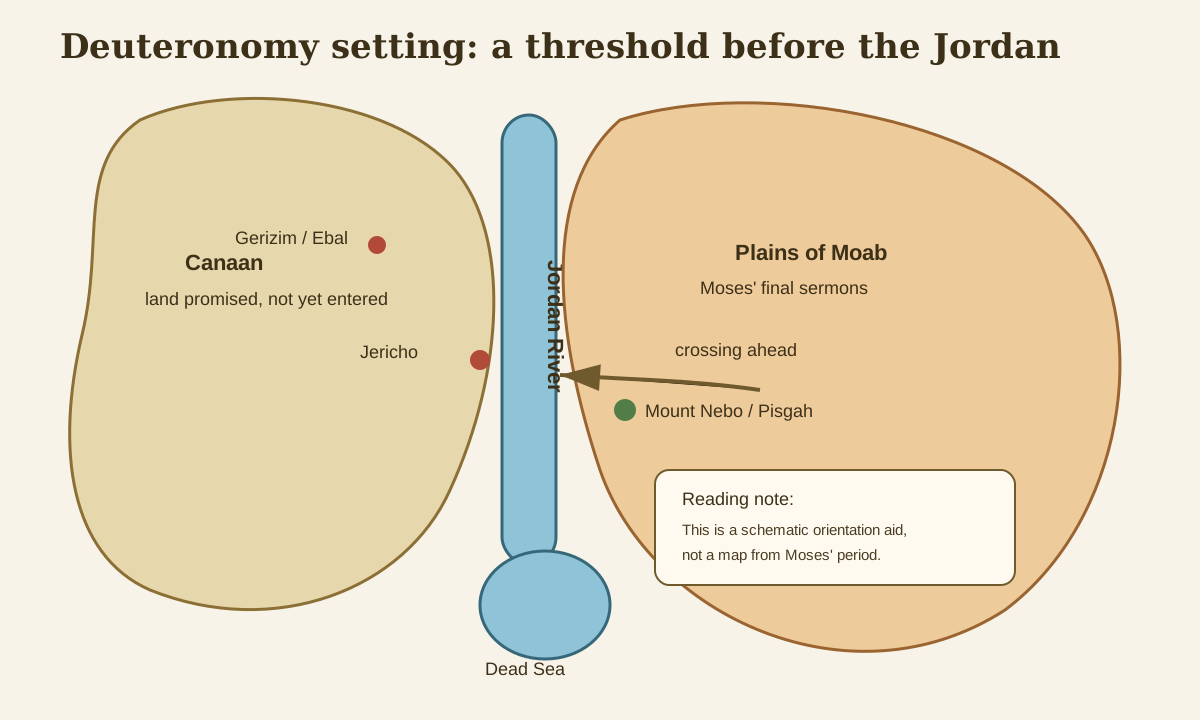 Source: Original project schematic, 2026-06-19. Schematic orientation only, not a period map or archaeological reconstruction.
Words written plainly, worship received with joy (Deuteronomy 27:1–8)
Scripture: Brenton Septuagint
1 And Moses and the elders of Israel commanded, saying, Keep all these commands, all that I command you this day. 2 And it shall come to pass in the day when ye shall cross over Jordan into the land which the Lord thy God gives thee, that thou shalt set up for thyself great stones, and shalt plaster them with plaster. 3 And thou shalt write on these stones all the words of this law, as soon as ye have crossed Jordan, when ye are entered into the land, which the Lord God of thy fathers gives thee, a land flowing with milk and honey, according as the Lord God of thy fathers said to thee. 4 And it shall be as soon as ye are gone over Jordan, ye shall set up these stones, which I command thee this day, on mount Gæbal, and thou shalt plaster them with plaster. 5 And thou shalt build there an altar to the Lord thy God, an altar of stones; thou shalt not lift up iron upon it. 6 Of whole stones shalt thou build an altar to the Lord thy God, and thou shalt offer upon it whole-burnt-offerings to the Lord thy God. 7 And thou shalt there offer a peace-offering; and thou shalt eat and be filled, and rejoice before the Lord thy God. 8 And thou shalt write upon the stones all this law very plainly.
The stones are plastered so the law can be written plainly. The promised land is named twice as God’s gift, and the inscription declares how its recipients are to live there. Receiving land cannot mean becoming free of the Giver. A clear command is mercy to the person who would otherwise remain unsure whom to obey.
The altar uses whole stones, with no iron lifted upon them. This repeats the restraint in Exodus 20:25: worship begins with God’s command before the worshiper’s wish to improve it. It is a rule for this altar, not a rejection of all craftsmanship. The offerings culminate in eating, fullness, and rejoicing before the Lord. Obedience makes room for communion and gratitude.
Joshua 8:30–35 joins altar, inscription, sacrifices, and the reading of blessing and curse to the whole assembly. Israel’s victories must be interrupted by listening. The same temptation meets us when a successful week makes prayer seem unnecessary. Let the gift bring us back before God, while it is still a gift and before we begin calling it our achievement.
Be silent and hear (Deuteronomy 27:9–14)
Scripture: Brenton Septuagint
9 And Moses and the priests the Levites spoke to all Israel, saying, Be silent and hear, O Israel; this day thou art become a people to the Lord thy God. 10 And thou shalt hearken to the voice of the Lord thy God, and shalt do all his commands, and his ordinances, as many as I command thee this day. 11 And Moses charged the people on that day, saying, 12 These shall stand to bless the people on mount Garizin having gone over Jordan; Symeon, Levi, Judas, Issachar, Joseph, and Benjamin. 13 And these shall stand for cursing on mount Gæbal; Ruben, Gad, and Aser, Zabulon, Dan, and Nephthali. 14 And the Levites shall answer and say to all Israel with a loud voice,
‘Be silent and hear’ asks the people to receive a word that comes before their own response. Moses and the priests call Israel God’s people and immediately join that belonging to doing His commands. Covenant identity is a gift with a shape. It is not an exemption from the truth that formed it.
The tribes stand in two groups, while the Levites speak loudly enough for all Israel to hear. The division is ceremonial, not a statement that one group consists of good tribes and the other of rejected tribes. Each belongs to the one people that must answer.
When we answer Amen in prayer, assent should reach farther than the last syllable. Quiet before a reading, attention to the words, and willingness to change an action are parts of one response. The people cannot answer on one another’s behalf, and a Christian cannot borrow another person’s attentiveness to God.
The hidden neighbor stands before God (Deuteronomy 27:15–25)
Scripture: Brenton Septuagint
15 Cursed is the man whosoever shall make a graven or molten image, an abomination to the Lord, the work of the hands of craftsmen, and shall put it in a secret place: and all the people shall answer and say, So be it. 16 Cursed is the man that dishonours his father or his mother: and all the people shall say, So be it. 17 Cursed is he that removes his neighbour’s landmarks: and all the people shall say, So be it. 18 Cursed is he that makes the blind to wander in the way: and all the people shall say, So be it. 19 Cursed is every one that shall pervert the judgment of the stranger, and orphan, and widow: and all the people shall say, So be it. 20 Cursed is he that lies with his father’s wife, because he has uncovered his father’s skirt: and all the people shall say, So be it. 21 Cursed is he that lies with any beast: and all the people shall say, So be it. 22 Cursed is he that lies with his sister by his father or his mother: and all the people shall say, So be it. 23 Cursed is he that lies with his daughter-in-law: and all the people shall say, So be it. Cursed is he that lies with his wife’s sister: and all the people shall say, So be it. 24 Cursed is he that smites his neighbour secretly: and all the people shall say, So be it. 25 Cursed is he whosoever shall have taken a bribe to slay an innocent man: and all the people shall say, So be it.
The list moves from an idol installed in secret to the corruption of family, property, justice, sexuality, and human life. Many of these acts can escape public scrutiny. A moved boundary steals quietly; misleading a blind person exploits a weakness; a bribe can make murder appear lawful. God places the unprotected neighbor within the covenant’s public hearing.
Verse 19 names stranger, orphan, and widow because legal power can be used most easily against those without defenders. Religious respectability offers no shelter to a person who distorts their case. In our circumstances, the command reaches false records, withheld wages, dishonest advice, and pressure upon someone who cannot readily challenge us. Repentance must include repair wherever repair is possible.
The sexual prohibitions guard the integrity of kinship and the body. Their solemnity must never be used to humiliate a survivor or transfer an offender’s guilt to a victim. Honoring parents likewise never requires accepting abuse or obeying a command to sin. A truthful covenant response protects the person harmed and refuses to conceal the act behind the reputation of a family or parish.
Every person, all the words, and the need for Christ (Deuteronomy 27:26)
Scripture: Brenton Septuagint
26 Cursed is every man that continues not in all the words of this law to do them: and all the people shall say, So be it.
The final curse gathers the preceding commands into a whole. Selective fidelity cannot make a person righteous: the same Lord guards worship, truth, the family, and the stranger. Our preferred obedience cannot buy permission for the injustice we wish to retain.
Language insight: “every man” and “all the words”
Swete’s Greek has pas anthrōpos, ‘every person’, and pasin tois logois, ‘all the words’. The Masoretic Hebrew does not contain separate words for ‘every’ and ‘all’ in this clause. NKJV nevertheless prints ‘all’ in italics in ‘confirm all the words’, indicating supplied wording. The comparison concerns the actual Hebrew and Greek, not an assumption that every English Bible displays their difference. Galatians 3:10 quotes the comprehensive Greek-shaped wording. Paul brings those who rely on works of the Law before its own demand, then announces redemption in Christ in Galatians 3:13–14.1
Gems from the Fathers: the innocent One bears the tree’s curse
St. John Chrysostom, in his Commentary on Galatians, chapter 3, on verses 10–13, follows Paul’s argument from transgression to redemption. He distinguishes our failure to keep the Law from the curse attached to hanging on a tree. Christ remains innocent while freely entering death for us: ‘For Christ took upon Him not the curse of transgression, but the other curse, in order to remove that of others.’2
This directs confession away from bargaining. We bring Christ the actual wrong, rather than balancing it against our religious achievements. His Cross opens the way to forgiveness and renewed obedience. The public Amen can become the assent of a person who has stopped hiding and begun to receive mercy.
Glossary
- Covenant sanctions: blessings and curses attached to Israel’s pledged life with God.
- Amen: assent; Brenton renders it ‘So be it’.
- Whole stones: stones not worked with an iron tool for this altar.
- Landmark: a boundary marker protecting a neighbor’s property.
Spiritual Fruit
Give one hidden act a truthful name. Before confession, examine the wrong you would prefer to describe vaguely. Name it plainly before Christ. If another person has lost money, safety, or a good name because of it, seek prudent ways to make restitution and protect that person.
Bring gratitude back to its Giver. Choose a recent good you have treated as self-made. Give thanks for it in prayer, then share a concrete portion of its benefit with someone less protected. Thanksgiving should make obedience more willing.
Answer Amen with one act. After the next Scripture reading, keep one command in mind through the day. Refuse one damaging story, correct one dishonest account, or attend to one overlooked person. A small truthful action gives your spoken answer a place to live.
The stones stand in the land, and the words remain plain. You do not need to invent a righteousness that can hide the truth about you. Come before the innocent Savior who bore the tree’s curse. Let your Amen be a beginning of repentance, and let His mercy teach your hands what your mouth has confessed.
Teaching Notes
Teacher guidance
Read the repeated responses without turning them into a threat against someone in the room. Show the covenant geography schematic on this page. Keep national covenant sanctions distinct from diagnoses of an individual’s illness or misfortune; the final section is completed through Paul’s proclamation of Christ.
Words written plainly, worship received with joy (Deuteronomy 27:1–8)
- Ask: What does the altar add to a scene that could otherwise look like a public legal ceremony?
- Watch for: Making unhewn stone a ban on craftsmanship, or treating worship as a substitute for obedience.
Be silent and hear (Deuteronomy 27:9–14)
- Ask: What habit would help our Amen become an attentive answer rather than an automatic sound?
- Watch for: Calling the tribes on Ebal inherently cursed, or shaming people who find sustained attention difficult.
The hidden neighbor stands before God (Deuteronomy 27:15–25)
- Ask: Which wrong can remain socially invisible while costing a vulnerable person dearly?
- Watch for: Using the curse list to accuse sufferers, conceal abuse, or authorize private punishment.
Every person, all the words, and the need for Christ (Deuteronomy 27:26)
- Ask: Why does the final curse expose selective obedience, and where does Paul lead the exposed sinner?
- Watch for: Implying that the Law is evil, that Christ became a sinner, or that grace excuses continued injustice.
Sources
Embedded Scripture is from Brenton’s English Septuagint (LXX). New Testament comparisons follow NKJV.
St. John Chrysostom, Commentary on Galatians, chapter 3, on verses 10–14, direct text.
No appointed Coptic lectionary reading from this chapter is known in the references consulted.
Footnotes
-
Deuteronomy 27:26, Swete’s Greek text and Masoretic Hebrew; NKJV comparison. ↩
-
St. John Chrysostom, Commentary on Galatians, chapter 3, on Galatians 3:13, direct text. ↩