


A crown is being prepared at Shechem, but the reader has already seen what it costs. Silver passes from an idol’s shrine to hired men; the sons of Gideon are killed upon one stone; their surviving brother hides. Judges 9 begins where Gideon’s story left a dangerous opening. The man who had refused hereditary rule left behind a household marked by wealth, many sons, and religious compromise. Abimelech turns that inheritance into an opportunity to seize power.
There is no summons from God, no cry for deliverance, and no gift of the Spirit upon this ruler. Abimelech is an anti-judge: where a deliverer risks his life for Israel, he spends other lives to secure his own position. Yet the chapter does not leave the dead forgotten. Jotham speaks, the alliance fractures, and the final verses name God’s requital. Between the stone of the brothers’ murder and the millstone of Abimelech’s death, Scripture exposes a kingship that can command followers but cannot give life.
The Church reads this history before Christ, who shares our humanity and calls us His brethren. Abimelech invokes brotherhood to obtain power and murders brothers who stand in his way. The Son of God enters our flesh and blood to deliver His brethren through His own death (Hebrews 2:11-14). The contrast reaches deeper than a preference for gentler rulers. It reveals what authority becomes when love of self governs it, and what communion becomes when Christ is King.
Historical and Scriptural Context
Judges 8:22-35 holds Gideon’s faith and failures together. He refused to establish a dynasty, yet his ephod became a snare, and after his death Israel turned to Baal-berith and forgot the good he had done. Judges 9:16-18 insists that gratitude to Gideon’s house was a real obligation. His compromises explain the setting; they neither excuse Abimelech’s murder nor make the murdered sons responsible for their father’s failures.
Shechem carries a troubled biblical memory. Abraham built an altar there (Genesis 12:6-7); Jacob put away foreign gods beneath a tree there (Genesis 35:4). Genesis 34 remembers Dinah’s violation by Shechem son of Hamor and the subsequent violence of her brothers. When Hamor, called Emmor in Brenton, reappears in Gaal’s speech in Judges 9:28, an old identity is being recruited into a new quarrel. Sacred associations and ancestral loyalties can be invoked while the obligations they should awaken are ignored.
In the Hebrew location tradition, Joshua gathered Israel at Shechem, and placed a witness stone under an oak after the covenant renewal (Joshua 24:1, 25-27). The Greek B tradition reflected in Brenton locates this gathering at Shiloh. The Hebrew tradition makes Shechem’s later betrayal particularly searching, but it does not establish that Abimelech was crowned beneath Joshua’s very tree or beside the same stone.1 Shechem would later be the place where Israel gathered to make Rehoboam king (3 Kingdoms 12:1). The setting can receive a covenant promise or a royal claim; the place itself cannot supply the faithfulness of those assembled.
Deuteronomy 17:14-20 supplies a positive measure of kingship. The ruler is to be chosen by God, learn His law, and keep his heart from rising above his brethren. Abimelech begins with a claim to kinship and proceeds to destroy his father’s household. His story therefore warns against corrupted authority, not against every acceptance of responsibility. The remedy for a bramble king is faithful service under God, not abandonment of everyone who needs care.
Geographical Significance ⛰️
- Shechem / Sychem / Sicima: the city associated with Gerizim and Ebal, with patriarchal memory, and, in the Hebrew tradition of Joshua 24, covenant renewal. Its inhabitants’ support funds Abimelech’s first crime.
- Mount Gerizim / Garizin: the mountain assigned to blessing in Deuteronomy 27:12, opposite Ebal’s curse. Jotham speaks here because covenant blessing cannot be separated from covenant truth. Joshua 8:33 recalls Israel assembled before the two mountains.2
- Ephratha / Ophrah: Brenton’s Ephratha is the name at Judges 9:5, where the father’s household is attacked; Hebrew-based translations use Ophrah. This difference should not be silently corrected inside the Scripture.
- Beth-millo / Bethmaalo: the group or house joined to Shechem in the coronation and included in Jotham’s warning. The narrative makes their allegiance clear without requiring a precise reconstruction of their institution.
- Mount Zalmon / Selmon: the wooded height from which Abimelech and his followers take branches for the tower fire.
- Thebez / Thebes: the town near Shechem where Abimelech dies. Brenton’s name does not mean Egyptian Thebes. Brown-Driver-Briggs identifies Thebez as a location near Shechem and connects it with modern Tubas; that geographical identification is distinct from the certainty of the biblical event.3
The Characters 👥
- God: the Judge who brings the blood of Gideon’s sons into account, even through the collapse of an alliance formed without reference to Him.
- Abimelech: Gideon’s son by his concubine at Shechem, who uses maternal kinship, money, and violence to make himself king.
- Jerubbaal / Gideon: the deceased deliverer whose service creates a debt of gratitude and whose mixed legacy provides the chapter’s background.
- The men of Shechem: Abimelech’s funders and kingmakers, explicitly charged in verse 24 with strengthening his hands for murder. Their guilt must not be transferred without distinction to every person later killed in the city.
- Jotham / Joatham: the surviving son whose fable and accusation place the coronation under God’s judgment.
- Gaal son of Ebed / Jobel: a challenger whose promise to replace Abimelech centres on having the people under his own hand.
- Zebul: the city ruler who conceals Abimelech’s approach and turns Gaal’s boast against him.
- The tower refugees: men and women seeking safety who are burned in Abimelech’s assault. The text counts their deaths, not the individual guilt of each victim.
- The unnamed woman of Thebez: the defender whose millstone stops Abimelech’s repeated attempt to burn a tower.
- The armour-bearer: the young man whom the dying Abimelech orders to preserve his preferred account of his death.
Iconography and Visual Teaching 🖼️
The genealogy displays the household relationships that Abimelech exploits and then violates. The map locates the principal settings without claiming to reconstruct the campaign in detail.
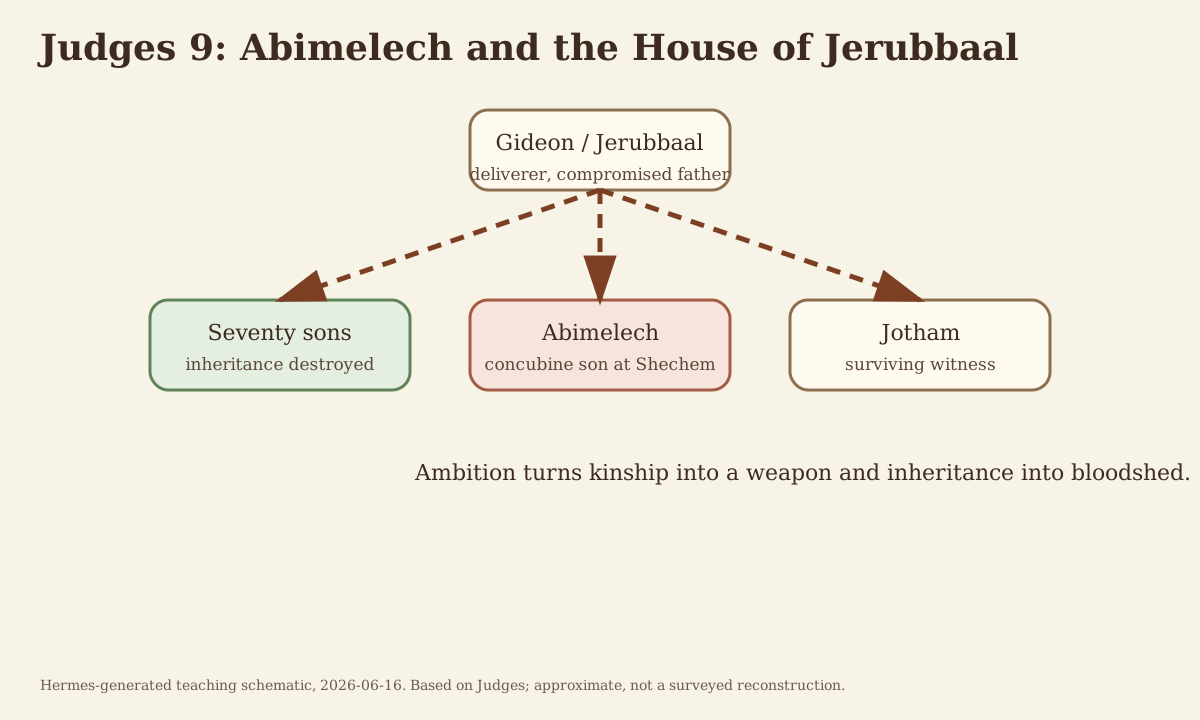 Source: Hermes-generated teaching genealogy, 2026-06-16; based on Judges 8-9.
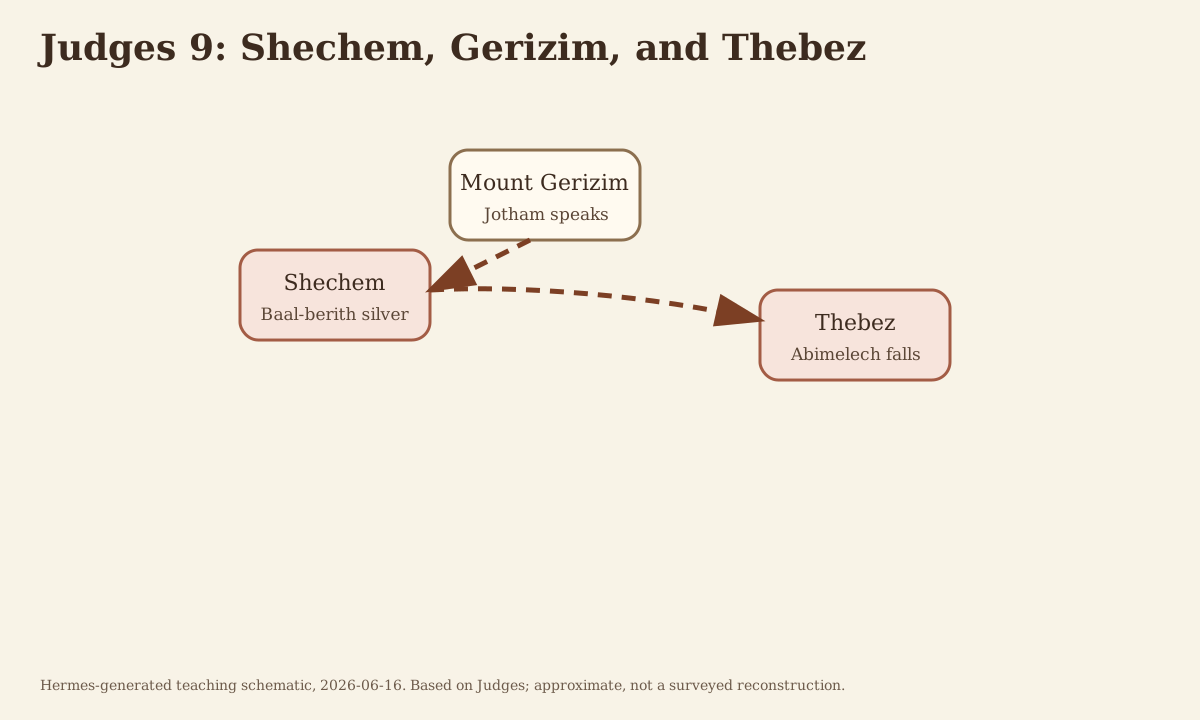 Source: Hermes-generated teaching schematic, 2026-06-16; approximate, not a surveyed reconstruction.
Light from the Word 🕯️
Judges 9:1-6 - Abimelech buys a kingdom with blood
1 And Abimelech son of Jerobaal went to Sychem to his mother’s brethren; and he spoke to them and to all the kindred of the house of his mother’s father, saying, 2 Speak, I pray you, in the ears of all the men of Sychem, saying, Which is better for you, that seventy men, even all the sons of Jerobaal, should reign over you, or that one man should reign over you? and remember that I am your bone and your flesh. 3 And his mother’s brethren spoke concerning him in the ears of all the men of Sychem all these words; and their heart turned after Abimelech, for they said, He is our brother. 4 And they gave him seventy pieces of silver out of the house of Baalberith; and Abimelech hired for himself vain and cowardly men, and they went after him. 5 And he went to the house of his father to Ephratha, and slew his brethren the sons of Jerobaal, seventy men upon one stone; but Joatham the youngest son of Jerobaal was left, for he hid himself.
6 And all the men of Sicima, and all the house of Bethmaalo, were gathered together, and they went and made Abimelech king by the oak of Sedition, which was at Sicima.
Abimelech’s opening question excludes the question that matters. He asks which arrangement will be better for Shechem: seventy rulers or one. The narrative has not said that Gideon’s sons were planning to establish such a government. Abimelech presents a threatening alternative and offers himself as the obvious solution. His maternal relatives repeat the appeal until the citizens’ hearts incline toward him. Brotherhood becomes a reason to stop examining his conduct.
The money comes from Baal-berith’s shrine, and it purchases armed allegiance. What follows reveals the purpose of the coalition. Abimelech kills the sons of the man who delivered Israel, at their father’s home, on one stone. Jotham’s escape keeps a witness alive, but the coronation proceeds. A public ceremony can make violence look settled without making it righteous.
The repeated seventy belongs first to the actual household, the payment, and the crime. A more useful biblical comparison than speculative symbolism is Judges 1:7, where Adonibezek remembers seventy kings mutilated beneath his table and acknowledges divine repayment. The crimes differ: mutilated captive rulers there, murdered brothers here. Their shared number and the theme of recompense make the earlier confession an apt preparation for Judges 9:56. God remembers persons whom powerful men have reduced to a number.
Abimelech’s words about bone and flesh expose a betrayal of a genuine good. Family loyalty should protect the vulnerable and restrain wrongdoing. Here it excuses wrongdoing. Hebrews 2:11-14 presents the healing contrast: Christ is not ashamed to call us brethren, shares our flesh and blood, and through death overcomes the enslaving power of the devil. Abimelech makes his relationship a claim upon others; Christ makes His relationship with us the occasion of His self-giving.
Language insight: “Abimelech” and “the oak of Sedition”
The NAS Exhaustive Concordance glosses “Abimelech” as “father is king.” That wording gives the name a sharp irony beside Gideon’s refusal of hereditary rule. It should not be treated as proof of what Gideon secretly intended, or as the only interpretation of the ancient name: Brown-Driver-Briggs gives a different explanation, “Melek … is father.”4 The narrative, rather than an etymology, establishes the son’s ambition.
Brenton’s “oak of Sedition” translates an expression with “στάσεως” (staseōs), a form of “στάσις” (stasis). Rahlfs’ A and B texts both retain this word, though the B wording is longer and difficult. NETS renders it in terms of “placing” and notes “sedition” as an alternative in A; the Hebrew-based rendering is the oak or terebinth at the pillar.5 The word can evoke standing or an established position as well as faction, so the English “Sedition” must not carry the theology by itself. Abimelech’s rebellion against righteousness is established by the murder and its funding, whatever precise monument or gathering-place verse 6 describes.
Judges 9:7-21 - Jotham’s parable of the bramble king
7 And it was reported to Joatham, and he went and stood on the top of mount Garizin, and lifted up his voice, and wept, and said to them, Hear me, ye men of Sicima, and God shall hear you.
8 The trees went forth on a time to anoint a king over them; and they said to the olive, Reign over us. 9 But the olive said to them, Shall I leave my fatness, with which men shall glorify God, and go to be promoted over the trees? 10 And the trees said to the fig-tree, Come, reign over us. 11 But the fig-tree said to them, Shall I leave my sweetness and my good fruits, and go to be promoted over the trees? 12 And the trees said to the vine, Come, reign over us. 13 And the vine said to them, Shall I leave my wine that cheers God and men, and go to be promoted over the trees? 14 Then all the trees said to the bramble, Come thou and reign over us. 15 And the bramble said to the trees, If ye in truth anoint me to reign over you, come, stand under my shadow; and if not, let fire come out from me and devour the cedars of Libanus.
16 And now, if ye have done it in truth and integrity, and have made Abimelech king, and if ye have wrought well with Jerobaal, and with his house, and if ye have done to him according to the reward of his hand, 17 as my father fought for you, and put his life in jeopardy, and delivered you out of the hand of Madiam; 18 and ye are risen up this day against the house of my father, and have slain his sons, being seventy men, upon one stone, and have made Abimelech the son of his bondwoman king over the men of Sicima, because he is your brother: 19 if then ye have done truly and faithfully with Jerobaal, and with his house this day, rejoice ye in Abimelech, and let him also rejoice over you: 20 but if not, let fire come out from Abimelech, and devour the men of Sicima, and the house of Beth-maalo; and let fire come out from the men of Sicima and from the house of Beth-maalo, and devour Abimelech.
21 And Joatham fled, and ran away, and went as far as Bæer, and dwelt there out of the way of his brother Abimelech.
Jotham stands on Gerizim and asks Shechem to listen so that God may hear them. The appeal puts their public decision before a higher Judge. Gerizim had been assigned to blessing, and Ebal to cursing (Deuteronomy 27:12-13). From the mountain of blessing, the surviving brother now announces what betrayal will bring. Covenant blessing cannot be retained while covenant obligations are discarded.
The fable lets the hearers recognize the absurdity before they are named in the accusation. The olive, fig, and vine already give something: oil, sweetness, good fruit, and wine. Each would have to leave a useful work to accept the proposed elevation. The bramble accepts immediately and invites the trees, even the great cedars, into its shadow. Its offer is out of proportion to its capacity. Then its promise turns into an ultimatum: shelter beneath me, or be consumed.
Oil that glorifies God and wine that cheers God and men place the gifts of creation within thanksgiving and worship. Olive oil belongs to the holy anointing of Exodus 30:24-30, and wine to the drink offering in Numbers 15:7. God is honoured by gifts received and offered rightly; He is not imagined as needing intoxication. Orthodox readers may hear a modest sacramental resonance in anointing and offering, without assigning each tree a fixed sacrament or turning the fable into a complete sacramental allegory. Its immediate test remains the contrast between fruitful service and destructive promotion.
Jotham then supplies the interpretation in verses 16-20. Gideon risked his life to rescue them, while they killed his sons and enthroned Abimelech because he was their brother. “Truth and integrity” are the conditions of genuine rejoicing. If these conditions are absent, the ruler and his supporters will become fire to one another. This is more exact than a general complaint about ambition: the coronation has ratified ingratitude and bloodshed.
The bramble test for leadership. A title cannot create the capacity to nourish people. In a parish, household, or ministry, look for truthfulness, repentance, steadiness in service, willingness to be corrected, and care for those who cannot repay attention. A protective claim becomes dangerous when it requires silence about harm or personal loyalty above conscience. Jotham’s fable neither condemns all leadership nor licenses a gifted person to refuse a duty. It asks whether authority serves the fruit God is giving or sacrifices people to the ruler’s importance.
Christ wears the crown of thorns that soldiers use to mock His kingship (Matthew 27:29). This is a Christian contrast, not a claim that Jotham predicted the botanical material of that crown. The bramble threatens others to defend its rule; the King crowned with thorns bears the violence of others and gives Himself for them. His kingdom is also pictured as a mustard seed becoming a tree in whose branches birds can nest (Matthew 13:32). Smallness can become shelter through God’s life-giving work. Abimelech’s smallness becomes a demand that everyone else submit to it.
Gems from the Fathers 💎: Service without an audience
St John Cassian’s treatment of vainglory in the Institutes is a thematic witness, not a commentary on Jotham. In XI.3-4 he shows that the craving for admiration can enter work, fasting, prayer, silence, and even apparent humility. Useful service therefore needs more than visible productivity; it needs a heart directed toward God. His remedy in XI.19 is plain: “To begin with we should not allow ourselves to do anything at the suggestion of vanity, and for the sake of obtaining vainglory.”6 The olive’s usefulness gives the reader a concrete examination: can I continue to give the good entrusted to me when someone else receives the praise?
The Church’s Voice in Worship ⛪
At the Sixth Hour, the Agpeya prays Psalm 91:1 (LXX Ps 90:1): “He who dwells in the help of the Most High, shall rest under the shelter of the God of heaven.”7 The Greek psalm speaks of “σκέπη” (skepē), shelter or covering. Rahlfs A uses the same shelter word in Judges 9:15, while B uses “σκιά” (skia), shadow.8 The decisive contrast is between the bramble’s threatening promise and God’s true refuge; it does not depend on different Greek nouns. The prayer teaches where ultimate refuge belongs. A human shepherd serves that refuge by leading people to God; he cannot make his personal approval the condition of their safety. Reciting the psalm after Jotham’s fable turns discernment into prayer: Lord, free me from demanding a place under my own shadow, and teach me to dwell under Yours.
Judges 9:22-25 - God sends division and begins requital
22 And Abimelech reigned over Israel three years. 23 And God sent an evil spirit between Abimelech and the men of Sicima; and the men of Sicima dealt treacherously with the house of Abimelech: 24 to bring the injury done to the seventy sons of Jerobaal, and to lay their blood upon their brother Abimelech, who slew them, and upon the men of Sicima, because they strengthened his hands to slay his brethren. 25 And the men of Sicima set liers in wait against him on the top of the mountains, and robbed every one who passed by them on the way; and it was reported to the king Abimelech.
Three years pass before the alliance breaks. The interval can make the original crime seem established, but the narrator has neither called those years peace nor forgotten the sons of Gideon. Verse 24 gives the purpose of what now happens: their blood is brought against Abimelech and against the men who strengthened his hands to kill them. The killer and the enablers are both accountable. Funding, legitimizing, and knowingly sustaining wrongdoing are acts, even when another person wields the weapon.
“God sent an evil spirit” is a statement of providential judgment, not a statement that evil is part of God’s character. The related account of Saul’s torment in 1 Kingdoms 16:14 and Micaiah’s vision of the lying spirit in 3 Kingdoms 22:19-23 also place destructive spiritual activity under God’s sovereignty. These passages must retain their severity. At the same time, sovereignty over judgment does not make the Holy God a sinner or remove the responsibility of those who lie and betray. Romans 1:24-28 describes divine handing over of people who reject the truth to the disorder they have chosen. That supplies a theological parallel, not a reason to explain the spirit away as nothing more than a human mood.
Judges tells us the outcome here: Shechem acts treacherously, places ambushes in the mountains, and robs travellers. The initial coalition’s fracture spreads danger beyond the king and his supporters. People using the road now pay for their conflict. The evil of the alliance was never confined to the men who thought they could profit from it.
For our repentance, verse 24 calls for precision rather than indiscriminate suspicion. If we have knowingly helped conceal an injury, financed it, or discredited its witnesses, we should confess the part that is ours and take steps to stop the harm. It does not authorize us to pronounce every disaster a punishment, or every sufferer secretly guilty. The narrator reveals God’s judgment in this history; we have no permission to invent a matching revelation about our neighbour’s suffering. Nor should an exposed sin drive us into despair. God brings hidden blood into the light because the victims matter; bringing our own complicity into the light is the beginning of a truthful return to Him.
Judges 9:26-41 - Gaal’s boasting and the instability of bramble-rule
26 And Gaal son of Jobel came, and his brethren, and passed by Sicima, and the men of Sicima trusted in him. 27 And they went out into the field, and gathered their grapes, and trod them, and made merry; and they brought the grapes into the house of their god, and ate and drank, and cursed Abimelech. 28 And Gaal the son of Jobel said, Who is Abimelech, and who is the son of Sychem, that we should serve him? Is he not the son of Jerobaal, and is not Zebul his steward, his servant with the son of Emmor the father of Sychem? and why should we serve him? 29 And would that this people were under my hand! then would I remove Abimelech, and I would say to him, Multiply thy host, and come out.
30 And Zebul the ruler of the city heard the words of Gaal the son of Jobel, and he was very angry. 31 And he sent messengers to Abimelech secretly, saying, Behold, Gaal the son of Jobel and his brethren are come to Sychem; and behold, they have besieged the city against thee. 32 And now rise up by night, thou and the people with thee, and lay wait in the field. 33 And it shall come to pass in the morning at sunrising, thou shalt rise up early and draw toward the city; and behold, he and the people with him will come forth against thee, and thou shalt do to him according to thy power.
34 And Abimelech and all the people with him rose up by night, and formed an ambuscade against Sychem in four companies. 35 And Gaal the son of Jobel went forth, and stood by the door of the gate of the city: and Abimelech and the people with him rose up from the ambuscade. 36 And Gaal the son of Jobel saw the people, and said to Zebul, Behold, a people comes down from the top of the mountains: and Zebul said to him, Thou seest the shadow of the mountains as men. 37 And Gaal continued to speak and said, Behold, a people comes down westward from the part bordering on the middle of the land, and another company comes by the way of Helon Maonenim. 38 And Zebul said to him, And where is thy mouth as thou spokest, Who is Abimelech that we should serve him? Is not this the people whom thou despisedst? go forth now, and set the battle in array against him. 39 And Gaal went forth before the men of Sychem, and set the battle in array against Abimelech. 40 And Abimelech pursued him, and he fled from before him; and many fell down slain as far as the door of the gate.
41 And Abimelech entered into Arema, and Zebul cast out Gaal and his brethren, so that they should not dwell in Sychem.
The harvest brings grapes, wine, and celebration, but worship becomes a setting for curses. The vine in Jotham’s fable had spoken of wine that cheers God and men. Here its fruit is carried to an idol’s house, and the gathering turns toward another claimant. A good gift has become fuel for resentment. The contrast is especially searching because nothing about the harvest itself was evil.
Gaal appeals to the old identity of Shechem and to Hamor, Emmor in Brenton. Genesis 34:2 identifies Shechem as Hamor’s son, the ruler’s household in the land. Hebrew-based versions of Judges 9:28 make the call to serve Hamor’s men more explicit than Brenton’s difficult sentence. The historical appeal is a claim about allegiance, not proof of a documented, uninterrupted descent of the present citizens from Hamor.9 Gaal turns the same question that Abimelech had exploited, who belongs to us, against the man it first helped enthrone.
His next sentence removes the disguise: he wants the people under his hand. He promises to depose Abimelech, but the speech supplies no renewed covenant, repentance, or care for the murdered household. A rival to a violent ruler may expose a real wrong while still wanting the same possession of people. Opposition itself does not purify a heart.
Zebul answers boasting with concealment. He secretly sends for Abimelech, encourages a night ambush, and initially tells Gaal that the approaching soldiers are only mountain shadows. When concealment is no longer useful, he mocks Gaal’s mouth and sends him out to face the enemy he despised. Men fall as far as the gate, and Gaal and his brothers are expelled. Words offered as confident protection have brought others into danger.
James 3:14-16 names bitter envy and self-seeking as the companions of disorder. That diagnosis belongs to this passage without turning every disagreement into faction. A truthful correction seeks the good of those involved and accepts scrutiny of its own claims; a faction asks people to share resentment and surrender judgment. Christ calls disciples into truth and communion, not into ownership by a persuasive personality. Before repeating an accusation or rallying supporters, let the tongue answer to the Lord whom it claims to serve.
Judges 9:42-49 - The fire of the bramble devours Shechem
42 And it came to pass on the second day that the people went out into the field, and one brought word to Abimelech. 43 And he took the people, and divided them into three companies, and formed an ambush in the field; and he looked, and, behold, the people went forth out of the city, and he rose up against them, and smote them. 44 And Abimelech and the chiefs of companies that were with him rushed forward, and stood by the door of the gate of the city; and the two other companies rushed forward upon all that were in the field, and smote them. 45 And Abimelech fought against the city all that day, and took the city, and slew the people that were in it, and destroyed the city, and sowed it with salt.
46 And all the men of the tower of Sychem heard, and came to the gathering of Bæthel-berith. 47 And it was reported to Abimelech, that all the men of the tower of Sychem were gathered together. 48 And Abimelech went up to the mount of Selmon, and all the people that were with him; and Abimelech took an axe in his hand, and cut down a branch of a tree, and took it, and laid it on his shoulders; and said to the people that were with him, What ye see me doing, do quickly as I. 49 And they cut down likewise even every man a branch, and went after Abimelech, and laid them against the place of gathering, and burnt the place of gathering over them with fire; and they died, even all the men of the tower of Sicima, about a thousand men and women.
Gaal has been removed, but Abimelech continues the assault. People go into the fields; he divides his force and attacks them while another company holds the gate. The narrative moves from the challenger and his armed followers to the city’s inhabitants and those who seek refuge. Victory is no longer enough for Abimelech. He ruins the place that had made him king.
Sowing the captured city with salt completes the account of devastation. The act expresses a determination that Shechem should remain ruined, though the verse does not describe a measurable effect on every surrounding field. At the tower, the refugees gather in the place Brenton calls Bæthel-berith. The shrine that belongs to their city’s religious life cannot secure them against the ruler supported by idol-shrine silver at the beginning of the chapter.
The branches bring Jotham’s warning into terrible visibility. Abimelech cuts one, carries it on his shoulders, and orders his followers to imitate him. Each man repeats the act; together they set the gathering-place on fire. About a thousand men and women die. Verse 24 has already identified the murderer’s enablers, but verse 49 does not establish the individual culpability of all these victims. Divine judgment on a city’s wicked alliance is not a licence to treat every burned person as a willing accomplice or to call Abimelech’s atrocity righteous. The horror must be allowed to remain horror.
This scene also shows the moral danger of imitation. “Do quickly as I” can sound like decisive leadership; here it organizes killing. Obedience in the Church belongs within obedience to God. No human authority can make cruelty holy, require the concealment of abuse, or replace conscience with personal allegiance. The reader should feel the need to protect endangered people, not merely the satisfaction of seeing a prediction fulfilled.
In the Sychar and Gerizim region of John 4:5-26, Christ meets a Samaritan woman, speaks truth about her life, and offers living water. This is a regional and theological contrast, not an assertion that Sychar is the precise tower site. Where Abimelech turns a gathering into a place of death, the Lord opens the way to worship in spirit and truth. Neither a remembered mountain nor an inherited shrine can manufacture communion with God. The Saviour gives what fearful refuge-seekers and compromised worshippers alike need: life received from Him and truth that can be spoken without being consumed.
Judges 9:50-57 - The woman of Thebez and the requital of God
50 And Abimelech went out of Bæthel-berith, and encamped against Thebes, and took it. 51 And there was a strong tower in the midst of the city; and thither all the men and the women of the city fled, and shut the door without them, and went up on the roof of the tower. 52 And Abimelech drew near to the tower, and they besieged it; and Abimelech drew near to the door of the tower to burn it with fire. 53 And a woman cast a piece of a millstone upon the head of Abimelech, and broke his skull. 54 And he cried out quickly to the young man his armour-bearer, and said to him, Draw thy sword, and slay me, lest at any time they should say, A woman slew him: and his young man thrust him through and he died. 55 And the men of Israel saw that Abimelech was dead; and they went each to his place.
56 So God requited the wickedness of Abimelech, which he wrought against his father, in slaying his seventy brethren. 57 And all the wickedness of the men of Sychem God requited upon their head; and the curse of Joatham the son of Jerobaal came upon them.
At Thebez, Abimelech approaches another tower and attempts the same fire. The repetition makes his confidence visible. The tactic that killed the refugees of Shechem appears ready to succeed again. Then a woman drops a piece of millstone from above and breaks his skull. The man who killed his brothers on a stone is brought down by a stone. That narrative correspondence is enough; it needs no claim that God has prescribed a method of revenge for us to imitate.
The woman stands beside Jael in the reader’s memory: another woman brings down an armed man whose apparent strength has threatened others (Judges 4:21). Her deed is an act in the defence of the tower, and Abimelech’s shame reveals his own contempt. The lesson is not that death at a woman’s hand is inherently degrading. His pride makes it so in his imagination. Scripture honours the truth of what happened rather than adopting his estimate of a woman’s worth.
Even now his speech is an order to another person. He asks the armour-bearer to kill him so people will not say that a woman slew him. He tries to govern the account when he can no longer govern his body. The request recalls Saul asking his armour-bearer to kill him to escape his enemies’ mockery (1 Kingdoms 31:4), although Saul’s attendant refuses and Abimelech’s obeys. These are tragic efforts to control the manner of dying, not examples for a Christian to follow.
His attempt to manage his image fails beyond this chapter. In 2 Kingdoms 11:21, Joab’s message recalls Abimelech’s death specifically as the result of a woman’s millstone. What he wanted suppressed becomes the detail later generations remember. For us, the spiritual danger is recognizable on a smaller scale: an apology that conceals the injury, a public explanation that leaves out the victim, a confession occupied chiefly with how we will be regarded. Truthful repentance begins when the injured person matters more than our preferred account.
Gems from the Fathers 💎: Pride as an inward tyrant
St John Cassian, Institutes XII.3, describes pride through the image of a captured city. Other faults may damage particular virtues; pride seeks dominion over the whole person. Once established, it acts “like some most brutal tyrant” and “utterly destroys and lays waste the whole city.”10 Cassian is describing the soul, not directly interpreting Thebez. His image helps us see why outward defeat alone need not heal the inward ruler. Abimelech loses the battle and still commands someone to defend his reputation. Cassian’s remedy in XII.33 joins humility to dependence on God’s grace, including the recognition that our ability to recognize this dependence is itself God’s gift.
The chapter ends with God’s account, not Abimelech’s. God requites his wickedness against his father and brothers, and the wickedness of the men of Shechem returns upon their heads. Requital means wrongdoing brought into just account. Human violence does not become good because God limits or judges it; the narrator has consistently called it wickedness. Christ’s voluntary self-offering reveals another kingship altogether. He accepts the shame of the Cross for our salvation and rises to give life. We need more than an end to Abimelech’s rule. We need the grace of the King who can free the heart from ruling in Abimelech’s manner.
The Church’s Voice in Worship ⛪
The Agpeya’s Eleventh Hour Gospel is Luke 4:38-41: Christ enters Simon’s house, heals his mother-in-law, and at sunset lays His hands upon the sick and heals them.11 The restored woman rises and serves. This is a worshipful counter-image to the ruler whose presence destroys a household. The Church’s evening prayer brings the day’s wounds before the Lord who heals, and presents recovered strength as a gift for service. It is a Gospel connection to this study, not an appointment of Judges 9 as the Eleventh Hour reading.
Summary Table
| Text | Literal focus | Spiritual and Christological reading |
|---|---|---|
| Judges 9:1-6 | Kinship appeal, shrine silver, murder, coronation | Brotherhood becomes exploitation; Christ shares flesh and blood to save |
| Judges 9:7-21 | The fable and Jotham’s interpretation | Test authority by fruit, truth, and service rather than a promise of protection |
| Judges 9:22-25 | Alliance breaks under divine judgment | Killer and knowing enablers answer for the blood they shed |
| Judges 9:26-41 | Gaal boasts and Zebul arranges his defeat | A replacement ruler may preserve the same self-seeking |
| Judges 9:42-49 | Shechem is devastated and refugees are burned | Coercive imitation spreads harm; victims must not be assigned guilt without warrant |
| Judges 9:50-57 | A woman stops Abimelech and God requites wickedness | Reputation control fails; repentance and life belong to Christ |
Spiritual Fruit 🍇
Serve where fruit is already possible. The olive, fig, and vine confront the resentment that can enter unnoticed work. If a ministry title has become the condition of your willingness to help, name that desire before God. Keep one useful service this week without arranging to be thanked for it: visit, prepare, listen, or finish the task someone else will receive credit for. Hidden service is not a performance of being humble. It is freedom to give because Christ sees and because another person needs the gift.
Refuse to strengthen a harmful hand. Verse 24 gives complicity a concrete form. Examine what your money, recommendation, silence, or repetition of a claim is helping to do. Where you have knowingly sustained harm, stop the assistance, acknowledge your part, and seek truthful repair with appropriate pastoral and safeguarding help. Loyalty to a friend or a respected servant cannot require abandoning an injured person. God’s remembrance of Gideon’s sons gives courage to those whose suffering has been treated as inconvenient.
Choose confession over reputation. Abimelech’s last words disclose a will still occupied with its own image. Prepare for confession by stating the wrong plainly before explaining circumstances. If someone has been harmed, let an apology acknowledge that person’s injury rather than solicit reassurance about your character. Christ receives the repentant sinner; you do not need to make your account admirable before coming to Him. Shame can become a doorway to healing when it ceases to be something we must force others to hide.
Find refuge without surrendering conscience. The bramble offers shelter and threatens fire in the same breath. When affection or spiritual belonging is made conditional on hiding cruelty, remember that ultimate shelter belongs to God. Pray the Sixth Hour psalm, ask for wise counsel, and take practical steps to protect those in danger. Humility is compatible with truthful speech and firm protection. The good shepherd leads toward Christ, whose love gives life rather than demanding the sacrifice of the vulnerable.
Let justice deepen hope rather than revenge. The final verses assure us that hidden blood is not lost to God’s memory. Entrust judgment to Him while doing the work of truth, protection, and repair that lies before you. Resist the pleasure of assigning guilt to everyone who suffers when a corrupt arrangement falls. The thousand men and women in the tower are persons, not a lesson’s expendable scenery. Before Christ the wounded and the repentant both have a claim on our care.
Jotham’s voice reaches Shechem from the mountain, and the bramble’s promise has already been spoken. Stand for a moment among the trees that still have fruit to give. Bring to Christ the work you resent, the praise you crave, and the truth you have tried to control. The King crowned with thorns receives the repentant heart without requiring another person to burn for its sins. Ask Him to make your presence a place of service rather than a demand for shelter beneath your own name.
Teaching Notes
Whole-guide teaching cautions
- Begin by saying clearly that Abimelech is not a normal judge figure. He is an anti-judge and an early image of false kingship.
- Read Judges 9 in light of Judges 8:22-35. Without Gideon’s mixed ending, Abimelech’s rise can seem disconnected.
- Spend real time on Jotham’s parable. It is the theological key to the chapter, not a decorative interruption.
- Do not let the class turn the chapter into mere political analysis. The deeper issue is spiritual ambition and covenant collapse.
- When discussing the “evil spirit,” explain judicial permission and divine judgment carefully. Avoid language that makes God morally evil.
- In teaching about leadership, apply the text pastorally and first to the Church’s own life: ambition, factions, image-management, and charisma without holiness.
- Contrast Abimelech and Christ repeatedly. This chapter becomes spiritually fruitful when false kingship is set against the true King.
- The unnamed woman at Thebez should be handled reverently. Her role exposes Abimelech’s pride and God’s justice; it is not material for cheap humor.
- Helpful New Testament lenses include Mark 10:42-45, James 3:14-16, John 10:11-13, Philippians 2:5-11, and 1 Peter 5:2-3.
- If time is short, focus on Judges 9:4-6, 9:8-15, 9:23-24, 9:29, 9:45, and 9:56-57.
- Use the family tree for Abimelech’s maternal alliance and the murdered brothers. The map locates Shechem, Gerizim, and Thebez; explain Ebal, Zalmon, and tactical positions verbally rather than treating them as plotted sites. Do not identify the coronation tree with Joshua’s tree.
Judges 9:1-6 - Abimelech buys a kingdom with blood
- Ask: When Abimelech asks what is better for Shechem, which question about his conduct has he left out?
- Watch for: Do not infer that Gideon’s sons actually planned a seventy-man regime, or make the disputed tree-name prove the interpretation.
Judges 9:7-21 - Jotham’s parable of the bramble king
- Ask: What would count as real fruit in a person asking us to trust his protection?
- Watch for: The fable condemns barren, coercive rule; it does not excuse refusal of a genuine responsibility or prove that every leader is ambitious.
Judges 9:22-25 - God sends division and begins requital
- Ask: What does strengthening someone’s hands look like when the helper never commits the final act?
- Watch for: Retain providential judgment without making God morally evil, reducing the spirit to a mood, or diagnosing a neighbour’s suffering as punishment.
Judges 9:26-41 - Gaal’s boasting and the instability of bramble-rule
- Ask: What in Gaal’s promise shows that changing the ruler would not necessarily change the kind of rule?
- Watch for: Do not mistake every criticism for faction; distinguish truthful correction from resentment recruited for personal power.
Judges 9:42-49 - The fire of the bramble devours Shechem
- Ask: How does Abimelech’s command to imitate him make each follower responsible for what he does next?
- Watch for: Verse 49 does not prove every victim culpable; divine judgment neither sanctifies cruelty nor requires victims to remain silent.
Judges 9:50-57 - The woman of Thebez and the requital of God
- Ask: Why does Abimelech care about the account of his death when repentance is still absent from his words?
- Watch for: Do not use the woman for humour, imitate the request for death, or read Cassian’s inward-city image as direct Judges commentary.
Sources
Embedded Scripture is from Brenton’s English Septuagint (LXX). The commentary uses familiar English names while leaving Brenton’s name forms unchanged in the quotations. The books commonly called 1 and 2 Samuel and 1 and 2 Kings are cited here as 1, 2, 3, and 4 Kingdoms.
No appointment of Judges 9 was found in sources checked for this study. The Agpeya connections above are verified prayer and Gospel parallels, not lectionary assignments of this chapter.
🔗 Brenton, Judges 9, with Judges 8:22-35 and 1:7 for the immediate inheritance and requital connections.
🔗 NETS, Judges, translated by Philip E. Satterthwaite, for the A and B wording of 9:6, with the Rahlfs-based A and B textual evidence cited below.
🔗 St John Cassian, Institutes XI, especially 3-4 and 19, and 🔗 Institutes XII, especially 3 and 33. These are thematic ascetical witnesses, not direct Judges exposition.
🔗 Agpeya, Sixth Hour and 🔗 Eleventh Hour, for the verified worship connections.
Scripture parallels developed in the exposition: Genesis 12:6-7; 34:1-4; 35:4; Exodus 30:24-30; Numbers 15:7; Deuteronomy 17:14-20; 27:12-13; Joshua 8:33; 24:1, 25-27; 1 Kingdoms 16:14; 31:4; 2 Kingdoms 11:21; 3 Kingdoms 12:1; 22:19-23; Matthew 13:32; 27:29; John 4:5-26; Romans 1:24-28; Hebrews 2:11-14; James 3:14-16. Christian contrasts and the modest sacramental resonance are distinguished from the fable’s immediate historical meaning.
Footnotes
-
Joshua 24:1, 25-27 in the Hebrew tradition, with the witness stone at 26-27; 🔗 Joshua 24:26. For the Greek location, see 🔗 NETS, Iesous, introduction and chapter 24 and 🔗 Brenton, Joshua 24. ↩
-
Deuteronomy 27:12-13; 🔗 Joshua 8:33, including NKJV wording. The reference follows Hebrew-based chapter numbering; NETS prints the corresponding assembly at Joshua 9:2d (8:33). ↩
-
Brown-Driver-Briggs, Hebrew 8405, location “near Shechem,” with the Tubas identification; 🔗 Thebez, identified lexicon entries. The modern topical material on that page is not the authority for archaeological claims, and none are made here. ↩
-
NAS Exhaustive Concordance, Hebrew 40, definition “father is king”; compare the different explanation in the Brown-Driver-Briggs entry on the same page. 🔗 Hebrew 40, identified lexicon entries. The unattributed topical discussion is not the basis of the name explanation. ↩
-
Rahlfs A, Judges 9:6: “πρὸς τῇ βαλάνῳ τῆς στάσεως”; B includes “τῇ εὑρετῇ” and a second “τῆς”. 🔗 CCAT, Rahlfs-based Judges A morphological text; 🔗 Judges B; 🔗 NETS Judges A and B, 9:6 and notes; 🔗 Hebrew Judges 9:6. ↩
-
St John Cassian, Institutes XI.19, trans. C. S. Gibson, NPNF, Second Series, vol. 11; context in XI.3-4. 🔗 Direct text. ↩
-
Agpeya, Sixth Hour, Psalm 91 (LXX Ps 90), printed with the LXX number. 🔗 Sixth Hour text. This psalm also appears in other Agpeya offices; the Sixth Hour connection is not an exclusive placement. ↩
-
Psalm 91:1 (LXX Ps 90:1), “ἐν σκέπῃ τοῦ θεοῦ τοῦ οὐρανοῦ”; 🔗 Rahlfs-based Psalms, Greek-numbered text. Judges 9:15 B uses “ἐν τῇ σκιᾷ μου”; A uses “ἐν τῇ σκέπῃ μου.” 🔗 Rahlfs-based Judges B; 🔗 Rahlfs-based Judges A; 🔗 CCAT textual basis. Compare “in a shelter of the God of the sky” in 🔗 NETS Psalms. The A/B difference concerns the wording of the bramble’s offered refuge, not the source of true safety. ↩
-
Genesis 34:2; Judges 9:28, with the more explicit Hebrew-based form of the appeal in 🔗 Judges 9:28. No name etymology or unbroken genealogical claim is inferred. ↩
-
St John Cassian, Institutes XII.3 and XII.33, trans. C. S. Gibson, NPNF, Second Series, vol. 11. 🔗 Direct text. ↩
-
Agpeya, Eleventh Hour (Vespers), Gospel Luke 4:38-41. 🔗 Printed Gospel and prayer text. ↩