


Twenty years under iron chariots have taught Israel to fear. Deborah’s word calls Barak out of that fear, and the song that follows the victory teaches the people what to remember instead. Judges 4 tells how the Lord broke Sisera’s power. Judges 5 lets us hear the deliverance received in worship: the earth trembles before God, ordinary roads become safe again, willing servants are honored, and comfortable absence is exposed.
Read the prose before the song. The narrative prevents the poetry from floating free of Israel’s suffering; the poetry prevents the narrative from shrinking into a tale of military skill. Their shared center is the Lord who goes before His people. Deborah speaks His command, Barak follows it with a faith still needing support, and Jael brings the promised reversal to its unexpected conclusion. Hebrews 11:32 remembers Barak among the faithful. His need for Deborah and his actual obedience belong in the same account.
These chapters bring us before hard questions about judgment, bloodshed, and the duties of love. Their Christian reading must preserve both the oppressed people’s deliverance and Christ’s command to love enemies. In the Church, warfare against evil means resisting sin and the devil, protecting those who are harmed, and learning costly faithfulness. A human neighbor, even an enemy, must never become the target of a spiritual interpretation’s violence.
Historical and Scriptural Context
Ehud has died, and Israel again does evil against the Lord. The people who received the land now live under twenty years of oppression. Jabin rules at Hazor; Sisera commands his army. Nine hundred iron chariots make the imbalance visible before the battle begins. When Israel cries to God, His answer comes through a prophetess judging under a palm-tree, a commander from Kedesh, and a Kenite woman’s tent.
The pairing of event and song recalls Exodus 14–15. There too an army’s chariots fail, water takes part in deliverance, and the rescued people sing. Miriam is called a prophetess in Exodus 15:20; Deborah is called a prophetess in Judges 4:4. The resemblance places this northern rescue within Israel’s memory of the God who brought His people out of bondage. The events remain distinct: Kishon is not the Red Sea, and forty years of rest is not yet the everlasting salvation brought by Christ.
Greek Judges has two major textual forms, printed as A and B in Rahlfs and translated separately in NETS. Brenton generally follows the Vaticanus-based tradition represented by B; his translation is not identical to Rahlfs B. Neither A nor B can simply be equated with the earliest Greek text. Where a difference changes the reading, it is explained with the passage.1
Geographical Significance ⛰️
- Asor / Hazor: the northern royal center associated with Jabin. Its mention links Judges 4 to older northern Canaanite power and reminds the reader that hostile strength still survives in the land.
- Arisoth of the Gentiles / Harosheth-hagoyim: Sisera’s base of operations, suggesting a militarized stronghold tied to the nations.
- Mount Thabor / Tabor: the strategic height to which Barak is summoned. From this elevation the people descend in obedience when the Lord gives the signal.
- The brook or torrent of Kison / Kishon: a decisive battleground. In the song, the watercourse itself becomes part of the theology of victory.
- Cades Nephthali / Kedesh in Naphtali: Barak’s home region in the north and a gathering point for the tribes called to battle.
- Rama and Bæthel in mount Ephraim: the region where Deborah judged under her palm-tree, showing that her ministry had recognized public authority among the people.
- The tent of Chaber / Heber the Kenite: the seemingly marginal domestic setting in which the final overthrow of Sisera occurs. The mighty commander falls not in a palace but in a tent.
The Characters 👥
- The Lord: judge of Israel’s evil, hearer of Israel’s cry, giver of victory, and the true warrior who goes before His people.
- Israel: oppressed, fearful, inconsistent, yet still the people to whom God shows mercy when they cry out.
- Deborah / Debbora: prophetess and judge, a mother in Israel, whose authority is rooted in God’s word rather than self-assertion.
- Barak / Barac: commander who asks for prophetic support, then gathers the tribes and acts in faith.
- Jabin: king of Canaan at Hazor, the ruling oppressor under whom Israel suffers.
- Sisera / Sisara: captain of Jabin’s army, embodiment of military intimidation and violent power.
- Heber / Chaber the Kenite: a detached Kenite whose household becomes the setting for Sisera’s end.
- Jael: wife of Heber, unexpected instrument through whom Deborah’s prophecy is fulfilled.
- Zebulun and Naphtali: tribes praised for exposing themselves to danger in the cause of deliverance.
- Other tribes in the song: some answer nobly, others hesitate, remain distant, or fail to help.
- Sisera’s mother: a mother waiting for her son, whose consoling fantasy of plunder exposes the cruelty within the household’s hopes.
Iconography and Visual Teaching 🖼️
The schematic locates the places named in the story without claiming to reconstruct the battle. The Deborah roundel is an Orthodox iconographic witness. Salomon de Bray’s painting is Western biblical art, not an Orthodox icon.
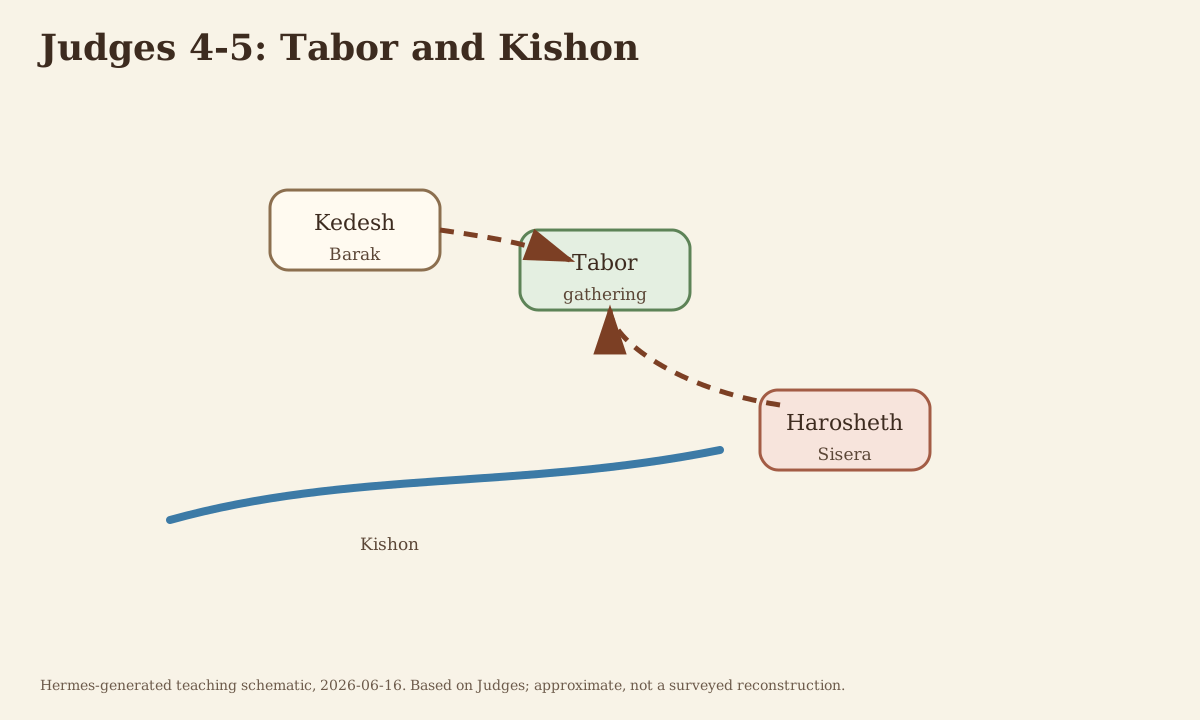 Source: Hermes-generated teaching schematic, 2026-06-16; approximate, not a surveyed reconstruction.
 Source: Righteous Deborah, roundel from a Russian Orthodox icon depicting Old Testament women; Public domain, via Wikimedia Commons.
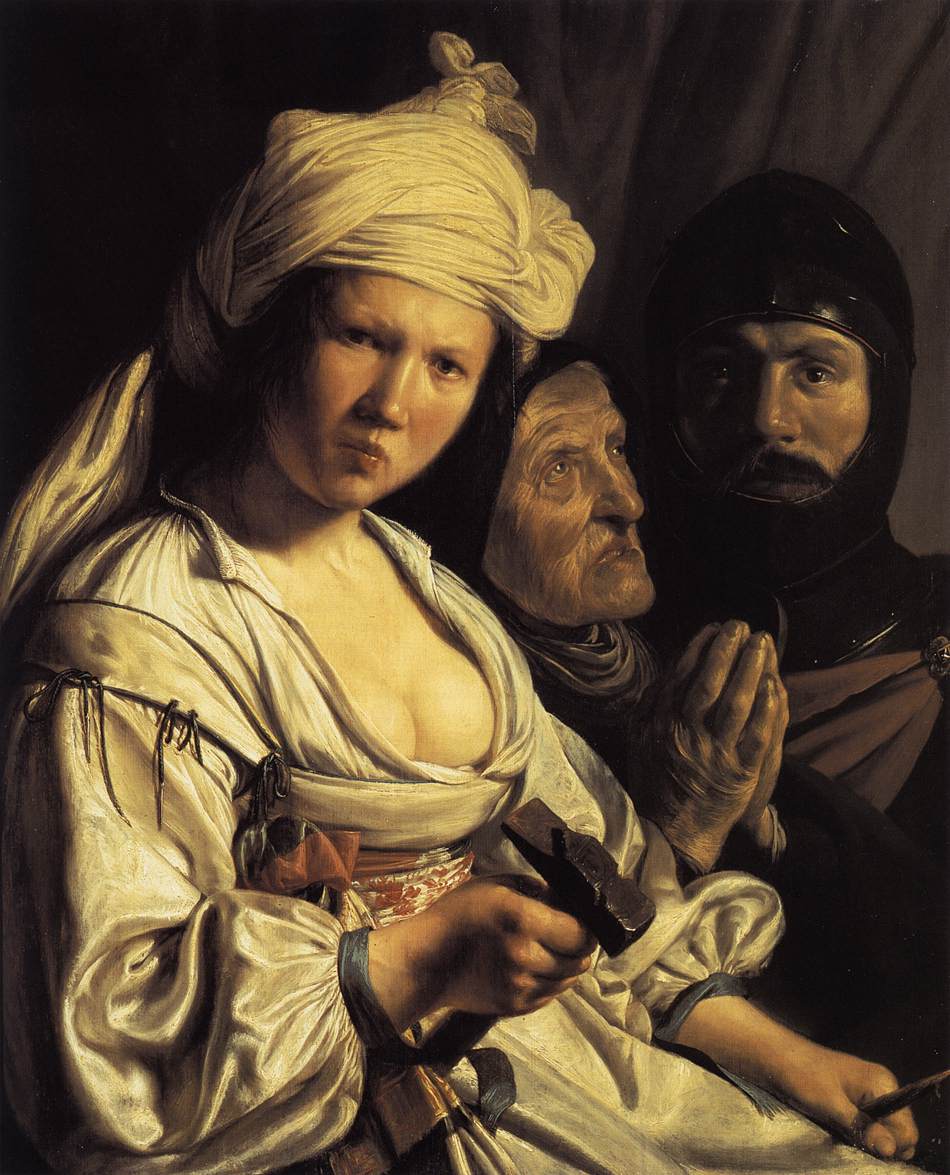 Source: Salomon de Bray, Jael, Deborah and Barak, Public domain, via Wikimedia Commons.
Light from the Word 🕯️
Judges 4:1-10 - Deborah summons Barak to obedient faith
1 And the children of Israel continued to do evil against the Lord; and Aod was dead. 2 And the Lord sold the children of Israel into the hand of Jabin king of Chanaan, who ruled in Asor; and the chief of his host was Sisara, and he dwelt in Arisoth of the Gentiles. 3 And the children of Israel cried to the Lord, because he had nine hundred chariots of iron; and he mightily oppressed Israel twenty years.
4 And Debbora, a prophetess, the wife of Lapidoth,—she judged Israel at that time.
5 And she sat under the palm-tree of Debbora between Rama and Bæthel in mount Ephraim; and the children of Israel went up to her for judgment.
6 And Debbora sent and called Barac the son of Abineem out of Cades Nephthali, and she said to him, Has not the Lord God of Israel commanded thee? and thou shalt depart to mount Thabor, and shalt take with thyself ten thousand men of the sons of Nephthali and of the sons of Zabulon.
7 And I will bring to thee to the torrent of Kison Sisara the captain of the host of Jabin, and his chariots, and his multitude, and I will deliver them into thine hands.
8 And Barac said to her, If thou wilt go with me, I will go; and if thou wilt not go, I will not go; for I know not the day on which the Lord prospers his messenger with me. 9 And she said, I will surely go with thee; but know that thy honour shall not attend on the expedition on which thou goest, for the Lord shall sell Sisara into the hands of a woman: and Debbora arose, and went with Barac out of Cades. 10 And Barac called Zabulon and Nephthali out of Cades, and there went up at his feet ten thousand men, and Debbora went up with him.
Israel’s cry meets God’s word before it meets an army. Deborah is already judging the people when she summons Barak. The narrator names her prophetic office and describes Israelites coming to her for judgment. Her authority serves God’s people by bringing His command into their distress. Nothing in the narrative treats her womanhood as an embarrassment or explains it as a punishment for men.
Deborah’s question, “Has not the Lord God of Israel commanded thee?”, joins a command to a promise. Barak must gather ten thousand men; the Lord will bring Sisera to Kishon and deliver him into Barak’s hands. Obedience therefore has a concrete shape. He is being asked to act upon a promise, not to manufacture confidence out of military odds.
Language insight: “I know not the day”
Barak’s answer includes a clause that readers of many Hebrew-based translations will not find: “for I know not the day on which the Lord prospers his messenger with me.” Both Rahlfs A and B contain it. The Greek “ἄγγελον” means “messenger” or “angel”; NETS renders the sentence as the Lord sending His angel on a good journey with Barak. Brenton’s wording should therefore be heard as concern about divine guidance and the timing of the expedition, not automatically as a request for Deborah to replace his courage. In 4:14 Deborah will answer that uncertainty with “this is the day.”12
His conditional answer still receives a sobering response: the final honor will go to a woman. Yet Deborah agrees to accompany him, and Barak gathers the men. Scripture neither hides the condition he places on going nor erases what he does afterward. His faith takes the form of following a prophetic word with help he knows he needs.
Gems from the Fathers 💎: Courage strengthened by prophecy
St. Ambrose, in Concerning Widows 8.43-46, praises Deborah’s governing courage and explicitly cites Barak’s concern about the day on which the Lord sends His angel. His emphasis is the strength of the prophetess through whom the army receives direction. This supports a more generous hearing of Barak than a simple charge of cowardice. Ambrose’s account also calls Deborah a widow and Barak her son; those details are not supplied by Judges and are not adopted here.3
For our life
Some believers are ashamed to need help and so never begin. Others turn the need for help into a permanent condition that nobody can satisfy. Deborah’s accompaniment and Barak’s gathering of the tribes show a better course: receive faithful support, then act on the word you have received. Ask a trusted spiritual father for guidance, seek a fellow servant’s help, and begin the duty that is already clear. Dependence can become obedience rather than delay.
Judges 4:11-16 - The Lord goes before Barak and breaks Sisera’s strength
11 And Chaber the Kenite had removed from Caina, from the sons of Jobab the father-in-law of Moses, and pitched his tent by the oak of the covetous ones, which is near Kedes.
12 And it was told Sisara that Barac the son of Abineem was gone up to mount Thabor. 13 And Sisara summoned all his chariots, nine hundred chariots of iron and all the people with him, from Arisoth of the Gentiles to the brook of Kison.
14 And Debbora said to Barac, Rise up, for this is the day on which the Lord has delivered Sisara into thy hand, for the Lord shall go forth before thee: and Barac went down from mount Thabor, and ten thousand men after him. 15 And the Lord discomfited Sisara, and all his chariots, and all his army, with the edge of the sword before Barac: and Sisara descended from off his chariot, and fled on his feet. 16 And Barac pursued after the chariots and after the army, into Arisoth of the Gentiles; and the whole army of Sisara fell by the edge of the sword, there was not one left.
Heber’s tent appears before Sisera arrives at it. The brief notice in verse 11 prepares the ending while reminding us of the Kenites already mentioned in Judges 1:16, a people connected with Moses’ family. Heber has separated from other Kenites. Verse 17 will explain why Sisera expects refuge in his household: it has peaceful relations with Jabin. The story’s decisive turn will happen where the commander assumes his safety is assured.
For now, Sisera answers Barak’s ascent with the force that has terrorized Israel. He gathers all his chariots to Kishon. Deborah tells Barak to rise because the Lord goes before him. Barak then descends with ten thousand men; the Lord throws the opposing army into confusion. The repeated descent sharpens the reversal: Barak comes down to obey, while Sisera comes down from his chariot to flee on foot.
The song will say that Kishon swept the enemy away. Its storm language gives reason to see water as part of the chariots’ defeat, but the text does not provide a modern reconstruction of weather, soil, or tactics. What the prose makes certain is divine initiative and actual human response. Barak pursues; God gives the victory.
Tabor later bears another meaning in Orthodox remembrance. St. Cyril of Jerusalem names Mount Tabor as the place of Christ’s Transfiguration in Catechetical Lecture 12.16. The Gospels themselves leave the mountain unnamed. Psalm 89:12 (LXX Ps 88:13) also names Tabor and Hermon rejoicing in God’s name. This received association enriches Christian memory of the place without making Barak’s descent a prediction of the Transfiguration.45
For our life
A long habit of resentment or concealment can acquire the apparent weight of iron chariots. Age does not make it unconquerable. Christ has entered death and risen; our struggle begins from His victory, not from the belief that our willpower will finally be enough. His going before us does not excuse passivity. It makes possible the honest confession, the removal of an occasion of sin, and the patient daily obedience we have postponed.
Judges 4:17-24 - Jael and the shame of the tyrant
17 And Sisara fled on his feet to the tent of Jael the wife of Chaber the Kenite his friend: for there was peace between Jabin king of Asor and the house of Chaber the Kenite. 18 And Jael went out to meet Sisara, and said to him, Turn aside, my lord, turn aside to me, fear not: and he turned aside to her into the tent; and she covered him with a mantle.
19 And Sisara said to her, Give me, I pray thee, a little water to drink, for I am thirsty: and she opened a bottle of milk, and gave him to drink, and covered him. 20 And Sisara said to her, Stand now by the door of the tent, and it shall come to pass if any man come to thee, and ask of thee, and say, Is there any man here? then thou shalt say, There is not. 21 And Jael the wife of Chaber took a pin of the tent, and took a hammer in her hand, and went secretly to him, and fastened the pin in his temple, and it went through to the earth, and he fainted away, and darkness fell upon him and he died. 22 And, behold, Barac was pursuing Sisara: and Jael went out to meet him, and she said to him, Come, and I will shew thee the man whom thou seekest: and he went in to her; and, behold, Sisara was fallen dead, and the pin was in his temple. 23 So God routed Jabin king of Chanaan in that day before the children of Israel.
24 And the hand of the children of Israel prevailed more and more against Jabin king of Chanaan, until they utterly destroyed Jabin king of Chanaan.
Sisera reaches Jael’s tent because he believes a political arrangement will protect him. There is peace between Jabin and Heber’s household. Jael’s action therefore crosses the allegiance on which his trust rests. Her Kenite connection reaches back into Israel’s story, while her husband’s treaty connects the household with Israel’s oppressor. The narrator gives us both facts; he does not tell us the whole history of her decision.
Sisera asks her to guard the doorway and deny that anyone is inside. The commander who ruled through an army now depends on a woman to conceal him. She uses a tent pin and a hammer, and Barak arrives to find the man he pursued already dead. Deborah’s word has been fulfilled, but Jabin’s kingdom does not disappear in an instant. Verse 24 describes Israel’s hand prevailing “more and more” until his power is destroyed. One decisive defeat opens a continuing liberation.
The song will explicitly bless Jael. That blessing is Scripture’s judgment within this deliverance, and it should be heard without embarrassment. A Christian teacher’s caution about imitating killing belongs to the reception of the story under Christ’s commands; it should not be substituted for what the song actually says. Neither an exhausted man’s killing nor the promise of shelter becomes a model for private revenge or sanctified deception.
Gems from the Fathers 💎: The Church’s weapons
St. Ambrose directly interprets Deborah, Barak, and Jael in Concerning Widows 8.47-49. He sees Jael as a figure of the Church gathered from the nations, receiving victory over hostile spiritual powers. Crucially, he names the weapons with which that victory is won: “The weapons of the Church are faith, the weapons of the Church are prayer, which overcomes the enemy.”3 His reading takes the household’s overthrow of the tyrant toward the Church’s spiritual struggle, not toward attacks on other people. His contrast between Israel and the nations must not become contempt for Jews; the biblical story itself honors Deborah and Barak, and Christian disciples stand under the same demand for faith.
St. Basil offers a different, thematic safeguard rather than commentary on Jael. In Letter 188, Canon 13, he says the Fathers did not reckon killing in war as murder, making concession to those fighting for chastity and true religion. Yet he counsels that those whose hands are not clean abstain from communion for three years. Both clauses matter: warfare is not simply equated with murder, and killing is not treated as spiritually inconsequential.6
For our life
An ascetical application can speak of refusing a secret refuge to sin. After anger has lost its public voice, it may survive as rehearsed accusations; after dishonesty is confessed, it may survive in an account we still refuse to correct. Faith and prayer seek the healing of those inner shelters. The person who has hurt us remains someone for whom Christ commands us to pray. The evil resisted is the passion, not that person’s life.
Judges 5:1-5 - The song begins with praise and divine march
1 And Debbora and Barac son of Abineem sang in that day, saying,
2 A revelation was made in Israel when the people were made willing: Praise ye the Lord. 3 Hear, ye kings, and hearken, rulers: I will sing, it is I who will sing to the Lord, it is I, I will sing a psalm to the Lord the God of Israel. 4 O Lord, in thy going forth on Seir, when thou wentest forth out of the land of Edom, the earth quaked and the heaven dropped dews, and the clouds dropped water. 5 The mountains were shaken before the face of the Lord Eloi, this Sina before the face of the Lord God of Israel.
Deborah and Barak sing together. The prophetess who summoned him and the commander who needed her support now join in praise. Their shared song already corrects the idea that the whole victory belongs to one hero. Its opening honors the people’s willingness and turns immediately to the Lord.
The appeal to kings and rulers announces a deliverance larger than Sisera’s battlefield. Seir, Edom, and Sinai bring Israel’s wilderness memory into the present. Earth quakes, heavens drip, and mountains shake before the God of Israel. This is a theophany, language of God’s appearing in power. The Lord who meets a people under northern oppression is the same Lord who formed them at Sinai.
Psalm 68:7-8 (LXX Ps 67:8-9) echoes the going forth, the quaking earth, the dripping heavens, and Sinai. The song’s memory thus enters another biblical act of praise. Israel learns to recognize fresh mercy through the mercies already received.7 For a frightened soul, that is a discipline of hope: today’s threat need not become the only fact we remember.
The Church’s Voice in Worship ⛪
The Coptic Midnight Praise sings the First Hoos, or first canticle, using the Song of Moses from Exodus 15. Its text opens with Moses and Israel singing to the Lord and names Pharaoh’s chariots cast into the sea. The actual hymn thus gives a close worship parallel to Judges’ prose followed by song, though it is Exodus, not Judges 5, that is sung here.8
When the Church sings deliverance, the worshiper learns to receive salvation as a gift. Gratitude does not wait until suffering has been easy or every danger has ended. It remembers the Savior within the struggle. In the Eucharist we offer thanksgiving for Christ’s saving work; in daily prayer we can name particular mercies instead of letting anxiety tell the entire story of our lives.
Judges 5:6-11 - Israel’s collapse, Deborah’s arising, and the return of righteous memory
6 In the days of Samegar son of Anath, in the days of Jael, they deserted the ways, and went in by-ways; they went in crooked paths. 7 The mighty men in Israel failed, they failed until Debbora arose, until she arose a mother in Israel. 8 They chose new gods; then the cities of rulers fought; there was not a shield or spear seen among forty thousand in Israel.
9 My heart inclines to the orders given in Israel; ye that are willing among the people, bless the Lord. 10 Ye that mount a she-ass at noon-day, ye that sit on the judgment-seat, and walk by the roads of them that sit in judgment by the way; declare 11 ye that are delivered from the noise of disturbers among the drawers of water; there shall they relate righteous acts: O Lord, increase righteous acts in Israel: then the people of the Lord went down to the cities.
The song brings deliverance down to the level of roads and wells. Travelers had abandoned the direct ways and taken byways. Public life had become dangerous. The statement “They chose new gods” supplies the covenant setting of this fear. It echoes the Song of Moses, where Deuteronomy 32:17 speaks of newly arrived gods whom Israel’s ancestors had not known.9 Judges portrays the people forsaking the Lord who gave them life and becoming vulnerable within the life He gave.
The crooked paths are first the roads travelers used under danger. Their spiritual application must begin there rather than pretending the verse originally describes private evasiveness. Idolatry has public consequences: a people divided from its covenant loses the order in which ordinary tasks can be done safely. This is the account of Israel’s covenant history, not a warrant to blame every oppressed society or every frightened person for secret sin.
Deborah arises “a mother in Israel.” The title expresses leadership that preserves and gathers the people. Her judging under a palm-tree and her summons to Barak now appear as care for a whole community. She helps others act; she does not absorb their responsibilities into herself. The willing leaders and people are praised, and the righteous acts of the Lord are recounted where people draw water.
For our life
Mercy becomes visible when people can again carry out ordinary duties without terror. A parish serving Christ should notice such needs: a household under intimidation, an elderly person who cannot safely travel, a child afraid to speak. Motherly and fatherly care in the Church strengthens the weak without demanding gratitude or control in return. To tell God’s righteous acts at the wells is also to recognize His goodness in these restored, uncelebrated parts of life.
Judges 5:12-18 - Willing tribes, hesitant tribes, and the cost of answering God’s call
12 Awake, awake, Debbora; awake, awake, utter a song: arise, Barac, and lead thy captivity captive, son of Abineem. 13 Then went down the remnant to the strong, the people of the Lord went down for him among the mighty ones from me.
14 Ephraim rooted them out in Amalec, behind thee was Benjamin among thy people: the inhabitants of Machir came down with me searching out the enemy, and from Zabulon came they that draw with the scribe’s pen of record. 15 And princes in Issachar were with Debbora and Barac, thus she sent Barac on his feet in the valleys into the portions of Ruben; great pangs reached to the heart. 16 Why did they sit between the sheep-folds to hear the bleating of flocks for the divisions of Ruben? there were great searchings of heart. 17 Galaad is on the other side of Jordan where he pitched his tents; and why does Dan remain in ships? Aser sat down on the sea-coasts, and he will tabernacle at his ports. 18 The people Zabulon exposed their soul to death, and Nephthali came to the high places of their land.
The song calls Deborah to awake and sing, and Barak to arise and lead captivity captive. They are remembered as active servants, not competitors for ownership of the victory. The tribes are then weighed by their response. Ephraim, Benjamin, Machir, Zebulun, and Issachar belong to the willing company. Reuben searches its heart among the sheepfolds; Gilead stays beyond Jordan, Dan with ships, and Asher at the coast. Zebulun and Naphtali expose their lives to death.
Reuben’s refrain is searching because it gives hesitation an inward life. The people do not lack thoughts about the crisis; they lack the act their thoughts ought to produce. Flocks, ships, and harbors are ordinary goods. In this emergency their continuing claims become reasons for absence. The song is not condemning work or family duty in themselves. It tests whether a tribe’s own security has become more precious than its neighbors’ deliverance.
Biblical connection: “lead thy captivity captive”
The phrase in 5:12 belongs to a wider biblical language of victory. Psalm 68:18 (LXX Ps 67:19) also speaks of leading captivity captive. Ephesians 4:8 takes up the psalm’s ascent and captivity language in speaking of Christ’s victory and His gifts to the Church. Paul is citing the psalm, not directly quoting Deborah’s song. Through that biblical connection, Barak’s temporal deliverance can be read toward the Lord who frees His people and gives them gifts for service.10
For our life
Repeated “searchings of heart” can feel devout while protecting us from a definite act of love. We can spend weeks considering a visit, an apology, or a needed conversation because thought costs less than exposure. Discernment has its place, especially where harm is possible. But when a duty is clear, one modest act can be more truthful than another season of interior debate. Christ’s gifts equip His body to serve, not to remain spectators of one another’s distress.
Judges 5:19-23 - Cosmic conflict and the curse of refusal
19 Kings set themselves in array, then the kings of Chanaan fought in Thanaach at the water of Mageddo; they took no gift of money. 20 The stars from heaven set themselves in array, they set themselves to fight with Sisara out of their paths. 21 The brook of Kison swept them away, the ancient brook, the brook Kison: my mighty soul will trample him down. 22 When the hoofs of the horse were entangled, his mighty ones earnestly hasted 23 to curse Meroz: Curse ye it, said the angel of the Lord; cursed is every one that dwells in it, because they came not to the help of the Lord, to his help among the mighty.
The kings fight at Taanach by the waters of Megiddo. Above them, the song pictures stars fighting from their courses; below them, Kishon sweeps the enemy away. Heaven and water together make Sisera’s military strength look small. The poetry declares that creation belongs to the Lord. It does not offer astrology or explain which celestial mechanism produced the victory.
Megiddo’s battle memory also helps a Christian reader understand Revelation 16:16 and its name Armageddon. The place carries the memory of decisive conflict. This connection does not turn Judges into a predictive map of a future campaign; Revelation’s vision must be read in its own setting.11
Psalm 83:9 (LXX Ps 82:10), explored in Psalm 83 (LXX 82), expressly remembers Sisera, Jabin, and Kishon when asking God to overthrow hostile powers. The chapter’s victory becomes language for later prayer. Read through Christ’s command to love enemies, that prayer seeks the defeat of cruelty and falsehood and the conversion of those captive to them, not our private satisfaction at a neighbor’s ruin.12
Meroz receives the curse because its inhabitants did not come to help. The Lord did not need strength added to His own. The people were called to stand with those He was delivering. The song does not tell us enough to identify the town securely or reconstruct every inhabitant’s motive. It does give the reason for the judgment: their absence when help was required.
For our life
There is a difference between prudent restraint and protecting our comfort at another person’s expense. When someone is threatened, helping may mean reporting abuse, arranging safe shelter, accompanying the vulnerable, or refusing a lie that keeps an aggressor secure. Meroz must never be used to pressure victims into dangerous confrontation, to endorse a leader’s every project, or to call Christians to aggression. Its warning searches the person who could offer needed help and chooses indifference.
Judges 5:24-31 - Jael blessed, Sisera’s mother waiting, and the final wish of the song
24 Blessed among women be Jael wife of Chaber the Kenite; let her be blessed above women in tents. 25 He asked for water, she gave him milk in a dish; she brought butter of princes. 26 She stretched forth her left hand to the nail, and her right hand to the workman’s hammer, and she smote Sisara with it, she nailed through his head and smote him; she nailed through his temples. 27 He rolled down between her feet; he fell and lay between her feet; he bowed and fell: where he bowed, there he fell dead.
28 The mother of Sisara looked down through the window out of the loophole, saying, Why was his chariot ashamed? why did the wheels of his chariots tarry? 29 Her wise ladies answered her, and she returned answers to herself, saying, 30 Will they not find him dividing the spoil? he will surely be gracious to every man: there are spoils of dyed garments for Sisara, spoils of various dyed garments, dyed embroidered garments, they are the spoils for his neck. 31 Thus let all thine enemies perish, O Lord: and they that love him shall be as the going forth of the sun in his strength. And the land had rest forty years.
The blessing of Jael answers the curse of Meroz. One place failed to help; one woman acted, and the song gives her honor. Its account of Sisera’s fall is more concentrated than the prose: falling, bowing, and lying dead strip the commander of every claim to power. The blessing belongs to this historical rescue. Our Christian guardrails should preserve it while refusing to make bloodshed an object of delight.
Judith 13:18 offers another blessing above women, joined to a blow against the enemy leader’s head. Judges 9:53 will tell of an unnamed woman at Thebez crushing Abimelech’s skull with a millstone. These women overturn men who exercise destructive power. Within a Christian reading of the whole canon, their victories can be set beside Genesis 3:15 and the defeat of the serpent, then beside Elizabeth’s blessing of Mary in Luke 1:42. This is a typological synthesis, a reading of earlier events toward Christ, not proof that each author intended all these connections. Mary bears the Savior; Christ’s Cross and Resurrection destroy the tyranny of death. She is not being equated with Jael’s method of killing.13
Language insight: The spoils imagined in 5:30
Sisera’s mother waits at the window and wonders why his chariot is late. Her attendants offer a consoling answer: he must be dividing spoil. Brenton’s Greek-based wording speaks of gracious provision for each man and embroidered garments. The Hebrew text is more disturbing. Its phrase “רַחַם רַחֲמָתַיִם”, literally “a womb, two wombs,” reduces captured women to their bodies; Hebrew-based translations render it as a woman or two for each warrior. In warfare this is the expectation of female captives and sexual domination, not harmless festivity. That Hebrew detail is not a quotation of the Greek Scripture printed above.14
The mother is a human being waiting for a son who will not return. Her waiting deserves sober attention. Yet the household’s consolation is built on the suffering of other women. Maternal affection and a cruel expectation coexist. The song exposes how domination can be welcomed at home as comfort, wealth, and success. It does not require us to mock a bereaved mother in order to see what her hopes have concealed.
The last prayer sets destruction beside radiance: may the Lord’s enemies perish, and may those who love Him rise like the sun. Matthew 13:43 promises that the righteous will shine like the sun in their Father’s kingdom; Revelation 1:16 shows Christ’s face shining like the sun in its strength.15 Christian hope is therefore larger than the tyrant’s humiliation. It seeks life made bright by communion with Christ. We pray for evil’s defeat and for human beings to be freed from it.
The land rests forty years. Rest is a real mercy, but another generation will need deliverance. The song must be handed on because the book has already shown how quickly a rescued people can forget. Christ’s Resurrection gives a victory deeper than this temporary peace. Our praise remembers Him so that gratitude can become faithfulness when fear returns.
Summary Table
| Text | Literal focus | Spiritual and Christological reading |
|---|---|---|
| Judges 4:1-10 | Deborah summons Barak after long oppression | God addresses fearful hearts through His word and calls obedience before full reassurance |
| Judges 4:11-16 | Barak descends; Sisera’s chariots collapse | The Lord goes before His people and breaks what seemed immovable |
| Judges 4:17-24 | Jael becomes the unexpected instrument of Sisera’s fall | The tyrant of the soul must not be given hidden refuge; Christ shames the enemy through seeming weakness |
| Judges 5:1-5 | The song opens with praise and divine march | Deliverance becomes worship; memory becomes hymnody |
| Judges 5:6-11 | Crooked paths, social collapse, and Deborah’s arising | False gods disorder life; God restores through faithful, maternal, prophetic care |
| Judges 5:12-18 | Willing tribes are praised; hesitant tribes exposed | Inner conflict must become obedience; Christ calls costly discipleship |
| Judges 5:19-23 | Creation fights; Meroz is cursed for refusal | Negligence and sterile neutrality can serve the enemy of the soul |
| Judges 5:24-31 | Jael is blessed; Sisera’s mother waits; song ends in prayer | Christ defeats death and calls His people to share His light without rejoicing in human misery |
Spiritual Fruit 🍇
Receive help without making obedience wait forever. Barak asks Deborah to accompany him, then gathers the tribes and goes. Bring a concrete uncertainty to confession or spiritual counsel, and accept the support you need. Where the duty is clear, take the first faithful step instead of requiring a feeling of invulnerability. A trembling obedience is still an obedience Christ can strengthen.
Let thought become a work of mercy. Reuben searches its heart and remains with the flocks. Name one act of love that you have repeatedly considered but not done: a visit, a call, a contribution, or an honest apology. Choose a definite time for it. Where another person is unsafe, seek competent help and act with their protection in view, rather than treating boldness as a virtue apart from wisdom.
Give no hidden shelter to the passion you have confessed. Sisera expects safety in a friendly tent. Our sins also seek familiar shelter in excuses, secrecy, and wounded pride. After confession, correct the account, remove the concealed opportunity, or stop rehearsing the grievance. Ambrose’s weapons are faith and prayer. They belong beside practical watchfulness, never beside contempt for a person.
Examine the happiness built on another’s suffering. Sisera’s household imagines plunder while his mother waits. Ask whether comfort has trained you not to see the cost paid by someone else: a silenced family member, an exploited worker, or a person whose distress is dismissed as inconvenient. Repentance can begin by listening without defending yourself. Christ’s mercy teaches us to want freedom for those whom our advantages have made invisible.
Give mercy a place in your memory. Deborah and Barak sing what the Lord has done. At evening prayer, name a particular mercy before naming tomorrow’s anxieties. Let the First Hoos train your voice in gratitude for the God who rescues, and let Eucharistic thanksgiving restore proportion to your fears. Remembering Christ’s victory helps the heart act faithfully without pretending that every earthly danger has ended.
The chariots that filled Israel’s imagination lie defeated, and the people learn a different sound. Deborah and Barak sing together; the Lord’s mercy becomes a memory the next generation must receive. Stand within that thanksgiving, with whatever fear still troubles you. Christ has entered death before us and risen, and His light gives us courage to love, to serve, and to begin again.
Teaching Notes
Whole-guide teaching cautions
- Keep chapter 4 and chapter 5 together. The prose tells what happened; the song tells what it meant.
- Say early that Deborah is not a culture-war symbol. She is a prophetess and judge raised by God in a time of disorder.
- Present Barak with balance: asking for prophetic support, explicitly uncertain about the day in the Greek text, yet acting in faith and remembered in Hebrews 11:32.
- Handle Jael soberly. The narrative reports judgment and the song blesses her in an Old Covenant war setting; neither grants permission for Christian private violence.
- Spend time on Judges 5:6-8. The song connects idolatry with public disorder, fear, and the abandonment of straight roads.
- Reuben, Dan, Asher, and Meroz are pastorally useful. Many believers are not openly rebellious; they are merely hesitant, comfortable, or absent when costly obedience is needed.
- Use Ephesians 6:10-18 as a New Testament horizon for warfare language, Hebrews 11:32 for Barak’s remembered faith, and Luke 1:42 carefully if drawing the “blessed among women” echo.
- Do not let the class fixate on violent detail. Repeatedly return to the chapter’s main themes: oppression, obedience, divine initiative, humility, and praise.
- If time is short, focus on Judges 4:6-9, 4:14, 4:23, 5:7, 5:12, 5:16-18, 5:23, and 5:31.
Judges 4:1-10 - Deborah summons Barak to obedient faith
- Ask: How does the extra clause about the day change our hearing of Barak’s request, and how does his gathering of the tribes complete his answer?
- Watch for: Reducing Deborah to an ideological symbol or treating Barak’s need for prophetic guidance as proof of cowardice.
Judges 4:11-16 - The Lord goes before Barak and breaks Sisera’s strength
- Ask: What does Barak do after hearing that the Lord goes before him, and what does Sisera’s flight on foot reveal about the chariots?
- Watch for: Reconstructing precise weather or military tactics beyond the narrative, or treating divine initiative as a reason for passivity.
Judges 4:17-24 - Jael and the shame of the tyrant
- Ask: Why does Sisera expect Jael’s tent to protect him, and how does Ambrose change the meaning of weapons for the Church?
- Watch for: Imitating killing or deception; also distinguish the song’s blessing from a modern pastoral caution and Basil’s canon from direct Judges exegesis.
Judges 5:1-5 - The song begins with praise and divine march
- Ask: Why does the song begin by remembering Sinai rather than by praising Barak’s tactics?
- Watch for: Claiming that Judges 5 itself is the First Hoos; the verified Coptic canticle uses Exodus 15.
Judges 5:6-11 - Israel’s collapse, Deborah’s arising, and the return of righteous memory
- Ask: What does restored access to roads and water show about the kind of care expressed by “a mother in Israel”?
- Watch for: Blaming every victim’s suffering on personal idolatry or using motherly care to justify control.
Judges 5:12-18 - Willing tribes, hesitant tribes, and the cost of answering God’s call
- Ask: When can careful consideration become Reuben’s remaining among the sheepfolds, and what action would turn thought into love?
- Watch for: Confusing ordinary work with unfaithfulness or saying that Ephesians directly quotes Judges rather than the psalm.
Judges 5:19-23 - Cosmic conflict and the curse of refusal
- Ask: What distinguishes refusing needed help from wise restraint when another person is at risk?
- Watch for: Weaponizing Meroz against victims or using Megiddo as a timetable for future warfare.
Judges 5:24-31 - Jael blessed, Sisera’s mother waiting, and the final wish of the song
- Ask: How do Sisera’s mother’s imagined spoils and the final image of radiant love change the way we hear victory?
- Watch for: Mocking bereavement, concealing the sexual cruelty of the Hebrew spoil image, or equating Jael’s act with Mary’s motherhood.
Sources
Embedded Scripture is from Brenton’s English Septuagint (LXX). Familiar English name forms are used in the commentary while the Scripture retains Brenton’s spelling. The occasional Hebrew-based comparison is identified where it changes interpretation.
🔗 Brenton, Judges 4 and Judges 5, for the prose and song studied here.
🔗 NETS, Judges, translated by Philip E. Satterthwaite, introduction and Judges 4-5; the A/B distinction and Barak’s additional clause are used above.
🔗 St. Ambrose, Concerning Widows, chapter 8, §§43-49, for Deborah’s courage, Barak’s request, Jael, and the Church’s spiritual weapons.
🔗 St. Basil the Great, Letter 188, Canon 13, as a thematic canonical safeguard concerning warfare and communion.
🔗 St. Cyril of Jerusalem, Catechetical Lecture 12.16, for the received Tabor association, not a comment on Barak’s battle.
🔗 The First Hoos, Coptic Midnight Praise, for the worship parallel using Exodus 15. No particular Coptic reading of Judges 4-5 or feast use of the ascent psalm is claimed here.
Footnotes
-
Philip E. Satterthwaite, “Judges,” A New English Translation of the Septuagint, introduction and A/B Judges 4:8,14. 🔗 Actual NETS text; NETS general introduction on Brenton’s Vaticanus-based edition. ↩ ↩2
-
Rahlfs-based CCAT/CATSS, Judges 4:8 A and B, with the additional clause in both textual forms. 🔗 CCAT textual basis; Judges A; Judges B. ↩
-
St. Ambrose, Concerning Widows 8.43-49, especially §§46-49; trans. H. de Romestin, E. de Romestin, and H. T. F. Duckworth, NPNF, Second Series, vol. 10. 🔗 Direct text. The quote is from §49. The treatise’s description of Deborah as a widow and Barak as her son is not supplied by Judges. ↩ ↩2
-
St. Cyril of Jerusalem, Catechetical Lecture 12.16; trans. Edwin Hamilton Gifford, NPNF, Second Series, vol. 7. 🔗 Direct text. The Old Testament passage named there is 3 Kingdoms 19:8 in LXX naming, corresponding to 1 Kings 19:8 in Hebrew-based naming. The four LXX books 1-4 Kingdoms correspond to 1-2 Samuel and 1-2 Kings. ↩
-
Psalm 89:12 (LXX Ps 88:13). 🔗 Brenton’s Greek-numbered text; Hebrew-numbered text. The verse number includes the psalm title in Brenton’s numbering. ↩
-
St. Basil the Great, Letter 188, to Amphilochius, Canon XIII; trans. Blomfield Jackson, NPNF, Second Series, vol. 8. 🔗 Direct text. ↩
-
Psalm 68:7-8 (LXX Ps 67:8-9). 🔗 Brenton’s Greek-numbered text; Hebrew-numbered text, counting the title. ↩
-
Coptic Midnight Praise, First Hoos, actual English/Coptic/Arabic hymn text, beginning with Exodus 15:1. 🔗 The First Hoos. Miriam’s prophetic title and answering song: 🔗 Exodus 15:20-21. ↩
-
Deuteronomy 32:17 and Judges 5:8, compared as a canonical echo rather than a claim of proven literary dependence. 🔗 Deuteronomy 32. ↩
-
Psalm 68:18 (LXX Ps 67:19) and Ephesians 4:8. 🔗 Brenton’s Greek-numbered text; Ephesians 4. ↩
-
Judges 5:19 and Revelation 16:16. 🔗 Revelation 16, including the note on Megiddo’s battle memory. ↩
-
Psalm 83:9 (LXX Ps 82:10), expressly naming Sisera, Jabin, and Kishon. 🔗 Brenton’s Greek-numbered text; Hebrew-numbered text. ↩
-
These are canonical comparisons and Christian typological synthesis, not an attributed patristic argument or proof of each author’s intention. 🔗 Judith 13:18; Judges 9:53; Genesis 3:15; Luke 1:42. ↩
-
Hebrew Judges 5:30 and its English rendering. 🔗 Hebrew/English text; NABRE, “a slave woman or two for each man”. The noun and its dual form are listed in the Brown–Driver–Briggs entry for “womb”. Brenton’s Greek-based wording is retained in the Scripture block, not silently replaced by the Hebrew reading. ↩
-
Matthew 13:43 and Revelation 1:16, read as canonical fulfillment and resonance rather than an assertion that either text directly quotes Judges. 🔗 Matthew 13; Revelation 1. ↩