


Israel can ask to be rescued while still keeping the gods that enslave her. Jephthah can speak persuasively about the Lord’s past victories while misunderstanding what the Lord desires. A people can defeat an enemy and then turn their weapons against their own brothers. Judges 10-12 brings these painful contradictions together: mercy reaches people whose hearts still need healing.
The quiet years of Tola and Jair open the account after Abimelech’s ruin. Then Israel’s confession becomes real renunciation, an outcast returns to lead Gilead, and victory over Ammon gives way to the grief of an only daughter and the bloodshed at the Jordan fords. Hebrews 11:32 remembers Jephthah’s faith; his place there does not make his vow an example to follow. These chapters call for gratitude where God preserves, repentance where loyalties remain divided, and reverent grief where the innocent bear another person’s folly.
Our final hope rests in Christ, whose strength and goodness never part company. He receives the rejected, gives Himself freely for sinners, and reconciles those whom pride has taught to despise one another. Before Him, we can stop bargaining for relief and begin surrendering the things that keep us bound.
Historical and Scriptural Context
After Abimelech’s violent attempt at kingship, Tola and Jair provide years of quieter leadership. Israel then serves the gods of seven neighboring peoples and traditions in Judges 10:6. Her allegiance has become scattered. Oppression comes from both the Philistines and Ammon: the eastern crisis governs Jephthah’s story, while the western threat will continue into Samson’s.
Gilead is east of the Jordan. Jephthah’s exile in Tob, his return to Mizpah, and the later struggle at the river crossings belong to this divided tribal world. His rejection comes from an inheritance dispute within his father’s household. His brothers use the circumstances of his birth to exclude him; those circumstances are not his fault. When the elders need his military ability, they recall a man whose grievance they have never adequately answered. His guarded negotiations are understandable, but acceptance into office cannot by itself heal rejection.
The speech to Ammon follows Israel’s wilderness history, especially Numbers 20:14-21 and 21:21-26. Jephthah distinguishes the land of the Amorites from the lands of Moab and Ammon. Deuteronomy 2:19 forbids Israel to seize Ammon’s land. This is an argument about a particular disputed territory, not a license for later readers to claim their own wars as God’s judgment.
Brenton’s spellings reflect the Greek tradition: Jephthae is Jephthah, Galaad is Gilead, Massepha is Mizpah, and Jaboc is Jabbok. The shorter accounts of judges are often called notices of the minor judges; the word describes their shorter narratives, not a lesser worth before God.
Geographical Significance ⛰️
- Samir in mount Ephraim: Tola’s home and burial place, in the central hill country.
- Gilead and Tob: the eastern region Jephthah is recalled to defend and the place of his exile.
- Mizpah of Gilead: where he speaks before the Lord and later returns to his daughter.
- Arnon and Jabbok: rivers marking the territory disputed in his speech to Ammon.
- Aroer, Heshbon, and Jahaz: places in the account of Israel’s encounter with Sihon.
- The Jordan fords: river crossings that become places of civil slaughter.
- Bethlehem, Zebulun, and Pirathon: places associated with the judges who follow Jephthah. The brief notice of Ibzan does not itself settle which Bethlehem is meant.
The Characters 👥
- Israel: a people whose cries become repentance when they put away their idols.
- Tola and Jair: judges through whom Israel is preserved after public ruin.
- Jephthah: a rejected son, capable negotiator, and deliverer whose faith coexists with grave failure.
- The elders of Gilead: leaders who seek help from the man they once rejected.
- Ammon’s king: the ruler who claims disputed land and refuses Jephthah’s answer.
- Jephthah’s daughter: his only child, whose words, companions, and remembrance must remain central to the account.
- Ephraim and Gilead: fellow Israelites whose dispute turns into a war against one another.
- Ibzan, Elon, and Abdon: later judges whose households and burial notices frame the unfinished story of Israel’s renewal.
Iconography and Visual Teaching 🖼️
The map brings the public conflict and the household tragedy into one view: the region saved from Ammon later fights its own brethren at the Jordan. Doré’s work is Western biblical illustration, not an Orthodox icon. The daughter should remain a person whose grief deserves attention, rather than an image used to make suffering appear beautiful.
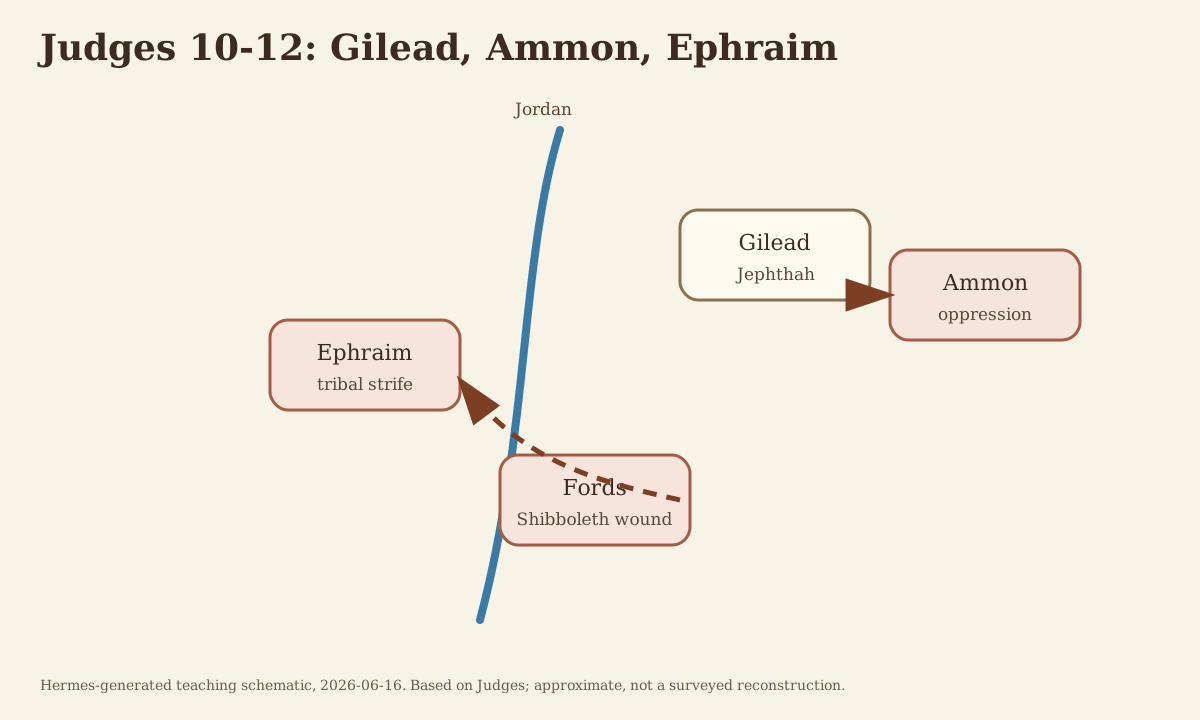 Source: Hermes-generated teaching schematic, 2026-06-16; approximate, not a surveyed reconstruction.
Optional illustrative artwork source: Gustave Doré, Jephthah’s Daughter Comes to Meet Her Father, Public domain, via Wikimedia Commons. Use sparingly and pastorally.
Judges 10:1-5 - Tola and Jair: quiet mercies after public ruin
1 And after Abimelech Thola the son of Phua rose up to save Israel, being the son of his father’s brother, a man of Issachar; and he dwelt in Samir in mount Ephraim. 2 And he judged Israel twenty-three years, and died, and was buried in Samir.
3 And after him arose Jair of Galaad, and he judged Israel twenty-two years. 4 And he had thirty-two sons riding on thirty-two colts, and they had thirty-two cities; and they called them Jair’s towns until this day in the land of Galaad. 5 And Jair died, and was buried in Rhamnon.
Tola rises ‘to save Israel’ after Abimelech. His twenty-three years and Jair’s twenty-two years are compressed into a few lines. The absence of a battle story does not make these years empty. After the destruction of the preceding chapter, someone remaining in place, judging disputes and preserving a community, is a mercy worth receiving.
Jair’s sons, riding animals, and towns suggest an influential household and regional authority. Such strength can support public order, but the account does not say that it healed Israel’s worship. The next paragraph begins with renewed apostasy. We should neither despise this quieter preservation nor turn its outward prosperity into proof of inward faithfulness.
There is a form of service that rarely receives a song: keeping a household steady, visiting someone who is alone, praying when prayer feels ordinary, or refusing to let a small responsibility fall into neglect. Tola and Jair help us recognize the value of sustained care. Their deaths also set a limit on what any human leader can provide. Gratitude for faithful servants belongs beside trust in Christ, whose life is not ended by a burial notice.
Judges 10:6-18 - Restless repentance and the pain of a divided heart
6 And the children of Israel did evil again in the sight of the Lord, and served Baalim, and Astaroth, and the gods of Aram, and the gods of Sidon, and the gods of Moab, and the gods of the children of Ammon, and the gods of the Phylistines; and they forsook the Lord, and did not serve him. 7 And the Lord was very angry with Israel, and sold them into the hand of the Phylistines, and into the hand of the children of Ammon. 8 And they afflicted and bruised the children of Israel at that time eighteen years, all the children of Israel beyond Jordan in the land of the Amorite in Galaad. 9 And the children of Ammon went over Jordan to fight with Juda, and Benjamin, and with Ephraim; and the children of Israel were greatly afflicted.
10 And the children of Israel cried to the Lord, saying, We have sinned against thee, because we have forsaken God, and served Baalim. 11 And the Lord said to the children of Israel, Did I not save you from Egypt and from the Amorite, and from the children of Ammon, and from the Phylistines, 12 and from the Sidonians, and Amalec, and Madiam, who afflicted you? and ye cried to me, and I saved you out of their hand? 13 Yet ye forsook me and served other gods; therefore I will not save you any more. 14 Go, and cry to the gods whom ye have chosen to yourselves, and let them save you in the time of your affliction. 15 And the children of Israel said to the Lord, We have sinned: do thou to us according to all that is good in thine eyes; only deliver us this day. 16 And they put away the strange gods from the midst of them, and served the Lord only, and his soul was pained for the trouble of Israel.
17 And the children of Ammon went up, and encamped in Galaad; and the children of Israel were gathered together and encamped on the hill. 18 And the people the princes of Galaad said every man to his neighbour, Who is he that shall begin to fight against the children of Ammon? he shall even be head over all that dwell in Galaad.
The long list of gods in verse 6 makes Israel’s divided allegiance visible. Baalim and Astaroth name forms of idol worship; the gods of Aram, Sidon, Moab, Ammon, and the Philistines widen the betrayal. Israel has multiplied supposed protectors and finds herself exposed to multiplied oppression. The Ammonites cross the Jordan, so the trouble reaches beyond Gilead into Judah, Benjamin, and Ephraim.
The Lord answers the cry with the memory of earlier rescues. His words in verse 14 echo Deuteronomy 32:37-38: let the gods on whom you relied arise and help you. The rebuke exposes the lie that Israel can abandon the Lord and still summon Him as an emergency servant. He brings her divided worship into the light.
Verse 15 moves toward surrender: ‘according to all that is good in thine eyes.’ Near the end of Judges, people will do what is right in their own eyes. Here Israel asks that God’s judgment govern her need. Yet verse 16 supplies the decisive action: they put away the strange gods and serve the Lord only. Confession has become renunciation. A request for relief can be sincere and still incomplete; repentance begins to change the loyalties that helped create the misery.
‘His soul was pained’ speaks of divine mercy in the language of human sorrow. It does not picture a changing or helpless God. The One who rebukes Israel also cares about her affliction. Hosea 11:8-9 gives a close companion to this tenderness, joining the turning of God’s heart with His declaration that He is God and not man. Isaiah 63:9, in Brenton’s Greek-based wording, speaks of God Himself saving because He loved and spared His people. Its wording should not be confused with the different rendering ‘He was afflicted’ found in some English Bibles.
For us, verse 16 gives confession a practical shape. Someone struggling with resentment can name the injury truthfully and stop rehearsing revenge. Someone protecting a hidden habit can remove the means of returning to it and seek help. Renunciation is more than a dramatic promise about tomorrow. It is the first concrete act of obedience today. Israel’s situation is still dangerous at the chapter’s end, but she no longer has to call her idols faithful.
Judges 11:1-11 - Jephthah rejected and recalled
1 And Jephthae the Galaadite was a mighty man; and he was the son of a harlot, who bore Jephthae to Galaad. 2 And the wife of Galaad bore him sons; and the sons of his wife grew up, and they cast out Jephthae, and said to him, Thou shalt not inherit in the house of our father, for thou art the son of a concubine.
3 And Jephthae fled from the face of his brethren, and dwelt in the land of Tob; and vain men gathered to Jephthae, and went out with him.
4 And it came to pass when the children of Ammon prepared to fight with Israel, 5 that the elders of Galaad went to fetch Jephthae from the land of Tob. 6 And they said to Jephthae, Come, and be our head, and we will fight with the sons of Ammon. 7 And Jephthae said to the elders of Galaad, Did ye not hate me, and cast me out of my father’s house, and banish me from you? and wherefore are ye come to me now when ye want me? 8 And the elders of Galaad said to Jephthae, Therefore have we now turned to thee, that thou shouldest go with us, and fight against the sons of Ammon, and be our head over all the inhabitants of Galaad. 9 And Jephthae said to the elders of Galaad, If ye turn me back to fight with the children of Ammon, and the Lord should deliver them before me, then will I be your head. 10 And the elders of Galaad said to Jephthae, The Lord be witness between us, if we shall not do according to thy word.
11 And Jephthae went with the elders of Galaad, and the people made him head and ruler over them: and Jephthae spoke all his words before the Lord in Massepha.
Jephthah’s brothers deny him a share in their father’s house. Scripture places his military strength beside the injustice done to him, without making his birth a moral defect of his own. In Tob, men described as ‘vain’ gather around him. He has learned to survive outside the household that should have received him. When the elders come, his question is exact: why do they want him now, when they previously drove him away?
They offer leadership rather than an explicit confession of their wrongdoing. Jephthah asks for assurance that he will remain head if the Lord grants victory. His bargaining belongs to a wounded man’s effort to secure a place that cannot immediately be withdrawn. The text lets us understand this without concluding that office has made him whole. Being needed can feel like being loved; the two are not always the same.
At Mizpah, his words are spoken before the Lord. Public promises are now placed under a greater witness than the elders’ convenience. Yet the account will show that speaking solemnly before God still requires learning what God desires.
David’s gathering at Adullam in 1 Samuel 22:1-2, also called 1 Kingdoms, offers a useful comparison: distressed and indebted men collect around a leader outside settled security. Psalm 118:22 (LXX Psalm 117:22) gives the larger biblical pattern of the rejected stone becoming the cornerstone. These connections help us see rejection and reversal, without declaring every act of the rejected leader holy.
Gems from the Fathers 💎: The rejected one raised to lead
Aphrahat, in Demonstration 21, section 12, connects Jephthah’s exclusion and later leadership with Christ’s rejection and kingship: ‘Jephthah though persecuted arose as leader to his people; Jesus though persecuted arose and became King of the Nations.’1 His comparison recognizes a positive pattern in a damaged life. The same section also compares the daughter’s sacrifice with Christ’s offering. That ancient typology must be distinguished from approval of Jephthah’s vow: Christ gives Himself freely, and His saving love never requires us to harm a child. Jephthah’s rejection can illuminate Christ’s suffering while his failure makes us long for Christ’s goodness.
A wound does not disqualify a person from serving, but usefulness does not remove the need for healing. In service, we can ask whether we are caring for the people before us or still trying to make the people behind us admit our worth. Christ receives the rejected without making revenge the price of belonging.
Judges 11:12-28 - Jephthah’s diplomacy and covenant memory
12 And Jephthae sent messengers to the king of the children of Ammon, saying, What have I to do with thee, that thou hast come against me to fight in my land? 13 And the king of the children of Ammon said to the messengers of Jephthae, Because Israel took my land when he went up out of Egypt, from Arnon to Jaboc, and to Jordan: now then return them peaceably and I will depart.
14 And Jephthae again sent messengers to the king of the children of Ammon, 15 and said to him, Thus says Jephthae, Israel took not the land of Moab, nor the land of the children of Ammon; 16 for in their going up out of Egypt Israel went in the wilderness as far as the sea of Siph, and came to Cades. 17 And Israel sent messengers to the king of Edom, saying, I will pass, if it please thee, by thy land: and the king of Edom complied not: and Israel also sent to the king of Moab, and he did not consent; and Israel sojourned in Cades. 18 And they journeyed in the wilderness, and compassed the land of Edom and the land of Moab: and they came by the east of the land of Moab, and encamped in the country beyond Arnon, and came not within the borders of Moab, for Arnon is the border of Moab. 19 And Israel sent messengers to Seon king of the Amorite, king of Esebon, and Israel said to him, Let us pass, we pray thee, by thy land to our place. 20 And Seon did not trust Israel to pass by his coast; and Seon gathered all his people, and they encamped at Jasa; and he set the battle in array against Israel. 21 And the Lord God of Israel delivered Seon and all his people into the hand of Israel, and they smote him; and Israel inherited all the land of the Amorite who dwelt in that land, 22 from Arnon and to Jaboc, and from the wilderness to Jordan. 23 And now the Lord God of Israel has removed the Amorite from before his people Israel, and shalt thou inherit his land? 24 Wilt thou not inherit those possessions which Chamos thy god shall cause thee to inherit; and shall not we inherit the land of all those whom the Lord our God has removed from before you? 25 And now art thou any better than Balac son of Sepphor, king of Moab? Did he indeed fight with Israel, or indeed make war with him, 26 when Israel dwelt in Esebon and in its coasts, and in the land of Aroer and in its coasts, and in all the cities by Jordan, three hundred years? and wherefore didst thou not recover them in that time? 27 And now I have not sinned against thee, but thou wrongest me in preparing war against me: may the Lord the Judge judge this day between the children of Israel and the children of Ammon.
28 But the king of the children of Ammon hearkened not to the words of Jephthae, which he sent to him.
Jephthah sends messengers before drawing the sword. Ammon’s king demands land between Arnon, Jabbok, and the Jordan. Jephthah answers that Israel did not take Ammon’s territory: the disputed land was ruled by Sihon the Amorite, who refused passage and attacked Israel. Numbers 20:14-21 supplies the refusal by Edom; Numbers 21:21-26 supplies the encounter with Sihon. Jephthah also appeals to the length of Israel’s possession and to Balak of Moab, who had not fought the war that Ammon now proposes.
Remembering this history is an act of resistance to a false account of the past. Jephthah can distinguish neighboring peoples and explain how the borders came to be. His final appeal is to ‘the Lord the Judge,’ rather than merely to his own ability to win. The king nevertheless refuses to listen. Diplomacy has not succeeded, but its place in the story matters: this deliverer first seeks an answer through words.
Verse 24 names Chamos, or Chemosh, in a challenge framed around the king’s own religious claims. Chemosh is associated with Moab in 1 Kings 11:7, also called 3 Kingdoms. The speech here addresses an Ammonite ruler, so its wording should not be tidied into a simple lesson that Chemosh was exclusively Ammon’s god. Nor does Jephthah’s argument establish that another god genuinely gives land. He presses the opponent’s claim while grounding Israel’s claim in the Lord’s victory.
The mention of Chemosh also belongs to a region whose worship Israel has already imitated in Judges 10:6. In 2 Kings 3:27, also called 4 Kingdoms, a Moabite king offers his son as a whole-burnt-offering during a military crisis. That later account reveals a disturbing resemblance to Jephthah’s story. It does not prove Jephthah copied that practice or let us diagnose his private motives. It does help explain why the vow must be read against the danger of Israel absorbing the worship she was called to renounce.
The contrast between this well-argued speech and the vow that follows is searching. A person may know the history of salvation and still mistake fear-driven religious intensity for obedience. Biblical knowledge is a gift when it teaches us to trust and obey; it becomes dangerous when we use it to defend our position while leaving our picture of God uncorrected.
Judges 11:29-40 - The Spirit, the vow, and the daughter of Jephthah
29 And the Spirit of the Lord came upon Jephthae, and he passed over Galaad, and Manasse, and passed by the watch-tower of Galaad to the other side of the children of Ammon.
30 And Jephthae vowed a vow to the Lord, and said, If thou wilt indeed deliver the children of Ammon into my hand, 31 then it shall come to pass that whosoever shall first come out of the door of my house to meet me when I return in peace from the children of Ammon, he shall be the Lord’s: I will offer him up for a whole-burnt-offering.
32 And Jephthae advanced to meet the sons of Ammon to fight against them; and the Lord delivered them into his hand. 33 And he smote them from Aroer till one comes to Arnon, in number twenty cities, and as far as Ebelcharmim, with a very great destruction: and the children of Ammon were straitened before the children of Israel.
34 And Jephthae came to Massepha to his house; and behold, his daughter came forth to meet him with timbrels and dances; and she was his only child, he had not another son or daughter. 35 And it came to pass when he saw her, that he rent his garments, and said, Ah, ah, my daughter, thou hast indeed troubled me, and thou wast the cause of my trouble; and I have opened my mouth against thee to the Lord, and I shall not be able to return from it. 36 And she said to him, Father, hast thou opened thy mouth to the Lord? Do to me accordingly as the word went out of thy mouth, in that the Lord has wrought vengeance for thee on thine enemies of the children of Ammon. 37 And she said to her father, Let my father now do this thing: let me alone for two months, and I will go up and down on the mountains, and I will bewail my virginity, I and my companions. 38 And he said, Go: and he sent her away for two months; and she went, and her companions, and she bewailed her virginity on the mountains.
39 And it came to pass at the end of the two months that she returned to her father; and he performed upon her his vow which he vowed; and she knew no man: 40 and it was an ordinance in Israel, That the daughters of Israel went from year to year to bewail the daughter of Jephthae the Galaadite for four days in a year.
The Spirit of the Lord comes upon Jephthah before he vows anything. The Lord then gives Ammon into his hand. These details keep the order clear: God’s gift precedes Jephthah’s bargain. The vow neither earns the Spirit nor purchases the victory. Jephthah adds an ‘if’ and a promised offering to a work of mercy already begun.
When his daughter comes out with timbrels and dances, the homecoming should have completed the joy of deliverance. Instead, her father’s torn clothing announces that his own words have made joy unbearable. She is his only child. His complaint, ‘thou wast the cause of my trouble,’ wrongly places the weight of his decision on the person who came to welcome him. She did not make his vow. Religious language must never be used to transfer a parent’s responsibility onto a child.
Language insight: ‘whosoever’, ‘only child’, and ‘beloved’
In Judges 11:31, both principal Greek texts, commonly called A and B, use masculine wording, including ὃς, ‘whoever,’ and αὐτόν, ‘him,’ for the one coming out to meet Jephthah. Their word for the offering is ὁλοκαύτωμα, a whole-burnt-offering. This supports taking the possibility of a human victim seriously. Masculine grammar alone cannot reveal every intention in Jephthah’s mind, but the Greek does not justify reassuring ourselves that he certainly expected an animal.
Both Greek texts call the daughter μονογενής, ‘an only child,’ in verse 34. A also adds ἀγαπητή, ‘beloved’; B does not. The additional word deepens the tenderness of the A account: this is a beloved daughter, never an expendable offering. Genesis 22:2 in the Greek tradition calls Isaac ‘beloved,’ while John 3:16 speaks of the Father’s only-begotten Son. These words place the cost of losing an only child before us. Shared vocabulary does not equate Jephthah’s vow with God’s saving will.
A vow cannot authorize evil. Deuteronomy 12:31 forbids Israel to worship the Lord through the burning of sons and daughters. Jephthah’s claim that he cannot turn back is his own conclusion, not a command from God. Numbers 30:2 treats promises seriously, but it cannot cancel that prohibition. Leviticus 5:4-6 directs a person guilty through an oath toward confession and atonement. Leviticus 27:1-8 assigns monetary valuations in vows concerning persons and provides for the poor to stand before a priest. These laws show that a vow is not a private power over another person’s life. They do not establish a mechanical payment by which Jephthah’s forbidden promise could become lawful. The needed response is repentance and protection of his daughter, not greater determination to carry out harm.
Genesis 22 brings this distinction into focus: God stops Abraham’s hand and provides a ram. In 1 Samuel 14:43-45, Saul’s oath threatens Jonathan, but the people intervene and Jonathan does not die. A solemn word spoken by a leader does not require everyone else to cooperate in the destruction of the innocent. Christ’s teaching in Matthew 5:33-37 and James 5:12 directs speech toward a truthful yes and no, freeing it from attempts to secure control by ever more binding oaths. If a promise would harm someone, seek pastoral help, confess the rashness, and refuse the harm.
Hear the daughter. She answers her father, asks for two months with her companions, and goes into the mountains with them. Her words and the time she requests give her a voice within a calamity she did not create. They cannot be used to make parents or religious leaders entitled to a child’s suffering. The repeated mourning of her virginity grieves the future marriage and household life she will never have. The later notices of large families make the loss of this only child still more painful.
Verse 39 says that Jephthah fulfilled his vow upon her, without narrating the act in detail. A reading of lifelong virginity has been proposed to explain ‘she knew no man.’ Yet the whole-burnt-offering language gives the reading of her death its grave force. The Christian witnesses quoted in this study understand her fate as death. Her companions and the daughters of Israel keep her grief from disappearing: the passage ends with four days of yearly lament, not a song celebrating the vow.
Gems from the Fathers 💎: Faith remembered, folly mourned
Saint John Chrysostom reads this account as a warning about rash promises in Homily 14 on the Statues, section 7. He understands the daughter to have been killed and explains the lament as instruction against such vows. His governing conclusion is that God ‘does not delight in such sacrifices.’2 His account of divine permission is an interpretation of the tragedy, not a statement that God demanded the killing. Nor should we turn his explanation of the annual lament into the exclusive meaning of the woman’s remembrance.
In Homily 27 on Hebrews, section 4, Chrysostom also answers readers troubled by Jephthah’s inclusion among the faithful: ‘For do not tell me of the rest of their life, but only whether they did not believe and shine in Faith.’3 Hebrews honors faith without making every act of a remembered person righteous. We can receive that distinction without diminishing the daughter’s loss.
The Church’s Voice in Worship ⛪
Fr. Jacob Nadian’s Funeral Services, First Book: Laity, printed pages 231-232, places Judges 11:30-40 in funeral services for female children during Passion Week.4 In that setting, the daughter’s story is heard amid mourning for a child. Her companions’ grief and Israel’s remembrance can help the bereaved recognize that this loss deserves tears and loving attention. This is a pastoral connection with the reading, not a claim to know its only intended meaning or the current practice of any parish.
The Gospel’s answer to this house of grief is the freely offered life of Christ. The Father and the Son act in one saving love; the Son is not caught in a rash promise made by someone else. His voluntary offering cannot be borrowed to justify abuse, religious coercion, or harm to the innocent. Before Him, zeal learns obedience and the grieving daughter remains someone to mourn.
Judges 12:1-7 - Ephraim, Jephthah, and the civil war at the fords
1 And the men of Ephraim assembled themselves, and passed on to the north, and said to Jephthae, Wherefore didst thou go over to fight with the children of Ammon, and didst not call us to go with thee? we will burn thy house over thee with fire. 2 And Jephthae said to them, I and my people and the children of Ammon were very much engaged in war; and I called for you, and ye did not save me out of their hand. 3 And I saw that thou wert no helper, and I put my life in my hand, and passed on to the sons of Ammon; and the Lord delivered them into my hand: and wherefore are ye come up against me this day to fight with me?
4 And Jephthae gathered all the men of Galaad, and fought with Ephraim; and the men of Galaad smote Ephraim, because they that were escaped of Ephraim said, Ye are of Galaad in the midst of Ephraim and in the midst of Manasse. 5 And Galaad took the fords of Jordan before Ephraim; and they that escaped of Ephraim said to them, Let us go over: and the men of Galaad said, Art thou an Ephrathite? and he said, No. 6 Then they said to him, Say now Stachys; and he did not rightly pronounce it so: and they took him, and slew him at the fords of Jordan; and there fell at that time of Ephraim two and forty thousand.
7 And Jephthae judged Israel six years; and Jephthae the Galaadite died, and was buried in his city Galaad.
Ephraim’s first words after the victory are a threat to burn Jephthah’s house. Jephthah answers that he had called for help and received none. The accusation and the answer never become reconciliation. Insults about Gilead’s identity in verse 4 sharpen the division, and people who share Israel’s covenant now fight one another.
The earlier encounter with Ephraim in Judges 8:1-3 makes the descent plain. Gideon answered a similar grievance by honoring Ephraim’s part in the victory, and their anger cooled. That comparison does not make Gideon faultless elsewhere or excuse Ephraim’s threat here. It shows how different an outcome can follow speech that leaves another person room to step back. Proverbs 15:1 names the wisdom involved: a gentle answer turns away wrath, while a grievous word stirs it up.
The fords deepen the horror. Israel had seized Jordan crossings against Moab in Judges 3:28 and against Midian in Judges 7:24. Now the crossings trap fellow Israelites. A place used to secure deliverance has become a place where brethren are denied passage and killed. The slaughter is not an ingenious lesson in pronunciation; it is a picture of a people turning victory into self-destruction.
Language insight: ‘Stachys’ and ‘Password’
Brenton’s ‘Stachys’ in verse 6 represents the Greek B text’s στάχυς, meaning an ear of grain. The A text instead has σύνθημα, a password. NETS renders these respectively ‘Ear-of-Grain’ and ‘Password.’ Both retain the failure to say the required word correctly. Hebrew-based translations commonly show the pair ‘Shibboleth’ and ‘Sibboleth’; that pair is not reproduced as two contrasting Greek spellings here. The Greek versions preserve the lethal test while presenting its wording differently. The word’s ordinary meaning makes the scene all the more dreadful: a harmless expression has become a sentence of death.
Peter’s speech identifies him in Matthew 26:73, but recognition need not become contempt. Acts 2:6-11 gives a hopeful contrast: people hear God’s works in the languages in which they were born. At Pentecost, different speech can carry one proclamation. Ephesians 2:14-18 names the deeper healing in Christ, who reconciles the divided through His Cross and gives access to the Father in one Spirit. These are Christian connections with the scene, not claims that Judges explicitly predicts these events.
In parish and family life, a person can make pronunciation, background, or familiar customs a test of whether someone belongs. The fords expose where that impulse leads when pride governs it. After a successful task, guard the first contemptuous sentence. Credit another person’s work, answer a grievance before it hardens, and refuse to turn difference into humiliation. Jephthah’s six years close with death and burial; this account gives no formula saying the land rested.
Judges 12:8-15 - Ibzan, Elon, and Abdon: outward order, inward questions
8 And after him Abaissan of Bethleem judged Israel. 9 And he had thirty sons, and thirty daughters, whom he sent forth; and he brought in thirty daughters for his sons from without; and he judged Israel seven years. 10 And Abaissan died, and was buried in Bethleem.
11 And after him Ælom of Zabulon judged Israel ten years. 12 And Ælom of Zabulon died, and was buried in Ælom in the land of Zabulon.
13 And after him Abdon the son of Ellel, the Pharathonite, judged Israel. 14 And he had forty sons, and thirty grandsons, that rode upon seventy colts: and he judged Israel eight years. 15 And Abdon the son of Ellel, the Pharathonite, died, and was buried in Pharathon in the land of Ephraim in the mount of Amalec.
Ibzan, Elon, and Abdon follow Jephthah in short notices. Ibzan’s thirty sons and thirty daughters are connected with marriages beyond his household, and Abdon’s forty sons and thirty grandsons ride seventy colts. These are signs of family reach and social standing. The text does not supply hidden spiritual meanings for the numbers, nor does it accuse these judges of the violence that preceded them.
Placed beside Jephthah’s only daughter, the abundant households are painful to read. Other families continue through sons, daughters, marriages, and grandchildren; her father’s house has lost the future represented by its one child. This contrast arises from the details the account gives, without reducing her value to the survival of a family line. Her life matters before any usefulness or descendants could be counted.
Each judge dies and is buried. The account records years of leadership but says little about the people’s return to the Lord. Since the last explicit statement of the land’s rest in Judges 8:28, the familiar rest formula has not returned. That literary silence does not prove that every later year was spent in war. It does leave the reader without the earlier assurance that deliverance has brought rest.
There is a place for gratitude for ordinary order and a place for asking what that order conceals. A full calendar and a household that appears successful can still leave grief unattended. After these chapters, faithfulness includes remembering the person who did not share the community’s prosperity. Christ’s care reaches the bereaved as well as the busy household, and no impressive total makes a single lost person insignificant.
Summary Table
| Text | What happens | What the passage asks of us |
|---|---|---|
| Judges 10:1-5 | Tola and Jair preserve Israel after Abimelech | Receive quiet service with gratitude without equating prosperity with holiness |
| Judges 10:6-18 | Israel’s confession becomes the removal of idols | Join confession to concrete renunciation and trust God’s mercy |
| Judges 11:1-11 | An excluded man is recalled and made head | Distinguish usefulness from healed belonging; receive Christ the rejected Savior |
| Judges 11:12-28 | Jephthah answers a territorial claim from Israel’s history | Let knowledge of salvation correct our conduct as well as our arguments |
| Judges 11:29-40 | The Spirit precedes a rash vow; the daughter is mourned | Refuse bargaining, protect the innocent, and honor grief |
| Judges 12:1-7 | Pride turns deliverance into civil slaughter | Seek reconciliation and refuse to make difference a weapon |
| Judges 12:8-15 | Large households and successive burials close the account | Give thanks for order while attending to the grief of the one |
Spiritual Fruit 🍇
Let confession change one protected habit. Israel puts away the gods it had named only indirectly in its cry. In preparation for confession, name what you have been unwilling to release, then choose the next obedient act: remove an occasion of sin, stop rehearsing an insult, return what is owed, or ask someone trustworthy for help. The aim is renewed service of the Lord, not relief followed by the same arrangement of life.
Receive usefulness without making it your worth. Jephthah’s recall answers a public need but leaves an old wound exposed. If service has become the place where you try to prove that you deserved love, bring that hunger into prayer and pastoral counsel. Allow yourself to be cared for when you have nothing impressive to offer. Thank God also for the quiet servants whose steadiness preserves others without public recognition.
Put zeal under obedience. The Spirit comes before the vow. You do not need to invent a painful bargain to make God willing to help. A rash promise should lead to confession and counsel, never to harm done in God’s name. Parents and servants have a particular duty to protect those who may find it hardest to refuse them. The daughter must not become an argument for demanding another person’s suffering.
Guard the tongue after success. The people who have survived Ammon begin destroying one another. When a task goes well, resist the urge to settle old scores, claim all the credit, or measure someone else’s belonging by familiar speech and customs. Offer a truthful acknowledgment of their contribution. A gentle answer can preserve a relationship that an accurate but contemptuous answer would ruin.
Remember the one whom the celebrations leave behind. Israel’s women return to the daughter’s memory. Make room for grief when everyone else seems ready to move on. A visit, a remembered name, or patient listening can keep a bereaved person from being treated as an interruption to normal life. In Christ, mercy is not measured by the size of the successful household.
The timbrels at Mizpah were meant for a welcome. Stay for a moment beside the daughter and her companions, before their joy has been swallowed by her father’s words. Bring to Christ the promises you made in fear and the people who have borne their cost. Ask Him for repentance that releases its idols, speech that protects the weak, and a heart willing to mourn with those who mourn.
Teaching Notes
Leading the study. Use the map to locate Gilead, Ammon, and the crossings before discussing the household tragedy. Hold together God’s use of Jephthah, his remembrance in Hebrews 11, and the danger of his vow. Give his daughter time and attention without sensational detail. If time is short, concentrate on Judges 10:6-18, 11:29-40, and 12:1-7.
Tola and Jair (Judges 10:1-5)
- Ask: Which forms of quiet service in our community preserve others without becoming public stories?
- Watch for: Treating the size or influence of Jair’s household as proof of spiritual renewal.
Repentance and mercy (Judges 10:6-18)
- Ask: What changes between Israel’s spoken confession and its action in verse 16?
- Watch for: Reading God’s rebuke as coldness, or calling relief from consequences the whole of repentance.
Rejection and recall (Judges 11:1-11)
- Ask: What do the elders offer Jephthah, and what part of his original grievance remains unanswered?
- Watch for: Blaming Jephthah for his birth or assuming that being useful heals rejection.
Diplomacy and memory (Judges 11:12-28)
- Ask: How can Jephthah know Israel’s history so well and still fail to discern God’s will in the next passage?
- Watch for: Treating his appeal to Chemosh as a settled declaration of Israel’s theology, or using the territorial argument to bless modern aggression.
The vow and the daughter (Judges 11:29-40)
- Ask: How does the Spirit’s coming before the vow change the way we understand the victory and Jephthah’s promise?
- Watch for: Praising harmful promise-keeping, silencing the daughter, erasing the grief through the dedication theory, or presenting the funeral book as proof of current parish practice.
The Jordan fords (Judges 12:1-7)
- Ask: What differs between Gideon’s answer to Ephraim in Judges 8 and the encounter here, and where could a less destructive answer have begun?
- Watch for: Making this a clever pronunciation anecdote instead of confronting tribal contempt and the killing of brethren.
Households and burials (Judges 12:8-15)
- Ask: How do the large families in these notices affect our hearing of the loss of Jephthah’s only child?
- Watch for: Inventing meanings for the numbers or assuming that the brief notices prove either complete peace or complete moral failure.
Sources
Embedded Scripture is from Brenton’s English Septuagint (LXX).
Judges 10-12; Numbers 20:14-21; 21:21-26; 30:2; Deuteronomy 2:19; 12:31; 32:37-38; Leviticus 5:4-6; 27:1-8; Genesis 22:2-13; Hosea 11:8-9; Isaiah 63:9; 1 Samuel 14:43-45 and 22:1-2; 1 Kings 11:7; 2 Kings 3:27; Psalm 118:22 (LXX Psalm 117:22); Proverbs 15:1.
Matthew 5:33-37; 26:73; John 3:16; Acts 2:6-11; Ephesians 2:14-18; Hebrews 11:32-34. New Testament cross-references are discussed with the NKJV wording in view.
A. Rahlfs, Septuaginta, Judges A and B; NETS, Judges, translated by Philip E. Satterthwaite, printed pages 222-223. The two Greek texts differ at important points; neither should be silently treated as the only Septuagint wording.
Aphrahat, Demonstration 21, section 12; Saint John Chrysostom, Homily 14 on the Statues, section 7, and Homily 27 on Hebrews, section 4, cited below. These are particular witnesses, not a claim of uniform interpretation.
Fr. Jacob Nadian, Funeral Services, First Book: Laity, printed pages 231-232, cited below. This source establishes the placement in that service book, not the current practice of a particular parish.
Footnotes
-
Aphrahat, Demonstration 21: Of Persecution, section 12, translated by John Gwynn, Nicene and Post-Nicene Fathers, Second Series, vol. 13. Text. ↩
-
Saint John Chrysostom, Homily 14 on the Statues, section 7, Nicene and Post-Nicene Fathers, First Series, vol. 9. Text. ↩
-
Saint John Chrysostom, Homily 27 on Hebrews, section 4, Nicene and Post-Nicene Fathers, First Series, vol. 14. Text. ↩
-
Fr. Jacob Nadian, Funeral Services, First Book: Laity, ‘Funeral Services for Female Children during Passion Week,’ printed pages 231-232. Service book. ↩