


Gideon is beating wheat in a winepress, trying to preserve food from the people who have made Israel hungry. The Lord finds him there and calls him to deliver the nation. By the end of these chapters, Midian is defeated and the land has rest, yet a golden ephod in Gideon’s town has become a snare. The story begins with a man hiding from an enemy and ends with a people drawn toward a danger made by their deliverer.
That whole arc belongs to the study. God’s patience makes a fearful servant useful; victory then exposes temptations fear had kept out of sight. Hebrews 11:32 remembers Gideon’s faith, and verse 34 speaks of those who “out of weakness were made strong.” Gratitude for God’s work through him and watchfulness about his failures belong together. Christ is the hope toward which both lead: the Deliverer who gives His people light, cleanses their worship, and reigns by offering Himself for their life.
Historical and Scriptural Context
After the rest described at the end of Deborah’s song, Israel again does evil. Midian and its allies raid the land when its produce is ready, impoverishing Israel and forcing people into hiding. God answers their cry by sending a prophet before raising a deliverer. The prophet’s memory of the Exodus gives the key to the call, the battle, and the later danger: the Lord who rescued Israel must remain the Lord they obey.
The sequence carries that burden: rebuke, call, destruction of Baal’s altar, empowerment by the Spirit, reassurance, reduction of the army, victory, conflict among brethren, and the ephod. The story’s question grows sharper after the enemy has fled. What will Israel do with freedom, and what will Gideon do with honor?
Greek Judges is transmitted in two major forms, printed as A and B in Rahlfs and translated separately in NETS. Brenton generally follows the Vaticanus-based tradition represented by B, though the editions are not identical. Differences that affect this exposition are explained beside their verses.1
Geographical Significance ⛰️
- Ephratha / Ophrah of Abi-ezri: Gideon’s home region in Manasseh.
- The valley of Jezreel: where Midian gathers in threatening numbers.
- The fountain of Harod / Brenton’s Arad: staging point for the reduced army.
- The hill of Moreh: enemy position in the valley.
- Jordan and its crossings: crucial in the pursuit and Ephraim’s role.
- Succoth and Penuel: east-Jordan towns that refuse aid.
- Karkor: place of the final strike on Midian’s remnant.
- Tabor: tied to the murder of Gideon’s brothers.
- Shechem: setting of Gideon’s concubine and Abimelech’s birth.
The Characters 👥
- The Lord: true Deliverer who will not let Israel boast.
- Israel: frightened, impoverished, forgetful, yet still heard.
- Gideon / Gedeon / Jerobaal: weak, helped, victorious, and later compromised.
- The unnamed prophet: interprets Israel’s suffering.
- The angel of the Lord: calls and reassures Gideon.
- Joash: Gideon’s father, who briefly exposes Baal’s impotence.
- Midian and its allies: devouring oppressors.
- Ephraim: helpful in pursuit, touchy about honor.
- Succoth and Penuel’s leaders: cowardly and self-protective.
- Zebah and Zalmunna: Midianite kings captured after the rout.
- Jether: Gideon’s young firstborn.
- Abimelech: ominous son born at the story’s end.
Iconography and Visual Teaching 🖼️
The Orthodox icon presents Gideon within the Church’s remembrance of the righteous judges. Aelbrecht Bouts’ painting is Western biblical art, while the campaign diagram is an illustrative schematic. The three images bring different parts of the story into view: the servant, the fleece, and the whole course from call to ephod.
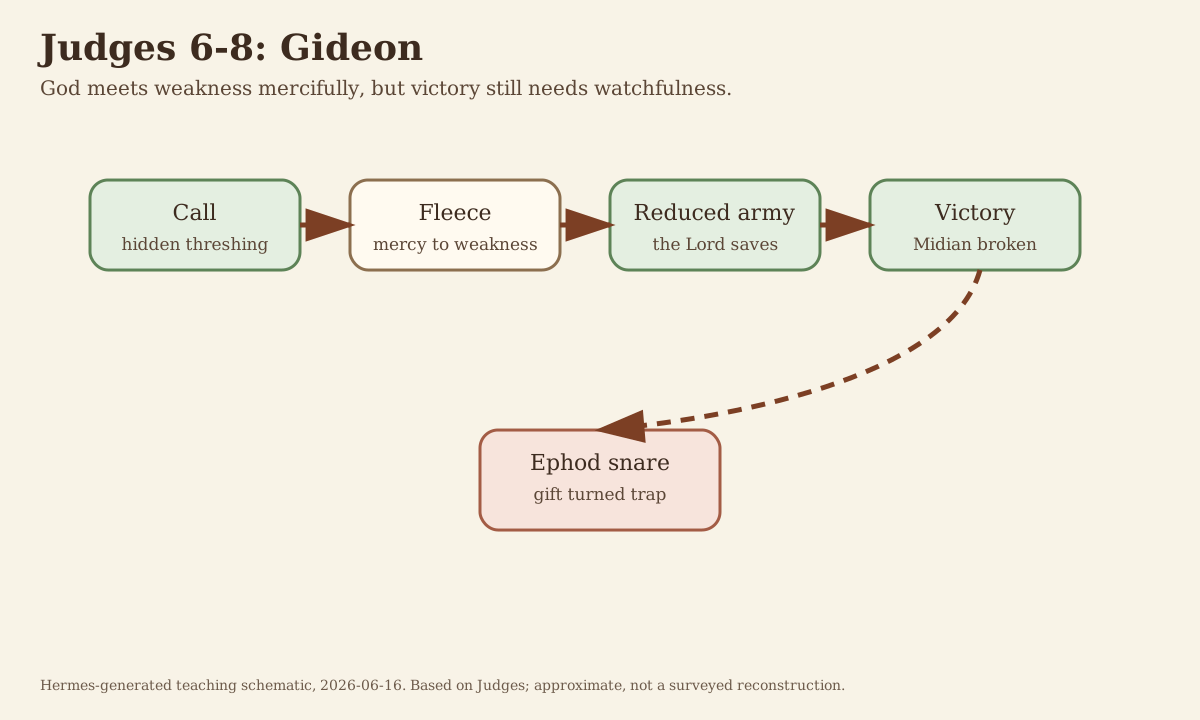 Source: Hermes-generated teaching schematic, 2026-06-16; approximate, based on Judges 6-8.
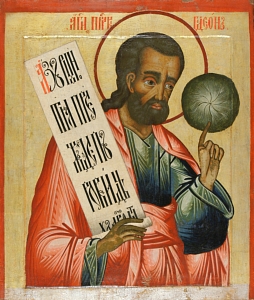 Source: Judge Gideon, Russian Orthodox icon from the first quarter of the 18th century, iconostasis of Kizhi monastery, Karelia, Russia; Public domain, via Wikimedia Commons.
 Source: Aelbrecht Bouts, Gideon and the Fleece, Public domain, via Wikimedia Commons.
Light from the Word 🕯️
Judges 6:1-10 - Midian’s oppression and the prophet’s rebuke
1 And the children of Israel did evil in the sight of the Lord, and the Lord gave them into the hand of Madiam seven years.
2 And the hand of Madiam prevailed against Israel: and the children of Israel made for themselves because of Madiam the caves in the mountains, and the dens, and the holes in the rocks. 3 And it came to pass when the children of Israel sowed, that Madiam and Amalec went up, and the children of the east went up together with them. 4 And they encamped against them, and destroyed their fruits until they came to Gaza; and they left not the support of life in the land of Israel, not even ox or ass among the herds. 5 For they and their stock came up, and their tents were with them, as the locust in multitude, and there was no number to them and their camels; and they came to the land of Israel, and laid it waste. 6 And Israel was greatly impoverished because of Madiam. 7 And the children of Israel cried to the Lord because of Madiam.
8 And the Lord sent a prophet to the children of Israel; and he said to them, Thus says the Lord God of Israel, I am he that brought you up out of the land of Egypt, and I brought you up out of the house of your bondage. 9 And I delivered you out of the hand of Egypt, and out of the hand of all that afflicted you, and I cast them out before you; and I gave you their land. 10 And I said to you, I am the Lord your God: ye shall not fear the gods of the Amorites, in whose land ye dwell; but ye hearkened not to my voice.
Midian waits for Israel to sow, then comes to consume the harvest. The repetition makes oppression intimate: the people work, but cannot keep the fruit of their work. The land given by God has become a place where His people hide in holes in the rocks. The multitude compared to locusts devours what should sustain families, leaving neither grain nor livestock secure.
Israel cries out, and the first answer is a prophet. His speech begins with deliverance before it names disobedience. The Lord brought them out of bondage, rescued them from oppressors, and gave them the land. His command arose from that relationship: they were to fear Him, rather than the gods of the people around them. Their poverty is real; so is the broken allegiance that the prophet exposes. Rescue without restored worship would leave the root of the trouble untouched.
The rebuke also prepares us for Gideon’s question about the Exodus in verse 13. God has remembered the very wonders Gideon fears He has forgotten. Israel must learn to remember them as a call to obedience, rather than as a promise that belonging to God makes apostasy harmless. Judges 2:10 had described a generation that did not know the Lord’s works. Here the memory survives in stories told by the fathers, yet its power to direct life has grown weak.
This is a particular explanation of Israel’s covenant crisis, not permission to tell every suffering person that his hardship proves a hidden sin. The Christian hears the prophet first as a summons to examine his own allegiance. When resentment, a concealed habit, or the need for approval repeatedly consumes the fruit of prayer, asking for relief must be joined to listening. The Lord who hears the cry also tells the truth that can heal its source.
Judges 6:11-24 - Gideon is called from hiding
11 And an angel of the Lord came, and sat down under the fir tree, which was in Ephratha in the land of Joas father of Esdri; and Gedeon his son was threshing wheat in a wine-press in order to escape from the face of Madiam. 12 And the angel of the Lord appeared to him and said to him, The Lord is with thee, thou mighty in strength. 13 And Gedeon said to him, Be gracious with me, my Lord: but if the Lord is with us, why have these evils found us? and where are all his miracles, which our fathers have related to us, saying, Did not the Lord bring us up out of Egypt? and now he has cast us out, and given us into the hand of Madiam. 14 And the angel of the Lord turned to him, and said, Go in this thy strength, and thou shalt save Israel out of the hand of Madiam: behold, I have sent thee. 15 And Gedeon said to him, Be gracious with me, my Lord: whereby shall I save Israel? behold, my thousand is weakened in Manasse, and I am the least in my father’s house. 16 And the angel of the Lord said to him, The Lord shall be with thee, and thou shalt smite Madiam as one man. 17 And Gedeon said to him, If now I have found mercy in thine eyes, and thou wilt do this day for me all that thou hast spoken of with me, 18 depart not hence until I come to thee, and I will bring forth an offering and offer it before thee: and he said, I will remain until thou return.
19 And Gedeon went in, and prepared a kid of the goats, and an ephah of fine flour unleavened; and he put the flesh in the basket, and poured the broth into the pot, and brought them forth to him under the turpentine tree, and drew nigh. 20 And the angel of God said to him, Take the flesh and the unleavened cakes, and put them on that rock, and pour out the broth close by: and he did so. 21 And the angel of the Lord stretched out the end of the rod that was in his hand, and touched the flesh and the unleavened bread; and fire came up out of the rock, and consumed the flesh and the unleavened bread, and the angel of the Lord vanished from his sight.
22 And Gedeon saw that he was an angel of the Lord; and Gedeon said, Ah, ah, Lord my God! for I have seen the angel of the Lord face to face. 23 And the Lord said to him, Peace be to thee, fear not, thou shalt not die.
24 And Gedeon built there an altar to the Lord, and called it The peace of the Lord, until this day, as it is still in Ephratha of the father of Esdri.
Gideon is threshing wheat where grapes should be pressed. The work of feeding a household has been pushed into concealment. Into that cramped life comes the greeting, “The Lord is with thee.” His future courage rests on a presence given before the battle. The address to a mighty man and the admission that he is the least in a weak clan are held together by the Lord’s promise to be with him.
Gideon’s question has a communal heart: if the Lord is with us, why has this happened to us? He remembers the miracles his fathers recounted. Yet he interprets the present disaster as abandonment, while the prophet has already named Israel’s refusal to listen. His anguish contains both a faithful longing for the God of the Exodus and an incomplete reading of the nation’s plight. The Lord meets him there and commissions him. Fear is answered by a task and a promise, not by an invitation to manufacture self-confidence.
The call follows a pattern already heard by Moses: God sends a reluctant servant to rescue His people; the servant asks how he can do it; God promises His presence (🔗 Exodus 3:10-12). The greeting also has an Annunciation-shaped resonance with Luke 1:28, where Gabriel tells the Virgin Mary that the Lord is with her. This is a thematic comparison between divine callings, not a claim that Gideon’s response equals hers or that Luke is demonstrably quoting Judges. Grace makes obedience possible in the life it addresses.
Fire rises from the rock and consumes the offering. The messenger disappears, and Gideon’s fear changes: he now fears death after encountering holiness. The Lord answers with peace. His altar bears that gift in its name. Before Gideon can bring rest to Israel, he receives peace himself. A servant who prays before taking responsibility may discover the same order: God’s nearness is the foundation of the work, not its reward.
Gems from the Fathers 💎: The rock and the healing of sin
St. Ambrose reads the rock and the fire through Christ’s saving flesh. In On the Holy Spirit, Book I, prologue 2-3, he connects the rock with 1 Corinthians 10:4 and the consuming fire with the destruction of human sin through the Lord’s Passion. He calls the rock “a figure of the Body of Christ.”2 This is Christian typology, a reading of an earlier event in the light of Christ, rather than a replacement for the account of Gideon’s offering. The consolation becomes fuller in Christ: the holiness before which sinners tremble is the holiness that comes to cleanse them.
Judges 6:25-40 - Baal’s altar falls, the Spirit empowers, and God gives dew
25 And it came to pass in that night, that the Lord said to him, Take the young bullock which thy father has, even the second bullock of seven years old, and thou shalt destroy the altar of Baal which thy father has, and the grove which is by it thou shalt destroy. 26 And thou shalt build an altar to the Lord thy God on the top of this Maozi in the ordering it, and thou shalt take the second bullock, and shalt offer up whole-burnt-offerings with the wood of the grove, which thou shalt destroy. 27 And Gedeon took ten men of his servants, and did as the Lord spoke to him: and it came to pass, as he feared the house of his father and the men of the city if he should do it by day, that he did it by night.
28 And the men of the city rose up early in the morning; and behold, the altar of Baal had been demolished, and the grove by it had been destroyed; and they saw the second bullock, which Gedeon offered on the altar that had been built. 29 And a man said to his neighbour, Who has done this thing? and they enquired and searched, and learnt that Gedeon the son of Joas had done this thing. 30 And the men of the city said to Joas, Bring out thy son, and let him die, because he has destroyed the altar of Baal, and because he has destroyed the grove that is by it. 31 And Gedeon the son of Joas said to all the men who rose up against him, Do ye now plead for Baal, or will ye save him? whoever will plead for him, let him be slain this morning: if he be a god let him plead for himself, because one has thrown down his altar. 32 And he called it in that day Jerobaal, saying, Let Baal plead thereby, because his altar has been thrown down.
33 And all Madiam, and Amalek, and the sons of the east gathered themselves together, and encamped in the valley of Jezrael. 34 And the Spirit of the Lord came upon Gedeon, and he blew with the horn, and Abiezer came to help after him. 35 And Gedeon sent messengers into all Manasse, and into Aser, and into Zabulon, and into Nephthali; and he went up to meet them.
36 And Gedeon said to God, If thou wilt save Israel by my hand, as thou hast said, 37 behold, I put the fleece of wool in the threshing-floor: if there be dew on the fleece only, and drought on all the ground, I shall know that thou wilt save Israel by my hand, as thou hast said. 38 And it was so: and he rose up early in the morning, and wrung the fleece, and dew dropped from the fleece, a bowl full of water. 39 And Gedeon said to God, Let not, I pray thee, thine anger be kindled with me, and I will speak yet once; I will even yet make one trial more with the fleece: let now the drought be upon the fleece only, and let there be dew on all the ground. 40 And God did so in that night; and there was drought on the fleece only, and on all the ground there was dew.
The Lord sends Gideon first to his father’s altar. Israel’s bondage is bound up with a false worship already established inside the deliverer’s own household. Gideon destroys the altar and its grove, then offers the prescribed sacrifice to the Lord with the wood of what he has cut down. Repentance includes a positive dedication: the place and materials once serving an idol now serve obedience.
Verse 27 names his fear plainly, but also records that he did what the Lord commanded. Nighttime obedience is still obedience. The town’s response exposes the depth of its captivity: its people want to kill the man who has attacked the god unable to defend its own altar. Joash’s challenge brings that absurdity into the open. If Baal is a god, let him plead for himself. Elijah will later expose the same silence at Carmel (🔗 3 Kingdoms 18:27). The Lord saves His servants; Baal’s servants must try to save Baal.
Language insight: The speaker and the Spirit’s “clothing”
Brenton’s verse 31 names “Gedeon the son of Joas” as the speaker. The Hebrew and both Greek forms printed in Rahlfs name Joash; NETS translates both with “Ioas.” The exposition follows those witnesses in identifying the father’s reply, while preserving Brenton’s wording above.1 The difference should be faced rather than silently rewritten.
In verse 34 the Hebrew says the Spirit “clothed” Gideon, using “לָבְשָׁה” (lāḇəšāh); Greek A has “ἐνέδυσεν,” clothing language, while Greek B has “ἐνεδυνάμωσεν,” strengthened or empowered. Brenton’s “came upon” is less vivid than either.3 The source of the summons to battle is the Spirit, not a new capacity Gideon has made for himself. Luke 24:49 supplies a helpful Christian parallel in Christ’s promise of power from on high, whose Greek uses clothing language. It does not make Gideon’s empowerment and Pentecost the same event.
The fleece reverses the distribution of dew: first the wool alone is wet, then all the ground receives dew while the wool remains dry. Gideon repeats “as thou hast said.” He has a promise, but still asks for reassurance. God patiently grants both requests. Christians should not make this extraordinary mercy a rule for demanding signs; discernment ordinarily grows through prayer, Scripture, wise counsel, and willing obedience.
Gems from the Fathers 💎: Dew for the whole earth
The Church’s ancient reading sees more here than hesitation. St. Irenaeus, Against Heresies 3.17.3, reads the dew as the Spirit, first received by Israel and then diffused through the earth in Christ’s gift to the Church. His spiritual conclusion is personal: “we have need of the dew of God, that we be not consumed by fire, nor be rendered unfruitful.”4 St. Ambrose, Book I, prologue 5-9, likewise reads the change as the extension of faith and divine grace to the nations. He explicitly defends Gideon against a charge of faithlessness, saying that he spoke in mysteries.5 The historical narrative’s reassurance of a hesitant servant and Ambrose’s prophetic reading should both be heard, without pretending they make the same judgment about Gideon’s interior state.
Ambrose connects the fleece with Psalm 72:6 (LXX Ps 71:6), whose Greek-based wording is “He shall come down as rain upon a fleece.”6 The image brings deliverance into the gentle, life-giving action of Christ and His Spirit. These ancient interpretations include severe language about Israel’s unbelief; their fruitful use is to contemplate grace reaching the nations, not to cultivate contempt for Jewish people. A Christian who receives that dew is called to bear fruit himself, and Romans 11 forbids Gentile boasting over Israel.
Judges 7:1-8 - The army is reduced so that God alone may be glorified
1 And Jerobaal rose early, the same is Gedeon, and all the people with him, and encamped at the fountain of Arad; and the camp of Madiam was to the north of him, reaching from Gabaathamorai, in the valley.
2 And the Lord said to Gedeon, The people with thee are many, so that I may not deliver Madiam into their hand, lest at any time Israel boast against me, saying, My hand has saved me. 3 And now speak in the ears of the people, saying, Who is afraid and fearful? let him turn and depart from mount Galaad: and there returned of the people twenty-two thousand, and ten thousand were left. 4 And the Lord said to Gedeon, The people is yet numerous; bring them down to the water, and I will purge them there for thee: and it shall come to pass that of whomsoever I shall say to thee, This one shall go with thee, even he shall go with thee; and of whomsoever I shall say to thee, This one shall not go with thee, even he shall not go with thee. 5 And he brought the people down to the water; and the Lord said to Gedeon, Whosoever shall lap of the water with his tongue as if a dog should lap, thou shalt set him apart, and also whosoever shall bow down upon his knees to drink. 6 And the number of those that lapped with their hand to their mouth was three hundred men; and all the rest of the people bowed upon their knees to drink water. 7 And the Lord said to Gedeon, I will save you by the three hundred men that lapped, and I will give Madiam into thy hand; and all the rest of the people shall go every one to his place. 8 And they took the provision of the people in their hand, and their horns; and he sent away every man of Israel each to his tent, and he strengthened the three hundred; and the army of Madiam were beneath him in the valley.
The Lord states the reason for reducing the army before giving the test: Israel might boast against Him and claim that its own hand had saved it. The danger lies in the story the victors will tell. Defeating Midian while learning to trust in themselves would exchange one captivity for another.
The dismissal of the fearful recalls Deuteronomy 20:8, where fear can weaken a brother’s heart. But the second reduction goes beyond that provision. Even the remaining army is too large for the lesson God intends. At the water the Lord identifies those who will go, and Gideon follows His selection. The text does not explain the test as a military assessment of alertness. Treating the chosen men as obviously superior soldiers can miss the very reason supplied in verse 2.
Deuteronomy 8:17 had warned Israel against crediting wealth to its own strength. Judges 7:2 exposes the same temptation in victory. St. Paul’s account of God choosing the weak to shame the mighty reaches the same spiritual conclusion: no flesh should glory in His presence (1 Corinthians 1:27-29). Skill and preparation remain gifts to use responsibly. The rebuke falls on the heart that makes them its savior.
Gems from the Fathers 💎: The three hundred and the Cross
The three hundred have a real Christian symbolic reception. St. Augustine, explaining Psalm 68 (LXX Ps 67), section 29, links Gideon’s number to the Greek letter tau, “T,” whose numerical value is three hundred and whose shape suggests the Cross. St. Gregory the Great gives the same reading in Moralia on Job 30.25.74, directing it toward taking up the cross, self-denial, and compassionate love of one’s neighbor.7 Gregory concludes that “the sword of the enemy is overcome by the wood of the cross.” This is a patristic typology, not a mathematical proof that the narrator encoded a secret message. Its force belongs to the Church’s confession that Christ conquers through the Cross and forms servants who share His humility.
Loss of resources can feel like proof that service is impossible. This passage teaches a different examination: have I made the size of my help a measure of God’s presence? The answer is neither recklessness nor a cult of small numbers. It is grateful dependence on the Lord who chooses, equips, and saves.
Judges 7:9-25 - The dream, the broken pitchers, and victory through weakness
9 And it came to pass in that night that the Lord said to him, Arise, go down into the camp, for I have delivered it into thy hand. 10 And if thou art afraid to go down, go down thou and thy servant Phara into the camp. 11 And thou shalt hear what they shall say, and afterwards thy hands shall be strong, and thou shalt go down into the camp: and he went down and Phara his servant to the extremity of the companies of fifty, which were in the camp. 12 And Madiam and Amalec and all the children of the east were scattered in the valley, as the locust for multitude; and there was no number to their camels, but they were as the sand on the seashore for multitude.
13 And Gedeon came, and behold a man was relating to his neighbour a dream, and he said, Behold, I have dreamed a dream, and behold, a cake of barley bread rolling into the camp of Madiam, and it came as far as a tent, and smote it, and it fell, and it turned it up, and the tent fell. 14 And his neighbour answered and said, This is none other than the sword of Gedeon, son of Joas, a man of Israel: God has delivered Madiam and all the host into his hand.
15 And it came to pass when Gedeon heard the account of the dream and the interpretation of it, that he worshipped the Lord, and returned to the camp of Israel, and said, Rise, for the Lord has delivered the camp of Madiam into our hand. 16 And he divided the three hundred men into three companies, and put horns in the hands of all, and empty pitchers, and torches in the pitchers: 17 and he said to them, Ye shall look at me, and so shall ye do; and behold, I will go into the beginning of the host, and it shall come to pass that as I do, so shall ye do. 18 And I will sound with the horn, and all ye with me shall sound with the horn round about the whole camp, and ye shall say, For the Lord and Gedeon.
19 And Gedeon and the hundred men that were with him came to the extremity of the army in the beginning of the middle watch; and they completely roused the guards, and sounded with the horns, and they broke the pitchers that were in their hands, 20 and the three companies sounded with the horns, and broke the pitchers, and held the torches in their left hands, and in their right hands their horns to sound with; and they cried out, A sword for the Lord and for Gedeon. 21 And every man stood in his place round about the host; and all the host ran, and sounded an alarm, and fled. 22 And they sounded with the three hundred horns; and the Lord set every man’s sword in all the host against his neighbour. 23 And the host fled as far as Bethseed Tagaragatha Abel-meula to Tabath; and the men of Israel from Nephthali, and from Aser, and from all Manasse, came to help, and followed after Madiam.
24 And Gedeon sent messengers into all mount Ephraim, saying, Come down to meet Madiam, and take to yourselves the water as far as Bæthera and Jordan: and every man of Ephraim cried out, and they took the water before hand unto Bæthera and Jordan. 25 And they took the princes of Madiam, even Oreb and Zeb; and they slew Oreb in Sur Oreb, and they slew Zeb in Jakephzeph; and they pursued Madiam, and brought the heads of Oreb and Zeb to Gedeon from beyond Jordan.
After the army has been reduced, the Lord attends once more to Gideon’s fear. He offers him the company of Phara and allows him to hear a dream inside the enemy camp. God supplies encouragement rather than waiting for His servant to become fearless. The barley loaf, an ordinary and humble food, overturns the tent. From the camp Gideon had feared comes the testimony that God has delivered Midian into his hand.
His first response is worship. His second is to return and announce the Lord’s gift to Israel. These details hold the victory’s meaning steady. The men break the jars, expose the torches, sound the horns, and stand in their appointed places; verse 22 gives the decisive action to the Lord, who turns the enemy’s swords against one another. Gideon’s leadership is real, and Israel’s participation is real. Neither displaces the Giver.
The cry “For the Lord and Gedeon” places the Lord’s name and the servant’s name together. In this battle it accompanies a genuinely God-given deliverance; the text does not declare the cry sinful or tell us Gideon’s private motive. Yet it prepares an important question for chapter 8, where Israel will tell Gideon, “thou hast saved us,” and offer him hereditary rule. Verse 7:2 remains the measure: will the honor paid to a servant preserve gratitude to God, or gradually replace it?
Gems from the Fathers 💎: Fire in clay vessels
St. Ambrose, On the Holy Spirit I.14.167, explicitly interprets Gideon’s pitchers as the fragile bodies of Christians, the fire within them as the fervor of the Spirit, and their loud witness as confession of the Lord’s Passion. He writes that “the pitchers are our bodies, fashioned of clay, which know not fear if they burn with the fervour of the grace of the Spirit.”8 A weak vessel becomes useful because it carries a gift. This is a spiritual reading of the battle equipment, not an invitation to despise the body or harm it.
St. Paul gives the Christian substance of the image in 2 Corinthians 4:6-7: God shines in our hearts with the knowledge of His glory in the face of Jesus Christ. “But we have this treasure in earthen vessels, that the excellence of the power may be of God and not of us.” The light belongs to Christ; its presence in a tired or vulnerable servant is still real. His Cross and Resurrection open a life that human frailty can receive and communicate.
Later Scripture remembers Midian as a pattern of deliverance. Isaiah 9:4 (LXX 9:3) recalls the day of Midian before the promise of the Child in Isaiah 9:6 (LXX 9:5). Isaiah 10:26 again recalls Midian when consoling the oppressed. Psalm 83:9-11 (LXX Ps 82:10-12) names Midian and its defeated rulers.9 These connections let Gideon’s victory point positively toward Christ, the King whose light and peace reach beyond a temporary military rest.
Judges 8:1-9 - Peace with Ephraim and bread refused
1 And the men of Ephraim said to Gedeon, What is this that thou hast done to us, in that thou didst not call us when thou wentest to fight with Madiam? and they chode with him sharply. 2 And he said to them, What have I now done in comparison of you? is not the gleaning of Ephraim better than the vintage of Abiezer? 3 The Lord has delivered into your hand the princes of Madiam, Oreb and Zeb; and what could I do in comparison of you? Then was their spirit calmed toward him, when he spoke this word.
4 And Gedeon came to Jordan, and went over, himself and the three hundred with him, hungry, yet pursuing. 5 And he said to the men of Socchoth, Give, I pray you, bread to feed this people that follow me; because they are faint, and behold, I am following after Zebee and Salmana, kings of Madiam. 6 And the princes of Socchoth said, Are the hands of Zebee and Salmana now in thy hand, that we should give bread to thy host? 7 And Gedeon said, Therefore when the Lord gives Zebee and Salmana into my hand, then will I tear your flesh with the thorns of the wilderness, and the Barkenim. 8 And he went up thence to Phanuel, and spoke to them likewise: and the men of Phanuel answered him as the men of Socchoth had answered him. 9 And Gedeon said to the men of Phanuel, When I return in peace, I will break down this tower.
Ephraim has helped complete the victory, yet its first words concern its exclusion from the earlier call. Recognition can become so urgent that a common deliverance is experienced as a personal slight. Gideon answers with the language of harvest: Ephraim’s gleanings are better than Abiezer’s vintage. He praises their capture of the princes and credits it to the Lord. He can acknowledge their good without insisting that his own part receive the last word. Their anger subsides.
Judges 12:1-6 will show a similar complaint to Jephthah ending in slaughter at the Jordan crossings. The contrast gives Gideon’s restraint here a lasting value. Peace among brethren often requires surrendering the satisfaction of winning an argument about importance. A parish servant can practice this by naming another person’s contribution honestly, especially when his own work has gone unnoticed.
The hungry three hundred then cross the Jordan and ask Succoth for bread. These are exhausted people still carrying a common burden. The town’s leaders demand that the kings already be captured before they risk giving help. Penuel responds in the same way. Their refusal makes the danger of self-protection visible: they will share the safety of victory only after others have borne its cost.
Gideon’s threats change the tone. He names punishment with thorns and the destruction of a tower. The narrative exposes the refusal to support Israel while allowing us to hear how severe his response has become. It does not give a Christian leader authority to retaliate against people who fail to help him. The practical counterpart of the requested bread is mercy given while need remains uncertain: a meal, relief for an exhausted caregiver, or quiet help offered before one knows whether it will be appreciated. Christ teaches His people to share another’s burden rather than wait until help is safe for their reputation.
Judges 8:10-21 - Captured kings, punished towns, and a fearful son
10 And Zebee and Salmana were in Carcar, and their host was with them, about fifteen thousand, all that were left of all the host of the aliens; and they that fell were a hundred and twenty thousand men that drew the sword. 11 And Gedeon went up by the way of them that dwelt in tents, eastward of Nabai and Jegebal; and he smote the host, and the host was secure. 12 And Zebee and Salmana fled; and he pursued after them, and took the two kings of Madiam, Zebee and Salmana, and discomfited all the army.
13 And Gedeon the son of Joas returned from the battle, down from the battle of Ares. 14 And he took prisoner a young lad of the men of Socchoth, and questioned him; and he wrote to him the names of the princes of Socchoth and of their elders, seventy-seven men. 15 And Gedeon came to the princes of Socchoth, and said, Behold Zebee and Salmana, about whom ye reproached me, saying, Are the hands of Zebee and Salmana now in thy hand, that we should give bread to thy men that are faint? 16 And he took the elders of the city with the thorns of the wilderness and the Barkenim, and with them he tore the men of the city. 17 And he overthrew the tower of Phanuel, and slew the men of the city.
18 And he said to Zebee and Salmana, Where are the men whom ye slew in Thabor? and they said, As thou, so were they, according to the likeness of the son of a king. 19 And Gedeon said, They were my brethren and the sons of my mother: as the Lord lives, if ye had preserved them alive, I would not have slain you. 20 And he said to Jether his first-born, Rise and slay them; but the lad drew not his sword, for he was afraid, for he was yet very young. 21 And Zebee and Salmana said, Rise thou and fall upon us, for thy power is as that of a man; and Gedeon arose, and slew Zebee and Salmana; and he took the round ornaments that were on the necks of their camels.
Gideon reaches a force that believes itself secure and captures its two kings. The military rescue continues. But he returns to settle the threats made against his own countrymen: the elders of Succoth are torn with thorns and briers; Penuel’s tower falls, and men of the city are killed. The change from a plea for bread to punishment of Israelite towns is morally disturbing. The account records what happened without making each act a pattern for imitation.
The questioning of Zebah and Zalmunna then discloses murdered brothers at Tabor. Gideon says directly that he would have spared the kings if they had preserved them alive. His pursuit has a personal claim of blood within the public conflict. Their comparison with kings’ sons, Jether’s place as firstborn, and the ornaments taken from the camels bring the language and objects of royal standing closer to Gideon’s house. These details prepare the offer of rule in the next passage without proving a hidden plan to seize a crown.
Jether remains afraid because he is very young. The narrative lets his youth explain his hesitation. It does not ask us to ridicule him as a failed son. Gideon, who himself needed repeated strengthening, now commands a child to kill. The contrast should slow a reader who mistakes a newly forceful manner for mature holiness. A father or teacher must never demand a harsh display from a young person to vindicate his own honor.
Gems from the Fathers 💎: Sobriety about bloodshed
St. Basil’s Canon 13, in Letter 188 to Amphilochius, is a thematic canonical witness, not commentary on Gideon. He distinguishes killing in war from ordinary homicide in the received judgment he reports, yet counsels abstention from communion for those whose hands are not clean: “Perhaps, however, it is well to counsel that those whose hands are not clean only abstain from communion for three years.”10 Both parts matter. The canon neither treats every act of warfare as identical to murder nor presents killing as spiritually costless. Its restraint helps a Christian read Judges with gravity rather than excitement at violence. Christ’s victory directs the Church toward repentance, healing, and the salvation of enemies, not private vengeance.
Judges 8:22-35 - Refused kingship, the golden ephod, and Gideon’s mixed legacy
22 And the men of Israel said to Gedeon, Rule, my lord, over us, both thou, and thy son, and thy son’s son; for thou hast saved us out of the hand of Madiam. 23 And Gedeon said to them, I will not rule, and my son shall not rule among you; the Lord shall rule over you. 24 And Gedeon said to them, I will make a request of you, and do ye give me every man an earring out of his spoils: for they had golden earrings, for they were Ismaelites. 25 And they said, We will certainly give them: and he opened his garment, and each man cast therein an earring of his spoils. 26 And the weight of the golden earrings which he asked, was a thousand and seven hundred pieces of gold, besides the crescents, and the chains, and the garments, and the purple cloths that were on the kings of Madiam, and besides the chains that were on the necks of their camels. 27 And Gedeon made an ephod of it, and set it in his city in Ephratha; and all Israel went thither a whoring after it, and it became a stumbling-block to Gedeon and his house.
28 And Madiam was straitened before the children of Israel, and they did not lift up their head any more; and the land had rest forty years in the days of Gedeon. 29 And Jerobaal the son of Joas went and sat in his house. 30 And Gedeon had seventy sons begotten of his body, for he had many wives. 31 And his concubine was in Sychem, and she also bore him a son, and gave him the name Abimelech. 32 And Gedeon son of Joas died in his city, and was buried in the sepulchre of Joas his father in Ephratha of Abi-Esdri.
33 And it came to pass when Gedeon was dead, that the children of Israel turned, and went a whoring after Baalim, and made for themselves a covenant with Baal that he should be their god. 34 And the children of Israel remembered not the Lord their God who had delivered them out of the hand of all that afflicted them round about. 35 And they did not deal mercifully with the house of Jerobaal, (the same is Gedeon) according to all the good which he did to Israel.
Israel offers Gideon rule extending to his son and grandson because he has saved them. His answer is theologically sound: the Lord shall rule. Verse 7:2 had warned against Israel’s claim that its hand had saved it. Now the people risk attaching their security to the deliverer’s household. Gideon refuses the crown, but the story asks whether his conduct will preserve the truth his words confess.
He requests golden earrings from the spoil and makes an ephod. In Israel’s priestly worship an ephod is a sacred garment; the exact form of Gideon’s gold object is disputed. Whatever its form or his intention, its effect is explicit: Israel goes after it in unfaithfulness, and it becomes a stumbling-block to Gideon and his house. Calling it a harmless memorial cannot survive verse 27. The man who destroyed Baal’s altar has now made something through which Israel’s worship becomes disordered.
The earrings recall Aaron’s collection of gold for the calf in Exodus 32:2-4. Gideon’s story began with a Moses-like call, but here an Aaron-like danger appears: a gift brought by the people is shaped into a religious object that draws them away from obedience. The comparison concerns the pattern, not a claim that the ephod was a calf. Judges 17:5 will place an ephod among the furnishings of Micah’s private sanctuary. An attempt to secure divine guidance through Gideon’s ephod is a possible explanation, but the text does not specify an oracle or a system of signs on demand. The certainty is the snare, not our reconstruction of the object.11
The gold and many wives also recall Deuteronomy 17:17, which forbids a ruler from multiplying wives and greatly increasing silver and gold. Gideon has rejected a dynasty in speech while his household acquires features associated with royal power. Seventy sons and a son at Shechem prepare the next chapter’s disaster. The forty years of rest remain a genuine gift; the family’s danger remains real beside it.
Language insight: “Abimelech” and the naming of the son
The name “אֲבִימֶלֶךְ,” Abimelech, contains father and king language. The NAS Exhaustive Concordance gives “father is king”; BDB gives the more specific analysis “Melek (= Malik, Molech) is father.”12 The royal resonance matters beside Gideon’s refusal, but the name alone cannot prove his intention. Brenton says that the concubine “gave him the name.” The Hebrew naming verb is masculine singular, normally read as Gideon naming him; NETS renders both Greek forms with “he.” Greek verbs here do not themselves mark the subject’s gender. This translation difference prevents us from building a confident accusation on Brenton’s wording or the name alone.13
At Gideon’s death Israel forgets both the Lord’s deliverance and the good Gideon did. The last verse keeps the judgment balanced: the ephod was a snare, and Gideon’s service deserved gratitude. Hebrews 11 remembers him among those who through faith “out of weakness were made strong.” Christ fulfills that hope in a deliverance that reaches the heart as well as the oppressor. His kingship joins true worship, mercy, and enduring life. Gideon could not save Israel from Gideon; Christ can save both the servant and the people who have depended too much on him.
The Church’s Voice in Worship ⛪
The Coptic Synaxarium commemorates the departure of the righteous Gideon, one of the judges of Israel, on 16 Kiahk.14 Its account remembers the call, the destruction of the idols, the fleece, and the deliverance through three hundred men. In the season when the Church praises the Incarnation, the remembrance keeps a servant made strong by God’s presence before us. The Church can honor his faith while Scripture continues to tell the truth about his failures. A saint’s remembrance is an occasion for gratitude and repentance, not permission to excuse everything in his history.
Summary Table
| Text | Literal focus | Spiritual and Christological significance |
|---|---|---|
| Judges 6:1-10 | Midian consumes the harvest; the prophet recalls the Exodus | God’s mercy restores truthful memory and obedience |
| Judges 6:11-24 | A hidden servant receives a call and peace | God’s presence gives courage; Christ’s saving holiness cleanses |
| Judges 6:25-40 | The false altar falls; the Spirit empowers; dew is given | Obedience begins at home; grace reaches the nations |
| Judges 7:1-8 | The army is reduced to prevent boasting | Deliverance is God’s gift; the Cross forms humble servants |
| Judges 7:9-25 | Worship, horns, torches, and the enemy’s rout | Christ’s light is carried in fragile vessels |
| Judges 8:1-9 | Ephraim is calmed; hungry pursuers are refused bread | Honor another’s service and give mercy before help becomes safe |
| Judges 8:10-21 | Towns are punished and the kings slain | Public success requires inner sobriety; bloodshed calls for gravity |
| Judges 8:22-35 | Rule is refused; the ephod ensnares; rest and decline coexist | Right words need faithful worship; Christ heals deliverers and people |
Spiritual Fruit 🍇
Obedience before confidence. Gideon tears down the altar while still afraid. When a needed confession, apology, or act of service feels beyond us, waiting to become a different person can become a quiet refusal. Begin with the part of obedience already clear: name the wrong in confession, ask forgiveness without defending yourself, or complete the hidden duty. Courage can grow while the Lord’s word is being obeyed.
An altar cleansed at home. The Lord’s first command concerns Gideon’s own household. It is easier to speak forcefully about the sins of a nation than to surrender the habit that governs our evening, our spending, or our speech at home. Choose one recurring allegiance that competes with prayer or charity and remove what feeds it. Repentance should also build something: restored prayer, honest attention to family, and a place for mercy in the time or resources released.
Gratitude that gives God the victory. The reduced army exposes the heart’s eagerness to say that its own hand has saved it. After useful work or answered prayer, thanksgiving can be displaced by a private recital of how capable we have become. Pray by naming the help received: another’s patience, a strength restored, a timely word, the mercy of Christ. Gratitude protects the servant from asking people to depend on him as though he were the source of their life.
Bread before certainty. Succoth waits until the outcome is secure; Ephraim waits for its honor to be recognized. Both temptations enter ordinary service. Give practical help to someone still tired and still struggling, and speak honestly of another person’s good work without adding a comparison with your own. Gideon’s peaceful answer shows that love can surrender the last word; the request for bread shows that love must sometimes act before it can see the result.
Watchfulness when the battle is over. A successful ministry, a cherished religious object, or a reputation for spiritual wisdom can begin to gather the trust that belongs to God. Gideon’s ephod asks us to examine the effect of what we have made, not merely the intention we remember having. Let correction reach the work we are proudest of. In prayer and confession, bring Christ the part of success we fear losing, and receive the freedom to serve without becoming indispensable.
Gideon’s story begins in a winepress and ends in a shrine. Between them stand a true calling, a gift of peace, and a deliverance Israel could never give itself. Bring before Christ both the fear with which service began and the pride that may have entered after it prospered. The light belongs to Him, and His mercy can still cleanse the vessel that carries it.
Teaching Notes
Whole-guide priorities
- Keep Gideon’s genuine faith and serious failure together. Hebrews 11:32-34 and Judges 8:27 are both controlling texts.
- Keep the sequence visible: prophet, call, altar, Spirit, reassurance, reduced army, victory, aftermath, ephod, decline.
- Spend time on Judges 7:2, then return to it when Israel offers Gideon a dynasty in 8:22.
- Let the fleece’s ancient Christian reception enrich the account of God’s patience; distinguish each Father’s spiritual reading from the historical narrative.
- Explain Ambrose’s clay vessels and the verified Cross typology as Christian reception, without presenting either as a secret code supplied by the narrator.
- Handle the bloodshed soberly and keep the Christian guardrail beside the violent verses.
- Treat the ephod as the stumbling-block the text names, without claiming certainty about its shape, a private oracle, or Gideon’s motive.
- Use the diagram to follow the whole arc; distinguish the Orthodox icon from the Western painting and the illustrative schematic.
- If time is short, focus on 6:10, 6:14-16, 6:25-32, 6:36-40, 7:2, 7:15-22, 8:3, 8:23, and 8:27.
Judges 6:1-10 - Midian’s oppression and the prophet’s rebuke
- Ask: Why does the Lord answer the cry with a reminder of deliverance and disobedience before sending a judge?
- Watch for: Do not turn this particular covenant judgment into a diagnosis of every person’s suffering.
Judges 6:11-24 - Gideon is called from hiding
- Ask: What changes when Gideon hears that the Lord will be with him, rather than receiving a claim about his own ability?
- Watch for: Keep the Moses parallel and the Annunciation-shaped resonance distinct; neither makes Gideon equal to Christ or to the Virgin Mary.
Judges 6:25-40 - Baal’s altar falls, the Spirit empowers, and God gives dew
- Ask: What does Gideon’s obedience at night show, and how does the widening gift of dew enrich the Christian reading?
- Watch for: Do not prescribe fleece tests as normal discernment. Honor the Fathers’ typology without contempt for Jewish people.
Judges 7:1-8 - The army is reduced so that God alone may be glorified
- Ask: How would the story of the victory change if Israel could say that its own hand had saved it?
- Watch for: The drinking test is divine selection; military-alertness explanations are conjecture, and Cross symbolism is patristic reception.
Judges 7:9-25 - The dream, the broken pitchers, and victory through weakness
- Ask: Why does Gideon worship before returning to lead the battle, and who acts decisively in verse 22?
- Watch for: The Lord-and-Gideon cry is not declared sinful; do not invent a proud motive or turn broken vessels into bodily harm.
Judges 8:1-9 - Peace with Ephraim and bread refused
- Ask: What do Ephraim’s demand for recognition and Succoth’s refusal of bread reveal about the ways brethren withhold love?
- Watch for: Gideon’s threats do not authorize retaliation against people who fail to support a Christian leader.
Judges 8:10-21 - Captured kings, punished towns, and a fearful son
- Ask: How do Gideon’s words about his brothers and Jether’s fear change the way we hear this victory?
- Watch for: Do not ridicule the child or celebrate bloodshed. Basil’s canon is a thematic guardrail, not a verdict on Gideon.
Judges 8:22-35 - Refused kingship, the golden ephod, and Gideon’s mixed legacy
- Ask: How can “the Lord shall rule” be contradicted by the effect of a religious object or the habits of a household?
- Watch for: Distinguish stated results from reconstructed intentions; the naming translations differ and the name alone proves no motive.
Sources
Embedded Scripture is from Brenton’s English Septuagint (LXX). New Testament quotations are from NKJV.
🔗 Brenton, Judges 6, Judges 7, and Judges 8. Commentary uses familiar English name forms while preserving the embedded translation.
🔗 NETS, Judges, translated by Philip E. Satterthwaite, introduction and A/B translations; Greek A, chapter 6 and Greek B, chapter 6.
Biblical parallels used in the exposition: Exodus 3:10-12; 32:2-4; Deuteronomy 8:17-18; 17:17; 20:8; Judges 2:10; 12:1-6; 17:5; 3 Kingdoms 18:27; Isaiah 9:4,6 (LXX 9:3,5); 10:26; Psalm 72:6 (LXX Ps 71:6); Psalm 83:9-11 (LXX Ps 82:10-12); Luke 1:28; 24:49; Romans 11:17-24; 1 Corinthians 1:27-29; 2 Corinthians 4:6-7; Hebrews 11:32-34.
Ancient Christian witnesses used here: Irenaeus on the fleece; Ambrose on the offering, dew, Cross, and pitchers; Augustine and Gregory on the three hundred; Basil’s thematic canonical caution on warfare. Their exact locations and links appear below.
Coptic Reader, Diocese of the Southern United States, Synaxarium, 16 Kiahk, for Gideon’s commemoration; public parallel: 🔗 CopticChurch.net. This remembrance is distinct from an ordinary lectionary assignment. No particular Coptic Theotokia stanza is attributed here.
Footnotes
-
NETS, Judges, introduction and 6:31, printed p. 211, 🔗 A/B text and translation. Both forms name Ioas. Compare 🔗 Hebrew Judges 6:31. Brenton’s wording differs and is retained in the Scripture block. ↩ ↩2
-
St. Ambrose, On the Holy Spirit, Book I, prologue 2-3, NPNF, Second Series, vol. 10, translated by H. de Romestin, E. de Romestin, and H. T. F. Duckworth, 🔗 primary text. ↩
-
Judges 6:34, 🔗 Hebrew, 🔗 Greek A, and 🔗 Greek B. A uses clothing language; B uses strengthening language. Compare “ἐνδύσησθε,” clothed, in 🔗 Luke 24:49, Nestle Greek text. ↩
-
St. Irenaeus, Against Heresies 3.17.3, ANF vol. 1, translated by Alexander Roberts and William Rambaut, 🔗 primary text. ↩
-
St. Ambrose, On the Holy Spirit, Book I, prologue 5-9, especially 6 on Gideon’s faith and 8 on the psalm and the Spirit’s rain, NPNF, Second Series, vol. 10, 🔗 primary text. ↩
-
Psalm 72:6 (LXX Ps 71:6), 🔗 Brenton’s fleece wording. ↩
-
St. Augustine, Exposition on Psalm 68 (LXX Ps 67), section 29, NPNF, First Series, vol. 8, 🔗 primary text; St. Gregory the Great, Moralia on Job 30.25.74, Oxford translation, 🔗 Book XXX. St. Ambrose also connects the three hundred with the Cross in On the Holy Spirit, Book I, prologue 5. ↩
-
St. Ambrose, On the Holy Spirit I.14.167, NPNF, Second Series, vol. 10, translated by H. de Romestin, E. de Romestin, and H. T. F. Duckworth, 🔗 chapter XIV, paragraph 167. ↩
-
🔗 Isaiah 9, where Brenton numbers the Midian reference 9:3 and the Child 9:5; 🔗 Isaiah 10:26; 🔗 Psalm 83:9-11 (LXX Ps 82:10-12). The Hebrew-based Isaiah 10:26 names the rock of Oreb; Brenton renders the location differently. ↩
-
St. Basil the Great, Letter 188 to Amphilochius, Canon 13, NPNF, Second Series, vol. 8, translated by Blomfield Jackson, 🔗 primary text. The counsel follows his distinction concerning killing in war. ↩
-
🔗 Exodus 32:2-4, 🔗 Judges 17:5, and 🔗 Deuteronomy 17:17, for the comparisons developed here. Judges 8 specifies the object’s effects, not its exact design or every aspect of its use. ↩
-
NAS Exhaustive Concordance, Hebrew 40, “father is king,” and Brown-Driver-Briggs, Hebrew 40, “Melek (= Malik, Molech) is father,” 🔗 named lexicons. These are lexicon entries, not the page’s unattributed topical essay. ↩
-
Judges 8:31, 🔗 Hebrew naming verb, third-person masculine singular; NETS A/B, printed p. 215, 🔗 translations. Brenton’s “she” is preserved; no claim about Gideon’s naming intention rests on it. ↩
-
Coptic Reader, Diocese of the Southern United States, Synaxarium, 16 Kiahk, “The Departure of the Righteous Gideon, One of the Judges of Israel.” Public parallel: 🔗 CopticChurch.net commemoration. ↩