


Content note: This chapter contains sexual violence and death; it will be discussed without graphic detail.
The man goes after the woman to speak kindly to her. By the end of the chapter, the next words we hear him address to her are, “Rise, and let us go.” Between those two moments stands a household that fails to protect her, a town that attacks her, and a religious man who hands her over. Judges 19 follows the corrupted worship of chapters 17-18 into the life of the neighbor. The question is no longer only what Israel has done with an image it made, but what it does to a person made in God’s image.
The Church receives this chapter as an exposure of sin, never as permission to imitate it. The woman is grievously wronged. The attackers are wicked; the host’s proposal is evil; the Levite acts with cowardice and callousness. There is no human hero among the men who surround her. Israel’s sacred identity supplies no refuge when obedience and mercy are abandoned.
If you have suffered abuse, the wrong done to you has not diminished your dignity before God. You may pause this reading. You deserve care and protection, and you can speak with a trusted priest or a qualified helper experienced in supporting people who have suffered violence. If you are in danger, seek immediate safety and emergency help; you need not wait for a priest’s availability, an institution’s approval, or proof that will satisfy everyone. Christian forgiveness never requires remaining exposed to abuse or concealing a crime.
The chapter directs our longing toward Christ, the true Shepherd and Bridegroom. The Levite preserves himself by surrendering another. Christ gives Himself for His people (John 10:11; Ephesians 5:25). That contrast places a responsibility upon the Church: to defend the vulnerable, name evil truthfully, and refuse every religious excuse that makes a human person expendable.
Historical and Scriptural Context
Judges 19 stands within the closing appendix of the book, along with chapters 17-18 and 20-21. These closing narratives are not merely “what happened next” in a simple chronological sense. They are the book’s final unveiling of how deep Israel’s disorder had become. The repeated refrain matters: “In those days there was no king in Israel” (Judges 17:6; 18:1; 19:1; 21:25). The point is not merely administrative weakness. The deeper issue is covenant anarchy. Israel no longer lives in obedience, memory, and holy fear.
That is why chapter 19 comes after the story of Micah, the Levite, and the Danite shrine. False worship is followed by social desecration. Private religion has already replaced covenant faithfulness; now the fabric of communal life tears open. The arrangement of these chapters makes corrupted worship and social desecration confront us together. It does not authorize a teacher to explain an individual victim’s suffering as punishment for her religion or conduct.
The text is also deliberately shaped to recall Genesis 19. There too a traveler enters a city at evening. There too hospitality is offered by one household when the city fails. There too violent men surround the house. There too there is a monstrous offer involving women. Scripture wants us to feel that echo. But Judges 19 is in one sense even worse, because this is not Sodom outside the covenant line. This is Gibeah in Benjamin, inside Israel. The chapter says, without saying it directly, that the covenant people have become like the city once remembered as the emblem of deep corruption.
Later Scripture remembers Gibeah as a sign of Israel’s corruption (Hosea 9:9; 10:9). The Hebrew prophetic references name Gibeah; Brenton renders the corresponding Septuagint wording with “the hill” and “the hills.” The memory belongs to Israel’s own self-indictment, not to an accusation against an alien people.1
The chapter is also notable for what it does not include. There is no judge raised up. There is no cry to the Lord. There is no divine intervention in the form familiar earlier in the book. The Lord is not absent in the sense of losing sovereignty, but the narrative atmosphere is one of terrible moral exposure. Israel is left to see what it has become.
Several figures in the chapter should have embodied order, but do not. A Levite should have represented some closeness to the law and worship of God, yet this Levite proves morally compromised and spiritually hollow. An old host extends welcome, but even he reveals how far social instincts have fallen when he proposes evil rather than protection. The men of Gibeah are openly wicked. The wider nation will later respond, but only after a public outrage has forced attention. In that sense Judges 19 is not just about a mob. It is about the failure of covenant life across the community.
The refrain about the missing king belongs to this exposure of failed covenant life. It does not make any future monarch automatically righteous. The royal books will show kings who repeat Israel’s sins. The Christian reader seeks a kingship whose authority protects persons rather than consuming them, fulfilled in the crucified and risen Lord.
Geographical Significance ⛰️
- The sides of mount Ephraim: the Levite’s home region. The story begins in the hill country associated elsewhere in Judges with leadership and tribal life, but even there no moral safety is guaranteed.
- Bethleem Juda / Bethlehem of Judah: the woman’s father’s house, a place of temporary shelter and attempted reconciliation before the journey north.
- Jebus (Jerusalem): the foreign city the travelers deliberately refuse for lodging. The irony is central: they believe an Israelite town will be safer than a non-Israelite one.
- Gabaa / Gibeah in Benjamin: the setting of the outrage. This town becomes a symbol of covenant collapse and is remembered later in Hosea.
- Rama / Ramah: another possible stopping point mentioned on the road, showing that the travelers are moving through the heartland of Israel rather than a pagan frontier.
- Benjamin: the tribal territory in which Gibeah stands. The sin of one town will soon trigger catastrophe for the tribe and then for all Israel.
- The street of the city: not merely a location detail, but a sign of failed public responsibility. The travelers sit exposed in the open because no household welcomes them.
- The threshold of the house: the place where the woman falls becomes an image of failed refuge. She reaches the door of supposed safety and is not saved there.
The Characters 👥
- The Lord: largely silent in this chapter as the narrative exposes human wrongdoing. His covenant standards remain real even when His people no longer live by them. Narrative silence is not divine approval of what follows.
- The Levite: a religious figure who should have shown integrity and protection, but instead emerges as compromised, self-protective, and hard-hearted.
- The concubine: grievously wronged and never named. Her speech is never reported, and the decisions of others determine her fate. Scripture nevertheless preserves what was done to her as an accusation against those who harmed and abandoned her. We should not pretend to know why the narrator leaves her unnamed.
- The father of the woman: welcoming and insistent that the travelers remain. His delays affect the journey’s timing; responsibility for the violence belongs to those who commit or facilitate it, not to an unproved intention in his hospitality.
- The young servant: practical and perceptive on the road, urging a stop before night deepens.
- The old man in Gibeah: the one figure who practices hospitality, but even he is no moral hero, because he proposes evil against women to shield the male guest.
- The men of Gibeah: named by Brenton as “sons of transgressors,” openly embodying predatory wickedness and social corruption.
- The men of Israel generally: not yet present in the chapter’s main action, but the final verse prepares their later response and shows that the atrocity becomes national in significance.
Iconography and Visual Teaching 🖼️
The schematic locates Bethlehem, Gibeah, and the tribal setting without making the violated woman an object of visual attention. The sober geography keeps the journey and the wider community in view.
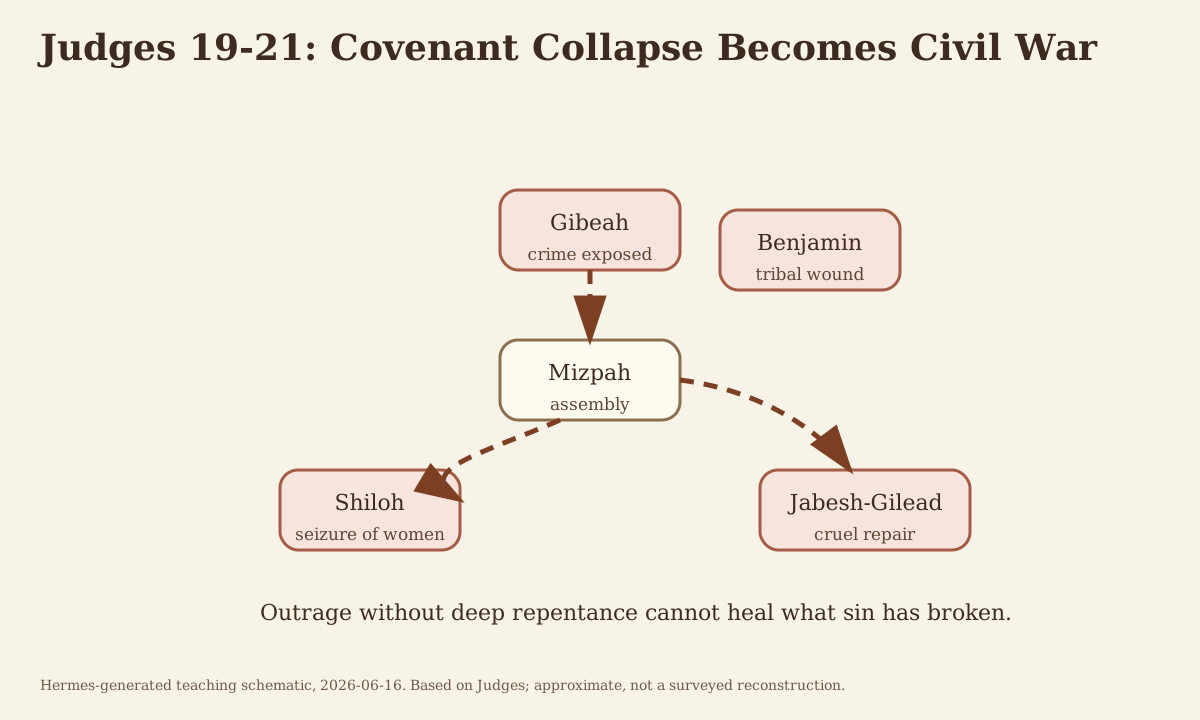 Source: Hermes-generated teaching schematic, 2026-06-16; approximate, not a surveyed reconstruction.
Light from the Word 🕯️
Judges 19:1-10 - A fractured household and a delayed departure
1 And there was a Levite sojourning in the sides of mount Ephraim, and he took to himself a concubine from Bethleem Juda. 2 And his concubine departed from him, and went away from him to the house of her father to Bethleem Juda, and she was there four months.
3 And her husband rose up, and went after her to speak kindly to her, to recover her to himself; and he had his young man with him, and a pair of asses; and she brought him into the house of her father; and the father of the damsel saw him, and was well pleased to meet him. 4 And his father-in-law, the father of the damsel, constrained him, and he staid with him for three days; and they ate and drank, and lodged there. 5 And it came to pass on the fourth day that they rose early, and he stood up to depart; and the father of the damsel said to his son-in-law, Strengthen thy heart with a morsel of bread, and afterwards ye shall go. 6 So they two sat down together and ate and drank: and the father of the damsel said to her husband, Tarry now the night, and let thy heart be merry. 7 And the man rose up to depart; but his father-in-law constrained him, and he staid and lodged there.
8 And he rose early in the morning on the fifth day to depart; and the father of the damsel said, Strengthen now thine heart, and quit thyself as a soldier till the day decline; and the two ate. 9 And the man rose up to depart, he and his concubine, and his young man; but his father-in-law the father of the damsel said to him, Behold now, the day has declined toward evening; lodge here, and let thy heart rejoice; and ye shall rise early to-morrow for your journey, and thou shalt go to thy habitation. 10 But the man would not lodge there, but he arose and departed, and came to the part opposite Jebus, (this is Jerusalem,) and there was with him a pair of asses saddled, and his concubine was with him.
Literal sense. The chapter opens not with a mob or a battlefield, but with a damaged household. A Levite has taken a concubine, a secondary wife of lower status than a full wife. She leaves him and returns to her father’s house. After four months, the Levite goes to speak kindly to her and bring her back. For several days the woman’s father shows hospitality and repeatedly delays the departure.
The fractured household. The woman’s lower social standing and the four-month separation make the household’s vulnerability visible before the chapter’s central horror begins. Yet the story does not disclose the history of their relationship, and we cannot fill it with imagined accusations. Judges often shows national disorder through domestic life. Here the covenant people are first shown in the intimate spaces where fidelity, protection, and truth should have been strongest.
Language insight: “departed” and “speak kindly”
The textual difference in verse 2 is real. The Masoretic Hebrew has “וַתִּזְנֶה עָלָיו” (wattizneh ʿalaw), conventionally understood as sexual unfaithfulness toward him. Rahlfs’ Greek A text has “ὠργίσθη αὐτῷ,” meaning that she became angry with him. The B text has “ἐπορεύθη ἀπ᾿ αὐτοῦ,” meaning that she went away from him, followed by another statement of her departure. Brenton’s “departed from him” agrees with the B reading at this point; it should not be presented as the single wording of every Greek witness. These are different readings, not three meanings that must all be imposed upon her story.2
No reading makes the subsequent violence deserved. The Hebrew description, even read in its conventional sense, cannot turn the mob’s crime into justice or remove the Levite’s duty to protect her. The narrative gives no warrant to invent her motives, make her departure the cause of her abuse, or demand that a harmed reader establish moral innocence before being helped.
Verse 3 gives a more tender expression than a purely functional attempt to retrieve her. The Hebrew “לְדַבֵּר עַל־לִבָּהּ” means to speak to her heart; Rahlfs A and B retain the heart-language with “λαλῆσαι ἐπὶ [τὴν] καρδίαν αὐτῆς.” NETS renders both with “to speak to her heart.” The intended reconciliation is named, but no speech by the woman is recorded. The next words addressed to her that the narrator reports come at the threshold in verse 28. The story measures the man’s intentions against his acts, not against an imagined loving conversation.3
Christological reading. Hosea uses the same heart-language when God promises to address His estranged people: “λαλήσω ἐπὶ τὴν καρδίαν αὐτῆς,” “I will speak to her heart” (Hosea 2:14 in common English numbering; 2:16 in the Hebrew and Septuagint numbering). The promise continues into betrothal in righteousness, mercy, and faithfulness (Hosea 2:19-20, LXX 2:21-22). The prophet who remembers Gibeah also gives Israel the promise of divine faithfulness.4 This is a biblical contrast, not a claim that the woman secretly represents an unfaithful Church or that her suffering is a necessary stage of reconciliation. Christ’s love is made visible in His own self-offering for the Church (Ephesians 5:25); it condemns the Levite’s betrayal rather than giving it a sacred meaning.
Hospitality with unease beneath it. The father’s welcome is genuine, but the repeated delay creates narrative tension. The scene is full of eating, drinking, and tarrying. It is almost domestic and ordinary. That is part of the chapter’s force. The repeated meals make the later refusal of hospitality more striking: there is abundance in one house, then no welcome in an Israelite town. The delays make evening travel intelligible, but they do not make the attack inevitable or excusable.
Spiritual reading. Reconciliation must be tested by what follows the welcome. A meal, a kindly approach, and the wish to bring someone home cannot by themselves show that a relationship has become safe. The Levite’s later conduct exposes the distance between recovering someone into his household and actually guarding her life. In our households and ministries, restored appearances must never take the place of changed conduct.
Pastoral reading. To seek reconciliation truthfully is to accept responsibility for another’s well-being. Someone who has been harmed may need distance, protection, and qualified care. The wish to reunite a household never overrides those needs. A community that celebrates reunion while refusing to examine danger repeats the error of valuing the appearance of peace above the person.
Judges 19:11-21 - The terrible irony of unsafe Israel and a stranger’s hospitality
11 And they came as far as Jebus: and the day had far advanced, and the young man said to his master, Come, I pray thee, and let us turn aside to this city of the Jebusites, and let us lodge in it. 12 And his master said to him, We will not turn aside to a strange city, where there is not one of the children of Israel, but we will pass on as far as Gabaa. 13 And he said to his young man, Come, and let us draw nigh to one of the places, and we will lodge in Gabaa or in Rama. 14 And they passed by and went on, and the sun went down upon them near to Gabaa, which is in Benjamin. 15 And they turned aside thence to go in to lodge in Gabaa; and they went in, and sat down in the street of the city, and there was no one who conducted them into a house to lodge.
16 And behold, an old man came out of the field from his work in the evening; and the man was of mount Ephraim, and he sojourned in Gabaa, and the men of the place were sons of Benjamin. 17 And he lifted up his eyes, and saw a traveller in the street of the city; and the old man said to him, Whither goest thou, and whence comest thou? 18 And he said to him, We are passing by from Bethleem Juda to the sides of mount Ephraim: I am from thence, and I went as far as Bethleem Juda, and I am going home, and there is no man to take me into his house. 19 Yet is there straw and food for our asses, and bread and wine for me and my handmaid and the young man with thy servants; there is no want of anything. 20 And the old man said, Peace be to thee; only be every want of thine upon me, only do thou by no means lodge in the street. 21 And he brought him into his house, and made room for his asses; and they washed their feet, and ate and drank.
Literal sense. The servant recommends lodging in Jebus, a foreign city, but the Levite refuses and prefers an Israelite town. He assumes that covenant kinship will offer safety. Yet when they reach Gibeah, no one receives them. Only later does an old man, himself from mount Ephraim, take them in and insist that they not remain in the street.
The central irony. The travelers bypass a non-Israelite city in order to seek safety among Israelites, and that decision leads them into catastrophe. This irony is one of the chapter’s sharpest accusations. Israelite identity without covenant obedience is empty. A town belonging to Benjamin betrays the very expectation of safety for which the travelers chose it.
Failed hospitality. Israel’s law makes welcome a matter of obedience. Leviticus 19:33-34 forbids afflicting the stranger and commands love as for oneself because Israel knew life as strangers in Egypt. Deuteronomy 10:18-19 grounds the same duty in God’s care for the stranger, orphan, and widow. Hospitality was therefore more than a polite extra; it was a form of righteousness. To leave a traveler exposed in the street was a communal shame. The old man understands this immediately: “do thou by no means lodge in the street.” The warning makes the danger of the public square felt, though it does not tell us exactly what he already knows about the town. Gibeah’s public life is so disordered that a guest in the open is already at risk.
The Levite says that food and supplies are already available (verse 19). The lack is someone willing to take responsibility for their shelter. This makes the public failure especially sharp: the town is not being asked to solve every need, only to open a door. Wisdom 19:13-17 links the punishment of Egypt with hostile treatment of strangers and recalls Sodom’s rejection of visitors. Ezekiel 16:49 names Sodom’s pride, plenty, and neglect of the poor before speaking of its iniquities in verse 50. These passages do not reduce the mob’s sexual violence to bad manners; they expose a wider refusal to recognize the neighbor’s claim upon us.5
Jebus and Israel’s future. The rejected city is the Jebusite Jerusalem that David will later take (2 Kingdoms 5:6-9). The contrast here is between the Levite’s confidence in an Israelite name and the conduct he actually encounters. We cannot know what would have happened had he stayed in Jebus. Scripture tells enough to break the false assurance that “our own people” must be safe simply because they share our identity.6
Yet even the best figure is compromised. The old man’s hospitality is real, but the chapter will soon show that it is incomplete and morally unstable. Judges 19 refuses easy heroes. The town fails; one man acts; but even that action will not mature into true courage.
Spiritual reading. It is possible to trust external belonging too much. “We are among our own” can become a false assurance if repentance, justice, and love of neighbor are absent. Communities, families, and churches are not made safe by labels alone. They are made safe when people live in truth, fear God, and protect those entrusted to them.
Christological reading. The old man welcomes the travelers into his house, and that gesture echoes a genuine biblical instinct. Yet only Christ is the host who shelters without compromise. He does not merely bring the endangered inside; He also guards them faithfully. Christ identifies Himself with the stranger received into a home (Matthew 25:35), and Hebrews 13:2 commands the Church to remember hospitality. The welcome we offer belongs to discipleship: shelter, food, attentive listening, and responsible protection are ways of serving Him, not favors that leave us free to abandon someone when keeping them safe becomes costly.
Judges 19:22-26 - Gibeah revealed, and the abandonment of the vulnerable
22 And they were comforting their heart, when, behold, the men of the city, sons of transgressors, compassed the house, knocking at the door: and they spoke to the old man the owner of the house, saying, Bring out the man who came into thy house, that we may know him. 23 And the master of the house came out to them, and said, Nay, brethren, do not ye wrong, I pray you, after this man has come into my house; do not ye this folly. 24 Behold my daughter a virgin, and the man’s concubine: I will bring them out, and humble ye them, and do to them that which is good in your eyes; but to this man do not this folly. 25 But the men would not consent to hearken to him; so the man laid hold of his concubine, and brought her out to them; and they knew her, and abused her all night till the morning, and let her go when the morning dawned.
26 And the woman came toward morning, and fell down at the door of the house where her husband was, until it was light.
This passage must be read with pastoral sobriety. Scripture is naming evil here, not endorsing it. The chapter is exposing a town’s wickedness, a host’s distorted priorities, and a Levite’s cowardice. The vulnerable woman is not the moral problem in the scene. The men are.
Literal sense. The city is now unmasked. Brenton calls the attackers “sons of transgressors,” a phrase that rightly signals deliberate moral corruption. Their intention is wicked. The old man goes out to resist them verbally, but his resistance is itself corrupted by what he proposes. He is willing to expose his daughter and the Levite’s concubine in order to shield the male guest. When the crowd refuses, the Levite lays hold of his concubine and puts her outside. She suffers the violence of the mob and collapses at the door by morning.
No heroes here. The men of Gibeah are wicked. That much is obvious. But the chapter does not allow the reader to stop there. The old man’s offer is itself evil and must be condemned plainly. Hospitality is not righteous if it preserves one vulnerable person by sacrificing another. Nor can the Levite be excused. He does not protect the woman. He delivers her. The chapter’s moral horror lies not only in predatory violence, but in the complicity, cowardice, and disposability revealed by the surrounding men.
An Israelite Sodom. The Genesis 19 echo becomes unmistakable here. But unlike Lot’s visitors, these travelers receive no angelic rescue. The woman reaches the door of the house but finds no deliverance there. Israel has become like the city it was once meant to judge. That is one of the chapter’s heaviest theological burdens.
The phrase “that which is good in your eyes.” The host’s proposal uses language that echoes the wider theme of Judges. Everyone does what seems right in his own eyes, and the result is desecration. What the law of God calls abomination, the disordered heart calls acceptable or useful. Once moral vision is detached from God’s will, the weak become negotiable.
Spiritual and ascetical reading. The passions do not merely produce private impurity. They rearrange a whole moral world. Lust joins hands with cowardice. Shame joins hands with self-preservation. Hospitality is corrupted into male preference. The soul in bondage will justify evil if it helps preserve its own comfort. One no longer sees the neighbor as image of God, but as cost, obstacle, or object. The host can call the attack on his guest “folly” while offering women to the same attackers. Sin has narrowed his moral sight until protection means preserving the person whose status he values most.
The deeper insight is that this darkness is anti-liturgical. True worship trains the body to bow, the mouth to bless, the hands to serve, and the heart to guard the image of God in the other. Gibeah shows the reverse formation: bodies are used, words become excuses, doors become barriers, and sacred identity no longer protects anyone. This is why repentance must include the re-formation of perception itself.
Christological contrast. The Levite preserves himself by handing another over. Christ, the true Shepherd, says, “The good shepherd gives His life for the sheep” (John 10:11, NKJV). Judges 19 shows the anti-shepherd: a man linked to sacred service who keeps himself alive through another’s humiliation. Christ reveals the opposite pattern. He does not cast out the weak to save Himself. He gives Himself to save the weak.
Pastoral application. This passage must also train communities to examine themselves. Abuse flourishes not only where predators exist, but where bystanders calculate, institutions protect themselves, and the vulnerable are treated as expendable. Judges 19 is ancient, but its moral logic is not ancient only. The Church must hear it as a call to truth-telling, protection, accountability, and repentance.
Gems from the Fathers 💎
Saint Ambrose gives a firm rule for the temptation to preserve oneself at another’s expense. In On the Duties of the Clergy III.2.13, he teaches that genuine benefit cannot be separated from righteousness: “The upright man must never think of depriving another of anything, nor must he ever wish to increase his own advantage to the disadvantage of another.”7 This is a thematic witness, not Ambrose’s direct explanation of this verse. It gives us a precise test for the host’s offer and the Levite’s act: neither safety nor reputation becomes a Christian good when purchased with someone else’s violation.
Ambrose also retells Judges 19-21 directly in III.19.110-116, but his retelling needs limits. He supplies a dying woman’s concern for her husband’s feelings that Judges does not report, and he defends the later marriage raids in ways this guide does not accept. We must neither invent her devotion nor use ancient approval to excuse the victimization of women. His ethical rule cited above is useful; his direct retelling cannot be made into an unqualified endorsement of this protective reading.8
Judges 19:27-30 - Hardness of heart, public outrage, and a nation confronted with itself
27 And her husband rose up in the morning, and opened the doors of the house, and went forth to go on his journey; and, behold, the woman his concubine had fallen down by the doors of the house, and her hands were on the threshold. 28 And he said to her, Rise, and let us go; and she answered not, for she was dead: and he took her upon his ass, and went to his place.
29 And he took his sword, and laid hold of his concubine, and divided her into twelve parts, and sent them to every coast of Israel. 30 And it was so, that every one who saw it said, Such a day as this has not happened nor has been seen from the day of the going up of the children of Israel out of the land of Egypt until this day: take ye counsel concerning it, and speak.
Literal sense. Morning comes, but there is no relief. The Levite finds the woman fallen at the threshold. His first recorded words are stark and cold: “Rise, and let us go.” When she does not answer, he places her on his animal, returns home, and then dismembers her body into twelve parts, sending them throughout Israel. The act shocks the tribes into national attention.
The hardness is part of the horror. The Levite’s response is not framed by grief, prayer, repentance, or self-accusation. The text’s starkness is deliberate. He finds her where she has fallen and speaks as if the journey must continue. Judges often becomes morally devastating not only by what it narrates, but by what it refuses to soften.
Language insight: “she was dead” and “laid hold”
Brenton states that she did not answer “for she was dead.” Rahlfs A reads “ἀλλὰ τεθνήκει,” “but she had died”; B reads “ὅτι ἦν νεκρά,” “because she was dead.” NETS preserves the difference in phrasing while both Greek texts establish her death at this point. The Masoretic Hebrew instead says “וְאֵין עֹנֶה,” “and there was no answer,” without the explicit death-clause. Its silence leaves the timing less explicit. It does not prove that she was alive when dismembered, and we must not convert an omission into a further unreported horror.9
Brenton repeats “laid hold” in verses 25 and 29. Hebrew repeats the same verbal form apart from cantillation, “וַיַּחֲזֵק” (wayyaḥazeq), from the root “חזק,” here taking or holding someone firmly. Rahlfs A repeats “ἐπελάβετο,” “took hold,” in both verses. B uses “ἐπελάβετο” in verse 25 but “ἐκράτησεν,” “seized” or “held,” in verse 29. Thus the repeated English wording corresponds to an exact Hebrew and Greek A repetition, but not to one identical Greek verb in both recensions.10 The repeated act gives the chapter a terrible continuity: hands that should protect her exercise power over her instead. This is an observation about his actions, not a claim that the verb itself always implies abuse.
A second desecration. The dismemberment is meant to summon Israel, and it succeeds in provoking national alarm. Yet the action remains another desecration of the woman’s body. She is once more made into an instrument after having been utterly unprotected as a person. The text does not praise this. It exposes the final indignity of a world where the vulnerable are not loved for themselves.
National shock and selective conscience. Verse 30 shows that Israel is horrified. The narrative first shows the tribes responding when the violation becomes public. It does not tell us what each tribe knew during the night. Its sharp contrast still searches our conscience: the woman suffered before the national alarm, and her body becomes the message that forces attention. Communities often fail in this same way. Hidden suffering receives little attention, while public scandal finally forces speech.
A later summons from Gibeah. In 1 Kingdoms 11:4-7, messengers reach Saul at Gibeah with news of the threat to Jabesh-Gilead. Saul cuts up oxen and sends the pieces through Israel to summon the people to rescue. The parallel of divided pieces and a national summons is striking, and the place-name strengthens the connection. Yet the acts differ morally: Saul’s sign uses livestock in a call to save an endangered city; the Levite’s uses the body of the woman he failed to protect. A successful summons cannot cleanse the betrayal that preceded it.6
Theological force. Gibeah has become a revelation of Israel to itself. The people can no longer pretend that covenant membership alone guarantees righteousness. From the exodus until now, they say, no such day has been seen. The line is meant to be chilling. The people redeemed from Egypt have become capable of this. Redemption remembered without obedience lived does not preserve holiness.
Prophetic memory. Later prophets will remember Gibeah precisely because the chapter exposes a pattern, not just an isolated event. A people can keep its stories, its tribes, its sacred offices, and its external identity, yet still become deeply corrupt. Hosea’s appeal to “the days of Gibeah” shows that this chapter became part of Israel’s long memory of shame.
Christological reading. The Levite uses the woman’s broken body to unite Israel in outrage. John 11:52 speaks of Christ’s death so that He would “gather together in one the children of God who were scattered abroad” (NKJV). Christ gives His own body; He does not make an abandoned person pay the price of national unity. The contrast is immense. One man fails the weak and then makes her suffering serve his public cause. Christ takes suffering upon Himself in order to heal, reconcile, and raise up the violated. Judges 19 therefore intensifies the Church’s longing not only for justice, but for a Priest and King whose holiness does not devour the vulnerable.
Pastoral reading. Teachers should linger here not to sensationalize, but to insist on truth. Sin brutalizes. Cowardice compounds brutality. Communities awaken too late. Bodies matter. The image of God in the vulnerable matters. Repentance must include not only private sorrow, but public protection, truthful judgment, and refusal to let the weak be used by the strong.
The Church’s Voice in Worship ⛪
In the Coptic Liturgy of Saint Basil, the Prayer of Reconciliation asks God to cleanse the faithful from “all guile, all hypocrisy, all malice” before they greet one another with a holy kiss and receive the heavenly gift.11 The sequence matters: peace and sacramental communion call for truth in the heart and love toward the person beside us. The same liturgy prays for those in captivity and those distressed under oppression. These are actual forms of Coptic prayer, a worship parallel rather than a lectionary assignment for Judges 19.
Gibeah’s conduct is anti-liturgical in precisely this sense. Words of peace become useless when those speaking them accept someone else’s destruction. The Church’s greeting must never become a demand that a harmed person act as though danger has passed. Eucharistic reverence joins prayer to protection; it cannot be invoked to suppress testimony, avoid lawful accountability, or hurry a wounded person back into an unsafe relationship. The Cross gives hope because the Lord enters suffering to save, not because abuse is holy or must be endured in silence.
Summary Table
| Text | Literal focus | Spiritual and Christological reading |
|---|---|---|
| Judges 19:1-10 | Separation, intended reconciliation, and a delayed journey | Kind words must be tested by protective conduct; Christ gives Himself for His Bride |
| Judges 19:11-21 | Jebus bypassed, an Israelite town fails to welcome, and one stranger offers shelter | Shared identity cannot substitute for obedience; receiving the stranger is service to Christ |
| Judges 19:22-26 | The host offers women, the Levite hands over his concubine, and the mob attacks her | No person may become the price of another’s safety; the good Shepherd gives His own life |
| Judges 19:27-30 | Death at the threshold, further desecration, and a summons to Israel | Outrage must become truth and protection, not another use of the victim; Christ gathers through His own self-offering |
Spiritual Fruit 🍇
Let repentance reach the person behind the closed door. The previous chapters expose false worship; this chapter exposes what happens to a neighbor when sacred identity is emptied of obedience. Examine the distance between what your household or ministry professes and what a vulnerable person actually experiences there. When someone reports harm, listen without making reputation the first concern. Protect them from renewed exposure, involve appropriate qualified help and lawful authorities where required, and resist the urge to make a quick reconciliation stand in for accountability.
Refuse safety purchased with another’s suffering. The host’s proposal begins as an attempt to save his guest; its price is the violation of women. Fear can still present such bargains as prudence. We may remain silent because speaking could threaten our standing, or send someone back into danger because honest intervention would disturb a respected family. Confess that self-protection by its name. Ask Christ for courage that accepts a cost rather than assigning it to the person least able to resist.
Hear hidden suffering before public scandal forces attention. The final summons makes Israel speak, but the woman has already been abandoned. Communities share responsibility through bystanders who calculate, institutions that defend themselves, and people who wait for someone else to act. Be attentive to the quiet request for help, the person withdrawing in fear, or the report dismissed because it is inconvenient. These signs do not authorize amateur investigation or assumptions of guilt; they do require a responsible response instead of indifference. Truthful lament becomes fruitful when it changes whom we hear and how promptly we protect.
Receive Christ’s love without carrying the abuser’s shame. If this chapter touches your own wounds, you do not have to supply testimony in a discussion group or explain why you could not prevent what happened. Another person’s wrongdoing is not your loss of dignity. Prayer, the Church’s sacramental care, and qualified help can support healing without erasing the need for safety and justice. Bring to the good Shepherd what you can, even if all you can offer today is a short prayer. His self-giving love is the measure of faithful authority, and His judgment does not depend upon a community finally admitting the truth.
At the threshold, the woman’s hands remain where refuge should have been. Let that detail stay with us without turning her suffering into spectacle. Lord Jesus Christ, cleanse the hands that grasp for power and teach our hands to shelter and serve. Guard those who are in danger, give courage to those who can help, and bring the wounded into care that will not betray them. Under Your reign, let our doors, our speech, and our worship bear truthful witness to Your mercy.
Teaching Notes
Whole-guide pastoral care. Give the content warning before reading aloud; discuss the sexual violence directly but never graphically. Readers may step away, and no one should be asked to disclose personal experience. In sensitive settings, summarize the central outrage and focus discussion on responsibility, covenant failure, truth-telling, protection, and Christ’s healing kingship. Use only the sober schematic map, never graphic artwork. Keep the Genesis 19 echo, the irony of avoiding Jebus for Gibeah, and the connection with false worship in chapters 17-18 clear. The woman is sinned against; her earlier departure never explains away the crime. The host and Levite are not partial heroes. Christ’s voluntary self-offering must never be transferred into a demand that an abused person submit to harm.
Judges 19:1-10 - A fractured household and a delayed departure
- Ask: How do the Levite’s later actions test his stated wish to speak kindly and restore the relationship?
- Watch for: Blaming her departure, or treating reunion as obligatory before safety and changed conduct are established.
Judges 19:11-21 - The terrible irony of unsafe Israel and a stranger’s hospitality
- Ask: What does the travelers’ possession of food and supplies reveal about the kind of help the town refuses?
- Watch for: Assuming that the avoided foreign city was certainly safe, or making the old man a hero before examining his offer.
Judges 19:22-26 - Gibeah revealed, and the abandonment of the vulnerable
- Ask: Where does the host’s attempt to protect a guest become complicity in violence against someone else?
- Watch for: Excusing abuse as ancient hospitality, treating consent as present, or using the Sodom parallel to stigmatize a class of people rather than condemn these acts of coercion.
Judges 19:27-30 - Hardness of heart, public outrage, and a nation confronted with itself
- Ask: What must a community do beyond expressing shock if it is to honor the person whose suffering exposed its failure?
- Watch for: Claiming that Hebrew silence proves she was alive at dismemberment, or forcing her suffering into a sacrificial type that legitimizes abuse.
Sources
Embedded Scripture is from Brenton’s English Septuagint (LXX). New Testament quotations are from NKJV. Familiar place-names in the commentary correspond to Brenton’s Bethleem Juda, Gabaa, and Rama. References to the royal books use the Septuagint names 1 and 2 Kingdoms.
Judges 19, Rahlfs’ Greek A and B texts, compared with Philip E. Satterthwaite’s NETS translation: Greek A, Greek B, and NETS Judges. A and B designate edited textual traditions, not two interchangeable names for a single text.
Masoretic Hebrew, Judges 19:2-3, 25, 28-29, and Hosea’s heart-language; exact passages linked in the notes below. Numbering for Hosea 2:14 follows common English Bibles; the corresponding Hebrew and Greek verse is 2:16.
Saint Ambrose, On the Duties of the Clergy, III.2.13 and III.19.110-116, translated by H. de Romestin, E. de Romestin, and H. T. F. Duckworth, NPNF, Second Series, volume 10. The ethical rule is used thematically; the direct Judges retelling is acknowledged with explicit limits, not presented as patristic consensus.
Coptic Liturgy of Saint Basil, Prayer of Reconciliation and intercessions, Copt-Net text. This is a verified worship connection. No appointment of Judges 19 as a Coptic reading is claimed; such a placement was not found in the data consulted for this guide.
Footnotes
-
Hosea 9:9 and 10:9, Hebrew 9:9, Hebrew 10:9; compare Brenton’s Hosea 9 and Hosea 10. ↩
-
Judges 19:2, Rahlfs A, Rahlfs B, Hebrew, and NETS Judges, introduction and chapter 19. ↩
-
Hosea 2:14 in common English numbering, Hebrew text with that numbering; compare 2:16, 21-22 in the Hebrew chapter numbering and Rahlfs Greek. The same address to the heart appears in Judges 19:3; the comparison is a biblical and Christian reading, not an attribution to an ancient commentator. ↩
-
Leviticus 19:33-34; Deuteronomy 10:18-19; Wisdom 19:13-17; Ezekiel 16:49-50. See Leviticus 19, Deuteronomy 10, Wisdom 19, and Ezekiel 16. Wisdom is used as a thematic biblical parallel, not direct commentary on Gibeah. ↩
-
1 Kingdoms 11:4-7 and 2 Kingdoms 5:6-9, Brenton, 1 Kingdoms 11 and 2 Kingdoms 5. ↩ ↩2
-
Saint Ambrose, On the Duties of the Clergy, III.2.13, trans. H. de Romestin, E. de Romestin, and H. T. F. Duckworth, NPNF, Second Series, volume 10, Book III. ↩
-
Saint Ambrose, On the Duties of the Clergy, III.19.110-116, especially the added motive in 114 and approval of the marriage raids in 110 and 115, Book III. ↩
-
Judges 19:28, Rahlfs A, Rahlfs B, Hebrew, and NETS Judges. ↩
-
Judges 19:25, 29, Rahlfs A chapter 19, Rahlfs B chapter 19, Hebrew 19:25, and Hebrew 19:29. ↩
-
Coptic Liturgy of Saint Basil, Prayer of Reconciliation and intercessions, Copt-Net text. This quotation concerns purification before the holy kiss and communion; it does not require a harmed person to conceal a crime or accept unsafe contact. ↩