


An offering rises in flame, and two parents fall on their faces. A chapter later, their son leaves a wedding in anger. Judges 13-14 sets holy promise beside a life already struggling to carry it. The contrast is painful because the promise is real: God visits an unnamed barren woman, gives a child, blesses him, and begins to move him by His Spirit. Samson’s disorder cannot explain away that mercy, and his strength cannot explain away his disorder.
Chapter 13 deserves the reverence of a birth-announcement narrative. The mother receives the word, shares it, obeys it, and eventually helps her husband understand that divine holiness has come near in mercy. Chapter 14 brings another kind of seeing. Samson sees a woman and wants her because she is right in his eyes. The story moves from receiving God’s word to making desire its own authority.
Hebrews 11:32 remembers Samson among the witnesses of faith. That remembrance keeps us from dismissing him; Judges keeps us from flattering him. His promised work is to begin to save Israel from the Philistines. Our final hope rests in Jesus Christ, whose saving love reaches the sin and death that no judge of Israel could overcome.
Historical and Scriptural Context
Israel’s renewed iniquity brings forty years of Philistine domination. Judges 13:1 records no cry for deliverance. This silence differs from the cries in Judges 3:9, 3:15, 4:3, and 6:7 in Brenton. It may suggest an oppression that has become familiar, but silence in the account does not prove that no Israelite prayed. What it does show is that the promised rescue begins with God’s initiative, before the narrative reports a national appeal.
Samson’s calling is unusually personal. Before there is a campaign, there is a household asked to receive and guard a promise. His later conflicts arise through marriage, secrecy, humiliation, and retaliation rather than a united tribal response. The enemy rules Israel, yet the enemy also becomes attractive to its appointed deliverer. The story therefore searches both public bondage and the heart’s willingness to accommodate it.
The Characters 👥
Manoë / Manoah is a Danite from Saraa / Zorah. His unnamed wife is the first recipient of the announcement and its clearest interpreter at the offering. Sampson / Samson grows near Zorah and Esthaol / Eshtaol, where the Spirit begins to accompany him. These familiar English names refer to the people and places named in Brenton’s Scripture below.
Geographical Significance ⛰️
Thamnatha / Timnah is the town to which Samson goes for the Philistine woman. The vineyards matter because the angel has explicitly forbidden produce of the vine to Samson’s mother. They make consecration a live question in the story without proving that Samson drinks wine. Ascalon / Ashkelon is the Philistine city where he kills thirty men to pay his wager. The woman and the wedding companions belong to a people ruling Israel; that political reality gives their dealings a weight beyond an unhappy private romance.
Iconography and Visual Teaching 🖼️
The schematic places Samson’s home and his journeys in relation to Philistine territory. Sorek and Gaza belong to the later story. The Russian icon concentrates on the lion encounter: genuine strength received from God, whose use must still be read within the whole narrative.
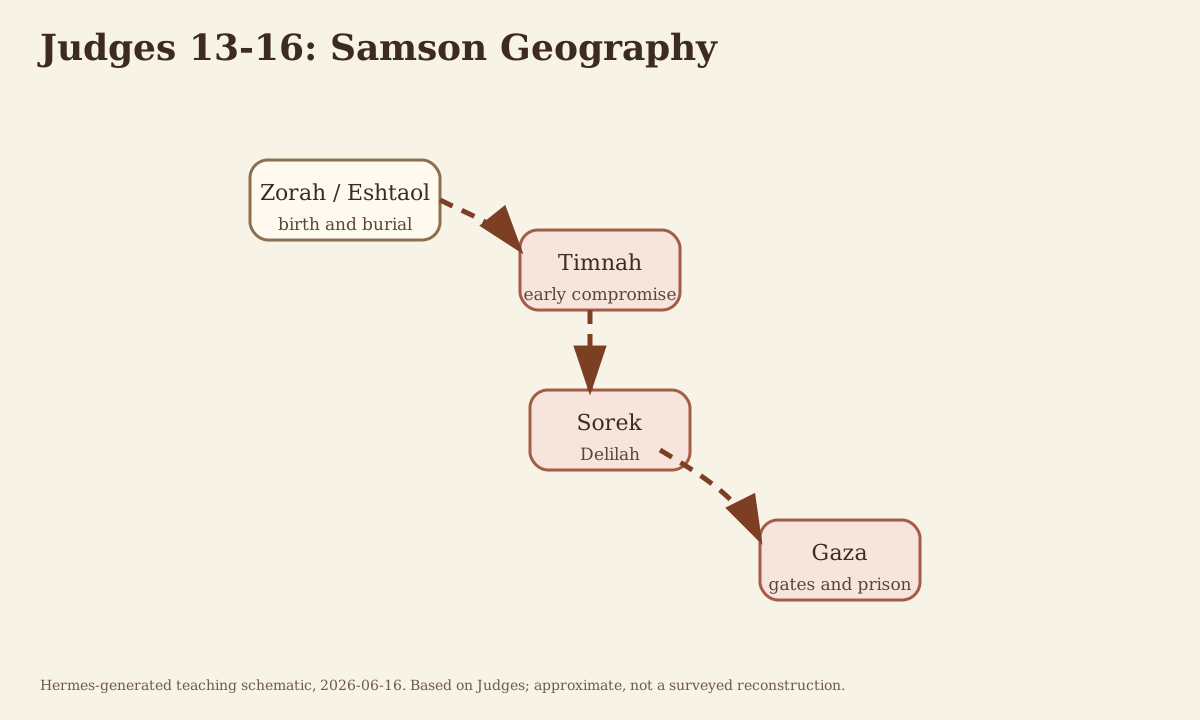 Source: Hermes-generated teaching schematic, 2026-06-16; approximate, not a surveyed reconstruction.
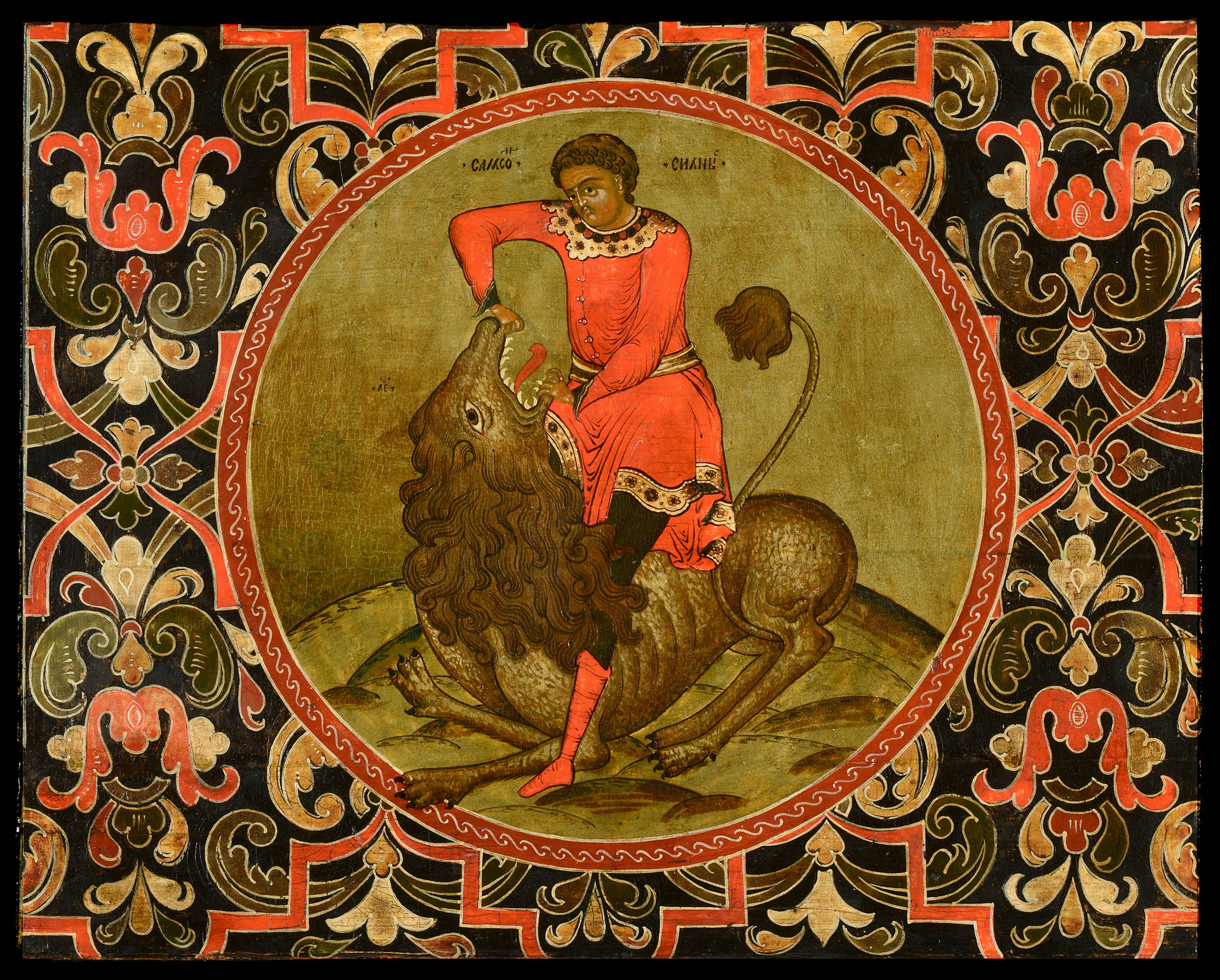 Source: Samson Fighting the Lion, Russian icon painting, first half 18th century, Kargopol region; Public domain, via Wikimedia Commons.
Judges 13:1-7 - The barren woman, the angelic announcement, and the promised Nazarite
1 And the children of Israel yet again committed iniquity before the Lord; and the Lord delivered them into the hand of the Phylistines forty years.
2 And there was a man of Saraa, of the family of the kindred of Dan, and his name was Manoë, and his wife was barren, and bore not. 3 And an angel of the Lord appeared to the woman, and said to her, Behold, thou art barren and hast not born; yet thou shalt conceive a son. 4 And now be very cautious, and drink no wine nor strong drink, and eat no unclean thing; 5 for behold, thou art with child, and shalt bring forth a son; and there shall come no razor upon his head, for the child shall be a Nazarite to God from the womb; and he shall begin to save Israel from the hand of the Phylistines.
6 And the woman went in, and spoke to her husband, saying, A man of God came to me, and his appearance was as of an angel of God, very dreadful; and I did not ask him whence he was, and he did not tell me his name. 7 And he said to me, Behold, thou art with child, and shalt bring forth a son; and now drink no wine nor strong drink, and eat no unclean thing; for the child shall be holy to God from the womb until the day of his death.
Israel’s rescue begins in the house of a woman who cannot bear a child. The angel addresses her directly, rather than treating her as a means to someone else’s greatness. The promise concerns her life as well as her son’s: what she drinks and eats becomes part of receiving the vocation announced from the womb. Her obedience is hidden, bodily, and immediate. The mighty works have not yet begun, but consecration has.
A Nazirite, Brenton’s “Nazarite,” is someone set apart for God. Numbers 6:1-21 describes a vow of separation with abstinence from vine products, uncut hair, and avoidance of the dead. Samson’s consecration differs from an ordinary voluntary, time-limited vow: God appoints it before birth, and his mother reports that it lasts until his death. The uncut hair is a visible sign of belonging, not an independent magical source of strength.
The word “begin” sets a boundary around the promise. Samson will begin to save Israel from the Philistines, not accomplish all its salvation. Matthew 1:21 announces that Jesus will save His people from their sins. The contrast concerns the reach of salvation, not merely the comparative strength of two heroes. Christ heals the bondage within us as well as defeating the enemy who oppresses us.
Language insight: “conceive a son” and “Nazarite”
The Greek announcement shares the pattern of other biblical birth promises. Judges 13:5 and 13:7 contain “behold,” “in the womb,” and “bear a son.” The two Greek forms of Judges differ: A has ἐν γαστρὶ ἕξεις, “you will have in the womb”; B has ἐν γαστρὶ ἔχεις, “you have in the womb.” Isaiah 7:14 speaks of the virgin who will conceive and bear a son; Luke 1:31 has συλλήμψῃ ἐν γαστρὶ καὶ τέξῃ υἱόν, “you will conceive in the womb and bear a son.” The family resemblance is real, but the wording is not identical and Samson’s birth is not a virgin conception.1
Samson’s title also needs precision. Judges A uses ναζιραῖον, “Nazirite”; B uses ναζιρ at 13:5 and “holy to God” at 13:7. Matthew 2:23 uses Ναζωραῖος, “Nazarene,” in relation to Nazareth. Similar English sounds do not make these the same Greek title or prove that Jesus took a Nazirite vow.2 Luke 1:15 gives a closer comparison with John the Forerunner: abstinence from wine and strong drink, and the Holy Spirit’s work from his mother’s womb. These connections teach us to recognize God’s promises without erasing the unique Incarnation of the Son.
Mercy arrives here before any national awakening is reported. A household may receive an answer while the wider community still seems asleep. Give thanks for such beginnings, and receive their concrete demands. Hope becomes presumption when we welcome the promise but refuse the obedience that accompanies it.
Judges 13:8-14 - Manoah asks how the child should be ordered
8 And Manoë prayed to the Lord and said, I pray thee, O Lord my Lord, concerning the man of God whom thou sentest; let him now come to us once more, and teach us what we shall do to the child about to be born.
9 And the Lord heard the voice of Manoë, and the angel of God came yet again to the woman; and she sat in the field, and Manoë her husband was not with her. 10 And the woman hasted, and ran, and brought word to her husband, and said to him, Behold the man who came in the other day to me has appeared to me.
11 And Manoë arose and followed his wife, and came to the man, and said to him, Art thou the man that spoke to the woman? and the angel said, I am. 12 And Manoë said, Now shall thy word come to pass: what shall be the ordering of the child, and our dealings with him? 13 And the angel of the Lord said to Manoë, Of all things concerning which I spoke to the woman, she shall beware. 14 She shall eat of nothing that comes of the vine yielding wine, and let her not drink wine or strong liquor, and let her not eat anything unclean: all things that I have charged her she shall observe.
Manoah’s first response is prayer: “teach us what we shall do.” He wants instruction, not merely the pleasure of knowing that his son will be important. God hears him, yet the visitor returns first to the woman. She runs to bring her husband; he follows her. The order of these actions quietly honors her attentiveness without making his sincere prayer foolish.
Manoah asks about the child’s ordering, but the angel repeats what the mother must observe. The future does not require a new secret before it requires obedience to the word already given. The mother has heard enough to begin. The father is invited to receive that instruction with her. Their home is being formed through shared attention to God.
This is a searching word for parents, godparents, and servants who want to arrange a child’s future. Prayer for a child’s vocation belongs beside the habits that make a household truthful and receptive: keeping promises, refusing degrading entertainment, asking forgiveness, making time for prayer, and speaking respectfully. A child can hear many lessons about holiness while watching adults excuse the opposite. Manoah’s question becomes fruitful when it turns our attention from controlling another person’s future to ordering our own conduct before God.
The Theotokos offers a deeper example of receiving a divine word, but Luke does not portray her as initially untroubled. She is troubled at the greeting in Luke 1:29, asks how the promised conception will happen, and then consents in Luke 1:38. Her obedience is faithful assent amid a mystery, not absence of all questioning. Manoah and his wife receive a consecrated child; the Virgin receives the Son of God through the Holy Spirit. Reverence joins these scenes, while the identity of the promised Son distinguishes them.
Judges 13:15-23 - The offering, the wonderful name, and the ascent in the flame
15 And Manoë said to the angel of the Lord, Let us detain thee here, and prepare before thee a kid of the goats. 16 And the angel of the Lord said to Manoë, If thou shouldest detain me, I will not eat of thy bread; and if thou wouldest offer a whole-burnt-offering, to the Lord thou shalt offer it: for Manoë knew not that he was an angel of the Lord. 17 And Manoë said to the angel of the Lord, What is thy name, that when thy word shall come to pass, we may glorify thee? 18 And the angel of the Lord said to him, Why dost thou thus ask after my name; whereas it is wonderful? 19 And Manoë took a kid of the goats and its meat-offering, and offered it on the rock to the Lord; and the angel wrought a distinct work, and Manoë and his wife were looking on. 20 And it came to pass when the flame went up above the altar toward heaven, that the angel of the Lord went up in the flame; and Manoë and his wife were looking, and they fell upon their face to the earth. 21 And the angel appeared no more to Manoë and to his wife: then Manoë knew that this was an angel of the Lord. 22 And Manoë said to his wife, We shall surely die, because we have seen God. 23 But his wife said to him, If the Lord were pleased to slay us, he would not have received of our hand a whole-burnt-offering and a meat-offering; and he would not have shewn us all these things, neither would he have caused us to hear all these things as at this time.
Manoah offers hospitality, but the messenger directs any burnt offering to the Lord. The distinction matters: the gift of divine help leads toward God, not toward possession of the visitor. Manoah then asks the name so that he may honor him when the promise is fulfilled. The answer refuses the kind of knowledge that would make this encounter manageable.
The offering recalls Gideon’s encounter in Judges 6:19-24: a young goat, a rock, fire, recognition of the angel, and fear of death. Gideon receives the word of peace. Here consolation comes through Manoah’s wife. His words, “we have seen God,” recall the danger expressed in Exodus 33:20. She does not dismiss holiness or mock his fear. She remembers the actual acts of mercy: the Lord accepted the offering, showed them these things, and spoke a promise of life. Fear has narrowed his attention to death; discernment restores the whole encounter.
Language insight: “wonderful”
Both Greek forms of Judges 13:18 call the name θαυμαστόν, “wonderful” or “marvellous.” The word makes the visitor’s identity a cause for awe. Isaiah 9:6 in the Septuagint calls the promised child Μεγάλης βουλῆς ἄγγελος, “Messenger of Great Counsel.” That is a significant Christian connection through the language of name and divine announcement, but it is not the same Greek wording as Judges. We should not turn an English resemblance to “Wonderful Counselor” into a claim of an exact Greek quotation.3
The narrative calls the visitor the angel of the Lord and records Manoah’s recognition that he has seen God. It presents a theophanic encounter, an encounter in which God’s presence is disclosed. It does not explicitly name the visitor Jesus Christ. Christian contemplation can relate this divine self-disclosure to the eternal Word who reveals the Father, while keeping that theological synthesis distinct from what this chapter directly identifies. No isolated adjective settles the visitor’s identity.
The mother teaches a kind of remembrance needed in prayer. When the conscience awakens, it may see only its failures and assume that God has come near solely to destroy. She reasons from the mercy already shown. For Christians, the giving of the Son is stronger ground for hope still. Such hope does not excuse sin; it makes confession possible. We can fall before the holy God without believing that His purpose is our ruin.
Ambrose also honors the mother’s discernment in Letter 19, section 12: “This sight, which terrified the man, the woman interpreted more auspiciously, and so removed his solicitude.” His point follows the chapter’s reversal from fear toward confidence in mercy.4
Judges 13:24-25 - Samson is born and the Spirit begins to stir
24 And the woman brought forth a son, and she called his name Sampson; and the child grew, and the Lord blessed him. 25 And the Spirit of the Lord began to go out with him in the camp of Dan, and between Saraa and Esthaol.
The woman bears the promised son, and the Lord blesses him. These plain words give the chapter a quiet fulfillment. Neither the later tragedy nor our knowledge of it should steal the joy of this beginning. A child is given, he grows, and the Spirit begins to accompany him in the region of his home.
Yet blessing is the beginning of a relationship to be lived, not a guarantee that every subsequent choice is sound. Chapter 14 will make the distinction visible. The same man who receives real power can prefer his own judgment to wise counsel. We need neither call the gift false nor call the self-will holy.
This is especially necessary in ministry. Skill, influence, insight, or evident usefulness can tempt a servant to stop listening. Those helped by the gift may also hesitate to name the harm done by its bearer. Samson’s history gives us a better response: thank God for the good, attend honestly to conduct, and seek repentance without making reputation its substitute. The Spirit’s gift is meant to be carried in humility.
Judges 14:1-4 - “She is right in my eyes”: desire outruns discernment
1 And Sampson went down to Thamnatha, and saw a woman in Thamnatha of the daughters of the Philistines. 2 And he went up and told his father and his mother, and said, I have seen a woman in Thamnatha of the daughters of the Phylistines; and now take her to me for a wife. 3 And his father and his mother said to him, Are there no daughters of thy brethren, and is there not a woman of all my people, that thou goest to take a wife of the uncircumcised Philistines? And Sampson said to his father, Take her for me, for she is right in my eyes.
4 And his father and his mother knew not that it was of the Lord, that he sought to be revenged on the Philistines: and at that time the Philistines lorded it over Israel.
Samson sees the woman, reports what he has seen, and commands his parents to obtain her. When they raise the question of covenant belonging, he answers with his own eyes. The account gives us no conversation about her faith or their shared obedience to God. His visible desire carries the decision.
Language insight: “right in my eyes”
The B text says αὕτη εὐθεῖα ἐν ὀφθαλμοῖς μου, “she is right in my eyes.” Judges 17:6 B repeats the root and the eyes-language in its verdict that a man did “what was right in his eyes.” At 21:25 B the same root appears with “before him.” The A text of 14:3 instead says ἤρεσεν ἐν ὀφθαλμοῖς μου, “she pleased my eyes”; A’s later refrains also vary. This is a strong verbal and thematic echo, especially in B, not one identical sentence repeated throughout both Greek forms.5 Samson’s eyes are becoming a private court in which wanting something is enough to pronounce it right.
Verse 4 complicates that judgment: the affair is “of the Lord,” who seeks an occasion against the Philistines. The narrator grants a knowledge the parents lack and names the political bondage that God is addressing. We should let that assertion stand rather than pretend the story is only a domestic failure. Yet divine providence is not a permission to declare every appetite holy. The wording gives God’s purpose; it does not make Samson’s abrupt demand a rule for marriage or prove that every motive in him is pure.
Nor does the parents’ concern authorize contempt for another ethnicity. The issue in their speech is covenant belonging, expressed in the reference to uncircumcision, within a relation of Philistine domination. Christian discernment about marriage likewise concerns shared faith, responsibility, and truthful love, not imagined racial superiority.
James 1:14-15 describes desire drawing a person away, conceiving sin, and bringing death. The connection explains the danger in treating attraction as its own justification. A prudent pause can be a real act of freedom: bring the desire into prayer, listen to counsel, and ask whether we are seeking another person’s good or only the fulfillment of our own demand.
Christ’s love for His Bride in Ephesians 5:25-27 moves in the opposite direction: He gives Himself to cleanse and sanctify her. That is the measure for Christian love. Its strength is shown by what it is willing to give, not by how forcefully it insists on taking.
Judges 14:5-9 - The lion, the honey, and the secrecy of compromise
5 And Sampson and his father and his mother went down to Thamnatha, and he came to the vineyard of Thamnatha; and behold, a young lion roared in meeting him. 6 And the Spirit of the Lord came powerfully upon him, and he crushed him as he would have crushed a kid of the goats, and there was nothing in his hands: and he told not his father and his mother what he had done. 7 And they went down and spoke to the woman, and she was pleasing in the eyes of Sampson.
8 And after some time he returned to take her, and he turned aside to see the carcase of the lion; and behold, a swarm of bees, and honey were in the mouth of the lion. 9 And he took it into his hands, and went on eating, and he went to his father and his mother, and gave to them, and they did eat; but he told them not that he took the honey out of the mouth of the lion.
The lion’s attack meets Samson’s empty hands, and the Spirit supplies strength. The text insists on the source of the victory. When he returns, however, he turns aside toward the dead lion, takes its honey, eats, and shares it with his parents. He tells them neither the story of the killing nor the source of the sweetness. Power and concealment appear together.
The vineyard setting does not establish that he drinks wine, and the feast later does not state that he becomes drunk. Numbers 6 gives the Nazirite rule concerning a dead person; Leviticus 11:27-28 supplies the wider rule about contact with unclean animal carcasses. Judges describes Samson taking honey from the lion’s remains without spelling out every physical contact or ritual consequence. The scene warrants concern about purity and secrecy, not an invented inventory of proven vow violations.
Language insight: honey “in the mouth of the lion”
Brenton’s striking wording follows a real Greek detail. Both A and B put the bees and honey ἐν τῷ στόματι τοῦ λέοντος, “in the mouth of the lion,” in 14:8. B repeats the mouth in 14:9; A’s wording differs at that point. The Hebrew of 14:8 speaks of the lion’s body, בִּגְוִיַּת, rather than specifying its mouth.6 The mouth that threatened to consume Samson now gives him food. That reversal prepares the riddle. It also helps explain why Christian interpreters could see more here than a warning about impurity.
Gems from the Fathers 💎
St. Ambrose holds strength and vigilance together. In On the Holy Spirit II, introduction 5, he praises the Spirit’s work in Samson, then says, “Would that he had been as careful to preserve grace, as strong to overcome the beast!” In sections 6-8, he sees the honey as a sign of Gentile believers transformed into Christ’s people and of life emerging where death had threatened: “Dangers are changed into safety, bitterness into sweetness.”7 This is a positive spiritual interpretation of the deliverance and its fruit, not a denial of Samson’s need for watchfulness.
The lion can also recall the roaring adversary of 1 Peter 5:8. That is a thematic comparison, not the zoological meaning of Judges. It presses the practical question raised by Ambrose: do we guard grace as seriously as we face an obvious enemy?
Honey from death, shared secretly, remains a searching moral image. Someone may pass on a pleasure, recommendation, or habit while concealing the cost by which it was obtained. The sweetness reaches others; the account of its source does not. Honest love refuses that separation. Before sharing what delights us, we should be able to tell the truth about where it came from.
Judges 14:10-18 - The wedding feast, the riddle, and the unraveling of false union
10 And his father went down to the woman, and Sampson made there a banquet for seven days, for so the young men are used to do. 11 And it came to pass when they saw him, that they took thirty guests, and they were with him.
12 And Sampson said to them, I propound you a riddle: if ye will indeed tell it me, and discover it within the seven days of the feast, I will give you thirty sheets and thirty changes of raiment. 13 And if ye cannot tell it me, ye shall give me thirty napkins and thirty changes of apparel: and they said to him, Propound thy riddle, and we will hear it. 14 And he said to them, Meat came forth of the eater, and sweetness out of the strong: and they could not tell the riddle for three days.
15 And it came to pass on the fourth day, that they said to the wife of Sampson, Deceive now thy husband, and let him tell thee the riddle, lest we burn thee and thy father’s house with fire: did ye invite us to do us violence? 16 And Sampson’s wife wept before him, and said, Thou dost but hate me, and lovest me not; for the riddle which thou hast propounded to the children of my people, thou hast not told me: and Sampson said to her, If I have not told it to my father and my mother, shall I tell it to thee? 17 And she wept before him the seven days, during which their banquet lasted: and it came to pass on the seventh day, that he told her, because she troubled him; and she told it to the children of her people. 18 And the men of the city said to him on the seventh day, before sunrise, What is sweeter than honey? and what is stronger than a lion? and Sampson said to them, If ye had not ploughed with my heifer, ye would not have known my riddle.
Samson turns a private event into a public wager. Thirty companions must either uncover his secret or pay for their failure. Cleverness has become a contest of advantage. The riddle is true to his experience, yet it gives the listeners no fair access to the experience on which its answer depends.
There is a bitter progression from hidden honey to public performance. What he has not explained to his parents becomes poetry before his companions. As a moral reading of the narrative, the riddle makes poetry out of compromise: sweetness drawn from death is converted into a display of wit. This does not exhaust the riddle’s meaning. Ambrose’s interpretation reaches further, finding a promise of God’s power to turn danger into life. The moral reading asks what Samson is doing with his secret; the typological reading asks what divine victory the strange reversal can signify.
Ambrose explicitly says in On the Holy Spirit II, introduction 7, that the riddle is “not without mystery,” and connects its disclosure with faith and understanding after the Lord’s Passion.7 That is his Christian interpretation, not a claim that the wedding companions understand the gospel. His reading directs attention to Christ’s victory without requiring us to admire Samson’s wager, the threat, or the coarse accusation that follows.
The companions’ threat to burn the woman and her father’s house must govern how we read her tears. She is under coercion, not simply a convenient illustration of female deceit. Samson does not know all that the narrator has told us. His refusal places her outside a secret even his parents do not know; her repeated pressure eventually gains the answer, and she passes it to those threatening her. A wedding intended to join lives becomes a place where fear organizes every conversation.
The insult about ploughing with his heifer expresses Samson’s humiliation; it is not language for Christian husbands to copy. Nor should this episode teach anyone to remain silent about threats in order to prove loyalty. A person threatened with violence needs protection and trustworthy help. Genuine communion cannot be built on terror, possessiveness, or extracting a secret as a test of love.
James’s account of desire ripening into sin and death becomes concrete here. One demand has multiplied into concealment, wagering, coercion, and blame. Repentance interrupts the chain by telling the truth early, while the damage can still be faced rather than defended.
Judges 14:19-20 - Spirit-given strength, fleshly anger, and the first broken ending
19 And the Spirit of the Lord came upon him powerfully, and he went down to Ascalon, and destroyed of the inhabitants thirty men, and took their garments, and gave the changes of raiment to them that told the riddle; and Sampson was very angry, and went up to the house of his father. 20 And the wife of Sampson was given to one of his friends, with whom he was on terms of friendship.
The Spirit comes powerfully upon Samson again. He kills thirty men in Ashkelon, takes their garments, and settles the debt created by his wager. God’s announced conflict with Philistine domination has begun, yet the chapter also names Samson’s anger and his departure to his father’s house. The narrative gives divine empowerment and a broken human relationship in the same ending.
We should resist both evasions. Calling the Spirit’s presence unreal contradicts the text; treating every act of Samson as an example for us ignores the anger, the wager, and the rupture. This history of an appointed deliverer under foreign domination does not authorize private revenge, violence in marriage, or using religious gifts to intimidate others. God’s government of the story is greater than Samson’s emotional mastery.
The wife is given to a companion with whom Samson was friendly. The friend who should have belonged to the wedding’s joy now becomes part of its fracture. John 3:29 gives a sharply different image: the friend of the bridegroom stands, hears his voice, and rejoices. John the Forerunner is glad that the Bride belongs to Christ. A faithful servant does not use nearness to another person’s calling as an opportunity to possess what belongs to him.
Chapter 13 ended with a child blessed and accompanied by the Spirit; chapter 14 ends with rage and a marriage broken. The gift has not disappeared, but the life carrying it needs healing. In Christ there is no division between saving power and holy love. He freely gives Himself rather than making others pay for His wounded pride. Let that love test both the desires we defend and the ways we use the gifts entrusted to us.
Summary Table
| Passage | What happens | What the passage teaches |
|---|---|---|
| Judges 13:1-7 | God announces a consecrated child amid Philistine domination | Mercy begins before a cry is reported; Samson will only begin to save |
| Judges 13:8-14 | Manoah prays; the angel repeats the mother’s instruction | A household receives a calling through concrete obedience |
| Judges 13:15-23 | The offering rises; Manoah fears; his wife reasons from mercy | Holy fear needs remembrance of God’s life-giving promise |
| Judges 13:24-25 | Samson grows, is blessed, and receives the Spirit’s activity | A true gift must be carried in humility |
| Judges 14:1-4 | Samson demands the woman who is right in his eyes | Providence does not make desire its own moral authority |
| Judges 14:5-9 | The lion is defeated; honey is taken and shared secretly | Victory calls for vigilance; sweetness does not excuse concealment |
| Judges 14:10-18 | A riddle becomes a wager, threat, disclosure, and accusation | Fear and possessiveness destroy communion; Christ brings life from death |
| Judges 14:19-20 | Samson pays the wager through killing and leaves in anger | Divine empowerment cannot authorize our private revenge |
Spiritual Fruit 🍇
Receive mercy without presumption. No national cry is recorded before the announcement. Thank God for the help that reached you before your prayer was clear. Then name one act of obedience that help requires now. Gratitude becomes real when a promise changes how we live.
Ask how the household should be ordered. Manoah’s prayer concerns a child, but the answer concerns conduct already entrusted to the mother. Before demanding a change in a child or pupil, examine the habits you model. Set aside a brief regular time for family prayer, apologize for a harsh word, or keep a promise you have allowed to become negotiable. These small actions make instruction credible.
Remember mercy when fear becomes narrow. Manoah sees death; his wife remembers the accepted offering and the promise. In confession, name the sin truthfully while remembering that Christ has come to save. Fear can bring us to our knees, but despair must not keep us from receiving forgiveness and beginning again.
Bring desire out of its private court. Samson’s eyes pronounce the woman right, and the discussion ends. When a wish starts to sound unquestionable, pause before acting. Ask someone trustworthy to help you distinguish longing from entitlement. Prayer is especially needed when we have already prepared our reasons for refusing correction.
Tell the truth about the sweetness. The parents receive honey without its history. Examine the pleasures and advice you pass on: can you name their source honestly? Refuse to make a concealed wrong attractive to someone else. Where secrecy has already harmed a relationship, seek confession and repair rather than another ingenious explanation.
Guard grace as carefully as strength. Ambrose’s question follows us beyond the lion encounter. A useful ministry does not make its servant incapable of harm. Welcome correction, protect those who have less power, and let your work be judged by truthful love as well as visible results. Christ can heal the division between the gift we exercise and the life we live.
Stand for a moment beside the rock where the offering rises. Hear the mother recall the mercy her husband has nearly forgotten. Then follow the son to the road where sweetness is shared without its story. Lord Jesus Christ, teach us to receive Your gifts with reverence, to tell the truth about our desires, and to carry the grace You give in love.
Teaching Notes
Whole-study focus: Keep chapter 13 reverent and chapter 14 honest. Honor the mother’s discernment, the true work of the Spirit, and Hebrews 11:32 without making Samson a model for every action. Use the map to distinguish the home region, Timnah, and Ashkelon; the lion icon belongs beside the question of received strength and preserved grace. If time is short, concentrate on 13:3-5, 13:18-23, 13:25, 14:3-4, 14:9, and 14:19-20.
Judges 13:1-7 - The barren woman, the angelic announcement, and the promised Nazarite
- Ask: What changes when rescue begins before the story records a cry, and why does the promise say “begin”?
- Watch for: Distinguish Nazirite from Nazarene and a barren woman’s promised conception from the virgin birth of Christ.
Judges 13:8-14 - Manoah asks how the child should be ordered
- Ask: Why does Manoah’s prayer receive an answer that repeats the instruction already given to his wife?
- Watch for: Do not reduce the mother to an incidental figure or describe Mary as initially untroubled in Luke 1.
Judges 13:15-23 - The offering, the wonderful name, and the ascent in the flame
- Ask: How does the mother interpret the same encounter differently from Manoah?
- Watch for: Keep the narrative’s angel-language distinct from a Christian theological identification; “wonderful” is not an exact Greek quotation of Isaiah 9:6.
Judges 13:24-25 - Samson is born and the Spirit begins to stir
- Ask: How can we honor a real gift while still recognizing that its bearer needs correction?
- Watch for: Do not equate spiritual usefulness with maturity or dismiss the genuine action of the Spirit.
Judges 14:1-4 - “She is right in my eyes”: desire outruns discernment
- Ask: Where do we use “right in my eyes” as the end of discernment rather than its beginning?
- Watch for: God’s providence in verse 4 is not a license for desire, and covenant concern is not ethnic contempt.
Judges 14:5-9 - The lion, the honey, and the secrecy of compromise
- Ask: What is lost when Samson gives the sweetness but hides its source?
- Watch for: Do not invent drinking or a complete catalogue of technical vow violations; distinguish Ambrose’s positive typology from the guide’s moral reading.
Judges 14:10-18 - The wedding feast, the riddle, and the unraveling of false union
- Ask: How does the threat against Samson’s wife change the way we hear her tears?
- Watch for: Never use this scene to justify threats, misogyny, or silence about abuse; the riddle’s Christian interpretation does not bless coercion.
Judges 14:19-20 - Spirit-given strength, fleshly anger, and the first broken ending
- Ask: How does the companion’s role contrast with the rejoicing friend of the bridegroom in John 3:29?
- Watch for: The Spirit’s empowerment of an appointed deliverer does not authorize private revenge or intimidation today.
Sources
Embedded Scripture is from Brenton’s English Septuagint (LXX). Commentary uses familiar English name forms while preserving the names in the embedded text.
- Rahlfs’ Greek Judges, A and B forms, compared with the NETS translation of Judges.
- Numbers 6:1-21 and Leviticus 11:27-28 for consecration and uncleanness; Judges 6:19-24 and Exodus 33:20 for the offering and fear; Judges 17:6 and 21:25 for the eyes refrain.
- Isaiah 7:14 and 9:6 in the Septuagint; Luke 1:15, 29-38; Matthew 1:21 and 2:23; Ephesians 5:25-27; John 3:29; James 1:14-15; 1 Peter 5:8; Hebrews 11:32.
- St. Ambrose of Milan, On the Holy Spirit, Book II, introduction 5-9, for the lion, honey, riddle, Gentile believers, and vigilance; Letter 19 to Vigilius, especially 11-12, for the parents’ reception of the announcement. The letter is a freer retelling and is not used to correct Scripture’s details.
No ordinary Coptic lectionary placement for Judges 13-14 was found in the sources checked for this guide. That finding does not establish that the passage has no place in Coptic worship.
Footnotes
-
Greek Judges A/B, 13:5, 7; compare Isaiah 7, verse 14, and Luke 1:31 Greek text. The passages share birth-announcement language without identical wording. ↩
-
Judges 13:5, 7 A/B; Matthew 2:23 Greek text. See Numbers 6:1-21 for the Nazirite vow. ↩
-
Judges 13:18 A/B; Isaiah 9, verse 6. “Wonderful” in Judges and “Messenger of Great Counsel” in Greek Isaiah are related interpretive connections, not identical phrases. ↩
-
St. Ambrose, Letter 19 to Vigilius, sections 11-12, The Letters of S. Ambrose, Bishop of Milan (Oxford, 1881). ↩
-
Rahlfs’ Judges A/B, 14:3; 17:6; 21:25; NETS Judges, parallel translations of the two Greek forms. ↩
-
Rahlfs’ Judges A/B, 14:8-9; Hebrew Judges 14:8; NETS Judges. Both Greek forms specify the mouth at 14:8; the Hebrew specifies the body. ↩
-
St. Ambrose, On the Holy Spirit, II, introduction 5-9, translated by H. de Romestin, E. de Romestin, and H. T. F. Duckworth, NPNF, second series, vol. 10. Quotations above are from sections 5, 8, and 7 respectively. ↩ ↩2