


Content note: These chapters describe sexual violence, mass killing, and the forced seizure of women.
Israel gathers “as one man” to answer the crime at Gibeah. By the end, each man goes home to his inheritance, while the women whose lives have been taken or commandeered receive no comparable restoration. Between those two scenes lie a necessary demand for justice, a civil war, and an effort to preserve Benjamin that spreads the very injury Israel set out to punish. The book ends with its familiar judgment: “in those days there was no king in Israel; every man did that which was right in his own sight.”
The distinction between justice and vengeance matters from the beginning. Benjamin should surrender Gibeah’s perpetrators; the Levite should tell the truth about his own part in the woman’s suffering; Israel should hear its brother without making tribal survival an excuse for further cruelty. The narrative permits none of these obligations to cancel the others. Religious assembly, divine answers, tears, and sacrifice are all present, yet chapter 21 leaves us with fresh victims. A wounded community needs more than an enemy defeated or its institutions preserved. It needs conversion.
If this account recalls harm done to you, its burden does not belong to you to carry as the offender’s guilt. Seek safety and support from trustworthy people, a trusted priest, and qualified professional help as appropriate. Immediate danger calls for immediate protection and emergency assistance, not delay while waiting for a religious meeting. Forgiveness never requires accepting continuing abuse or concealing a crime.
Historical and Scriptural Context
Chapters 17-21 form the book’s closing accounts: a household manufactures worship, Dan takes what it wants, Gibeah violates hospitality, and the assembled tribes try to restore Israel by force. Their position at the end gives a diagnosis of the whole people; it does not establish that every event happened after Samson. Phinehas, son of Eleazar and grandson of Aaron, ministers before the ark in 20:28. Taken as the named priest known from Numbers 25 and Joshua 22, he points toward an early setting within the Judges period. An exact generation or absolute date cannot be established from that notice alone.
The demand to purge evil belongs to Israel’s covenant law. Deuteronomy 17:7 and 22:21-24 use this language, as does Deuteronomy 13:5 in usual English numbering, 13:6 in Brenton’s LXX numbering. Yet the law’s words do not make every action taken in their name lawful. The guilty must be identified; testimony must be truthful; the wrong done to a woman must not become permission to use other women. These are ancient Israelite narratives, not instructions for Christian communities to wage religious war.
Phinehas carries a particularly searching memory into this gathering. His zeal in Numbers 25:6-13 is well known, but Joshua 22:10-34 also places him among a delegation sent to a suspected covenant breach before Israel fights its eastern brethren. There the accused tribes explain that their altar is a witness, not a rival place for sacrifice, and the delegation accepts their explanation. Listening is part of fidelity. That episode does not prove the later war could have been prevented simply by one better conversation: Judges 20 records an actual atrocity, a demand for surrender, and Benjamin’s refusal. It does show that zeal need not dispense with enquiry, patient hearing, or a desire to preserve brotherhood.
Greek Judges is transmitted in two major forms, printed as A and B in Rahlfs and translated separately in NETS. Brenton generally follows the Vaticanus-based tradition represented by B; his wording is not identical in every detail with either modern edition. The Scripture below retains his English, including an unusual number in 20:35 discussed beside that passage.
Geographical Significance ⛰️
- Massepha / Mizpeh: the national assembly point where Israel gathers before the Lord. It becomes the setting for outrage, oath-making, and the beginning of war.
- Dan to Bersabee: a formula for the full breadth of Israel, stressing that the whole nation is implicated in the crisis.
- The land of Galaad / Gilead: included in the opening gathering formula, showing that the eastern tribes also stand within the assembly.
- Gabaa / Gibeah: the Benjaminite town whose wickedness becomes the flashpoint for civil war and later a symbol of deep corruption.
- Bæthel / Bethel: the place where Israel weeps, fasts, offers sacrifice, and inquires of God. The movement to Bethel shows that the crisis is not merely military but religious.
- Baal Thamar: a battlefield location connected with Israel’s third-day strategy.
- Maraagabe: the place from which the ambush rises against Gibeah in Brenton’s wording.
- The rock of Remmon / Rimmon: the place of refuge for the six hundred surviving Benjaminites.
- Methla: named in Brenton during the final devastation of Benjaminite cities.
- Jabis Galaad / Jabesh Gilead: the city later attacked for not joining the assembly, showing how the civil war spills outward into further acts of violence.
- Selom / Shiloh: the site of the feast of the Lord and of the second wife-procurement scheme, making the chapter’s moral confusion even more grievous.
- Sychem and Lebona: used to locate Shiloh geographically in chapter 21.
The Characters 👥
- The Lord: still sovereign, still receiving Israel’s inquiries, yet not endorsing the nation’s moral confusion simply because it asks religious questions.
- The assembly of Israel: capable of real outrage against evil, yet also capable of rash vows, excess in war, and deeply flawed attempts at repair.
- The Levite: a compromised witness whose testimony contains truth but conceals his own guilt.
- The tribe of Benjamin: tragically loyal to its own men rather than to righteousness, and therefore drawn into catastrophic judgment.
- The men of Gibeah: the original perpetrators whose wickedness should have been purged early and locally.
- Phinees (Phinehas): priestly figure before the ark at Bethel, signaling that this crisis unfolds before God and not merely before men.
- The survivors at the rock of Remmon: the remnant of Benjamin, preserved but deeply wounded.
- The inhabitants of Jabesh Gilead: absent from the assembly and then subjected to the congregation’s violent oath-enforcement.
- The daughters of Jabesh Gilead: spared alive but then treated as a supply of wives for Benjamin.
- The daughters of Shiloh: placed at risk by Israel’s scheme and seized during a festal gathering.
- The elders of the congregation: men trying to preserve tribal completeness without addressing the deeper sickness of the nation.
Iconography and Visual Teaching 🖼️
The schematic joins Gibeah, the place of the original crime, to the sites of assembly, tribal devastation, and attempted repair. The harm extends from one town into the life of the whole people; Jabesh Gilead and Shiloh become part of that widening wound.
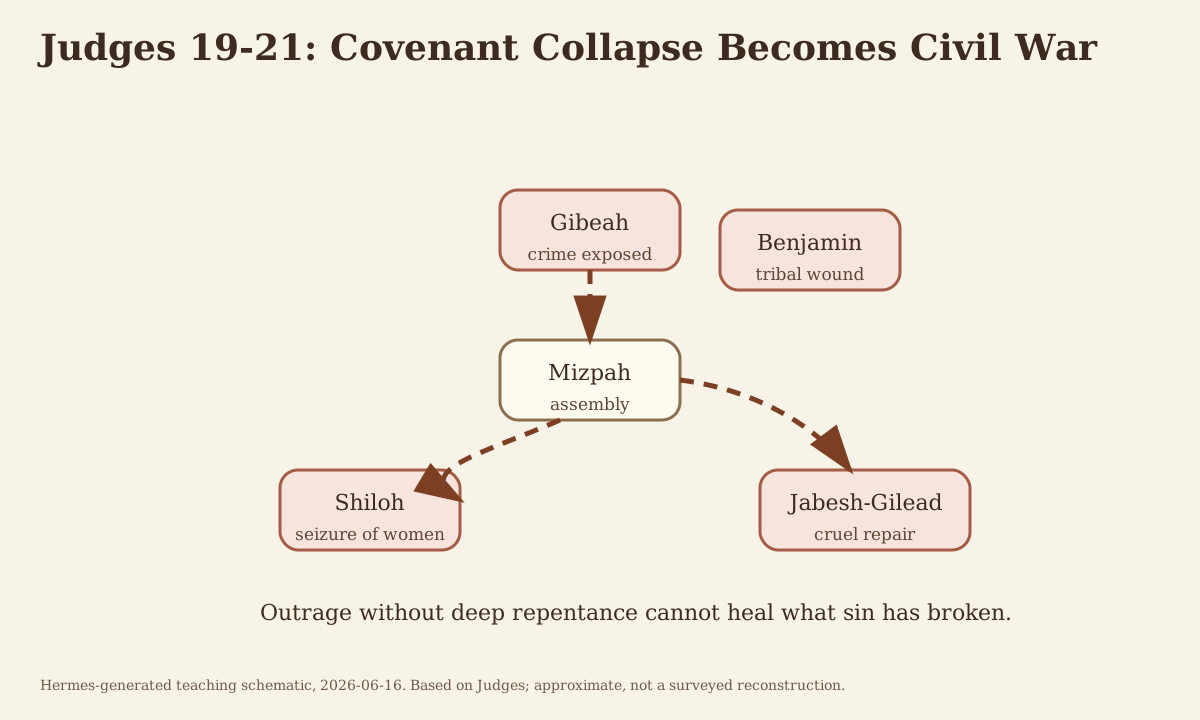 Source: Hermes-generated teaching schematic, 2026-06-16; approximate, not a surveyed reconstruction.
Light from the Word 🕯️
Judges 20:1-17 - A nation gathers, a crime is named, and Benjamin refuses judgment
1 And all the children of Israel went out, and all the congregation was gathered as one man, from Dan even to Bersabee, and in the land of Galaad, to the Lord at Massepha. 2 And all the tribes of Israel stood before the Lord in the assembly of the people of God, four hundred thousand footmen that drew sword. 3 And the children of Benjamin heard that the children of Israel were gone up to Massepha: and the children of Israel came and said, Tell us, where did this wickedness take place? 4 And the Levite, the husband of the woman that was slain, answered and said, I and my concubine went to Gabaa of Benjamin to lodge. 5 And the men of Gabaa rose up against me, and compassed the house by night against me; they wished to slay me, and they have humbled my concubine, and she is dead. 6 And I laid hold of my concubine, and divided her in pieces, and sent the parts into every coast of the inheritance of the children of Israel; for they have wrought lewdness and abomination in Israel. 7 Behold, all ye are children of Israel; and consider and take counsel here among yourselves.
8 And all the people rose up as one man, saying, No one of us shall return to his tent, and no one of us shall return to his house. 9 And now this is the thing which shall be done in Gabaa; we will go up against it by lot. 10 Moreover we will take ten men for a hundred for all the tribes of Israel, and a hundred for a thousand, and a thousand for ten thousand, to take provision, to cause them to come to Gabaa of Benjamin, to do to it according to all the abomination, which they wrought in Israel. 11 And all the men of Israel were gathered to the city as one man.
12 And the tribes of Israel sent men through the whole tribe of Benjamin, saying, What is this wickedness that has been wrought among you? 13 Now then give up the men the sons of transgressors that are in Gabaa, and we will put them to death, and purge out wickedness from Israel: but the children of Benjamin consented not to hearken to the voice of their brethren the children of Israel. 14 And the children of Benjamin were gathered from their cities to Gabaa, to go forth to fight with the children of Israel. 15 And the children of Benjamin from their cities were numbered in that day, twenty-three thousand, every man drawing a sword, besides the inhabitants of Gabaa, who were numbered seven hundred chosen men of all the people, able to use both hands alike; 16 all these could sling with stones at a hair, and not miss. 17 And the men of Israel, exclusive of Benjamin, were numbered four hundred thousand men that drew sword; all these were men of war.
Israel’s repeated unity is impressive: the congregation gathers, rises, and comes against the city “as one man.” That unity can make the demand for justice effective. It can also make an incomplete account difficult to question. The Levite identifies himself through the woman who has been slain, places the threat to his own life at the center of his testimony, and reports what the men did to her. He leaves out what 19:25 has already told the reader: he seized her and brought her outside. The assembly hears a true accusation without hearing the witness’s confession.
The difference is morally serious. In 19:22 the crowd demanded the man for sexual assault; in 20:5 he describes their intention as killing him. We need not invent a hidden psychological motive to notice the shift. His version emphasizes his danger and her injury while suppressing his agency. Verse 6 openly admits his dismemberment of her body, but presents it as the means of summoning public judgment. Even after death, her story is being told through the man who failed to protect her. No conclusion about her consent, blame, or deserved suffering follows from his testimony.
Israel’s first demand to Benjamin is limited: surrender the guilty men. The covenant formula in verse 13 makes responsibility concrete. Benjamin refuses to hear “their brethren” and prepares to fight. Loyalty has become protection of perpetrators. A parish or family repeats this sin when a person’s position, reputation, or connection to the group becomes more important than truthful enquiry and the safety of those harmed. Brotherhood should make us answerable for one another, not untouchable by one another.
Deuteronomy 22:25-27 places the guilt for a forced sexual act on the attacker and explicitly treats the assaulted woman as innocent of a capital offense. Its legal case is not identical in every circumstance to Judges 19, but it destroys the assumption that a woman’s violation gives the community a claim against her. Deuteronomy 24:16 likewise refuses the ordinary transfer of capital guilt between parent and child. These texts help us resist the widening destruction that follows; they are not a complete reconstruction of the ancient court that never convened here.
Language insight: “able to use both hands alike”
The Greek adjective “ἀμφοτεροδέξιος” (amphoterodexios) means able to use either hand. Both Rahlfs A and B use its singular form “ἀμφοτεροδέξιον” for Ehud in Judges 3:15 and its plural “ἀμφοτεροδέξιοι” for these slingers in 20:16. Brenton attaches the description to the selected men in his verse 15; NETS displays the adjective in verse 16. The Hebrew expression conventionally translated “left-handed” describes restriction of the right hand, so it should not be silently substituted for the Greek’s ambidexterity.1
The repeated Greek word joins two Benjaminite scenes. In chapter 3 unusual skill serves the deliverance of Israel; here exceptional skill serves a tribe shielding Gibeah. A gift remains a gift, but its purpose can be corrupted. Accuracy with a sling is no evidence of accuracy in moral judgment. The reader who possesses learning, influence, or a persuasive tongue faces the same question: whom does this ability protect?
Christological light. The compromised husband uses his wife’s injury to assemble a people without confessing his own responsibility. Christ the Good Shepherd gives His own life for the sheep (John 10:11). This is a moral contrast grounded in the actions narrated, not an identification of the murdered woman with Christ or an excuse to turn her suffering into a symbol that erases her person. Those who belong to the Shepherd must protect the harmed person rather than make her story serve their authority.
Judges 20:18-28 - Defeat, tears, and the humbling of religious presumption
18 And they arose and went up to Bæthel, and enquired of God: and the children of Israel said, Who shall go up for us first to fight with the children of Benjamin? And the Lord said, Juda shall go up first as leader. 19 And the children of Israel rose up in the morning, and encamped against Gabaa.
20 And they went out, all the men of Israel, to fight with Benjamin, and engaged with them at Gabaa. 21 And the sons of Benjamin went forth from Gabaa, and they destroyed in Israel on that day two and twenty thousand men down to the ground.
22 And the men of Israel strengthened themselves, and again engaged in battle in the place where they had engaged on the first day. 23 And the children of Israel went up, and wept before the Lord till evening, and enquired of the Lord, saying, Shall we again draw nigh to battle with our brethren the children of Benjamin? and the Lord said, Go up against them. 24 And the children of Israel advanced against the children of Benjamin on the second day. 25 And the children of Benjamin went forth to meet them from Gabaa on the second day, and destroyed of the children of Israel yet further eighteen thousand men down to the ground: all these drew sword.
26 And the children of Israel and all the people went up, and came to Bæthel; and they wept, and sat there before the Lord; and they fasted on that day until evening, and offered whole-burnt-offerings and perfect sacrifices, before the Lord, 27 for the ark of the Lord God was there in those days, 28 and Phinees the son of Eleazar the son of Aaron stood before it in those days; and the children of Israel enquired of the Lord, saying, Shall we yet again go forth to fight with our brethren the sons of Benjamin? and the Lord said, Go up, to-morrow I will give them into your hands.
Israel asks who should go first, and the Lord names Judah. This opening question is tactical: battle is already assumed. After the first defeat the people weep and ask whether they should approach their Benjaminite brethren again. After the second, all the people sit before the Lord, fast until evening, and offer sacrifice. The questions and actions become more searching as the losses accumulate. We should distinguish that narrated sequence from a claim to know every heart or every reason God permitted the defeats.
The divine answers are real. They must not be reduced to a false oracle merely because defeat follows. At the same time, the first answer names a leader; it does not promise an immediate victory or certify the assembly’s complete righteousness. The final answer adds the explicit promise for the next day. Prayer cannot be measured only by whether it produces our preferred result at once. Here the people continue to stand before the God whose answer has not spared them loss.
“Who shall go up first?” recalls Judges 1:1-2. Both Greek forms give Judah as the answer, but the object of war has changed: Canaanites there, Benjamin here. Rahlfs A repeats the question’s leadership wording especially closely; B uses “ἐν ἀρχῇ,” “at the beginning” or “first,” in 20:18. The shared question and Judah’s answer support the literary comparison, without requiring every Greek word to be identical.1 The book that opened with tribes seeking an inheritance now watches them fight a brother within it.
Language insight: “Bæthel” and “Weepings”
Brenton names the destination “Bæthel,” Bethel, in 20:18, 26 and 21:2. His Judges 2:1 already names both the place of weeping and Bæthel; 2:4-5 records tears and sacrifice and names the place “Weepings,” commonly called Bochim. The return to tears and sacrifice at the end therefore answers an earlier scene in the book. This is a narrative echo, not proof that every sanctuary notice refers to one unchanging location. Nor should “house of God,” the meaning associated with the name Bethel, erase the place-name actually printed in this translation.
At the beginning Israel heard the charge that it had not obeyed God’s voice. At the end it weeps while struggling to judge evil within its own people. The recurrence gives the tears a test: will they become obedience? Chapter 21 prevents us from treating grief, fasting, or offerings as automatic evidence that the whole nation has been converted. Worship is the place where we come to be healed, not a certificate that our next decision will be wise.
Phinehas and the ark bring the gathering before covenant holiness. The priest’s ancestry should make the reader remember both his zeal and his role in Joshua 22’s patient enquiry. Here Scripture records him standing before the ark, but does not report a speech from him. We cannot fill that silence with an accusation or a promise. Nor can we declare that God sent each defeat specifically to punish Israel for tolerating Micah’s idol when this passage gives no such explanation. The sequence invites self-examination; it does not authorize certainty about undisclosed divine motives.
Gems from the Fathers 💎: Correction begins with clear sight
Saint John Chrysostom, explaining Matthew 7:1-5 rather than commenting directly on these defeats, insists that Christ’s warning against judgment does not abolish correction. The person correcting another must first attend to his own serious sin, and correction should seek the other’s healing. He writes: “Nay, correct him, but not as a foe, nor as an adversary exacting a penalty, but as a physician providing medicines.”2 This does not reduce rape and murder to a minor fault or forbid lawful protection. It tells the Christian what spirit should govern correction once the injured have been protected. Romans 2:1 supplies the same warning against condemning in others what we practice ourselves.
Christological light. Matthew 7:5 directs the would-be healer to remove the plank from his own eye so that he can see to help his brother. Benjamin remains accountable; Israel’s need for cleansing does not cancel that accountability. In Christ, truthful self-examination and the defense of another person belong together. We may act to stop harm while refusing the pleasure of imagining ourselves incapable of sin.
The Church’s Voice in Worship ⛪
In the Coptic Eucharistic liturgy the Prayer of Reconciliation is followed by the deacon’s call to greet one another with a holy kiss. The prayer asks purification from guilt, hypocrisy, malice, and the remembrance of evil, and asks that the faithful become one body and one spirit through Christ.3 This gives a concrete answer to the assembly’s unhealed unity: preparation for communion includes surrendering hatred, not simply joining the same gathering. The connection is a worship parallel, not a claim that Judges 20-21 is appointed for that rite. Reconciliation must never be used to pressure a victim into unsafe contact; the prayer calls the offender to conversion and the community to truthful peace.
Judges 20:29-48 - The third battle, the fall of Benjamin, and the bitterness of unchecked victory
29 And the children of Israel set an ambush against Gabaa round about it.
30 And the children of Israel went up against the children of Benjamin on the third day, and arrayed themselves against Gabaa as before. 31 And the children of Benjamin went out to meet the people, and were all drawn out of the city, and began to smite and slay the people as before in the roads, whereof one goes up to Bæthel, and one to Gabaa in the field, about thirty men of Israel. 32 And the children of Benjamin said, They fall before us as at the first: but the children of Israel said, Let us flee, and draw them out from the city into the roads; and they did so.
33 And all the men rose up out of their places, and engaged in Baal Thamar; and the liers in wait of Israel advanced from their place from Maraagabe. 34 And there came over against Gabaa ten thousand chosen men out of all Israel; and the fight was severe; and they knew not that evil was coming upon them. 35 And the Lord smote Benjamin before the children of Israel; and the children of Israel destroyed of Benjamin in that day a hundred and twenty-five thousand men: all these drew sword. 36 And the children of Benjamin saw that they were smitten; and the men of Israel gave place to Benjamin, because they trusted in the ambuscade which they had prepared against Gabaa.
37 And when they retreated, then the liers in wait rose up, and they moved on toward Gabaa, and the whole ambush came forth, and they smote the city with the edge of the sword.
38 And the children of Israel had a signal of battle with the liers in wait, that they should send up a signal of smoke from the city. 39 And the children of Israel saw that the liers in wait had seized Gabaa, and they stood in line of battle; and Benjamin began to smite down wounded ones among the men of Israel about thirty men; for they said, Surely they fall again before us, as in the first battle.
40 And the signal went up increasingly over the city as a pillar of smoke; and Benjamin looked behind him, and behold the destruction of the city went up to heaven.
41 And the men of Israel turned back, and the men of Benjamin hasted, because they saw that evil had come upon them. 42 And they turned to the way of the wilderness from before the children of Israel, and fled: but the battle overtook them, and they from the cities destroyed them in the midst of them.
43 And they cut down Benjamin, and pursued him from Nua closely till they came opposite Gabaa on the east. 44 And there fell of Benjamin eighteen thousand men: all these were men of might.
45 And the rest turned, and fled to the wilderness to the rock of Remmon; and the children of Israel picked off of them five thousand men; and the children of Israel went down after them as far as Gedan, and they smote of them two thousand men. 46 And all that fell of Benjamin were twenty-five thousand men that drew sword in that day: all these were men of might. 47 And the rest turned, and fled to the wilderness to the rock of Remmon, even six hundred men; and they sojourned four months in the rock of Remmon.
48 And the children of Israel returned to the children of Benjamin, and smote them with the edge of the sword from the city of Methla, even to the cattle, and every thing that was found in all the cities: and they burnt with fire the cities they found.
Benjamin misreads the opening of the third battle as another success. Israel’s retreat draws the defenders away, the ambush takes Gibeah, and the smoke becomes the sign that their confidence has failed. Verse 35 explicitly names the Lord’s action against Benjamin. A sober reading must retain divine judgment as well as the terrible human cost. The tribe’s refusal to surrender perpetrators has placed it in opposition to the rest of Israel.
The tactics recall Joshua 8:3-12, 14-22: an ambush, a feigned retreat, pursuers drawn from the city, fire, and the sight of smoke behind them. The comparison helps the reader feel the change in the book’s direction. The strategy once used in the struggle for the land now consumes an Israelite city. Resemblance in tactics does not establish that this whole campaign received the same commands as Joshua’s campaign, much less that its later violence is justified by those commands.
Verse 48 widens the killing beyond the routed army, into Benjamin’s cities, cattle, and whatever is found. The next chapter says the women of Benjamin have been destroyed and asks how a tribe can survive. Calling this a bitter victory is therefore more than discomfort with an ancient battlefield: the narrative itself carries the reader from success in battle to anguish over the destruction of a brother. The community that could identify the offenders now has to face the consequences of its broader devastation.
There is a resemblance to the destruction prescribed for an apostate city in Deuteronomy 13:12-18, usual English numbering, 13:13-19 in Brenton. But that law concerns a city led into worship of other gods and requires diligent enquiry; the resemblance is not proof that Gibeah was legally such a city or that destroying the rest of Benjamin was mandated. A law against covenant apostasy cannot become a general permission to erase anyone associated with an offender. In Christian life, neither collective punishment nor retaliation against a perpetrator’s family is a work of justice.
The six hundred at the rock of Rimmon are a surviving remnant in the ordinary narrative sense. The text records their number and four months of refuge; it does not turn the number into a secret prophecy. Survival will make a future possible, but the means chosen to rebuild their households will leave further injury. A community may survive a crisis and still owe confession, accountability, and care to those it has harmed.
Translation note: the number in Judges 20:35
The preserved Brenton quotation reads “a hundred and twenty-five thousand men,” whereas his 20:46 gives twenty-five thousand. NETS A and B at 20:35 read twenty-five thousand one hundred. This exposes a difficulty in the English text being read; it is not a basis for enlarging the army or harmonizing the losses by conjecture.1 The quotation is retained as printed, while the explanation rests on the sequence of battle, destruction, and surviving men rather than on a reconstructed total.
Gems from the Fathers 💎: Bloodshed still calls for healing
Saint Basil’s Letter 188, Canon 13, offers a thematic Christian witness, not a commentary on this civil war. He distinguishes killing in war from murder under the concession he reports from earlier Fathers. Yet he also counsels a period away from communion for those whose hands are not clean: “Perhaps, however, it is well to counsel that those whose hands are not clean only abstain from communion for three years.”4 Both parts matter. He is neither equating every wartime killing with murder nor treating warfare as spiritually harmless. His cautious counsel is not an automatic Coptic disciplinary sentence for readers to impose on others. It witnesses to the Church’s concern that grave involvement in bloodshed needs pastoral healing, even when a public cause is judged defensible.
Christological light. Ephesians 2:14-18 speaks first of the reconciliation of Jew and Gentile: Christ makes peace and reconciles both to God in one body through the Cross. The passage does not narrate Benjamin’s war, but it gives the Church her own form of unity. Christ puts hostility to death, rather than defining communion by the destruction of one side. Christian discipline should protect those at risk, tell the truth about wrongdoing, and seek the sinner’s conversion without allowing the desire for victory to become permission for cruelty.
Judges 21:1-15 - Rash vows, grief, and the cruel repair attempted at Jabesh Gilead
1 Now the children of Israel swore in Massephath, saying, No man of us shall give his daughter to Benjamin for a wife. 2 And the people came to Bæthel, and sat there until evening before God: and they lifted up their voice and wept with a great weeping; 3 and said, Wherefore, O Lord God of Israel, has this come to pass, that to-day one tribe should be counted as missing from Israel? 4 And it came to pass on the morrow that the people rose up early, and built there an altar, and offered up whole-burnt-offerings and peace-offerings.
5 And the children of Israel said, Who of all the tribes of Israel, went not up in the congregation to the Lord? for there was a great oath concerning those who went not up to the Lord to Massephath, saying, He shall surely be put to death.
6 And the children of Israel relented toward Benjamin their brother, and said, To-day one tribe is cut off from Israel. 7 What shall we do for wives for the rest that remain? whereas we have sworn by the Lord, not to give them of our daughters for wives. 8 And they said, What one man is there of the tribes of Israel, who went not up to the Lord to Massephath? and, behold, no man came to the camp from Jabis Galaad to the assembly. 9 And the people were numbered, and there was not there a man from the inhabitants of Jabis Galaad.
10 And the congregation sent thither twelve thousand men of the strongest, and they charged them, saying, Go ye and smite the inhabitants of Jabis Galaad with the edge of the sword. 11 And this shall ye do: every male and every woman that has known the lying with man ye shall devote to destruction, but the virgins ye shall save alive: and they did so.
12 And they found among the inhabitants of Jabis Galaad four hundred young virgins, who had not known man by lying with him; and they brought them to Selom in the land of Chanaan.
13 And all the congregation sent and spoke to the children of Benjamin in the rock Remmon, and invited them to make peace. 14 And Benjamin returned to the children of Israel at that time, and the children of Israel gave them the women whom they had saved alive of the daughters of Jabis Galaad; and they were content.
15 And the people relented for Benjamin, because the Lord had made a breach in the tribes of Israel.
Israel has bound itself by two oaths: no daughter will be given to Benjamin, and whoever failed to join the assembly will die. After devastating Benjamin, the people discover that their first oath obstructs its future. Their second oath supplies an apparent way around the obstruction. Jabesh Gilead is absent; another armed force can be sent there; young women can be kept alive and assigned to the survivors. The question becomes how to supply wives without admitting that the chosen means of preserving Israel are themselves injuring Israel.
The tears deserve to be taken seriously. In verse 6 Benjamin is again “their brother,” and the people grieve a tribe cut off. Yet neither the prayer in verse 3 nor the plans that follow records confession of their part in the devastation. “Wherefore, O Lord God of Israel, has this come to pass” places the catastrophe before God; it does not by itself prove deliberate blame-shifting. Verse 15 genuinely attributes the breach to the Lord. Divine judgment and human responsibility are both in the account. What reveals the inadequacy of the grief is the next action: a new massacre and the use of surviving women as the means of repair.
The command in 21:11 resembles Numbers 31:17-18’s distinction between women who have known a man and those kept alive. That verbal resemblance is disturbing in this setting, but it does not establish a divine command to repeat the Midian campaign against Jabesh Gilead. Here the congregation issues the order. The text’s record of an oath and its enforcement is not a legal vindication of every killing carried out under it. Women’s lives do not become disposable because elders face a political difficulty.
Verse 12 brings the surviving women to “Selom in the land of Chanaan.” That geographical notice places the proposed restoration at Shiloh, within the land Israel received. It should not be turned into a claim that the victims are foreigners: they come from Jabesh Gilead. The national wound is being handled at a sacred place, yet the women are treated as a quantity sufficient for some of the men rather than as persons whose families have just been destroyed. Peace is offered to Benjamin, but the story reports no comparable act of care for them.
Jephthah’s vow in Judges 11:30-40 helps us recognize the pattern. A man’s solemn words become a daughter’s burden. Her timbrels and dances in 11:34 anticipate the danger to the dancing daughters in 21:21; the yearly remembrance in 11:40 differs from the annual feast explicitly named in 21:19. We may observe these correspondences without pretending the occasions or every detail are identical.
Leviticus 5:4-6 places rash sworn speech within a path of acknowledging sin, confession, offering, and atonement. It does not supply a complete legal ruling on these particular collective oaths, but it refutes the religious instinct that the only possible response to sinful words is further sin. No vow makes rape, abduction, or the murder of bystanders lawful. The way toward God is to confess the wrong, not recruit another victim to keep the speaker’s appearance of faithfulness intact.
Christological light. In John 11:51-52 the death of Christ is linked to gathering God’s scattered children into one. Judges 21 seeks tribal continuity by taking life from one community and commandeering women for another. Christ’s gathering rests on His own self-offering. The Cross exposes the lie that the vulnerable must be expendable for a people to survive. The offender’s repentance begins by accepting the cost of truth rather than shifting it onto those with less power.
Judges 21:16-25 - Shiloh, the seizure of women, and the book’s final judgment on self-rule
16 And the elders of the congregation said, What shall we do for wives for them that remain? for the women have been destroyed out of Benjamin. 17 And they said, There must be an inheritance of them that are escaped of Benjamin; and so a tribe shall not be destroyed out of Israel. 18 For we shall not be able to give them wives of our daughters, because we swore among the children of Israel, saying, Cursed is he that gives a wife to Benjamin.
19 And they said, Lo! now there is a feast of the Lord from year to year in Selom, which is on the north of Bæthel, eastward on the way that goes up from Bæthel to Sychem, and from the south of Lebona. 20 And they charged the children of Benjamin, saying, Go and lie in wait in the vineyards; 21 and ye shall see; and lo! if there come out the daughters of the inhabitants of Selom to dance in dances, then shall ye go out of the vineyards and seize for yourselves every man a wife of the daughters of Selom, and go ye into the land of Benjamin. 22 And it shall come to pass, when their fathers or their brethren come to dispute with us, that we will say to them, Grant them freely to us, for we have not taken every man his wife in the battle: because ye did not give to them according to the occasion, ye transgressed.
23 And the children of Benjamin did so; and they took wives according to their number from the dancers whom they seized: and they went and returned to their inheritance, and built the cities, and dwelt in them. 24 And the children of Israel went thence at that time every man to his tribe and his kindred; and they went thence every man to his inheritance. 25 And in those days there was no king in Israel; every man did that which was right in his own sight.
The elders can count the remaining men and identify the problem their oath has created. What they cannot yet imagine is a truthful way to face that oath. Their plan makes the dancing daughters of Shiloh accessible to men hidden in the vineyards. When fathers or brothers protest, the elders will handle the dispute. The arrangement is deliberate: the women are seized, while their families can be told that they did not formally “give” them.
A loophole preserves the appearance of oath-keeping while defeating the protection that truthful fidelity should serve. Verse 22 is awkward in Brenton’s English, and the argument should not be made more precise than that wording permits. The broad scheme is nonetheless explicit in verses 20-23: ambush, seizure, anticipated objections, and departure with the women. Calling the seizure a marriage solution must not soften its coercion. The women’s consent is not recorded; a feast does not authorize their abduction; rebuilding cities does not repair what has been done to them.
Shiloh is the place of a feast “from year to year.” Its holiness makes the abuse of the gathering more searching. Worshippers should be safe among those who invoke the Lord’s name. In 1 Kingdoms 1, Hannah comes to this same sanctuary in grief, prays, and brings the child for whom she has prayed. The contrast is between a woman placing her petition before God and women made the objects of others’ plans. This is a canonical comparison, not proof that Hannah’s visit followed immediately after the events here. Eli’s sons later give the sanctuary another history of scandal. The Hebrew form of 1 Kingdoms 2:22 alleges sexual misconduct with women serving at the sanctuary entrance; Brenton’s LXX verse omits that allegation. The comparison should therefore distinguish the textual forms, while keeping the central warning: sacred office never places anyone above accountability.5
The later history also joins Gibeah and Jabesh Gilead differently. In 1 Kingdoms 11 Saul hears the plea of Jabesh at Gibeah, sends the pieces of oxen to summon Israel, and leads a rescue. The people of Jabesh later retrieve the bodies of Saul and Jonathan in 1 Kingdoms 31:11-13. Places associated here with injury can later become places of help and gratitude. The resemblance between the summons by dismembered oxen and the Levite’s summons must not make their victims morally equivalent. It reminds us how a national memory can be repeated and redirected.
The Benjaminites return to an inheritance, rebuild, and dwell in cities. Other Israelites go back to tribe and family. The final refrain refuses to let ordinary settlement be mistaken for a healed covenant. Deuteronomy 12:8 had already warned against each person doing what was pleasing in his own sight, in a context of ordered worship. Judges’ phrase judges a people whose religious language and private judgment have come apart. It is more searching than a complaint about administrative vacancy.
Christological light. The elders arrange a seizure to preserve households; the true King teaches that greatness among His disciples takes the form of service (Luke 22:25-27). His authority makes the vulnerable safer and calls the powerful to bear responsibility. The final refrain therefore presses a Christian reader beyond the wish for efficient leadership toward obedience to Christ. A leader who speaks of peace while allowing the weak to be used has not learned His kingship.
Book Capstone: From the first enquiry to the last refrain
Judges begins after Joshua’s death with a question addressed to the Lord; it ends with each person’s own sight as the measure of conduct. Between those statements the book repeatedly shows that receiving a land and living faithfully in it are different things. Israel can possess an inheritance while losing the habits that make it a holy people: hearing God’s voice, handing on the memory of His deliverance, refusing rival worship, and accepting responsibility for the neighbor. The closing return to “every man” and his inheritance in 21:24 is therefore unsettled. The people are back on their land, but the women seized to preserve that settlement remain part of its unhealed history.
The book’s diagnosis is deeper than the failure of one leader or tribe. In 2:1-5 the people weep at the angel’s rebuke. In 20:26 and 21:2 they again weep and sacrifice. Tears recur because the wound recurs. When the heart refuses obedience, an intense religious occasion can leave ordinary conduct unchanged. The book teaches us to take sorrow seriously while asking what follows it. A confession that protects our reputation, a fast accompanied by the same cruelty at home, or a parish settlement that silences the harmed person may leave the appearance of return without the act of return. The evidence of repentance is not the strength of the feeling alone, but the truthful change grace enables.
Yet Judges must not be reduced to a gallery of failures. God repeatedly raises deliverers when His people cry out. Sirach 46:11-12 blesses the memory of the faithful judges, describing those whose hearts did not turn from the Lord. Their service is worthy of gratitude even though no temporary rescue cures Israel forever. Ehud’s skill illustrates the distinction sharply beside chapter 20: Benjamin’s ability once serves deliverance, then serves its defense of guilty men. The question is not whether human gifts, courage, or leadership are worthless. It is whether they remain obedient to God and merciful toward the people they were given to serve.
The cry for a king should be heard with the same discernment. Gideon says in 8:23 that the Lord will rule over Israel; his ensuing ephod nevertheless becomes a snare. In 1 Kingdoms 8:7 God identifies the demand for a king as a rejection of His own reign. These witnesses prevent us from treating the final refrain as a simple assurance that monarchy will solve everything. A throne can organize a people without converting it. The deeper need is for rule that is true because it belongs to God, and for hearts willing to receive that rule. Christ fulfills this need through the authority of the incarnate Son, whose service and self-offering reveal what power is for.
Benjamin also leaves a future larger than the disaster. Genesis 49:27 pictures him as a ravening wolf. The image can help a reader recognize the force associated with the tribe, but it should not be used as an excuse for its conduct here or as a claim that Jacob predicted each event of this war. Paul later identifies himself as a Benjaminite in Philippians 3:5 and Romans 11:1. In Romans 11:1-5 he places his own existence within the testimony that God has not cast away His people and speaks of a remnant according to grace. This later apostolic witness keeps the Christian reader from declaring a people beyond mercy because of an awful history. It does not make the six hundred at Rimmon a coded prediction of Paul. Grace opens a future without making yesterday’s injuries unreal.
The canonical turn to Ruth makes that future more concrete. Ruth 1:1 explicitly places her story in the time of the judges, so the next book need not be forced into a chronology immediately following this civil war. Bethlehem, which appears in the closing accounts of Judges, becomes a place where another household’s faithfulness is shown. In Ruth 2:8-12 Boaz protects a foreign woman: he directs her to glean among his women, commands the young men not to touch her, and gives her access to water. He commends the trust by which she has sought refuge under the Lord’s wings. Where Gibeah’s hospitality failed and Shiloh’s festival was made dangerous, ordinary work in a field can become shelter.
This is neither a sentimental escape from Judges nor a claim that Ruth erases its victims. It shows that fidelity can be practiced during the same troubled age. Boaz’s protection is observable, not a declaration that everything is well. Ruth’s foreignness does not make her expendable; her need becomes a reason for care. The contrast gives servants a clear measure for communal health: can someone with little status live, work, pray, and speak safely among us?
Ruth 4:17-22 carries the household to David, and Matthew 1:1-6 carries Ruth and David into the genealogy of Jesus Christ. Micah’s Bethlehem promise, 5:2 in usual English numbering and 5:1 in Brenton’s LXX, speaks of the ruler who will come forth from that small place. The answer to Judges’ final wound is therefore received across the canon, not manufactured by a forced symbolism of its battles. God preserves His promise through the faithfulness of people who shelter rather than consume others. In Christ the promise reaches its fulfillment: the King serves, the Shepherd gives His life, and the scattered are gathered through His Cross. We finish Judges longing for that rule, and begin to receive it by telling the truth, protecting our neighbor, and yielding the life we had reserved for our own judgment.
Summary Table
| Text | Literal focus | Spiritual and Christological reading |
|---|---|---|
| Judges 20:1-17 | The Levite’s selective account; Israel demands the perpetrators; Benjamin refuses | Truthful justice requires responsibility without factional exemption; the Good Shepherd bears the cost Himself |
| Judges 20:18-28 | Judah leads; two defeats; weeping, fasting, sacrifice, and the final promise | Divine answers are not a certificate of our purity; correction requires self-examination and a desire to heal |
| Judges 20:29-48 | Ambush, judgment on Benjamin, destruction of cities, and six hundred survivors | Success in battle leaves a wounded people; Christ reconciles through the Cross, and bloodshed requires sobriety |
| Judges 21:1-15 | Oaths obstruct restoration; Jabesh Gilead is attacked; surviving women are assigned as wives | Real grief can coexist with further wrongdoing; rash words call for confession, not new victims |
| Judges 21:16-25 | Daughters of Shiloh are seized; cities are rebuilt; the final refrain judges self-rule | A loophole is not repentance; communal continuity cannot be bought with another person’s freedom |
Spiritual Fruit 🍇
Tell the part of the story that costs you something. The Levite can accuse Gibeah while concealing his own act. Before repeating an account of conflict, distinguish what you know, what you assume, and what you have done. In confession, name the action rather than explaining why someone else made it necessary. If a vulnerable person has been harmed, correction of your own story must serve their protection, not become another demand on them to comfort you.
Let prayer interrupt your chosen outcome. Israel’s first question assumes battle and asks for the leader. Our prayer can sound equally devout while leaving our plan untouched. Before a difficult meeting or decision, ask for clear sight, truthful testimony, and freedom from the wish to humiliate. Seek wise counsel and lawful action where harm requires it. Waiting for certainty about every motive is no excuse for allowing danger to continue; humility makes protection more faithful, not less urgent.
Test sorrow by the next decision. The people weep over Benjamin and then destroy another community. When remorse rises, take one act that reverses the wrong: correct a misleading statement, stop the damaging conduct, accept appropriate accountability, or make restitution where it can be made safely. Tears may be the beginning of repentance. They become evasive when we use their sincerity to avoid what obedience will cost.
Refuse solutions that spend another person’s life. Jabesh Gilead and Shiloh put faces to religious expediency. In family or parish life, resist arrangements that protect reputation by placing the burden on the injured, the young, or those without influence. Do not demand silence as the price of belonging. Establish safe ways for concerns to be heard, bring serious allegations to appropriate authorities, and make protection more important than the appearance of an undisturbed community.
Receive Christ’s peace as a rule of life. The holy kiss at the Eucharist calls the faithful toward a communion greater than agreement with their own group. Pray the Prayer of Reconciliation attentively; bring your own malice and remembrance of evil before Christ. This need not mean approaching an unsafe person or abandoning boundaries. It means allowing the Lord to remove the desire for revenge while strengthening the courage to act truthfully and mercifully. Boaz’s protection of Ruth gives that peace an ordinary form: someone with less power becomes safer because you are present.
At Shiloh the daughters come out to dance, and the elders have arranged an ambush. Stay with the grief of that contrast before turning the page. Bring before Christ the people whom a community has used to keep itself intact, and ask Him to make His Church a place of truthful shelter. Then let the field of Ruth teach the next step: guard the neighbor whose safety has been placed in your hands. The King for whom Judges teaches us to long is received in such obedience.
Teaching Notes
General guidance
- Teach these chapters within the book’s descent into covenant disorder, not as an isolated war story; keep the faithful deliverers and God’s repeated mercy in view.
- Make clear that Benjamin’s refusal to surrender the guilty turns a local demand for judgment into national catastrophe.
- Note that the Levite’s testimony is selective; the assembly hears truth, but not the whole truth.
- Stress that Israel’s first question to God is tactical rather than penitential; distinguish it from the later questions about continuing battle.
- Emphasize the fasting and sacrifice before the final promise without assigning God an undisclosed motive for each defeat.
- Avoid triumphal language about Benjamin’s destruction; chapter 21’s grief makes the victory bitter.
- Handle the slaughter at Jabesh Gilead and the seizure at Shiloh soberly and directly, without graphic detail.
- Say plainly that the women in chapter 21 are being treated as means to an end. Do not sanitize coercion or imply that a victim’s prior history lessens the attacker’s guilt.
- Use the law’s concern to purge evil with its requirements for truth and personal responsibility; connect Christian correction to Matthew 7:3-5 and peace to Ephesians 2:14-18. Do not turn the civil war into a Christian prescription.
- Keep the final refrain central: self-rule can survive beneath religious language. Preserve safety when discussing forgiveness, reconciliation, and church authority.
Judges 20:1-17 - Testimony and tribal loyalty
- Ask: Which parts of the Levite’s account are true, and what essential act does he leave out when compared with 19:25?
- Watch for: Criticism of the witness must never become disbelief of the woman’s injury or blame placed upon her.
Judges 20:18-28 - Enquiry, loss, and worship
- Ask: How do the questions and actions before God change between the first enquiry and the final promise?
- Watch for: The narrated sequence does not license certainty about why God allowed every death, or a claim that worship purchases success.
Judges 20:29-48 - Victory and devastation
- Ask: What changes when the killing moves from the defeated army to Benjamin’s cities in verse 48?
- Watch for: Tactical resemblance to Joshua 8 or verbal resemblance to a law is not a blanket authorization for collective punishment.
Judges 21:1-15 - Oaths and the cost of repair
- Ask: How do the two oaths combine to make another community bear the cost of Israel’s attempted restoration?
- Watch for: An oath never obliges a person to commit rape, abduction, or murder; grief does not absolve the next wrong.
Judges 21:16-25 - Shiloh and the final refrain
Ask: What does the elders’ distinction between giving and seizing reveal about the repentance still missing from their plan?
Watch for: The festival must not be named more precisely than the text permits, and communal reconciliation must never require unsafe contact or silence about harm.
Sources
Embedded Scripture is from Brenton’s English Septuagint (LXX). New Testament cross-references were read in NKJV. Hebrew-based English legal references whose numbering differs are identified beside the comparison. Greek observations distinguish Rahlfs A and B; NETS provides their separate English translations.
- Lancelot Charles Lee Brenton, The Septuagint Version of the Old Testament, Judges 20-21; the cross-references developed above in Genesis, Leviticus, Numbers, Deuteronomy, Joshua, Judges, Ruth, 1 Kingdoms, Micah, and Sirach. Brenton Judges 20 and Judges 21.
- Philip E. Satterthwaite, “Judges,” in A New English Translation of the Septuagint, introduction and Judges 1:1-2; 3:15; 20:16, 18, 35. NETS Judges. Rahlfs-based Greek is available in the University of Pennsylvania CCAT/CATSS Judges A and Judges B texts.
- Saint John Chrysostom, Homilies on Matthew, Homily 23, on Matthew 7:1-5; a thematic witness about self-examination and correction, not direct commentary on Judges. Homily 23.
- Saint Basil the Great, Letter 188 to Amphilochius, Canon 13; a thematic witness concerning bloodshed and pastoral healing, with the distinction and cautious counsel retained. Letter 188.
- CopticChurch.net, “Sacrament of the Eucharist,” account of the Prayer of Reconciliation and holy kiss. Coptic Eucharistic practice. This supports the worship parallel, not a Judges lectionary appointment.
For comparison, Saint Ambrose retells these events in On the Duties of the Clergy III.19.110-116 and in Letter VI to Syagrius, Latin appendix to the 1881 Letters. His first account commends the zeal to avenge violated chastity and treats the raid as a permitted expedient; the second also describes the solution as preserving the oaths. These are real patristic readings, but they do not support this guide’s condemnation of the seizure of women and should not be presented as doing so. On the Duties III.19 and Letter VI, Latin appendix.
Footnotes
-
Rahlfs-based CCAT/CATSS, Judges A and Judges B, at 1:1-2; 3:15; 20:16, 18, 35; Philip E. Satterthwaite, NETS Judges. Compare the Hebrew and its English rendering at Judges 20:16 and Judges 3:15. ↩ ↩2 ↩3
-
Saint John Chrysostom, Homilies on Matthew, Homily 23, on Matthew 7:1-5, translated by George Prevost, revised by M. B. Riddle, NPNF First Series 10, direct text. ↩
-
CopticChurch.net, “Sacrament of the Eucharist,” description and wording of the Prayer of Reconciliation and the deacon’s invitation to the holy kiss, source. ↩
-
Saint Basil the Great, Letter 188 to Amphilochius, Canon 13, translated by Blomfield Jackson, NPNF Second Series 8, direct text. ↩
-
Compare Brenton, 1 Kingdoms 2:22, with the Hebrew text and English rendering. ↩