


This narration is from a previous version of the study and may include a combined recording of multiple chapters.
Ruth 4 brings hidden mercy into public redemption. Boaz goes to the gate, the nearer kinsman refuses the costly responsibility, Boaz redeems the inheritance and marries Ruth, and Obed is born. The book ends with genealogy because the private sorrows of Naomi and Ruth have become part of the public history of salvation.
The chapter’s spiritual depth is that redemption is costly, witnessed, fruitful, and larger than the people experiencing it. Naomi wanted bread. Ruth sought shelter. Boaz acted righteously. God was preparing David, and through David, Christ.
Lesson Guide
- Key phrases: redemption at the gate; costly mercy; a child for Naomi; genealogy as thunder.
- Emphasize: the legal scene is spiritually rich, not a boring conclusion.
- Avoid: skipping the genealogy. It is the theological climax.
Historical and Scriptural Context
Ruth 4 resolves what Ruth 3 left open. Boaz promised to act, but he could not bypass the nearer kinsman. The city gate was a public place of legal transaction, elder witness, and judgment. The promise made to Ruth must become a responsibility acknowledged before others.
The customs involve family land, widowhood, name, and inheritance. Land redemption and the duty to preserve a deceased man’s family line meet here, but Boaz is not described as Mahlon’s surviving brother. The scene therefore should not be reduced to a straightforward application of the brother-in-law marriage law in Deuteronomy 25:5-10. Its exact legal mechanics remain less clear than its human purpose: a widow needs a household, and a family threatened with extinction needs a future.
The ending reaches beyond those immediate needs. Perez leads to David, and Matthew 1:1-17 carries the line to Christ. God’s care for these women belongs to the history through which the Son of God comes among us.
Geographical Significance ⛰️
The gate is where Boaz makes his intention accountable to elders and neighbors. The household is where the result of that public act becomes visible: Ruth bears a son, and Naomi holds him. The chapter moves between these two places without separating lawful dealings from personal care.
The elders name Ephratha and Bethlehem in their blessing. Micah 5:2 later names Bethlehem Ephrathah as the place from which the ruler will come, and Matthew 2:6 takes up that promise. Ruth supplies the Davidic family story of the town; Micah gives the prophetic promise of its ruler.
The Characters 👥
Boaz / Booz
Boaz acts quickly, publicly, and lawfully. He honors the nearer relative’s right before taking responsibility himself. The same righteousness that protected Ruth in the field now gives her an acknowledged place in his household.
The nearer kinsman
The man agrees to redeem the field, then withdraws when the obligation includes Ruth and the preservation of the dead man’s name. His stated fear is damage to his own inheritance. The story leaves him unnamed while remembering the people for whom Boaz accepts responsibility. That contrast exposes self-protective mercy without telling us everything about the man’s motives or circumstances.
Ruth
Ruth speaks no words in this chapter, yet the transaction, blessing, marriage, and birth all concern her. She remains identified as the Moabitess even as the elders bless her among the mothers who built Israel. Her reception honors her allegiance to Israel’s God without pretending that she has no earlier history.
Naomi / Noemin
Naomi receives a child into her bosom. The women honor both the new life and the daughter-in-law whose love sustained her. Her losses remain real, but her claim to be empty no longer describes the whole of her life.
Obed, Jesse, and David
Obed is Ruth and Boaz’s son, Jesse’s father, and David’s grandfather. His place in that line gives a domestic scene its royal horizon. Matthew then sets the same household within Christ’s human ancestry.
Boaz brings redemption to the gate (Ruth 4:1-6)
1 And Booz went up to the gate, and sat there; and behold, the relative passed by, of whom Booz spoke: and Booz said to him, Turn aside, sit down here, such a one: and he turned aside and sat down. 2 And Booz took ten men of the elders of the city, and said, Sit ye here; and they sat down.
3 And Booz said to the relative, The matter regards the portion of the field which was our brother Elimelech’s which was given to Noemin, now returning out of the land of Moab; 4 and I said, I will inform thee, saying, Buy it before those that sit, and before the elders of my people: if thou wilt redeem it, redeem it, but if thou wilt not redeem it, tell me, and I shall know; for there is no one beside thee to do the office of a kinsman, and I am after thee: and he said, I am here, I will redeem it. 5 And Booz said, In the day of thy buying the field of the hand of Noemin and of Ruth the Moabitess the wife of the deceased, thou must also buy her, so as to raise up the name of the dead upon his inheritance. 6 And the kinsman said, I shall not be able to redeem it for myself, lest I mar my own inheritance; do thou redeem my right for thyself, for I shall not be able to redeem it.
Boaz sits at the gate, calls the relative aside, and gathers ten elders. He neither conceals his intention nor treats his promise to Ruth as permission to disregard another man’s right. His haste is joined to patience with the lawful process. A good intention becomes trustworthy when its fulfillment can bear witnesses.
The nearer kinsman’s first answer is willing. His second answer comes after Ruth is named and the duty to raise up the dead man’s name is explained. He fears that taking this responsibility will damage his inheritance. The field cannot be separated from the family whose need gives the transaction its purpose. Boaz accepts what the other man declines.
The language of buying is difficult for a modern reader. In this public declaration it concerns marriage and inheritance within an ancient household order. Ruth’s earlier request for covering and her confessed allegiance remain part of the story; she is not an unwanted burden that Boaz graciously tolerates. The elders will bless her, and the women will call her love better than seven sons. A Christian application must never use these verses to authorize treating a woman as property or overriding her consent.
The contrast searches our charity. We may offer help while keeping control of its terms, willing to give money but unwilling to be inconvenienced by the person who needs it. Boaz’s act joins provision to responsibility. Mercy reaches the person, not only the asset.
Language insight: “kinsman” and the work of redemption
The Hebrew “גֹּאֵל” (go’el) names one who redeems through family responsibility. The Greek repeatedly uses kinship vocabulary: “ἀγχιστεύς” (anchisteus), next of kin, and forms of “ἀγχιστεύω” (anchisteuō), to perform a kinsman’s office. In verse 6 the noun and the command to act as kinsman stand together. The point is legal and familial nearness, not merely affectionate feeling or physical proximity.1
Hebrews 2:11-17 gives the Christian connection its firm foundation. The Son shares our flesh and blood, calls His people brethren, and is made like them to become the merciful High Priest. The Incarnation is not proved by a Greek word in Ruth. Hebrews reveals the saving reality that Boaz’s kinship can help us contemplate: Christ enters our condition rather than relieving it from a distance. His nearness reaches even into death, where He breaks death’s power.
Witnesses bless the redemption (Ruth 4:7-12)
7 And this was in former time the ordinance in Israel for redemption, and for a bargain, to confirm every word: A man loosed his shoe, and gave it to his neighbour that redeemed his right; and this was a testimony in Israel. 8 And the kinsman said to Booz, Buy my right for thyself: and he took off his shoe and gave it to him.
9 And Booz said to the elders and to all the people, Ye are this day witnesses, that I have bought all that was Elimelech’s, and all that belonged to Chelaion and Maalon, of the hand of Noemin. 10 Moreover I have bought for myself for a wife Ruth the Moabitess, the wife of Maalon, to raise up the name of the dead upon his inheritance; so the name of the dead shall not be destroyed from among his brethren, and from the tribe of his people: ye are this day witnesses.
11 And all the people who were in the gate said, We are witnesses: and the elders said, The Lord make thy wife who goes into thy house, as Rachel and as Lia, who both together built the house of Israel, and wrought mightily in Ephratha, and there shall be a name to thee in Bethleem. 12 And let thy house be as the house of Phares, whom Thamar bore to Juda, of the seed which the Lord shall give thee of this handmaid.
The narrator explains the sandal as an old sign confirming redemption and exchange. The relative removes his own sandal and transfers his right; Boaz then declares his acquisition of the inheritance and his marriage to Ruth before elders and people. The witnesses give the household a publicly acknowledged future.
Deuteronomy 25:9 describes a different act: the widow removes the refusing brother-in-law’s sandal and spits in his face, with a spoken reproach. Ruth records no spitting or explicit shame formula, and its own explanation concerns attestation of a transaction. The distinction clarifies the scene without proving that the law has been relaxed or that refusal carried no social embarrassment. John 1:27 also speaks of a sandal, in the Baptist’s confession of unworthiness before Christ; it is a different setting, not an explanation of Ruth’s legal custom.
Boaz says twice that the people are witnesses. His concern is that the dead man’s name should survive among his brethren. The transaction therefore serves those who cannot repay him: the deceased and the widow whose future is exposed. Public righteousness here protects memory and belonging.
The blessing names Rachel and Leah together as builders of Israel’s house. Ruth the Moabitess is received into that family story with a prayer for fruitfulness. Rachel was buried on the way to Ephrath, identified as Bethlehem in Genesis 35:19. Later, Matthew 2:18 applies Rachel’s lament to the mothers bereaved by Herod’s violence in Bethlehem and its vicinity, while the quoted prophecy still locates the voice in Ramah. Rachel, Ruth, and the Theotokos can be contemplated together around Bethlehem, where birth and sorrow meet. This is a Christian scriptural connection, not a claim that their stories form one uninterrupted maternal line.
The elders also name Perez, whom Tamar bore to Judah. Genesis 38 tells how Judah’s failure to honor his household duty threatened Tamar’s future and how her action brought him to acknowledge her righteousness. Ruth 4 explicitly carries that troubled history into its blessing. Boaz’s public acceptance of responsibility stands beside an earlier story in which responsibility had to be wrested from Judah. The line of promise survives human failure, but the failure is neither hidden nor made holy by its outcome.
The people do more than approve a bargain. They ask the Lord to build a house through this woman. Ruth receives a remembered place among Israel’s mothers, and the nations’ later gathering into Christ’s Church can be seen in that reception. Israel’s covenant history is the root of this mercy, not something the Church’s reading discards.
Obed is born and Naomi is restored (Ruth 4:13-17)
13 And Booz took Ruth, and she became his wife, and he went in to her; and the Lord gave her conception, and she bore a son. 14 And the women said to Noemin, Blessed is the Lord, who has not suffered a redeemer to fail thee this day, even to make thy name famous in Israel. 15 And he shall be to thee a restorer of thy soul, and one to cherish thy old age; for thy daughter-in-law which has loved thee, who is better to thee than seven sons, has born him. 16 And Noemin took the child and laid it in her bosom, and became a nurse to it.
17 And the neighbours gave it a name, saying, A son has been born to Noemin; and they called his name Obed; this is the father of Jessæ the father of David.
Boaz takes Ruth as his wife, and the Lord gives her conception. The narrative explicitly attributes bread and conception to God near the opening and close of the book: in 1:6 Naomi hears the report that the Lord has visited His people to give them bread; in 4:13 the narrator tells of the gift of conception. These are two clear statements of divine provision, not a limit on how often God acts. Between them, His care becomes visible through decisions made by ordinary people. Bethlehem, conventionally “house of bread,” receives both nourishment and new life. Christians may contemplate bread and birth beside the Eucharist and the Incarnation while keeping that meditation distinct from the narrator’s immediate claims.
The women’s blessing turns toward Naomi. Verse 15 speaks of one whom Ruth has borne, so the newborn is a strong candidate for the “redeemer” named in verse 14: through him Naomi’s household gains a future and support in old age. Some interpreters instead relate the title to Boaz, who has secured that future. The blessing can be heard with both the child’s arrival and Boaz’s work in view, without forcing an agreement the commentators do not share.2
A newborn associated with redemption in Bethlehem opens a tender Christian anticipation of the Nativity. Obed continues a threatened family; Christ, born in the same town, saves His people from sin and death. The resemblance leads toward Christ while the difference protects the child’s ordinary humanity.
The women call Ruth better to Naomi than seven sons. Their praise measures her love by what it has actually done: she stayed, worked, brought food, and now has borne this child. The statement does not diminish sons or promise that every widow will receive the same visible consolation. It gives full weight to a daughter-in-law’s faithful care. Naomi’s restoration has come through the very woman whose presence beside her once stood against her account of being utterly empty.
Naomi lays the child in her bosom and becomes his nurse. The neighbors’ announcement of a son born to Naomi is language of restored family life, not a transfer of biological motherhood away from Ruth. The book holds both women in honor. Grain had already answered emptiness when Boaz sent Ruth back to Naomi in 3:17; now a child rests in the arms that grief had emptied.
Language insight: “a restorer of thy soul” and “Obed”
In verse 15 the Greek phrase “ἐπιστρέφοντα ψυχὴν” (epistrephonta psychēn) speaks of restoring life or the self. Psalm 23:3 (LXX 22:3) uses the same Greek verb, “ἐπιστρέφω”, and noun, “ψυχή”, for the Shepherd’s restoration of the soul. The Hebrew texts likewise share the root “שוב”, associated with returning or restoring. The clauses are related, not identical sentences.3 Obed is the grandfather of David, to whom the psalm’s superscription attributes the song. This family relationship enriches the comparison without explaining why or when David composed it.
Here restoration includes renewed life, care, and hope for an aging woman. It is not a contrast between an immaterial soul and an unimportant body. Naomi’s restored life is visible in the child she holds and the love around her.
The Hebrew name “עוֹבֵד” (Obed) has the sense “serving” or “one who serves”; a lexicon also gives the name’s gloss as “worshipper”. Ruth does not explain whom he served or why the neighbors chose the name.4 A Christian meditation may turn from this name to God’s Servant in Isaiah 42:1 and to Christ’s taking the form of a servant in Philippians 2:7. That connection rests on those Scriptures, not on a prophecy encoded in Obed’s name. In the household itself, service has already taken flesh in Ruth’s care, Boaz’s responsibility, and Naomi’s nursing of the child.
The genealogy (Ruth 4:18-22)
18 And these are the generations of Phares: Phares begot Esrom: 19 Esrom begot Aram; and Aram begot Aminadab. 20 And Aminadab begot Naasson; and Naasson begot Salmon. 21 And Salmon begot Booz; and Booz begot Obed. 22 And Obed begot Jessæ; and Jessæ begot David.
The book ends with ten names, from Perez to David: Perez, Hezron, Ram, Amminadab, Nahshon, Salmon, Boaz, Obed, Jesse, and David. Boaz stands seventh and David tenth in this list. This is its literary shape, not a calculation proving exemption from Deuteronomy’s assembly restrictions or a guarantee that no generations have been omitted. The repeated begetting carries the family’s future beyond the people who could first see it.
The genealogy answers the book’s opening threat. A family appeared to be ending in famine and death; the final name is David. The sequence begins with Perez, already named in the elders’ blessing, so the blessing and the ending belong together. Naomi’s consolation is part of a history larger than Naomi could know.
Matthew carries the line into Christ’s ancestry. Before naming Mary, the Theotokos, his genealogy includes Tamar, Rahab, Ruth, and Uriah’s wife. He also names Rahab as Boaz’s mother where Ruth 4:21 is silent. A Christian reader can place Rahab’s reception and Ruth’s reception beside one another without inventing Boaz’s private motives. The Gospel remembers women whose histories include peril, foreign origin, and grievous wrongdoing by others. These are not four interchangeable stories of sin; Ruth’s Moabite ancestry is not itself a moral fault.
The Son of God enters a real human history of births, marriages, losses, and names. His ancestry neither conceals human wounds nor makes their causes innocent. He comes to heal the people whose history He receives. The Incarnation gives the genealogy its deepest Christian meaning: salvation reaches human life because the Word truly becomes flesh.
Gems from the Fathers 💎: Ruth among Christ’s ancestors
St John Chrysostom, in Homilies on the Gospel of Matthew, Homily 3.5, explains Ruth’s presence in the genealogy through Christ’s healing purpose. He sets her poverty and foreign origin beside Boaz’s reception, then reads her new allegiance and royal descendants as an image of the Church received by Christ the Bridegroom. Her place in the royal line becomes a witness to grace: those once far from the promises are welcomed into their blessings. His reading calls the Church to grateful fidelity, not pride in ancestry.5
This Ruth did too, and because of this she became a mother of kings, even as the Church did likewise. For of her David himself sprung.5
Her royal descendants disclose the reach of mercy beyond the household that first received her.
St Ambrose, in Exposition of the Gospel according to Luke 3.30, asks how Ruth’s foreign origin and union with an Israelite can stand within Christ’s genealogy. Appealing to 1 Timothy 1:9, he interprets her righteousness and allegiance as surpassing the legal restriction and speaks of her kinship of mind rather than body. He sees her reception as a figure of the gathering of the nations into the Lord’s Church. This is Ambrose’s theological answer, paraphrased here, not proof of the sole historical solution to Deuteronomy 23:3.6
These witnesses make the genealogy consequential for parish life. No one should be humiliated for the family or nation from which they came. Faithful allegiance to Christ matters more than an ancestry someone can boast of, and reception into His household calls for a real change of life. The Gentiles are gathered into the saving promises of Israel’s God; their welcome does not authorize contempt for Israel.
The Church’s Voice in Worship ⛪
The Coptic lectionary evidence records Matthew 1:1-17, the genealogy naming Ruth, as the Vespers Gospel of the Nativity Paramoun, the preparation for the Nativity feast.7 Ruth 4 supplies the Perez-to-David ancestry behind part of that Gospel. The names at the end of this small book lead toward the proclamation of the incarnate Son.
Hearing Christ’s ancestors before the feast gives the genealogy the weight of confession. The One born of the Virgin comes within the history in which God has cared for widows, received strangers, and preserved the promise through endangered households. The Church approaches the Nativity remembering that history rather than treating the birth of Christ as an event detached from it.
No reading from Ruth itself was found in the Coptic lectionary sources checked, and the packaged Synaxarium lists no separate named commemoration of Ruth, Boaz, Naomi, or Obed. The connection here is the appointed Gospel’s ancestry, not an appointment of Ruth 4.
Christological and Typological Reading
Boaz helps us contemplate Christ through kinship freely accepted, cost borne, and an endangered household restored. Hebrews 2 supplies the controlling Christian truth: the Son shares our humanity and enters death to deliver those enslaved by its fear. The type is fulfilled far beyond the ancient transaction. Boaz preserves a dead man’s name; Christ raises the dead themselves and grants an inheritance death cannot consume.
Ruth’s reception also gives a bridal image of belonging. Boaz joins himself to the woman he protects. Christ unites us to Himself and gathers His people into one Body, where salvation becomes communion rather than relief left outside our life. Ruth can image the Church gathered from the nations without turning the nearer kinsman into a symbol of Israel rejected by God. The narrative contrasts two men’s responses to responsibility; it does not condemn a people.
Obed’s birth directs the story toward David and, through Matthew, toward the Nativity. This Christian reading lets household mercy retain its full human value. Ruth’s marriage and Naomi’s consolation matter in their own right, even as God makes them part of the history of Christ’s coming.
Iconography and Visual Teaching 🖼️
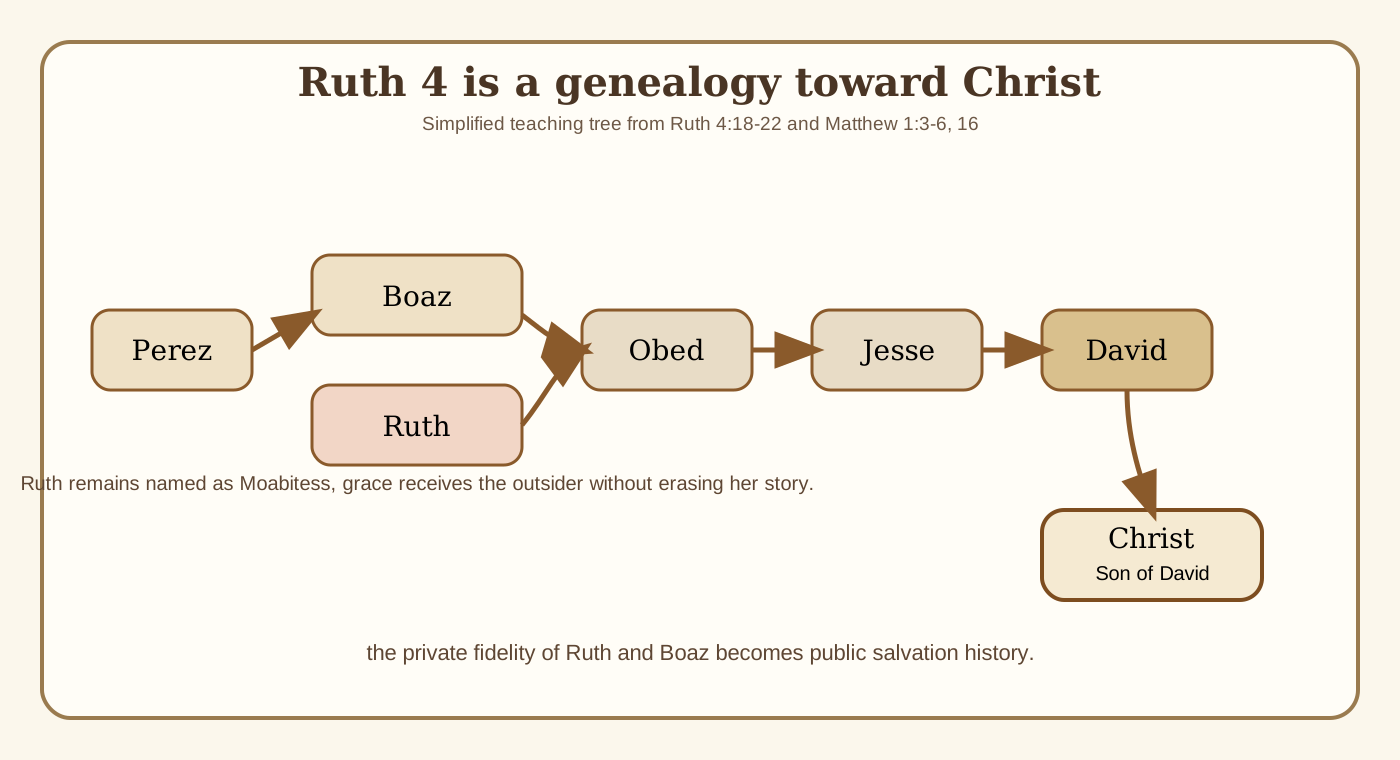 Source: Hermes original teaching chart, 2026-06-19, based on Ruth 4:18-22 and Matthew 1:3-6, 16.
The chart joins Ruth’s final names to Matthew’s genealogy. The birth of Obed stands between the mercy shown at Bethlehem’s gate and the royal ancestry that the Gospel carries to Christ.
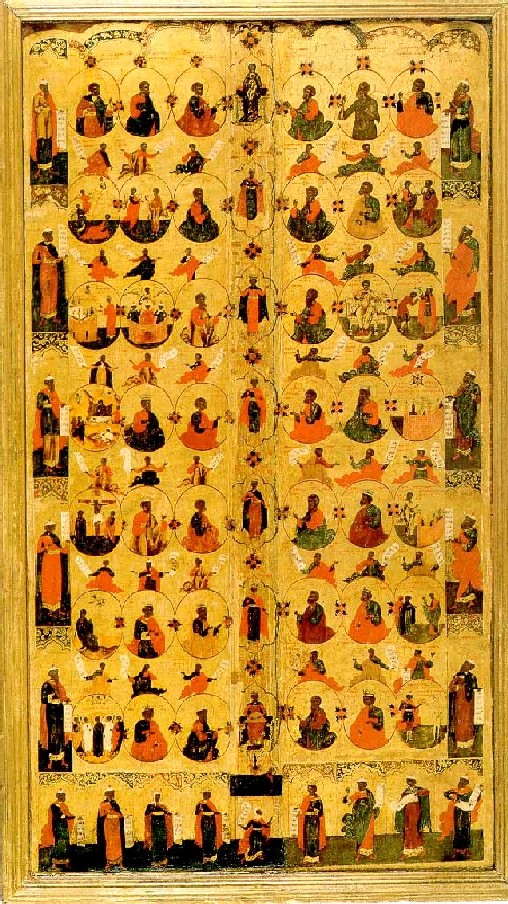 Source: Anonymous Tree of Jesse icon, seventeenth century, public domain via Wikimedia Commons; the record names ru-icons.ru as its source but does not identify a precise regional origin or collection.
The branching Tree of Jesse gives visible form to Christ’s human ancestry rooted in Jesse and David. Ruth is not the center of this image, but the ending of her book explains why that root matters. Its figures and branches serve the confession of an Incarnation prepared within real generations.
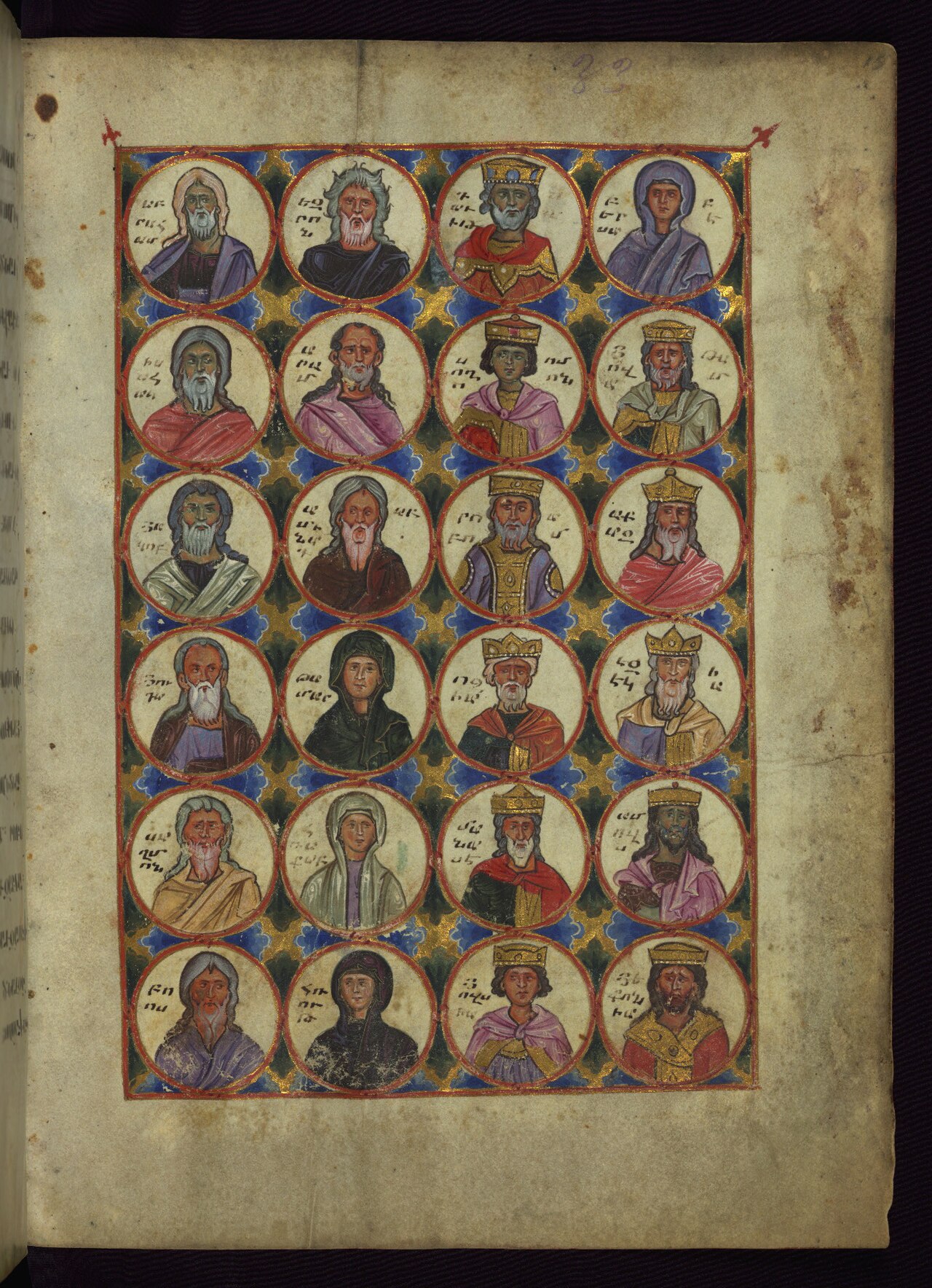 Source: T’oros Roslin Gospels, made at Hromkla in 1262, The Ancestors of Christ, Walters Manuscript W.539, fol. 15r, CC0 via Wikimedia Commons.
This Armenian Christian manuscript comes from a sister Oriental Orthodox tradition. Its portrait columns place women as well as kings within Christ’s ancestry; the source record identifies Tamar, Rahab, and Ruth in the second column. The image bears witness to the Gospel genealogy’s spiritual importance without functioning as an illustration of every event at Boaz’s gate.
Summary Table
| Element in Ruth 4 | Meaning in the story | Christian contemplation |
|---|---|---|
| Boaz at the gate | A promise becomes witnessed responsibility | Christ’s mercy calls His people to truthful, accountable care |
| The nearer kinsman refuses | Concern for inheritance limits his response | Christ shares our humanity and bears the cost of redemption |
| The witnesses bless Ruth | The Moabite widow receives an honored place in Israel’s family | The nations are gathered into the promises of Israel’s God |
| Obed is born | Naomi’s household receives renewed life and a future | Bethlehem’s later Nativity brings the Savior, not merely a successor |
| The genealogy ends with David | Local mercy belongs to the royal history | Matthew carries the line to the incarnate Son of David |
Spiritual Fruit 🍇
1. Let mercy reach the person
The nearer kinsman agrees to the field until its responsibility is made clear. Our help can fail in the same place: we give what is convenient and withdraw when someone needs time, patience, or continuing attention. One way to repent is to return to an obligation we have allowed to become vague. A promised visit to an elderly relative, a practical task for a grieving household, or a reliable parish duty can become care that someone is able to depend on. Christ’s sharing of our flesh and blood makes such care more than efficient generosity; it becomes a small participation in His willingness to come near.
2. Give promises a truthful form
Boaz does not leave Ruth waiting indefinitely on private reassurance. He acts before witnesses. In family, work, and parish service, love sometimes requires a clear commitment, an honest account, or an apology without evasions. We need not make private suffering public to practice that truth. The good of the person served determines what must be disclosed and what must remain protected. Our word should become dependable enough that another person’s future is not held hostage to our changing mood.
3. Receive consolation without silencing grief
Naomi holds Obed, yet Elimelech and her sons have not returned. God gives new life without declaring the earlier deaths unimportant. A grieving person need not pretend to be healed because some good has arrived. We can thank God for present care and still pray honestly over what has been lost. Those who accompany the bereaved can bring meals, visits, prayer, and patient company rather than demand a happy ending. The women bless both God’s gift and Ruth’s enduring love; consolation often arrives through people who remain.
4. Honor people whose history differs from yours
The elders bless Ruth while the narrative still calls her the Moabitess. Reception does not require humiliating a stranger for an accent, family, nationality, or poverty. A parish can confess one faith while making room for a person’s real history. That welcome becomes concrete in learning a name, sharing a table, explaining what someone does not yet know, and refusing gossip about their background. Christ’s genealogy gives no permission to rank the worth of people by their ancestors.
5. Serve without demanding to see the whole result
Ruth and Boaz could care for the household before them; they could not see Matthew’s Gospel. The genealogy releases us from needing to know every consequence of obedience. Faithfulness to a child, an aging parent, or an unnoticed task can be offered to Christ without being turned into a prediction of greatness. Obed’s name has the sense of service, and the book’s closing household is sustained by it. We can pray for those entrusted to us and do today’s duty, leaving the reach of that mercy to God.
Ruth ends with names because the people in this household belong to a history God has not abandoned. Naomi holds the child, Ruth’s love is honored, and Boaz’s public responsibility has become a family’s shelter. Beyond them lie Jesse, David, and the manger of Bethlehem. The Lord who gives a future to this household is the Lord who enters our history to save it.
Teaching Notes
Boaz brings redemption to the gate, Ruth 4:1-6
- Ask: When does a helpful promise become a responsibility someone can actually trust?
- Watch for: Treating Ruth as unwanted property or using ancient marriage language to override consent. Keep her earlier request and the chapter’s praise of her in view.
- Watch for: Overstating the unnamed man’s motives. The text gives his concern for inheritance, not a complete account of his inner life.
- Connect: Use Hebrews 2:11-17 to explain Christ’s shared humanity. Kinship vocabulary supports the comparison; it does not prove the Incarnation.
Witnesses bless the redemption, Ruth 4:7-12
- Ask: What is restored when a community publicly acknowledges a person rather than offering only private kindness?
- Watch for: Conflating Ruth’s transfer custom with Deuteronomy 25:9. Explain the different agents, settings, and presence or absence of the recorded reproach; do not claim this proves legal relaxation.
- Connect: Compare the elders’ naming of Tamar and Perez with Genesis 38. Do not supply Tamar’s ethnicity where Scripture does not state it.
- Watch for: Matthew 2:18 quotes a voice in Ramah and applies Rachel’s lament to Bethlehem’s bereaved mothers.
Obed is born and Naomi is restored, Ruth 4:13-17
- Ask: How can new consolation be received without requiring a bereaved person to deny the earlier loss?
- Watch for: Erasing Ruth’s motherhood, promising every widow a child, or treating grief as deficient faith.
- Watch for: The child is a strong reading of the redeemer in verse 14, but Boaz is also proposed. Retain that distinction when making the Nativity connection.
- Connect: Compare Ruth 4:15 with Psalm 23:3 (LXX 22:3) as related restoration wording, not an identical sentence or a claim about the circumstances of David’s composition.
The genealogy, Ruth 4:18-22
- Ask: What changes when the household’s story ends with David rather than with the marriage alone?
- Show: Use the Ruth-to-Christ chart after the transaction and birth, when the genealogy can be heard as the book’s ending.
- Show: Set the Tree of Jesse and the Armenian T’oros Roslin image beside the chart. Explain the difference between a generated schematic, an anonymous icon, and a dated manuscript witness.
- Watch for: Numerical doctrine from the ten names, anti-Jewish readings of the nearer kinsman, or claims that Christ’s ancestry makes wrongdoing innocent.
- Connect: Name the Nativity Paramoun Vespers Gospel accurately. The bridge appoints Matthew’s genealogy, not Ruth 4 or the Nativity feast Gospel itself.
Whole-study guidance
- Suggested timing: context 5 minutes; verses 1-6, 14 minutes; verses 7-12, 10 minutes; verses 13-17, 12 minutes; verses 18-22, 8 minutes; Spiritual Fruit and discussion, 6 minutes.
- Linger over the change between the kinsman’s first and second answers, then Naomi’s reception of the child. Keep the genealogy as the concluding horizon.
- Compress technical legal reconstruction where the evidence is uncertain; explain the sandal’s attestation function without making that detail carry the whole lesson.
Glossary
- City gate: A public setting for legal transactions, witness, and judgment.
- Kinsman-redeemer: A relative with responsibility for family interests such as land, name, and protection.
- Levirate marriage: The brother-in-law marriage duty described in Deuteronomy 25:5-10; Ruth’s related customs cannot simply be equated with it.
- Paramoun: Preparation for a major feast; here, the Nativity Paramoun and its Vespers Gospel.
- Obed: Ruth and Boaz’s son, Jesse’s father, and David’s grandfather; the name has the sense of serving.
- Tree of Jesse: Genealogical imagery showing Christ’s human ancestry rooted in Jesse and David.
- Typology: A Christian reading in which earlier persons or events help disclose their fuller fulfillment in Christ, without making every detail identical.
Translation and Source Notes
Embedded Scripture is from Brenton’s English Septuagint (LXX).
Greek comparisons use the CCAT Rahlfs-based electronic Septuagint, not an independently collated modern printed edition. Its kinship and restoration wording explains the passage without replacing the displayed Brenton text. Hebrew name and root observations use the cited interlinear and lexical sources.
The patristic witnesses include a verified quotation from Chrysostom and an attributed paraphrase of Ambrose. Chrysostom’s discussion belongs to his explanation of Matthew’s genealogy, not a continuous commentary on Ruth 4. Ambrose’s section is confirmed in the Latin text and a printed French translation; no newly translated English sentence is presented as a published quotation. Their selected interpretations do not import the polemical synagogue contrasts in the surrounding texts.
The Nativity Paramoun appointment is attested by @andraws/lectionary-data 1.3.1 through its public-practice source records. It has not been independently reconfirmed here in Coptic Reader. The negative Ruth and Synaxarium findings are limited to the sources checked, not every historical service text.
Sources
Ruth, Brenton Septuagint; especially 1:6, 1:21, 3:17, and chapter 4. Matthew 1:1-17; Hebrews 2:11-17; Genesis 35:19; Genesis 38; Micah 5:2; Matthew 2:6, 18; John 1:27; Isaiah 42:1; Philippians 2:7; Psalm 23:3 (LXX 22:3).
Leviticus 25:25 and Deuteronomy 25:5-10 for related land and household duties; Deuteronomy 23:3-6 for assembly exclusion; Deuteronomy 24:19-22 for care of widows and strangers.
St John Chrysostom, Homilies on the Gospel of Matthew, Homily 3.5, primary text. St Ambrose, Exposition of the Gospel according to Luke 3.30, primary Latin text.
CCAT Rahlfs-based Ruth; edition description; LSJ, “ἀγχιστεύς” and “ἀγχιστεύω”; Ruth 4 Hebrew interlinear; BDB, “Obed”.
@andraws/lectionary-data 1.3.1, Nativity Paramoun Vespers Gospel and checked Ruth/Synaxarium coverage, with underlying CopticChurch.net date-resolved reading record.
Visual records: Tree of Jesse icon; T’oros Roslin, Ancestors of Christ, Walters W.539, fol. 15r.
Robert L. Hubbard Jr., The Book of Ruth, NICOT; Edward F. Campbell Jr., Ruth, Anchor Bible; Katharine Doob Sakenfeld, Ruth, Interpretation. These remain further reading, not the source of an unlocated page-specific claim.
Footnotes
-
CCAT Rahlfs-based Ruth 4:6; LSJ, “ἀγχιστεύς” and “ἀγχιστεύω”. ↩
-
Competing interpretations collected under Ruth 4:14: Ellicott reads the child; Cambridge discusses that reading while favoring Boaz. ↩
-
CCAT, Ruth 4:15 and Psalm 23:3 (LXX 22:3); compare the Hebrew wording. ↩
-
BDB, “Obed”; Ruth 4:17 Hebrew. ↩
-
St John Chrysostom, Homilies on the Gospel of Matthew, Homily 3.5, primary text. Quotation and attributed interpretation of his Ruth-and-Church reading. ↩ ↩2
-
St Ambrose, Exposition of the Gospel according to Luke 3.30, primary Latin text; section verified in Gabriel Tissot’s French translation, Traité sur l’Évangile de S. Luc, Sources Chrétiennes 45, pp. 136-137. Attributed paraphrase. ↩
-
@andraws/lectionary-data 1.3.1 records Matthew 1:1-17 at Nativity Paramoun Vespers, drawing on the CopticChurch.net reading witness. This is package-attested, not a fresh Coptic Reader confirmation. ↩