


Samuel is still mourning Saul when God tells him to fill his horn with oil. The throne remains occupied, yet the Lord has already seen a king among Jesse’s sons. Even Samuel will mistake an impressive appearance for God’s choice. David is called from the sheep, anointed among his brothers, and then sent into the service of the troubled king he will eventually succeed. The chapter’s promise is joined to a searching demand: receive grace with a heart that can be corrected and returned, and let calling become service before it becomes recognition.
Lesson guide
- Key phrases: the Lord looks at the heart; hidden anointing; Bethlehem before the throne.
- Emphasize: David is chosen by God before he is useful to men.
- Avoid: turning David into a self-esteem lesson detached from Christ.
Historical and Scriptural Context
This study uses the familiar English book names. In the Septuagint, 1-2 Samuel and 1-2 Kings form the four books of Kingdoms, so this book is 1 Kingdoms there.
Saul’s rejection in the preceding chapter leaves Samuel grieving and Israel with a king whose authority has outlasted his obedience. God sends Samuel to Bethlehem without immediately removing Saul. David’s consecration therefore begins a long period in which the chosen king must wait, serve, and suffer. He is introduced here both as Jesse’s overlooked son and as the musician Saul comes to love.
Geographical Significance ⛰️
Bethlehem belongs to the story of Ruth and Boaz, whose family line reaches Jesse and David (Ruth 4:17–22). Here a king is sought in a household rather than a palace. Micah later names Bethlehem as the place from which Israel’s ruler will come and describes his shepherding in the Lord’s strength (Micah 5:2–4 in Hebrew-based English numbering; LXX 5:1–3). Matthew 2:6 brings ruler and shepherd together when it announces Christ’s birthplace. David’s anointing prepares us to recognize the Son of David, while Christ’s coming reveals a kingship greater than David’s.
The Characters 👥
Samuel is a faithful prophet who still needs correction. His grief is honored, his fear is heard, and his first judgment about Eliab is overturned. Jesse presents seven sons; the youngest remains in the field until Samuel asks about him. David is both shepherd and anointed servant; the same hands that tend the flock will bring relief to Saul. Saul remains king, but now suffers torment. His need calls forth mercy before his later hostility brings danger.
Grief Sent into Obedience (1 Samuel 16:1–5)
- And the Lord said to Samuel, How long dost thou mourn for Saul, whereas I have rejected him from reigning over Israel? Fill thy horn with oil, and come, I will send thee to Jessæ, to Bethleem; for I have seen among his sons a king for me.
- And Samuel said, How can I go? whereas Saul will hear of it, and slay me: and the Lord said, Take a heifer in thine hand and thou shalt say, I am come to sacrifice to the Lord.
- And thou shalt call Jessæ to the sacrifice, and I will make known to thee what thou shalt do; and thou shalt anoint him whom I shall mention to thee.
- And Samuel did all that the Lord told him; and he came to Bethleem: and the elders of the city were amazed at meeting him, and said, Dost thou come peaceably, thou Seer?
- And he said, Peaceably: I am come to sacrifice to the Lord. Sanctify yourselves, and rejoice with me this day: and he sanctified Jessæ and his sons, and he called them to the sacrifice.
God’s question does not make Samuel’s sorrow foolish. Samuel loved Saul and had invested years in his kingship. Yet grief can become a way of standing still before a command already given. The Lord places a horn of oil in the prophet’s hands and gives him someone else to seek. Samuel cannot restore Saul’s obedience by mourning longer; he can obey the Lord’s next word. For us, mourning a failed ministry, a broken friendship, or our own wasted opportunities must eventually open into the faithful work still entrusted to us.
Samuel’s fear is also concrete: Saul may kill him. God does not dismiss the danger or require an announcement of everything Samuel has been sent to do. The sacrifice is real, and Jesse is genuinely invited to it. Samuel speaks a true purpose while keeping the anointing from a king who might violently oppose it. Obedience here includes prudence. Christ’s command to be wise as serpents and harmless as doves joins clear judgment to innocence (Matthew 10:16).
The elders’ question, “Dost thou come peaceably,” shows how much anxiety surrounds authority. Samuel answers with peace and calls them to sanctify themselves. God’s work in this household begins with worship and preparation, not with a campaign for David’s advancement. The prophet must himself listen before he can reveal the king.
Gems from the Fathers 💎: Truthfulness and Protective Silence
Saint Augustine distinguishes withholding a truth from asserting a falsehood. In Against Lying §23 he discusses this distinction through Christ’s silence and the patriarchs, rather than commenting directly on Samuel’s visit. His principle helps us understand why a truthful statement need not disclose every purpose to a dangerous hearer: “It is not, however, the same thing to hide the truth as it is to utter a lie.”1
Saint John Cassian’s Conference XVII gives a different account of exceptional deception. Abba Joseph permits it as a last resort against grave danger, comparing it to a dangerous medicine, while still requiring a humbled conscience. He insists, “But where there is no call of the utmost necessity present, there a lie should be most carefully avoided as if it were something deadly”2. This is a thematic witness about peril and truthfulness, not a direct exposition of 16:2. Augustine and Cassian should not be made to say the same thing about whether lying can ever be justified.
For Samuel’s actual words, Fr. Tadros Y. Malaty, a modern Coptic commentator, explains that the public sacrifice and the undisclosed anointing allow Samuel to reveal part of the truth without lying.3 The practical distinction matters: protecting someone from violence differs from inventing a holy excuse for convenience, reputation, or gain. A person threatened by abuse is not obliged to provide an aggressor with information that enables further harm. Seeking safety and trustworthy help is compatible with a truthful life.
The Heart Seen and the Shepherd Anointed (1 Samuel 16:6–13)
- And it came to pass when they came in, that he saw Eliab, and said, Surely the Lord’s anointed is before him.
- But the Lord said to Samuel, Look not on his appearance, nor on his stature, for I have rejected him; for God sees not as a man looks; for man looks at the outward appearance, but God looks at the heart.
- And Jessæ called Aminadab, and he passed before Samuel: and he said, Neither has God chosen this one.
- And Jessæ caused Sama to pass by: and he said, Neither has God chosen this one.
- And Jessæ caused his seven sons to pass before Samuel: and Samuel said, The Lord has not chosen these.
- And Samuel said to Jessæ, Hast thou no more sons? And Jessæ said, There is yet a little one; behold, he tends the flock. And Samuel said to Jessæ, Send and fetch him, for we may not sit down till he comes.
- And he sent and fetched him: and he was ruddy, with beauty of eyes, and very goodly to behold. And the Lord said to Samuel, Arise, and anoint David, for he is good.
- And Samuel took the horn of oil, and anointed him in the midst of his brethren: and the Spirit of the Lord came upon David from that day forward: and Samuel arose, and departed to Armathaim.
Samuel sees Eliab and reaches his conclusion at once. The prophet who has witnessed Saul’s failure still finds an impressive figure persuasive. God’s correction reaches the teacher before it reaches the household: “Look not on his appearance, nor on his stature.” Samuel’s authority does not make his first impression infallible. His holiness appears in his willingness to yield it. We can become attached to our spiritual judgment precisely because it is ours; Samuel lets the Lord interrupt him.
Language insight: “I have rejected him” and “for he is good”
Rahlfs’ Greek uses the same form, ἐξουδένωκα, “I have rejected,” for Saul in 16:1 and Eliab in 16:7. The repetition links Samuel’s mistake to the kingship just rejected. Eliab’s appearance and stature recall the qualities that made Saul seem an obvious king in 1 Samuel 9:2 and 10:23. In that limited sense Eliab stands before Samuel as another Saul. The comparison concerns the prophet’s criteria; it does not reveal Eliab’s secret motives or establish that he has committed Saul’s sins.4
The Greek contrast in 16:7 is between seeing into a πρόσωπον, “face,” and seeing into a καρδία, “heart.” God knows the person whom the visible surface cannot disclose. This does not give us permission to claim knowledge of other people’s hidden hearts. It teaches us to submit our judgments to the One who does. When the apostles choose Matthias, they pray to the Lord who knows everyone’s hearts (Acts 1:24). Jeremiah 17:10 joins God’s searching of the heart to judgment according to one’s ways. The heart is more than a sincere feeling: thought, desire, choice, and obedience belong together before God.
David is himself beautiful in verse 12. The passage does not condemn beauty; it removes beauty from the throne of judgment. Rahlfs’ final command reads ὅτι οὗτος ἀγαθός ἐστιν, rendered by NETS “for this one is good,” and by Brenton “for he is good.” Hebrew-based English versions instead identify him as the one to anoint. The Greek gives God’s favorable judgment, but verse 7 governs how we receive it. David is not elected because Samuel has discovered the better-looking candidate, nor is the phrase a promise that David will never sin.4 Acts 13:22 describes God’s approval of David in terms of doing His will. A heart God can correct is more important than an appearance people admire.
This reaches ordinary parish life. Christ warns about what is highly esteemed among people while God knows the heart (Luke 16:15), and commands righteous judgment rather than judgment by appearance (John 7:24). James 2:1–4 makes the test painfully visible: the richly dressed visitor receives a good seat while the poor person is kept standing. A community can confess that God sees the heart and still arrange its attention around money, confidence, influence, and useful connections.
Waiting for the Son in the Field
Seven sons pass before Samuel, and none is chosen. Only then does Samuel ask whether there are more. Jesse’s youngest is still with the flock. The Lord’s choice reaches the son whom the family has not brought into view. Samuel’s response changes the whole gathering: “we may not sit down till he comes.” The important people must wait for the overlooked one. Sometimes the first amendment a community needs is to stop its own proceedings long enough to include the person it has forgotten.
David’s place among his brothers belongs to a wider biblical reversal. Jacob receives a promise that does not follow ordinary birth order, and Joseph’s older brothers must eventually receive help from the brother they rejected (Genesis 25:23; 37; 45). These stories have their own difficulties; being younger is no automatic sign of virtue. Their shared lesson is that family rank cannot command God’s election. Saint Paul brings the point home to the Church: God chooses what the world dismisses so that no flesh may glory before Him (1 Corinthians 1:26–29). The overlooked reader may take courage in God’s attention without treating David’s royal calling as a guarantee of personal greatness.
The shepherd’s work is already preparation for care of a people. Psalm 78:70–72 (LXX Ps 77:70–72) reads David’s life this way: God takes him from the sheep to shepherd Israel with integrity of heart and skill of hand. The elders later recall God’s charge that David feed His people (2 Samuel 5:2), and God reminds David that He took him from the sheepfold (2 Samuel 7:8). Authority is measured by the life it tends. Ezekiel 34:23–24 promises one shepherd, God’s servant David; in Christ, the Good Shepherd, that promise reaches the One who gives His own life for the sheep (John 10:11). Hidden responsibility in the field matters because real people will one day need faithful care.
Anointed, but Still Waiting
The oil is poured out “in the midst of his brethren,” and the Spirit comes upon David from that day forward. His calling is hidden from the wider nation, not from everyone. The consecration is real, but the throne does not become his at once. Scripture records this anointing, another over Judah at Hebron (2 Samuel 2:4), and a third over all Israel (2 Samuel 5:3). Between the first and the later anointings lie flight, danger, and restraint. Grace sustains the long obedience rather than abolishing it.
Psalm 89:20 (LXX Ps 88:21) joins the finding of David with his anointing. Brenton renders the latter as being anointed by God’s “holy mercy,” while Hebrew-based English speaks of holy oil. Both readings turn our attention toward God’s initiative. A Christian receives grace as a gift, not as a certificate of entitlement. Romans 8:17 and 2 Timothy 2:12 place sharing Christ’s glory and reign beside suffering and endurance. Our hope is communion with Christ, not a promise that every faithful person will be publicly successful.
Gems from the Fathers 💎: Christ Anointed for Our Sanctification
Saint Athanasius reads Psalm 45:7 (LXX Ps 44:8), quoted in Hebrews 1:9, with the preceding confession of the Son’s everlasting throne. David becomes king through God’s appointment; the eternal Word does not become God or acquire a kingdom He previously lacked. Athanasius writes that Christ is anointed “not that He may become God, for He was so even before; nor that He may become King, for He had the Kingdom eternally”5.
The anointing belongs to His saving Incarnation. The eternal Son truly takes our humanity and, as man, receives the Spirit for our sanctification. Isaiah 61:1, proclaimed by Christ in Luke 4:18, and Acts 10:38 name this anointing with the Holy Spirit. Athanasius explains that the descent at Jordan “did not take place for promotion to the Word, but again for our sanctification, that we might share His anointing”5. The Holy Spirit is true God, the giver of sanctification, not a lesser divine power used to promote an inferior Son. The Father’s eternal Son brings us into the life of the Holy Trinity.
In the Church’s Holy Myron, the consecrated chrism with which the baptized are sealed, anointing speaks of receiving the Spirit and belonging to Christ. David’s oil and the Christian mystery are distinct, yet the fulfillment gives the earlier sign its deepest light: consecration is a gift for holiness and service, not an ornament of spiritual rank.
The Church’s Voice in Worship ⛪
LXX Psalm 151 remembers the little son among his brothers, his father’s sheep, his music, his anointing, and the handsome brothers whom the Lord did not choose. The relevant remembrance is LXX Psalm 151:1–5 in Brenton and NETS: the anointing is verse 4, and the comparison with the brothers is verse 5. The psalm then continues into David’s encounter with the Philistine. It holds together the hidden calling and the later deliverance.6
The Coptic Night of the Apocalypse on Bright Saturday begins with LXX Psalm 151 in the printed service book. The rubric directs it to be chanted with its known tune. After it, the Book of Psalms is wrapped in white linen and carried in procession while the thanksgiving “Let us give thanks, to Christ our God, with David the prophet, and psalmist” is sung.7 In the vigil following the Lord’s burial, the Church receives David’s smallness, election, and victory within its praise of Christ. The shepherd chosen in obscurity becomes a voice of hope as the faithful await the Resurrection. This is a worship connection through LXX Psalm 151’s remembrance, not an assertion that 1 Samuel 16 itself is appointed as that service’s chapter reading.
Lesson guide
- Key phrases: God sees before people summon; the anointing comes before usefulness.
- Emphasize: hiddenness is not absence from God’s sight.
- Avoid: making the heart into vague sincerity without obedience.
The Anointed One Serves the Rejected One (1 Samuel 16:14–23)
- And the Spirit of the Lord departed from Saul, and an evil spirit from the Lord tormented him.
- And Saul’s servants said to him, Behold now, an evil spirit from the Lord torments thee.
- Let now thy servants speak before thee, and let them seek for our lord a man skilled to play on the harp; and it shall come to pass when an evil spirit comes upon thee and he shall play on his harp, that thou shalt be well, and he shall refresh thee.
- And Saul said to his servants, Look now out for me a skilful player, and bring him to me.
- And one of his servants answered and said, Behold, I have seen a son of Jessæ the Bethleemite, and he understands playing on the harp, and the man is prudent, and a warrior, and wise in speech, and the man is handsome, and the Lord is with him.
- And Saul sent messengers to Jessæ, saying, Send to me thy son David who is with thy flock.
- And Jessæ took a homer of bread, and a bottle of wine, and one kid of the goats, and sent them by the hand of his son David to Saul.
- And David went in to Saul, and stood before him; and he loved him greatly; and he became his armour-bearer.
- And Saul sent to Jessæ, saying, Let David, I pray thee, stand before me, for he has found grace in my eyes.
- And it came to pass when the evil spirit was upon Saul, that David took his harp, and played with his hand: and Saul was refreshed, and it was well with him, and the evil spirit departed from him.
The Spirit comes upon David in verse 13 and departs from Saul in verse 14. The adjacent verses make the contrast unmistakable. Saul retains his position, while the spiritual gift that equipped his kingship is withdrawn. David’s later prayer in Psalm 51:11 (LXX Ps 50:13), that God not remove His Holy Spirit, gives us words with which to receive this warning. Grace is neither a possession we control nor a reason to stop repenting.
The phrase “an evil spirit from the Lord” is difficult, and it must retain its weight as language of judgment. God remains sovereign even where evil brings suffering. Judges 9:23 speaks of an evil spirit between Abimelech and the men of Shechem; 1 Kings 22:19–23 depicts a lying spirit in the judgment of Ahab. These are related accounts of judgment under divine sovereignty, not a complete explanation of Saul’s particular torment. Read with James 1:13, which denies that God tempts anyone to evil, they do not make God morally evil or the creator of an evil nature. Withdrawal of the royal gift and providential permission describe judgment without identifying God’s goodness with the evil that torments Saul.
Fr. Tadros Malaty explains Saul’s condition in terms of resisting the Spirit and being given over to what one has chosen, drawing a parallel with Romans 1:24–28.3 That moral and spiritual reading belongs to this narrated kingship. We should not diagnose Saul by modern categories, nor turn his story into a diagnosis of our neighbors. Mental illness is not evidence of personal wickedness or demonic possession. A suffering person deserves compassionate company, prayer, appropriate medical care, and protection from stigma. David’s response is to bring relief, not to accuse Saul.
Saul’s servants notice his suffering and propose something that may help. Their concern matters. The servant who recommends David lists skill, prudence, courage, speech, and beauty, but ends with “the Lord is with him.” The final phrase gives the list its center. Gifts become life-giving through communion with the Lord, rather than through talent alone.
The same recognition returns in 1 Samuel 18:14, where David’s prudent conduct is joined to the Lord’s presence, and in 18:28, where Saul sees that the Lord is with David. In Brenton’s shorter 18:12 Saul is simply alarmed on account of David; the reason found in longer Hebrew-based accounts is not stated in that verse. As Saul comes to fear David, the gift that first refreshed him becomes something he perceives as a threat. The danger lies in a heart that sees another person’s grace as its own loss.
Mercy Before Recognition
Jesse sends bread, wine, and a kid with David, who stands before Saul and becomes his armour-bearer. Saul loves him greatly. The chapter begins their relationship in affection and service, which makes the later persecution more grievous. David’s calling does not cause him to treat Saul as disposable. The anointed one serves the rejected one. He neither announces his superiority nor uses Saul’s weakness to press his claim.
This service is a searching test of our own use of spiritual gifts. We may readily help someone who recognizes our worth, then withdraw when that person disappoints us. David enters a house that will later become dangerous and brings the mercy needed now. Christ fulfills the servant’s kingship far beyond David: He comes into humanity’s suffering to heal and save, and gives His life even for those who reject Him. Our service is true when the other person’s need, rather than our desire to be admired, governs what we give. Mercy also requires wise limits when a relationship becomes unsafe; David’s later flight will not cancel the goodness of his present care.
Gems from the Fathers 💎: Psalmody and the Soul’s Harmony
In his Letter to Marcellinus §§27–29, Saint Athanasius explains why psalmody, the singing of the Psalms, reaches deeper than pleasure in a tune. The mind and bodily members are to become harmonious under the Spirit’s guidance. In §29 he expressly recalls David’s music for Saul: David’s own communion with God enables his song to quiet another person’s troubled condition. Melody serves the ordering of the soul toward God.8
David takes the harp and plays “with his hand.” The relief is concrete: Saul is refreshed, and the spirit departs. Athanasius helps us hear a spiritual significance in that action without treating music as a mechanical cure. In the Church, the words of the Psalms school our grief, fear, repentance, thanksgiving, and hope. Singing them attentively lets the body join the prayer of the mind and heart. A beautifully sung psalm reaches its purpose when the singer also consents to its truth.
For someone too burdened to sustain a long prayer, a few verses sung or read slowly may become a place to begin again. Another person’s steady prayer can also help carry us when our own words fail. Psalmody belongs beside pastoral and medical care, never as a demand to abandon treatment or a test by which sick people are blamed for remaining ill.
Lesson guide
- Key phrases: the anointed one serves the rejected one; ordered beauty brings relief.
- Emphasize: David’s humility after anointing.
- Avoid: careless claims about mental illness or demonization.
Iconography Connection 🖼️
The Dura-Europos panel is an ancient Jewish synagogue painting of Samuel anointing David, not an Orthodox icon. It witnesses to the scene’s importance in the reception of Scripture. The genealogy schematic places Jesse and David within Ruth’s closing family line; neither ancestry nor a family’s first arrangement of its sons replaces God’s discernment.
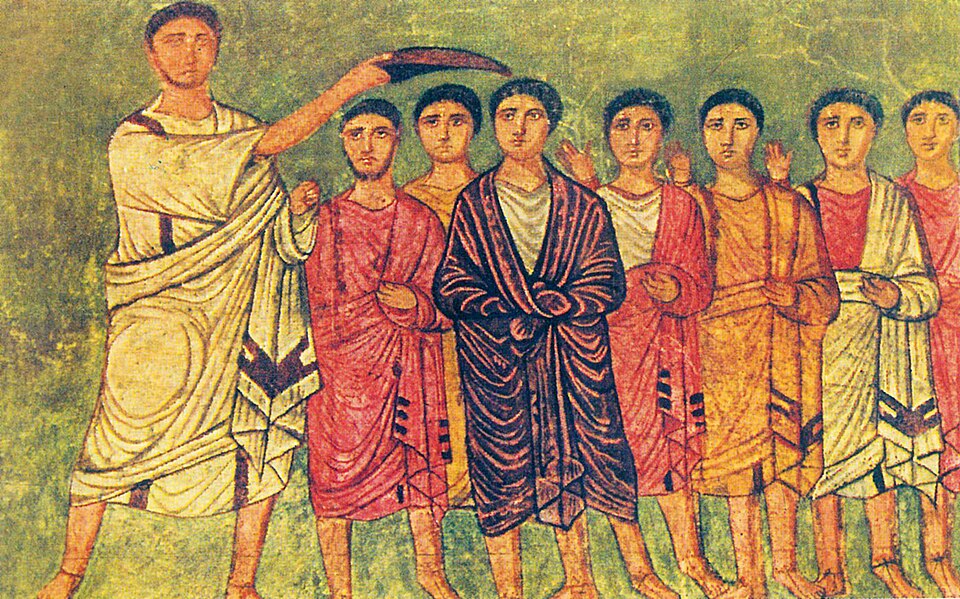 Dura-Europos Synagogue, panel WC3, third century. Yale Gilman collection image, reworked by Marsyas; public-domain art reproduction via Wikimedia Commons. 🔗
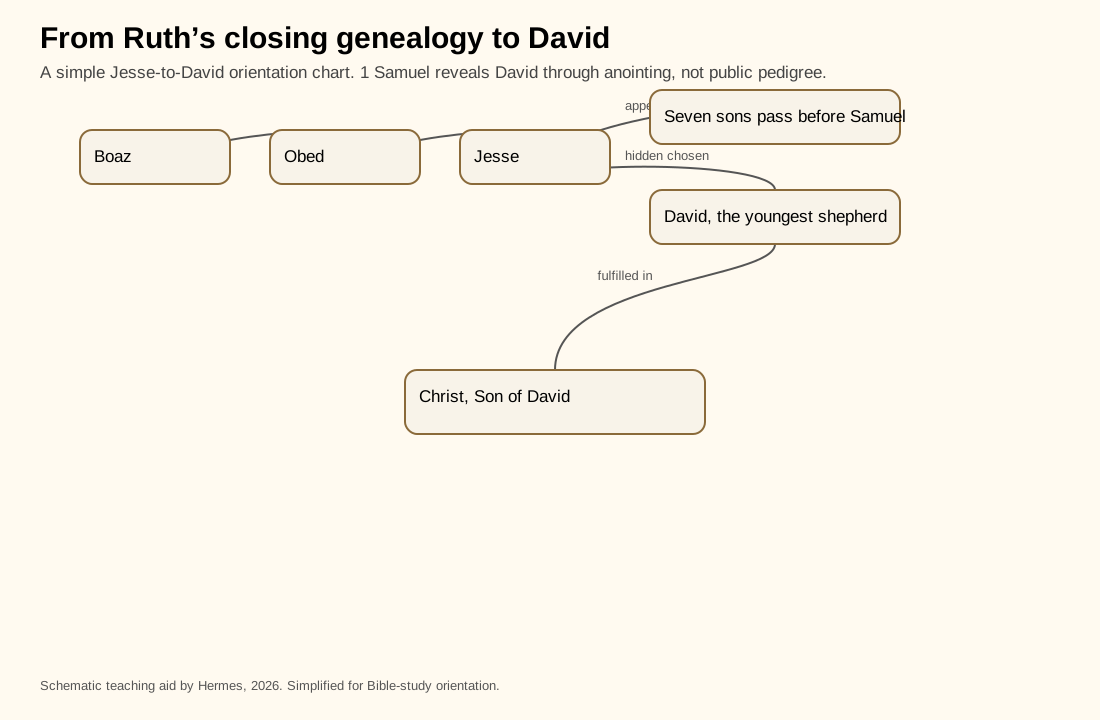 Genealogy schematic based on Ruth 4:17–22: Boaz and Ruth, Obed, Jesse, David.
| God’s work in Israel | What this chapter reveals | Fulfillment and life in Christ |
|---|---|---|
| Samuel sent to Bethlehem | Grief becomes obedience without reckless exposure to violence | Christ joins wisdom to innocence; we can obey and protect those at risk |
| The overlooked shepherd called and anointed | God sees the heart, and all must wait for the son in the field | The Son of David shepherds His people; grace removes boasting and trains patient service |
| David brings relief to Saul | The anointed one serves the rejected one | Christ heals and gives Himself; gifts are received for mercy rather than rivalry |
Spiritual Fruit 🍇
-
Let correction reach your judgment. Samuel had to surrender his first certainty about Eliab. Before assigning importance in a household or parish, notice whom you hear readily and whom you leave standing. Give the neglected person time and attention. Pray for a heart willing to discover that its first impression was wrong.
-
Bring grief into the next obedience. Name before God what you cannot repair, then undertake one duty that sorrow has kept you from doing. Samuel’s horn of oil does not erase Saul’s failure; it makes his hands available for God’s continuing work. Mourning may need patient support, but it need not become abandonment of love.
-
Receive hidden service as real service. David tends sheep before he is summoned and serves Saul before he reigns. Complete a small responsibility without turning it into a claim for recognition. At confession, name resentment over being unnoticed if it has begun to poison the work. God’s sight is a firmer rest than an audience’s approval.
-
Use your gifts to relieve another person’s burden. Visit, listen, bring food, offer practical help, or pray with someone who is suffering. Refrain from spiritual diagnoses that add shame. If singing a psalm brings comfort, offer it gently and alongside the person’s appropriate care, without promising an instant cure.
Lord, give me Samuel’s willingness to be corrected and David’s hands ready for service. Remember the person I have left outside my attention. Keep me faithful in the field, and merciful in the troubled house. Let the grace You give me become another person’s relief, and keep my heart near You while I wait.
Teaching Notes
Whole-study focus: God’s choice sees deeper than public appearance, and His gift becomes service. Preserve the distinction between LXX Psalm 151’s confirmed Bright Saturday use and an exact reading appointment of this narrative chapter. The images are a Jewish historical witness and a biblical genealogy schematic.
Grief Sent into Obedience (1 Samuel 16:1–5)
- Ask: How does Samuel’s truthful announcement of a sacrifice differ from both reckless disclosure and a lie told for personal advantage?
- Watch for: Treating Augustine and Cassian as unanimous about exceptional lying, or using prudence to excuse manipulation or to demand that an endangered person disclose information to an aggressor.
The Heart Seen and the Shepherd Anointed (1 Samuel 16:6–13)
- Ask: What changes in the household when Samuel refuses to sit down until the overlooked son arrives?
- Watch for: Equating God’s election with good looks, sinlessness, guaranteed worldly success, or the idea that Christ became God through His anointing.
The Anointed One Serves the Rejected One (1 Samuel 16:14–23)
- Ask: What does David’s service reveal about receiving a gift from God without making another person’s weakness an opportunity for self-advancement?
- Watch for: Calling mental illness a proof of sin or possession, treating psalmody as a substitute for treatment, or urging a person to remain in an unsafe relationship.
Glossary
- Heart: the inner center of thought, desire, decision, and obedience, known fully by God.
- Anointing: consecration by oil for an appointed service; Christ is the Anointed One who sanctifies us.
- Holy Myron: consecrated chrism used in the Church to seal the baptized with the gift of the Holy Spirit.
- Psalmody: the prayerful singing of the Psalms, joining words, attention, and bodily voice in worship.
- Bright Saturday: the Coptic observance following Good Friday and leading toward the celebration of the Resurrection; the Night of the Apocalypse includes LXX Psalm 151 and the reading of Revelation.
Translation and Source Notes
Embedded Scripture is from Brenton’s English Septuagint (LXX).
All twenty-three verses of the chapter are included. Brief New Testament references use NKJV. Psalm citations give Hebrew-based English numbering first, followed by the LXX reference where different. Verse numbers have also been checked: Psalm 78:70–72 corresponds to LXX 77:70–72; 89:20 to LXX 88:21; 45:7 to LXX 44:8; and 51:11 to LXX 50:13. LXX Psalm 151:1–5 covers both anointing and the brothers in the Brenton and NETS divisions. NETS is used for comparison with Rahlfs, not as a replacement for the embedded Brenton text. Greek observations concern the actual wording of the indicated verses, not a claim that Brenton and NETS are identical in every detail.
Sources
Lancelot C. L. Brenton, The Septuagint Version of the Old Testament, 1 Samuel 16; biblical parallels discussed above. Public chapter text: 🔗
A New English Translation of the Septuagint (NETS), “1 Reigns,” translated by Bernard A. Taylor, and “Psalms,” translated by Albert Pietersma. 🔗 🔗
Alfred Rahlfs, Septuaginta (1935), 1 Samuel 16:1, 7, 12–14; CCAT/CATSS Greek text and morphological edition. 🔗
Saint Augustine, To Consentius, Against Lying, §23, translated by H. Browne, Nicene and Post-Nicene Fathers, First Series, volume 3. 🔗
Saint John Cassian, Conference XVII, especially chapters 17–20, translated by Edgar C. S. Gibson, Nicene and Post-Nicene Fathers, Second Series, volume 11. 🔗
Saint Athanasius, Discourse I Against the Arians, §§46–47, translated by John Henry Newman and Archibald Robertson, Nicene and Post-Nicene Fathers, Second Series, volume 4. 🔗
Saint Athanasius, Letter to Marcellinus on the Interpretation of the Psalms, §§27–29, English translation by Robert C. Gregg. Used here by paraphrase. 🔗
Fr. Tadros Y. Malaty, First Samuel: A Patristic Commentary (2004), chapter 16, translated by Dr. George Botros, English text revised by Sameh Shafik and Ferial Moawad; Coptic Orthodox Christian Center, Orange, California. A modern Coptic commentary, distinguished from the primary patristic texts. 🔗
Fr. Jacob Nadian, Rites of the Pascha Week, Book 6, Night of the Apocalypse, pp. 9–10: LXX Psalm 151, its opening rubric, and the procession with the Book of Psalms. Saint Bishoy Coptic Orthodox Church. 🔗
Hebrew-based English Psalm parallels, New King James Version: Psalms 78:70–72; 89:20; 45:7; 51:11. 🔗
Wikimedia Commons, “Dura Synagogue WC3 David anointed by Samuel,” Yale Gilman collection; reproduction reworked by Marsyas, public-domain art. 🔗
Footnotes
-
Saint Augustine, Against Lying, §23, H. Browne translation, NPNF First Series 3. 🔗 ↩
-
Saint John Cassian, Conference XVII, chapter 17, Edgar C. S. Gibson translation, NPNF Second Series 11. Chapters 18–20 continue the debate about exceptional deception. 🔗 ↩
-
Fr. Tadros Y. Malaty, First Samuel (2004), chapter 16, pp. 83–87, on David’s anointing and his service to Saul. Modern Coptic pastoral interpretation. 🔗 ↩ ↩2
-
Rahlfs’ Greek, 1 Samuel 16:1, 7, 12, in the CCAT/CATSS edition, 🔗; Bernard A. Taylor, NETS, 1 Reigns, 1 Samuel 16:7, 12, 🔗. ↩ ↩2
-
Saint Athanasius, Discourse I Against the Arians, §§46–47, Newman and Robertson translation, NPNF Second Series 4. Both quotations come from these consecutive sections. 🔗 ↩ ↩2
-
Brenton, LXX Psalm 151:1–5; Albert Pietersma, NETS, Psalms, pp. 619–620. The anointing is verse 4 and the handsome brothers verse 5 in both divisions. 🔗 ↩
-
Fr. Jacob Nadian, Rites of the Pascha Week, Book 6, Night of the Apocalypse, pp. 9–10. The printed order is LXX Psalm 151 followed by the procession and thanksgiving with David the psalmist. 🔗 ↩
-
Saint Athanasius, Letter to Marcellinus, §§27–29, Robert C. Gregg translation, especially §29’s direct reference to David playing for Saul. 🔗 ↩