


This narration is from a previous version of the study and may include a combined recording of multiple chapters.
Micah 5 is the book’s Christological center. Bethlehem is small, but God chooses smallness to reveal the Shepherd-King whose origin is from eternity.
The preceding chapter leaves Zion under siege. Here the answer begins not with a larger army in Jerusalem but with a ruler coming from Bethlehem. His coming gathers a scattered people, gives peace under threat, and strips away the securities that have competed with God. The wonder of the Nativity and the work of repentance belong to the same salvation.
Micah 5:1-3 - Bethlehem, the Birth, and the Shepherd from Eternity
Translation: Brenton Septuagint.
- And thou, Bethleem, house of Ephratha, art few in number to be reckoned among the thousands of Juda; yet out of thee shall one come forth to me, to be a ruler of Israel; and his goings forth were from the beginning, even from eternity.
- Therefore shall he appoint them to wait till the time of her that travails: she shall bring forth, and then the remnant of their brethren shall return to the children of Israel.
- And the Lord shall stand, and see, and feed his flock with power, and they shall dwell in the glory of the name of the Lord their God: for now shall they be magnified to the ends of the earth.
In Brenton’s Septuagint, the Bethlehem prophecy appears at Micah 5:1. Many English Bibles cite it as Micah 5:2, placing the preceding siege verse at the beginning of this chapter. The numbering changes, not the identity of the prophecy. Matthew 2:5-6 applies it to Christ; John 7:40-43 shows the expectation of the Messiah from David’s line and Bethlehem within a divided crowd.
Bethlehem’s smallness is real, but it is not the final measure of its significance. The ruler comes forth “to me”: His mission belongs to God before it answers anybody’s political ambitions. The promise concerns Israel, then opens toward the ends of the earth. Christian readers receive it through the Jewish Scriptures and the Jewish Messiah, not as permission to despise the people whose hope the prophecy first addresses.
Gems from the Fathers 💎: The eternal Son and the searching disciple
St. Cyril of Jerusalem reads this prophecy as testimony that the Son did not begin to exist at His human birth. He writes:
For godliness it sufficeth thee to know, as we have said, that God hath One Only Son, One naturally begotten; who began not His being when He was born in Bethlehem, but Before All Ages.1
The eternal generation of the Son means that He is begotten of the Father without a beginning in time. It does not mean that He was the first creature or became divine after His birth. His birth in Bethlehem belongs to His true human life; it is not the beginning of the One who is born. The One born of Mary is the Father’s eternal Son made man. Cyril’s appeal to Micah belongs within this confession, not merely within a claim about the antiquity of David’s dynasty.
This doctrine is a consolation, not only an answer in controversy. The Child does not bring us a temporary kindness from a distant God. In Him, God the Son Himself has come near. His humility does not conceal the absence of divine power; it reveals how divine love exercises it.
St. John Chrysostom brings the Bethlehem expectation into the encounter with Nathanael in John 1. He explains the disciple’s hesitation at hearing that Jesus came from Nazareth: “For he had heard from the Scriptures, that Christ must come from Bethlehem, and from the village in which David was.”2 Chrysostom then praises his willingness to go and see rather than dismiss Philip. Careful reading should make us attentive, not immovable. A true expectation can become an obstacle if we mistake our partial information about a person for the whole truth.
The birth and the Theotokos
Verse 2 must not disappear between the ruler’s eternity and His shepherding. Micah makes the people wait for a birth. In the previous chapter, Zion’s anguish was compared to travail; now the promise of a ruler from Bethlehem gives the birth-language a sharper focus. Read in the light of the Gospel, this brings us to the Virgin Mary and the birth of Christ. It is a Christian reading of the prophecy’s fulfillment, not a detailed description of the circumstances of Mary’s delivery.
The title Theotokos, Mother of God, safeguards who her Son is. Mary does not give existence to the Godhead. She truly gives birth according to the flesh to God the Word, who has made our humanity His own. St. Cyril of Alexandria explains this in his Second Letter to Nestorius: the Word’s divinity did not begin in the Virgin, yet the body born from her, animated by a rational soul, is truly His own. We therefore confess one Christ and Son, not a human child alongside a separately present divine Son.3
The angel’s promise of a Son who receives David’s throne and reigns without end in Luke 1:31-35 helps us hold birth, kingship, and divine identity together. The Church’s honor for the Theotokos does not turn attention away from Christ. It keeps us from making His Incarnation less real. He did not save humanity from outside it.
The birth also leads into return: the remnant of the brethren comes back. Christ does not enter our life merely to be admired as an isolated marvel. His coming gathers. People divided by exile, sin, and enmity are brought into communion with Him and with one another.
Verse 3 then describes what His rule does. “stand, and see, and feed” is an attentive sequence. The Lord is not absent from the flock, indifferent to its condition, or content to issue commands from afar. He sustains those He rules. The power is His; the glory of His name becomes their dwelling. This answers the shepherding failures exposed earlier in Micah. For the Christian, the promise comes into focus in Christ the Good Shepherd, whose authority gives life rather than consumes the flock.
The Church’s Voice in Worship ⛪
The Coptic Liturgy Gospel of the Nativity, Matthew 2:1-12, carries the Bethlehem prophecy within the story of the Magi. The fixed Kiahk 29 cycle also appoints this Gospel.4 It is Matthew’s Gospel that is appointed here, and through it we hear Micah’s witness to the Saviour.
This gives our preparation for the Nativity a searching question. We can know where the Christ is to be born and still need to go to Him. The Magi do not stop at correct information; they come to worship. Honoring the Theotokos likewise leads us toward the Son she bore, so that the wonder of His coming becomes an actual welcome in our life.
Micah 5:4-8 - Peace under Threat, Dew among the Nations
Translation: Brenton Septuagint.
- And she shall have peace when Assur shall come into your land, and when he shall come up upon your country; and there shall be raised up against him seven shepherds, and eight attacks of men.
- And they shall tend the Assyrian with a sword, and the land of Nebrod with her trench: and he shall deliver you from the Assyrian, when he shall come upon your land, and when he shall invade your coasts.
- And the remnant of Jacob shall be among the Gentiles in the midst of many peoples, as dew falling from the Lord, and as lambs on the grass; that none may assemble nor resist among the sons of men.
- And the remnant of Jacob shall be among the Gentiles in the midst of many nations, as a lion in the forest among cattle, and as a lion’s whelp among flocks of sheep, even as when he goes through, and selects, and carries off his prey, and there is none to deliver.
- Thine hand shall be lifted up against them that afflict thee, and all thine enemies shall be utterly destroyed.
Brenton promises that “she shall have peace” even when Assur invades. Peace is not postponed until every threat has become unimaginable. The prophecy speaks into the fear of a people exposed to imperial power and promises that the invader will not be their final lord.
The rising number, “seven shepherds, and eight attacks of men”, expresses abundant provision against the threat, not a timetable or a list of rulers we must identify. Seven followed by eight suggests sufficiency and more than sufficiency.5 Brenton’s second phrase is “attacks of men”, however, not another set of shepherds. The point here is the completeness of God’s answer, not an arithmetic puzzle about church offices.
The sword and lion images are fierce. We should neither pretend they are gentle nor recruit them to justify our own aggression. They announce the overthrow of an oppressor and the remnant’s deliverance in prophetic language. They are not commands for Christians to injure opponents, dominate other religions, or treat neighbors as prey. The peace promised in Micah 4 still governs the horizon of these promises.
Dew and lion stand beside one another because the remnant’s presence among the nations is not insignificant. Dew comes “from the Lord”; its gift cannot be manufactured by self-importance. The flock’s life among other peoples can bring refreshment rather than demand attention. Yet the lion image refuses the thought that God’s work can simply be swept aside. Christian strength is fidelity to Christ under pressure, including truthfulness, protection of the vulnerable, and courage to endure loss. It is not cruelty with a religious name.
Gems from the Fathers 💎: A remnant sent as dew
Eusebius of Caesarea, an early Christian exegetical witness, reads the Bethlehem and remnant promises together. He describes what the passage announces:
Nothing surely could be more clear than this; at one and the same time it proclaims the birth of the Saviour at Bethlehem, and His existence before eternity, His Birth of the Virgin, the call of His apostles and disciples, and their preaching of the Christ carried throughout all the world.6
He identifies the remnant given as dew to the nations with the apostles and understands the lion image as the courage of their preaching. His interpretation draws our attention from the remnant’s mere survival to its mission: those whom Christ gathers are sent to bring His word to others. We use this as a particular early Christian reading, not as a claim that every detail has only one meaning. Nor does receiving this insight require repeating the work’s polemical claims against Jewish people. The apostles themselves belong to Israel, and their proclamation brings a blessing we have received, not a superiority we have earned.
The Church’s witness is weakened when a parish becomes either timid about Christ or eager to overpower people. Dew and courage can belong to the same life: quiet service, honest confession of the faith, and refusal to answer hostility with hatred.
Micah 5:9-14 - Salvation That Purifies False Security
Translation: Brenton Septuagint.
- And it shall come to pass in that day, saith the Lord, that I will utterly destroy the horses out of the midst of thee, and destroy thy chariots:
- and I will utterly destroy the cities of thy land, and demolish all thy strong-holds:
- and I will utterly destroy thy sorceries out of thine hands; and there shall be no soothsayers in thee.
- And I will utterly destroy thy graven images, and thy statues out of the midst of thee; and thou shalt never any more worship the works of thine hands.
- And I will cut off the groves out of the midst of thee, and I will abolish thy cities.
- And I will execute vengeance on the heathen in anger and wrath, because they hearkened not.
After promising deliverance from the enemy, the Lord turns toward what must be removed from His own people. Horses, chariots, fortified cities, and strongholds are not merely someone else’s dangerous possessions. Sorcery and divination seek control over the future; manufactured gods receive the worship due to their Maker. The refuge has become a rival to the One who gives refuge.
Salvation is not only rescue from enemies. It is purification from the things we trusted instead of God. This is hard mercy. Christ does not come only to comfort the soul. He comes to free it from false securities that cannot save.
The repeated “I will” matters. This is God’s judgment, not an instruction to destroy other people’s buildings, sacred objects, or communities. Nor does every loss in a person’s life prove that God is removing an idol. To tell someone newly bereaved or displaced that God has demolished a false security would be both presumptuous and cruel. The proper first application is self-examination: what am I asking wealth, influence, prediction, or control to give me that only the Lord can give?
The chapter ends with judgment on those who would not listen. Nativity hope does not make refusal harmless; the Shepherd’s mercy is not indifference to evil. Yet His people hear that warning after their own false protections have been exposed. We cannot take shelter in our religious identity while withholding the obedience we demand of others.
Art and Biblical Orientation
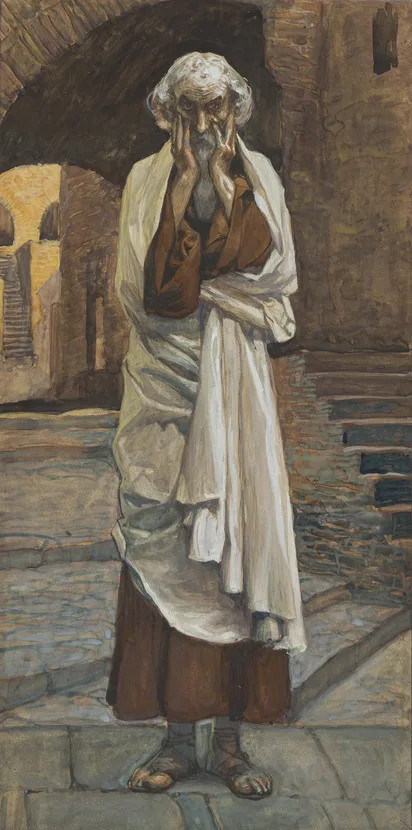
James Tissot, Micah, circa 1900. Western biblical art, not an Orthodox icon. Public domain, via Wikimedia Commons.
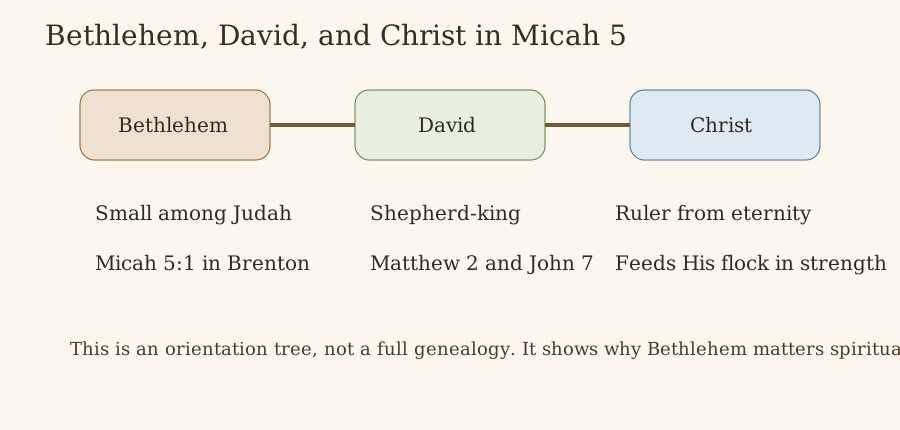
Bethlehem, David, and Christ: a schematic of biblical connections, not a complete genealogy.
Spiritual Fruit 🍇
- Do not despise small beginnings. Bethlehem is small, yet the Son is truly born there. Do one hidden good without waiting for a larger role: visit, prepare food, keep a promise, or pray attentively. Smallness is not absence from God’s attention.
- Let the confession become worship. When you honor Christ’s Nativity and His holy Mother, remember that the Child is the eternal Son made man. Bring Him the part of your life you have treated as too ordinary or wounded for His presence. His coming is real enough to reach it.
- Name a false security without condemning a sufferer. Ask what you use to escape trusting God: controlling every outcome, consulting superstitions, accumulating influence, or making money the measure of safety. Take a concrete step of repentance, with wise counsel where needed. Do not turn someone else’s loss into your lesson about idols.
- Become dew before becoming lion. Refresh someone before asserting yourself: listen, serve, give, or encourage. Then stand firmly where truth or another person’s safety requires courage. The two images never require you to become a predator; Christ gives strength without teaching us to hate.
The Lord who feeds His flock does not ask us to manufacture our own life. We may come to Him small, learn to receive, and let what He gives become nourishment for someone else.
Teaching Notes
Micah 5:1-3
- Ask: How does the promise hold together Bethlehem’s smallness, the ruler’s eternity, a real birth, and the gathering of a people?
- Emphasize: Brenton Micah 5:1 corresponds to common Micah 5:2. The feeding verse is Brenton 5:3 and belongs in this unit.
- Watch for: Reducing “from eternity” to an old royal pedigree, implying that the Son began at Bethlehem, or presenting Mary as the source of the Godhead.
- Connect: Read the reception in Matthew 2 and John 7:40-43 without treating the divided crowd’s limited knowledge as the Evangelist’s conclusion.
- Show: Use the Bethlehem orientation tree as a set of connections, not a father-to-son genealogical chain.
Micah 5:4-8
- Ask: How can the same community refresh others and remain courageous under pressure?
- Emphasize: Brenton says “she shall have peace”; retain its wording rather than silently quoting another translation.
- Watch for: Decoding seven and eight into named modern figures, or applying the sword and lion to human targets.
- Connect: Eusebius reads the dew as the apostolic remnant and the lion as bold proclamation; distinguish that reading from the verse’s plain images.
Micah 5:9-14
- Ask: Why does deliverance include the removal of things within God’s own people?
- Emphasize: The Lord exposes false security before the chapter’s concluding judgment of the nations.
- Watch for: Treating tragedy as proof of personal idolatry, or turning divine judgment into permission for destruction.
- Connect: Bethlehem’s humility and repentance belong to one life with the Shepherd-King.
Sources
Embedded Scripture is from Brenton’s English Septuagint (LXX).
Micah 4:14; Micah 5; Matthew 2:1-12; John 7:40-43; Luke 1:31-35; and John 10:1-21.
St. Cyril of Jerusalem, Catechetical Lecture 11.19-21, especially 11.20 on Micah and the Son’s eternal existence.1
St. Cyril of Alexandria, Second Letter to Nestorius (Letter 4), on the Incarnation and the title Mother of God.3
St. John Chrysostom, Homilies on John, Homily 20, beginning with John 1:43-44 and discussing Nathanael’s response in John 1:46-51.2
Eusebius of Caesarea, Proof of the Gospel 2.3, an early Christian reading of Bethlehem, the Virgin birth, and the apostolic remnant.6
Footnotes
-
St. Cyril of Jerusalem, Catechetical Lecture 11.20, translated by Edwin Hamilton Gifford, Nicene and Post-Nicene Fathers, Second Series, 7, text at CCEL. Sections 19-21 distinguish the Son’s eternal generation from creation and our adoption. ↩ ↩2
-
St. John Chrysostom, Homilies on John, Homily 20, section 1, discussion of John 1:46-47, Nicene and Post-Nicene Fathers, First Series, 14, text at CCEL. ↩ ↩2
-
St. Cyril of Alexandria, Second Letter to Nestorius (Letter 4), especially the paragraphs on the Word’s birth according to the flesh and the title Mother of God, in Nicene and Post-Nicene Fathers, Second Series, 14, text at CCEL. This is a doctrinal companion, not Cyril’s commentary on Micah. ↩ ↩2
-
Coptic Orthodox Lectionary Data (@andraws/lectionary-data), version 1.3.5, Nativity Liturgy Gospel: Matthew 2:1-12. The fixed-day Katameros cycle associates this Gospel with Kiahk 29. This is an appointment of Matthew’s Gospel, not of Micah 5 itself. ↩
-
The numerical pattern is discussed in Keil and Delitzsch, commentary on Micah 5:5, under the Hebrew-based numbering, as sufficiency exceeded by further provision. ↩
-
Eusebius of Caesarea, Proof of the Gospel, book 2, chapter 3, commentary following the Bethlehem and remnant quotations, translated by W. J. Ferrar (1920), text at the Tertullian Project. Used as early exegetical reception, not as an independent rule of Coptic doctrine. ↩ ↩2