


This narration is from a previous version of the study and may include a combined recording of multiple chapters.
Micah is a short book with a long reach. It begins with the Lord coming down as witness against sin, moves through the collapse of false leadership, points to Bethlehem and the Shepherd-King, and ends by wondering at the God who forgives. The journey matters. Mercy is not an escape from the truth about sin. It is what the truthful God gives to people who can no longer save themselves.
The Name Answered by Mercy (Micah 7:18-20)
Translation: Brenton Septuagint.
- Who is a God like thee, cancelling iniquities, and passing over the sins of the remnant of his inheritance? and he has not kept his anger for a testimony, for he delights in mercy.
- He will return and have mercy upon us; he will sink our iniquities, and they shall be cast into the depths of the sea, even all our sins.
- He shall give blessings truly to Jacob, and mercy to Abraam, as thou swarest to our fathers, according to the former days.
The question recalls the meaning of Micah’s name, “Who is like the Lord?” But the book answers with deeds rather than a definition. God cancels, passes over, returns, has mercy, and sinks sins beyond our retrieval. The nations’ armies can carry a people away; they cannot carry its guilt away. The Lord can do what neither empire nor idol can do.
Nor does He forgive by ceasing to care about justice. The same book has named stolen fields, bought judgments, lying speech, and worship offered without mercy. Its final prayer does not call those things harmless. It asks God to remove what destroys His people. The remnant is the people God preserves and gathers, not a self-appointed circle congratulating itself on being better than everyone else. These closing verses give the whole book its destination; their fuller exposition belongs to Micah 7.
Historical and Scriptural Context
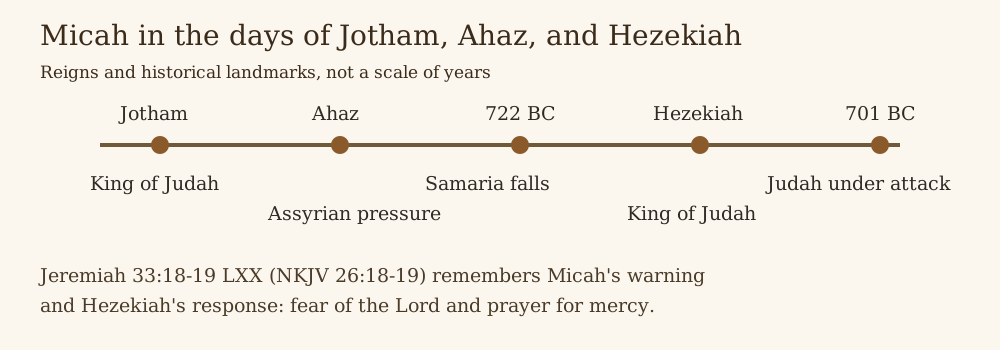
Micah’s opening places his prophetic ministry in the days of Jotham, Ahaz, and Hezekiah, kings of Judah, in the later eighth century BC. He speaks concerning both Samaria, capital of the northern kingdom, and Jerusalem, capital of Judah. Assyria stands behind the book’s historical horizon: Samaria fell in 722/721 BC, and Sennacherib’s campaign struck Judah in 701 BC. Micah belongs to Isaiah’s age; the vision of the nations learning God’s ways in Micah 4 closely parallels Isaiah 2.
A later biblical scene shows what severe prophecy is for. In Jeremiah 33:18-19 LXX (NKJV 26:18-19), elders recall Micah’s warning that Zion would be ploughed. Hezekiah did not silence the prophet. He and Judah feared the Lord and prayed, and the Lord relented from the threatened calamity. Judgment announced was an invitation to turn, not proof that prayer had become useless.
The book belongs to the Twelve, the collection often called the Minor Prophets. “Minor” describes the books’ relative length, not the weight of their witness. These studies follow Brenton’s English Septuagint. Some names and sentences therefore differ from familiar Hebrew-based translations, and the Bethlehem prophecy begins at Micah 5:1 in Brenton rather than the common 5:2. The wording actually being read must lead the interpretation.
The Structure of the Book
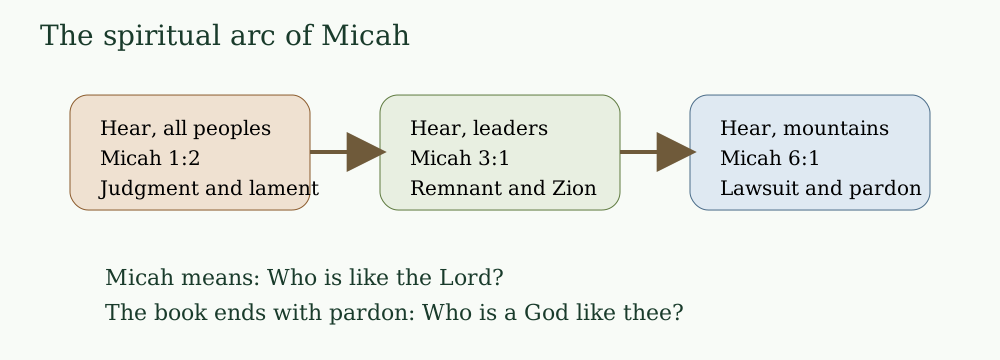
Micah moves in three great summonses to hear:
| Summons | Passage | Burden |
|---|---|---|
| Hear, all peoples | Micah 1:2 | The Lord comes as witness and Judge. |
| Hear, leaders | Micah 3:1 | Rulers, priests, and prophets have corrupted their calling. |
| Hear, mountains | Micah 6:1 | The Lord pleads His covenant case before creation. |
Micah 1 and Micah 2 expose sin and promise a gathered remnant. Micah 3, Micah 4, and Micah 5 move from corrupt leadership and Zion’s ruin to God’s instruction of the nations and the ruler from Bethlehem. Micah 6 and Micah 7 bring the covenant case into remembered mercy, honest confession, patient hope, and pardon.
This is not a staircase on which judgment is left behind after the first step. Warning interrupts promise, and promise breaks into warning. The reader learns to refuse both presumption and despair: covenant membership is no shelter for unrepented cruelty, but failure does not put the repentant beyond God’s reach.
Geographical Significance ⛰️
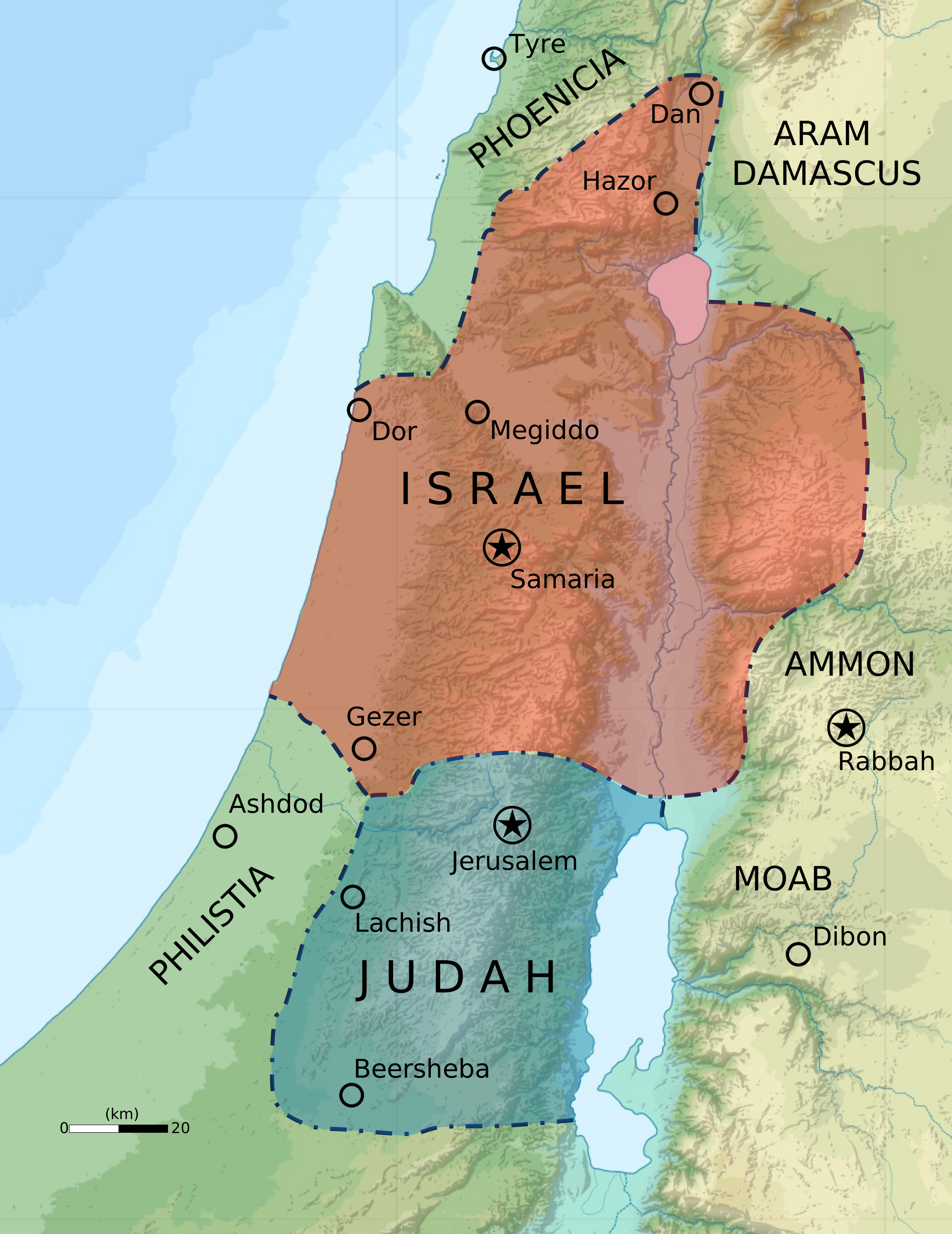 Source: Tobias Schäfer 87, Wikimedia Commons, CC BY 4.0.
Micah is associated with Moresheth-Gath in the Shephelah, Judah’s low hill country between the coastal plain and the higher hills around Jerusalem. The area contained farms, villages, roads, and fortified towns such as Lachish. Moresheth-Gath is commonly identified with Tell ej-Judeideh near Lachish, although the exact identification is debated.1
This is the landscape from which the book addresses the capitals. A field coveted by someone with power is another family’s food and inheritance. A decision made at a city gate can uproot people far from the court. Micah does not let the reader admire Jerusalem’s religious importance while forgetting the households wounded by its injustice. His geography makes the cost of sin visible.
Christ in Micah
Christ is not confined to the verse that names Bethlehem. The Lord’s descent in Micah 1 prepares the reader to ask how the holy God comes among His people. In Micah 2:13 the king goes before the gathered flock and the Lord leads it. Micah 5 joins the ruler’s beginnings in eternity to Bethlehem, the woman in travail, and the feeding of the flock. The Church receives this as a witness to the eternal Son truly born of the Virgin Mary, the Theotokos, not a merely earthly ruler with an impressive ancestry.
Micah 7:8 gives the fallen speaker words of rising and light. In its immediate setting this is the hope of a people awaiting God’s rescue; read in the light of Pascha, it also schools Christians in confidence that darkness does not have the last word. Finally, the God who cancels iniquities is made known in Jesus Christ, who forgives and restores. The chapters develop these connections in their own places, without making every image a prediction of a separate Gospel event.
Gems from the Fathers 💎
St. Augustine reads Micah’s mountain and Bethlehem together. In The City of God XVIII.30 he describes the prophet as “representing Christ under the figure of a great mountain,” then cites both the nations coming to God’s mountain and the ruler born at Bethlehem.2 The juxtaposition gives a useful way into the book: the small place and the worldwide hope belong to the same Christ. The Child is not an incidental answer to the failure of the powerful. In Him, God gathers and teaches people whom the powerful could not heal.
The Church’s Voice in Worship ⛪
The Coptic Holy Pascha readings give Micah a searching place in the Church’s prayer. The First Hour of Good Friday includes Micah 1:16-2:3 and Micah 7:1-8. The first passage moves from captivity and mourning to evil planned by night and carried out by daylight; the second moves through lament and betrayal toward the promise of rising and the Lord’s light. These are appointments in the current working lectionary edition, not a separate Coptic Reader confirmation.3
Micah’s Bethlehem prophecy is also heard through the Nativity Liturgy Gospel, Matthew 2:1-12, on Kiahk 29.4 This is a Gospel reading carrying Micah’s words, not an appointment of Micah 5 itself. Thus the book meets the worshipper at both the birth of the Saviour and the morning of His Passion. That setting does not erase Micah’s historical address to Israel and Judah; it brings his call to hear, repent, and hope into the Christian’s own prayer.
Iconography and Visual Teaching 🖼️
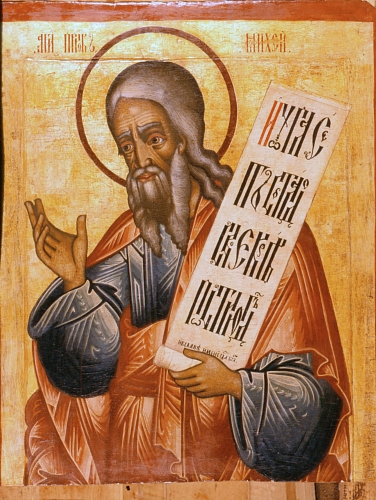 Source: Russian icon, first quarter of the eighteenth century, Kizhi; Wikimedia Commons, public domain.
This is a Russian Orthodox icon, not a historical portrait or a Coptic image. It places the prophet within the Church’s remembrance of those who bore God’s word. Alongside the book’s accounts of corrupt religious speech, it recalls the dignity and cost of receiving that word faithfully.
Spiritual Fruit 🍇
- Examine a desire before it becomes someone else’s wound. Micah follows evil from the bed to the field. Before an important decision about money, work, or family, ask who will carry its cost. Bring the dishonest advantage to confession before it becomes an accomplished fact.
- Let worship reach the person nearest you. Micah does not oppose prayer to justice; he exposes the attempt to keep them apart. After the Liturgy, fulfill an obligation you have delayed, repay what is owed, or speak truthfully where concealment has seemed easier.
- Read warning as a summons to pray. Hezekiah’s response keeps the book from becoming an exercise in condemning society. When a sentence exposes your own conduct, pause there. Ask for mercy and make the next act of obedience small enough to begin today.
- End where Micah ends. The final prayer is not about how bad other people are: “Who is a God like thee, cancelling iniquities, and passing over the sins of the remnant of his inheritance?” Name the sin without defending it, then give equal attention to the God who delights in mercy. Repentance is not complete when we have learned to accuse ourselves; it leads us back to trust in Him.
Teaching Notes
The Name Answered by Mercy (Micah 7:18-20)
- Ask: Which actions in the closing prayer can God do that human power cannot?
- Emphasize: The closing doxology gives the book its destination without cancelling its warnings.
- Watch for: Defining the remnant as our preferred religious group or treating other people’s suffering as proof of their guilt.
- Connect: Jeremiah 33:18-19 LXX (NKJV 26:18-19) shows a warning received with fear of the Lord and prayer.
- Show: Use the timeline and three-summons schematic for orientation. The regional map shows the capitals and Lachish; it does not reconstruct an exact invasion route. Introduce the Russian icon as sacred remembrance, not portrait evidence.
Sources
Embedded Scripture is from Brenton’s English Septuagint (LXX).
St. Augustine, The City of God, XVIII.30, on Micah’s mountain and Bethlehem; translated by Marcus Dods, NPNF1, volume 2.
George A. Pierce, Understanding Micah’s Lament for Judah (Micah 1:10-16) through Text, Archaeology, and Geography, for historical and regional orientation, not doctrinal interpretation.
Coptic Orthodox Lectionary Data, edition 1.3.5, Holy Pascha First Hour of Good Friday and Nativity Liturgy Gospel; source qualifications are given below.
Footnotes
-
George A. Pierce, Understanding Micah’s Lament for Judah (Micah 1:10-16) through Text, Archaeology, and Geography, in Approaching Holiness, especially the sections on geography and Moresheth-Gath, full article. Used for history and geography only. ↩
-
St. Augustine, The City of God, XVIII.30, translated by Marcus Dods, NPNF1, volume 2 (1887), direct text. Augustine quotes Micah in his own translation and numbering. ↩
-
Coptic Orthodox Lectionary Data, edition 1.3.5, First Hour of Good Friday: Micah 1:16-2:3 and Micah 7:1-8. These are current working-source appointments, not independently confirmed here against Coptic Reader. ↩
-
Coptic Orthodox Lectionary Data, edition 1.3.5, Nativity, Kiahk 29, Liturgy Gospel: Matthew 2:1-12. The edition cites this dated reading page. This is a Gospel appointment, not a direct reading from Micah. ↩