


This narration is from a previous version of the study and may include a combined recording of multiple chapters.
Micah ends with lament, but not with despair. The prophet finds no fruit, sees social trust collapse, waits for God his Savior, and ends by praising the God who cancels iniquities. The way to that praise passes through a darkness he neither denies nor mistakes for God’s final word.
Micah 7:1-6 - No Fruit and Broken Trust
Translation: Brenton Septuagint.
- Alas for me! for I am become as one gathering straw in harvest, and as one gathering grape-gleanings in the vintage, when there is no cluster for me to eat the first-ripe fruit: alas my soul!
- For the godly is perished from the earth; and there is none among men that orders his way aright: they all quarrel even to blood: they grievously afflict every one his neighbour:
- they prepare their hands for mischief, the prince asks a reward, and the judge speaks flattering words; it is the desire of their soul:
- therefore I will take away their goods as a devouring moth, and as one who acts by a rigid rule in a day of visitation. Woe, woe, thy times of vengeance are come; now shall be their lamentations.
- Trust not in friends, and confide not in guides: beware of thy wife, so as not to commit anything to her.
- For the son dishonours his father, the daughter will rise up against her mother, the daughter-in-law against her mother-in-law: those in his house shall be all a man’s enemies.
The harvest image is painful. Micah looks for fruit and finds none. He speaks as someone hungry for goodness, not as an observer pleased to have proved everyone else corrupt. A harvest ought to sustain life; here it gives him straw and an empty search among the vines. The cry “alas my soul!” lets the grief enter his own life.
The following verses show what this barrenness means. Neighbours afflict one another, hands are prepared for mischief, rulers demand rewards, and flattering judgment serves desire rather than truth. The absence of godliness is not an invisible defect detectable only by a prophet. It becomes visible in the cost other people bear. The threatened loss of goods in verse 4 answers a society that has used power to secure itself at others’ expense.
Then the damage reaches the place where trust should be safest. Micah is not telling people to distrust their spouse or household as a life strategy. He is describing social breakdown. Even the closest bonds can be corrupted when dishonour and deceit become normal. These words lament that condition; they do not make it holy.
Christ takes up this family-division language in Matthew 10:34-39 when He speaks of the cost of allegiance to Him. Discipleship may encounter hostility at home, but neither Micah nor Christ licenses contempt, coercive control, or a teacher’s demand that someone abandon trustworthy support. Where a household is unsafe, seeking protection and wise help is not a failure of faith. Where it is loving, suspicion is not a spiritual achievement.
Gems from the Fathers 💎: Lament without superiority
St. John Chrysostom uses Micah’s lament to turn his hearers away from accusing others and toward repentance. In Homily 23 on Hebrews, opening with Hebrews 11:7, he cites Micah 7:1-2 and continues: “let us also now cry out, first about our own selves: but aid me in my lamentation.”1 The continuation matters. This is not a private exercise in contempt for oneself, but a shared grief in which the preacher includes himself.
Later in the same appeal he rebukes the habit of making other people’s faults the substance of church conversation. His use of Micah helps us read the chapter without turning its barren vineyard into a vantage point from which we judge everybody else. Examining our own sin does not mean accepting responsibility for another person’s violence. It means refusing to use another person’s wrongdoing to excuse our own.
Micah 7:7-13 - Waiting for God My Savior
Translation: Brenton Septuagint.
- But I will look to the Lord; I will wait upon God my Saviour: my God will hearken to me.
- Rejoice not against me, mine enemy; for I have fallen yet shall arise; for though I should sit in darkness, the Lord shall be a light to me.
- I will bear the indignation of the Lord, because I have sinned against him, until he make good my cause: he also shall maintain my right, and shall bring me out to the light, and I shall behold his righteousness.
- And she that is mine enemy shall see it, and shall clothe herself with shame, who says, Where is the Lord thy God? mine eyes shall look upon her: now shall she be for trampling as mire in the ways.
- It is the day of making of brick; that day shall be thine utter destruction, and that day shall utterly abolish thine ordinances.
- And thy cities shall be levelled, and parted among the Assyrians; and thy strong cities shall be parted from Tyre to the river, and from sea to sea, and from mountain to mountain.
- And the land shall be utterly desolate together with them that inhabit it, because of the fruit of their doings.
Verse 7 is the hinge of the chapter. When trust among people has broken down, the answer is not that the faithful person must become sufficient to himself. He looks to the Lord. The assurance “my God will hearken to me” is the ground of waiting. Prayer remains possible when dependable human answers have failed.
Verse 8 gives that hope a voice strong enough to answer mockery. “I have fallen” is an admission, not an evasion. The answer “yet shall arise” denies that the fall has authority to name the whole future. And the darkness has not vanished when the speaker confesses that the Lord will be a light. The promise is first that God is present and faithful there, not that the penitent must produce an immediate feeling of brightness.
The faithful community can speak these words after humiliation; the penitent can pray them after a real fall into sin. Their Christian resonance reaches further still, toward Christ’s Resurrection and the life He gives those who belong to Him. But the word “arise” by itself does not establish that Micah is directly predicting the Resurrection in this verse. The passage first concerns God’s restoration of His fallen people. In Christ we receive the fullest reason to trust that death, sin, and disgrace cannot have the final word.
Verse 9 protects this confidence from presumption. The speaker acknowledges sin and accepts God’s judgment, yet also asks God to maintain his cause and lead him into light. Admitting guilt does not require believing that every accusation is true or every injury deserved. One can repent honestly and still ask for justice. Christ, who is without sin, is not confessing personal guilt through this verse; rather, His people learn to confess theirs while hoping in Him.
No one should use “because I have sinned against him” to tell an abused person that mistreatment is God’s will, or an ill person that the illness proves a hidden fault. Micah gives the penitent words for his own prayer. He does not give a bystander authority to assign guilt to sufferers. Confession belongs with truth, protection from harm, and the help needed for healing.
The enemy in verse 10 mocks the presence of God. Her humiliation answers that mockery, but it does not give the Christian permission to cultivate fantasies of revenge. Vindication belongs to God. Verses 11-13 also keep hope from becoming an easy promise of prosperity. In the Brenton wording, the day of making bricks is followed by destruction, cities levelled and divided, and a desolate land. The “fruit” here is the consequence of deeds, an answer to the missing fruit at the chapter’s beginning. Hope does not make these warnings unreal; it teaches us to turn toward the God who can save rather than toward the practices that destroy.
The Church’s Voice in Worship ⛪
The Coptic lectionary data in version 1.3.5 lists Micah 7:1-8 as the last prophecy of the First Hour of Good Friday. It is a current working-source appointment, not an independent Coptic Reader confirmation.2 The same hour includes John 18:28-40, Mark 15:1-5, Luke 22:66-23:12, and Matthew 27:1-14: the morning proceedings against Christ, Judas’s remorse in Matthew, and Jesus before Pilate.
This places the lament over corruption and broken trust within the morning of the Passion. Its closing words are not a denial of the Cross: “for I have fallen yet shall arise; for though I should sit in darkness, the Lord shall be a light to me.” The Church hears hope while the Passion is unfolding, not only after the sorrow has passed. That is a fitting school for prayer when an ending is not yet visible. This is an observation about the readings heard together, not a claim to know why their compilers chose them.
Micah 7:14-20 - Shepherd Your People and Cast Sins into the Sea
Translation: Brenton Septuagint.
- Tend thy people with thy rod, the sheep of thine inheritance, those that inhabit by themselves the thicket in the midst of Carmel: they shall feed in the land of Basan, and in the land of Galaad, as in the days of old.
- And according to the days of thy departure out of Egypt shall ye see marvellous things.
- The nations shall see and be ashamed; and at all their might they shall lay their hands upon their mouth, their ears shall be deafened.
- They shall lick the dust as serpents crawling on the earth, they shall be confounded in their holes; they shall be amazed at the Lord our God, and will be afraid of thee.
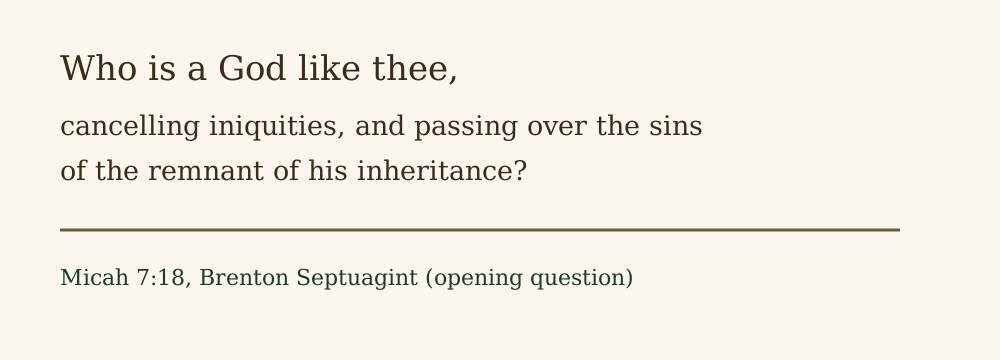
- Who is a God like thee, cancelling iniquities, and passing over the sins of the remnant of his inheritance? and he has not kept his anger for a testimony, for he delights in mercy.
- He will return and have mercy upon us; he will sink our iniquities, and they shall be cast into the depths of the sea, even all our sins.
- He shall give blessings truly to Jacob, and mercy to Abraam, as thou swarest to our fathers, according to the former days.
The chapter now becomes an appeal: tend Your people. The sheep still belong to God, even when they are isolated and in need of pasture. The rod here belongs to the shepherd asked to care for his inheritance, not to the predators who have consumed their neighbours. Carmel, Basan, and Galaad belong to this picture of restored feeding and a life no longer starved. The prayer does not ask the scattered sheep to invent their own deliverer.
The answer in verse 15 returns to the Exodus. At the end of Micah’s covenant controversy, God again points to His deliverance from Egypt, now as a pattern of wonders yet to come. The nations’ boastful strength falls silent before Him. Their fear is not an invitation for us to despise peoples or rejoice in suffering. It announces the failure of power that sets itself against the Lord and His people.
LXX insight: “he will sink our iniquities”
Brenton’s sequence lets us follow the action closely. God is “cancelling iniquities” in verse 18; in verse 19 “he will sink our iniquities”, and all our sins are cast into the sea. Read beside the explicit Exodus promise in verse 15, the sea recalls the overthrow of the power that held Israel captive. Here it is our iniquities, not our neighbours, that must go under. The rescued person must not be confused with the sin from which God rescues him.
The words also answer a conscience that keeps retrieving what it has confessed, as though remembering a failure proved that God’s pardon had failed. The passage calls us to trust His mercy, not to deny what happened. Forgiveness does not erase the duty to make restitution, protect those harmed, or face lawful consequences. It does mean that the penitent’s life need not remain imprisoned within the wrong.
Gems from the Fathers 💎: The God who forgives, the water that frees
St. John Chrysostom explicitly joins Micah’s final question to Christ’s forgiveness of the paralytic. In his Homily on the Paralytic Let Down Through the Roof, §6, he explains that the objection about God’s unique authority to forgive becomes the starting point for Christ to reveal His equality with the Father. He then brings in Micah 7:18 as testimony that taking away iniquity belongs to God.3 Christ is not merely announcing a favourable opinion about the sufferer. His forgiving and healing action makes the divine mercy present.
Chrysostom describes the effect of Christ’s word upon the man: “He uplifts the spirit and rouses the downcast soul”.3 The God beyond comparison is known not by remoteness from the guilty, but by His power to release them. This does not imply that every bodily illness comes from a particular sin, or that a person whose illness remains has not been forgiven. The healing in this Gospel encounter reveals who Christ is; it is not a test by which we judge another person’s spiritual condition.
The Exodus and sea also open a baptismal horizon. St. Cyril of Jerusalem, teaching about baptism rather than directly commenting on Micah, sets Israel’s deliverance from Pharaoh beside the world’s deliverance from sins through the washing of water and the word of God.4 He insists that the font is not bare water but bears the grace given through the invocation of the Father, Son, and Holy Spirit. The biblical movement from bondage through water into freedom belongs to the Church’s understanding of the life Christ gives.
Romans 6:3-11 makes the Paschal depth of baptism explicit: burial with Christ is unto a new life with Him. Micah’s sunken sins are therefore more than an attractive image of forgetting. They can nourish thanksgiving for real forgiveness and release from slavery to sin. For the baptized person who has fallen again, the way is repentance and confession, not despair or repeated baptism. The remembered gift calls us back to the life received; it does not make the struggle against sin imaginary.
The final praise rests on God’s character: “for he delights in mercy.” It is not merely that He reluctantly agrees to pardon after enough distress has been displayed. Mercy is His delight. His promise to Jacob and Abraam outlasts the people’s failure. The same covenant remembrance sounds at the opening of the Gospel in the Theotokos’s praise and in Zacharias’s blessing: mercy to the fathers and the promise to Abraham (Luke 1:54-55; Luke 1:72-73). Micah ends facing the faithfulness from which the Gospel begins.
Spiritual Fruit 🍇
- Lament without making yourself superior. Name one absence of fruit in your own life and ask God to cultivate it. Do not use self-examination to excuse a wrong done against you, or another person’s wrong to excuse your own.
- Pray verse 8 in the darkness you actually have. The words “for I have fallen yet shall arise” can accompany an honest confession and one concrete return to prayer. Do not demand an instant feeling of relief as proof that God has heard you; seek pastoral or clinical help where needed.
- Confess without surrendering justice. The same voice that admits sin asks God to maintain its cause. Accept responsibility for your own acts, make repair where possible, and do not take responsibility for another person’s abuse.
- End prayer with God’s mercy, not your failure. Give thanks for baptism and bring renewed falls to confession. If shame keeps returning, remember that Christ’s forgiveness is not measured by the persistence of the feeling. Let His mercy also teach you to relinquish revenge without pretending harm was harmless or restoring unsafe access.
The chapter began with a hungry search among empty vines. It ends not with a claim that the people have finally produced enough to earn God back, but with the God who delights in mercy. We can bring Him the truth about the barren field and still ask Him to tend it.
Teaching Notes
Micah 7:1-6
- Ask: What is the difference between grieving over corruption and taking pleasure in exposing it?
- Emphasize: The lack of fruit becomes visible in the harm done to neighbours and households.
- Watch for: Treating broken trust as a command to distrust a spouse, isolating a vulnerable person, or confusing self-examination with responsibility for abuse.
- Connect: Matthew 10:34-39 takes up the family-division language in the cost of discipleship.
Micah 7:7-13
- Ask: How can confession of guilt and a request for vindication belong in the same prayer?
- Emphasize: Verse 8 promises restoration without denying the fall or the darkness. Its Christian resurrection resonance is not established by one verb alone.
- Watch for: Making Christ the personally guilty speaker of verse 9, diagnosing suffering as punishment, or reading Brenton’s verses 11-13 as an unqualified promise of rebuilding.
- Connect: The Good Friday First Hour appointment ends at verse 8; verses 9-13 remain essential to the chapter’s fuller movement.
Micah 7:14-20
- Ask: What changes when the sea swallows our iniquities rather than becoming an imagined punishment for our enemies?
- Emphasize: God’s delight in mercy and fidelity to His promise sustain repentance; pardon does not abolish restitution or protection.
- Watch for: Reducing baptism to a mental symbol, promising an end to every struggle, or confusing the forgiveness of sin with guaranteed bodily healing.
- Connect: Romans 6:3-11, Luke 1:54-55, and Luke 1:72-73 unfold the baptismal and covenantal horizon.
- Show: Use the closing question as an invitation to praise rather than as a substitute for reading the complete verses.
Sources
Embedded Scripture is from Brenton’s English Septuagint (LXX).
St. John Chrysostom, Homilies on Hebrews, Homily 23, §8, for Micah’s lament received as shared repentance.
St. John Chrysostom, Homily on the Paralytic Let Down Through the Roof, §6, for Micah 7:18 and Christ’s divine authority to forgive.
St. Cyril of Jerusalem, Catechetical Lecture 3, §§3-5, for baptism, the invocation of the Trinity, and deliverance through water. This is a thematic witness, not direct commentary on Micah.
Matthew 10:34-39; Romans 6:3-11; Luke 1:54-55; Luke 1:72-73 for the Gospel and apostolic connections developed here.
Footnotes
-
St. John Chrysostom, Homilies on Hebrews, Homily 23 on Hebrews 11:7, §8, NPNF, First Series, vol. 14, Oxford translation revised by Frederic Gardiner, Micah’s lament and the appeal to lament together. ↩
-
Coptic Orthodox Lectionary Data, version 1.3.5, Good Friday, First Hour, Micah 7:1-8 and the four Gospel readings. The appointment is current working-source data derived from the Katameros API and curated Holy Pascha material, not a Coptic Reader confirmation. ↩
-
St. John Chrysostom, Homily on the Paralytic Let Down Through the Roof, §6, NPNF, First Series, vol. 9, Christ’s forgiving word and Micah 7:18. ↩ ↩2
-
St. Cyril of Jerusalem, Catechetical Lecture 3, §§3-5, NPNF, Second Series, vol. 7, translation revised by Edwin Hamilton Gifford, baptism and deliverance through the sea. ↩