
Matthew 9 ends with a command to pray. Jesus has seen the crowds harassed and helpless, sheep without a shepherd, and He has told His disciples to ask the Lord of the harvest to send laborers. Matthew 10 is the answer to that prayer, and it is sterner than volunteer enthusiasm. He calls twelve men to Himself, names them one by one, gives them His own authority over unclean spirits and disease, and sends them with empty money belts into a world of wolves. The same Lord who has been healing, forgiving, raising, and shepherding now makes His compassion apostolic. Those who were told to pray for laborers become the laborers. They will carry His power without owning it, His peace without forcing it, and His Cross without the illusion that the world will love them for His name.
Authority given to the Twelve (Matthew 10:1-4)
1 And when He had called His twelve disciples to Him, He gave them power over unclean spirits, to cast them out, and to heal all kinds of sickness and all kinds of disease. 2 Now the names of the twelve apostles are these: first, Simon, who is called Peter, and Andrew his brother; James the son of Zebedee, and John his brother; 3 Philip and Bartholomew; Thomas and Matthew the tax collector; James the son of Alphaeus, and Lebbaeus, whose surname was Thaddaeus; 4 Simon the Cananite, and Judas Iscariot, who also betrayed Him.
Jesus first calls the Twelve to Himself before He sends them away from Himself. Mission begins with nearness to Christ. The disciples do not invent authority, borrow it from the crowds, or create it by strategy. He gives them power over unclean spirits and over every kind of sickness and disease. The works that filled Matthew 8 and 9 now become the works entrusted to His apostles.
Matthew names the Twelve slowly. Peter is first, but not alone. Andrew is his brother. James and John are sons of Zebedee. Matthew names himself plainly as “the tax collector,” without hiding the mercy that called him from the table. Judas is also named as the one who betrayed Him. The apostolic list is therefore both gift and warning. Christ truly gives authority, but authority does not remove the need for faithfulness. Judas’s place in the list does not prove that authority is empty. It proves that a real gift can still be refused.
The number Twelve is not accidental. Jesus is gathering and renewing Israel around Himself. The mission begins within Israel, but it already points beyond Israel, because the renewed people of God will become the witness through whom the nations are blessed.
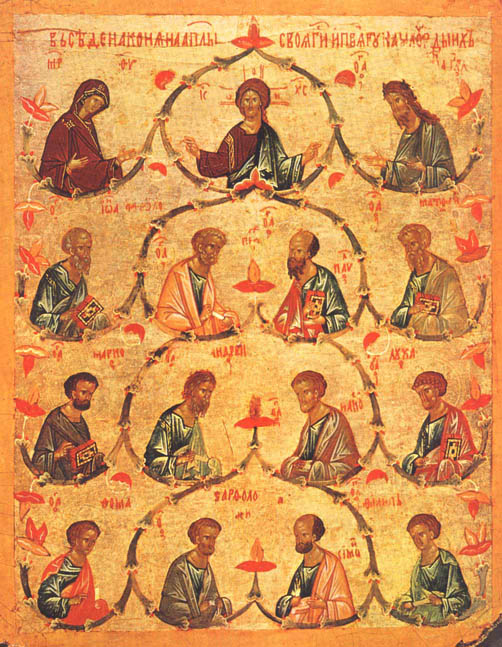 Source: Synaxis of the Twelve Apostles, public domain, via Wikimedia Commons.
The icon keeps the list from becoming a bare roster. Christ gathers real men into apostolic communion, including Matthew the tax collector and Judas the betrayer, so the Church receives mission with both gratitude and holy fear.
Language insight
The disciples are called mathētai, learners, and then named as apostoloi, those sent with commission. Jesus gives them exousia, authority, over unclean spirits, pneumatōn akathartōn. Matthew does not present the apostles as independent miracle-workers. They are sent ones carrying authority that belongs first to Christ.
Gems from the Fathers 💎: Christ’s Authority in the Twelve
Saint John Chrysostom links this sending to the previous harvest saying. Christ calls the ministry a harvest not because it belongs to someone else; the One who commands prayer for laborers is Himself both husbandman and Lord of the harvest.1
Chrysostom also notes that the apostles cast out spirits by Christ’s own command and authority.2 Their mission is therefore a manifestation of Christ’s own lordship, not a separate power possessed by the disciples.
Freely received, freely given (Matthew 10:5-15)
5 These twelve Jesus sent out and commanded them, saying: “Do not go into the way of the Gentiles, and do not enter a city of the Samaritans. 6 But go rather to the lost sheep of the house of Israel. 7 And as you go, preach, saying, ‘The kingdom of heaven is at hand.’ 8 Heal the sick, cleanse the lepers, raise the dead, cast out demons. Freely you have received, freely give. 9 Provide neither gold nor silver nor copper in your money belts, 10 nor bag for your journey, nor two tunics, nor sandals, nor staffs; for a worker is worthy of his food.
11 “Now whatever city or town you enter, inquire who in it is worthy, and stay there till you go out. 12 And when you go into a household, greet it. 13 If the household is worthy, let your peace come upon it. But if it is not worthy, let your peace return to you. 14 And whoever will not receive you nor hear your words, when you depart from that house or city, shake off the dust from your feet. 15 Assuredly, I say to you, it will be more tolerable for the land of Sodom and Gomorrah in the day of judgment than for that city!
Jesus first sends the Twelve to “the lost sheep of the house of Israel.” This Israel-first sending is an order in Matthew’s salvation history, not contempt for Gentiles, Samaritans, or Jews. The same Gospel has already shown Gentile Magi worshiping Christ and a Roman centurion praised for faith, and it will end with the risen Lord’s commission to all nations. The promise comes to Israel first, and through Israel the blessing will reach the nations.
Their message is simple: “The kingdom of heaven is at hand.” Their works make the message visible. They heal the sick, cleanse lepers, raise the dead, and cast out demons. These signs are not a performance to attract attention. They show that the kingdom is not merely an idea. In Christ, God’s reign touches bodies, households, sickness, uncleanness, death, and demonic bondage.
“Freely you have received, freely give” is the heart of apostolic poverty. The apostles cannot turn grace into a market. They must not make the power of Christ serve greed, status, or control. Their simplicity of travel is also a spiritual school. They go without money belts, extra bag, or layers of security. The same Lord who forbids a money belt also says that a worker is worthy of his food. Dependence on God does not become a weapon against clergy, missionaries, or ordinary workers who need legitimate provision.
The peace they bring is real, but it is not forced. A worthy household receives peace. A rejecting household loses it. Shaking the dust from the feet is departure and sober witness, not revenge, harassment, or a license for disciples to pronounce final judgment. The missionaries are poor and vulnerable, but the word they carry is not light. Sodom and Gomorrah stand as a scriptural comparison that intensifies the gravity of refusing Christ’s word. The verse does not hand the apostles a verdict to deliver against particular people.
Language insight
Jesus “sent” the Twelve with apostellō, the verb behind apostle. He “commanded” them, parangellō, showing that mission is obedient commission, not personal initiative. The kingdom is “at hand,” ēngiken, near and pressing upon the hearer. The apostles are told to give freely, dōrean, because they have received freely. Grace keeps its character when it is passed on without possession.
The Church’s Voice in Worship ⛪
The CopticChurch.net calendar attests Matthew 10:1-15 at Liturgy on Abib 5, the Apostle’s Feast, in years such as 2023 when that appointment is used; Sunday precedence can bring a different Gospel.3 In worship the poverty, proclamation, healing, and peace of Matthew 10:1-15 are received as Christ’s freely given mercy rather than private religious enterprise. The Church does not treat Matthew 10:1-42 as one exact reading. Later portions of the chapter also recur in Vespers and Matins in martyr and apostolic contexts, so faithful witness, confession, cross-bearing, and hospitality are heard as one Christ-shaped life.
Gems from the Fathers 💎: Freely Given Mission
Chrysostom says Christ did not send them at the beginning, but only after they had followed Him and seen His works: the dead raised, the sea rebuked, demons expelled, sins remitted, and a leper cleansed.4 They are sent after being formed by the sight of Christ’s power.
On the poverty of the apostles, Chrysostom explains that Christ casts out their anxiety by the promise that a worker is worthy of support, and by opening the houses of those who would receive them.5
Sheep among wolves (Matthew 10:16-23)
16 “Behold, I send you out as sheep in the midst of wolves. Therefore be wise as serpents and harmless as doves. 17 But beware of men, for they will deliver you up to councils and scourge you in their synagogues. 18 You will be brought before governors and kings for My sake, as a testimony to them and to the Gentiles. 19 But when they deliver you up, do not worry about how or what you should speak. For it will be given to you in that hour what you should speak; 20 for it is not you who speak, but the Spirit of your Father who speaks in you.
21 “Now brother will deliver up brother to death, and a father his child; and children will rise up against parents and cause them to be put to death. 22 And you will be hated by all for My name’s sake. But he who endures to the end will be saved. 23 When they persecute you in this city, flee to another. For assuredly, I say to you, you will not have gone through the cities of Israel before the Son of Man comes.
The mission is not romantic. Jesus sends them as sheep in the midst of wolves. He does not hide the danger. They will face councils, scourging, governors, kings, betrayal, hatred, and persecution. Apostolic mission carries healing power, but it also carries the Cross-shaped pattern of the Master. Councils and synagogues name local Jewish settings of witness; governors and kings name wider civic ones. Matthew does not here reconstruct a particular trial calendar. He names the kinds of rooms in which the Gospel will have to be spoken.
The command is balanced: wise as serpents and harmless as doves. Christian innocence is not naivete. Christian prudence is not manipulation. The apostle must discern danger without becoming violent, suspicious, or wolf-like. The Church is not preserved by matching the methods of her enemies, but by faithful witness under Christ’s protection.
Jesus also promises the Spirit’s help. When they are delivered up, they must not be consumed by anxious self-defense. The Spirit of the Father will speak in them. This does not excuse laziness or careless teaching. It comforts those who suffer for Christ and find themselves dragged before powers stronger than themselves.
The family betrayals are among the most painful warnings in the chapter. The Gospel can expose divided loyalties even inside the household. Christ does not command hatred of family. He warns that allegiance to His name may provoke hatred from others. Endurance is remaining under pressure with Christ; it is not a command to remain in preventable danger. Christ also commands flight: when they persecute you in this city, flee to another. Discernment, lawful protection, and pastoral care belong with fidelity. This study does not settle a timetable for “before the Son of Man comes.” The verse keeps the mission urgent and unfinished; it does not authorize a speculative calendar.
Language insight
“Wise” is phronimos, prudent or discerning, and “harmless” is akeraios, unmixed, innocent, or pure. Jesus holds them together. The disciple needs clear judgment without corrupting simplicity. “Endures” is hypomenō, to remain under pressure. Salvation is not a brief burst of zeal, but faithful remaining in Christ through trial, held together with the command to flee when persecution drives the witness from one city to the next.
Gems from the Fathers 💎: Sheep among Wolves
Chrysostom sees Christ’s power precisely in the weakness of the sheep. He says Christ shows His might when sheep overcome wolves, bitten again and again, and yet instead of being consumed they change the wolves.6
He then turns the image into an ascetical warning: “For so long as we are sheep, we conquer,” but if we become wolves, the Shepherd’s help departs.7 The apostolic way does not defeat evil by imitating it.
Fear God, not persecutors (Matthew 10:24-33)
24 “A disciple is not above his teacher, nor a servant above his master. 25 It is enough for a disciple that he be like his teacher, and a servant like his master. If they have called the master of the house Beelzebub, how much more will they call those of his household! 26 Therefore do not fear them. For there is nothing covered that will not be revealed, and hidden that will not be known.
27 “Whatever I tell you in the dark, speak in the light; and what you hear in the ear, preach on the housetops. 28 And do not fear those who kill the body but cannot kill the soul. But rather fear Him who is able to destroy both soul and body in hell. 29 Are not two sparrows sold for a copper coin? And not one of them falls to the ground apart from your Father’s will. 30 But the very hairs of your head are all numbered. 31 Do not fear therefore; you are of more value than many sparrows.
32 “Therefore whoever confesses Me before men, him I will also confess before My Father who is in heaven. 33 But whoever denies Me before men, him I will also deny before My Father who is in heaven.
Jesus grounds the disciples’ courage in union with Himself. A disciple is not above his teacher. If they call the Master of the house Beelzebub, His household should not be surprised by slander. The disciple should not expect a softer path than the Lord.
Then Christ repeats: “Do not fear.” The hidden will be revealed. The whispered word will be preached on housetops. The persecutor can kill the body, but cannot kill the soul. This does not make bodily suffering unreal. It puts bodily suffering under the judgment and providence of God. The warning about Gehenna stands beside the Father’s care and the repeated command, “Do not fear.” Holy fear is reverence that refuses to disown Christ. It is not a tool for scrupulosity, intimidation, or spiritual abuse.
The sparrows and the numbered hairs show the tenderness of the Father. Jesus is not saying that disciples will avoid death. He is saying that no suffering falls outside the Father’s knowledge. The martyr is not forgotten. The confessing disciple is not abandoned. The one who confesses Christ before men will be confessed by Christ before the Father.
The opposite warning is severe: whoever denies Christ before men will be denied before the Father. Matthew will later show Peter denying Christ and being restored through repentance; this warning should wake the careless without crushing the repentant. Confession matters because Christ Himself is the life of the disciple.
Language insight
“Confess” is homologeō, to acknowledge openly, to say the same. Christian confession is not merely private admiration. It is public belonging to Christ. “Deny” is arneomai, to refuse or disown. The contrast is relational: the disciple either acknowledges Christ before men, or disowns Him under pressure.
Gems from the Fathers 💎: Courage under Providence
Chrysostom says Christ strengthens the apostles against slander by pointing them to Himself: if the Master is called Beelzebub, the servants should not be shaken when they are accused.8
On the sparrows, Chrysostom explains that Christ is teaching perfect knowledge and providence: not even sparrows fall without God’s knowledge, and the Father loves the disciples more truly than a father.9
The sword, the Cross, and receiving Christ (Matthew 10:34-42)
34 “Do not think that I came to bring peace on earth. I did not come to bring peace but a sword. 35 For I have come to ‘set a man against his father, a daughter against her mother, and a daughter-in-law against her mother-in-law’; 36 and ‘a man’s enemies will be those of his own household.’ 37 He who loves father or mother more than Me is not worthy of Me. And he who loves son or daughter more than Me is not worthy of Me. 38 And he who does not take his cross and follow after Me is not worthy of Me. 39 He who finds his life will lose it, and he who loses his life for My sake will find it.
40 “He who receives you receives Me, and he who receives Me receives Him who sent Me. 41 He who receives a prophet in the name of a prophet shall receive a prophet’s reward. And he who receives a righteous man in the name of a righteous man shall receive a righteous man’s reward. 42 And whoever gives one of these little ones only a cup of cold water in the name of a disciple, assuredly, I say to you, he shall by no means lose his reward.”
These verses are often misunderstood. Christ is not praising conflict for its own sake, and He is not commanding contempt for family. He is revealing that true peace cannot be built on refusing God. When Christ is received, disordered peace is exposed. False unity can break because truth has entered. Matthew 10:35-36 quotes Micah 7:6, placing household division inside an existing scriptural lament rather than inventing an anti-family program.
The sword falls even inside households because the deepest loyalty is being revealed. Father, mother, son, and daughter are real loves, but none can be loved above Christ. This is not a rejection of family life. It is the purification of every love. If family love becomes an idol that claims the place of God, it cannot save the family. Only Christ can. The saying does not authorize coercion, sought-out estrangement, neglect of dependents, or remaining in abuse. Cross-bearing is self-giving after Christ; it is never another person’s demand for submission, and it does not counsel anyone to remain in abuse.
The first explicit cross-bearing saying in Matthew appears here. Before the Passion narrative, Jesus teaches that the disciple must take his cross and follow Him. The Cross is not merely an unpleasant circumstance. It is the willing loss of self for Christ’s sake. The one who tries to possess life apart from Christ loses it. The one who loses life for Him finds it.
The chapter ends with receiving. Whoever receives the apostles receives Christ, and whoever receives Christ receives the Father who sent Him. This gives dignity to humble hospitality. A prophet’s reward, a righteous man’s reward, and even a cup of cold water given to a little one in the name of a disciple are remembered. Mission involves apostles who go, but also households that receive, support, and honor Christ in His servants. The reward is grace, not a market, and hospitality must not become a demand that exploits the generous.
Language insight
The “sword” is machaira, an image of division and conflict. Jesus’ point is not that He delights in violence, but that His coming cuts through false peace. “Worthy” is axios, fitting or rightly ordered. To be worthy of Christ is to have love ordered around Him. The “cross” is stauros, already foreshadowing the manner of His own suffering and the shape of discipleship. “Receives,” dechetai, identifies welcome of the sent ones with welcome of the Sender.
Gems from the Fathers 💎: The Cross and the Small Gift
Chrysostom answers the difficulty of Christ bringing a sword by saying that true peace sometimes requires separating what is diseased or mutinous from what can be healed. Concord is not good in every case; even robbers, he observes, can agree together.10
On the cup of cold water, Chrysostom emphasizes the mercy of Christ toward both giver and receiver: “Though a cup of cold water be thy gift, on which there is nothing laid out, even of this shall a reward be stored up for thee.”11
| Promise in Israel | The sign or event here | Fulfillment in Christ |
|---|---|---|
| The Lord of the harvest and the lost sheep of Israel | Jesus calls twelve named men and sends them with His own authority, poverty, and peace | Christ remains the husbandman; apostolic mission is His compassion taking form in the Church |
| Micah 7:6’s household fracture | The sword of divided allegiance, the first cross-bearing word, and a cup of cold water | The Cross of Christ orders every love, and whoever receives His servants receives Him |
Spiritual Fruit 🍇
Matthew 10 searches the servant who has begun to possess grace. The Twelve heal, preach, and cast out demons only because they have received. A parish gift treated as a personal brand, a labor that withholds mercy until it pays, a need to be noticed in every service: these already convert what Christ gave freely into property. “Freely give” answers that heart. Give without collecting status, and receive ordinary provision as a worker worthy of food, not as a right to control others.
Fear also grows teeth. When a word is refused, a reputation is stained, or a household grows cold, the heart wants to become a wolf in order to protect the sheep. Christ forbids that exchange. Wisdom and innocence must stay together. Pray for the Spirit of the Father before speaking. Refuse contempt. Do not use the language of persecution to excuse harshness at home, online, or in the parish.
Family, safety, and life itself are precious gifts, and they become idols when they claim Christ’s place. The opposite distortion is equally real: using the sword saying to wound relatives, neglect dependents, or demand submission. Honor father and mother. Love sons and daughters. Then refuse to let any of them outrank the Lord, and refuse to stay in abuse in the name of a false cross.
Confession before men can be as public as a courtroom or as quiet as telling the truth when silence would disown Christ. The careless need the warning. The fallen need Peter’s later restoration. Both need the sparrows. Nothing suffered for His name is forgotten, and holy fear is not a weapon against the scrupulous.
Hidden hospitality, a meal for a servant, a kind word to someone who cannot advance you: Christ remembers these. Receive them as grace, never as a religious market.
Jesus has called the Twelve to Himself and spoken their names, including Matthew the tax collector and Judas who would betray Him. He sends them without gold, as sheep among wolves, and still He numbers the hairs of their heads. The last word over that road is not the sword. It is a cup of cold water given in the name of a disciple, remembered by the Father who sent the Son.
Teaching Notes
Authority given to the Twelve (Matthew 10:1-4)
- Ask: Why does Jesus call the disciples to Himself before sending them out?
- Emphasize: Apostolic authority is received from Christ. It is not personality, charisma, or institutional self-importance.
- Watch for: Treating Judas’s presence as proof that authority is meaningless. The passage shows both real authority and the need for faithfulness.
- Connect: Link the Twelve to the renewal of Israel and to the Church’s apostolic foundation.
- Show: Use the embedded Synaxis of the Twelve Apostles icon, then point back to Matthew 9:35-38. The mission answers Christ’s compassion for sheep without a shepherd.
Freely received, freely given (Matthew 10:5-15)
- Ask: What does “freely you have received, freely give” protect the apostles from?
- Emphasize: Grace cannot be sold, owned, or used for status. Simplicity of life protects the mission from greed, while the worker remains worthy of food.
- Watch for: Turning the Israel-first order into contempt for Jews, Samaritans, or Gentiles; using apostolic poverty to deny workers legitimate provision; treating dust-shaking as revenge or a disciple’s right to condemn.
- Connect: Link the kingdom proclamation to the visible signs of healing and liberation, and to the attested Abib 5 Liturgy appointment of Matthew 10:1-15 when used; do not present it as invariable when Sunday precedence intervenes.
- Show: Contrast receiving peace with refusing peace. The apostles are vulnerable, but the word they carry is serious.
Sheep among wolves (Matthew 10:16-23)
- Ask: How can a disciple be both wise and harmless?
- Emphasize: Christian courage is not naivete, and Christian prudence is not manipulation. Endurance and flight belong together.
- Watch for: Using persecution language to excuse harshness, romanticizing danger, or ordering a person to remain unsafe. Christ sends sheep, not wolves, and He commands flight from city to city.
- Connect: Link the Spirit’s promise in persecution to the witness of the martyrs and confessors, without settling a timetable for the coming of the Son of Man in verse 23.
- Show: Use Chrysostom’s image: the victory is not sheep killing wolves, but wolves being changed.
Fear God, not persecutors (Matthew 10:24-33)
- Ask: What fears does Jesus directly confront in this passage?
- Emphasize: The Father knows, values, and remembers His servants. No suffering is hidden from Him.
- Watch for: Minimizing bodily suffering; using Gehenna to intensify scrupulosity or spiritual intimidation; using the denial warning to crush those who failed under fear. Jesus does not deny death; He places it beneath God’s judgment and providence, and He later restores Peter.
- Connect: Link confession before men to later scenes of denial, repentance, and martyr witness.
- Show: Let the sparrow image carry pastoral comfort for people afraid of being forgotten.
The sword, the Cross, and receiving Christ (Matthew 10:34-42)
- Ask: How can Christ bring peace and yet say He brings a sword?
- Emphasize: False peace breaks when Christ exposes disordered love. True peace comes only when love is ordered around Him. The cup of cold water keeps costly discipleship from becoming heroic elitism.
- Watch for: Using these verses to justify family cruelty, neglect, coercion, remaining in abuse, or a transactional account of reward. The Cross is self-denial, not domination, and hospitality must not become exploitation.
- Connect: Link Matthew 10:38 to Christ’s later Passion and to Matthew 16:24, and keep Micah 7:6 as lament rather than an anti-family program.
- Show: End with the cup of cold water. The chapter’s severe words do not erase small acts of mercy; Christ remembers them.
Sources
Scripture is from NKJV.
Lexical notes follow the Mounce Reverse Interlinear New Testament for Matthew 10:1-42: https://www.biblegateway.com/passage/?search=Matthew%2010%3A1-42&version=MOUNCE.
Patristic material is drawn from St John Chrysostom’s Homilies on the Gospel of Matthew, especially Homily XXXII on Matthew 9:35-10:4, Homily XXXIII on Matthew 10:16, Homily XXXIV on Matthew 10:24-33, and Homily XXXV on Matthew 10:34-42, in NPNF1 10, translated by George Prevost, revised with notes by M. B. Riddle: https://www.ccel.org/ccel/schaff/npnf110.html.
Primary biblical anchors for this guide include Genesis 12:1-3, Exodus 19:5-6, Micah 7:6, Matthew 4:17, Matthew 8:1-9:38, Matthew 16:24-27, Matthew 18:1-14, Matthew 26:69-75, Matthew 28:16-20, Acts 4:1-22, Acts 5:17-42, Romans 10:9-13, 1 Corinthians 9:14, and 2 Timothy 2:11-13.
Footnotes
-
St John Chrysostom, Homilies on the Gospel of Matthew, Homily XXXII, NPNF1 10, trans. George Prevost, revised with notes by M. B. Riddle, https://www.ccel.org/ccel/schaff/npnf110.iii.XXXII.html. ↩
-
CopticChurch.net attests Matthew 10:1-15 at Liturgy on Abib 5, the Apostle’s Feast, July 12, 2023: https://copticchurch.net/readings?g_year=2023&g_month=07&g_day=12. This is not an invariable annual Gospel: on July 12, 2026, the first Sunday of Abib coincides with the feast and the date-resolved Liturgy has Luke 10:1-20: https://copticchurch.net/readings?g_year=2026&g_month=07&g_day=12. Other examples are Matthew 10:16-23 at Vespers on Abib 12 (July 19, 2023), https://copticchurch.net/readings?g_year=2023&g_month=07&g_day=19; Matthew 10:24-33 at Vespers on Abib 19 (July 26, 2023), https://copticchurch.net/readings?g_year=2023&g_month=07&g_day=26; and Matthew 10:34-42 at Vespers on Abib 10 (July 17, 2023), https://copticchurch.net/readings?g_year=2023&g_month=07&g_day=17, and Matins on Abib 11 (July 18, 2023), https://copticchurch.net/readings?g_year=2023&g_month=07&g_day=18. These are source-qualified examples, not a claim that Matthew 10:1-42 is one reading or that every year and edition has identical appointments. ↩
-
St John Chrysostom, Homilies on the Gospel of Matthew, Homily XXXII on Matthew 10:1, NPNF1 10, trans. George Prevost, revised with notes by M. B. Riddle, https://www.ccel.org/ccel/schaff/npnf110.iii.XXXII.html. ↩
-
St John Chrysostom, Homilies on the Gospel of Matthew, Homily XXXII on Matthew 10:1-15, NPNF1 10, trans. George Prevost, revised with notes by M. B. Riddle, https://www.ccel.org/ccel/schaff/npnf110.iii.XXXII.html. ↩
-
St John Chrysostom, Homilies on the Gospel of Matthew, Homily XXXIII on Matthew 10:16, NPNF1 10, trans. George Prevost, revised with notes by M. B. Riddle, https://www.ccel.org/ccel/schaff/npnf110.iii.XXXIII.html. ↩
-
St John Chrysostom, Homilies on the Gospel of Matthew, Homily XXXIII on Matthew 10:16, NPNF1 10, trans. George Prevost, revised with notes by M. B. Riddle, https://www.ccel.org/ccel/schaff/npnf110.iii.XXXIII.html#iii.XXXIII-p8. ↩
-
St John Chrysostom, Homilies on the Gospel of Matthew, Homily XXXIV on Matthew 10:24-26, NPNF1 10, trans. George Prevost, revised with notes by M. B. Riddle, https://www.ccel.org/ccel/schaff/npnf110.iii.XXXIV.html. ↩
-
St John Chrysostom, Homilies on the Gospel of Matthew, Homily XXXIV on Matthew 10:29-31, NPNF1 10, trans. George Prevost, revised with notes by M. B. Riddle, https://www.ccel.org/ccel/schaff/npnf110.iii.XXXIV.html. ↩
-
St John Chrysostom, Homilies on the Gospel of Matthew, Homily XXXV on Matthew 10:34, NPNF1 10, trans. George Prevost, revised with notes by M. B. Riddle, https://www.ccel.org/ccel/schaff/npnf110.iii.XXXV.html. ↩
-
St John Chrysostom, Homilies on the Gospel of Matthew, Homily XXXV on Matthew 10:40-42, NPNF1 10, trans. George Prevost, revised with notes by M. B. Riddle, https://www.ccel.org/ccel/schaff/npnf110.iii.XXXV.html. ↩