
Matthew opens with a genealogy and closes on a mountain. Between them, Jesus enters Israel’s wounded history, passes through water and wilderness, teaches the righteousness of the kingdom, cleanses and forgives, forms disciples, confronts fruitless religion, gives His Body and Blood, dies as the mocked King, rises, and sends the Church to the nations. The first chapter names Him Emmanuel, “God with us” (Matthew 1:23). The final sentence gives the same promise in the risen Lord’s own voice: “I am with you always, even to the end of the age” (Matthew 28:20).
That promise governs the whole Gospel. Christ is not merely near the scenes Matthew records. His presence creates a people. He teaches them how to pray when no one is watching, how to forgive from the heart, how to protect little ones, how to carry authority without domination, how to approach money without bondage, how to endure persecution without hatred, and how to await judgment without speculation or despair. Matthew calls the Church to receive Jesus as Emmanuel and King by becoming a repentant, merciful, cruciform, watchful, sacramental people who obey His teaching and make disciples under His abiding presence.
Why Matthew Matters
Matthew is a catechesis in recognizing the King and living under His reign. Its Christology does not remain in titles, though its titles are magnificent: Son of David, Son of Abraham, beloved Son, Son of Man, Bridegroom, Shepherd, Lord, Judge. Each title unfolds through action. The Son of David has compassion on the blind. The beloved Son refuses the devil’s shortcuts. The Lord of the Sabbath restores the wounded. The Bridegroom gives the covenant cup. The King reigns from a Cross before He declares that all authority in heaven and on earth is His.
The Gospel therefore resists two reductions. Jesus is more than a moral instructor whose sayings can be admired without worship. He is also not a distant sovereign whose kingship leaves the hidden life untouched. His reign reaches anger, desire, speech, prayer, fasting, anxiety, marriage, money, status, mercy, suffering, and mission. The kingdom of heaven is God’s active rule entering human life through Christ and forming it for communion with the Father.
Matthew’s severe warnings belong to this same mercy. The narrow gate, the unfruitful tree, the unforgiving servant, the foolish virgins, the buried talent, and the judgment of the nations do not exist to nourish panic. They strip away the presumption that religious familiarity is the same as faithfulness. Christ warns because repentance is possible now. Judgment gives weight to love, and mercy gives hope to judgment.
The Gospel’s Literary Architecture
Matthew alternates narrative and teaching with unusual clarity. Five major discourses conclude with recognizable formulas:
- Matthew 7:28: Jesus ends the sayings of the Sermon on the Mount.
- Matthew 11:1: Jesus finishes commanding the Twelve.
- Matthew 13:53: Jesus finishes the kingdom parables.
- Matthew 19:1: Jesus finishes the teaching on humility, correction, and forgiveness.
- Matthew 26:1: Jesus finishes “all these sayings” before the Passion.
The fivefold pattern is real, but its symbolic meaning should not be forced. It may recall the five books of Moses, especially because Matthew repeatedly presents Christ as the One who fulfills the Law, yet Matthew never states that equation. The safer conclusion is also spiritually rich: the evangelist has ordered the Gospel for formation. Deeds reveal the Teacher; teaching interprets the deeds; every section presses toward the Cross and Resurrection.
| Range | Literary burden | Major teaching within the range |
|---|---|---|
| Matthew 1:1-4:25 | The promised King enters Israel’s history, is revealed as Emmanuel and beloved Son, overcomes temptation, and brings light to Galilee. | The call to repentance and the first proclamation of the kingdom. |
| Matthew 5:1-7:29 | Christ declares the righteousness of the kingdom and carries the commandment into the heart. | The Sermon on the Mount. |
| Matthew 8:1-10:42 | The King’s authority cleanses, heals, forgives, defeats chaos, calls sinners, and takes apostolic form. | The mission of the Twelve. |
| Matthew 11:1-16:28 | Recognition and refusal sharpen; mercy, the Spirit, parables, bread, confession, and the first clear Cross prediction converge. | The parables of the kingdom. |
| Matthew 17:1-20:34 | Glory descends toward suffering; Christ forms a community marked by humility, protection, correction, forgiveness, covenant fidelity, detachment, and servant authority. | The Church discourse of Matthew 18. |
| Matthew 21:1-25:46 | The lowly King enters Jerusalem, judges fruitless worship, answers hostile tests, laments the city, and commands watchfulness expressed in mercy. | The Mount of Olives discourse. |
| Matthew 26:1-28:20 | Anointing, betrayal, the Mystical Supper, Gethsemane, trial, Cross, burial, Resurrection, Baptism, teaching, and mission complete the Gospel. | The Passion and the risen Lord’s commission. |
This architecture keeps doctrine and discipleship together. Peter’s confession in Matthew 16 is immediately followed by the Passion prediction and the command to take up the cross. The Transfiguration is followed by descent into a family’s suffering. The Mystical Supper leads into Gethsemane. The Resurrection leads into Baptism, teaching, and obedience. In Matthew, glory never licenses escape from costly love.
Authorship, Received Witness, and Historical Humility
The Church receives this canonical Gospel as according to Matthew and identifies the evangelist with the apostle and former tax collector whom Christ calls in Matthew 9:9. Orthodox commemoration preserves that received identification and remembers the sinner called from the tax office into apostolic witness.1
Early Christian testimony deserves to be heard precisely. Papias, as preserved by Eusebius, says that Matthew compiled the logia in a Hebrew language or dialect and that each interpreted them as able.2 Irenaeus likewise says that Matthew issued a written Gospel among the Hebrews in their own dialect.3 These are important witnesses to the Church’s early memory. They do not, by themselves, settle how Papias’s logia relates to the final canonical Greek Gospel, whether an earlier Semitic collection lies behind it, or how the extant text reached its finished literary form.
Modern historical study commonly argues that the final Greek Gospel used earlier written and oral traditions, including material shared with Mark, and proposes dates and locations ranging around the late first century. Antioch is often suggested; other settings remain possible. None of these reconstructions should be treated as an article of faith, and the available evidence does not make date or location certain.4 Reverence does not require false precision. The ecclesial title, the early witnesses, and the unresolved literary history can be stated together without forcing one to erase the others.
Matthew’s authorial voice is easier to see than his full compositional history. He writes with sustained attention to fulfillment, the kingdom of heaven, righteousness, mercy, discipleship, the Father, the Church, and the Son of Man. He places teaching in large, memorable blocks and repeatedly shows a division in response: worship or calculation, repentance or self-protection, mercy or accusation, confession or demand for spectacle. His Gospel is exacting because it is pastoral. It wants the hearer not only to know who Jesus is, but to become the kind of person who can receive Him.
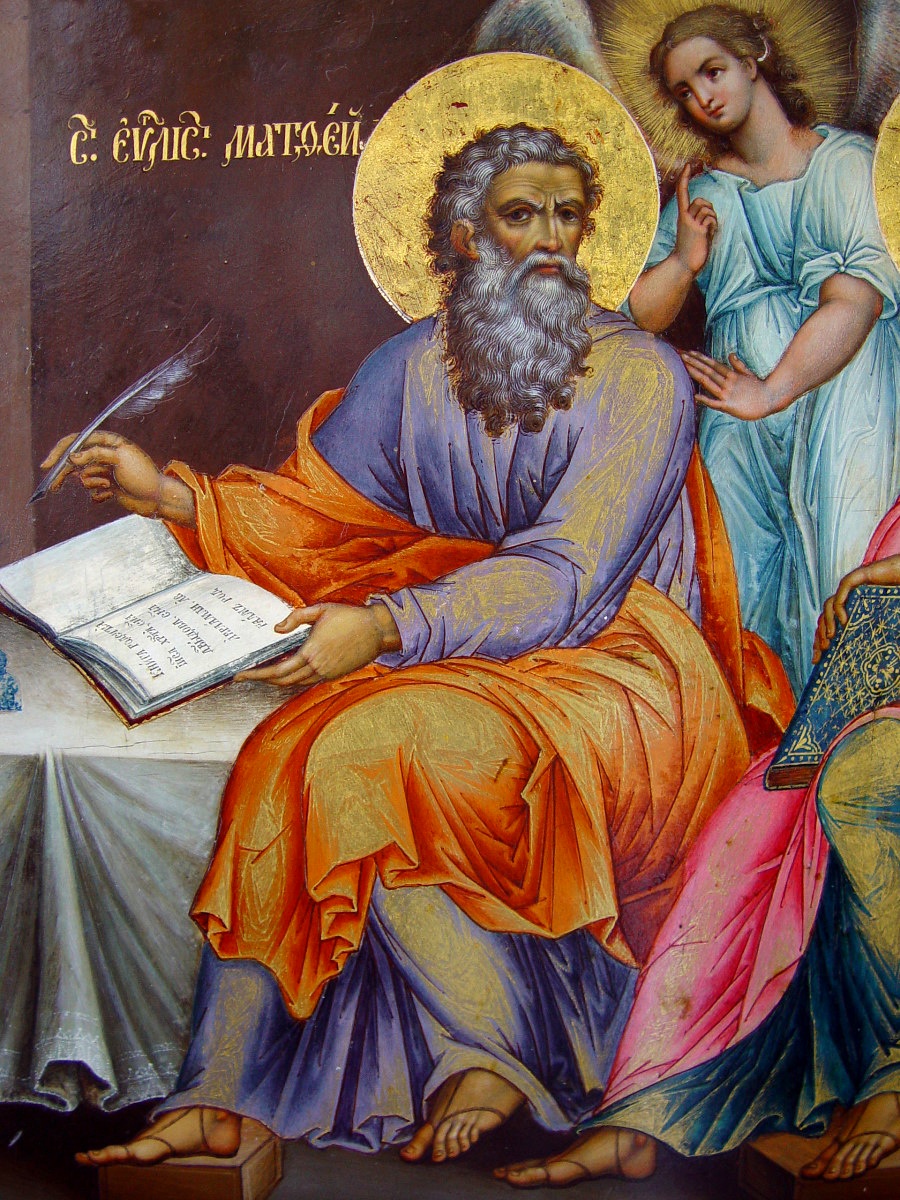 Saint Matthew the Evangelist, Russian Orthodox icon from Palekh. Public-domain source, via Wikimedia Commons.
The icon belongs near the authorship discussion for a theological reason. “Matthew” is not merely a label attached to a text. The apostolic memory is a memory of vocation: Christ calls a compromised man, sits at table with sinners, and makes the former tax collector a witness to mercy. The book’s authority cannot be separated from the Lord whose call remakes a life.
The Christological Arc: The King Revealed Through the Cross
Matthew begins with royal and covenantal claims: Jesus Christ is Son of David and Son of Abraham (Matthew 1:1). Yet the genealogy already unsettles a merely triumphant idea of kingship. It passes through scandal, exile, compromised rulers, faithful women, Gentile inclusion, and long hiddenness. The King comes inside the history He will heal.
In the infancy narrative He is Jesus, the One who saves His people from their sins, and Emmanuel, God with us (Matthew 1:21-23). He relives Israel’s descent to Egypt and return, passes through the Jordan, and enters the wilderness. At His Baptism the Father names Him the beloved Son while the Spirit descends. In temptation He refuses bread without obedience, protection turned into presumption, and rule purchased through idolatry. He is the faithful Son and true Israel, not because Israel’s story is discarded, but because He bears it faithfully to its goal.
On the mountain He teaches with divine authority. In the towns and roads He cleanses the leper, receives Gentile faith, forgives sins, restores the excluded, commands the sea, and frees the tormented. His miracles reveal the character of His reign: authority serves restoration. His demand is equally personal. “Who do you say that I am?” reaches Peter’s confession in Matthew 16:16, but the confession becomes Christian only when it accepts the Cross. A Messiah without the Passion is precisely the misunderstanding Christ rebukes.
The Transfiguration confirms the identity of the One who will suffer. Moses and Elijah stand with Him; the bright cloud overshadows them; the Father’s command is “Hear Him” (Matthew 17:5). The descent from the mountain then leads toward Jerusalem. The Son of Man gives His life as a ransom (Matthew 20:28). The lowly King enters on a donkey, cleanses the temple, receives children’s praise, and becomes the rejected Stone.
At the Mystical Supper He gives His Body and the blood of the new covenant “for the remission of sins” (Matthew 26:28). In Gethsemane His obedience is neither playacting nor defeat. The Passion is voluntary royal self-giving. The scarlet robe, crown of thorns, reed, inscription, and mock homage tell the truth in the form of ridicule: the Crucified One is King. The Resurrection vindicates the crucified Christ without leaving the Cross behind. The risen Lord still bears the identity of the One who was crucified, receives worship, and sends weak disciples under His own authority.
Matthew’s Christology therefore has a cruciform grammar. Power restores. Authority serves. Judgment exposes hypocrisy and protects the vulnerable. Glory prepares the disciple to endure. Kingship reaches its clearest earthly revelation when the King gives Himself.
Fulfillment, Israel, and the Septuagint Background
Matthew’s fulfillment language is broader than prediction followed by event. It includes promise, recapitulation, typology, lament, covenant, worship, and judgment. Christ fulfills Israel without making Israel’s Scriptures disposable.
| Matthean cluster | Scriptural background | Fulfillment in Christ |
|---|---|---|
| Matthew 1-2 | Abraham, David, exile, Isaiah’s Emmanuel, Bethlehem, the Exodus, Rachel’s lament | The promised royal Son enters Israel’s genealogy, gathers exile and return into Himself, and receives Gentile worship without bypassing Israel’s grief. |
| Matthew 3-7 | Isaiah’s wilderness voice, Israel’s testing, Deuteronomy, Moses and Sinai | The beloved Son passes through water and wilderness, defeats temptation through obedience, and brings the Law to its fullness in the heart. |
| Matthew 8-13 | Isaiah’s Servant, Hosea’s call for mercy, Jonah, Solomon, Psalm 78 (LXX Ps 77) | The healer bears infirmity, mercy interprets sacrifice, the greater-than-Jonah calls to repentance, and the kingdom’s mysteries are spoken in parables. |
| Matthew 14-21 | Wilderness bread, sea theophany, Moses and Elijah, Zechariah’s lowly king, the rejected Stone | Christ feeds, rules the sea, is revealed in glory, enters Jerusalem meekly, and judges fruitless stewardship. |
| Matthew 22-28 | Psalm 110 (LXX Ps 109), Daniel’s Son of Man, Passover and covenant blood, Zechariah, Psalm 22 (LXX Ps 21), the righteous sufferer | David’s Son is David’s Lord; the Judge becomes the sacrificial King; the sealed tomb yields to Resurrection and mission. |
The Greek Septuagint forms part of the scriptural world in which Matthew and the early Church heard these texts. At several points, including the Emmanuel citation in Matthew 1:23, the wording and its textual history require more care than a simple “prediction fulfilled” formula can provide. Matthew’s citations do not all relate to one textual form in the same way. Responsible reading proceeds passage by passage: identify the Old Testament context, note where Greek and Hebrew traditions differ materially, and ask how Matthew reads the passage in light of Christ.
That care is also a guard against contempt for Jewish people. The Gospel’s disputes occur within Israel’s Scriptures and among Jewish teachers, disciples, crowds, rulers, and families. Matthew never permits the Church to flatten those people into a single unbelieving mass. The woes, vineyard warnings, temple judgment, blood cry, and false report must be heard first as judgment on Christian hypocrisy, exploitation, cowardice, and refusal of truth. Fulfillment means that Israel’s God has kept His promises in Israel’s Messiah; it does not authorize disdain for Israel or for living Jewish neighbors.
Matthew’s Repeated Words
Matthew’s vocabulary traces the spiritual argument of the book. These terms should not be treated as decorative Greek. Each names a reality that Christ creates and commands.
| Greek term | Key Matthean references | Theological force |
|---|---|---|
| βασιλεία (basileia), kingdom, kingship, reign | Matthew 3:2; 4:17; 5:3; 6:33; 13; 25 | God’s reign comes near in Christ, confronts rival masters, grows in hidden ways, and will be revealed in judgment. |
| δικαιοσύνη (dikaiosynē), righteousness, justice | Matthew 3:15; 5:6, 10, 20; 6:1, 33; 21:32 | Righteousness is God’s will embodied in covenant faithfulness, reconciled worship, purity of heart, mercy, and obedience. |
| ἔλεος (eleos), mercy | Matthew 5:7; 9:13; 12:7; 23:23 | Mercy is covenant action toward the wounded and sinful. It does not abolish truth; it is one of the “weightier matters” that truth demands. |
| ἐκκλησία (ekklēsia), assembly, Church | Matthew 16:18; 18:17 | The gathered people confess Christ, protect the vulnerable, seek restoration, bind and loose, forgive, worship, and live under the Cross. The term also carries the Septuagintal resonance of God’s assembled people. |
| μαθητεύω (mathēteuō), become or make a disciple | Matthew 13:52; 27:57; 28:19 | A disciple is formed into the kingdom and then sent to make disciples through Baptism, teaching, and obedience under Christ’s presence. |
Together the words give a compact account of Matthew: the reign of God produces righteousness and mercy in the Church, which is sent to make disciples.
The Church Formed Under the Cross
The word ekklēsia appears explicitly in Matthew 16 and 18, but the whole Gospel forms the Church. Disciples are called from ordinary work, taught on the mountain, sent with authority, corrected in failure, gathered around the Mystical Supper, scattered in fear, met by the risen Lord and commissioned to make disciples through Baptism in the Trinitarian Name and teaching all that Christ commanded.
Authority in this Church is medicinal, protective, and missional. Matthew 16 joins confession, rock, keys, and binding and loosing. St John Chrysostom reads the rock in relation to the faith of Peter’s confession, then refuses to separate that confession from the Passion Christ immediately announces.5 Matthew 18 places Church correction after Christ has set a child in the midst, warned against scandal, and described the Father’s will that no little one should perish. Correction seeks to “gain” the brother; forgiveness answers the immeasurable debt already forgiven. Ecclesial authority that secures status, shields abusers, humiliates the weak, or evades truth contradicts the chapter’s order.
The same pattern governs leadership. The rulers of the nations “lord it over” others, but greatness among Christ’s disciples takes the form of service because the Son of Man gives His life as a ransom (Matthew 20:25-28). Matthew does not sanctify domination by placing Christian language over it. The Cross defines authority.
Nor is the Church a gathering of the naturally impressive. The disciples misunderstand, compete, sleep, flee, deny, and doubt. Their weakness is not celebrated, but neither is it concealed. The risen Christ meets worship mixed with weakness and still commands the mission. The Church’s hope rests in His authority and presence, not in a fantasy of flawless servants.
Sacramental Life in Matthew
Matthew is not a systematic sacramental treatise, yet its Gospel becomes Church life sacramentally.
At the Jordan, Christ enters the water, the Spirit descends, and the Father speaks (Matthew 3:13-17). The scene reveals the Trinity and prepares the final command to baptize the nations “in the name of the Father and of the Son and of the Holy Spirit” (Matthew 28:19). St Athanasius explains why the Son is named with the Father in Baptism: He is the Father’s own Word, not a creature added to the Creator. The Father gives grace in the Son, and the one baptized is consecrated in the Holy Spirit.6
At the Mystical Supper, Christ does not offer a metaphor detached from His Passion. He gives the bread as His Body and the cup as His blood of the new covenant, shed for the remission of sins. St Cyril of Jerusalem teaches the newly baptized to receive the bread and wine according to the Lord’s own declaration rather than as bare elements.7 The Eucharist is therefore covenant, sacrifice, communion, remission, and preparation for faithful suffering. It must remain joined to repentance, reconciliation, love of the poor, and watchfulness. Judas’s presence at the table makes sentimental sacramentalism impossible.
Matthew also presents sacramental implications in the Church’s binding and loosing (Matthew 16 and 18), Christ’s restoration of marriage to the Creator’s intention (Matthew 19), and the union of Baptism with catechesis and obedient life (Matthew 28). The sacraments are not religious moments added to discipleship. They are acts of Christ in His Church that create, heal, nourish, reconcile, and send disciples.
The Ascetical Grammar of the Kingdom
Matthew’s asceticism begins with repentance and fruit (Matthew 3), passes through fasting and Scripture-shaped resistance in the wilderness (Matthew 4), and reaches its clearest concentration in the Sermon on the Mount. Christ brings the commandment beneath visible behavior: murder is traced into anger and contempt; adultery into the consuming gaze; public piety into hunger for recognition; anxiety into divided trust; judgment into the unmerciful eye.
Almsgiving, prayer, and fasting are not rejected. They are healed of display and returned to the Father who sees in secret. This hiddenness is not individualism. It purifies the heart so that love of the neighbor becomes free of performance. St John Chrysostom begins the Beatitudes with humility, explaining the poor in spirit as “the humble and contrite in mind.”8 Contrition is not self-hatred. It is the end of self-sufficiency and the beginning of receptivity to grace.
The Sermon’s hidden practices prepare the later Gospel. The person trained to pray in secret can watch with Christ in Gethsemane. The person released from mammon can pour out costly love without calculating recognition. The person learning enemy love can endure persecution without becoming an image of the persecutor. The person who forgives debts can receive Matthew 18 without turning correction into revenge. The person who seeks first the kingdom can hear the parables of readiness without panic.
Asceticism here is participation in the King’s healing, not merit accumulation or religious self-optimization. Fasting exposes rival appetites. Prayer gathers the scattered heart before the Father. Almsgiving loosens possession and restores the neighbor to sight. Reconciliation makes worship truthful. Watchfulness refuses to postpone repentance. Cross-bearing follows Christ; it must never be used to keep a person exposed to abuse, conceal violence, or baptize another person’s sin.
The Fathers Reading Matthew
The Fathers are most useful when they help the reader see Matthew’s own argument. They should not be displayed as a list of impressive names.
St John Chrysostom’s Homilies on Matthew provide a sustained early commentary on the Gospel. His reading repeatedly joins close attention to spiritual diagnosis. The Beatitudes begin with humility; salt and light make holiness responsible to the world; Peter’s confession must accept the Passion; Matthew 18 seeks the brother’s restoration; the Mystical Supper joins Christ’s true gift to repentance; the Resurrection sends doctrine and commandments together. His great strength is that he seldom allows doctrine to remain abstract. The identity of Christ changes prayer, money, speech, power, forgiveness, and care for the poor.
St Cyril of Jerusalem gives sacramental clarity to Matthew 26. The Lord’s words govern the Church’s reception of the Eucharist.7 St Athanasius gives Trinitarian clarity to Matthew 28:19: the grace of Baptism comes from the Father in His own Son, with consecration in the Holy Spirit.6 These witnesses do not add foreign ideas to Matthew. They show how the Gospel was received in catechesis, worship, and doctrinal confession.
Chrysostom’s final homily on Matthew is especially apt for the whole book. He holds together the Great Commission’s doctrine, commandments, and promise of Christ’s presence. The Lord does not send the Church with information alone. He sends a baptized and taught people to live everything He commanded.9 He makes the mission possible by remaining with believers as one Body until the end of the age.10
The Church’s Voice in Worship ⛪
The Coptic Church does not encounter Matthew only in continuous reading. The lectionary places its scenes within the saving year, allowing the Gospel’s theology to become prayer.
- Nativity: Matthew 1:1-17 is heard in Christmas Paramoune Vespers; Matthew 1:18-25 in Christmas Paramoune Matins; Matthew 2:1-12 in the Christmas Liturgy. Genealogy, Emmanuel, and Gentile worship belong together.
- Theophany: Matthew 3 appears in Epiphany and water-rite contexts, where the Baptism of Christ reveals the Trinity and the sanctification of the waters.
- The daily hours and Great Lent: Matthew 5:1-16 is the Sixth Hour Gospel in the Agpeya. Major portions of Matthew 4-7 are appointed through the Lenten cycle, joining fasting to repentance, prayer, reconciliation, trust, and obedience.
- Palm Sunday: Matthew 21:1-17 is proclaimed in the Palm Sunday Liturgy. The procession receives the lowly King who enters the temple to purify worship and heal.
- Holy Week: Matthew 24-25 supplies watchfulness readings; Matthew 26:20-29 is the Covenant Thursday Liturgy Gospel; Matthew 26-27 is distributed through the Passion hours of Good Friday Eve and Good Friday. The Church does not hurry from the cup to the garden or from the trial to the Cross.
- Resurrection and mission: Matthew 28:1-20 is heard in annual Matins readings, and Matthew 28:16-20 at Matins on Tuesday of the first week of the Holy Fifty Days. Retained local service references also place Matthew 28:1-20 at Bright Saturday Liturgy and Matthew 28:16-20 in the third Liturgy at the consecration of the Myron, the holy anointing oil. Those local witnesses have a different standing from the public annual and Holy Fifty appointments. Together these readings join Resurrection, Baptism, mission, and abiding presence.
These examples are deliberately range-specific. Many larger chapters are distributed across several services rather than appointed as one continuous reading. The point is not to build a calendar catalogue. It is to see the Church’s interpretation: Emmanuel is worshiped at Nativity, the beloved Son is revealed in the water, the commandments become ascetical life, the King enters in meekness, the covenant is received at the altar, the Passion is watched hour by hour, and the risen Lord sends a baptized people.
Geography and Visual Teaching
Matthew’s geography forms three theological arcs.
Bethlehem, Egypt, and Nazareth hold promise, danger, exile, return, and hidden obedience. The royal child is born in David’s city, receives the Magi, flees the violence of Herod, and grows in a place that invites contempt. The King enters vulnerability before He displays authority.
Galilee, the sea, wilderness, and mountains hold testing, light, teaching, healing, and revelation. Galilee of the Gentiles becomes the first great field of public ministry. The sea exposes fear and reveals the Lord who rules chaos. Mountains gather the Sermon, prayer, Transfiguration, eschatological warning, and the final commission. Matthew’s mountains do not all mean the same thing, but they repeatedly place the disciple before divine authority.
Jericho, Jerusalem, the Mount of Olives, Golgotha, the tomb, and the Galilean mountain trace the royal ascent, confrontation, Passion, Resurrection, and mission. Matthew 20 locates the blind men as Jesus leaves Jericho on the way toward Jerusalem; it is better to speak of Jericho and the ascent than to import another Gospel’s road scene. Jerusalem receives palms, witnesses temple judgment, and is lamented by Christ. Golgotha reveals the King under mockery. The tomb is sealed; the risen Lord meets the women and the eleven. The Gospel then returns to a mountain in Galilee, from which the Church is sent outward.
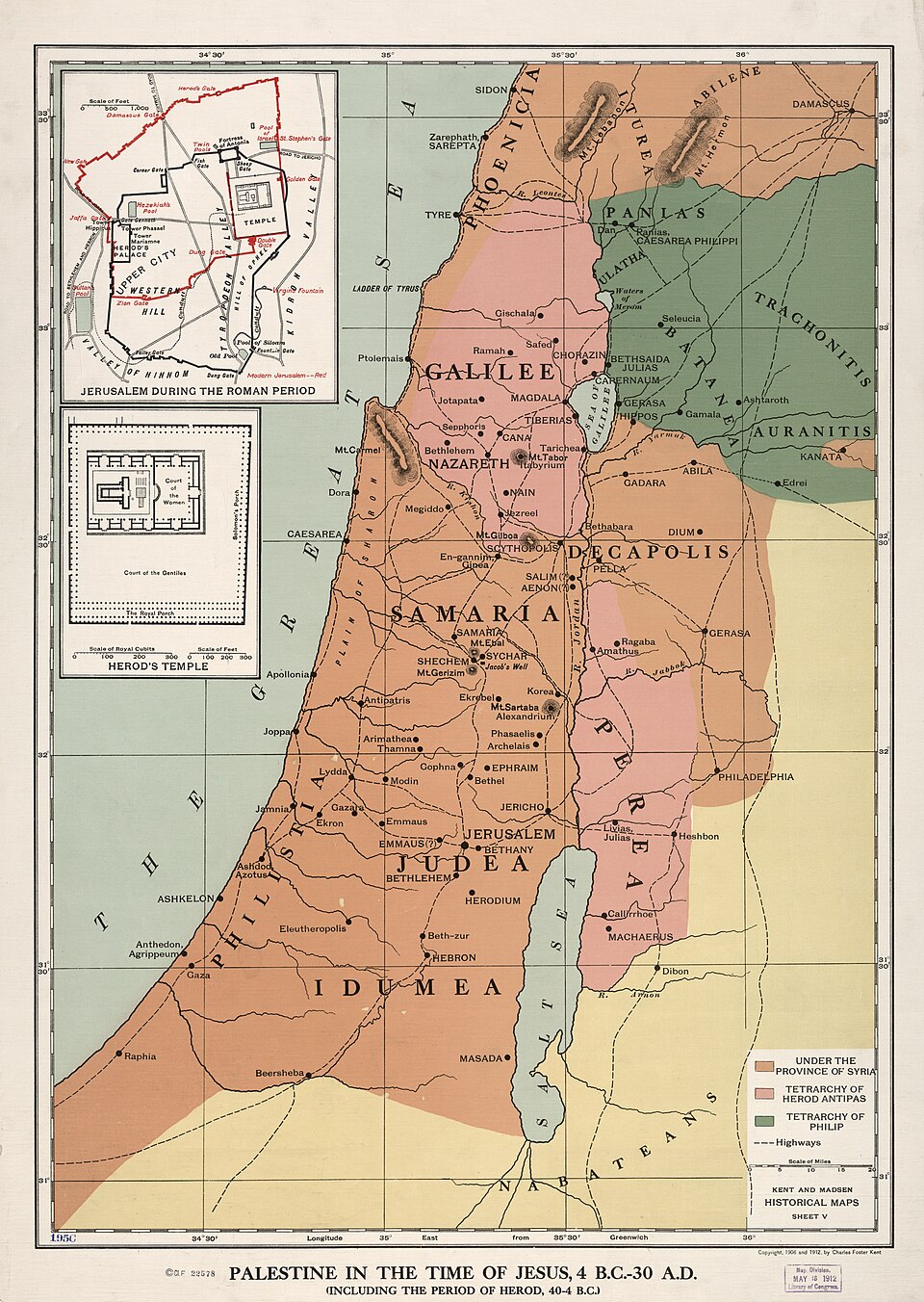 Palestine in the time of Jesus, 4 B.C.-30 A.D., Library of Congress map. Public-domain source, via Wikimedia Commons.
Maps should clarify these arcs rather than suggest false certainty about every traditional site. Icons should interpret, not decorate: Nativity iconography serves Emmanuel and the humility of the King; Baptism iconography serves Trinitarian revelation; Transfiguration iconography holds glory and the approaching Cross together; Passion and Resurrection iconography preserves the royal and worshipful character of the events.
Reading Matthew’s Hard Texts Without Causing Harm
Matthew contains words that can be mishandled in predictable ways. Faithful teaching names the danger instead of hiding it.
- Sexuality, marriage, and divorce: Matthew 5 and 19 uphold purity and covenant fidelity. They do not authorize humiliation of wounded people or demand that a person remain exposed to violence. Hardness of heart must be confronted, and danger requires competent pastoral and civil help.
- Money, anxiety, and reward: Matthew 6, 19-20, and 25 condemn slavery to mammon, entitlement, envy, and buried stewardship. They do not shame poverty, responsible provision, or psychological suffering. Mercy is not a technique for purchasing salvation; it is the fruit of communion with the merciful King.
- Demonic affliction, illness, and disability: Christ’s healings reveal compassion and authority. They must not become spectacle, an equation between illness and personal sin, or an accusation that continued suffering proves weak faith. Prayer and sacramental care do not forbid appropriate medical and psychological care.
- Scandal, correction, and forgiveness: Matthew 18 begins with little ones. Its procedures cannot be used to conceal abuse, silence victims, or prevent appropriate intervention. Forgiveness rejects vengeance; it does not require denial, unsafe access, or the removal of accountability.
- Religious opponents and the Passion: Matthew’s conflicts and Passion narrative have been weaponized against Jewish people. Such use is a betrayal of the Gospel. The warnings address religious hypocrisy, exploitation, cowardice, and refusal of truth wherever they appear, especially in the Church’s own leaders and disciples.
- Judgment and the end: Matthew 24-25 calls for endurance, mercy, and faithful service. It does not license date-setting, panic, partisan prediction, or endless decoding. Watchfulness means doing the Master’s work today.
- Failure, remorse, and despair: Judas and Peter both fall, but their stories are not interchangeable. Remorse that turns inward can harden into despair; repentance turns back toward mercy. Peter’s bitter tears and later mission show that failure need not have the last word. The risen Lord approaches disciples who worship with weakness.
Pastoral care does not weaken Matthew’s demands. It protects them from being turned into instruments of domination, contempt, or despair.
Spiritual Fruit 🍇
-
Receive the King in the hidden life. Matthew will not let worship remain public performance. Bring anger, lust, the need to be seen, anxious accumulation, and the urge to judge into prayer and confession. The Father who sees in secret is not policing an image; He is healing a person.
-
Let mercy become concrete. “I desire mercy” reaches the table where sinners are called, the bruised reed Christ does not break, the debt forgiven from the heart, the little one protected, and the hungry person served. Choose one reachable act of mercy, especially one that costs attention, time, pride, or convenience.
-
Submit authority to the Cross. In the home, parish, ministry, or workplace, ask whether your influence protects the vulnerable and helps another person become faithful. Christ’s authority washes out domination. The Son of Man gives His life; His servants cannot build importance by making others small.
-
Practice watchfulness as faithfulness, not fear. Pray before temptation arrives. Reconcile while there is time. Use what has been entrusted to you. Feed the household. Visit the suffering. Watchfulness is the refusal to postpone love while waiting for a dramatic future.
-
Bring weakness into worship. Matthew does not hide the disciples’ fear, sleep, flight, denial, or doubt. Christ corrects them, restores them, and sends them. Do not make peace with sin, but do not stay away from Christ until you feel impressive. Repent, worship, receive His gifts, and obey the next command.
-
Live from Emmanuel’s promise. The mission is larger than the disciples, and the commandments reach deeper than natural strength. The Gospel begins and ends with God’s presence. Pray Matthew 28:20 when service feels beyond you: the One who commands is the One who remains.
Teaching the Whole Gospel
A parish study should keep four threads visible from beginning to end.
- Emmanuel: Return often to Matthew 1:23 and 28:20. Christ’s presence is the frame for commandment, sacrament, suffering, and mission.
- Kingdom righteousness: Explain the Sermon before applying it. The commandments reveal the healed life under Christ, not a ladder of self-salvation or an excuse for disobedience.
- Mercy and judgment: Do not place these against each other. Mercy calls the sinner home; judgment exposes the seriousness of refusing communion with Christ and the neighbor.
- The Cross-shaped Church: Connect confession to self-denial, correction to protection and restoration, Eucharist to repentance, leadership to service, Resurrection to Baptism and teaching.
Where a passage is hard, place the safety guardrail in the explanation itself. Do not leave anti-Jewish misuse, abuse concealment, despair, or suffering-related blame for a closing note after the damage has already been done. Where lectionary evidence covers only a sub-range, name the sub-range. Where a patristic witness is thematic rather than direct commentary, say so. Precision is part of pastoral love.
Sources
Scripture is from NKJV.
Early Christian and patristic sources
- Eusebius of Caesarea, Church History 3.39.16, preserving Papias’s witness concerning Matthew: https://www.newadvent.org/fathers/250103.htm
- St Irenaeus of Lyons, Against Heresies 3.1.1: https://www.newadvent.org/fathers/0103301.htm
- St John Chrysostom, Homilies on the Gospel of Matthew, public-domain NPNF translation: https://www.ccel.org/ccel/schaff/npnf110.html
- St Cyril of Jerusalem, Catechetical Lecture XXII, On the Body and Blood of Christ: https://www.ccel.org/ccel/schaff/npnf207.ii.xxvi.html
- St Athanasius of Alexandria, Against the Arians II.41-42, on the Father, Son, and Holy Spirit in Baptism: https://www.ccel.org/ccel/schaff/npnf204.xxi.ii.iii.v.html#xxi.ii.iii.v-p90
Orthodox, historical, and lexical orientation
Orthodox Church in America, “Apostle and Evangelist Matthew”: https://www.oca.org/saints/lives/2026/11/16/103313-apo-and-evangelist-matthew
USCCB, “Introduction to the Gospel according to Matthew,” used for a clearly labeled modern critical account of structure and historical questions: https://bible.usccb.org/bible/matthew/0
Greek lexical orientation: basileia, dikaiosynē, eleos, ekklēsia, and mathēteuō.
Coptic Orthodox lectionary references were used at exact passage-range level for the worship examples above; broad chapter occurrence counts were not treated as publication evidence.
Footnotes
-
Orthodox Church in America, “Apostle and Evangelist Matthew,” https://www.oca.org/saints/lives/2026/11/16/103313-apo-and-evangelist-matthew ↩
-
Eusebius of Caesarea, Church History 3.39.16, preserving Papias’s statement about Matthew’s logia, https://www.newadvent.org/fathers/250103.htm ↩
-
St Irenaeus of Lyons, Against Heresies 3.1.1, https://www.newadvent.org/fathers/0103301.htm ↩
-
USCCB, “Introduction to the Gospel according to Matthew,” for a modern critical account of sources, date, location, and literary structure, https://bible.usccb.org/bible/matthew/0 ↩
-
St John Chrysostom, Homily LII on Matthew, on Matthew 16:18-19 and the faith of Peter’s confession, https://www.ccel.org/ccel/schaff/npnf110.iii.LII.html#iii.LII-p183 ↩
-
St Athanasius of Alexandria, Against the Arians II.41-42, especially II.41 on the Father giving grace in the Son and consecration in the Holy Spirit: https://www.ccel.org/ccel/schaff/npnf204.xxi.ii.iii.v.html#xxi.ii.iii.v-p90 ↩ ↩2
-
St Cyril of Jerusalem, Catechetical Lecture XXII, On the Body and Blood of Christ, on receiving the bread and wine according to Christ’s declaration, https://www.ccel.org/ccel/schaff/npnf207.ii.xxvi.html#ii.xxvi-p26 ↩ ↩2
-
St John Chrysostom, Homily XV on Matthew, on “poor in spirit” as the humble and contrite in mind, https://www.ccel.org/ccel/schaff/npnf110.iii.XV.html#iii.XV-p19 ↩
-
St John Chrysostom, Homily XC on Matthew, on doctrine, commandments, and discipleship in the Great Commission, https://www.ccel.org/ccel/schaff/npnf110.iii.LXXXVI.html#iii.LXXXVI-p19 ↩
-
St John Chrysostom, Homily XC on Matthew, on Christ’s promise to remain with believers as one Body until the end of the age, https://www.ccel.org/ccel/schaff/npnf110.iii.LXXXVI.html#iii.LXXXVI-p22 ↩