


This narration is from a previous version of the study and may include a combined recording of multiple chapters.
Micah 3 is severe because leadership is holy work. Rulers, priests, prophets, parents, servants, and teachers are not judged only by what they say, but by what their authority does to the people entrusted to them.
The chapter moves from devoured bodies to purchased words to a city built with blood. These are not three unrelated failures. Power, religious speech, and sacred institutions have been made to serve appetite. Against them stands a prophet strengthened by the Lord’s Spirit, whose task is to tell the truth that those institutions no longer want to hear.
Micah 3:1-4 - Leaders Who Devour Instead of Shepherd
Translation: Brenton Septuagint.
- And he shall say, Hear now these words, ye heads of the house of Jacob, and ye remnant of the house of Israel; is it not for you to know judgment?
- who hate good, and seek evil; who tear their skins off them, and their flesh off their bones:
- even as they devoured the flesh of my people, and stripped their skins off them, and broke their bones, and divided them as flesh for the caldron, and as meat for the pot,
- thus they shall cry to the Lord, but he shall not hearken to them; and he shall turn away his face from them at that time, because they have done wickedly in their practices against themselves.
Micah asks, “is it not for you to know judgment?” The question concerns responsibility before it concerns information. The leaders ought to recognise what is right and render justice accordingly. Instead, they hate good and seek evil. Their failure is not excused by the difficulties of office, because the moral direction of their desire has been reversed.
The images are brutal: tearing skin, breaking bones, treating the people like meat for a pot. Micah is describing anti-shepherds. Authority that was meant to protect becomes appetite. These are images of exploitation, not an account of a literal meal. They uncover what respectable arrangements can conceal: people are being used up so that their rulers may flourish. The phrase “my people” makes the offence more terrible. Those whom the leaders treat as material still belong to the Lord.
It is the wicked leaders themselves who cry in verse 4. They have treated others as disposable; now, in the crisis of judgment, they discover that invocation of God’s name cannot make their conduct harmless. Brenton adds that their evil practices have been “against themselves”. What injures the neighbour also destroys the one who insists on doing it. Power cannot insulate a person from the spiritual consequences of its misuse.
This warning must not be turned against someone whose prayers seem unanswered. Micah does not say that silence, grief, or prolonged suffering proves secret wickedness. He addresses named acts of predatory leadership. Nor does he forbid the guilty to repent. The later remembrance of this prophecy in Jeremiah will show that a severe warning can be received in fear of God and answered with mercy.
Christ reveals the opposite use of authority in John 10:1-21. The Good Shepherd lays down His life for the sheep. The contrast is not merely between cruel leaders and a kinder leader. Where these rulers preserve themselves by consuming the flock, Christ gives Himself so that the flock may live. In the Eucharist He feeds His people with His own life-giving Body and Blood. That gift cannot be reconciled with treating the communicant beside us as expendable.
The same contrast governs Ezekiel 34, where the Lord confronts shepherds who serve themselves and promises to tend His sheep. Micah’s fierce images make us long for that Shepherd. They also give those who have been harmed permission to recognise exploitation as a contradiction of pastoral care, not its necessary cost. Seeking protection and truthful accountability is not disloyalty to Christ.
Gems from the Fathers 💎: To know judgment is to obey it
St John Chrysostom cites Micah 3:1 while discussing the religious rulers’ dismissal of the crowd in John 7. His point is that claiming knowledge of the Law does not establish obedience to it. In his words, “And what other proof can a man bring of your not knowing the Law than your not obeying it?”1
This brings Micah’s question into the conscience of a Christian teacher. The ability to explain a commandment is not yet the knowledge that has become life. Chrysostom’s criticism must not become contempt for the Jewish people: the dispute in John includes Nicodemus, himself a ruler, insisting that a person be heard before being judged. The searching application is to us whenever office or learning becomes an excuse not to listen.
Micah 3:5-8 - Paid Peace and the Spirit-Filled Prophet
Translation: Brenton Septuagint.
- Thus saith the Lord concerning the prophets that lead my people astray, that bite with their teeth, and proclaim peace to them; and when nothing was put into their mouth, they raised up war against them:
- therefore there shall be night to you instead of a vision, and there shall be to you darkness instead of prophecy; and the sun shall go down upon the prophets, and the day shall be dark upon them.
- And the seers of night-visions shall be ashamed, and the prophets shall be laughed to scorn: and all the people shall speak against them, because there shall be none to hearken to them.
- Surely I will strengthen myself with the Spirit of the Lord, and of judgment, and of power, to declare to Jacob his transgressions, and to Israel his sins.
The mouth links this passage to the first. The leaders devoured the people; now the prophets’ message depends on whether their own mouths are filled. They announce peace to those who feed them and raise war against those who do not. Religious words become a means of reward and retaliation. The question is no longer what the Lord has spoken, but what a hearer will provide.
This does not condemn every material provision for ministry. It condemns selling favourable spiritual judgments and threatening those who cannot or will not pay. The same corruption can work without money when attention, influence, or personal loyalty buys a teacher’s approval. A donor should not be able to purchase a different moral truth from the one spoken to a person without resources.
The punishment fits the pretence. Those who traded in visions receive night instead of vision; those who claimed illumination meet a setting sun. The imagery concerns the collapse of a false claim to spiritual sight. It is not a description of depression or proof that someone experiencing spiritual dryness has been abandoned by God. Here the pretended seers lose both their authority and the audience whose dependence they exploited.
Verse 8 gives a different foundation for speech: “Surely I will strengthen myself with the Spirit of the Lord”. The prophet’s resolve is real, but its strength is not self-manufactured. The purpose is equally clear: to declare transgressions and sins, not to cultivate a reputation for boldness. Courage is tested by fidelity to what must be said, not by the pleasure of saying something severe.
LXX insight: “strengthen myself with the Spirit of the Lord”
The Greek text has emplēsō ischyn en pneumati Kyriou, language of filling with strength in the Spirit of the Lord.2 Brenton’s “strengthen myself” must therefore be read together with “with the Spirit of the Lord”, not as an assertion of independence. The rest of the sentence names judgment, power, and the task of declaring sin. The gift has a service to perform.
For a Christian servant, this guards against two mistakes. We cannot wait for natural confidence before obeying a difficult duty, and we cannot baptise our irritation as the Spirit’s courage. Strength received from God must remain accountable to truth, justice, and the good of the people addressed. Humiliating someone is not made prophetic by being fearless.
Gems from the Fathers 💎: The Spirit who spoke in the prophets
St Cyril of Jerusalem includes Micah 3:8 among the prophetic testimonies to the Holy Spirit in Catechetical Lecture 16.29. In the next section he describes the Spirit as “one and undivided, but His operations various.”3
Cyril’s setting matters. Micah is not an isolated religious genius with an extraordinary temperament. His strength belongs within the work of the one Holy Spirit, who spoke through the prophets. The Spirit’s gifts differ, but their divine source is not divided. This helps us pray for courage without pretending that every strong impression is revelation. The Spirit who gives strength does not authorise our private passions to speak in God’s name.
Micah 3:9-12 - False Security in Zion
Translation: Brenton Septuagint.
- Hear now these words, ye chiefs of the house of Jacob, and the remnant of the house of Israel, who hate judgment, and pervert all righteousness;
- who build up Sion with blood, and Jerusalem with iniquity.
- The heads thereof have judged for gifts, and the priests thereof have answered for hire, and her prophets have divined for silver: and yet they have rested on the Lord, saying, Is not the Lord among us? no evil shall come upon us.
- Therefore on your account Sion shall be ploughed as a field, and Jerusalem shall be as a storehouse of fruits, and the mountain of the house as a grove of the forest.
The final summons brings the offices together. Rulers sell judgment for gifts, priests answer for hire, and prophets divine for silver. The city may be growing, but its growth is built with blood and iniquity. Micah makes us ask not only what has been achieved, but whose injury has made the achievement possible. A successful institution cannot make the means of its success holy.
The leaders’ defence is religious: “Is not the Lord among us? no evil shall come upon us.” The falsehood is not the confession that God dwells with His people. It is the conclusion that His presence exempts them from justice. They turn the Lord, whom they should obey, into a guarantee that their habits need not change.
Christians can repeat the error with holy buildings, inherited traditions, ordained office, or sacramental participation. This does not mean that the mysteries are unreal or that their grace is manufactured by our good behaviour. It means that real gifts call for real reception. We cannot ask communion with the Holy One to shelter a deliberate refusal of His mercy toward another person.
Verse 12 reverses the city’s supposed permanence. Sion becomes a ploughed field; Jerusalem becomes a storehouse of fruits; the temple mountain becomes a wooded grove. In this sequence the agricultural building is an image of the city’s reduction, not a promise of prosperity. Isaiah 1:8 similarly pictures the daughter of Sion as a tent in a vineyard and a storehouse in a cucumber garden. Micah 1:6 has already brought Samaria down into the landscape of fields and a vineyard. Sacred prestige does not prevent the same judgment from reaching Jerusalem.
Gems from the Fathers 💎: A warning received inside the Church
St Gregory the Theologian takes up Micah’s accusation in Oration 2.58, his defence of his flight from priestly responsibility. He recalls the rulers’ gifts, the priests’ hire, the prophets’ money, and the threatened ploughing of Sion. In the surrounding argument he sets the burden of caring for souls beside the labours of St Paul, then turns the prophets’ warnings toward the conscience of Christian ministers.4
Gregory does not use Micah to enjoy someone else’s exposure. In section 59, discussing Joel, he writes: “so far is he from allowing us to revel in the misfortunes of others”.4 His reception gives this chapter its proper ecclesial direction. We pray for faithful shepherds, protect those entrusted to them, and let the warning search our own use of authority. Lament and repentance are more faithful responses than either concealment or delight in scandal.
The story of the warning does not end with devastation. Jeremiah 33:18-19 LXX (NKJV 26:18-19) remembers Micah’s prophecy and asks whether Hezekiah and Judah killed him for speaking it. Instead, they feared the Lord and made supplication; the Lord ceased from the announced calamity. The warning was not a demand for despair. Hearing it truthfully opened a future that denying it would have closed.
Leadership Discernment Table
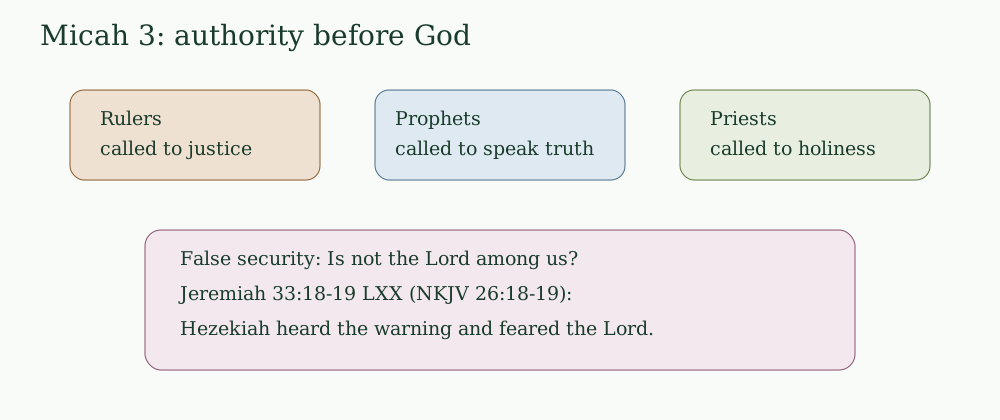
An interpretive schematic of the chapter’s three offices and their accountability before God.
| Calling | Corruption in Micah 3 | True calling |
|---|---|---|
| Rulers | Hate good, seek evil, devour the people | Render justice and protect those without power |
| Prophets | Proclaim peace when fed and raise war when unfed | Speak truth with strength received from the Spirit |
| Priests | Answer for hire | Serve the people in holiness and truth, without selling God’s answer |
| Servants today | Use ministry for validation, control, or comfort | Serve as stewards who will answer to Christ |
Spiritual Fruit 🍇
- Examine how your authority affects the weak. Think of one person who depends on your decisions. Can that person disagree, ask for help, or report harm without fearing retaliation? Give them a real opportunity to be heard, and accept the accountability that their safety requires.
- Do not purchase peace for your conscience. Notice whether you seek counsel only from people who will approve your plans. Receive a truthful correction without demanding either flattery or cruelty. The Spirit’s courage is not the same as a harsh temperament.
- Let the mysteries lead you into repentance. Before receiving communion, bring a particular refusal of mercy into confession and prayer. Where you have harmed someone, seek wise help to repair it. Holy things are not a shield behind which we may continue to wound Christ’s people.
- Remember Hezekiah when a hard word reaches you. Do not waste the first moment defending your image. Ask what is true, what must stop, and what must be restored. The Shepherd who exposes a consuming appetite also gives His life to make a different life possible.
Teaching Notes
Micah 3:1-4
- Ask: What would it mean to know judgment rather than merely explain it?
- Emphasize: The anti-shepherd image exposes exploitation. It is the wicked leaders themselves who cry in verse 4.
- Watch for: Applying this only to clergy, or telling sufferers that unanswered prayer proves wrongdoing. Do not use obedience to excuse abuse or obstruct protection.
- Connect: Christ the Good Shepherd gives His life for the sheep rather than consuming their lives for His comfort.
- Show: Use the leadership table to distinguish the offices without separating their accountability.
Micah 3:5-8
- Ask: What can purchase a teacher’s approval besides money?
- Emphasize: Brenton’s “strengthen myself” is qualified by “with the Spirit of the Lord”. The gift serves truth, not the prophet’s self-image.
- Watch for: Confusing harshness with prophecy, or treating honest material support for ministry as the purchase of a favourable oracle.
- Connect: Cyril places Micah 3:8 within the testimony to the one Holy Spirit who spoke in the prophets.
Micah 3:9-12
- Ask: What is wrong with the conclusion drawn from “Is not the Lord among us?”
- Emphasize: Jeremiah 33:18-19 LXX (NKJV 26:18-19) remembers the warning as one that could be received with fear of God and supplication.
- Watch for: Treating the Church as magical protection, denying the reality of sacramental grace, or using the chapter to relish another person’s disgrace.
- Connect: Gregory receives Israel’s prophetic warning within the Church’s own examination of ministry.
Sources
Embedded Scripture is from Brenton’s English Septuagint (LXX).
Micah 3, Brenton and Greek text, with Jeremiah 33:18-19 LXX and Isaiah 1:8 read in Brenton.
St John Chrysostom, Homilies on John, Homily 52, discussion of John 7:49-51.
St Cyril of Jerusalem, Catechetical Lecture 16.29-30, on the Holy Spirit who spoke in the prophets.
St Gregory the Theologian, Oration 2.52-59, especially 58, on the responsibility of ministry.
Footnotes
-
St John Chrysostom, Homilies on John 52, §1, on John 7:49-51, translated by Charles Marriott, Nicene and Post-Nicene Fathers, First Series, vol. 14 (1889). Containing homily. ↩
-
Micah 3:8, Greek text beside Brenton, “ἐμπλήσω ἰσχὺν ἐν πνεύματι Κυρίου”. ↩
-
St Cyril of Jerusalem, Catechetical Lecture 16.29-30, translated by Edwin Hamilton Gifford, Nicene and Post-Nicene Fathers, Second Series, vol. 7 (1894). The Micah citation is in §29; the quoted description of the Spirit is in §30. Containing lecture. ↩
-
St Gregory the Theologian, Oration 2.52-59, especially §§58-59, translated by Charles Gordon Browne and James Edward Swallow, Nicene and Post-Nicene Fathers, Second Series, vol. 7 (1894). Containing oration. ↩ ↩2