


This narration is from a previous version of the study and may include a combined recording of multiple chapters.
Micah 6 is one of Scripture’s clearest words against worship that refuses to become life. The Lord does not reject sacrifice because worship is unimportant. He rejects sacrifice detached from covenant mercy.
Micah 6:1-5 - The Lord Pleads His Case
Translation: Brenton Septuagint.
- Hear now a word: the Lord God has said; Arise, plead with the mountains, and let the hills hear thy voice.
- Hear ye, O mountains, the controversy of the Lord, and ye valleys even the foundations of the earth: for the Lord has a controversy with his people, and will plead with Israel.
- O my people, what have I done to thee? or wherein have I grieved thee? or wherein have I troubled thee? answer me.
- For I brought thee up out of the land of Egypt, and redeemed thee out of the house of bondage, and sent before thee Moses, and Aaron, and Mariam.
- O my people, remember now, what counsel Balac king of Moab took against thee, and what Balaam the son of Beor answered him, from the reeds to Galgal; that the righteousness of the Lord might be known.
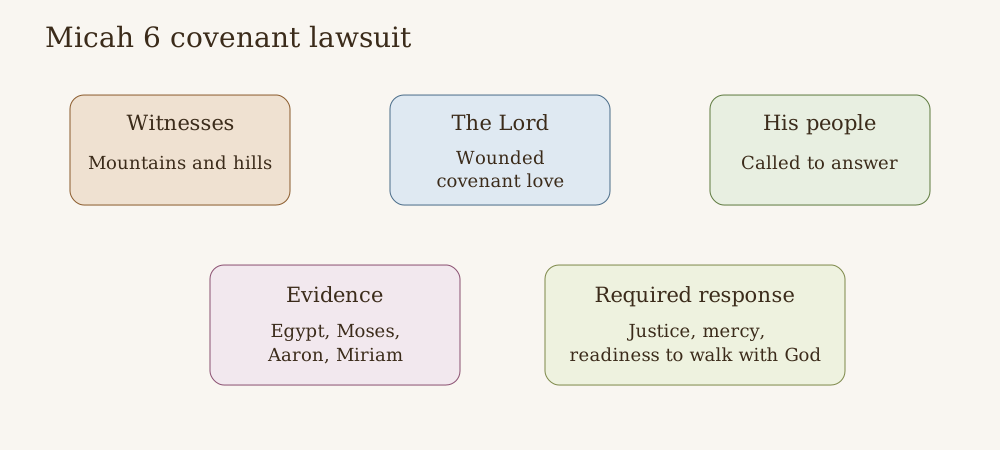
The mountains and foundations of the earth hear the case. Human courts have been corrupted, but the covenant cannot be made to disappear by buying a judge. Creation witnesses a controversy between the Lord and His own people. Yet before the passage names their dishonest scales, God asks what wrong they have suffered at His hands: “O my people, what have I done to thee?” The words expose estrangement without ceasing to claim the estranged as His people.
This is wounded covenant love. God is not coldly prosecuting strangers. He is pleading with the people He redeemed. His question does not mean that every grief in their history was imaginary. It asks whether His saving faithfulness gives them any reason to answer Him with treachery. The relationship began with liberation, not with a demand that slaves purchase their freedom.
The evidence is mercy: Egypt, Moses, Aaron, Mariam, and the defeat of Balac’s counsel against Israel through Balaam’s answer. Even hostility that the people could not master did not annul God’s care. The phrase “from the reeds to Galgal” recalls the journey from Shittim, before the Jordan crossing, to Gilgal beyond it. Joshua 3:1 and Joshua 4:19-24 describe that passage into the land and its memorial stones. The God who brought them out of bondage also brought them through the water. Remembering is not nostalgia. It restores the truth about the One whom they have begun to treat as a burden.
Many sins become visible when placed beside remembered mercy. In confession we can name the lie, the grudge, or the money withheld without pretending that our whole life is nothing but failure. God has acted for us before we have answered Him rightly. Gratitude gives repentance its proper direction: back toward the Giver, not inward into endless disgust with ourselves.
Micah 6:6-8 - True Worship and the Ready Walk
Translation: Brenton Septuagint.
- Wherewithal shall I reach the Lord, and lay hold of my God most high? shall I reach him by whole-burnt-offerings, by calves of a year old?
- Will the Lord accept thousands of rams, or ten thousands of fat goats? should I give my first-born for ungodliness, the fruit of my body for the sin of my soul?
- Has it not been told thee, O man, what is good? or what does the Lord require of thee, but to do justice, and love mercy, and be ready to walk with the Lord thy God?
The answerer seems willing to offer everything except the changed life God asks for. A calf becomes thousands of rams, then ten thousands of goats, then one’s own first-born. The mounting price conceals a mistaken understanding of God: perhaps He can be reached by something sufficiently costly. But the Lord has just recalled how He redeemed His people. They are trying to buy a relationship that began as a gift.
The question about the first-born is not divine permission for human sacrifice. It is the terrible limit of the proposed bargain. Neither another person’s life nor a spectacular religious act can substitute for repentance. A child is not payment for a parent’s sin. The answer in verse 8 brings the worshipper out of this escalating fantasy and back to the good already made known.
The command “to do justice” means that the neighbour must actually receive what is right, not merely hear us praise righteousness. To “love mercy” goes deeper than reluctant compliance: another person’s need must cease to feel like an interruption to our real life. And walking “with the Lord thy God” keeps both justice and mercy within communion. This is not a programme for becoming respectable without God. Nor is communion a private experience exempt from the claims of a neighbour.
Micah 6:8 is often quoted as a slogan, but in the chapter it is the answer to worship used as a substitute for obedience. The prophet is not setting prayer against honest work, or the altar against the poor. The person who approaches God must bring the same heart into both places. A charitable donation does not sanctify wages deliberately withheld. Correct religious speech does not excuse humiliation at home.
LXX insight: “be ready to walk”
Brenton’s “be ready to walk with the Lord thy God” gives the last command the character of preparedness. The concern is not only whether we approve of God’s way, but whether we are available to take it. There is a familiar kind of delay that looks reverent: we wait for a deeper feeling before apologizing, for perfect circumstances before making restitution, or for a less inconvenient moment before helping. Readiness interrupts that delay. The next step may be small, but it must be real.
This does not require frantic activity or the belief that every demand made by another person is God’s command. One can be ready for God while resting, receiving care, or declining an unjust demand. The point is a willing heart, not exhaustion offered as proof of holiness.
Gems from the Fathers 💎
St. John Chrysostom brings Micah 6:8 into a sustained account of Christian sacrifice. In Homily 11 on Hebrews, whose opening passage is Hebrews 6:13-16, he speaks first of Christ our High Priest and then of the offerings Christians bring through their lives. He names “moderation, temperance, mercifulness, enduring ill-treatment, long-suffering, humbleness of mind.”1 These are not replacements for belonging to Christ. They are the soul’s offering because it belongs to Him.
Chrysostom then gathers the scriptural witnesses to righteousness, praise, a broken spirit, and obedience. His citation of Micah uses the wording about hearkening to God. The argument reaches a neighbour in immediate need: “When thou seest a poor man, do not hurry by, but immediately reflect what thou wouldest have been, hadst thou been he.”2 Mercy requires this work of attention. Before asking whether the poor person deserves our kindness, we learn to recognize a person whose hunger would matter terribly if it were our own.
His mention of enduring wrong must not be made into an instruction to remain accessible to abuse. Patient refusal of revenge is compatible with protection, truthful reporting, and justice. Micah’s first requirement is not abandoned when the second is loved.
Christ and the gift we cannot purchase
The question about giving one’s first-born takes on a different light beside Romans 8:31-34. Paul speaks of the Father giving His own Son for us, then of Christ dying, rising, and interceding. This is a Christian reading of Micah’s question, not a claim that Micah commands that sacrifice or that God needs to be bribed with a child’s death. Salvation comes from God’s initiative and the Son’s self-giving, not from our success in devising an adequate payment.
The Eucharistic life therefore cannot end at admiration for a gift we did not earn. Receiving Christ brings us into the life He gives. Thanksgiving at the altar calls for truth in the marketplace and mercy at the door. The neighbour does not purchase our salvation; the neighbour is someone whom the Saviour teaches us to love.
Micah 6:9-16 - Dishonest Measures and the Ways of Zambri
Translation: Brenton Septuagint.
- The Lord’s voice shall be proclaimed in the city, and he shall save those that fear his name: hear, O tribe; and who shall order the city?
- Is there not fire, and the house of the wicked heaping up wicked treasures, and that with the pride of unrighteousness?
- Shall the wicked be justified by the balance, or deceitful weights in the bag,
- whereby they have accumulated their ungodly wealth, and they that dwell in the city have uttered falsehoods, and their tongue has been exalted in their mouth?
- Therefore will I begin to smite thee; I will destroy thee in thy sins.
- Thou shalt eat, and shalt not be satisfied; and there shall be darkness upon thee; and he shall depart from thee, and thou shalt not escape; and all that shall escape shall be delivered over to the sword.
- Thou shalt sow, but thou shalt not reap; thou shalt press the olive, but thou shalt not anoint thyself with oil; and shalt make wine, but ye shall drink no wine: and the ordinances of my people shall be utterly abolished.
- For thou hast kept the statutes of Zambri, and done all the works of the house of Achaab; and ye have walked in their ways, that I might deliver thee to utter destruction, and those that inhabit the city to hissing: and ye shall bear the reproach of nations.
The Lord’s voice enters the city where wealth is counted and cases are settled. Verse 9 includes a promise of salvation for those who fear His name; the warnings that follow are not a command to surrender hope. They reveal what that fear must confront. The scales and weights appear to make a transaction impartial, yet they have been arranged to steal. A false tongue defends the gain, and pride turns the ability to escape exposure into a reason for boasting.
The question in verse 11 strikes at this counterfeit justification. Can a balance declare a person righteous when the weights themselves are deceitful? Respectable procedure cannot cleanse an unjust act. What looks orderly from the outside may be wickedness carefully organized.
The judgment reverses the promise of dishonest profit. Food does not satisfy; seed does not yield a harvest to its sower; olives and grapes do not become oil and wine to enjoy. These are concrete losses, not merely an illustration of feeling spiritually empty. The threatened destruction of the land and city takes away the security wealth seemed to guarantee. There is also a searching application for us: acquisition can continue while gratitude, rest, and communion wither. Something gained by cheating another person cannot make the life built upon it whole.
Verse 16 exposes a rival walk. The people were called to walk with their God, but they have walked in the ways of Zambri and the house of Achaab. The contrast returns us to verse 8. Readiness for God is not proved by knowing the command while following a different pattern of life. The soul can stand in the right place and still walk in the wrong ways.
These covenant judgments do not authorize us to diagnose a hungry neighbour, a failed harvest, or an illness as punishment for personal fraud. The text names particular wrongdoing; it does not give us hidden knowledge of another sufferer’s guilt. Its proper force is to expose our deceit, repair what can be repaired, and make us more attentive to those who suffer.
Spiritual Fruit 🍇
- Remember before defending yourself. Pray with the Lord’s question, “O my people, what have I done to thee?” Name a mercy you have received, then one way you have resisted the Giver. Many sins become visible when placed beside remembered mercy.
- Let worship reach one transaction. Examine a bill, a promise, a wage, or an expense claim. Correct what is false and restore what you have withheld. Do not offer religious generosity in place of money owed to another person.
- Be ready for the next faithful step. Choose the apology, prayer, or act of mercy that you have been postponing. Ask for grace to begin without waiting to feel impressive or completely prepared.
- Learn to notice the person in need. Give someone your unhurried attention and, where possible, practical help. Refuse both the pride that congratulates itself for giving and the restless search for more possessions to make life secure.
Teaching Notes
Micah 6:1-5
- Ask: Why does the Lord recount deliverance before naming dishonest gain?
- Emphasize: The controversy is within a covenant relationship; redemption precedes the people’s right response.
- Watch for: Turning God’s question into denial of suffering or into manipulative guilt over gratitude.
- Connect: Joshua 3:1 and Joshua 4:19-24 complete the movement from Egypt through the Jordan into the land.
- Show: Use the covenant lawsuit diagram to distinguish witnesses, remembered mercy, and the required response.
Micah 6:6-8
- Ask: Why do the offers grow more costly without becoming a faithful answer?
- Emphasize: Justice, love of mercy, and readiness are a life with God, not a payment to Him.
- Watch for: Approving human sacrifice, opposing liturgy to mercy, or using endurance to keep someone in danger.
- Connect: Hebrews 6:13-20 supplies the opening setting of Chrysostom’s Homily 11. Follow its movement from Christ our High Priest to the sacrifices of mercy in §5 and §7.
Micah 6:9-16
- Ask: What can appear fair while being designed to take advantage of someone?
- Emphasize: Brenton names ungodly wealth, falsehood, and a rival way of walking.
- Watch for: Diagnosing someone else’s poverty or illness as a sign of God’s punishment.
- Connect: Compare walking with God in verse 8 with walking in the rulers’ ways in verse 16.
Sources
Embedded Scripture is from Brenton’s English Septuagint (LXX).
St. John Chrysostom, Homilies on Hebrews, Homily 11, especially §5 and §7: Christ’s priesthood, Christian sacrifice, Micah 6:8, and attention to the poor.
Joshua 3:1 and Joshua 4:19-24 for the journey across the Jordan; Micah 6:5 in parallel translations for Shittim and Gilgal beside Brenton’s “reeds” and “Galgal”.
Romans 8:31-34 for the Father’s gift of the Son, Christ’s death and resurrection, and His intercession.
Footnotes
-
St. John Chrysostom, Homilies on Hebrews, Homily 11 on Hebrews 6:13-16, §5, NPNF, First Series, vol. 14, Oxford translation revised by Frederic Gardiner, Christian sacrifice and Micah 6:8. ↩
-
St. John Chrysostom, Homilies on Hebrews, Homily 11, §7, NPNF, First Series, vol. 14, Oxford translation revised by Frederic Gardiner, considering the poor. ↩