
Achsah has received land, but she knows that land without water will remain dry. Her request cuts through the long chapter of borders and towns: “Give me a blessing.” Judah’s inheritance is a real gift with a real shape, yet receiving it also calls for courage, discernment, and prayer. By the end of the chapter Jerusalem still shelters the Jebusites. The gift has been assigned; the work of inhabiting it is unfinished.
Historical and Scriptural Context
Judah’s allotment follows Caleb’s request for Hebron in Joshua 14:6-15. The promise made through Moses now takes the form of boundaries, fields, cities, and family responsibilities. Caleb’s continued campaign brings Othniel and Achsah into the story before the narrator returns to the town lists. Judges 1:10-15 retells their story, so these seemingly domestic details belong to the larger account of Israel’s life in the land.
Judah’s borders reach from the southern wilderness and Salt Sea toward the Mediterranean. Hebron carries the memory of Abraham’s burial ground in Genesis 23 and becomes both a refuge city and a priests’ city in Joshua 20:7 and 21:11-13. Later it is David’s first royal seat (2 Samuel 2:1-4; 5:1-5). Bethlehem appears in the additional Greek district at 15:59a; Jerusalem’s unfinished possession anticipates David’s capture in 2 Samuel 5:6-9. These later associations deepen our reading without turning a town register into a prediction of every later event.
Geographical Significance ⛰️
- Judah: the southern inheritance, stretching through wilderness, lowlands, and hill country.
- Hebron / Chebron: Caleb’s mountain city, later shared with priests and those needing refuge.
- Debir / Dabir: the “city of Letters,” conquered by Othniel.
- Bethlehem / Bæthleem: named in Brenton’s lettered Greek district, not in the corresponding NKJV list.
- Jerusalem / Jebus: a city named within the borders while its possession remains incomplete.
The Characters 👥
- The Lord: giver of the portion and keeper of the promise to Caleb.
- Caleb / Chaleb: the faithful elder whose courage continues within his allotted inheritance.
- Othniel / Gothoniel: Caleb’s kinsman who takes Debir and receives Achsah in marriage.
- Achsah / Ascha: the daughter who asks for the water needed to make her inheritance fruitful.
- Judah: the tribe receiving an extensive, carefully described portion.
Light from the Word 🕯️
Joshua 15:1-12 - Judah’s border and the holiness of given limits
1 And the borders of the tribe of Juda according to their families were from the borders of Idumea from the wilderness of Sin, as far as Cades southward.
2 And their borders were from the south as far as a part of the salt sea from the high country that extends southward. 3 And they proceed before the ascent of Acrabin, and go out round Sena, and go up from the south to Cades Barne; and go out to Asoron, and proceed up to Sarada, and go out by the way that is west of Cades. 4 And they go out to Selmona, and issue at the valley of Egypt; and the termination of its boundaries shall be at the sea: these are their boundaries southward.
5 And their boundaries eastward are all the salt sea as far as Jordan; and their borders from the north, and from the border of the sea, and from part of Jordan— 6 the borders go up to Bæthaglaam, and they go along from the north to Bætharaba, and the borders go on up to the stone of Bæon the son of Ruben. 7 And the borders continue on to the fourth part of the valley of Achor, and go down to Galgal, which is before the approach of Adammin, which is southward in the valley, and terminate at the water of the fountain of the sun; and their going forth shall be the fountain of Rogel. 8 And the borders go up to the valley of Ennom, behind Jebus southward; this is Jerusalem: and the borders terminate at the top of the mountain, which is before the valley of Ennom toward the sea, which is by the side of the land of Raphain northward. 9 And the border going forth from the top of the mountain terminates at the fountain of the water of Naphtho, and terminates at mount Ephron; and the border will lead to Baal; this is the city of Jarim. 10 And the border will go round from Baal to the sea, and will go on to the mount of Assar behind the city of Jarin northwards; this is Chaslon: and it will come down to the city of the Sun, and will go on to the south. 11 And the border terminates behind Accaron northward, and the borders will terminate at Socchoth, and the borders will go on to the south, and will terminate at Lebna, and the issue of the borders will be at the sea; and their borders shall be toward the sea, the great sea shall be the boundary. 12 These are the borders of the children of Juda round about according to their families.
Judah’s inheritance is described by edges, landmarks, valleys, ascent routes, water sources, and cities. This is not abstract promise. It is bounded gift. The tribe receives a portion large enough to sustain life and identity, and the text honors that concreteness by naming it carefully.
The border is the shape of the gift. It makes possible a settled life shared by families rather than an endless contest over who can take most. Spiritually, a received calling also has a shape: the people entrusted to us, the duties of our home, and the time we can honestly offer. Gratitude learns to care for this portion before envying another. Christian freedom finds its fullness in communion with Christ, not in refusing every limit.
Joshua 15:13-19 - Caleb, Othniel, and Achsah ask for blessing
Before the reading. NKJV 15:19 translates Achsah’s request as “springs of water” and distinguishes the upper and lower springs; Brenton’s Greek-based text gives “Botthanis” and “Gonæthla” as names. Holmes, commenting on 15:19, says the Greek took the Hebrew expression as a proper name and also reports differences between the Vaticanus and Alexandrinus forms; the English names should therefore not be treated as a uniform Greek reading.1 This is principally a translation and transmission difficulty, not a different request for wealth. The Hebrew-based wording makes the practical need for water explicit and helps us understand the scene in both traditions. Likewise, Brenton’s “city of Letters” renders the meaning of Kirjath Sepher in NKJV 15:15-16; that meaning is not peculiar to the Septuagint.
13 And to Chaleb the son of Jephone he gave a portion in the midst of the children of Juda by the command of God; and Joshua gave him the city of Arboc the metropolis of Enac; this is Chebron. 14 And Chaleb the son of Jephone destroyed thence the three sons of Enac, Susi, and Tholami, and Achima. 15 And Chaleb went up thence to the inhabitants of Dabir; and the name of Dabir before was the city of Letters.
16 And Chaleb said, Whosoever shall take and destroy the city of Letters, and master it, to him will I give my daughter Ascha to wife. 17 And Gothoniel the son of Chenez the brother of Chaleb took it; and he gave him Ascha his daughter to wife. 18 And it came to pass as she went out that she counselled him, saying, I will ask of my father a field; and she cried from off her ass; and Chaleb said to her, What is it? 19 And she said to him, Give me a blessing, for thou hast set me in the land of Nageb; give me Botthanis: and he gave her Gonæthla the upper, and Gonæthla the lower.
Caleb’s promise becomes a family history. He clears Hebron, Othniel takes Debir, and Achsah asks for what will sustain the land she has received. She neither rejects the gift nor pretends that a dry portion is enough. The father’s question opens the way for a daughter’s truthful request, and his answer gives both the upper and lower waters.
Achsah’s boldness offers a fitting Christian image of prayer. Christ teaches us to ask our heavenly Father for the Holy Spirit (Luke 11:9-13). A calling can become dry even while we outwardly fulfill it: parents grow weary, servants become resentful, and prayer becomes duty without attention. Ask for the springs. Ask for grace to forgive the person you must still serve, for patience with the child whose needs exhaust you, and for a heart that can receive God’s love while carrying responsibility. This is a spiritual reading of her request, not a claim that the town names themselves secretly name Christian sacraments.
Joshua 15:20-47 - Judah’s southern and lowland cities are named before God
20 This is the inheritance of the tribe of the children of Juda. 21 And their cities were cities belonging to the tribe of the children of Juda on the borders of Edom by the wilderness, and Bæseleel, and Ara, and Asor, 22 and Icam, and Regma, and Aruel, 23 and Cades, and Asorionain, and Mænam, 24 and Balmænan, and their villages, 25 and the cities of Aseron, this is Asor, 26 and Sen, and Salmaa, and Molada, 27 and Seri, and Bæphalath, 28 and Cholaseola, and Beersabee; and their villages, and their hamlets, 29 Bala and Bacoc, and Asom, 30 and Elboüdad, and Bæthel, and Herma, 31 and Sekelac, and Macharim, and Sethennac, 32 and Labos, and Sale, and Eromoth; twenty-nine cities, and their villages.
33 In the plain country Astaol, and Raa, and Assa, 34 and Ramen, and Tano, and Iluthoth, and Mæani, 35 and Jermuth, and Odollam, and Membra, and Saocho, and Jazeca. 36 And Sacarim and Gadera, and its villages; fourteen cities, and their villages; 37 Senna, and Adasan, and Magadalgad, 38 and Dalad, and Maspha, and Jachareel, 39 and Basedoth, and Ideadalea; 40 and Chabra, and Maches, and Maachos, 41 and Geddor, and Bagadiel, and Noman, and Machedan: sixteen cities, and their villages; 42 Lebna, and Ithac, and Anoch, 43 and Jana, and Nasib, 44 and Keilam, and Akiezi, and Kezib, and Bathesar, and Ælom: ten cities, and their villages; 45 Accaron and her villages, and their hamlets: 46 from Accaron, Gemna, and all the cities that are near Asedoth; and their villages. 47 Asiedoth, and her villages, and her hamlets; Gaza, and its villages and its hamlets as far as the river of Egypt, and the great sea is the boundary.
The narrator now moves through Judah’s southern and lowland cities. The long list may seem repetitive, but its function is clear. God is not giving Judah a mood or a slogan. He is giving towns, fields, villages, and a pattern of life spread across real terrain.
The recurring villages and hamlets keep ordinary life inside the promise. A town list names the places where children will be raised, meals prepared, work done, and neighbors encountered. The life of faith takes form there as surely as on a battlefield. The reader who hurries past these names may also overlook the unremarkable duties in which love is tested each day.
Gems from the Fathers 💎
Origen addresses the weariness caused by allotment lists in Philocalia 12.1-2, an excerpt identified in that collection as coming from his twentieth Homily on Joshua. He encourages the hearer whose understanding has not yet caught up with the reading: “Let us not then weary when we hear Scriptures which we do not understand.”2 His comparison with nourishment is especially helpful: food can strengthen us before we perceive its effect. Patient attention to Scripture need not produce an immediate insight to be worthwhile. His accompanying comparison with charms is an illustration of the power of God’s word, not an instruction to practice magic or neglect understanding.
Joshua 15:48-63 - Hill country cities and Jerusalem not yet fully possessed
Before the reading. Brenton 15:59a lists eleven towns, including “Ephratha, this is Bæthleem,” which the Masoretic text translated by the NKJV does not include. The lettered marker distinguishes this district from the six-town district ending at verse 59; the additional words are already part of Brenton’s reading. Both the Vaticanus and Alexandrinus columns translated in NETS preserve this Bethlehem district, despite differences in the forms of several names; Holmes’s note on 15:59 also accepts the eleven additional Greek names.3 The Greek list may preserve material lost from the Hebrew tradition, but these discussions do not establish the precise mechanism of the difference. Bethlehem is consequently visible here to a Septuagint reader, while an NKJV reader must learn its Judah setting elsewhere.
48 And in the hill country Samir, and Jether, and Socha, 49 and Renna and the city of Letters, this is Dabir; 50 and Anon, and Es, and Man, and Æsam, 51 and Gosom, and Chalu, and Channa, and Gelom: eleven cities, and their villages; 52 Ærem, and Remna, and Soma, 53 and Jemain, and Bæthachu, and Phacua, 54 and Euma, and the city Arboc, this is Chebron, and Soraith: nine cities, and their villages: 55 Maor, and Chermel, and Ozib, and Itan, 56 and Jariel, and Aricam, and Zacanaim, 57 and Gabaa, and Thamnatha; nine cities, and their villages; 58 Ælua, and Bethsur, and Geddon, 59 and Magaroth, and Bæthanam, and Thecum; six cities, and their villages; 59a Theco, and Ephratha, this is Bæthleem, and Phagor, and Ætan, and Culon, and Tatam, and Thobes, and Carem, and Galem, and Thether, and Manocho: eleven cities, and their villages, 60 Cariathbaal, this is the city of Jarim, and Sotheba: two cities, and their villages: 61 and Baddargeis, and Tharabaam, and Ænon; 62 and Æochioza, and Naphlazon, and the cities of Sadon, and Ancades; seven cities, and their villages.
63 And the Jebusite dwelt in Jerusalem, and the children of Juda could not destroy them; and the Jebusites dwelt in Jerusalem to this day.
The hill country includes Hebron, the city Caleb asked to face, and the Greek’s additional district includes Bethlehem. The list itself names a town; it does not predict the Nativity. Christian readers recognize Bethlehem through Micah 5:2 and Matthew 2:5-6, where the place becomes inseparable from the coming of the Son of David. God’s saving work enters an actual town among many towns, and the smallness of a place does not measure the greatness of His gift.
The chapter nevertheless ends with Jerusalem still Jebusite. Judges 1:21 repeats the unresolved presence, and 2 Samuel 5:6-9 tells of David taking the city. Judah’s title to an inheritance is not identical with complete possession. Spiritually, sacred belonging cannot replace repentance: a baptized person may still shelter resentment in the very place where prayer should be growing. The Christian struggle is against sin within us, never a warrant to attack a people or apply ancient conquest commands to modern conflicts.
The Church’s Voice in Worship 📖
Joshua 15 has no appointment in the current verse-addressed Coptic lectionary. The Nativity Liturgy Gospel is Matthew 2:1-12, and the Nativity Paramoun Liturgy Gospel is Luke 2:1-20. These Gospel readings, rather than a reading of Joshua, bring Bethlehem’s place in Judah into the Church’s celebration of the Incarnation. The Synaxarium commemorates the Children of Bethlehem on Toba 3, reminding us that the place of Christ’s birth also knew suffering.
Iconography and Visual Teaching 🖼️
The reconstructed tribal map locates Judah among the other inheritances. It is a modern teaching map, not an ancient survey or an icon.
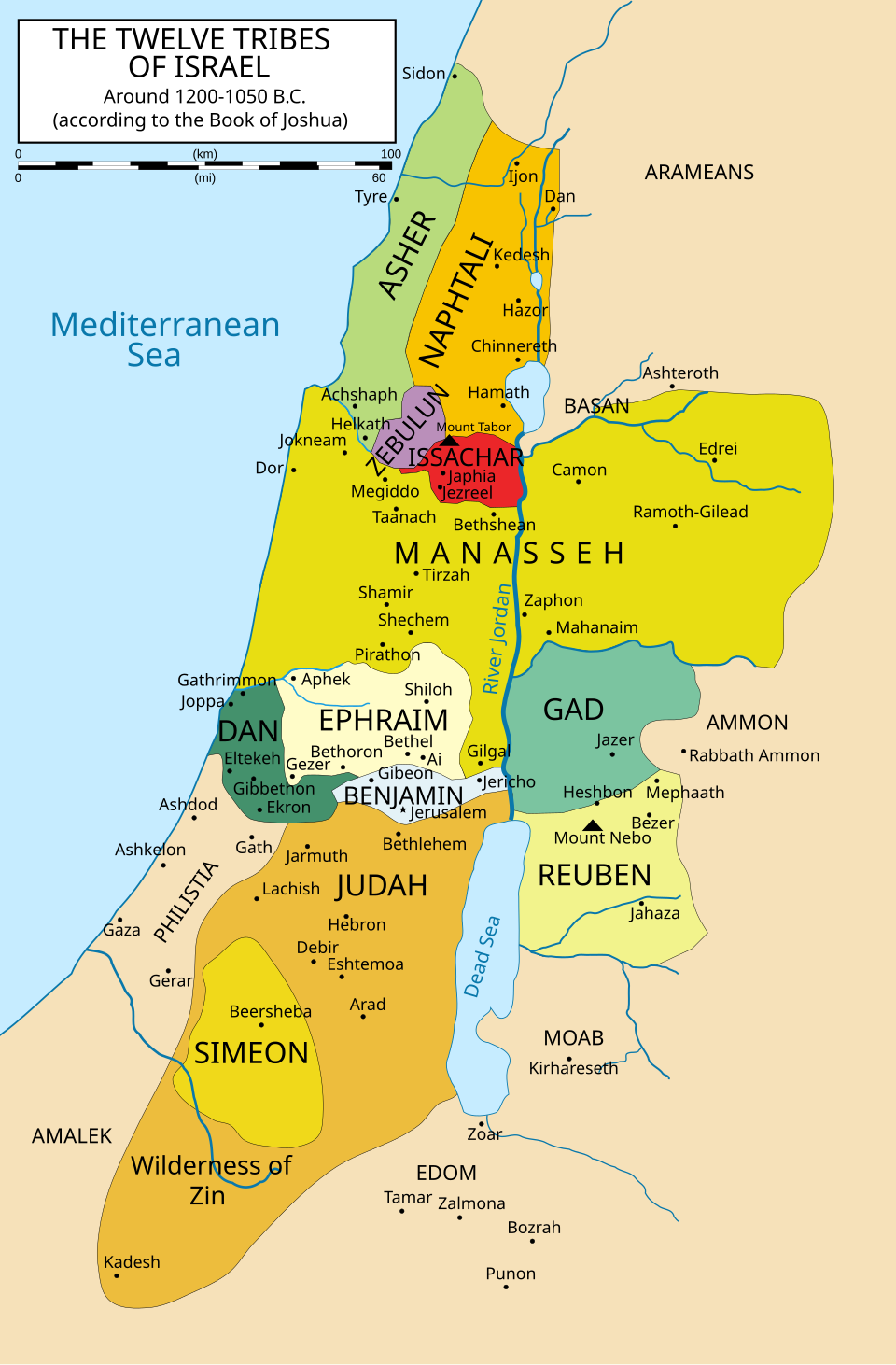 Source: 🔗 Wikimedia Commons, 12 tribus de Israel.svg translated by Kordas; 12 staemme israels heb.svg by user:יוסי; 12 staemme israels.png by user:Janz; derivative work Richardprins, CC BY-SA 3.0. Converted from SVG to PNG thumbnail with no substantive changes. Reconstructed tribal-allotment teaching map, not an ancient-period map and not to scale.
Spiritual Fruit 🍇
-
Boundaries can be mercy. This chapter is full of borders, towns, and allotments. Spiritually, boundaries are not always limitations; they can be the shape of obedience. A family needs boundaries around time, speech, screens, money, and worship. A servant needs boundaries against burnout and vanity. A soul needs boundaries around what it allows to enter the imagination. Inheritance without boundaries becomes confusion.
-
Achsah teaches holy boldness in asking for springs. She receives land and asks for water. This is not greed; it is wisdom. Many Christians accept a dry inheritance because they are afraid to ask God for the water needed to live faithfully. Ask for the springs: compunction in prayer, grace to forgive, strength for parenting, tears in confession, wisdom in ministry, love where duty has become dry.
-
Let belonging become repentance. Jerusalem is named in Judah’s portion while the Jebusites still dwell there. Name one habit you have sheltered behind the claim that you already belong to the Church. Bring it honestly to confession and ask for a practical rule that will weaken it. A holy identity is a gift to live, not a defense against correction.
-
Honor ordinary faithfulness. The villages of Judah are not blank space between important cities. Nor are washing dishes, caring for an aging parent, doing honest work, and praying when nobody sees blank space between important spiritual events. Receive one overlooked duty today as part of the portion entrusted to you.
Summary Table
| Text | Literal focus | Spiritual and Christological reading |
|---|---|---|
| Joshua 15:1-12 | Judah receives defined borders | A calling has a shape that gratitude learns to inhabit |
| Joshua 15:13-19 | Caleb, Othniel, and Achsah receive land and water | Bold asking seeks the grace that makes a gift fruitful |
| Joshua 15:20-47 | Southern and lowland towns are named | Hidden daily faithfulness belongs within the promise |
| Joshua 15:48-63 | Greek Bethlehem district; Jerusalem still Jebusite | Christ comes to a real town; belonging requires purification |
Closing Meditation
Stay for a moment beside Achsah’s request. She can name both what she has received and what she still needs. Bring your own dry responsibility before the Father with the same truthfulness. Ask for the springs, and then return to the portion He has given you. The water is His gift; the field is yours to tend.
Teaching Notes
Joshua 15:1-12 - Judah’s border and the holiness of given limits
- Ask: Which limit in your present calling protects a good you might otherwise neglect?
- Emphasize: A boundary protects a shared gift.
- Watch for: Turning every imposed restriction into a divine command.
Joshua 15:13-19 - Caleb, Othniel, and Achsah ask for blessing
- Ask: What grace would make a responsibility you already carry fruitful?
- Emphasize: Achsah asks for fruitfulness rather than rejecting her portion.
- Watch for: Treating her request as greed or inventing an Origen commentary on her.
Joshua 15:20-47 - Judah’s southern and lowland cities are named before God
- Ask: Which unnoticed duty has become invisible to you?
- Emphasize: Patient reading and ordinary obedience both require attention.
- Watch for: Using Origen’s charm analogy as magic or an excuse never to seek understanding.
Joshua 15:48-63 - Hill country cities and Jerusalem not yet fully possessed
- Ask: Why must Bethlehem be described as an additional Greek district, and what does Jerusalem still unpossessed expose?
- Emphasize: The list names Bethlehem; the prophecy belongs to Micah 5:2.
- Watch for: Applying conquest language to modern peoples.
Sources
Embedded Scripture is from Brenton’s English Septuagint (LXX). Chapter and verse headings follow NKJV numbering; lettered markers identify material present in Brenton beyond the corresponding Hebrew verse.
Brenton, Joshua 15; NKJV, Judges 1:10-21; 2 Samuel 5:6-9; Micah 5:2; Matthew 2:5-6; Luke 11:9-13.
Origen, Philocalia 12.1-2, trans. George Lewis (1911), excerpt from the twentieth Homily on Joshua.
S. Holmes, Joshua: The Hebrew and Greek Texts, pp. 61-62; Leonard J. Greenspoon, NETS Iesous, pp. 174-176.
Coptic Reader, Nativity and Nativity Paramoun Liturgy Gospels; Coptic Synaxarium, Toba 3.
Footnotes
-
S. Holmes, Joshua: The Hebrew and Greek Texts (1914), pp. 61-64, notes on 15:19, 15:59 and 16:10. Edition. ↩
-
Origen, Philocalia 12.1-2, excerpt headed as from the twentieth Homily on Joshua, trans. George Lewis (1911), pp. 54-57. Direct text. The section numbers here belong to the Philocalia excerpt. ↩
-
Leonard J. Greenspoon, NETS Iesous, p. 187, parallel Vaticanus and Alexandrinus columns at 15:59a; S. Holmes, Joshua: The Hebrew and Greek Texts, p. 62, note on 15:59. NETS translation. ↩