


This narration was recorded before the latest revision. The text on this page is current.
These chapters show the kingdom slowly turning toward David, but Scripture refuses to make the road look clean. Hebron receives David, Ish-bosheth is set up as a rival king, Abner and Joab play dangerous political games, Asahel dies through youthful pursuit, and Ish-bosheth is murdered by men who think David will reward useful violence. David’s restraint matters because he will not let God’s promise become an excuse for bloodguilt.
Previous: 2 Samuel 1 - David Laments Saul and Jonathan · Next: 2 Samuel 5 - David Anointed King and Jerusalem Taken
The spiritual burden is plain: ambition can wear religious language and still be ambition. God may truly be leading a person toward a calling, responsibility, or season of authority, but the way that calling is received reveals the heart. David’s rise is slow because the Lord is not only giving him a throne. The Lord is testing what kind of king will sit on it.
Historical and Scriptural Context
Where in Scripture
2 Samuel 1 showed David mourning Saul and Jonathan rather than celebrating their deaths. Chapters 2-4 move from lament into the unstable politics after Saul’s fall. David is anointed king over Judah in Hebron, while Abner, Saul’s commander, sets Ish-bosheth over Israel. The story therefore holds two realities together: David is truly chosen by God, yet the nation remains divided.
These chapters prepare for the unified kingship in 2 Samuel 5. They also expose themes that will return later with greater pain: Joab’s violent self-protection, David’s distance from bloodguilt, divided loyalties, and the temptation to use murder as a shortcut to political stability.
Where in history
Ancient royal succession was often brutal. The death of a king could lead to assassination, revenge killing, rival courts, and military consolidation. 2 Samuel does not romanticize that world. It shows how easily men confuse the movement of Providence with their own schemes.
David’s restraint should not be mistaken for passivity. He acts, inquires of the Lord, blesses loyalty, receives anointing, and publicly judges murder. But he refuses to make private violence the foundation of public blessing. That is the difference between waiting on God and hiding ambition behind holy vocabulary.
Geographical Significance ⛰️
The geography carries theological weight.
- Hebron becomes David’s first royal center. It is in Judah, associated with the patriarchs, and it becomes the place where David receives limited kingship before full kingship.
- Mahanaim is east of the Jordan, where Abner establishes Ish-bosheth. The rival court is geographically distant from David and politically dependent on Saul’s military structure.
- Gibeon becomes the site of conflict between Abner’s and Joab’s men. The contest begins almost like a controlled display but becomes real bloodshed.
- The pool of Gibeon, the wilderness, and the way of pursuit show how quickly political rivalry becomes bodily violence.
The movement from Hebron to wider Israel is not only political. It is spiritual. David does not seize the whole land at once. He receives part, waits, mourns, negotiates, and refuses the crown when it is offered through murder.
The Characters 👥
David
David is king over Judah but not yet over all Israel. His central test is whether he will receive God’s promise by patient obedience or by tolerating convenient bloodshed. In these chapters he appears as inquirer of God, public mourner, covenant-minded king, and judge of treachery.
Ish-bosheth
Ish-bosheth, Saul’s surviving son, is made king by Abner. He is weak, dependent, and politically vulnerable. His name in Brenton appears as Jebosthe, reflecting the Septuagint tradition. What is at stake for him is not heroic leadership but the fragility of a throne sustained by another man’s power.
Abner
Abner is Saul’s commander and the real strength behind Ish-bosheth. He is politically shrewd, capable, and dangerous. His eventual move toward David is partly a recognition of God’s promise and partly a response to insult and self-interest.
Joab
Joab is David’s commander. He is loyal to David’s cause, but his loyalty is mixed with vengeance, control, and violence. His murder of Abner foreshadows a lifelong problem in David’s reign: useful men can also be spiritually destructive men.
Asahel
Asahel is Joab’s brother, swift and relentless. His pursuit of Abner ends in his death. He embodies a zeal that cannot read danger and a kind of youthful ambition that confuses speed with wisdom.
Rechab and Baanah
These two commanders murder Ish-bosheth while he rests. They bring his head to David expecting reward. Like the Amalekite in chapter 1, they misunderstand David because they assume ambition thinks the way they do.
🕯️ Light from the Word
1. David asks the Lord and receives Judah, 2 Samuel 2:1-11
1 And it came to pass after this that David enquired of the Lord, saying, Shall I go up into one of the cities of Juda? and the Lord said to him, Go up. And David said, Whither shall I go up? and he said, To Chebron. 2 And David went up thither to Chebron, he and both his wives, Achinaam the Jezraelitess, and Abigaia the wife of Nabal the Carmelite, 3 and the men that were with him, every one and his family; and they dwelt in the cities of Chebron.
4 And the men of Judea come, and anoint David there to reign over the house of Juda; and they reported to David, saying, The men of Jabis of the country of Galaad have buried Saul. 5 And David sent messengers to the rulers of Jabis of the country of Galaad, and David said to them, Blessed be ye of the Lord, because ye have wrought this mercy toward your lord, even toward Saul the anointed of the Lord, and ye have buried him and Jonathan his son. 6 And now may the Lord deal in mercy and truth towards you: and I also will requite towards you this good deed, because ye have done this. 7 And now let your hands be made strong, and be valiant; for your master Saul is dead, and moreover the house of Juda have anointed me to be king over them.
8 But Abenner, the son of Ner, the commander-in-chief of Saul’s army, took Jebosthe son of Saul, and brought him up from the camp to Manaem 9 and made him king over the land of Galaad, and over Thasiri, and over Jezrael, and over Ephraim, and over Benjamin, and over all Israel. 10 Jebosthe, Saul’s son was forty years old, when he reigned over Israel; and he reigned two years, but not over the house of Juda, who followed David.
11 And the days which David reigned in Chebron over the house of Juda were seven years and six months.
Literal sense
David does not rush to Hebron after Saul’s death. He asks the Lord whether he should go up and where he should go. The answer is direct: go to Hebron. There the men of Judah anoint him king. David then sends a blessing to the men of Jabesh Gilead for burying Saul, honoring their covenant loyalty even though Saul had persecuted him.
Three times in these chapters someone tries to hand David the kingdom through blood: the Amalekite, Joab, and then Rechab and Baanah. The pattern should be seen early. David’s refusal is not one isolated courtesy. It is the same refusal three times. Matthew 4 rests on that pattern: the true Son of David will not take a kingdom from the hand that offers it by evil.
Hebron is not merely a convenient southern city. Joshua 20:7 and 21:13 set Chebron apart as a city of refuge. David’s reign begins there, near the burial place of the patriarchs (Genesis 23:19; Joshua 14:13-14), while a rival still holds most of Israel. He reigns, and not all things are yet under him (Hebrews 2:8-9; 1 Corinthians 15:25).
At the same time, Abner takes Ish-bosheth and sets him as king over Israel. David’s reign over Judah lasts seven years and six months before the kingdom is united. The promise is real, but its public fulfillment unfolds slowly.
LXX and textual insight
Brenton uses Jebosthe for Ish-bosheth and Memphibosthe later for Mephibosheth. These names preserve Septuagint forms that may look unfamiliar to readers used to English Old Testament naming. The guide keeps the common English names for clarity while noting the LXX forms.
The place of the young men’s combat is called “The portion of the treacherous ones” (2:16). That name already judges the contest before the commentary does. Abner’s lament asks, “Shall Abenner die according to the death of Nabal?” (3:33). The Greek reads a proper name. Nabal was struck by the Lord. Abner is struck by treachery. The lament ties this death to 1 Samuel 25 rather than to a generic fool.
The repeated act of anointing matters. David has already been anointed privately by Samuel, but now Judah recognizes him publicly. Scripture distinguishes divine election from public recognition. One can be called by God before the calling is visible to everyone.
Ascetical reading
Here David’s first move is inquiry. He does not treat God’s promise as self-executing permission. He asks, and he obeys. He had not inquired in 1 Samuel 27. He inquired again at Ziklag (30:7-8). Now he asks before he moves. A real calling still needs discernment. Zeal without that question can become destruction.
Christological and typological reading
David receives a partial kingdom in Hebron before Jerusalem becomes the royal center. Christ, the true Son of David, receives the Kingdom not by territorial expansion but through the Cross, Resurrection, and ascension. His reign begins in hiddenness and is revealed in the Church, yet the world still resists it (Hebrews 2:8-9).
David blessing the men of Jabesh Gilead also points toward Christ’s memory of hidden faithfulness. The Lord sees acts of love done for the dead, for the rejected, and for those who cannot repay. In the Kingdom, loyalty offered in obscurity is not forgotten. Christ will not take the kingdoms of the world from the hand that offers them without the Cross (Matthew 4:8-10).
2. The contest at Gibeon and the death of Asahel, 2 Samuel 2:12-32
12 And Abenner the son of Ner went forth, and the servants of Jebosthe the son of Saul, from Manaem to Gabaon. 13 And Joab the son of Saruia, and the servants of David, went forth from Chebron, and met them at the fountain of Gabaon, at the same place: and these sat down by the fountain on this side, and those by the fountain on that side. 14 And Abenner said to Joab, Let now the young men arise, and play before us. And Joab said, Let them arise. 15 And there arose and passed over by number twelve of the children of Benjamin, belonging to Jebosthe the son of Saul, and twelve of the servants of David. 16 And they seized every one the head of his neighbour with his hand, and his sword was thrust into the side of his neighbour, and they fall down together: and the name of that place was called The portion of the treacherous ones, which is in Gabaon. 17 And the battle was very severe on that day; and Abenner and the men of Israel were worsted before the servants of David. 18 And there were there the three sons of Saruia, Joab, and Abessa, and Asael: and Asael was swift in his feet as a roe in the field.
19 And Asael followed after Abenner, and turned not to go to the right hand or to the left from following Abenner. 20 And Abenner looked behind him, and said, Art thou Asael himself? and he said, I am. 21 And Abenner said to him, Turn thou to the right hand or to the left, and lay hold for thyself on one of the young men, and take to thyself his armour: but Asael would not turn back from following him. 22 And Abenner said yet again to Asael, Stand aloof from me, lest I smite thee to the ground? and how should I lift up my face to Joab? 23 And what does this mean? return to Joab thy brother. But he would not stand aloof; and Abenner smites him with the hinder end of the spear on the loins, and the spear went out behind him, and he falls there and dies on the spot: and it came to pass that every one that came to the place where Asael fell and died, stood still. 24 And Joab and Abessa pursued after Abenner, and the sun went down: and they went as far as the hill of Amman, which is in the front of Gai, by the desert way of Gabaon.
25 And the children of Benjamin who followed Abenner gather themselves together, and they formed themselves into one body, and stood on the top of a hill. 26 And Abenner called Joab, and said, Shall the sword devour perpetually? knowest thou not that it will be bitter at last? How long then wilt thou refuse to tell the people to turn from following our brethren? 27 And Joab said, As the Lord lives, if thou hadst not spoken, even from the morning the people had gone up every one from following his brother. 28 And Joab sounded the trumpet, and all the people departed, and did not pursue after Israel, and did not fight any longer.
29 And Abenner and his men departed at evening, and went all that night, and crossed over Jordan, and went along the whole adjacent country, and they come to the camp. 30 And Joab returned from following Abenner, and he assembled all the people, and there were missing of the people of David, nineteen men, and Asael. 31 And the servants of David smote of the children of Benjamin, of the men of Abenner, three hundred and sixty men belonging to him.
32 And they take up Asael, and bury him in the tomb of his father in Bethleem. And Joab and the men with him went all the night, and the morning rose upon them in Chebron.
Literal sense
Abner and Joab meet by the pool of Gibeon. What begins as a contest between selected young men becomes deadly. Twelve from each side kill one another, and the place receives a name connected with the slaughter. Asahel then pursues Abner relentlessly. Abner warns him to turn aside, but Asahel refuses. Abner kills him with the back of the spear.
Joab and Abishai continue the pursuit until Abner calls out the bitter truth: the sword will devour if they do not stop. The fighting ends, but the wound remains. Asahel is buried in Bethlehem, and the war between the houses continues.
Spiritual reading of the violence
The chapter is not entertainment and not strategy advice. It is a sober look at how political rivalry consumes the young first. Leaders speak, test, posture, and provoke, but young men bleed. The Church reads such texts with honesty. The Old Covenant narrative records the tragedy of a divided kingdom; Christian readers must receive the warning without baptizing violence as virtue.
Asahel’s speed is not enough to save him. His gift becomes dangerous because it is not governed by wisdom. Many spiritual falls happen this way: a real strength, intelligence, energy, charisma, courage, or zeal, becomes fatal when it will not listen.
Ascetical reading
Anger can call itself justice. Ambition can call itself service. Rashness can call itself courage. A strong thought is not yet a true one. It must be tested.
Asahel’s pursuit is a picture of undiscerned zeal. Abner’s warning is not holiness, but it is still a warning. Sometimes God restrains us even through imperfect voices, and pride refuses to listen because the warning comes from someone we do not respect.
Christological and typological reading
Christ does not win His Kingdom by sending young men into rivalry for His honor. He gathers disciples who misunderstand power, then teaches them that the greatest must become servant of all. The Cross exposes the false glory of violent competition. The King dies rather than letting His servants secure Him by the sword.
This is why David’s restraint matters. He belongs to the Old Covenant world of battle and kingdom, yet the trajectory of his best moments points beyond that world. The Son of David will not merely restrain bloodguilt. He will shed His own blood to end enmity.
3. Abner turns toward David, 2 Samuel 3:1-21
1 And there was war for a long time between the house of Saul and the house of David; and the house of David grew continually stronger; but the house of Saul grew continually weaker. 2 And sons were born to David in Chebron: and his first-born was Amnon the son of Achinoom the Jezraelitess. 3 And his second son was Daluia, the son of Abigaia the Carmelitess; and the third, Abessalom the son of Maacha the daughter of Tholmi the king of Gessir. 4 And the fourth was Ornia, the son of Aggith, and the fifth was Saphatia, the son of Abital. 5 And the sixth was Jetheraam, the son of Ægal the wife of David. These were born to David in Chebron.
6 And it came to pass while there was war between the house of Saul and the house of David, that Abenner was governing the house of Saul. 7 And Saul had a concubine, Respha, the daughter of Jol; and Jebosthe the son of Saul said to Abenner, Why hast thou gone in to my father’s concubine? 8 And Abenner was very angry with Jebosthe for this saying; and Abenner said to him, Am I a dog’s head? I have this day wrought kindness with the house of Saul thy father, and with his brethren and friends, and have not gone over to the house of David, and dost thou this day seek a charge against me concerning injury to a woman? 9 God do thus and more also to Abenner, if as the Lord swore to David, so do I not to him this day; 10 to take away the kingdom from the house of Saul, and to raise up the throne of David over Israel and over Juda from Dan to Bersabee. 11 And Jebosthe could not any longer answer Abenner a word, because he feared him.
12 And Abenner sent messengers to David to Thælam where he was, immediately, saying, Make thy covenant with me, and, behold, my hand is with thee to bring back to thee all the house of Israel. 13 And David said, With a good will I will make with thee a covenant: only I demand one condition of thee, saying, Thou shalt not see my face, unless thou bring Melchol the daughter of Saul, when thou comest to see my face. 14 And David sent messengers to Jebosthe the son of Saul, saying, Restore me my wife Melchol, whom I took for a hundred foreskins of the Philistines. 15 And Jebosthe sent, and took her from her husband, even from Phaltiel the son of Selle. 16 And her husband went with her weeping behind her as far as Barakim. And Abenner said to him, Go, return; and he returned.
17 And Abenner spoke to the elders of Israel, saying, In former days ye sought David to reign over you; 18 and now perform it: for the Lord has spoken concerning David, saying, By the hand of my servant David I will save Israel out of the hand of all their enemies. 19 And Abenner spoke in the ears of Benjamin: and Abenner went to speak in the ears of David at Chebron, all that seemed good in the eyes of Israel and in the eyes of the house of Benjamin. 20 And Abenner came to David to Chebron, and with him twenty men: and David made for Abenner and his men with him a banquet of wine. 21 And Abenner said to David, I will arise now, and go, and gather to my lord the king all Israel; and I will make with him a covenant, and thou shalt reign over all whom thy soul desires. And David sent away Abenner, and he departed in peace.
Literal sense
The war between Saul’s house and David’s house continues. David grows stronger while Saul’s house weakens. The text lists David’s sons born in Hebron, which shows the growth of his house but also quietly foreshadows later trouble within that house.
A conflict then erupts between Ish-bosheth and Abner over Rizpah, Saul’s concubine. In ancient royal politics, taking a king’s concubine could imply a claim to royal authority. Ish-bosheth accuses Abner, and Abner responds with rage. He declares that he will transfer the kingdom to David, acknowledging that the Lord had sworn the kingdom to David.
David receives Abner’s approach but requires the return of Michal, Saul’s daughter and David’s wife. Abner then persuades Israel and Benjamin to turn toward David.
LXX and historical insight
The chapter shows both theology and politics intertwined. Abner knows the Lord has spoken concerning David, yet his decision to act comes after personal insult. This is morally complex. People can speak true theology from mixed motives. The right conclusion does not purify every reason by which a person arrives there.
The return of Michal also has political meaning. David’s marriage into Saul’s house strengthens his legitimacy before Israel. Yet the human sorrow is visible in Paltiel following her and weeping. Biblical politics are never abstract. Every alliance has personal cost.
Ascetical reading
The movement of this chapter is marked by disordered love, especially the love of domination. Men speak of the kingdom, loyalty, and covenant, but much of the movement is driven by insult, insecurity, and control.
The spiritual reader should not ask only, “Was Abner right to support David?” He should ask, “Why did Abner support David now?” That question belongs to self-examination. We can do the right thing because it is right, or because our pride has been wounded.
Christological and typological reading
David’s kingdom gathers Israel slowly through negotiation, persuasion, and providential turns. Christ gathers His Kingdom by calling enemies into reconciliation. But unlike Abner, Christ’s motives are pure. He does not turn toward us because of wounded pride. He turns toward us because of mercy.
The transfer from the house of Saul to the house of David points toward the passing from the old order into the messianic fulfillment. Yet the text warns us not to oversimplify the transition. God’s purpose can advance through tangled human motives, but those motives still need judgment and healing.
4. Joab murders Abner, and David refuses the bloodguilt, 2 Samuel 3:22-39
22 And, behold, the servants of David and Joab arrived from their expedition, and they brought much spoil with them: and Abenner was not with David in Chebron, because he had sent him away, and he had departed in peace. 23 And Joab and all his army came, and it was reported to Joab, saying, Abenner the son of Ner is come to David, and David has let him go, and he has departed in peace. 24 And Joab went in to the king, and said, What is this that thou hast done? behold, Abenner came to thee; and why hast thou let him go, and he has departed in peace? 25 Knowest thou not the mischief of Abenner the son of Ner, that he came to deceive thee, and to know thy going out and thy coming in, and to know all things that thou doest?
26 And Joab returned from David, and sent messengers to Abenner after him; and they bring him back from the well of Seïram: but David knew it not. 27 And he brought back Abenner to Chebron, and Joab caused him to turn aside from the gate to speak to him, laying wait for him: and he smote him there in the loins, and he died for the blood of Asael the brother of Joab.
28 And David heard of it afterwards, and said, I and my kingdom are guiltless before the Lord even for ever of the blood of Abenner the son of Ner. 29 Let it fall upon the head of Joab, and upon all the house of his father; and let there not be wanting of the house of Joab one that has an issue, or a leper, or that leans on a staff, or that falls by the sword, or that wants bread. 30 For Joab and Abessa his brother laid wait continually for Abenner, because he slew Asael their brother at Gabaon in the battle.
31 And David said to Joab and to all the people with him, Rend your garments, and gird yourselves with sackcloth, and lament before Abenner. And king David followed the bier. 32 And they bury Abenner in Chebron: and the king lifted up his voice, and wept at his tomb, and all the people wept for Abenner.
33 And the king mourned over Abenner, and said, Shall Abenner die according to the death of Nabal? 34 Thy hands were not bound, and thy feet were not put in fetters: one brought thee not near as Nabal; thou didst fall before children of iniquity. 35 And all the people assembled to weep for him. And all the people came to cause David to eat bread while it was yet day: and David swore, saying, God do so to me, and more also, if I eat bread or any thing else before the sun goes down. 36 And all the people took notice, and all things that the king did before the people were pleasing in their sight. 37 So all the people and all Israel perceived in that day, that it was not of the king to slay Abenner the son of Ner.
38 And the king said to his servants, Know ye not that a great prince is this day fallen in Israel? 39 And that I am this day a mere kinsman of his, and as it were a subject; but these men the sons of Saruia are too hard for me: the Lord reward the evil-doer according to his wickedness.
Literal sense
Joab returns and learns that David sent Abner away in peace. He accuses Abner of deceit, then secretly recalls him and kills him at Hebron, avenging Asahel. David publicly separates himself and his kingdom from Joab’s bloodguilt. He curses the violence, commands mourning, follows the bier, and laments Abner. The people recognize that the murder was not David’s will.
David admits both things the verse says. He is “this day a mere kinsman” of Abner, “and as it were a subject,” and the sons of Zeruiah are too hard for him. He has the anointing, and he does not yet have the house in hand. He hands the reckoning to the Lord. The public settlement of Joab’s blood comes later, in 1 Kings 2:5-6 and 2:31-34. Leviticus 19:15 forbids partiality in judgment. David executes the Amalekite and the two Beerothites at once. Joab, his sister’s son, he curses and keeps. The contrast exposes David’s uneven restraint of violence. Joab drew Abner aside from the gate and struck him there (3:27). Chebron is one of the cities set apart for refuge (Joshua 20:7; 21:13). Numbers 35 gives a hearing and a refuge to the one who killed without lying in wait. Joab did not take that path.
Hard-text and pastoral reading
The passage neither conceals Joab’s violence nor makes David’s response complete. Joab’s grief over Asahel may be real, but grief does not excuse murder. He kills Abner in a city of refuge-like setting, at the gate, under the cover of conversation. It is vengeance disguised as prudence.
David’s response is morally clear but politically incomplete. He mourns and rejects the bloodguilt, yet Joab remains powerful. This anticipates later failures in David’s household and government. Scripture is honest: even a chosen king can fail to restrain destructive men close to him.
Ascetical reading
Joab’s murder of Abner is not sudden rage alone. It is remembered injury given a political opportunity. He may think he has defended his brother, but he has brought bloodguilt near the throne he claims to serve.
Christological and typological reading
David walks behind Abner’s bier and refuses to rejoice over the death of a rival. Christ goes further. He bears the sins of His enemies and prays for those who crucify Him. David says, “I and my kingdom are guiltless.” Christ, the guiltless King, willingly enters the place of the guilty to heal the kingdom from within.
Joab’s violence also exposes the need for a better kingdom. The Church is not built by Joab’s methods. The apostolic witness is not advanced by coercion, manipulation, or vengeance. The Kingdom of Christ is guarded by truth, holiness, repentance, and martyrdom, not by private revenge.
5. Ish-bosheth is murdered, and David again judges shortcut violence, 2 Samuel 4:1-12
1 And Jebosthe the son of Saul heard that Abenner the son of Ner had died in Chebron; and his hands were paralysed, and all the men of Israel grew faint. 2 And Jebosthe the son of Saul had two men that were captains of bands: the name of the one was Baana, and the name of the other Rechab, sons of Remmon the Berothite of the children of Benjamin; for Beroth was reckoned to the children of Benjamin. 3 And the Berothites ran away to Gethaim, and were sojourners there until this day.
4 And Jonathan Saul’s son had a son lame of his feet, five years old, and he was in the way when the news of Saul and Jonathan his son came from Jezrael, and his nurse took him up, and fled; and it came to pass as he hasted and retreated, that he fell, and was lamed. And his name was Memphibosthe.
5 And Rechab and Baana the sons of Remmon the Berothite went, and they came in the heat of the day into the house of Jebosthe; and he was sleeping on a bed at noon. 6 And, behold, the porter of the house winnowed wheat, and he slumbered and slept: and the brothers Rechab and Baana went privily into the house: 7 and Jebosthe was sleeping on his bed in his chamber: and they smite him, and slay him, and take off his head: and they took his head, and went all the night by the western road.
8 And they brought the head of Jebosthe to David to Chebron, and they said to the king, Behold the head of Jebosthe the son of Saul thy enemy, who sought thy life; and the Lord has executed for my lord the king vengeance on his enemies, as it is this day: even on Saul thy enemy, and on his seed.
9 And David answered Rechab and Baana his brother, the sons of Remmon the Berothite, and said to them, As the Lord lives, who has redeemed my soul out of all affliction; 10 he that reported to me that Saul was dead, even he was as one bringing glad tidings before me: but I seized him and slew him in Sekelac, to whom I ought, as he thought, to have given a reward for his tidings. 11 And now evil men have slain a righteous man in his house on his bed: now then I will require his blood of your hand, and I will destroy you from off the earth. 12 And David commanded his young men, and they slay them, and cut off their hands and their feet; and they hung them up at the fountain in Chebron: and they buried the head of Jebosthe in the tomb of Abenner the son of Ner.
Literal sense
When Ish-bosheth hears that Abner is dead, his courage fails and Israel is troubled. The text briefly mentions Mephibosheth, Jonathan’s crippled son, preserving the line that will become important in chapter 9. Then Rechab and Baanah murder Ish-bosheth in his bed, behead him, and bring the head to David. They frame the murder as divine vengeance on Saul’s house.
The displayed text adds a watchfulness the Hebrew telling often leaves aside. The porter of the house was winnowing wheat, and he slumbered and slept, while the king slept at noon (4:5-6). A doorkeeper asleep while the king is killed is a lesson in watchfulness (Mark 13:33-37). The study’s own reading is that the transfer from Saul’s house to David’s house is not itself a command to treat every rival as expendable.
David’s answer begins with an oath: “As the Lord lives, who has redeemed my soul out of all affliction” (4:9). He will swear it again in 1 Kings 1:29. The Lord is his redeemer, so he does not need another man’s knife. He remembers the Amalekite who brought glad tidings of Saul’s death, and he judges these men by the same measure. He commands judgment on the murderers and gives Ish-bosheth’s head burial in Abner’s tomb.
Theological insight
The murderers use religious language: “the Lord has avenged my lord the king.” David refuses the blasphemy. Not every event that benefits us should be called the Lord’s approval. Providence is not a permission slip for wickedness.
Ish-bosheth is called righteous here not because he is the messianic king or a great leader, but because in this matter he is innocent. He is sleeping in his house and is murdered by men who owed him loyalty. David can oppose Saul’s house politically while still naming murder as murder.
Ascetical reading
The apostle says evil must not be done so that good may come (Romans 3:8). Rechab and Baanah think the usefulness of the outcome will justify the crime. David’s judgment denies that logic. Do not call a door from God if sin was the key.
This is deeply relevant for spiritual life. A person can gain advantage through gossip, exposure, manipulation, or betrayal, then call the result “God opening a door.” David teaches us to examine the door, the key, and the hand that opened it.
Christological and typological reading
David refuses a throne secured by another man’s murder. Christ refuses to save by unrighteous means (Matthew 4:1-10). He will not turn stones to bread at Satan’s command. He will not leap from the Temple to force recognition. He will not bow for the kingdoms of the world. He receives the Kingdom by obedience to the Father, through the Cross. He sheds His own blood to end enmity (Ephesians 2:14-16), rather than requiring a rival’s blood as the price of peace.
The burial of Ish-bosheth’s head in Abner’s tomb is a small act of human dignity in a brutal scene. Christ restores dignity even to the ruined and dismembered human story. Where sin scatters, the true King gathers. Christ weeps, and He does not treat a corpse as a trophy (John 11:35; Luke 19:41-44).
The Church’s Voice in Worship
In the preparation of the Holy Myron, the Church reads 2 Samuel 2:1-4, David’s journey to Hebron and his anointing as king over Judah, alongside the anointings in 1 Samuel 9:25-10:1 and 16:1-13. The rite’s setting invites us to consider anointing as a gift received from God, not a power seized for oneself.1
Iconography Connection 🖼️
The strongest iconographic connection is David the King and Prophet, usually shown with harp, scroll, or royal clothing. In these chapters the icon should be read carefully. David’s crown is not a symbol of domination. It is a vocation under judgment. The kingdom map already on this page keeps Hebron, Mahanaim, and the pressure of divided rule in view.
Visual reading aid
The kingdom map keeps the divided rule visible: Hebron and Mahanaim stand apart while Israel waits for unity.
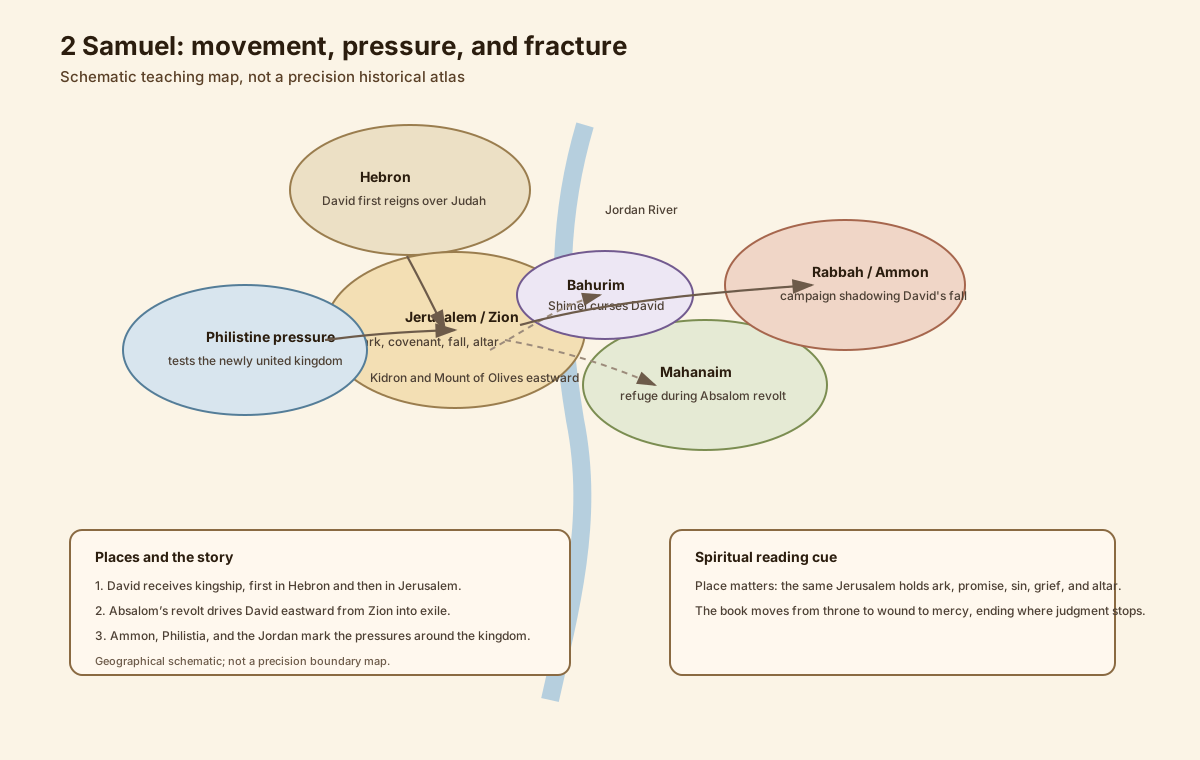 Hebron and Mahanaim in the years of divided rule; a geographical schematic.
Spiritual Fruit 🍇
1. Ask before you move
David begins by asking the Lord. That is not a small detail. Many sins begin when a person assumes that because the destination seems right, the next step needs no prayer. Before a job move, ministry decision, family confrontation, or difficult conversation, the Christian should learn to ask: Lord, should I go up? And if so, where?
2. Do not call ambition discernment
Abner, Joab, Rechab, and Baanah all move with confidence. Confidence is not the same as purity. The heart can attach itself to a cause and still be serving pride, anger, or self-protection. A useful question is: if this no longer benefited me, would I still believe it was righteous?
3. Refuse shortcut violence
Most Christians will not murder for advancement, but many will use smaller forms of violence: a strategic comment, a leaked weakness, a humiliating joke, a private coalition, a public silence when truth should be spoken. David’s refusal exposes these smaller betrayals. The Kingdom is not served by Joab’s knife.
4. Grieve what sin costs, even when the outcome helps you
Abner’s death and Ish-bosheth’s death clear the path toward David’s rule, yet David mourns and judges the crimes. This is spiritual maturity. When someone else’s collapse benefits us, we must still tell the truth about the collapse. A Christian should never need another person’s ruin in order to feel secure in God’s promise.
5. Let Christ purify your idea of power
David is at his best here when he refuses to seize. Christ is the fullness of that refusal. He does not grasp, manipulate, or build His Kingdom on the humiliation of enemies. He reigns from the Cross. Every Christian entrusted with responsibility must bring his idea of authority to the crucified King for purification.
Summary Table
| Passage | What happens | What to keep |
|---|---|---|
| 2:1-11 | David asks, and Judah anoints him | A real calling still needs discernment |
| 2:12-32 | Young men bleed while leaders posture | A gift without wisdom can become a grave |
| 3:1-21 | Abner turns, and Paltiel weeps | True words can come from mixed motives |
| 3:22-39 | Joab calls murder justice | Providence is not a permission slip |
| 4:1-12 | Two men bring a king’s head | Do not call a door from God if sin was the key |
Closing Meditation
The crown is in other men’s hands three times, and David will not take it from those hands. He asks before he goes up. He mourns the men whose deaths would have made his path shorter. The Lord who redeemed his soul does not need a knife to keep a promise. Christ receives a kingdom the same way, not by the tempter’s offer, but by the Cross.
Teacher's Notes
Passage teaching prompts 1
- Key phrases: “David asks before he moves.” “A real calling still needs discernment.”
- Emphasize: God’s promise does not remove the need for obedience in timing and method.
- Avoid: Do not present waiting as passivity. David waits actively, prayerfully, and with moral clarity.
Passage teaching prompts 2
- Key phrases: “A gift without discernment can become a wound.” “The sword always asks for more than leaders think it will cost.”
- Emphasize: Zeal must be governed by prayer, humility, and obedience.
- Avoid: Do not romanticize the fighting. Let the text feel as tragic as it is.
Passage teaching prompts 3
- Key phrases: “True words can come from mixed motives.” “Providence is pure, even when the instruments are not.”
- Emphasize: God can advance His promise without endorsing every motive of the people involved.
- Avoid: Do not flatten Abner into either hero or villain. The text gives a morally mixed man.
Passage teaching prompts 4
- Key phrases: “Joab calls it justice, but Scripture shows vengeance.” “David mourns the man his commander murdered.”
- Emphasize: We must reject sinful means even when they appear to help a righteous cause.
- Avoid: Do not excuse Joab because Abner was politically dangerous. The text itself condemns the act.
Passage teaching prompts 5
- Key phrases: “A result that helps David can still be wicked.” “David rejects religious language used to bless murder.”
- Emphasize: The Christian must not confuse advantage with God’s approval.
- Avoid: Do not treat Ish-bosheth’s weakness as permission to despise him. David does not.
Suggested timing
- Opening and context: 8 minutes
- David in Hebron and rival kingship: 10 minutes
- Gibeon and Asahel: 12 minutes
- Abner’s mixed motives and Joab’s murder: 15 minutes
- Ish-bosheth’s murder and David’s judgment: 12 minutes
- Spiritual fruit and discussion: 15 minutes
Where to linger
Linger over David asking the Lord before going to Hebron, because it is the cleanest spiritual entry point for the group. Also linger over Joab’s murder of Abner. Many adults understand the temptation to baptize resentment as justice.
Where to compress
Compress the military details if time is short. Do not get stuck reconstructing troop movements. The central teaching is moral and spiritual: ambition, vengeance, mixed motives, and the refusal to build by bloodguilt.
Key phrases to say slowly
- “A real calling still needs discernment.”
- “Providence is not permission for wickedness.”
- “The Kingdom of Christ is not guarded by Joab’s methods.”
- “Do not call a door from God if sin was the key that opened it.”
Pastoral warnings
Do not use this lesson to encourage passivity in the face of abuse or injustice. David’s refusal to murder rivals is not a command to tolerate harm silently. Also do not present Old Covenant executions as Christian civil practice. The Christian application is repentance, discernment, rejection of vengeance, and purification of power under Christ.
Accuracy notes
The exact textual relationship between the death of Saul in 1 Samuel 31 and the Amalekite’s report in 2 Samuel 1 is not repeated here, but it forms the background for David’s judgment in chapter 4. The Myron preparation reading is a short passage from chapter 2, not the whole of chapters 2–4.
Visual / teaching aid
- Show: Use the kingdom map for Hebron and Mahanaim, and keep Joab, Abner, Asahel, and Ish-bosheth in view as the danger of shortcut violence.
Glossary
- Hebron: David’s first royal center in Judah before Jerusalem becomes the capital.
- Mahanaim: Transjordan location where Abner sets Ish-bosheth as king.
- Ish-bosheth / Jebosthe: Saul’s surviving son, made king by Abner after Saul’s death.
- Abner: Saul’s commander and the power behind Ish-bosheth’s throne.
- Joab: David’s commander, loyal but violent and often spiritually dangerous.
- Bloodguilt: Guilt incurred through unlawful shedding of blood, especially serious in royal and covenant contexts.
- Discernment: Spiritual judgment by which zeal, thoughts, and actions are tested before God.
- Providence: God’s wise governance of history without endorsing every sinful act that occurs within history.
Translation and Source Notes
Embedded Scripture is from Brenton’s English Septuagint (LXX). The study follows NKJV chapter and verse numbering. Brenton’s spellings sometimes differ from common English forms, such as Jebosthe for Ish-bosheth.
Brief New Testament connections are referenced without extended quotation.
Sources
Primary sources
- Scripture: 2 Samuel 2-4; 1 Samuel 31; Joshua 20:7; Joshua 21:13; Numbers 35:9-28; Leviticus 19:15; 1 Kings 1:29; 1 Kings 2:5-6; Proverbs 24:17; Matthew 4:1-10; Luke 9:51-56; Matthew 20:25-28; Romans 3:8; Ephesians 2:14-16; Hebrews 2:8-9; 1 Corinthians 15:25; Mark 13:33-37.
- Brenton, Lancelot C. L., trans. The Septuagint Version of the Old Testament with an English Translation.