


The ending of 1 Samuel sets two collapses beside one another. David returns to Ziklag, finds his community burned and his family taken, weeps until strength is gone, then strengthens himself in the Lord and asks what obedience requires. Saul goes from Endor to Gilboa, where the long history of resisted correction ends in the destruction of his kingship. The difference is not that David suffers less. It is where the narrated paths turn when suffering breaks human strength. David’s recovery calls us toward prayer and mercy; Saul’s fall calls us toward lament, never satisfaction at an enemy’s death. Neither account gives us the right to pronounce another person’s eternal destiny.
A gentle content note: Chapter 31 describes suicide. If this touches your own grief, you may pause or read with someone you trust. If you are in immediate danger of harming yourself or cannot stay safe, contact emergency services or urgent clinical help now and stay with a trusted person. Prayer and pastoral support belong alongside that care; help must not wait for a priest’s approval.
Lesson Guide
- Key phrases: preserved from compromise; strengthened himself in the Lord; tragic kingship.
- Emphasize: David is rescued by grace, not superior cleverness.
- Avoid: treating Saul’s death as satisfying revenge.
Historical and Scriptural Context
This study uses the familiar English book names. In the Septuagint, 1-2 Samuel and 1-2 Kings form the four books of Kingdoms, so this book is 1 Kingdoms there.
Chapters 29-30 return to David’s predicament before chapter 31 records Saul’s final battle. Achish has already required David to accompany the Philistine army in 28:1-2. David’s refuge, built partly on misleading reports and lethal raids, has become a demand for allegiance. The commanders’ rejection sends him toward a different crisis at Ziklag. The story closes before his public anointing over Judah, and the next book begins with grief.
Brenton’s names are retained in the Scripture. The explanation generally uses familiar forms: Anchus is Achish, Sekelac is Ziklag, Bosor is Besor, Gelbue is Gilboa, Bæthsam is Beth-shan, Jabis Galaad is Jabesh-gilead, and Chebron is Hebron.
Geographical Significance ⛰️
The last chapters separate David’s southern recovery from Saul’s northern defeat. Aphek and Jezreel belong to the Philistine campaign; Ziklag and Besor belong to David’s pursuit and return. Gilboa becomes the place of Israel’s fall, Beth-shan the place of public humiliation, and Jabesh-gilead the place where gratitude refuses to abandon the dead. The separation matters: David is removed from the force fighting Saul. His absence from Gilboa is established before anyone arrives at Ziklag hoping to make Saul’s death welcome news.
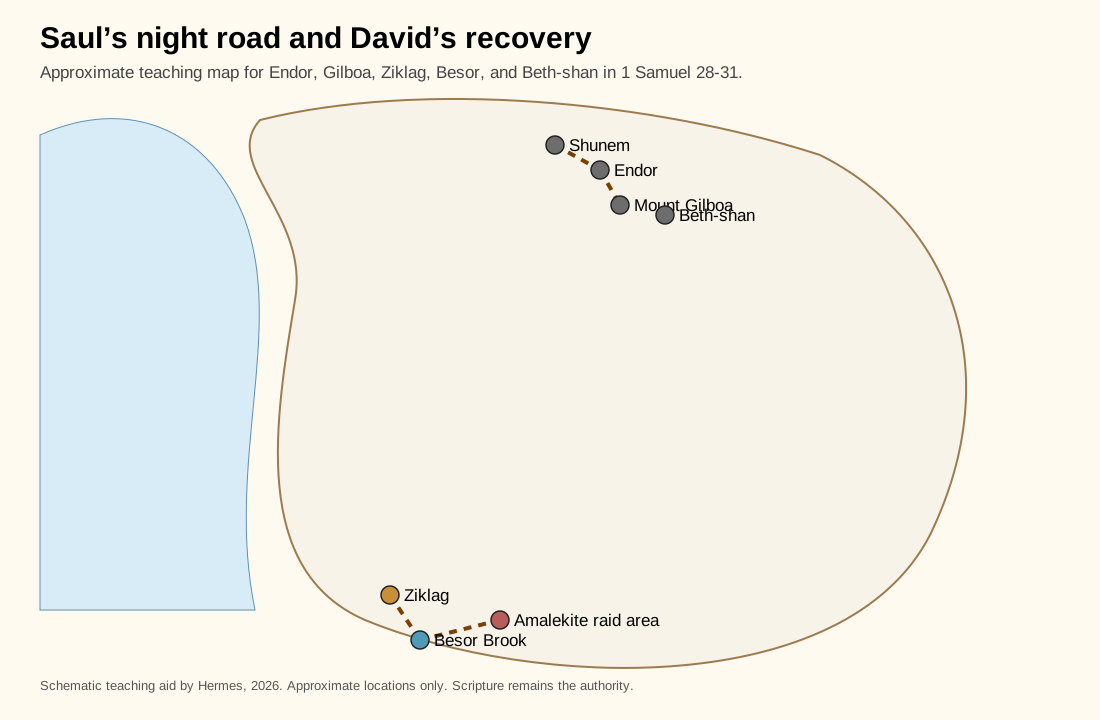 Generated geographical schematic of the narrative’s contrasting locations, not an ancient map or an exact reconstruction of routes and boundaries.
The Characters 👥
David receives mercy before he becomes its steward. His men need leadership through bereavement, threatened violence, and the temptation to despise their exhausted companions. Achish trusts the man whose reports have deceived him; the other Philistine commanders distrust him, and their rejection becomes his release. An Egyptian servant, abandoned when sick, supplies the way to the captives. Saul and his sons fall together, but Jonathan’s fidelity must not be swallowed up by his father’s failures. The men of Jabesh-gilead remember the king who once delivered them and answer disgrace with burial mercy.
The song that closes the road to battle (1 Samuel 29:1-5)
- And the Philistines gather all their armies to Aphec, and Israel encamped in Aendor, which is in Jezrael.
- And the lords of the Philistines went on by hundreds and thousands, and David and his men went on in the rear with Anchus.
- And the lords of the Philistines said, Who are these that pass by? And Anchus said to the captains of the Philistines, Is not this David the servant of Saul king of Israel? he has been with us some time, even this second year, and I have not found any fault in him from the day that he attached himself to me even until this day.
- And the captains of the Philistines were displeased at him, and they say to him, Send the man away, and let him return to his place, where thou didst set him; and let him not come with us to the war, and let him not be a traitor in the camp: and wherewith will he be reconciled to his master? will it not be with the heads of those men?
- Is not this David whom they celebrated in dances, saying, Saul has smitten his thousands, and David his ten thousands?
David walks at the rear of an army preparing to fight Israel. Achish calls him Saul’s servant while defending his loyalty to the Philistines. The contradiction is already in the scene: how can Saul’s servant safely belong to the force advancing against Saul? The commanders fear that David will buy reconciliation with the heads of their men. Their suspicion exposes the unstable allegiance that David’s earlier concealment has created.
Then the women’s song returns. It first stirred Saul’s envy in 18:7; it sounded again among Achish’s servants in Brenton 21:12, corresponding to the familiar Hebrew-based 21:11. Here, for the third time, it identifies David as the slayer of Philistines. The words that made him unsafe at Saul’s court now make him unacceptable in the army marching against Saul. Praise has not become morally simple, but its remembered words help close a road on which David could destroy his own calling.1
What the Greek text shows: “Aendor” and “this second year”
Verse 1 places Israel in “Aendor”, Endor, which has just appeared in chapter 28. Rahlfs-based Greek and NETS agree with that place name. The Hebrew-based account instead gives a spring or fountain in Jezreel. This difference should remain visible; the Greek does not by itself identify an exact camp site or provide a new timetable for Saul’s night journey.2
Achish’s “this second year” in verse 3 is also present in the critical Greek and NETS. Yet Brenton and that Greek form give four months at 27:7. We should retain both statements rather than invent a calendar calculation that reconciles them. Achish’s defence is a speech within the narrative, and the chronological tension is not solved by converting the earlier Greek four months into the Hebrew-based year and four months.2
Mercy through humiliation (1 Samuel 29:6-11)
- And Anchus called David, and said to him, As the Lord lives, thou art right and approved in my eyes, and so is thy going out and thy coming in with me in the army, and I have not found any evil to charge against thee from the day that thou camest to me until this day: but thou art not approved in the eyes of the lords.
- Now then return and go in peace, thus thou shalt not do evil in the sight of the lords of the Philistines.
- And David said to Anchus, What have I done to thee? and what hast thou found in thy servant from the first day that I was before thee even until this day, that I should not come and war against the enemies of the lord my king?
- And Anchus answered David, I know that thou art good in my eyes, but the lords of the Philistines say, He shall not come with us to the war.
- Now then rise up early in the morning, thou and the servants of thy lord that are come with thee, and go to the place where I appointed you, and entertain no evil thought in thy heart, for thou art good in my sight: and rise early for your journey when it is light, and depart.
- So David arose early, he and his men, to depart and guard the land of the Philistines: and the Philistines went up to Jezrael to battle.
Achish sends David away while protesting that he has found no evil in him. The reader knows more than Achish: chapter 27 has shown both killings and false reports. Approval from a powerful patron is therefore no assurance of a clean conscience. David’s protest keeps the ambiguity alive. The text never tells us what he planned to do once the battle began, and we should not supply either a secret patriotic strategy or a settled intention to betray Israel.
The result is clear even when his intentions remain hidden. David is dismissed, and dismissal becomes deliverance. This is mercy through humiliation: he loses his place in the advancing army and is spared the immediate demand to fight his own people. Providence here means God’s care within a history that human beings cannot control. God can rescue us from traps we helped create. That confession leaves room for repentance; it does not bless the trap.
Paul’s assurance in 1 Corinthians 10:13 concerns God’s faithfulness and a way through temptation that enables endurance. Psalm 124:7-8 (LXX Psalm 123:7-8) pictures a broken snare and deliverance, while Genesis 50:20-21 distinguishes the brothers’ evil purpose from God’s saving purpose. These texts give language to hope without turning every rejected application, lost job, or humiliation into a message that God is punishing us. A closed door may deliver us, but its meaning must be discerned through God’s commandments, truthful counsel, and the circumstances themselves.3
David is spared a battle against Israel. Christ’s mercy goes further: He accepts suffering without surrendering obedience, and gives His life for those who reject Him. At His arrest He protects the disciples rather than offering their lives to secure His own escape (John 18:8-9). David’s release prepares our gratitude for the King whose deliverance is received through His own self-giving.
Lesson Guide
- Key phrases: mercy through humiliation; suspicion as guardrail.
- Emphasize: God can rescue us from traps we helped create.
- Avoid: excusing David’s earlier ambiguity as pure wisdom.
Grief, prayer, and the first step of obedience (1 Samuel 30:1-10)
- And it came to pass when David and his men had entered Sekelac on the third day, that Amalec had made an incursion upon the south, and upon Sekelac, and smitten Sekelac, and burnt it with fire.
- And as to the women and all things that were in it, great and small, they slew neither man nor woman, but carried them captives, and went on their way.
- And David and his men came into the city, and, behold, it was burnt with fire; and their wives, and their sons, and their daughters, were carried captive.
- And David and his men lifted up their voice, and wept till there was no longer any power within them to weep.
- And both the wives of David were carried captive, Achinaam the Jezraelitess, and Abigaia the wife of Nabal the Carmelite.
- And David was greatly distressed, because the people spoke of stoning him, because the soul of all the people was grieved, each for his sons and his daughters: but David strengthened himself in the Lord his God.
- And David said to Abiathar the priest the son of Achimelech, Bring near the ephod.
- And David enquired of the Lord, saying, Shall I pursue after this troop? shall I overtake them? and he said to him, Pursue, for thou shalt surely overtake them, and thou shalt surely rescue the captives.
- So David went, he and the six hundred men with him, and they come as far as the brook Bosor, and the superfluous ones stopped.
- And he pursued them with four hundred men; and there remained behind two hundred men, who tarried on the other side of the brook Bosor.
At Ziklag the men find a burned city and missing families. They weep until there is no strength left to weep. David’s wives are among the captives; he stands inside the same loss as those he leads. Then grief turns on the leader, and the men speak of stoning him. Their wound deserves care, but it cannot make threatened violence righteous. A leader must answer honestly for his decisions, and wounded people must not be dismissed simply because their distress is difficult to bear.
The Amalekite raid is a bitter narrative aftershock of chapter 15. Amalek remains a source of injury in a book where Saul’s failure concerning Amalek helped expose his disobedience. The story does not establish that these raiders descend from particular survivors Saul spared, nor that every sufferer at Ziklag is being punished for Saul’s sin. Sin in leadership can wound a community without making the wounded morally responsible for the leader’s choice.
Verse 2 also places a hard contrast beside David’s raids in 27:9, 11. Those raids left neither man nor woman alive; here the raiders carry people away alive. Captivity is terrible, yet life remains to be recovered. David receives a preservation he did not extend to others. Gratitude should sober him before it strengthens him. The contrast exposes his need for mercy; the narrator does not disclose why the captives were spared or give us a formula explaining every disaster.
“David strengthened himself in the Lord his God” is the chapter’s turning point. In 27:1 he spoke within his own heart about being destroyed by Saul and sought Philistine protection; no inquiry of the Lord is narrated there. Here he asks Abiathar for the ephod, the priestly garment associated with inquiry, and receives a definite answer before pursuing. Grace renews his relation to God before it restores what has been taken.
Jonathan once “strengthened his hands in the Lord” in 23:16. At Ziklag Jonathan is absent, and David must turn to the Lord in the midst of his own company’s anger. Faithful friendship has taught him where strength is found. This does not make needing a friend a weakness: the Lord who strengthens the solitary also gives the consoling friend. Psalms 42-43 (LXX Psalms 41-42) offer a fitting prayer for this sorrow. The troubled soul remembers worship, names its distress, and bids itself hope in God. They are a prayerful application here, not psalms dated by the text to Ziklag.4
The promised rescue in verse 8 belongs to this inquiry. Christians cannot turn it into a prediction that every stolen possession, broken relationship, or lost life will be restored now. Its immediate fruit is obedience: David sets out, and two hundred men remain at Besor. Their inability to continue will test whether victory makes their companions more merciful.
Bread before intelligence (1 Samuel 30:11-15)
- And they find an Egyptian in the field, and they take him, and bring him to David; and they gave him bread and he ate, and they caused him to drink water.
- And they gave him a piece of a cake of figs, and he ate, and his spirit was restored in him; for he had not eaten bread, and had not drunk water three days and three nights.
- And David said to him, Whose art thou? and whence art thou? and the young man the Egyptian said, I am the servant of an Amalekite; and my master left me, because I was taken ill three days ago.
- And we made an incursion on the south of the Chelethite, and on the parts of Judea, and on the south of Chelub, and we burnt Sekelac with fire.
- And David said to him, Wilt thou bring me down to this troop? and he said, Swear now to me by God, that thou wilt not kill me, and that thou wilt not deliver me into the hands of my master, and I will bring thee down upon this troop.
The man found in the field is an Egyptian, a servant abandoned by an Amalekite master when he fell ill. His value to his master ended when he could no longer serve. David’s men give him bread and water, then fig cake, and “his spirit was restored in him”. Care comes before questioning. They feed a person whose usefulness they have not yet established. Help hidden in the discarded becomes the path to recovery, but his hunger deserves an answer even if he can supply no information.
Only afterward does David ask whose servant he is and where he has come from. The answer places him among the raiders who burned Ziklag. Mercy has reached someone connected with their suffering. David then asks whether he will guide them, and the servant requests an oath that he will neither be killed nor returned to his master. Verse 16 records that he leads David onward. The account does not narrate the completed oath, so the safest wording is that he asks for protection and then becomes their guide.
Deuteronomy forbids abhorring an Egyptian and returning a fugitive servant to his master: the references are 23:8 and 23:16-17 in Brenton and NETS, corresponding to 23:7 and 23:15-16 in familiar Hebrew-based numbering. This abandoned servant’s circumstances are not stated in exactly the same terms as the law’s fugitive, but the law gives a relevant moral horizon: ethnic identity and a master’s claim must not erase a vulnerable person’s dignity. Isaiah 19:19-25 opens a still wider hope by naming Egypt among the peoples blessed by the Lord. Neither text turns this individual into proof of every later event in Egyptian Christianity.5
Matthew 25:35-40 brings the bread and water into the light of Christ’s judgment: hunger, thirst, sickness, and estrangement are occasions for mercy to Him in the least of His brethren. A parish must not make food, protection, or clinical care the reward for supplying information or making a religious commitment. Here the food precedes the intelligence.
A modern Coptic reading of the abandoned servant
Fr Tadros Y. Malaty, in his commentary on chapter 30, reads the Egyptian as a figure of the repentant thief: one exhausted under bondage is received by the Son of David into the joy of His victory. This is Malaty’s spiritual interpretation, not an ancient Father’s direct explanation of the verse. It illuminates the person rescued from abandonment more securely than a claim that the Egyptian is himself Christ. The historical servant remains a hungry Egyptian who receives care and offers guidance.6
The “three days and three nights” of verse 12, beside David’s arrival “on the third day” in verse 1, can lead Christian memory toward Jonah 2:1 in Brenton and Christ’s explicit use of Jonah in Matthew 12:40. But the Egyptian is neither described as dead nor said to rise from a tomb. The repeated time language permits a restrained Paschal resonance; it cannot establish that this chapter directly predicts Christ’s burial or that every three-day event is the same type.7
“David recovered all” (1 Samuel 30:16-20)
- So he brought him down thither, and behold, they were scattered abroad upon the surface of the whole land, eating and drinking, and feasting by reason of all the great spoils which they had taken out of the land of the Philistines, and out of the land of Juda.
- And David came upon them, and smote them from the morning till the evening, and on the next day; and not one of them escaped, except four hundred young men, who were mounted on camels, and fled.
- And David recovered all that the Amalekites had taken, and he rescued both his wives.
- And nothing was wanting to them of great or small, either of the spoils, or the sons and daughters, or anything that they had taken of theirs; and David recovered all.
- And he took all the flocks, and the herds, and led them away before the spoils: and it was said of these spoils, These are the spoils of David.
The raiders feast on what they have taken from Judah and the Philistine land alike. David strikes, four hundred mounted men escape, and the account twice says that he recovers all. The words slow us down over the children, the wives, and the smallest missing things. These are lives restored to a community before they are proof of a leader’s success. The violence remains an ancient battle, not a model for Christian revenge or a permission to treat an ethnic people as evil by nature.
The recovery offers a real but limited likeness to the saving work of the Son of David. Luke 19:10 names His mission to seek and save the lost. John 6:39 joins His keeping of those given by the Father to resurrection at the last day. John 17:12 speaks of His keeping the disciples while explicitly naming Judas as the exception in that account; John 18:9 recalls His losing none as He protects them at His arrest. These passages should govern the likeness rather than become a promise that David’s earthly recovery will be repeated for every bereaved family. Christ’s salvation reaches beyond this chapter’s rescue of living captives.8
Gems from the Fathers 💎: The King redeems His heralds
St Cyril of Jerusalem, Catechetical Lecture 14.19, describes Christ’s descent into Hades, the realm of the dead, as the deliverance of the righteous awaiting Him. He names David and Samuel among them. His words give the doctrine its proper centre: “All the Just were ransomed, whom death had swallowed; for it behooved the King whom they had proclaimed, to become the redeemer of His noble heralds.”9 This is a thematic witness to Christ’s victory, not Cyril’s commentary on Ziklag. The earthly king recovers his captives; the eternal King delivers even the prophets who announced Him.
Calling Ziklag a descent into loss and recovery can therefore serve contemplation, provided the difference remains clear. David goes down toward a raiding band; Christ enters death itself through the Cross. David needs grace to be restored to faithful inquiry; Christ is the sinless Giver of life. The Church’s hope rests in Him, not in the claim that successful earthly rescue removes the tragedy of those who were not recovered.
Lesson Guide
- Key phrases: no more strength to weep; strengthened himself in the Lord; help hidden in the abandoned.
- Emphasize: David’s renewal begins before the pursuit succeeds.
- Avoid: turning grief into a quick victory slogan.
Not everyone can cross the brook (1 Samuel 30:21-31)
- And David comes to the two hundred men who were left behind that they should not follow after David, and he had caused them to remain by the brook of Bosor; and they came forth to meet David, and to meet his people with him: and David drew near to the people, and they asked him how he did.
- Then every ill-disposed and bad man of the soldiers who had gone with David, answered and said, Because they did not pursue together with us, we will not give them of the spoils which we have recovered, only let each one lead away with him his wife and his children, and let them return.
- And David said, Ye shall not do so, after the Lord has delivered the enemy to us, and guarded us, and the Lord has delivered into our hands the troop that came against us.
- And who will hearken to these your words? for they are not inferior to us; for according to the portion of him that went down to the battle, so shall be the portion of him that abides with the baggage; they shall share alike.
- And it came to pass from that day forward, that it became an ordinance and a custom in Israel until this day.
- And David came to Sekelac, and sent of the spoils to the elders of Juda, and to his friends, saying, Behold some of the spoils of the enemies of the Lord;
- to those in Bæthsur, and to those in Rama of the south, and to those in Gethor.
- And to those in Aroer, and to those in Ammadi, and to those in Saphi, and to those in Esthie, and to those in Geth, and to those in Cimath, and to those in Saphec, and to those in Themath,
- and to those in Carmel, and to those in the cities of Jeremeel, and to those in the cities of the Kenezite;
- and to those in Jerimuth, and to those in Bersabee, and to those in Nombe,
- and to those in Chebron, and to all the places which David and his men had passed through.
The two hundred come out to meet the returning company. In the displayed verse 21, David draws near and they ask him how he did. NETS and the critical Greek retain that direction of the greeting; a familiar Hebrew-based rendering makes David the one who greets them. His mercy in this account is clear from what follows, without changing who asks after whom.10
Some “ill-disposed and bad” men are inside David’s own victorious camp. They propose returning the families but withholding every share of the spoil and sending the exhausted men away. Military courage has not healed their contempt. The contrast with the Egyptian’s master is sharp: he left a sick servant behind, while these warriors would exclude the men unable to continue. Deuteronomy 25:17-18 remembers Amalek attacking the weary at Israel’s rear. Victory over an enemy is incomplete if the victors adopt the enemy’s disregard for weakness.
David begins with the Lord’s action: He has guarded them and delivered the troop into their hands. The spoil is received before it is distributed. Paul’s question in 1 Corinthians 4:7 exposes the boast that forgets its source: what do you have that you did not receive? Numbers 31:27 supplies an earlier precedent for dividing spoil between warriors and the congregation, though its allocation is not identical to David’s equal shares among these men. A gift cannot rightly become an occasion for declaring the exhausted worthless.11
Verse 24 says, “they are not inferior to us”. Rahlfs-based Greek and NETS say “not inferior to you”, addressing the men who would exclude them. Both forms resist the same contempt, but the pronouns should not be silently exchanged. Brenton’s “superfluous ones” at 30:9 identifies those remaining behind, not a judgment that their lives are surplus. Verse 24 assigns those with the baggage a share equal to those in battle.10
Not everyone can cross the brook. Weariness is a real limitation, not a moral identity. The men at Besor have neither rebelled nor refused their companions out of indifference. The community honors the work entrusted to them rather than demanding the same visible achievement from every body. In church life, a sick servant, an exhausted caregiver, or an older person whose strength has diminished must not lose belonging with usefulness. First Corinthians 12:22-26 calls the apparently weaker members necessary and joins the whole body’s suffering and honor. Receiving that teaching means arranging help, rest, and a genuine place in the community, not merely praising hidden service while leaving people unsupported.11
Matthew 20:1-16 makes generosity more searching still. The landowner gives the same denarius, the day’s payment, to the late and early workers, and the early workers resent the equality. David’s ordinance and Christ’s parable are not identical systems of payment. They meet in exposing an eye that cannot bear another person’s gift. Grace heals the boast that needs someone else to have less.
Gems from the Fathers 💎: Generosity without contempt
St John Chrysostom reads the vineyard parable in Homily on Matthew 64.3-4 as encouragement for those who come late to obedience and a warning to those tempted to reproach them. He says that those faithful from youth should “not be proud, neither reproach those called at the eleventh hour”.12 This is commentary on Matthew, applied here as a close moral parallel. The weary men are not late converts, but the same temptation to measure another person’s welcome by our own exertion is being judged. Chrysostom calls for diligence as well as humility; generosity gives no permission to become indifferent to one’s duty.
David’s generosity then reaches beyond his company. He sends gifts to the elders and friends in Judah, naming the spoil as taken from the Lord’s enemies. The places are remembered as those through which he and his men had passed. An exile begins to reconnect with the people among whom he will reign. Hebron, “Chebron” in verse 31, looks ahead to 2 Samuel 2:1-4, where David again inquires of the Lord and is anointed over Judah. The gifts prepare that transition without proving that every recipient’s loyalty was purchased.13
Christological reading. Recovery followed by gifts draws our attention to the victorious Christ. Psalm 68:18 (LXX Psalm 67:19) speaks of ascent, captivity led captive, and gifts received; Ephesians 4:8-10 speaks of Christ’s descent and ascent and gifts given. The Greek forms differ as well: “ἔλαβες”, you received, in Psalm 68:18 (LXX Psalm 67:19); “ἔδωκεν”, He gave, in Ephesians. Paul is not reproducing an identical sentence. His account makes the ascended Lord the Giver who equips His people. Luke 11:21-22 pictures the stronger one overcoming an armed captor and dividing his spoils; Colossians 2:15 names Christ’s triumph over hostile powers. These texts sustain the Christian contemplation, while none explicitly identifies David’s gifts in this chapter as its subject.14
Lesson Guide
- Key phrases: not everyone can cross the brook; shared honor rightly ordered.
- Emphasize: David resists contempt inside his own camp.
- Avoid: using this to excuse laziness. The men at Besor were exhausted, not indifferent.
Gilboa: tragedy, not triumph (1 Samuel 31:1-7)
- And the Philistines fought with Israel: and the men of Israel fled from before the Philistines, and they fall down wounded in the mountain of Gelbue.
- And the Philistines press closely on Saul and his sons, and the Philistines smite Jonathan, and Aminadab, and Melchisa son of Saul.
- And the battle prevails against Saul, and the shooters with arrows, even the archers find him, and he was wounded under the ribs.
- And Saul said to his armour-bearer, Draw thy sword and pierce me through with it; lest these uncircumcised come and pierce me through, and mock me. But his armour-bearer would not, for he feared greatly: so Saul took his sword and fell upon it.
- And his armour-bearer saw that Saul was dead, and he fell also himself upon his sword, and died with him.
- So Saul died, and his three sons, and his armour-bearer, in that day together.
- And the men of Israel who were on the other side of the valley, and those beyond Jordan, saw that the men of Israel fled, and that Saul and his sons were dead; and they leave their cities and flee: and the Philistines come and dwell in them.
The battle overwhelms Israel. Saul’s sons are killed, the archers find Saul, and the king is wounded. The end does not bring safety to those around him: the armour-bearer also dies, cities are abandoned, and the Philistines occupy them. Leadership’s long disorder has become communal sorrow, though the chapter does not assign every death to the dead person’s own sin.
Jonathan’s death makes that sorrow personal. He strengthened David in the Lord and hoped to stand second beside him in 23:17. He never occupies that place. Faithfulness is not an insurance policy against battle or bereavement. In 2 Samuel 1:23, David remembers Saul and Jonathan as not divided in death; in 4:4 and chapter 9 the covenant’s story reaches Jonathan’s injured son, whom David later receives at his table. Jonathan’s lost future cannot be reduced to a convenient removal of a rival.15
What the Greek text shows: “wounded under the ribs”
Verse 3’s wound is bodily. The critical Greek has “ἐτραυματίσθη εἰς τὰ ὑποχόνδρια”, wounded in the region under the ribs, which NETS renders as an abdominal wound. Whatever comparisons are made with Hebrew-based translations, the displayed text must not be paraphrased as merely saying that Saul became afraid of the archers.2
The armour-bearer refuses Saul’s request because “he feared greatly”. This can be heard beside David’s refusals to strike the Lord’s anointed in 24:7 and 26:9-11; David himself once served as Saul’s armour-bearer in 16:21. Yet verse 4 does not explicitly tell us the object of this man’s fear. The link is a grave hesitation before killing the king, not a rule about every Israelite’s conduct. David’s question to the Amalekite in 2 Samuel 1:14 makes that reverence explicit in the next account.16
Saul fears being pierced and mocked. His concern about public disgrace recalls his request to be honored before the elders in 15:30, while Judges 9:54 records Abimelech asking his armour-bearer to kill him rather than let people say that a woman killed him. These are sobering narrative comparisons, not access to Saul’s entire final consciousness. Christ accepts the soldiers’ mockery in Matthew 27:27-31 and remains obedient in self-giving love. His voluntary death for our salvation is never a precedent for self-destruction.17
Saul’s suicide is tragedy, not triumph. The act is not presented as spiritual courage and should never be romanticized. His story follows a long history of envy, fear, disobedience, and forbidden inquiry, but it gives no warrant for diagnosing every person who dies by suicide in those terms. Serious mental illness, trauma, impaired freedom, and acute suffering can affect responsibility; we must not presume to measure each person’s culpability or eternal destiny. Nor does the narrative tell us all that passed within Saul before death. We can condemn self-destruction as a choice to resist without claiming to know God’s final judgment of every soul.
A person in despair needs compassion, company, and timely help. Take thoughts of self-harm seriously, seek urgent clinical or emergency support when safety is at risk, and remain with the person while help is arranged. Prayer, confession where appropriate, and gentle pastoral care belong with professional treatment, never in competition with it. Bereaved people should not be interrogated about a loved one’s last moments or burdened with the claim that their love or prayers were insufficient. The answer Scripture gives to Gilboa is a lament in 2 Samuel 1, where David and his men weep and fast for Saul, Jonathan, and the people. Love can grieve even the person who once threatened it.18
David had named the possibility that Saul would go down to battle and die in 26:10. That possibility has now occurred without David making himself its instrument. His preserved hands are not a reason to celebrate. The mercy shown him must become grief for the life he refused to take.
Glad tidings to idols, mercy toward the dead (1 Samuel 31:8-13)
- And it came to pass on the morrow that the Philistines come to strip the dead, and they find Saul and his three sons fallen on the mountains of Gelbue.
- And they turned him, and stripped off his armour, and sent it into the land of the Philistines, sending round glad tidings to their idols and to the people.
- And they set up his armour at the temple of Astarte, and they fastened his body on the wall of Bæthsam.
- And the inhabitants of Jabis Galaad hear what the Philistines did to Saul.
- And they rose up, even every man of might, and marched all night, and took the body of Saul and the body of Jonathan his son from the wall of Bæthsam; and they bring them to Jabis, and burn them there.
- And they take their bones, and bury them in the field that is in Jabis, and fast seven days.
The Philistines turn Saul’s defeat into public celebration. His armour goes to Astarte’s temple and his body to the wall of Beth-shan. The king sought as visible security “like all the nations” cannot preserve his own body from disgrace. Goliath’s defeated armour in 17:54 offers a reversal of military fortune, but that verse places it in David’s tent, not an idol’s temple. Saul’s end must be explained by the details actually given, not by blending familiar trophies into one scene.
What the Greek text shows: “turned him” and “glad tidings”
Brenton’s verse 9 says “they turned him”, and the critical Greek reads “ἀποστρέφουσιν αὐτόν”, they turn him back; NETS renders the action as bringing him back. This line does not say that they cut off his head. The Hebrew-based 1 Samuel 31:9 does. Greek 1 Chronicles 10:9-10 separately names the taking of Saul’s head and its placement in Dagon’s house. The parallel supplies another witness; it should not replace the words in this Scripture block.19
“Sending round glad tidings” has the surface form “εὐαγγελίζοντες”, announcing good news. The same verb appears as “εὐαγγελίσησθε” in 2 Samuel 1:20, where David forbids announcing the defeat as glad tidings in Philistine streets, and as “εὐαγγελιζόμενος” in 4:10, describing the messenger who thought Saul’s death would delight David. The shared verb exposes a genuine irony: the death of the Lord’s anointed is treated as good news to idols, while David refuses to receive it that way. Ordinary victory news and the saving Gospel can use related vocabulary; this does not make the Philistine message the New Testament Gospel or establish a complete doctrine from one verb.20
Verse 12 names Saul’s body and Jonathan’s body, not the bodies of all three sons. Rahlfs-based Greek and NETS agree here; the Hebrew-based account names his sons collectively. Verse 13 places the bones in a field, cultivated ground in NETS, rather than under the tamarisk of the Hebrew-based account. Neither difference weakens the courage of the men who go all night to bring the dead home. It keeps our account faithful to the text we are reading.21
Jabesh-gilead remembers Saul’s rescue from Nahash in chapter 11. Their overnight march answers his earlier intervention with gratitude. The king’s failures have not erased the good they received through him. David later blesses them for their mercy in 2 Samuel 2:4-7; in 21:12-14 he brings Saul’s and Jonathan’s bones to the ancestral burial place. The book’s closing burial is therefore not the last word about either gratitude or responsibility for Saul’s house.22
Tobit 1:17-19 offers a close scriptural witness: Tobit buries those cast by Nineveh’s walls and those killed by Sennacherib, then must flee when his care exposes him to danger. Sirach 38:16 joins lament to the command not to neglect burial. These acts honor a person whom violence has made vulnerable even in death. Sirach’s counsel toward consolation must not be used to impose a rigid timetable on another person’s grief.23
Gems from the Fathers 💎: The body is honored, and God remains able to raise it
St Augustine, On the Care to Be Had for the Dead §§4-5, joins reverent burial to freedom from terror about an unburied body. God’s power to raise what He created is not defeated by what enemies do to the remains. Yet that hope does not authorize neglect: “Yet it follows not that the bodies of the departed are to be despised and flung aside”.24 In §5 he appeals to Tobit and to those who reverently laid Christ in the tomb. In §22 he calls burial “an office of humanity”, an act of humane love that bears witness to faith in resurrection.24
His teaching holds two truths together. Bodies belong to the person God created and deserve care; burial location, expense, and ceremony do not mechanically secure salvation. A family unable to recover remains has not thereby barred its loved one from resurrection. The men of Jabesh perform real mercy, and that mercy must not become a superstition that makes God dependent on a funeral rite.
Christological reading. John 19:38-42 brings another exposed body before us: Joseph and Nicodemus reverently prepare and bury the Lord Jesus. The resemblance concerns courage and care, but the contrast is decisive. Saul’s defeat ends his earthly reign; Christ’s self-offering leads through burial to Resurrection. John places the burial before the Sabbath, not on a secret night raid, and Jabesh’s burning of the bodies is not the manner of Christ’s burial. These histories meet in the duty to honor the body, not in an identical ritual.
The Church’s Voice in Worship ⛪
At the Twelfth Hour of Good Friday, the Coptic Holy Pascha service commemorates Christ’s burial. The printed order places the burial action with “Golgotha”, the Burial Hymn, whose words remember Joseph and Nicodemus taking and preparing His body. Their reverence becomes the Church’s prayer before the Lord who was crucified for us. This is an annual commemoration of Christ’s burial, not a reenactment of Jabesh’s cremation or evidence that 1 Samuel 31 is appointed at that hour.25
The Coptic Synaxarium for Tout 22 also remembers Saints Cotylas, Axoua, and Tatas. Its account says that priests and deacons secretly recovered Cotylas’s body by night and hid it during persecution. That received hagiographic remembrance gives a concrete example of care for a martyr’s remains in danger; it is not a contemporary report verifying every detail of the story. The same day’s notice of St Julius of Aqfahs remembers his ministry to the martyrs and the care of their bodies. Gratitude at Jabesh and Christian burial mercy are related acts of love, without making Saul a martyr or their rites identical.26
Lesson Guide
- Key phrases: tragedy, not triumph; gratitude remains; longing for the true King.
- Emphasize: handle Saul’s death with compassion and moral clarity.
- Avoid: making Saul’s suicide a dramatic flourish or a simplistic sermon illustration.
Hannah’s prayer at the end of the book
The story began with a woman pouring out her soul before the Lord. It ends with a city weeping, a king dying, and grateful men fasting over bones. Hannah’s song has given us the language to receive both the recovery and the grief: “The Lord kills and makes alive; he brings down to the grave, and brings up”; “he brings low, and lifts up”; “by strength cannot man prevail” (2:6-9). The tall king falls, and the once-hidden shepherd is being prepared for public kingship. Yet Jonathan falls too. Hannah’s praise announces God’s sovereignty and His reversal of pride, not a neat rule that every death identifies the wicked and every survival proves the innocent.
Her final royal promise is that the Lord “will exalt the horn of his Christ” (2:10), the strength of His anointed. David’s preservation keeps that royal story open; it does not finish it. Luke 1:32-33 names the fullness of the promise in Jesus, who receives David’s throne and reigns without end. The next act is therefore not a flawless David’s victory celebration. Before he goes to Hebron, he must receive the news of Gilboa and lament.27
The four motifs that have held the book together reach distinct, still unfinished conclusions. Heart: Hannah’s inward prayer and God’s seeing the heart in chapter 16 lead here to David seeking strength in the Lord rather than making fear his only counsellor. Word: Samuel’s established word and Saul’s resisted correction reach fulfillment in Saul’s fall, while David’s inquiry receives a word that directs him toward rescue. Glory and Presence: the Lord who vindicated His holiness when the ark was captured has not become the defeated possession of Philistine idols; their trophies expose Saul’s fall, not God’s impotence, and David names the Lord as the One who guarded and delivered his people. Anointing and Kingship: Saul’s real calling ends without losing the reverence due to the Lord’s anointed, David remains preserved but imperfect, and Hannah’s promise opens beyond both men toward Christ.
Seven recurring threads also leave their final impressions:
- The spear: Saul’s weapon of pursuit was taken without murder in chapter 26; his end comes by his own sword, and the spear returns in the Amalekite messenger’s account in 2 Samuel 1:6, not as an object whose final disposal this book records.
- The robe: Hannah’s garment for Samuel, Saul’s tearing of the prophet’s cloak, and David’s cutting of Saul’s robe make clothing a witness to gift, grasping, and restraint; Samuel’s mantle is recognized at Endor, and the next book opens with garments torn in grief.
- “Hearken to the voice”: the listening child Samuel grew into the prophet Saul resisted; at Endor Saul heard the plea to eat, while at Ziklag David again asked and acted upon the Lord’s direction.
- Gilgal: the place of Saul’s public confirmation became the setting of disobedience and rejection; its unresolved word reaches Gilboa without a narrated return that cancels the judgment.
- Jabesh-gilead: the city Saul saved answers his end with an overnight act of gratitude, and David will honor that mercy rather than demand hostility to the fallen king.
- Amalek: chapter 15’s judgment and chapter 30’s raid keep the enemy before us, but the escaping raiders and the messenger in 2 Samuel 1 show that this book has not supplied a complete ending to that thread.
- Inquiry by the ephod: Abiathar’s survival after Nob preserves a way of inquiry for David; the fugitive who acted from fear in chapter 27 now turns to the Lord, and inquiry will lead him onward to Hebron.
These threads leave a question for our own strength. Will a gift become something we use to escape correction, or something we receive again in prayer and share in mercy? Hannah gave back what she had received. At Besor David begins to govern his victory by the same truth. At Jabesh gratitude gives the fallen body its honor. And at the opening of 2 Samuel, the right answer to an enemy’s death is still lament.
| Passage | What the ending reveals | Response in the light of Christ |
|---|---|---|
| 29:1-11 | Rejection releases David from a compromised allegiance | Receive rescue humbly and return to truth |
| 30:1-10 | Grief can turn toward threatened violence or faithful inquiry | Bring the real wound to God and seek the next obedience |
| 30:11-20 | Care for the discarded opens a path to the captives | Feed the hungry before asking what they can give |
| 30:21-31 | Victory is received, and the weary retain their share | Honor the weaker members and share the gift |
| 31:1-7 | A fallen king’s tragedy wounds faithful people too | Seek help in despair and grieve without judging souls |
| 31:8-13 | Idols celebrate, but gratitude honors the dead | Care for bodies in resurrection hope |
| Hannah’s song and 2 Samuel 1 | God’s promise outlasts human strength, and promise does not cancel lament | Long for Christ’s reign and make room for tears |
Spiritual Fruit 🍇
-
Receive rescue without defending the compromise. If a dishonest arrangement has begun making demands upon you, name it truthfully before God and seek help to leave it. David’s rejection shows that grace can interrupt a road we should never have entered. Gratitude becomes repentance when we stop calling the trap wisdom.
-
Pray before answering blame. David’s men are genuinely wounded, and their threatened violence is still wrong. Before replying to a painful accusation, pray slowly with Psalms 42-43 (LXX Psalms 41-42), ask what is yours to confess, and remember that this responsibility gives no one a right to harm you. Strength in the Lord permits both humility and protection.
-
Give bread before asking for usefulness. Notice one person whom sickness, poverty, or exhaustion has made easy to overlook. Offer a meal, transport to care, or practical company without demanding information or gratitude in return. The Egyptian mattered before he could lead David anywhere.
-
Keep the weary inside the community. Ask an exhausted servant or caregiver what help would let them rest, then arrange that help. Besor teaches us to distinguish inability from indifference and belonging from visible achievement. Give another person’s gift room to make you grateful rather than resentful.
-
Meet tragic endings with reverence and help. Do not turn a death by suicide into a sermon about the dead person’s eternal state. Listen to those grieving, help anyone at risk reach urgent care, and pray without treating professional care as unbelief. Honor the departed body where care is possible, and entrust what cannot be recovered to the God whose resurrection power cannot be defeated.
Lord Jesus Christ, Hannah’s prayer teaches my heart to open its hands. At the burned city, receive the sorrow I cannot mend and show me the obedience still possible. At the brook, keep me from despising the strength another person lacks. Before the fallen king, teach me to lament without hatred and to hope in Your mercy. You are the King who enters death and brings His people into life.
Teaching Notes
The song that closes the road to battle (1 Samuel 29:1-5)
- Ask: How does the same remembered song endanger David at one point and help preserve him at another?
- Watch for: Brenton 21:12 corresponds to Hebrew-based 21:11. Aendor and the second year must not be silently replaced by a fountain and a revised chronology.
Mercy through humiliation (1 Samuel 29:6-11)
- Ask: What makes David’s dismissal a deliverance without making his earlier deception righteous?
- Watch for: The text does not reveal his intended battle strategy. Every rejection or lost job is not thereby a divine verdict.
Grief, prayer, and the first step of obedience (1 Samuel 30:1-10)
- Ask: What changes between speaking fear within the heart in chapter 27 and inquiring of the Lord here?
- Watch for: Grief never authorizes stoning; accountability never authorizes abuse. The Amalek connection is narrative continuity, not a proved genealogy or a general punishment formula.
Bread before intelligence (1 Samuel 30:11-15)
- Ask: Why does the order of feeding and questioning matter for our care of vulnerable people?
- Watch for: The Egyptian asks for an oath; its completion is not narrated. His restored spirit is recovery from hunger, not a reported resurrection. Malaty’s thief interpretation is modern Coptic commentary.
“David recovered all” (1 Samuel 30:16-20)
- Ask: How does Christ’s keeping and raising His people exceed the rescue of living captives here?
- Watch for: John 17:12 includes Judas’s exception. The rescue does not predict restoration now for every bereaved family; Christ’s descent is supported independently by the Gospel and Cyril.
Not everyone can cross the brook (1 Samuel 30:21-31)
- Ask: What does David’s appeal to the Lord’s gift change about the strong men’s claim to the spoil?
- Watch for: Exhaustion is not indifference, and service is not a purchase of superiority. In verse 21 the men ask after David; in verse 24 Brenton’s “us” differs from the critical Greek “you”. The psalm receives gifts while Ephesians gives them.
Gilboa: tragedy, not triumph (1 Samuel 31:1-7)
- Ask: What does David’s later lament teach us about grieving a person whose wrongdoing was real?
- Watch for: Do not romanticize suicide, speculate about final mental states, or judge each person’s culpability or eternal destiny. Emergency or clinical help must not wait for clergy. Never interrogate grieving people about whether they did enough.
Glad tidings to idols, mercy toward the dead (1 Samuel 31:8-13)
- Ask: How do Jabesh’s gratitude and Augustine’s resurrection hope keep burial mercy free from both neglect and superstition?
- Watch for: The displayed account says “turned him”, Saul and Jonathan, and a field. Good Friday commemorates Christ’s burial, not Jabesh’s burning of the bodies. Hagiographic remembrance has a different evidentiary character from a contemporary report.
Whole-study helps
- Linger over 30:6 and 30:21-25. Allow time for the final lament rather than ending with David’s success.
- Suggested timing: 10 minutes for chapter 29, 20 minutes for Ziklag and the Egyptian, 15 minutes for Besor and the gifts, and 20 minutes for Saul’s death and the whole-book closing synthesis.
- Use the geographical schematic rather than graphic depictions of suicide. It distinguishes David’s southern recovery from Saul’s northern fall; it does not establish exact ancient routes or a resolved camp chronology.
- Carry Hannah’s four motifs through the closing section, then read 2 Samuel 1:11-27. The lament comes before David’s public anointing at Hebron.
- An exact Coptic lectionary appointment for these chapters was not found in the data consulted. The Twelfth Hour connection is a verified burial rite and hymn, not an appointment of this narrative.
- Explain needed terms simply: providence is God’s care; the ephod is the priestly garment used here in inquiry; Hades is the realm of the dead; the denarius is a day’s payment in Matthew’s parable.
Sources
Embedded Scripture is from Brenton’s English Septuagint (LXX). Brief New Testament wording and references use NKJV. Hebrew-based witnesses and NETS are labeled where they differ from Brenton.
Brenton, 🔗 1 Samuel 29, 🔗 30, and 🔗 31, with the earlier narrative and biblical parallels cited below.
Bernard A. Taylor, 1 Reigns, in NETS, based principally on Rahlfs: 🔗 official edition, chapters 29-31, pp. 269-270; 🔗 NETS 1 Supplements, chapter 10. Rahlfs-based CCAT Greek: 🔗 edition provenance.
St Cyril of Jerusalem, Catechetical Lecture 14.19, translated Edwin Hamilton Gifford, NPNF, second series, vol. 7: 🔗 primary text. Thematic witness to Christ’s descent, not commentary on Ziklag.
St John Chrysostom, Homily on Matthew 64.3-4, on Matthew 20’s vineyard parable, translated George Prevost, revised M. B. Riddle, NPNF, first series, vol. 10: 🔗 primary text. Close moral parallel for generosity without contempt.
St Augustine, On the Care to Be Had for the Dead §§4-5, 22, translated H. Browne, NPNF, first series, vol. 3: 🔗 primary text. Thematic witness to humane burial and resurrection hope.
Fr Tadros Y. Malaty, First Samuel (2004), chapter 30, “David’s Victory”, pp. 154-155; translated Dr George Botros, revised Sameh Shafik and Ferial Moawad: 🔗 modern Coptic commentary. Its spiritual reading is distinguished from ancient primary commentary and from Brenton’s exact narrative wording.
The Katameros: The Readings for the Week of the Holy Pascha, Twelfth Hour of Good Friday, burial order and “Golgotha”, pp. 651-653: 🔗 printed service book. Coptic Synaxarium, Tout 22: 🔗 received notices.
Footnotes
-
Brenton, 🔗 1 Samuel 18:6-8 and 🔗 21:11-12, compared with 🔗 Hebrew-based 1 Samuel 21:11. ↩
-
Rahlfs-based Greek, 1 Samuel 27:7; 29:1, 3; 31:3: 🔗 CCAT surface text; 🔗 NETS, 1 Reigns. For the alternate camp wording, 🔗 NKJV 1 Samuel 29:1. ↩ ↩2 ↩3
-
Brenton, 🔗 Psalm 124:7-8, LXX Psalm 123 and 🔗 Genesis 50:20-21; NKJV, 🔗 1 Corinthians 10:13. ↩
-
Brenton, 🔗 1 Samuel 23:16; 🔗 Psalm 42, LXX Psalm 41 and 🔗 Psalm 43, LXX Psalm 42. Psalm verse numbering can also differ by the counting of titles. ↩
-
Brenton and 🔗 NETS Deuteronomy 23:8, 16-17, corresponding to Hebrew-based 23:7, 15-16; 🔗 Brenton Deuteronomy 23; 🔗 Isaiah 19:19-25. ↩
-
Malaty, First Samuel, chapter 30, “David’s Victory”, p. 155: 🔗 commentary. The Egyptian is interpreted as the repentant thief; this is a modern typological reading. ↩
-
Brenton, 🔗 Jonah 2:1; NKJV, 🔗 Matthew 12:40. ↩
-
NKJV, Luke 19:10; John 6:39; 17:12; 18:8-9: 🔗 Gospel passages. ↩
-
St Cyril of Jerusalem, Catechetical Lecture 14.19, Gifford translation: 🔗 primary text. ↩
-
Brenton, 1 Samuel 30:9, 21, 23-24; 🔗 Rahlfs-based CCAT Greek and 🔗 NETS. ↩ ↩2
-
St John Chrysostom, Homily on Matthew 64.4, with the interpretive explanation in §3: 🔗 primary text. ↩
-
Brenton, 🔗 2 Samuel 2:1-4. ↩
-
Brenton, 🔗 Psalm 68:18, LXX Psalm 67:19; 🔗 Rahlfs-based Greek, Psalm 68:18 (LXX Psalm 67:19); 🔗 Ephesians 4:8 Greek text; NKJV, 🔗 Ephesians 4:8-10; Luke 11:21-22; Colossians 2:15. ↩
-
Brenton, 🔗 2 Samuel 1:23, 🔗 4:4, and 🔗 9. ↩
-
Brenton, 1 Samuel 16:21; 24:7; 26:9-11, and 🔗 2 Samuel 1:14. The armour-bearer’s own motive is limited to the fear reported in 31:4. ↩
-
Brenton, 🔗 Judges 9:53-54; NKJV, 🔗 Matthew 27:27-31. ↩
-
Brenton, 🔗 2 Samuel 1:11-27. Lament is the next narrative response, not approval of self-destruction. ↩
-
Greek 1 Samuel 31:9 and 1 Chronicles 10:9-10: 🔗 CCAT 1 Samuel, 🔗 CCAT 1 Chronicles, 🔗 NETS 1 Reigns, 🔗 NETS 1 Supplements; 🔗 Hebrew-based 1 Samuel 31:9; 1 Chronicles 10:9-10. ↩
-
Rahlfs-based Greek, 🔗 1 Samuel 31:9 and 🔗 2 Samuel 1:20; 4:10. The comparison concerns surface forms of the same verb, not an identical proclamation. ↩
-
🔗 Rahlfs-based 1 Samuel 31:12-13; 🔗 NETS; 🔗 Hebrew-based account. ↩
-
Brenton, 🔗 1 Samuel 11:9-11, 🔗 2 Samuel 2:4-7, and 🔗 21:12-14. ↩
-
Brenton, 🔗 Tobit 1:17-19 and 🔗 Sirach 38:16-23. ↩
-
St Augustine, On the Care to Be Had for the Dead §§4-5, 22, translated H. Browne: 🔗 primary text. ↩ ↩2
-
The Katameros: The Readings for the Week of the Holy Pascha, Twelfth Hour of Good Friday, burial order, pp. 651-652, and “Golgotha”, p. 653: 🔗 printed rite and hymn. ↩
-
Coptic Synaxarium, Tout 22, first notice, Saints Cotylas, Axoua, and Tatas, and second notice, St Julius of Aqfahs: 🔗 public day text; 🔗 parallel St-Takla notice. Received hagiography is distinguished from independently established historical detail. ↩
-
Brenton, 🔗 1 Samuel 2:4-10; NKJV, 🔗 Luke 1:32-33; Brenton, 🔗 2 Samuel 1. ↩