


David rescues a town, yet cannot remain within its walls. He receives a friend’s assurance, yet must keep moving through the wilderness. At last his pursuer lies within reach, and David’s hardest victory is to leave him alive. These chapters hold deliverance and discernment together: God’s keeping does not excuse vengeance, and mercy does not require surrendering ourselves to danger. The promised king must learn what his hands are for before he receives the throne.
Lesson Guide
- Key phrases: inquire of the Lord; strengthened in God; mercy in the cave.
- Emphasize: David refuses to take by force what God has promised.
- Avoid: using forgiveness language to deny danger or justice.
Historical and Scriptural Context
This study uses the familiar English book names. In the Septuagint, 1-2 Samuel and 1-2 Kings form the four books of Kingdoms, so this book is 1 Kingdoms there.
After the massacre of the priests at Nob, Abiathar has escaped to David. Saul remains king, while David, already anointed by Samuel, bears responsibility for the men with him. The sequence from Keilah to the cave asks whether he will let fear or an apparently favorable opportunity govern his obedience. His restraint will be tested again by Nabal in chapter 25; one merciful decision does not finish the work of healing the heart.
Brenton calls Keilah “Keila,” En-gedi “Engaddi,” Jonathan’s meeting place “Cæne,” and the wilderness strongholds “Maserem” or “Messara.” These forms remain in the Scripture. The commentary uses familiar names where their identification is clear and leaves uncertain details modest.
Geographical Significance ⛰️
The town with gates and bars, the wilderness passes, the mountain separating the two companies, and the inner part of the cave each shape the story. Walls that shelter a town can trap a fugitive. Open country permits escape but offers little settled security. The cave conceals David and then places Saul within his reach. Geography changes what David can do; it never determines what he ought to do.
The Characters 👥
- David rescues others while hunted himself. He asks for guidance, receives encouragement, restrains his men, and gives evidence of his innocence.
- Abiathar brings priestly ministry and the ephod into the fugitive company. Saul’s attack on the priests has not extinguished David’s access to lawful inquiry.
- Jonathan strengthens David in the Lord and accepts his future kingship despite his own place in Saul’s house.
- Saul repeatedly turns David’s circumstances into reasons for pursuit, then recognizes the mercy he has received.
- David’s men express genuine fear at Keilah and later give dangerous counsel in the cave. Loyalty needs discernment as well as courage.
- The Ziphites disclose David’s hiding place. The people of Keilah are rescued, but the Hebrew witness’s prediction about their surrender must not be narrated as a betrayal they actually carried out.
Rescue, Inquiry, and Departure (1 Samuel 23:1-13)
- And it was told David, saying, Behold, the Philistines war in Keila, and they rob, they trample on the threshing-floors.
- And David enquired of the Lord, saying, Shall I go and smite these Philistines? And the Lord said, Go, and thou shalt smite these Philistines, and shalt save Keila.
- And the men of David said to him, Behold, we are afraid here in Judea; and how shall it be if we go to Keila? shall we go after the spoils of the Philistines?
- And David enquired yet again of the Lord; and the Lord answered him, and said to him, Arise and go down to Keila, for I will deliver the Philistines into thy hands.
- So David and his men with him went to Keila, and fought with the Philistines; and they fled from before him, and he carried off their cattle, and smote them with a great slaughter, and David rescued the inhabitants of Keila.
- And it came to pass when Abiathar the son of Achimelech fled to David, that he went down with David to Keila, having an ephod in his hand.
- And it was told Saul that David was come to Keila: and Saul said, God has sold him into my hands, for he is shut up, having entered into a city that has gates and bars.
- And Saul charged all the people to go down to war to Keila, to besiege David and his men.
- And David knew that Saul spoke openly of mischief against him: and David said to Abiathar the priest, Bring the ephod of the Lord.
- And David said, Lord God of Israel, thy servant has indeed heard, that Saul seeks to come against Keila to destroy the city on my account.
- Will the place be shut up? and now will Saul come down, as thy servant has heard? Lord God of Israel, tell thy servant. And the Lord said, It will be shut up.
- And David arose, and the men with him, in number about four hundred, and they went forth from Keila, and went whithersoever they could go: and it was told Saul that David had escaped from Keila, and he forbore to come.
The Philistines are trampling the threshing-floors, attacking the town’s food supply. David’s first concern is whether he should intervene. Being hunted has not closed his heart to people in danger. The Lord’s answer names both the enemy to be defeated and the people to be saved. David’s vocation already includes protection of others before it includes possession of a throne.
His men say they are afraid. David hears them and inquires again; the Lord answers again, and they go. The narrative does not rebuke this repeated inquiry as unbelief. It shows a leader bringing the fear of his companions before God instead of silencing them with his first answer. That is a fitting pattern for service: courage can listen, pray, and still act.
Abiathar has an ephod, a priestly vestment associated here with inquiry of the Lord. Verse 9 makes the priest’s role explicit. The passage does not describe the full procedure, so the object should not be turned into a self-operating charm. This lawful priestly inquiry contrasts with Saul’s later recourse to the medium at Endor in chapter 28. For Christians, the fruit is obedient prayer, attentive reading of Scripture, and wise counsel within the Church, not a promise that we can obtain an oracle for every decision by copying an ancient ritual.
Saul sees gates and bars and says, “God has sold him into my hands.” David sees a threatened town and asks the Lord. Both use God’s name, but only one brings his intended course before Him. The difference is not a religious vocabulary test. It is the difference between seeking God’s will and making God the sponsor of a plan already chosen.
What the source actually says
Brenton’s verse 11 asks, “Will the place be shut up?” His note explains this as besieged. The displayed answer is “It will be shut up.” The text then moves directly to verse 13. The separate question and answer about the citizens handing David over, present in the Hebrew witness at 23:12, are absent from this main Greek form. Rahlfs’ Greek and NETS likewise move from 11 to 13. This is a textual difference, not just a missing verse label. Brenton’s printed note mentions an Alexandrine supply, but the main text does not print its wording; no unverified verse is inserted here.1
The Hebrew witness makes the danger of surrender explicit. Even there, it predicts what would happen if David remained; David leaves, and Saul abandons the proposed descent. Keilah does not actually hand him over in this account. We may learn to serve without demanding guaranteed gratitude, but must not accuse rescued people of a completed betrayal the narrative never records. In the displayed Brenton text, the immediate lesson is equally clear: saving a town does not require remaining trapped inside it.
Verse 13 counts about four hundred men. That agrees with Rahlfs and NETS here; the Hebrew witness gives about six hundred. The explanation follows the number we have read. God’s answer frees David to leave, not to punish the town or prove his faith by awaiting a siege.1
Lesson Guide
- Key phrases: ask again under fear; obedience does not guarantee gratitude.
- Emphasize: David is both merciful and discerning.
- Avoid: telling servants to ignore danger because they helped someone.
Friendship That Strengthens the Hands (1 Samuel 23:14-18)
- And he dwelt in Maserem in the wilderness, in the narrow passes; and dwelt in the wilderness in mount Ziph, in the dry country. And Saul sought him continually, but the Lord delivered him not into his hands.
- And David perceived that Saul went forth to seek David; and David was in the dry mountain in the New Ziph.
- And Jonathan son of Saul rose, and went to David to Cæne, and strengthened his hands in the Lord.
- And he said to him, Fear not, for the hand of Saul my father shall not find thee; and thou shalt be king over Israel, and I shall be second to thee; and Saul my father knows it.
- So they both made a covenant before the Lord; and David dwelt in Cæne, and Jonathan went to his home.
Saul seeks David continually, “but the Lord delivered him not into his hands.” Verse 14 interprets the survival beneath all the movement. David’s flight is real action; the Lord’s keeping is the deeper reason Saul’s pursuit has not succeeded. Trust and practical escape belong together.
Jonathan comes to the place David occupies and “strengthened his hands in the Lord.” Hands that must keep moving, protect companions, and resist despair receive strength through a friend’s faithful words. Jonathan directs David beyond dependence on Jonathan himself. He affirms David’s kingship rather than treating it as a threat to his own honor. Their covenant is renewed before the Lord, and then they separate.
This is their last recorded meeting. Jonathan’s confidence about David’s kingship belongs beside Samuel’s earlier anointing in chapter 16 and Saul’s later acknowledgment in 24:21. His hope to be second to David has a different outcome: Jonathan dies with Saul in chapter 31. Scripture records his words without presenting every detail of his hoped-for future as a divine promise. The tragedy does not make their friendship false or God’s promise to David unfaithful. Faithful encouragement can rest on what God has given while leaving the shape of our own future in His hands.
A friend may strengthen us by recalling a neglected commandment, praying with us, or helping us take the next truthful step. Encouragement becomes dangerous when it claims certainty about a future God has not promised. Jonathan’s visit gives us something better than control: companionship that helps the threatened person remain turned toward the Lord.
Betrayal, a Divided Rock, and Refuge (1 Samuel 23:19-24:1)
- And the Ziphites came up out of the dry country to Saul to the hill, saying, Behold, is not David hidden with us in Messara, in the narrows in Cæne in the hill of Echela, which is on the right of Jessæmon?
- And now according to all the king’s desire to come down, let him come down to us; they have shut him up into the hands of the king.
- And Saul said to them, Blessed be ye of the Lord, for ye have been grieved on my account.
- Go, I pray you, and make preparations yet, and notice his place where his foot shall be, quickly, in that place which ye spoke of, lest by any means he should deal craftily.
- Take notice, then, and learn, and I will go with you; and it shall come to pass that if he is in the land, I will search him out among all the thousands of Juda.
- And the Ziphites arose, and went before Saul: and David and his men were in the wilderness of Maon, westward, to the right of Jessæmon.
- And Saul and his men went to seek him: and they brought word to David, and he went down to the rock that was in the wilderness of Maon: and Saul heard, and followed after David to the wilderness of Maon.
- And Saul and his men go on one side of the mountain, and David and his men are on the other side of the mountain: and David was hiding himself to escape from Saul: and Saul and his men encamped against David and his men, in order to take them.
- And there came a messenger to Saul, saying, Haste thee, and come hither, for the Philistines have invaded the land.
- So Saul returned from following after David, and went to meet the Philistines: therefore that place was called The divided Rock.
- And David rose up from thence, and dwelt in the narrow passes of Engaddi.
The Ziphites disclose David’s hiding place and invite Saul to descend. Saul blesses them in the Lord’s name because they have been concerned for him. His words reverse the moral weight of the scene: assistance to the pursuer is celebrated, while the life endangered by that assistance is ignored. Religious blessing becomes a covering for violent purpose. This serious misuse calls us to test speech by the deeds it supports, without supposing that all religious language is insincere.
Saul asks for careful intelligence and follows David to Maon. Verse 26 places the companies on opposite sides of the mountain, with Saul’s men moving to capture David’s company. Then a messenger brings news of a Philistine invasion. Saul breaks off the pursuit while David is still trying to escape.
The place is called “The divided Rock.” The name remembers the separation in the narrative. Its comfort lies in God’s keeping amid an unfinished danger, not in a rule that every faithful person will receive a last-minute rescue. We can receive this deliverance with thanksgiving while remaining near those whose sufferings have not ended.
The title of Psalm 54 (LXX Psalm 53:1-2) recalls the Ziphites reporting David to Saul. It does not distinguish the event here from the similar report in chapter 26. Its prayer gives the betrayed person a voice before God: “Save me, O God, by thy name, and judge me by thy might” (LXX Psalm 53:3). David’s pain can become petition instead of permission to retaliate.2
Brenton places David’s arrival at En-gedi at 24:1. Hebrew-based English Bibles place that same sentence at 23:29; Brenton 24:2-23 then corresponds to their 24:1-22. Keeping that seam visible matters when we turn from this guide to the Church’s appointed reading.3
The Church’s Voice in Worship ⛪
The Friday of the third week of Great Lent, at Matins, includes this escape and the whole cave encounter among the prophecies. The Katameros of the Holy Lent, published by Saint Mary Coptic Orthodox Church, Ottawa, in its second edition of 2003, prints 1 Samuel 23:26-29 and 24:1-22, on pages 258-260 under that Friday’s heading. Its preface identifies the New King James Version as the English biblical text. In this guide’s Brenton numbering, the appointed narrative corresponds to 23:26-28 and 24:1-23.4
The sequence joins deliverance from Saul to refusal to kill him. During the fast, a believer can ask for rescue and also ask that rescue not harden into revenge. Bodily restraint serves a heart learning mercy, truthful speech, and trust in God’s judgment. That is a spiritual reading of the appointment; the printed heading establishes the day and service, not an exclusive explanation of why the Church selected it. The appointment belongs to Great Lent itself, not to an unspecified Jonah or Nineveh observance.
Lesson Guide
- Key phrases: God did not deliver him; strengthened in God; pious-sounding persecution.
- Emphasize: friendship should strengthen the hand in God.
- Avoid: assuming religious language proves pure motive.
The Enemy Within Reach (1 Samuel 24:2-8)
- And it came to pass when Saul returned from pursuing after the Philistines, that it was reported to him, saying, David is in the wilderness of Engaddi.
- And he took with him three thousand men, chosen out of all Israel, and went to seek David and his men in front of Saddæem.
- And he came to the flocks of sheep that were by the way, and there was a cave there; and Saul went in to make preparation, and David and his men were sitting in the inner part of the cave.
- And the men of David said to him, Behold, this is the day of which the Lord spoke to thee, that he would deliver thine enemy into thy hands; and thou shalt do to him as it is good in thy sight. So David arose and cut off the skirt of Saul’s garment secretly.
- And it came to pass after this that David’s heart smote him, because he had cut off the skirt of his garment.
- And David said to his men, The Lord forbid it me, that I should do this thing to my lord the anointed of the Lord, to lift my hand against him; for he is the anointed of the Lord.
- So David persuaded his men by his words, and did not suffer them to arise and slay Saul: and Saul arose and went his way.
Saul returns from the Philistines and resumes the pursuit with three thousand chosen men. He enters a cave while David and his men sit within it. Brenton’s restrained phrase “to make preparation” corresponds to the bodily-needs wording of Hebrew-based translations. The narration gives Saul’s vulnerability without inviting ridicule.
David’s men call this the day the Lord spoke of. Those words are their interpretation of the opportunity, not a new divine speech reported by the narrator. David later agrees that Saul was delivered into his hands, but rejects the conclusion that this authorizes killing. A circumstance may genuinely be given by God while our proposed use of it comes from a passion. The ease of revenge cannot decide its righteousness.
David removes the edge of Saul’s garment, and afterward his heart smites him. His conscience responds before his companions recognize a problem. The narrative shows tenderness and restraint; it does not pronounce David incapable of sin. He then gives that inner rebuke a public consequence, persuading his men and preventing Saul’s death. Repentance must govern the hands as well as stir the feelings.
The garment recalls the torn robe in 15:27-28, where Samuel announced that the kingdom had been torn from Saul. The scenes can be read together as an echo of threatened kingship, but chapter 24 does not repeat Samuel’s symbolic pronouncement. In Rahlfs’ Greek, the form “διπλοΐδος” (“diploïdos,” of a double cloak) describes Samuel’s robe in 15:27 and Saul’s cloak in 24:5-6, 12. Shared clothing vocabulary supports the comparison without making the cloth a magical container of royal authority. The explicit force of the piece in David’s hand will be evidence that he could have killed Saul and did not.5
David calls Saul “the anointed of the Lord” and refuses to raise his hand against him. He honors the consecrated royal office without blessing Saul’s conduct. This is a refusal of private bloodshed, not immunity from moral judgment. No ruler or church leader may invoke this passage to forbid criticism, truthful reporting of abuse, lawful investigation, or protection of endangered people. David’s next act is to name Saul’s wrongdoing openly, and the chapter ends with the men still apart.
The cave also has a voice in the Psalms. Psalm 57 (LXX Psalm 56) names David’s flight from Saul to a cave in its title; Psalm 142 (LXX Psalm 141) names prayer in a cave. Neither title identifies this exact cave or fixes the psalm to this encounter. Their petitions for mercy and refuge show how a hidden place can become a place of prayer rather than a chamber for rehearsing revenge.2
Gems from the Fathers 💎: Strength Freed from Revenge
St John Chrysostom, in the concluding exhortation of Homilies on Acts 17, recalls David’s later refusal to use the spear against Saul in chapter 26. It is a closely related witness to the mercy shown here, not a commentary identifying the cave. Chrysostom joins renunciation of private revenge to care for another person under attack: “if you see another suffering deadly wrong, stretch out your hand to help him.”6 The hand that refuses hatred is still available for protection. His wider discussion includes violent Old Testament actions; this guide receives the distinction between revenge and help, not a Christian authorization to copy that violence.
Christ fulfills the restraint David can only practice imperfectly. In Matthew 26:53, Jesus asks whether He cannot pray to His Father for “more than twelve legions of angels”; verse 54 joins His refusal to the fulfillment of Scripture. His arrest is not caused by a lack of power. The true King freely obeys the Father’s saving purpose. David leaves his enemy alive; Christ goes further, giving His own life for sinners. Mercy is royal strength placed at the service of life.
Evidence, Truth, and Judgment Entrusted (1 Samuel 24:9-16)
- And David rose up and went after him out of the cave: and David cried after Saul, saying, My lord, O king! and Saul looked behind him, and David bowed with his face to the ground, and did obeisance to him.
- And David said to Saul, Why dost thou hearken to the words of the people, saying, Behold, David seeks thy life?
- Behold, thine eyes have seen this day how that the Lord has delivered thee this day into my hands in the cave; and I would not slay thee, but spared thee, and said, I will not lift up my hand against my lord, for he is the Lord’s anointed.
- And behold, the skirt of thy mantle is in my hand, I cut off the skirt, and did not slay thee: know then and see to-day, there is no evil in my hand, nor impiety, nor rebellion; and I have not sinned against thee, yet thou layest snares for my soul to take it.
- The Lord judge between me and thee, and the Lord requite thee on thyself: but my hand shall not be upon thee.
- As the old proverb says, Transgression will proceed from the wicked ones: but my hand shall not be upon thee.
- And now after whom dost thou come forth, O king of Israel? after whom dost thou pursue? after a dead dog, and after a flea?
- The Lord be judge and umpire between me and thee, the Lord look upon and judge my cause, and rescue me out of thy hand.
David waits until Saul has left the cave, then comes out and calls to him. His bow honors the king, but his speech challenges the king’s conduct. He asks why Saul listens to accusations, offers the garment as evidence, and names the snares laid for his life. Respect and truthful protest stand in the same speech.
“There is no evil in my hand” concerns the alleged rebellion and attempt on Saul’s life. It is not a claim to lifelong sinlessness. The piece of cloth makes David’s defense concrete: he reached the garment without taking the life. He has restrained his own men as well as himself. Mercy here has witnesses and consequences, not merely a favorable description of David’s intentions.
“The Lord judge between me and thee” releases private vengeance while asking for justice and rescue. David refuses to let Saul’s wrongdoing write his own next action. His proverb in verse 14 places the source of transgression in the wicked; it does not authorize him to become the instrument of another person’s final punishment. We can seek protection, legal accountability, and truthful judgment while surrendering the desire to make someone suffer for our satisfaction.
David compares himself to a dead dog and a flea to expose the disproportion of the king’s pursuit. These are images within an appeal, not a Christian command to despise our existence. Humility tells the truth about our limits and refuses pride; it does not declare a person worthless, stigmatize disability, or excuse humiliation by those with power.
Gems from the Fathers 💎: A Defense That Serves the Hearer
St John Chrysostom explicitly discusses this speech in Homilies on Second Corinthians 24.3, while explaining why Paul sometimes speaks about his own conduct. David, he says, spoke after cutting Saul’s garment “to repel an ill suspicion which they had scattered abroad against him”.7 Chrysostom directs us to the reason for the speech: truthful defense can protect the hearer from believing a harmful accusation. Christian humility need not silence evidence or leave a false story unanswered.
Christ’s innocence completes the likeness and reveals David’s limit. In 1 Peter 2:21-23, He leaves an example for us, commits no sin, has no deceit in His mouth, and does not answer reviling with reviling. He “committed Himself to Him who judges righteously”. The apostle joins truthfulness to the relinquishment of retaliation. Following Christ calls for truthful mercy, never the concealment of abuse or submission to renewed access by an aggressor.
Romans 12:17-21 makes that obedience concrete. “Repay no one evil for evil” governs the response; “If it is possible, as much as depends on you” acknowledges the limits of peacemaking; feeding a hungry enemy replaces harm with a good act. “Do not be overcome by evil, but overcome evil with good” describes a victory in which the wrong done to us does not become the pattern of what we do. Such goodness can include firm boundaries and responsible help for those still threatened.
Tears, an Oath, and Separate Ways (1 Samuel 24:17-23)
- And it came to pass when David had finished speaking these words to Saul, that Saul said, Is this thy voice, son David? and Saul lifted up his voice, and wept.
- And Saul said to David, Thou art more righteous than I, for thou hast recompensed me good, but I have recompensed thee evil.
- And thou hast told me to-day what good thou hast done me, how the Lord shut me up into thy hands to-day, and thou didst not slay me.
- And if any one should find his enemy in distress, and should send him forth in a good way, then the Lord will reward him good, as thou hast done this day.
- And now, behold, I know that thou shalt surely reign, and the kingdom of Israel shall be established in thy hand.
- Now then swear to me by the Lord, that thou wilt not destroy my seed after me, that thou wilt not blot out my name from the house of my father.
- So David swore to Saul: and Saul departed to his place, and David and his men went up to the strong-hold of Messera.
Saul recognizes David’s voice, calls him his son, and weeps. He names the moral contrast accurately: David has repaid him with good, while he has repaid David with evil. His acknowledgment is serious and should not be dismissed merely because it comes from Saul. Yet tears establish sorrow at this encounter, not lasting conversion. Chapter 26 will show Saul pursuing David again.
He now knows that David will reign and asks for an oath protecting his descendants and name. David’s mercy extends beyond sparing the immediate pursuer to refusing the destruction of his family. The children are not made payment for the father’s hostility. This concern will remain important when David later shows kindness to Jonathan’s son in 2 Samuel 9.
David swears, Saul departs, and David’s men return to the stronghold. The ending is merciful without pretending that everything has been repaired. Forgiveness relinquishes vengeance; restored trust requires truthful change and safety. Someone endangered by abuse may seek a trustworthy priest, qualified professional, or appropriate civil authority, and immediate danger calls for immediate protection. No one must return to unsafe closeness to prove that forgiveness is genuine.
The next chapter will place David before Nabal’s insult and show him preparing bloodshed until Abigail intervenes. The narrative contrast makes this victory more precious, not less real. A hand restrained today must receive grace and correction tomorrow. Our hope rests finally in Christ, whose mercy does not turn with His circumstances and whose kingship needs no innocent person’s blood to secure it.
Lesson Guide
- Key phrases: opportunity can test the heart; mercy does not require naivete.
- Emphasize: David refuses sinful shortcuts to God’s promise.
- Avoid: teaching forgiveness as return to unsafe closeness.
Iconography Connection 🖼️
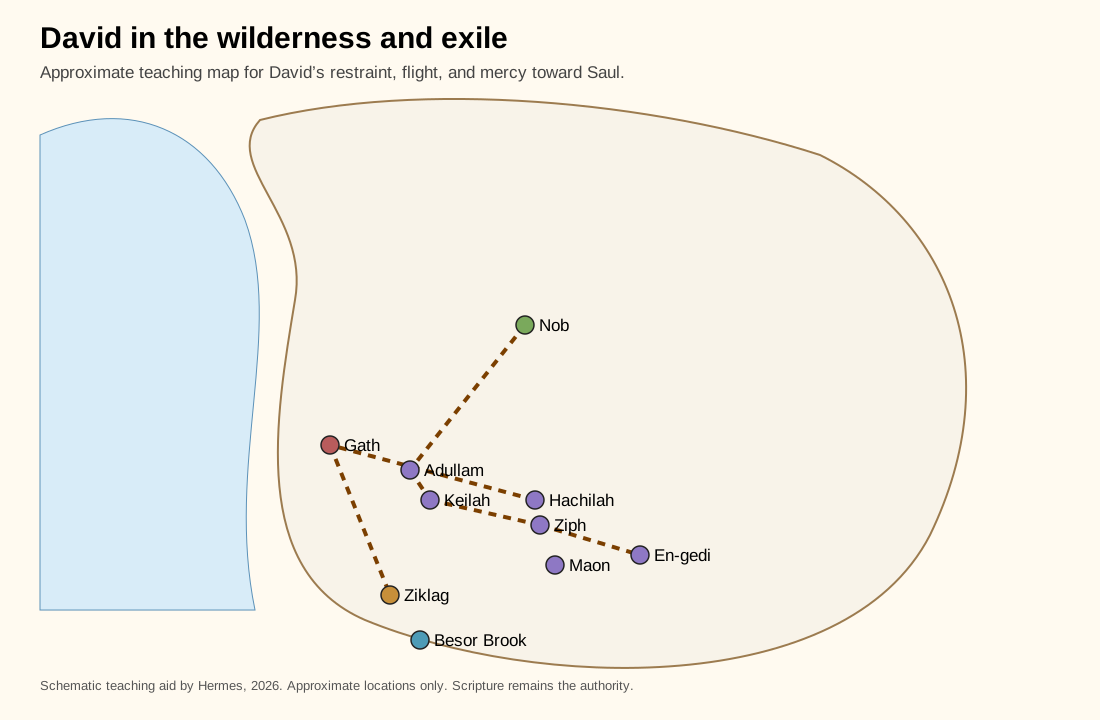 Generated schematic teaching map by Hermes, 2026. Approximate locations and connecting lines illustrate the narrative; they are not a measured reconstruction of David’s route.
| The narrative’s pressure | David’s faithful response | Fulfillment and fruit in Christ |
|---|---|---|
| Fear and danger within Keilah | Inquire, rescue, and leave when threatened | Prayer and protection remain together |
| Friendship amid pursuit | Receive strength in the Lord | Encourage another person toward faithful obedience |
| Escape followed by an enemy within reach | Refuse to turn deliverance into vengeance | The true King possesses power and gives life for enemies |
| False accusation and a ruler’s wrongdoing | Speak truth and entrust judgment to God | Christ’s innocence frees truthful witness from retaliation |
| Tears without established safety | Offer mercy and remain apart | Forgiveness does not purchase trust with exposure to harm |
Spiritual Fruit 🍇
-
Bring fear back into prayer without hiding the danger. David listens when his men are afraid and asks again. Before a pressured decision, distinguish the known facts from what fear has predicted, pray with them honestly, and seek wise counsel. Responsible action can follow prayer without requiring an extraordinary sign.
-
Serve without buying gratitude. Keilah needs rescue, and David acts. Where service has left you disappointed, confess the wish to make another person’s gratitude secure your worth. Continue the good you can do freely, while retaining the boundaries needed for safety and responsible work.
-
Strengthen a friend’s hands in the Lord. Offer a prayer, a faithful word from Scripture, or practical help toward the next obedient step. Resist making promises about a future God has not revealed. Jonathan’s friendship is a gift even though his hoped-for place beside David never comes.
-
Test the opportunity that flatters anger. Before sending the humiliating message, spreading the accusation, or using a person’s weakness against them, remember David’s men in the cave. Ask whether the proposed act obeys Christ or merely feels arranged in your favor. Receive the rebuke of conscience early, and let it change the action.
-
Join mercy to truth and protection. David leaves Saul alive, speaks plainly, and remains apart. Relinquish private revenge without suppressing evidence. Where harm continues, seek qualified help and accountable protection for yourself and others; prayer for the wrongdoer’s repentance need not reopen unsafe access.
The garment lies in David’s hand, and Saul’s life is still his own. God has given David an opening that becomes mercy instead of blood. Lord Jesus Christ, teach my hands to protect, my speech to tell the truth, and my heart to leave vengeance with You. Give me the humility to receive correction and the courage to remain faithful when mercy must keep a distance.
Teaching Notes
Whole-study helps. Linger over the difference between Saul’s claims about God and David’s inquiry, then read the men’s counsel and David’s answer in the cave together. Keep geography brief; the retained map is an illustrative schematic. Preserve the distinction between forgiveness, trust, and access throughout the discussion. The four retained Lesson guides remain near the passages they summarize.
Source cautions. The main Brenton text omits the separate surrender question at 23:12, gives four hundred at 23:13, and places the En-gedi arrival at 24:1. The confirmed Lenten appointment uses NKJV numbering. The cave and Ziphite Psalm titles do not fix an exact episode; Jonathan’s hoped-for office is not a divine promise. Christian authority has no immunity from criticism, reporting, or accountability.
Rescue, Inquiry, and Departure (1 Samuel 23:1-13)
- Ask: How do David’s questions and departure differ from Saul’s claim that God has delivered him?
- Watch for: Narrating Keilah’s surrender as completed, treating the missing verse as merely renumbered, or making the ephod a model for Christian fortune-telling.
Friendship That Strengthens the Hands (1 Samuel 23:14-18)
- Ask: What can a friend do to strengthen someone in God without promising control of the future?
- Watch for: Calling every part of Jonathan’s hope a guaranteed prophecy, or confusing his death with the failure of God’s promise to David.
Betrayal, a Divided Rock, and Refuge (1 Samuel 23:19-24:1)
- Ask: Why does the Lenten sequence of escape followed by mercy challenge the desire to repay harm?
- Watch for: Calling the appointment a Jonah-fast reading, ignoring its NKJV numbering, or making David’s escape a guarantee for every sufferer.
The Enemy Within Reach (1 Samuel 24:2-8)
- Ask: What changes when David accepts that an opportunity was given but refuses his men’s proposed use of it?
- Watch for: Treating their words as a new divine command, the garment as magical, or the anointed office as protection from accountability.
Evidence, Truth, and Judgment Entrusted (1 Samuel 24:9-16)
- Ask: How do the piece of cloth, David’s protest, and his appeal to God hold humility and truth together?
- Watch for: Silencing a truthful report in the name of humility, or using the dead-dog image to demand worthlessness or tolerate humiliation.
Tears, an Oath, and Separate Ways (1 Samuel 24:17-23)
- Ask: What does Saul’s confession establish, and what would require changed conduct over time?
- Watch for: Declaring tears proof of lasting repentance or making unsafe reconciliation the measure of forgiveness.
Sources
Embedded Scripture is from Brenton’s English Septuagint (LXX).
Lancelot C. L. Brenton, The Septuagint Version: Greek and English, 1 Samuel 23-24, printed pp. 387-390 and the Alexandrine appendix’s “Kings I” entries. The main text at 23:11 passes to 13; its note mentions Alexandrine supply, while the appendix’s 1 Samuel entries concern chapters 17-18 and do not provide 23:12. 🔗 Printed edition · 🔗 Chapter 23 · 🔗 Chapter 24.
Alfred Rahlfs, Septuaginta (1935), CCAT/CATSS text of 1 Samuel; Bernard A. Taylor, 1 Reigns, NETS, introduction and pp. 265-266. Used for critical-text comparison, not replacement Scripture. 🔗 Greek text · 🔗 NETS.
Hebrew witness of 1 Samuel 23:11-13, displayed with an English Jewish translation. 🔗 Hebrew comparison. Biblical connections actually discussed include 1 Samuel 15:27-28; 16; 25-26; 28; 31; 2 Samuel 9; Matthew 26:53-54; 1 Peter 2:21-23; and Romans 12:17-21. The New Testament excerpts are from NKJV.
St John Chrysostom, Homilies on Second Corinthians 24.3, direct discussion of David’s truthful defense; Homilies on Acts 17, concluding exhortation, recalling the later spear encounter. Public-domain NPNF translations, identified in the notes below. 🔗 Second Corinthians 24 · 🔗 Acts 17.
The Katameros of the Holy Lent, Saint Mary Coptic Orthodox Church, Ottawa, second edition, 2003, preface and Friday of the Third Week, Matins, pp. 254-260. This checked Coptic service book establishes the appointment; the supporting public reading page agrees. No separate Coptic Reader confirmation is claimed. 🔗 Service book · 🔗 Friday of the third week.
Brenton’s Psalms 53, 56, and 141, their titles and prayers, compared with the Rahlfs-based Greek titles. The usual English Psalm numbers are 54, 57, and 142. 🔗 Ziphite psalm · 🔗 Flight to a cave · 🔗 Prayer in a cave.
Footnotes
-
Brenton, 1 Samuel 23:11-13, printed p. 388 and its notes 🔗 Chapter 23; Rahlfs-based CCAT 🔗 Greek; Taylor, NETS 1 Reigns, p. 265 🔗 NETS. The distinct Hebrew surrender question and six-hundred reading appear at 23:12-13 🔗 Hebrew witness. ↩ ↩2
-
Brenton, LXX Psalms 53:1-3; 56:1-3; 141:1-6 🔗 Ziphite superscription · 🔗 Flight to a cave · 🔗 Prayer in a cave. Rahlfs-based CCAT titles 🔗 Psalms 1-76 · 🔗 Psalms 77-151. ↩ ↩2
-
Taylor, NETS 1 Reigns, pp. 265-266, showing the alternate numbering in parentheses at the chapter seam and throughout chapter 24 🔗 NETS; compare Brenton 🔗 Chapter 24. ↩
-
The Katameros of the Holy Lent, second edition, Lent 1719 AM / 2003 AD, Saint Mary Coptic Orthodox Church, Ottawa; Friday of the Third Week, Matins, printed pp. 254 and 258-260. Preface, pp. XVI-XVII, identifies NKJV. 🔗 Katameros. Corroborating date-resolved page 🔗 CopticChurch.net. ↩
-
Rahlfs-based CCAT, 1 Samuel 15:27-28 and 24:5-6, 12, inspecting the surface garment forms 🔗 Greek; Taylor, NETS, pp. 260 and 265-266 🔗 NETS. ↩
-
St John Chrysostom, Homilies on Acts, Homily 17, concluding exhortation on anger and aid to another person; translated by J. Walker, J. Sheppard, and H. Browne, revised by George B. Stevens, NPNF1, vol. 11 (1889) 🔗 Homily 17. ↩
-
St John Chrysostom, Homilies on Second Corinthians, Homily 24.3, on the reason for truthful self-defense, translated by Talbot W. Chambers, NPNF1, vol. 12 (1889) 🔗 Homily 24. ↩