


Saul once drove mediums from the land. Now he asks his servants to find one. Nothing has changed in God’s commandment; what has changed is the king’s willingness to obey it when obedience offers no immediate relief. His fear before the Philistine army is real, but it becomes desperation without repentance. The chapter asks where we carry our terror when the answer we want does not come. Fear must not choose the altar.
Embedded Scripture is from Brenton’s English Septuagint (LXX).
Lesson guide
- Key phrases: desperation without repentance; forbidden consolation; silence after resisted mercy.
- Emphasize: the sin is not seeking guidance, but seeking it apart from obedience to God.
- Avoid: sensationalizing the occult or making the medium the center of the lesson.
Historical and Scriptural Context
This study uses the familiar English book names. In the Septuagint, 1-2 Samuel and 1-2 Kings form the four books of Kingdoms, so this book is 1 Kingdoms there.
David’s refuge among the Philistines has become a demand to fight against Israel. Saul stands on the other side of that approaching war, bereaved of Samuel and estranged from the prophet’s correction. Chapter 28 begins with David’s danger, then turns to Saul’s forbidden inquiry. Chapters 29 and 30 return to David before chapter 31 narrates Saul’s death. The narrative order binds the two kings together without pretending that their decisions are alike.
The Law forbids divination and questioning the dead in Deuteronomy 18:9-14. It then promises a prophet whom Israel must hear in verses 15-19. God’s people are given a word to receive, not a hidden world to command. Saul’s earlier removal of mediums cannot substitute for his own continuing obedience.
Geographical Significance ⛰️
The Philistines gather at Shunem, called Sonam in the displayed Brenton text; Saul encamps at Gilboa, called Gelbue. Endor, Brenton’s Aendor, belongs to the northern setting of this crisis. Saul goes there by night with two companions. The schematic below helps distinguish these places; it does not establish his exact route or the position of every soldier. His disguise and the time of travel are explicit in the narrative. The secrecy of the king’s errand is more important than an imagined itinerary.
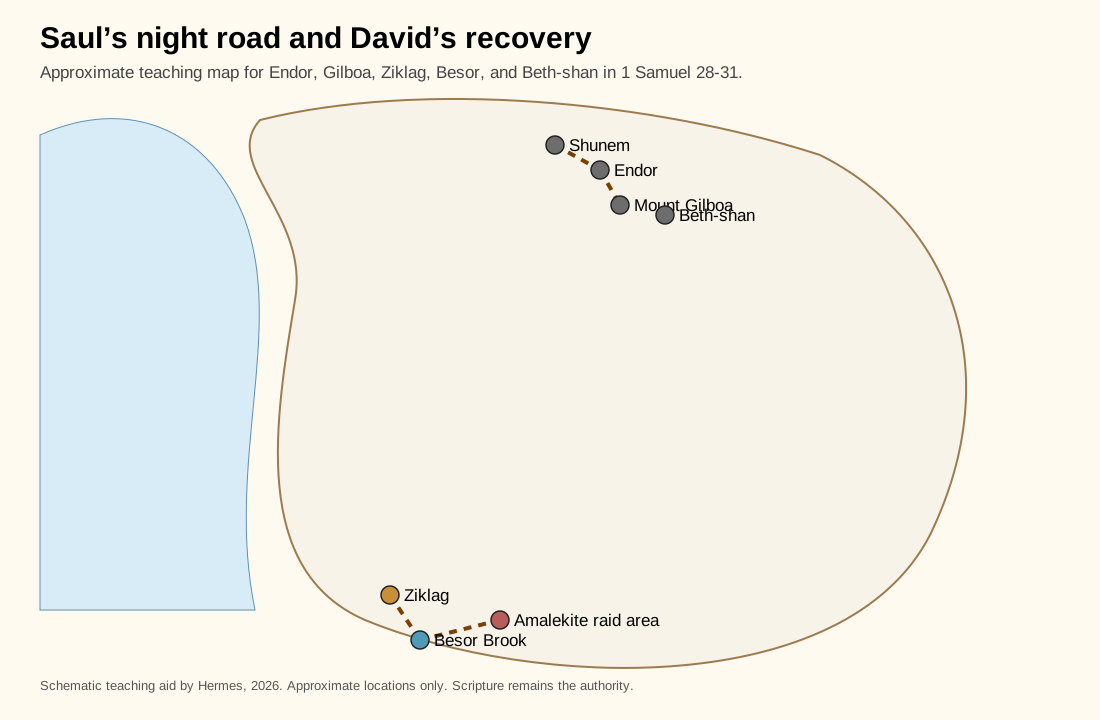 Generated geographical schematic: Endor, Gilboa, and the surrounding narrative setting; not an ancient map.
The Characters 👥
Saul wants guidance while evading the obedience already required of him. His long history of resistance matters here; his distress alone does not explain his sin.
The woman at Endor practices what the Law forbids, fears for her life, and later feeds a weakened man. Condemning her practice must not erase her humanity. The narrator lets us see both the forbidden consultation and her concern for Saul.
Samuel is dead, yet the narrator names him in the encounter. Other canonical witnesses also name his prophetic answer. Ancient Christian interpreters disagreed about how to understand this appearance. Their disagreement deserves attention after Scripture’s own testimony, not in place of it.
David and Anchus, usually called Achish, open the chapter. Achish trusts a servant whose earlier reports have misled him. David’s ambiguous answer leaves the coming crisis unresolved.
Fear when the Lord does not answer (1 Samuel 28:1-6)
- And it came to pass in those days that the Philistines gathered themselves together with their armies to go out to fight with Israel; and Anchus said to David, Know surely, that thou shalt go forth to battle with me, thou, and thy men.
- And David said to Anchus, Thus now thou shalt know what thy servant will do. And Anchus said to David, So will I make thee captain of my body-guard continually.
- And Samuel died, and all Israel lamented for him, and they bury him in his city, in Armathaim. And Saul had removed those who had in them divining spirits, and the wizards, out of the land.
- And the Philistines assemble themselves, and come and encamp in Sonam: and Saul gathers all the men of Israel, and they encamp in Gelbue.
- And Saul saw the camp of the Philistines, and he was alarmed, and his heart was greatly dismayed.
- And Saul enquired of the Lord; and the Lord answered him not by dreams, nor by manifestations, nor by prophets.
David’s words in verses 1-2 sound useful to Achish while avoiding an explicit promise to attack Israel. Achish rewards him with permanent responsibility for his bodyguard. The safety David sought in Gath now carries a demand for allegiance: will the Lord’s anointed fight against the Lord’s people? The text does not tell us what David intends to do. It leaves him trapped between his host’s confidence and his own calling. Protection obtained through deception can grow into an obligation we cannot honestly fulfil.
Saul sees the Philistine army and trembles. Fear itself is not sin. The decisive turn comes when he treats the absence of an answer as permission to seek a forbidden one. Verse 6 belongs within the whole book: Samuel’s commands have been resisted, his rebukes heard without lasting amendment, and the priests at Nob killed at Saul’s order in 22:17-19. Abiathar escaped, and the ephod, the priestly garment associated with inquiry, is with David in 23:6, 9-11. These are grave narrative contrasts. They do not establish that the loss of the priests is the sole cause of every silence named here.
Chronicles supplies the theological verdict on this apparent seeking. Saul asked for information in 28:6, yet 1 Chronicles 10:14 says that he did not seek the Lord. The distinction is visible in what he does next. He seeks relief from the consequence of disobedience while keeping disobedience available as his remedy. Seeking an answer is not the same as seeking the Lord who gives it.
That verdict must never be transferred carelessly to someone enduring unanswered prayer, depression, grief, or spiritual dryness. Saul’s history is told to us. Another person’s heart is not. The faithful may wait in darkness without being rejected by God.
What the Greek text shows
Brenton’s “manifestations” in verse 6 represents the Greek expression “the clear ones”, “dēlois”. NETS preserves that unusual wording and notes that it may refer to explaining devices. The Hebrew-based NKJV reads “Urim”, the priestly means of inquiry. Read the three named channels together: dreams, priestly disclosure, and prophets. None gives Saul the answer he seeks. The Greek wording does not introduce a new occult practice permitted to him.1
Christological and typological reading
Christ is the Word to whom the Father directs us: “Hear Him!” (Matthew 17:5). Saul wants a message without surrender; the Gospel calls us to receive a Person and obey His voice. The Son’s obedience reaches through fear and death. Christian prayer can therefore bring terror honestly before God without making relief the condition of faithfulness. Sometimes the word we most need is the commandment we already know.
Lesson guide
- Key phrases: fear is real; fear must not choose the altar.
- Emphasize: God had not failed to speak to Saul in the book as a whole.
- Avoid: teaching silence as if every unanswered prayer means rejection.
The forbidden night journey (1 Samuel 28:7-14)
- Then Saul said to his servants, Seek for me a woman who has in her a divining spirit, and I will go to her, and enquire of her: and his servants said to him, Behold, there is a woman who has in her a divining spirit at Aendor.
- And Saul disguised himself, and put on other raiment, and he goes, and two men with him, and they come to the woman by night; and he said to her, Divine to me, I pray thee, by the divining spirit within thee, and bring up to me him whom I shall name to thee.
- And the woman said to him, Behold now, thou knowest what Saul has done, how he has cut off those who had in them divining spirits, and the wizards from the land, and why dost thou spread a snare for my life to destroy it?
- And Saul swore to her, and said, As the Lord lives, no injury shall come upon thee on this account.
- And the woman said, Whom shall I bring up to thee? and he said, Bring up to me Samuel.
- And the woman saw Samuel, and cried out with a loud voice: and the woman said to Saul, Why hast thou deceived me? for thou art Saul.
- And the king said to her, Fear not; tell me whom thou hast seen. And the woman said to him, I saw gods ascending out of the earth.
- And he said to her, What didst thou perceive? and she said to him, An upright man ascending out of the earth, and he was clothed with a mantle. And Saul knew that this was Samuel, and he stooped with his face to the earth, and did obeisance to him.
Saul disguises himself, changes his clothing, and goes by night. The king who once enforced the prohibition now seeks protection from being recognised while breaking it. The woman suspects a trap, and he swears by the living Lord that she will suffer no injury. God’s name is used to reassure her about an act God forbids. Religious language can make a choice sound safe while leaving its wrongness untouched.
The woman sees Samuel and cries out. Saul asks her what she sees; the account does not first describe him seeing the figure with his own eyes. Her description leads him to recognise Samuel and bow down. Those details became important in the ancient dispute, but the narrative itself consistently calls the speaker Samuel.
Scripture’s own witnesses
Sirach 46:20 praises Samuel’s prophecy after death: Brenton reads, “And after his death he prophesied, and shewed the king his end”. NETS, at the same verse number, says that he prophesied after falling asleep and raised his voice from the ground. The Rahlfs-based Greek likewise speaks of Samuel prophesying after sleep. This is a canonical witness, not merely a later opinion about Endor.2
The Greek text of 1 Chronicles 10:13 is still more explicit. Brenton includes “and Samuel the prophet answered him”, and NETS also names the prophet’s answer. That clause is present in the Rahlfs-based Greek. Verse 14 immediately condemns Saul’s failure to seek the Lord. Scripture can name Samuel’s answer and condemn the consultation in the same account. A true judgment received in a forbidden place does not make the place holy.3
What the Greek text shows
The repeated term behind Brenton’s “divining spirit” is “engastrimythos”, traditionally rendered “ventriloquist” or “belly-speaker”; NETS uses “ventriloquizing woman” in verse 7. It names the kind of practitioner Saul seeks. The term explains the titles of ancient works about the episode, but its etymology alone cannot decide whether the apparition was Samuel or an imitation.
In verse 14 the Greek says “andra orthion”, a man standing upright. Brenton’s “upright” describes posture, not a declaration of moral innocence. NETS also reads a standing man. The familiar “old man” belongs to the Hebrew-based NKJV, not the displayed Greek form. This distinction matters when reading interpreters who quote a different form of the verse.1
The “mantle” translates a form of “diploïs”, a cloak or double cloak. The same garment word occurs for the little garment Hannah brought Samuel each year as a child in 2:19 and for the garment Saul tore in 15:27. This is a literary echo across Samuel’s life, not evidence that the adult prophet wears the same physical garment his mother made or that Saul once tore. Hannah clothed a child dedicated to God; Saul grasped the prophet’s garment as the kingdom was taken from him. Here the disguised king recognises the prophet by a garment, but still has no obedience to offer him.1
Gems from the Fathers 💎: A real disagreement at Endor
Origen, in his Homily on 1 Kingdoms 28:3-25, §§4-6, argues that Samuel truly appeared. His strongest point is the narrator’s wording: Scripture says that the woman saw Samuel and that Samuel spoke, rather than only reporting her claim. He also argues that the announced judgment exceeds a demon’s knowledge. His reading carries the plain naming of Samuel seriously. His further account of the powers involved remains disputed interpretation, not a warrant for mediums to command holy souls.4
St Eustathius of Antioch answers Origen in On the Belly-Myther against Origen, §§3-5. He denies that demons can summon the souls of the righteous and understands the scene as deceptive appearance. St Gregory of Nyssa, in his Letter concerning the Sorceress to Bishop Theodoxios, likewise reads it as demonic imitation. Gregory uses the fixed gulf in Luke 16 to resist the idea that sorcery can seize a saint at rest with God. These are substantial disagreements about what happened, not different names for one unanimous explanation.45
St Justin Martyr’s Dialogue with Trypho 105 takes Samuel’s appearance as evidence that souls survive death. Justin also draws an inference about the righteous being subject to hostile powers. That inference cannot simply be presented as the Church’s settled doctrine. His chapter ends by directing the dying believer to Christ’s prayer committing His spirit to the Father. The safe Christian response is trust in the Father, not fear that a medium possesses a right over the departed.6
Theodoret of Cyrus, Questions on the Books of Kingdoms, question 63, offers another explanation. Citing the Greek Chronicles clause, he rejects both a medium’s power to raise Samuel and the account of a demon delivering a false prediction. He understands God to have fashioned Samuel’s appearance and delivered the judgment Himself. This is a distinct ancient proposal, not proof that all who name Samuel’s answer mean exactly the same thing. Theodoret is cited here as a historical interpreter, not as a uniquely authoritative Coptic teacher.7
The canonical witnesses should therefore remain in view when weighing the dispute. They give strong grounds for taking Samuel’s prophetic answer seriously. The disputed accounts of its manner must not become a lesson in how to summon the dead. The commandment against necromancy, seeking answers from the dead by forbidden means, remains clear.
Christological and typological reading
Deuteronomy 18:9-14 forbids divination, including questioning the dead; verses 15-19 promise the prophet whom Israel must hear. At the Transfiguration, Moses and Elijah appear with Christ by God’s gift, and the Father’s command directs the disciples to the Son (Matthew 17:1-8). Endor is an attempt to procure an answer; the holy mountain is revelation received from God. The contrast concerns obedience and divine initiative, not the claim that the departed are absent from God’s living communion.
Saul’s disguise also contrasts with Christ’s voluntary humility. The Son veils His glory in the Incarnation to fulfil obedience and save sinners; Saul changes his clothing to evade the responsibility his calling carries. Christ’s hidden glory brings truth into the light, while Saul’s secrecy protects his flight from it.
Hebrews 12:1-2 places the Church among a cloud of witnesses while fixing her eyes on Jesus. Hebrews 12:22-24 names the spirits of the just made perfect and Jesus the Mediator. Revelation 6:9-11 shows the martyrs alive before God and praying for His judgment. These passages illuminate communion in Christ; they do not teach rituals for obtaining secret messages from the dead. The Church commemorates the departed and asks the saints’ intercessions within that communion. She receives life from Christ rather than attempting to control the departed.
The Church’s Voice in Worship ⛪
The Coptic baptismal rite gives fear a different allegiance. In the renunciation, the candidate, or the parent speaking for a child, turns west and rejects Satan, his works, worship, and deception. Turning east, the candidate accepts Christ with His commandments. The printed acceptance begins, “I accept You, O Christ, my God, with all Your Holy commandments”.8 That final phrase matters: belonging to Christ includes hearing and doing what He commands. Saul’s oath invokes the Lord while his errand refuses the Lord’s commandment.
The Coptic Liturgy of St Basil also prays to God for the souls of departed fathers and brethren and for their repose with Abraham, Isaac, and Jacob. Its direction is prayer to the Lord for His servants, not a request that they be brought up to supply hidden knowledge. Commemoration and necromancy differ in whom we trust and what we seek.9
Lesson guide
- Key phrases: the forbidden thing has gone underground; religious language can protect sin.
- Emphasize: secrecy often reveals the conscience already knows.
- Avoid: curiosity-driven discussion of occult details.
Judgment without repentance (1 Samuel 28:15-25)
- And Samuel said, Why hast thou troubled me, that I should come up? And Saul said, I am greatly distressed, and the Philistines war against me, and God has departed from me, and no longer hearkens to me either by the hand of prophets or by dreams: and now I have called thee to tell me what I shall do.
- And Samuel said, Why askest thou me, whereas the Lord has departed from thee, and taken part with thy neighbour?
- And the Lord has done to thee, as the Lord spoke by me; and the Lord will rend thy kingdom out of thy hand, and will give it to thy neighbour David,
- because thou didst not hearken to the voice of the Lord, and didst not execute his fierce anger upon Amalec, therefore the Lord has done this thing to thee this day.
- And the Lord shall deliver Israel with thee into the hands of the Philistines, and to-morrow thou and thy sons with thee shall fall, and the Lord shall deliver the army of Israel into the hands of the Philistines.
- And Saul instantly fell at his full length upon the earth, and was greatly afraid because of the words of Samuel; and there was no longer any strength in him, for he had eaten no bread all that day, and all that night.
- And the woman went in to Saul, and saw that he was greatly disquieted, and said to him, Behold now, thine handmaid has hearkened to thy voice, and I have put my life in my hand, and have heard the words which thou hast spoken to me.
- And now hearken, I pray thee, to the voice of thine handmaid, and I will set before thee a morsel of bread, and eat, and thou shalt be strengthened, for thou wilt be going on thy way.
- But he would not eat; so his servants and the woman constrained him, and he hearkened to their voice, and rose up from the earth, and sat upon a bench.
- And the woman had a fat heifer in the house; and she hasted and slew it; and she took meal and kneaded it, and baked unleavened cakes.
- And she brought the meat before Saul, and before his servants; and they ate, and rose up, and departed that night.
Saul asks Samuel to tell him what he should do. In 10:8 Samuel had promised to make known what Saul should do after the appointed waiting at Gilgal. In 13:8-14 the king waited the stated days, saw his people scattering, then offered the sacrifice before Samuel arrived. The scene at Endor returns to that old refusal to wait obediently. Saul now calls for the prophet from the grave, but the prophet’s answer returns him to the word spoken in life.
Verse 17 repeats the judgment of 15:28: the kingdom is torn from Saul and given to a better neighbour, now named as David. Samuel had already warned in 15:23 that sin is as divination. The comparison becomes painfully concrete when Saul seeks the very practice used to describe his disobedience. Endor reveals the direction in which his resistance has been taking him.
The warning in Luke 16:27-31 clarifies the desire for a more spectacular message. The rich man asks that Lazarus be sent to warn his brothers, but the request is refused. Abraham directs them to Moses and the prophets and says that refusing them will not be cured by someone rising from the dead. No such return occurs in the parable. At Endor, too, a terrifying encounter supplies no escape from the word Saul already resisted. Revelation received without obedience does not heal the will.
What the Greek text shows
Verse 19 in this Brenton text says, “thou and thy sons with thee shall fall”. The Greek has “pesountai”, “they shall fall”, and NETS agrees. The Hebrew-based NKJV instead reads “you and your sons will be with me”. These are different textual forms and must not be blended. The displayed Greek announces their fall; it does not itself specify that Saul and Samuel share the same spiritual condition after death. Gregory’s discussion of “with me” therefore needs its own textual qualification, rather than being treated as an explanation of words absent from this block.1
The repeated language of hearing also sharpens the ending. In verse 18 Saul did not hear the Lord’s voice; in verses 21-23 the woman says that she heard Saul, asks him to hear her, and he finally hears their voice. Verse 23 names the servants as well as the woman. The irony belongs to Saul’s disordered obedience, not to the woman’s humane desire to feed him. In 15:24 Saul had already confessed that fear made him hear the people’s voice. The king still needs to learn which voice governs him.
A table in the night
Saul’s public calling began with an honoured portion at Samuel’s table in 9:22-24. This night finds him eating at the medium’s table after hearing the sentence against his kingship. The woman kills a fat heifer and prepares unleavened cakes. Her food strengthens a man who has eaten nothing; the narrative gives no confession or return to the Lord alongside it. Physical recovery and repentance are different things.
Luke 15:23 supplies a useful contrast, not an institutional type: the father’s fatted calf celebrates a son’s return home. Here there is a substantial meal but no narrated return. Nor should the unleavened bread be made into a secret Eucharistic code. Its immediate place is in the woman’s hurried care for her guests. Her compassion remains compassion even though her house is the setting of Saul’s forbidden consultation.
Gems from the Fathers 💎: Christ goes where fear cannot save us
Origen’s homily, §6, moves from Samuel below the earth to Christ’s descent into Hades, the realm of the dead. He argues that the prophets were there before Christ and proclaimed His coming. This gives his interpretation a Christological horizon, but his particular explanation of Endor and the prophets’ activity must remain distinguished from received doctrine.4
St Cyril of Jerusalem provides a clearer authority for the doctrine itself in Catechetical Lecture 14.19. He names Samuel among the righteous awaiting the Saviour and describes Christ’s victory as their deliverance: “All the Just were ransomed, whom death had swallowed; for it behooved the King whom they had proclaimed, to become the redeemer of His noble heralds.”10 The King saves His heralds. No medium owns them, and the Church’s hope does not depend on access to a hidden technique.
Christological and typological reading
Saul receives a sentence of death and goes out again into the night. Christ willingly enters death and brings life to those it held. His descent is the victory of the crucified Lord, not the success of forbidden consultation. The Coptic Liturgy of St Basil confesses that He descended into Hades through the Cross and rose on the third day.9 This is the Paschal hope with which the Church approaches Bright Saturday; it is a theological connection, not a claim that this chapter is appointed as its reading.
Saul’s meal cannot reconcile him to the Lord. The Eucharist gives communion with the crucified and risen Christ, received in repentance and faith. Treating holy communion as protection while refusing known obedience would repeat the desire for relief without surrender. Christ gives Himself to heal the person, not to make disobedience safe.
Gems from the Fathers 💎: Bring fear into the light early
St John Cassian, Conference 2.10-13, records Abba Moses’ teaching on humility and disclosure of thoughts. This is a thematic witness, not direct commentary on Saul. Concealed thoughts become plans that feel beyond correction. Moses says, “For a wrong thought is enfeebled at the moment that it is discovered”.11 The counsel is to expose the thought to wise discernment before shame gives it a private kingdom.
The same conference protects the wounded person from harsh spiritual treatment. Chapters 12-13 describe a young monk driven toward despair by an elder’s reproaches and helped by Abba Apollos’ gentleness. Cassian does not make age alone a guarantee of wisdom. Bring frightening thoughts to a trustworthy confessor or mature guide who joins truth to mercy. Intrusive thoughts are not the same as chosen acts, and spiritual counsel should never prevent needed medical or psychological care.
The Church’s response to occult involvement is concrete. In Acts 16:16-18 Paul expels a spirit of divination in Christ’s name, even though the enslaved girl’s words sound favourable to the apostles. A truthful-sounding message does not sanctify its source, and the exploited person needs deliverance. In Acts 19:13-20 the attempt to use Jesus’ name as a formula is exposed, while believers confess their deeds and give up their magical books. The opposite of Endor is confession, repentance, prayer, and obedience, not a better technique for hidden power.
Saul’s collapse must be handled with care. The judgment in 1 Chronicles 10:13-14 explains his narrated end; it does not authorise us to pronounce rejection over every frightened or despairing soul. A person in acute distress needs someone to stay with them, immediate help if they cannot remain safe, and appropriate clinical care alongside prayer and pastoral support. Despair is not healed by being shamed for feeling it.
Lesson guide
- Key phrases: unrepented disobedience follows him; bring fear into the light early.
- Emphasize: the opposite of Endor is confession, prayer, and obedience.
- Avoid: joking about Saul, the medium, or despair.
| Element in the text | What it reveals | Light in Christ and the Church |
|---|---|---|
| David promised a place in Achish’s bodyguard | Safety through deception has become a demand for allegiance | Obedience cannot be secured by evading truth |
| Saul seeks an answer after resisting the word | Information without repentance cannot restore communion | The Father directs us to hear His Son |
| Samuel’s prophetic judgment is named in Scripture | A forbidden consultation cannot cancel an earlier command | Revelation is God’s gift, not a technique |
| Saul hears the plea to eat | Bodily strength and repentance are different | Mercy cares for the weak without blessing sin |
| The sentence of death | Human control reaches its limit | Christ descends into death to deliver His people |
Spiritual Fruit 🍇
-
Ask about the obedience already given. Before searching for an extraordinary sign, name the plain duty you have been postponing: telling the truth, ending a dishonest arrangement, forgiving an offence, or returning to prayer. Bring that duty to Christ and take its first concrete step. Saul’s problem was not a shortage of messages.
-
Bring fear into the light early. Tell a trustworthy confessor, priest, or mature Christian what you are afraid might happen and what fear is tempting you to do. Ask for discernment before the secret plan becomes a settled decision. Cassian’s gentle elder matters as much as his call to disclose thoughts.
-
Renounce forbidden consolation and accept Christ’s commandments. If you have sought occult guidance, confess it and stop returning to it. Acts 19 joins confession to a real break with the practice. Receive the Church’s prayer and sacramental life without expecting them to function as charms.
-
Remember the departed in hope, without trying to control them. Bring their names before God, pray for their repose, and seek the saints’ intercessions in Christ. Grief can make any promise of contact feel merciful. The Lord who holds the departed also receives the sorrow of those left behind.
-
Give despairing people mercy and company. Do not apply Saul’s verdict to your own unanswered prayer or another person’s depression. Ask for help when darkness deepens. Staying with a person, helping them obtain urgent care, and accompanying them toward wise pastoral support can be a faithful answer to this chapter.
Lord Jesus Christ, when fear asks for certainty, keep me near Your voice. Let me bring into the light what I have hidden in shame. Remember those I love who have fallen asleep, and teach me to entrust them to Your mercy. You entered death to deliver Your people; hold the frightened heart that cannot yet see the morning.
Teaching Notes
Fear when the Lord does not answer (1 Samuel 28:1-6)
- Ask: What distinguishes asking for an answer from seeking the Lord Himself?
- Watch for: Unanswered prayer is not a general proof of rejection. Nob and the ephod provide context, not a complete mechanism explaining divine silence.
The forbidden night journey (1 Samuel 28:7-14)
- Ask: How can Scripture name Samuel’s answer while condemning Saul’s means of inquiry?
- Watch for: The Greek standing man is not the Hebrew-based old man. Shared garment vocabulary does not identify one physical robe across Samuel’s life. The medium remains a human being.
Judgment without repentance (1 Samuel 28:15-25)
- Ask: Why does the terrifying encounter return Saul to a word he had already heard?
- Watch for: Brenton’s “shall fall” is not the NKJV’s “will be with me”. Luke 16 records a refused request, not an actual return. The meal contrast is interpretation, not a received sacramental type.
General teaching helps
- Begin with David’s trap in verses 1-2. Read Saul’s inquiry in verse 6 beside his history of resisted correction and 1 Chronicles 10:14. Use the geographical schematic to distinguish Shunem, Endor, and Gilboa without claiming an exact route.
- Present Sirach 46:20 and Greek 1 Chronicles 10:13 before the ancient debate. Distinguish Origen, Eustathius, Gregory, Justin, and Theodoret. Read Deuteronomy 18:9-19 and Matthew 17:1-8 together, keeping the Father’s command to hear the Son at the centre. Pair baptismal renunciation with acceptance of Christ and His commandments.
- For the final passage, compare 10:8, 13:8-14, and 15:23-28. Trace hearing in 28:18 and 21-23, including the servants’ voice. Cyril and Coptic worship support Christ’s descent independently of Origen’s disputed reasoning. Acts 16 and 19 give concrete responses to divination and magic.
- Suggested timing: 10 minutes for orientation, 15 for fear and inquiry, 20 for Scripture’s witnesses and the dispute, and 15 for the final meal and spiritual response.
- Linger over “fear must not choose the altar” and the difference between relief and repentance. Compress speculation about the apparition’s mechanics.
- A chapter-specific Coptic lectionary placement has not been verified in the readings consulted. Use Baptism and St Basil’s liturgy as verified worship connections; identify the Bright Saturday connection as theological resonance.
- Spiritual direction requires gentleness and discretion. Cassian 2.13 warns against an elder whose harshness deepens despair. In immediate danger, help the person contact emergency services or urgent clinical support and do not leave them alone.
- Useful terms: necromancy means forbidden inquiry of the dead; Hades means the realm of the dead; an ephod is a priestly garment associated here with inquiry; judicial silence describes this narrated history of resisted correction, not every experience of silence in prayer.
Sources
Embedded Scripture is from Brenton’s English Septuagint (LXX). Brief New Testament wording is from NKJV. Brenton, NETS, and the Hebrew-based NKJV are distinguished where their textual forms differ.
Scripture and Greek editions
- Brenton, 1 Samuel 28, with 2:19; 9:22-24; 10:8; 13:8-14; 15:23-28; 22:17-19; 23:6, 9-11; Deuteronomy 18:9-19; Sirach 46:20; and 1 Chronicles 10:13-14. NETS official book editions: 1 Reigns, pp. 268-269 🔗, 1 Supplements, chapter 10 🔗, Sirach, p. 758 🔗, and Deuteronomy, chapter 18 🔗.
- Rahlfs-based CCAT Greek texts: 1 Samuel 🔗, 1 Chronicles 🔗, Sirach 🔗, Deuteronomy 🔗, and edition provenance 🔗.
- Hebrew-based NKJV comparison: 1 Samuel 28, especially verses 14 and 19 🔗. New Testament passages consulted: Matthew 17:1-8; Luke 15:11-24; 16:27-31; 23:46; Acts 16:16-18; 19:13-20; Hebrews 12:1-2, 22-24; Revelation 6:9-11.
Ancient Christian primary texts
- Origen, Homily on 1 Kingdoms 28:3-25, §§4-6, and St Eustathius of Antioch, On the Belly-Myther against Origen, §§3-5. Primary works in modern Polish translation, E-Patrologos 2/2 (2016), especially pp. 54-57 and 64-67: texts 🔗. The Polish primary translations are used in paraphrase.
- St Gregory of Nyssa, Letter concerning the Sorceress to Bishop Theodoxios, primary letter, pp. 5-7 of the English PDF, especially GNO III/2, pp. 102-106: text 🔗. The letter’s demonic interpretation, rather than the introduction’s inconsistent summary, controls the account here.
- St Justin Martyr, Dialogue with Trypho 105: text 🔗. Theodoret of Cyrus, Questions on the Books of Kingdoms, question 63, PG 80.589-592: Greek and English text 🔗.
- St Cyril of Jerusalem, Catechetical Lecture 14.19: text 🔗. St John Cassian, Conference 2.10-13, the conference with Abba Moses: text 🔗.
Coptic worship primary sources
The Sacrament of Baptism: Order and Explanation, renouncing Satan and accepting Christ, PDF pp. 19-20, published through the Coptic Orthodox Diocese of Los Angeles: rite 🔗.
The Holy Liturgy of St Basil the Great, St Mary and St Mark Coptic Centre, Diocese of the Midlands, the Litany of the Departed and the account of salvation in the anaphora: service book 🔗. The chapter’s exact Coptic reading appointment remains unverified; worship connections are distinguished from lectionary assignments.
Footnotes
-
Rahlfs-based Greek, 1 Samuel 2:19; 15:27; 28:6-8, 14, 19, 21-23: CCAT text 🔗. English cross-check: NETS, 1 Reigns 🔗. Hebrew-based comparison: NKJV, 1 Samuel 28 🔗. ↩ ↩2 ↩3 ↩4
-
Sirach 46:20 in Brenton and NETS; NETS, p. 758 🔗; Rahlfs-based CCAT Greek 🔗. ↩
-
1 Chronicles 10:13-14; NETS, 1 Supplements 🔗; Rahlfs-based CCAT Greek 🔗. ↩
-
Origen, Homily on 1 Kingdoms 28:3-25, §§4-6, Polish translation by Stanisław Kalinkowski, E-Patrologos 2/2 (2016), pp. 54-57; St Eustathius, On the Belly-Myther against Origen, §§3-5, pp. 64-67: primary translations 🔗. ↩ ↩2 ↩3
-
St Gregory of Nyssa, Letter concerning the Sorceress to Bishop Theodoxios, GNO III/2, pp. 102-106, English PDF pp. 5-7: primary letter 🔗. ↩
-
St Justin Martyr, Dialogue with Trypho 105, ANF English translation: primary text 🔗. ↩
-
Theodoret of Cyrus, Questions on the Books of Kingdoms, question 63, PG 80.589-592, Greek and English: primary text 🔗. ↩
-
The Sacrament of Baptism: Order and Explanation, “Renouncing Satan” and “Accepting Christ”, PDF pp. 19-20: printed rite 🔗. ↩
-
The Holy Liturgy of St Basil the Great, St Mary and St Mark Coptic Centre, Diocese of the Midlands, Litany of the Departed and anaphora’s account of salvation: service book 🔗. ↩ ↩2
-
St Cyril of Jerusalem, Catechetical Lecture 14.19, translated by Edwin Hamilton Gifford, NPNF, second series, vol. 7: primary text 🔗. ↩
-
St John Cassian, Conference 2.10, with the complementary pastoral warning in 2.12-13, translated by C. S. Gibson, NPNF, second series, vol. 11: primary text 🔗. ↩