


Content note: This passage includes the killing of priests and families, including children. The discussion is non-graphic. Readers affected by violence may pause, seek a trusted priest or qualified helper, and take immediate safety measures without waiting for a religious discussion to conclude.
Bread is given to preserve life; a king later calls that gift treason and destroys the people who gave it. David’s flight through these chapters therefore asks more than whether he escapes. What becomes of the people drawn into his danger? The story keeps priestly mercy, Saul’s chosen violence, David’s compromised speech, and his explicit confession in view together. Its final word is a promise to seek safety for another life alongside his own.
Lesson Guide
- Key phrases: mercy and holy bread; fear has consequences; Saul destroys what he should protect.
- Emphasize: Jesus Himself interprets David and the holy bread.
- Avoid: flattening Nob into either David’s fault alone or Saul’s madness alone.
Historical and Scriptural Context
This study uses the familiar English book names. In the Septuagint, 1-2 Samuel and 1-2 Kings form the four books of Kingdoms, so this book is 1 Kingdoms there.
These chapters follow David and Jonathan’s farewell. Brenton’s 21:1 completes that departure, then David comes to the priestly city. The full displayed chapter 21 has sixteen verses: its opening corresponds to the end of Hebrew-based 20:42, and its 21:2-16 correspond broadly to Hebrew-based 21:1-15. Gospel references retain their separate Gospel numbering.
The displayed priest is Abimelech, at Nomba, commonly called Ahimelech at Nob in Hebrew-based English Bibles. Doec is called the Syrian and tends Saul’s mules. Those readings govern this guide; familiar alternate names and details are labeled rather than silently substituted.
Geographical Significance ⛰️
David passes from Nomba to Geth, then to the cave of Odollam, commonly called Gath and Adullam. He arranges shelter for his parents in Moab before Gad directs him back into Juda. The text names Saric as a city. It does not here say that he entered the forest of Hereth, the Hebrew-based reading familiar from other translations.
Iconography Connection 🖼️
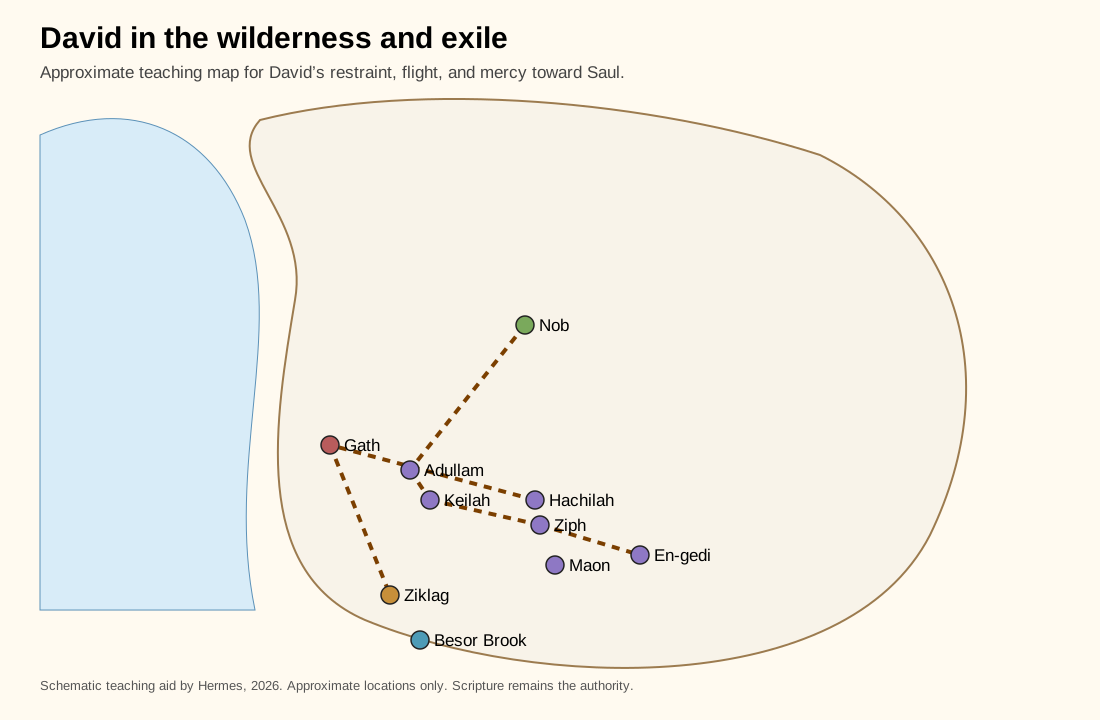 Approximate teaching schematic of David’s wider wilderness and exile setting; not an archaeological identification or a measured route for these chapters.
Holy bread for a hungry fugitive (1 Samuel 21:1-7)
- And David arose and departed, and Jonathan went into the city.
- And David comes to Nomba to Abimelech the priest: and Abimelech was amazed at meeting him, and said to him, Why art thou alone, and nobody with thee?
- And David said to the priest, The king gave me a command to-day, and said to me, Let no one know the matter on which I send thee, and concerning which I have charged thee: and I have charged my servants to be in the place that is called, The faithfulness of God, phellani maemoni.
- And now if there are under thy hand five loaves, give into my hand what is ready.
- And the priest answered David, and said, There are no common loaves under my hand, for I have none but holy loaves: if the young men have been kept at least from women, then they shall eat them.
- And David answered the priest, and said to him, Yea, we have been kept from women for three days: when I came forth for the journey all the young men were purified; but this expedition is unclean, wherefore it shall be sanctified this day because of my weapons.
- So Abimelech the priest gave him the shewbread; for there were no loaves there, but only the presence loaves which had been removed from the presence of the Lord, in order that hot bread should be set on, on the day on which he took them.
The farewell becomes flight. Abimelech is startled to see David alone, and David explains his arrival as secret royal business. That explanation hides the actual danger from the priest. His need is real, but the words by which he seeks help are not made true by the need.
The priest distinguishes common bread from holy bread and asks about the young men’s purity. He gives the loaves removed from the Lord’s presence when fresh bread is set out. “Shewbread” and “presence loaves” name consecrated provision associated with worship, not scraps considered worthless. The priest’s attention to purity and his act of feeding belong to the same scene. Neither the bread nor hungry life is treated casually.
David’s reply about the expedition, sanctification, and weapons is difficult in Brenton, and NETS also preserves a difficult Greek account of a profane journey being consecrated through his implements. We should not turn this into a confident rule that weapons sanctify people or that any urgent purpose cancels holy boundaries.1
Christ explicitly returns to this event in Matthew 12:1-8, Mark 2:23-28, and Luke 6:1-5. His disciples are hungry and accused over plucking grain on the Sabbath. He recalls David and the bread reserved for priests, then reveals the authority of the Son of Man over the Sabbath. In Matthew He also names the One greater than the temple and cites Hosea’s call for mercy. The Lord draws His argument from Israel’s own Scriptures; a Christian reading must not caricature Jewish worship as loveless or imagine that Christian institutions are immune to the same misuse of rules.
Hosea 6:4-6 rebukes fleeting loyalty and contrasts knowledge of God and mercy with sacrifice severed from faithful life. Christ’s citation therefore calls for the heart of obedience, not contempt for sacrifice. Mercy reveals the purpose of holiness: God’s gifts serve communion with Him and the preservation of life. This episode itself is not the institution of the Eucharist, though it prepares Christian reverence for holy provision that feeds rather than abandons the needy.
Gems from the Fathers 💎: The Lord of the temple
Saint John Chrysostom, in Homily XXXIX on Matthew, sections 1-3, follows Christ’s argument from David’s need to priestly service and Christ’s own authority. He stresses both the priest’s role in giving the bread and the greater dignity of the Lord who is present: “For the Lord of the temple Himself is here: the truth, not the type.”2 This is more than a convenient exception to a rule. The One to whom temple worship points is defending His hungry disciples.
Chrysostom also proposes that the priest in Mark and the Samuel narrative had two names. That is his harmonizing explanation, not an established identity demonstrated by these passages. Mark 2:26 says “in the days of Abiathar the high priest”; the displayed Samuel narrative names Abimelech, whose son Abiathar escapes in chapter 22. The difference should be acknowledged honestly rather than resolved with invented certainty.
A watcher and a remembered sword (1 Samuel 21:8-10)
- And there was there on that day one of Saul’s servants detained before the Lord, and his name was Doec the Syrian, tending the mules of Saul.
- And David said to Abimelech, See if there is here under thy hand spear or sword, for I have not brought in my hand my sword or my weapons, for the word of the king was urgent.
- And the priest said, Behold the sword of Goliath the Philistine, whom thou smotest in the valley of Ela; and it is wrapt in a cloth: if thou wilt take it, take it for thyself, for there is no other except it here. And David said, Behold, there is none like it; give it me.
The narrator names Doec before David asks for a weapon. His presence will matter when Saul demands information. Brenton’s Syrian mule-keeper agrees here with the Rahlfs-based Greek and NETS. The Hebrew-based account calls Doeg an Edomite and chief of Saul’s shepherds. These are alternate witnesses; his wrongdoing cannot be turned into a judgment on Syrians, Edomites, or any people.1
The text says that he was detained before the Lord but does not give a certain motive for his presence. It would be speculation to supply a hidden plan at this point. Later his report and his obedience to Saul’s murderous command will show how information gathered near holy things can become an instrument of violence.
David repeats the claim of urgent royal business and receives Goliath’s sword. The weapon recalls deliverance in the valley of Ela, but David is now a fugitive asking for provisions. A remembered victory cannot substitute for truthful dependence on God in the present. The sword is available; the narrative does not say that its possession makes the next refuge safe.
At Geth, fame becomes danger (1 Samuel 21:11-16)
- And he gave it him; and David arose, and fled in that day from the presence of Saul: and David came to Anchus king of Geth.
- And the servants of Anchus said to him, Is not this David the king of the land? Did not the dancing women begin the song to him, saying, Saul has smitten his thousands, and David his ten thousands?
- And David laid up the words in his heart, and was greatly afraid of Anchus king of Geth.
- And he changed his appearance before him, and feigned himself a false character in that day; and drummed upon the doors of the city, and used extravagant gestures with his hands, and fell against the doors of the gate, and his spittle ran down upon his beard.
- And Anchus said to his servants, Lo! ye see the man is mad: why have ye brought him in to me?
- Am I in want of madmen, that ye have brought him in to me to play the madman? he shall not come into the house.
David flees Saul but is recognized at the court of Anchus, commonly called Achish. The song that once celebrated victory now identifies him in enemy territory. Even the servants call him “the king of the land.” His public reputation has arrived before a secure kingship, and he is greatly afraid.
David changes his behavior and puts on an act. The story describes gestures and the ruler’s dismissive response, not a modern psychiatric evaluation. NETS uses different medical-sounding English for the Greek wording; neither translation licenses ridicule of people with mental-health or neurological conditions. David’s fearful performance is a narrated strategy, not a claim that illness is a disguise or that people who live with illness are deceitful.
God’s preservation does not require David to appear composed in every scene. His fear can be understood without canonizing all his tactics. In prayer we may bring terror and humiliation before the Lord before we know how to speak with courage.
Psalm 34 (LXX Psalm 33) has a title about changing his countenance before Abimelech. That title’s royal name differs from Anchus in this narrative; it must not be confused with the priest Abimelech who gave bread. Psalm 56 (LXX Psalm 55) explicitly remembers the Philistines catching David in Geth. The psalms turn the endangered person’s attention toward God’s mercy, the discipline of truthful speech, and His care for the lowly.3
Gems from the Fathers 💎: Humility and the holy gifts
Saint Augustine’s exposition of Psalm 34, numbered Psalm 33 in the Latin and Greek tradition, reads David’s seeming madness figuratively in relation to Christ’s humility, Cross, and Eucharistic gift. In section 1 he interprets wording in his biblical witness about being carried in one’s own hands as Christ holding His sacramental Body: “and in a manner carried Himself, when He said, This is My Body.”4 That wording is not a line of the Brenton passage displayed above. Augustine is giving a spiritual reading of his witness, not a historical explanation of David’s disguise.
His reading helps bring the Christian reader from humiliation to Christ’s freely offered humility. At the same time, it must not erase the story’s human danger, imply that Christ deceives, or turn the massacre that follows into an allegorical detail. His broad interpretation contains claims about Israel and the nations that are not needed here; the present use is the carefully limited Christological and Eucharistic reflection.
Lesson Guide
- Key phrases: mercy reveals the purpose of holiness; the anointed fugitive is not sanitized.
- Emphasize: Jesus interprets this episode.
- Avoid: using the passage to dismiss discipline or sacred boundaries casually.
Refuge gathers the burdened (1 Samuel 22:1-5)
- And David departed thence, and escaped; and he comes to the cave of Odollam, and his brethren hear, and the house of his father, and they go down to him there.
- And there gathered to him every one that was in distress, and every one that was in debt, and every one that was troubled in mind; and he was a leader over them, and there were with him about four hundred men.
- And David departed thence to Massephath of Moab, and said to the king of Moab, Let, I pray thee, my father and my mother be with thee, until I know what God will do to me.
- And he persuaded the king of Moab, and they dwelt with him continually, while David was in the hold.
- And Gad the prophet said to David, Dwell not in the hold: go, and thou shalt enter the land of Juda. So David went, and came and dwelt in the city of Saric.
The cave gathers David’s family and people who are distressed, indebted, or troubled in mind. Brenton’s last phrase corresponds to NETS’s people troubled in soul. Their burdens describe real vulnerability; they are not proof that every member is virtuous or a ready-made portrait of perfected church life. Leadership begins with responsibility toward people who need shelter, not with recruiting their pain for personal ambition.
David also asks the king of Moab to receive his parents until he knows what God will do. That sentence joins practical care with acknowledged uncertainty. Ruth 4:13-22 places the Moabite Ruth in David’s ancestry, so a family connection with Moab is plausible background. These verses do not state it as his motive or reveal a kinship agreement with the king. The stated concern is his parents’ safety.5
Gad directs David back into Juda, and David obeys, settling in the city of Saric. Both the Rahlfs-based Greek and NETS retain a city here. The guide follows that reading without pretending to identify its exact location.1
Christ’s call to those who labor and are heavy laden in Matthew 11:28-30 deepens the Christian reading of this refuge. The greater King gives rest for souls and teaches gentleness. A church claiming to shelter the distressed should therefore offer real care: food, counsel, practical help with debt, trustworthy safeguarding, and access to appropriate medical support. Gathering wounded people is no excuse to control them. The Church’s safety must be practiced, not merely asserted.
The court is asked to choose advantage over truth (1 Samuel 22:6-10)
- And Saul heard that David was discovered, and his men with him: now Saul dwelt in the hill below the field that is in Rama, and his spear was in his hand, and all his servants stood near him.
- And Saul said to his servants that stood by him, Hear now, ye sons of Benjamin, will the son of Jessæ indeed give all of you fields and vineyards, and will he make you all captains of hundreds and captains of thousands?
- that ye are all conspiring against me, and there is no one that informs me, whereas my son has made a covenant with the son of Jessæ, and there is no one of you that is sorry for me, or informs me that my son has stirred up my servant against me for an enemy, as it is this day?
- And Doec the Syrian who was over the mules of Saul answered and said, I saw the son of Jessæ as he came to Nomba to Abimelech son of Achitob the priest.
- And the priest enquired of God for him, and gave him provisions, and gave him the sword of Goliath the Philistine.
Saul is on the hill below the field in Rama, with his spear in hand. The displayed Brenton passage, supported by the Rahlfs Greek and NETS, does not put him under a tree. The spear links this court to the attacks on David and Jonathan. Royal authority is once again assembled around a weapon.1
His question about fields, vineyards, and military offices appeals to the servants’ expected advantage. It recalls the warning in 1 Samuel 8:11-18 that a king will take fields and vineyards and organize people for his own service. Here Saul tests allegiance by what the court might gain rather than by whether David has done wrong.6
Saul calls covenant friendship conspiracy and complains that no one feels sorry for him. He interprets protection of David as hostility to himself. These are chosen accusations in the narrative, not a diagnosis that explains or excuses the coming atrocity. Mental-health conditions do not automatically imply sin or dangerousness, and spiritual wrongdoing must not become a label for everyone who experiences distress.
Doec reports the bread, the sword, and inquiry of God. Much of the information concerns real priestly help; its delivery within Saul’s accusations turns help into supposed treason. Truthful reporting for safeguarding is very different from carrying information to a violent ruler. The ethical question is what the report actually serves and whom it endangers. The story does not establish a personal promotion as Doec’s proven motive.
The priest answers, and the king commands murder (1 Samuel 22:11-19)
- And the king sent to call Abimelech son of Achitob and all his father’s sons, the priests that were in Nomba; and they all came to the king.
- And Saul said, Hear now, thou son of Achitob. And he said, Lo! I am here, speak, my lord.
- And Saul said to him, Why have thou and the son of Jessæ conspired against me, that thou shouldest give him bread and a sword, and shouldest enquire of God for him, to raise him up against me as an enemy, as he is this day?
- And he answered the king, and said, And who is there among all thy servants faithful as David, and he is a son-in-law of the king, and he is executor of all thy commands, and is honourable in thy house?
- Have I begun to-day to enquire of God for him? by no means: let not the king bring a charge against his servant, and against the whole of my father’s house; for thy servant knew not in all these matters anything great or small.
- And king Saul said, Thou shalt surely die, Abimelech, thou, and all thy father’s house.
- And the king said to the footmen that attended on him, Draw nigh and slay the priests of the Lord, because their hand is with David, and because they knew that he fled, and they did not inform me. But the servants of the king would not lift their hands to fall upon the priests of the Lord.
- And the king said to Doec, Turn thou, and fall upon the priests: and Doec the Syrian turned, and slew the priests of the Lord in that day, three hundred and five men, all wearing an ephod.
- And he smote Nomba the city of the priests with the edge of the sword, both man and woman, infant and suckling, and calf, and ox, and sheep.
Abimelech answers from what he knows of David: faithful service, marriage into Saul’s house, royal commissions, and honor at court. His defense fits David’s cover story and Saul’s earlier treatment of him. He denies knowing the hidden conflict and asks that the king not charge his whole household. Saul answers with a death sentence rather than a refutation.
The servants refuse to raise their hands against the priests of the Lord. Their refusal shows that a royal command does not remove moral responsibility. Saul then turns to Doec, who carries out the killing. Brenton gives “three hundred and five” priests, as do the Rahlfs-based Greek and NETS, whereas Hebrew-based versions give eighty-five. The number is an edition difference, not a detail to silently correct or make into spiritual arithmetic.1
The violence extends to the city and its families, including children. The narrator reports Saul’s order and Doec’s action; no divine command authorizes this massacre. The priests’ mercy did not make them guilty, and their deaths do not prove that God rejected their service. Neither a victim’s inability to escape nor a survivor’s escape measures spiritual worth. Those harmed by violence should be met with care, not asked to find the hidden fault that supposedly caused it.
Psalm 52 (LXX Psalm 51) remembers Doec’s report and condemns destructive speech and trust in power and wealth. Its title calls him Idumean, corresponding to Edomite, while the displayed 1 Samuel text calls him Syrian. The difference remains visible even within Brenton’s Bible; the psalm’s title must not be used to rewrite the narrative.7
Nob also brings to mind the killing of children under Herod in Matthew 2:16-18. This is a narrative resemblance between rulers who injure innocent life, not a one-to-one prediction of that Gospel event. Christian typology should sharpen compassion for the victims, never make their suffering a necessary spectacle.
Confession becomes shared safety (1 Samuel 22:20-23)
- And one son of Abimelech son of Achitob escapes, and his name was Abiathar, and he fled after David.
- And Abiathar told David that Saul had slain all the priests of the Lord.
- And David said to Abiathar, I knew it in that day, that Doec the Syrian would surely tell Saul: I am guilty of the death of the house of thy father.
- Dwell with me; fear not, for wherever I shall seek a place of safety for my life, I will also seek a place for thy life, for thou art safely guarded while with me.
Abiathar escapes and tells David what happened. David does not answer with a defense of his own reputation. He admits that he knew Doec would report to Saul, then says explicitly, “I am guilty of the death of the house of thy father.” That is stronger than merely regretting an accidental association. The displayed text makes his acknowledgment part of the story’s truth.
Saul ordered and Doec committed the murder. Their guilt remains theirs. David’s confession recognizes responsibility for his own knowingly hazardous conduct and concealment; it does not transfer the murderers’ agency to him or to the priests. Readers harmed by another’s violence must not be compelled to imitate this confession of guilt. Its proper application concerns our own choices, not assigning responsibility to victims for an abuser’s crime.
The next words make his admission practical: he will seek a place of safety for Abiathar whenever he seeks one for himself. Repentance looks beyond the relief of having confessed to the continuing needs of the person affected. For us that may mean truthful disclosure, appropriate restitution, cooperation with safeguarding, and durable support. “Fear not” is accompanied by a commitment to protection, not by a demand that the survivor stop feeling fear.
Abiathar’s survival also preserves priestly witness amid the catastrophe. In the following chapter he brings the ephod, the priestly garment associated there with inquiry of the Lord, and David seeks God’s counsel. Saul has slain those who ministered before God; David is being taught to receive guidance rather than manufacture his own certainty. The survivor is a person to shelter and hear, not merely a useful religious resource.8
The cave titles of Psalm 57 (LXX Psalm 56) and Psalm 142 (LXX Psalm 141) give words for this wider fugitive life. They do not identify a particular night at Odollam. Their cries for mercy and refuge can accompany our prayer after danger, alongside honest confession where it is ours to make and care where another has been harmed.9
Lesson Guide
- Key phrases: the cave gathers the distressed; paranoia kills priests; responsibility without false guilt.
- Emphasize: Saul and Doeg are guilty, but David still reflects seriously.
- Avoid: blaming victims or excusing Saul through mental decline.
What the passage reveals The faithful response Christian fruit The priest gives holy bread under need Hold reverence and mercy together Receive Christ’s authority without abandoning the hungry The fugitive is afraid and the cave gathers burdened people Seek shelter and offer practical care Make refuge safe for real people, not only a religious image Saul calls help treason and commands murder Refuse authority’s demand to harm Protect innocent life and resist destructive reporting David names guilt and receives Abiathar Confess one’s own choices and share safety Join repentance to restitution and continuing protection
Spiritual Fruit 🍇
- Join reverence to feeding. Keep a fast or prayer rule with attention to the person beside you who lacks necessities. Arrange one concrete act of food or financial assistance; devotion that overlooks such need has missed the mercy Christ teaches.
- Speak truthfully about your own choices. David admits more than unfortunate proximity. Where your concealment or decisions have exposed someone to harm, seek honest confession and appropriate repair without taking away the perpetrator’s responsibility.
- Refuse destructive obedience. Before passing on sensitive information, ask whether the recipient will protect or endanger the person concerned. Bring safeguarding concerns to appropriate trustworthy channels, not to someone using power to punish dissent.
- Make refuge real. Offer the distressed practical help and a voice in decisions affecting them. Abiathar receives a promise of shared safety; the parish’s welcome should likewise be joined to reliable protection, material care, and patient listening.
Lord, receive the fear that makes me hide the truth and teach me to seek Your counsel. Feed the hungry without making me careless before holy things. Keep my hands from harmful obedience and my tongue from destructive reporting. Where I have done wrong, give me courage to confess and repair; where another has been harmed, make my care dependable. Gather the distressed into Your mercy, and make our life together a place of safety.
Teaching Notes
Whole-study care: Begin with the content note and avoid graphic elaboration. The Lesson guide’s phrase about “paranoia” describes Saul’s destructive suspicion, not a clinical diagnosis or a judgment on people with mental illness. Preserve the distinctions between the perpetrators’ crime, David’s confession, and the victims’ innocence. The schematic concerns David’s wider exile and does not establish an exact route or city identification.
1 Samuel 21:1-7
- Ask: How do the priest’s attention to holy bread and Christ’s defense of the hungry belong together?
- Watch for: Caricaturing Israel’s worship or treating emergency mercy as contempt for sacred boundaries.
1 Samuel 21:8-10
- Ask: Why does the narrator place Doec in the scene before mentioning the sword?
- Watch for: Importing the Hebrew shepherd detail or treating his ethnic designation as a moral explanation.
1 Samuel 21:11-16
- Ask: What happens when David’s fame reaches Geth before he has safety there?
- Watch for: Mocking illness or making Augustine’s figurative reading the historical meaning of every gesture.
1 Samuel 22:1-5
- Ask: How does David’s care for his parents join practical action to uncertainty before God?
- Watch for: Inventing a Moabite political agreement or turning the cave into an idealized Church without safeguarding.
1 Samuel 22:6-10
- Ask: How do fields, vineyards, and offices shape Saul’s appeal to the court?
- Watch for: Diagnosing Saul clinically or equating every report of wrongdoing with Doec’s destructive report.
1 Samuel 22:11-19
- Ask: What does the servants’ refusal show about responsibility under authority?
- Watch for: Blaming the priestly families or treating the massacre as a divine command.
1 Samuel 22:20-23
- Ask: How does David’s confession lead directly to a promise of shared safety?
- Watch for: Weakening the confession or compelling victims to assume an abuser’s guilt.
Sources
Embedded Scripture is from Brenton’s English Septuagint (LXX).
Brenton, 1 Samuel: 🔗 chapter 21, 🔗 chapter 22. The full ranges are 21:1-16 and 22:1-23. Brenton’s chapter boundary and wording are retained.
Rahlfs-based Greek and Bernard A. Taylor’s NETS 1 Reigns: 🔗 Greek text, 🔗 NETS translation. They corroborate the principal Greek details discussed here but are not identical English editions.
Gospel references are to NKJV: Matthew 12:1-8; Mark 2:23-28; Luke 6:1-5; Matthew 11:28-30; Matthew 2:16-18. No exact Coptic appointment of these chapters or specific distribution use of Psalm 34 is asserted.
Hebrew-based comparison, World English Bible, 1 Samuel 21:1,7; 22:5-6,18: 🔗 chapter 21, 🔗 chapter 22.
Brenton, Hosea 6:4-6, on fleeting loyalty, mercy, and knowledge of God: 🔗 Hosea 6.
Footnotes
-
Rahlfs-based Greek, 1 Samuel 21:1-16; 22:5-6,9,18-23, compared with Taylor, NETS, the corresponding verses: 🔗 Greek text, 🔗 NETS 1 Reigns. ↩ ↩2 ↩3 ↩4 ↩5
-
Saint John Chrysostom, Homilies on Matthew, Homily XXXIX, sections 1-3, NPNF First Series, volume 10, translated by George Prevost, revised by M. B. Riddle. Section 2 contains the quotation; section 1 contains the proposed two-name explanation: 🔗 homily on Matthew 12. ↩
-
Brenton, Psalm 33, title and counsel on speech; Psalm 55, title concerning Geth, corresponding to Hebrew-based Psalms 34 and 56: 🔗 Psalm 33, 🔗 Psalm 55. ↩
-
Saint Augustine, Exposition on Psalm 34 (LXX/Latin Psalm 33), sections 1-3, NPNF First Series, volume 8, translated by J. E. Tweed. The quotation is in section 1: 🔗 exposition of the title and Christ’s humility. ↩
-
Brenton, Ruth 4:13-22, on Ruth and David’s ancestry: 🔗 Ruth 4. ↩
-
Brenton, 1 Samuel 8:11-18, particularly fields and vineyards in verse 14: 🔗 warning about kingship. ↩
-
Brenton, Psalm 51, title and condemnation of destructive speech and trust in wealth, corresponding to Hebrew-based Psalm 52: 🔗 Psalm 51. ↩
-
Brenton, 1 Samuel 23:6,9-12, on Abiathar’s ephod and David’s inquiry: 🔗 chapter 23. ↩
-
Brenton, Psalms 56 and 141, their titles and prayers, corresponding to Hebrew-based Psalms 57 and 142: 🔗 Psalm 56, 🔗 Psalm 141. ↩