


1 Samuel begins with a barren woman pouring out her soul before God and a priestly house rotting from within. That contrast is the spiritual doorway into the whole book. Hannah is powerless in public but mighty in prayer; Eli’s sons are powerful in the sanctuary but empty before God. The Lord receives the tears of a faithful woman, raises a child who will listen, and sends judgment against those who misuse His sanctuary.
The passage teaches that prayer is not escape from history. Prayer is where God begins to heal history. Hannah’s womb, Samuel’s dedication, and the judgment on Eli’s house all prepare for the faithful Priest and true Anointed One, Christ.
Lesson Guide
- Key phrases: prayer before kingship; power near the altar can still be godless; the child who listens is raised in a house that no longer hears.
- Emphasize: Hannah is not a sentimental figure. She is a teacher of deep prayer.
- Avoid: using the passage to shame infertility, idealize suffering, or attack clergy broadly.
Historical and Scriptural Context
This study uses the familiar English book names. In the Septuagint, 1-2 Samuel and 1-2 Kings form the four books of Kingdoms, so this book is 1 Kingdoms there.
Where in Scripture
These chapters stand at the hinge between Judges and monarchy. Judges ended with Israel’s disorder. Ruth answered that darkness with hidden covenant mercy in Bethlehem. 1 Samuel now opens in Shiloh, where the sanctuary still stands but spiritual discernment is fading. The book is preparing the rise of Samuel, the collapse of Eli’s house, the failed kingship of Saul, and the hidden anointing of David.
The sequence matters. Before Israel asks for a king, Scripture shows us corrupt priesthood and faithful prayer. The deepest crisis is not administrative. It is spiritual. The people need more than political structure; they need a word from God, holy worship, and leaders whose hearts fear Him.
Where in history
The setting is the late period of the judges. Shiloh is the sanctuary center, and Eli serves as priest. Pilgrimage, sacrifice, vow-making, and family offerings form the background. Helkana is described by his Ephraimite setting, while Chronicles traces Samuel and Helkana through the Kohathite family of Levi: 1 Chronicles 6:27-28, 33-38 in the usual Hebrew-based numbering, corresponding to Brenton 6:12-13, 18-23. Residence in Ephraim and Levitical ancestry are compatible. Hannah’s vow sets Samuel apart in a Nazirite-like way: no wine or strong drink and no razor. The vow’s details express lifelong dedication: the life Hannah seeks is already being offered to God. Brenton’s forms Anna, Helkana, Heli, Ophni, Phinees, and Selom correspond to Hannah, Elkanah, Eli, Hophni, Phinehas, and Shiloh.
Eli’s sons, Hophni and Phinehas, turn priestly privilege into sacrilege. Their sin is public, institutional, and liturgical. They are not merely immoral men who happen to be priests. They are priests whose abuse of holy things wounds the worship of Israel.
Lesson Guide
- Key phrases: Israel’s crisis is spiritual before it is political; Samuel is born from prayer before kings are crowned.
- Emphasize: institutional holiness cannot survive without personal repentance.
- Avoid: modernizing the story too quickly. Let Shiloh be Shiloh before applying it.
Geographical Significance ⛰️
The movement is from Armathaim in the hill country of Ephraim to Shiloh, rendered Selom in Brenton. Shiloh is not just a setting. It is the place where Hannah’s anguish is brought before the Lord, where Eli misreads prayer as drunkenness, where Samuel is left to minister, and where priestly corruption is exposed.
The geography teaches a painful truth: holy places can contain unholy behavior. Yet the presence of corruption does not make prayer useless. Hannah still prays. God still hears. Samuel still grows before the Lord.
Lesson Guide
- Key phrases: holy place, wounded prayer; Shiloh exposes both faith and corruption.
- Emphasize: Hannah brings her soul to God despite the priestly household’s mistake; this is no command to remain exposed to harm.
- Avoid: telling wounded people to ignore corruption. The text names it clearly.
The Characters 👥
Hannah / Anna
Brenton calls her Anna. She is barren, beloved by her husband, and misunderstood by Eli. The Hebrew account also names Phennana’s repeated provocation, a detail absent from Brenton’s wording in 1:6-7. Her greatness is not that she gets what she wants. Her greatness is that once God gives Samuel, she gives Samuel back.
Elkanah / Helkana
Helkana loves Anna and gives her a prime portion. Yet his question, “Am I not better to thee than ten children?” shows the limits of even sincere human comfort. He loves her, but he cannot fully enter the wound.
Peninnah / Phennana
Phennana has children while Anna has none. In the Hebrew text of 1:6-7, she is Anna’s rival and provokes her over her childlessness. Brenton’s Greek-based account emphasizes Anna’s affliction and despondency instead. The Hebrew detail warns against turning another person’s wound into a place of superiority.1
Eli / Heli
Heli is priest at Shiloh. He blesses Hannah, but only after he misjudges her. He rebukes his sons, but too weakly and too late. His tragedy is not that he knows nothing of God. It is that he no longer governs the holy things entrusted to him.
Hophni and Phinehas / Ophni and Phinees
They are called priests, but the text says they are evil sons who do not know the Lord. That is one of the most frightening descriptions in the passage. They know the rituals but not the Lord of the rituals.
Samuel
Samuel is the child asked from the Lord and returned to the Lord. He grows quietly while the priestly house decays loudly. His presence is God’s answer beginning in hidden form.
Lesson guide
- Key phrases: Anna gives back the gift; Helkana cannot heal what only God can touch; priests who know ritual but not the Lord.
- Emphasize: each character reveals a different relation to suffering, worship, and power.
- Avoid: making Hannah only a fertility testimony or Eli only a caricature.
1 Samuel 1:1-8, grief that human love cannot fully heal
1 There was a man of Armathaim Sipha, of mount Ephraim, and his name was Helkana, a son of Jeremeel the son of Elias the son of Thoke, in Nasib Ephraim. 2 And he had two wives; the name of the one was Anna, and the name of the second Phennana. And Phennana had children, but Anna had no child.
3 And the man went up from year to year from his city, from Armathaim, to worship and sacrifice to the Lord God of Sabaoth at Selom: and there were Heli and his two sons Ophni and Phinees, the priests of the Lord.
4 And the day came, and Helkana sacrificed, and gave portions to his wife Phennana and her children. 5 And to Anna he gave a prime portion, because she had no child, only Helkana loved Anna more than the other; but the Lord had closed her womb.
6 For the Lord gave her no child in her affliction, and according to the despondency of her affliction; and she was dispirited on this account, that the Lord shut up her womb so as not to give her a child. 7 So she did year by year, in going up to the house of the Lord; and she was dispirited, and wept, and did not eat.
8 And Helkana her husband said to her, Anna: and she said to him, Here am I, my lord: and he said to her, What ails thee that thou weepest? and why dost thou not eat? and why does thy heart smite thee? am I not better to thee than ten children?
Year after year, Hannah goes up to worship and cannot eat for grief. Brenton places her despondency before us without naming a taunt in verses 6-7. The Hebrew account supplies the further detail of Phennana’s provocation. Both forms of the story reveal grief that returns with the yearly pilgrimage: a crowded family feast can make an unfulfilled longing more painful, even when those around us mean well.
Helkana’s love is real. The text says he gives Anna a prime portion because he loves her. But love is not the same as understanding. His question, “Am I not better to thee than ten children?” is tender and limited at the same time. It shows how even good people can fail to understand the specific shape of another person’s grief.
Hannah’s grief warns us against giving shallow answers to deep wounds. Some suffering cannot be solved by reminding someone what they still have. Hannah has love, food, and annual worship. She still weeps and cannot eat. Scripture honors that reality.
The narrative records a household with two wives; it does not commend polygamy. As in the households of Sarah and Hagar, or Rachel and Leah, the unequal circumstances carry a painful cost. The story asks us to attend to the suffering person before trying to explain her suffering away.
Hannah stands with the barren women of Scripture whose wombs become places of divine promise: Sarah, Rebekah, Rachel, the mother of Samson, Elizabeth. These stories do not mean every barren woman will bear a child. They mean salvation is God’s gift, not human production. The promise reaches its fullness in Christ, born of the Virgin Theotokos through the Holy Spirit. Hannah is a married woman delivered from barrenness; Mary conceives the incarnate Word as a virgin. The resemblance is God’s gracious initiative, not an identity between the two births.
Lesson Guide
- Key phrases: human love can be real and still unable to heal the wound; pain becomes supplication.
- Emphasize: Scripture does not shame Hannah for grief.
- Avoid: implying that enough prayer guarantees biological children.
1 Samuel 1:9-18, prayer of the heart and the misjudgment of Eli
9 And Anna rose up after they had eaten in Selom, and stood before the Lord: and Heli the priest was on a seat by the threshold of the temple of the Lord.
10 And she was very much grieved in spirit, and prayed to the Lord, and wept abundantly. 11 And she vowed a vow to the Lord, saying, O Lord God of Sabaoth, if thou wilt indeed look upon the humiliation of thine handmaid, and remember me, and give to thine handmaid a man-child, then will I indeed dedicate him to thee till the day of his death; and he shall drink no wine nor strong drink, and no razor shall come upon his head.
12 And it came to pass, while she was long praying before the Lord, that Heli the priest marked her mouth. 13 And she was speaking in her heart, and her lips moved, but her voice was not heard: and Heli accounted her a drunken woman. 14 And the servant of Heli said to her, How long wilt thou be drunken? take away thy wine from thee, and go out from the presence of the Lord. 15 And Anna answered and said, Nay, my lord, I live in a hard day, and I have not drunk wine or strong drink, and I pour out my soul before the Lord. 16 Count not thy handmaid for a pestilent woman, for by reason of the abundance of my importunity I have continued my prayer until now. 17 And Heli answered and said to her, Go in peace: the God of Israel give thee all thy petition, which thou hast asked of him. 18 And she said, Thine handmaid has found favour in thine eyes: and the woman went her way, and entered into her lodging, and ate and drank with her husband, and her countenance was no more sad.
Hannah rises and stands before the Lord. The text slows down: she is grieved in spirit, she prays, she weeps abundantly, she vows, she speaks in her heart, her lips move, her voice is not heard. This is one of Scripture’s clearest images of interior prayer.
Eli misreads her in verse 13, reckoning her drunk. In Brenton verse 14, it is his servant who speaks the rebuke and tells her to leave the Lord’s presence. The priest at the threshold fails to recognize a soul pouring itself out before God; his household speaks as though that soul were an intruder. Yet Hannah answers with humility: “I pour out my soul before the Lord.” She does not rage, flatter, or collapse. She tells the truth.
The phrase “pour out my soul” is the center of the passage. Prayer offers the heart itself. Hannah is praying actual words, though her voice cannot be heard. The same heart must inhabit the words of the Agpeya and the responses of the Divine Liturgy; silent prayer and the Church’s common prayer belong to one life before God.
The vow must also be read carefully. Hannah makes a real conditional vow, asking for a son and promising his dedication. The lifelong dedication should not be softened into a vague wish, nor made into a method for obliging God. The gift she asks for is already being surrendered. This is prayer purified by offering.
In Orthodox life, this speaks directly to how we pray in church. A person may stand silently, weep quietly, cross themselves slowly, or appear distracted to someone nearby. We do not know what is being poured out before God. Eli’s mistake warns every servant of the Church: be very careful when judging the prayer of the wounded.
Language insight: “the humiliation of thine handmaid”
Hannah asks the Lord to look upon “the humiliation of thine handmaid” in 1:11. Rahlfs’ Greek has “ἐπὶ τὴν ταπείνωσιν τῆς δούλης σου,” meaning “upon the lowliness of Your handmaid.” Luke 1:48 repeats the same core phrase with “His handmaid,” and uses the same verb for looking upon her. This is a closer Marian link than a general resemblance between two grateful mothers. The Magnificat takes up the language of a woman whose lowliness God has regarded, then proclaims the coming of the Savior Himself.2
“Lord God of Sabaoth” addresses the Lord of hosts. Hannah’s grief is personal, but the One she petitions is Lord over every power. Her cry also belongs beside Psalm 62:8 (LXX Ps 61:9), which calls God’s people to pour out their hearts before Him. Christ teaches prayer before the Father who sees in secret (Matthew 6:5-6), and Romans 8:26 gives hope when weakness leaves us unable to articulate our need. Even at Pentecost, people mistake God’s work for drunkenness (Acts 2:13-15). Appearances require discernment, not instant condemnation.
Gems from the Fathers 💎: The heart heard by God
St. Cyprian explicitly calls Hannah a type of the Church in On the Lord’s Prayer, §5. He sees her hidden prayer as an act of manifest faith: “She spoke not with her voice, but with her heart, because she knew that thus God hears.”3 The point is the heart’s truthfulness before God, not a promise that a believer can secure any desired outcome.
St. John Chrysostom, explaining Christ’s teaching on secret prayer in Homilies on Matthew 19.4, appeals directly to Hannah: “And Hannah too again, her voice not being heard, accomplished all she wished, forasmuch as her heart cried out.”4 In the preceding discussion he insists that Christians should indeed pray in church. Secret prayer means freedom from display, even among a congregation. A voice can be quiet and the heart distracted; a congregation can sing aloud and truly pray.
Lesson Guide
- Key phrases: her voice is not heard by Eli, but her soul is heard by God; the gift asked for is already surrendered.
- Emphasize: interior prayer is not lesser prayer.
- Avoid: praising silent prayer in a way that despises liturgical prayer. The two belong together.
1 Samuel 1:19-28, the remembered woman gives back the child
19 And they rise early in the morning, and worship the Lord, and they go their way: and Helkana went into his house at Armathaim, and knew his wife Anna; and the Lord remembered her, and she conceived. 20 And it came to pass when the time was come, that she brought forth a son, and called his name Samuel, and said, Because I asked him of the Lord God of Sabaoth.
21 And the man Helkana and all his house went up to offer in Selom the yearly sacrifice, and his vows, and all the tithes of his land. 22 But Anna did not go up with him, for she said to her husband, I will not go up until the child goes up, when I have weaned him, and he shall be presented before the Lord, and he shall abide there continually. 23 And Helkana her husband said to her, Do that which is good in thine eyes, abide still until thou shalt have weaned him; but may the Lord establish that which comes out of thy mouth: and the woman tarried, and suckled her son until she had weaned him.
24 And she went up with him to Selom with a calf of three years old, and loaves, and an ephah of fine flour, and a bottle of wine: and she entered into the house of the Lord in Selom, and the child with them. 25 And they brought him before the Lord; and his father slew his offering which he offered from year to year to the Lord; and he brought near the child, and slew the calf; and Anna the mother of the child brought him to Heli. 26 And she said, I pray thee, my lord, as thy soul liveth, I am the woman that stood in thy presence with thee while praying to the Lord. 27 For this child I prayed; and the Lord has given me my request that I asked of him. 28 And I lend him to the Lord all his days that he lives, a loan to the Lord:
The Lord remembers Hannah. Biblical remembrance is not God recalling forgotten information. It is God turning toward someone in covenant mercy. Hannah conceives, bears a son, and names him Samuel because she asked him from the Lord.
The most striking part is not only that Hannah receives Samuel. It is that she returns with him to Shiloh and leaves him there before the Lord. The child is not treated as a possession that proves her worth. He is a gift received and then offered.
This is spiritually demanding. Many prayers become possessive after they are answered. We ask God for healing, work, children, opportunity, ministry, or relief, then quietly claim the gift as ours. Hannah shows another way: the truest thanksgiving is not only words. It is offering the gift back to God.
Samuel’s childhood in Shiloh is also a paradox. Hannah gives him to the Lord in a place where Eli’s sons are corrupt. God receives him there. This does not excuse the corruption, but it shows God’s power to raise a listener even in a compromised environment.
Samuel’s dedication points toward the Son who is wholly offered to the Father. Yet Samuel is a servant; Christ is the beloved Son. Hannah offers what she received by grace. The Father gives His only-begotten Son for the life of the world.
Helkana’s response in verse 23 is more than permission to stay home. He assents to the dedication and asks that the Lord establish what Hannah has said. The laws of vows give this household agreement weight: in Brenton Numbers 30:7-9, 11-15, a husband’s hearing and confirming a vow matters. This setting clarifies their shared responsibility; it is no warrant for coercing another person’s vocation.
As a modern Coptic Orthodox pastoral commentator, Fr. Tadros Y. Malaty stresses that lending Samuel to the Lord does not abolish Hannah’s bond with her son. She remains his mother while giving his life to God’s service. Her later yearly garment makes that continuing love visible. Malaty also reads her offering as love gratefully received by God, rather than a loss that makes God her rival.5
The Church’s Voice in Worship ⛪: Dedication and the Theotokos
The Coptic Synaxarium commemorates the righteous Hannah, mother of Samuel, on 6 Baba.6 Her prayer and offering belong to the Church’s living remembrance. The name “Anna,” used for Hannah in Greek, also appears in Luke 2:36-38 for the prophetess who serves God with fasting and prayer and gives thanks at Christ’s presentation. They are different women, joined by the scriptural pattern of prayer bearing witness to salvation.
The Entrance of Saint Mary into the Temple is commemorated on 3 Kiahk. The Synaxarium recounts St. Anna’s childlessness, her vow, and the dedication of Mary, a received account that resembles Hannah’s offering of Samuel.7 This is later Church tradition, not a childhood narrative recorded in the canonical Gospels, and the resemblance does not prove a literary dependence. The Church honors the dedication that prepares for the Theotokos, the woman who bears God the Word in the flesh. Parents can learn reverence for a child’s vocation without assuming that God’s call erases their daily care.
Hannah’s willingness to leave Samuel in Shiloh cannot be used to require children or vulnerable people to remain exposed to harm. God’s ability to raise a servant in a corrupt setting never excuses the corruption. Offering a child to God includes protecting that child, seeking help when needed, and refusing to confuse obedience to God with submission to abuse.
Lesson Guide
- Key phrases: answered prayer becomes offering; Hannah does not possess the gift.
- Emphasize: thanksgiving means returning the gift to God.
- Avoid: romanticizing the pain of leaving Samuel. This is costly obedience.
1 Samuel 2:1-10, Hannah’s song and the Gospel of reversal
and she said,
1 My heart is established in the Lord, my horn is exalted in my God; my mouth is enlarged over my enemies, I have rejoiced in thy salvation. 2 For there is none holy as the Lord, and there is none righteous as our God: there is none holy beside thee. 3 Boast not, and utter not high things; let not high-sounding words come out of your mouth, for the Lord is a God of knowledge, and God prepares his own designs. 4 The bow of the mighty has waxed feeble, and the weak have girded themselves with strength. 5 They that were full of bread are brought low; and the hungry have forsaken the land; for the barren has born seven, and she that abounded in children has waxed feeble. 6 The Lord kills and makes alive; he brings down to the grave, and brings up. 7 The Lord makes poor, and makes rich; he brings low, and lifts up. 8 He lifts up the poor from the earth, and raises the needy from the dunghill; to seat him with the princes of the people, and causing them to inherit the throne of glory: 9 granting his petition to him that prays; and he blesses the years of the righteous, for by strength cannot man prevail. 10 The Lord will weaken his adversary; the Lord is holy. Let not the wise man boast in his wisdom, nor let the mighty man boast in his strength, and let not the rich man boast in his wealth; but let him that boasts boast in this, to understand and know the Lord, and to execute judgment and justice in the midst of the earth. The Lord has gone up to the heavens, and has thundered: he will judge the extremities of the earth, and he gives strength to our kings, and will exalt the horn of his Christ.
Hannah begins with her heart established in the Lord and ends with the Lord judging the extremities of the earth. Her gratitude has grown beyond her own deliverance. The horn is an image of strength and exaltation; the strength she receives is from God, so it cannot become a new excuse for boasting over the weak. Her enemies do not have the final word about her life, and she does not have the final word about theirs. The holy Lord knows and judges.
The mighty lose their advantage, the weak receive strength, and the poor are seated with princes. Verse 5’s seven children express abundant fruitfulness within the song; the narrative in verse 21 names five further children after Samuel, so the song should not be treated as a simple count of her household. This praise loosens our grip on status. Wealth, strength, and a large family cannot certify righteousness, and their absence cannot certify God’s rejection.
Language insight: “granting his petition” and “his Christ”
Verse 9 returns the song to its beginning: God is “granting his petition to him that prays.” The Greek joins the prayer or petition, “εὐχή,” to the person praying, “τῷ εὐχομένῳ.” Hannah’s history has become praise for the God who receives prayer; “by strength cannot man prevail” gives the reason her hope rests in Him. This wording is a distinctive feature of the Greek song, not a guarantee of whatever outcome a petitioner demands.8
Brenton verse 10 also has the extended warning against boasting in wisdom, might, and riches. Its language resembles Jeremiah 9:23-24 in Hebrew-based numbering, Brenton/LXX 9:22-23: the proper boast is knowing the Lord who exercises mercy, judgment, and righteousness. Paul gathers this teaching into 1 Corinthians 1:31, where boasting belongs in the Lord. To understand God while refusing justice toward one’s neighbor would contradict the very knowledge being praised.
“His Christ” translates “χριστοῦ αὐτοῦ,” His Anointed One. The Hebrew song also speaks of God’s anointed; the messianic promise is not an idea added only by the Greek rendering. Brenton’s “Christ” makes the Greek title readily recognizable to Christian ears, while the historical horizon opens toward the kings whom Samuel will anoint. The Church reads that promise to its fullness in Jesus Christ without pretending the whole history has disappeared.9
Gems from the Fathers 💎: Thanksgiving becoming prophecy
St. Augustine, in City of God 17.4, recognizes that Hannah’s words reach far beyond a private birth announcement. He asks whether anyone could fail to perceive “that the sayings this woman pours forth exceed her measure.”10 He reads the song prophetically of Christ and His kingdom, and Hannah as a figure of the Church. This protects thanksgiving from becoming self-congratulation: her deliverance is gathered into God’s salvation of His people.
Fr. Tadros Malaty, a modern Coptic Orthodox commentator, similarly places the joy in the Giver, not only in the son received. He distinguishes Hannah’s praise for the sign of salvation from Mary’s praise at the coming of the Messiah Himself.11 Luke 1:46-55 gives that resemblance concrete form: the proud are scattered, the mighty brought down, the lowly exalted, and the hungry filled. Mary bears the incarnate Word; Hannah bears the prophet who prepares Israel’s history for Him.
The Church’s Voice in Worship ⛪: The Lord brings up from the grave
On Bright Saturday, the Night of Apocalypse, the Coptic rite includes “Prayer of Hannah Mother of Samuel” among the prayers of the Old Testament prophets. The service book prints the prayer as 1 Samuel 2:1-10, rather than the longer narrative range 2:1-11.12 At the tomb of Christ, “he brings down to the grave, and brings up” becomes luminous Paschal speech. Christ willingly enters death and rises in victory; the Lord of life breaks the captivity that no human strength could overthrow.
This confession belongs with Deuteronomy 32:39, where the Lord declares His power to kill and make alive; Wisdom 16:13, which names His authority over life, death, and the gates of Hades; and Tobit 13:2, which joins descent with God’s mercy in bringing up again. These are witnesses to His sovereignty, not permission for us to cause suffering or to interpret every bereavement as a punishment. The Psalm 113 study (LXX Psalm 112) echoes Hannah’s poor lifted from the dunghill and seated with princes. The Lord’s glory is seen in His care for those the world overlooks.
The Coptic prophecy readings published by CopticChurch.net for Wednesday of the fifth week of Great Lent include 1 Samuel 1 and 2:1-21.13 During fasting, Hannah’s request, dedication, and praise teach a heart that turns toward God rather than merely imposing hunger on the body. Neither this Lenten reading nor the Bright Saturday prayer includes the complete judgment passage at 2:22-36.
Lesson Guide
- Key phrases: the barren woman becomes a prophet of the kingdom; Hannah’s song becomes Paschal speech.
- Emphasize: personal thanksgiving opens into cosmic theology.
- Avoid: making the song only about Hannah’s vindication over Phennana.
1 Samuel 2:11-21, Samuel grows while corruption grows
And she left him there before the Lord, 11 and departed to Armathaim: and the child ministered in the presence of the Lord before Heli the priest. 12 And the sons of Heli the priest were evil sons, not knowing the Lord. 13 And the priest’s claim from every one of the people that sacrificed was this: the servant of the priest came when the flesh was in seething, and a flesh-hook of three teeth was in his hand. 14 And he struck it into the great caldron, or into the brazen vessel, or into the pot, and whatever came up with the flesh-hook, the priest took for himself: so they did to all Israel that came to sacrifice to the Lord in Selom. 15 And before the fat was burnt for a sweet savour, the servant of the priest would come, and say to the man that sacrificed, Give flesh to roast for the priest, and I will by no means take of thee sodden flesh out of the caldron. 16 And if the man that sacrificed said, First let the fat be burned, as it is fit, and take for thyself of all things which thy soul desires: then he would say, Nay, for thou shalt give it me now; and if not, I will take it by force. 17 So the sin of the young men was very great before the Lord, for they set at nought the offering of the Lord.
18 And Samuel ministered before the Lord, a child girt with a linen ephod. 19 And his mother made him a little doublet, and brought it to him from year to year, in her going up in company with her husband to offer the yearly sacrifice. 20 And Heli blessed Helcana and his wife, saying, The Lord recompense to thee seed of this woman, in return for the loan which thou hast lent to the Lord: and the man returned to his place.
21 And the Lord visited Anna, and she bore yet three sons, and two daughters. And the child Samuel grew before the Lord.
The contrast is severe. Samuel ministers before the Lord. Eli’s sons are evil sons who do not know the Lord. Samuel wears a little linen ephod. His mother brings him a little doublet year by year. Meanwhile, the priests abuse the offerings and despise the sacrifice of the Lord.
The detail of Hannah’s yearly garment is tender. Her offering of Samuel does not erase maternal love. She remains his mother. Her love becomes liturgical, woven into a garment brought with worship. This is a beautiful image of faithful parenting: to love the child while remembering the child belongs first to God.
The sin of Hophni and Phinehas is liturgical theft. They take by force. They reverse the logic of priesthood. Priestly office exists to offer to God and bless the people. They use it to feed themselves. The text says their sin was very great because they set at nought the offering of the Lord.
This is one of the passage’s hardest pastoral warnings. Abuse of sacred office wounds more than administrative trust. It teaches people to associate worship with fear, coercion, and disgust. The Church must never soften this. The holiness of priesthood makes corruption more serious, not less.
Samuel’s growth in this context is hope. God is not absent. While corruption consumes one house, God quietly raises a faithful servant.
Language insight: “ministered before the Lord”
In Rahlfs’ Greek, Samuel is “λειτουργῶν,” serving or ministering, in 2:11 and 2:18; the same form appears in 3:1. It is the verb related to “liturgy,” though it can name service more broadly. Here its sanctuary setting matters: Samuel serves the Lord in the priest’s presence, while the priests use their position to seize what belongs to God. This does not identify his childhood service with a modern ordained order. It does teach families to form children in reverent participation, rather than merely rewarding proximity to the altar.14
When a servant handles an offering, a child’s lesson, a parish account, or another person’s confidence, sacred familiarity is no protection against greed. A concrete examination is needed: have I begun to treat what was entrusted to me as something owed to me? The people in verse 16 know that God’s portion comes first. Their refusal exposes the priestly household’s coercion. Reverence can require speaking truth to a religious authority.
Lesson Guide
- Key phrases: her love becomes liturgical, woven into a garment; priesthood reversed into appetite.
- Emphasize: sacred office is for offering, not consuming.
- Avoid: using this as a cynical anti-clergy lesson. The text condemns corrupt priests, not priesthood itself.
1 Samuel 2:22-36, Eli’s weak correction and the promise of a faithful priest
22 And Heli was very old, and he heard what his sons did to the children of Israel. 23 And he said to them, Why do ye according to this thing, which I hear from the mouth of all the people of the Lord? 24 Nay my sons, for the report which I hear is not good; do not so, for the reports which I hear are not good, so that the people do not serve God. 25 If a man should at all sin against another, then shall they pray for him to the Lord; but if a man sin against the Lord, who shall intreat for him? But they hearkened not to the voice of their father, because the Lord would by all means destroy them. 26 And the child Samuel advanced, and was in favour with God and with men.
27 And a man of God came to Heli, and said, Thus says the Lord, I plainly revealed myself to the house of thy father, when they were servants in Egypt to the house of Pharao. 28 And I chose the house of thy father out of all the tribes of Israel to minister to me in the priest’s office, to go up to my altar, and to burn incense, and to wear an ephod. And I gave to the house of thy father all the offerings by fire of the children of Israel for food. 29 And wherefore hast thou looked upon my incense-offering and my meat-offering with a shameless eye, and hast honoured thy sons above me, so that they should bless themselves with the first-fruits of every sacrifice of Israel before me? 30 Therefore thus says the Lord God of Israel, I said, Thy house and the house of thy father shall pass before me for ever: but now the Lord says, That be far from me; for I will only honour them that honour me, and he that sets me at nought shall be despised.
31 Behold, the days come when I will destroy thy seed and the seed of thy father’s house. 32 And thou shalt not have an old man in my house for ever. 33 And if I do not destroy a man of thine from my altar, it shall be that his eyes may fail and his soul may perish; and every one that remains in thy house shall fall by the sword of men. 34 And this which shall come upon thy two sons Ophni and Phinees shall be a sign to thee; in one day they shall both die. 35 And I will raise up to myself a faithful priest, who shall do all that is in my heart and in my soul; and I will build him a sure house, and he shall walk before my Christ for ever. 36 And it shall come to pass that he that survives in thy house, shall come to do obeisance before him for a little piece of silver, saying, Put me into one of thy priests’ offices to eat bread.
Eli hears the reports and rebukes his sons, but the rebuke does not heal the situation. The text is sobering because Eli says true things. He knows their report is not good. He knows sin against the Lord is dreadful. Yet he does not act with the severity required by his office.
The Hebrew text of 2:22 adds that his sons lie with the women serving at the entrance of the tent of meeting. That sexual clause is absent from the shorter Greek text in Rahlfs, from its translation in NETS, and from the Brenton verse quoted here.15 The Hebrew witness broadens the indictment of sanctuary abuse; it must be identified as that witness rather than presented as words in this Scripture block. Under either account, sacred office offers no cover for coercion. Reporting harm, protecting those at risk, and requiring accountable action are compatible with reverence for priesthood.
Verse 25 says they refuse their father’s voice “because the Lord would by all means destroy them.” This is a judgment on the men whose repeated contempt has already been described, not a diagnosis of every sinner who struggles to obey. The text gives the Lord’s judicial resolve its full weight; it does not turn evil into virtue or teach that repentant people should abandon hope. Eli’s question about who will intercede when someone sins against God finds its answer in the Gospel: Christ is the one Mediator (1 Timothy 2:5), and He lives to intercede for those who come to God through Him (Hebrews 7:25). That hope calls us to repentance now, not to calculating how much contempt we may safely continue.
Between refusal and judgment, verse 26 places Samuel’s growth and favor with God and people. Luke 2:52 uses the same pattern to describe Jesus increasing in wisdom, stature, and favor. The resemblance is a narrative witness to faithful growth; it does not make the child Samuel divine or reduce the incarnate Word to another prophet.
The man of God names the heart of Eli’s failure: “thou hast honoured thy sons above me.” This is not only a parenting failure. It is disordered love. Eli’s affection, fear, passivity, or weakness has become stronger in practice than his reverence for God.
This is a severe word for every form of service. We can honor family, reputation, comfort, donors, friends, tradition, or institutional peace above God. When that happens, holy things are sacrificed to human management.
The promise of a faithful priest in verse 35 first addresses the history of Eli’s house. In 1 Kings 2:27, 35, Solomon removes Abiathar and appoints Zadok, Brenton’s Sadoc, in his place; the account explicitly connects the removal with the word against Eli’s house. Faithful worship will outlast this corrupt household. The priests’ future dependence on bread in verse 36 reverses their present demands for meat by force.
Language insight: “a faithful priest” and “a sure house”
The Greek repeats “πιστός,” faithful or reliable, for both priest and house: “ἱερέα πιστόν” and “οἶκον πιστόν.” God’s promise concerns a trustworthy servant and a household established by Him. Hebrews 2:17 calls Christ a “faithful High Priest,” using the same adjective; Hebrews 3:1-6 joins faithfulness and house, distinguishing Moses the servant from Christ the Son over His house. These shared words strengthen a Christian reading, but Hebrews does not explicitly identify these verses as a quotation of Samuel.16
Samuel serves faithfully, and Zadok belongs to the historical answer. Christ brings the promise to a greater fullness: the incarnate Word is the merciful High Priest who offers Himself for us and gathers us into His house. He does not exploit the vulnerable; He gives His life for them. In the Divine Liturgy, the Church receives the gift of His life, rather than treating the altar as a place from which leaders may feed their pride. Christ does not consume the offering; He becomes the offering.
Gems from the Fathers 💎: Responsibility cannot hide behind office
St. John Chrysostom uses Eli in On the Priesthood, Book IV, in his reply to Basil near the beginning of the book, after the comparison with Saul. He argues that neither reluctance to accept office nor inheritance of it removes responsibility for its use: “neither was Eli ambitious of obtaining his high office, yet what advantage was this to him when he sinned therein?”17 His concern is accountable pastoral care, not a rule blaming parents for every sin an adult child freely chooses. Here Scripture names Eli’s own failure: he honored his sons above God while entrusted with the sanctuary.
God will not leave His sanctuary to corruption forever. The promise therefore offers hope to the wounded and a summons to those who serve: return to the Lord’s heart before the words of correction become another way to avoid action.
Lesson Guide
- Key phrases: disordered love can become stronger than reverence; Christ does not consume the offering, He becomes the offering.
- Emphasize: Eli’s failure is soft but deadly.
- Avoid: making this only about parenting. It is about sacred responsibility.
Iconography Connection 🖼️
This Western biblical artwork is not an Orthodox icon. It depicts the child received in prayer being brought before Eli, helping us attend to the cost of Hannah’s offering without turning her story into a promise that every request receives the desired outcome.
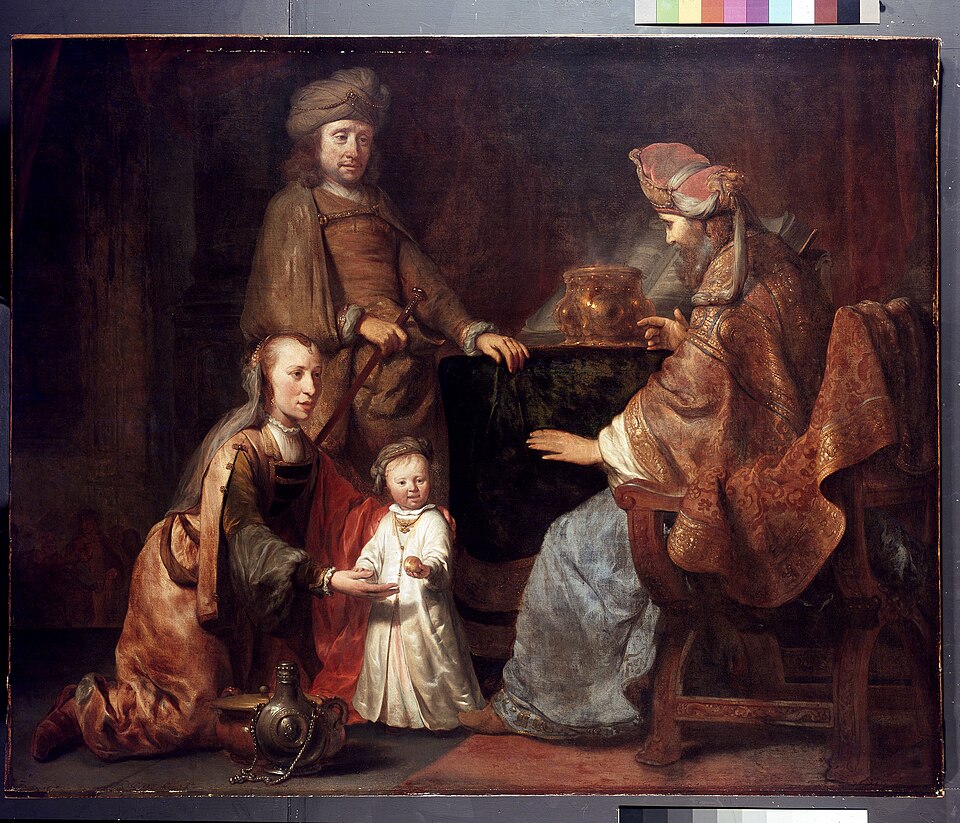 Western biblical painting by Gerbrand van den Eeckhout; Ashmolean Museum. Source: 🔗 Hannah presenting Samuel to Eli.
Summary Table
| Element in the text | Spiritual meaning | Fulfillment in Christ / the Church |
|---|---|---|
| Hannah’s barrenness | Human inability and humiliation brought to God | Salvation is gift, not human production |
| Hannah’s silent prayer | The heart poured out before God | Christ hears the hidden cry of the soul |
| Samuel dedicated to the Lord | The gift returned to the Giver | The Son is wholly offered to the Father for us |
| Hannah’s song | Divine reversal and Paschal hope | Christ descends and rises, exalting the lowly |
| Eli’s sons | Sacred office corrupted by appetite | The Church must serve, not consume |
| Faithful priest promised | God will not abandon His sanctuary | Christ the faithful High Priest |
Spiritual Fruit 🍇
-
Pour out the soul, not just the request. Hannah asks for a child, but the deeper act is that she pours herself before God. In prayer today, name the wound honestly, then offer the heart itself. Do not only ask God to change the circumstance. Ask Him to receive and purify the person who is suffering inside it.
-
Be careful with wounded people. Eli misjudges Hannah, and his servant rebukes her, because her outward appearance is mistaken for drunkenness. A servant of God must learn reverence before hidden grief. Before correcting someone, ask whether you are seeing clearly.
-
Give back what God gives. Hannah’s answered prayer becomes offering. This is a hard test of gratitude. Children, ministry, work, talent, money, reputation, and opportunity all become dangerous when received as possession rather than stewardship.
-
Do not let sacred familiarity replace fear of God. Hophni and Phinehas are near sacrifice but far from God. Serving near holy things is not the same as knowing the Lord. The same danger exists for anyone close to church life. The hymns, altar, vestments, books, meetings, and service can become familiar while the heart becomes careless.
-
Honor God above disordered affection. Eli honors his sons above God. This can happen quietly in families, ministries, friendships, and leadership teams. Love becomes disordered when it protects sin from correction.
Hannah stands before the Lord with a grief no one around her can fully carry. Bring Him the wound without rehearsing how to make it respectable. Her lips move, her soul is poured out, and God hears. Then remember the little garment she brings year after year: surrender leaves the hands free to love, to care, and to offer again. May the Lord teach us both the prayer that trusts Him with our sorrow and the fidelity that keeps serving after the gift has been received.
Teaching Notes
General session guidance
- Suggested timing: 10 minutes for context and characters, 20 for prayer and dedication, 15 for the song, 15 for Eli’s house, and 10 for application and discussion.
- Linger over 1:10-18, 2:6-10, and 2:29. Compress genealogical and sacrificial details only after their basic meaning is clear.
- Say slowly: “The gift she asks for is already being surrendered.” “They know the rituals but not the Lord.” “Christ does not consume the offering; He becomes the offering.”
- General warnings: infertility is neither a verdict on someone’s worth nor evidence of inadequate prayer. Grief is not faithlessness. God’s hearing is not a technique for obtaining biological children. Honor the holiness of priesthood while naming abuse plainly. Protect vulnerable people; never make continued exposure to harm a test of obedience.
- Keep the Hebrew comparisons clearly labeled. Do not substitute them for the Brenton words being studied.
Grief that human love cannot fully heal (1 Samuel 1:1-8)
- Ask: What does Helkana’s love give Hannah, and what can it not give her?
- Watch for: explaining infertility as punishment or telling a suffering person that gratitude should make grief disappear.
Prayer of the heart and the misjudgment of Eli (1 Samuel 1:9-18)
- Ask: What changes between Hannah’s arrival and her return to eat in verse 18, before a child has been conceived?
- Watch for: confusing quietness with greater holiness, or overlooking that Brenton assigns the spoken rebuke to Eli’s servant.
The remembered woman gives back the child (1 Samuel 1:19-28)
- Ask: How does Hannah’s continued maternal love help us understand her surrender?
- Watch for: using Samuel’s placement in Shiloh to discourage protection, reporting, or a child’s free discernment of vocation.
Hannah’s song and the Gospel of reversal (1 Samuel 2:1-10)
- Ask: Why does a thanksgiving for one child end with justice throughout the earth and God’s Anointed?
- Watch for: claiming that the Hebrew lacks an anointed one, treating seven as a literal household count, or making death and poverty proofs of God’s rejection.
Samuel grows while corruption grows (1 Samuel 2:11-21)
- Ask: What do the meat seized by force and the garment freely sewn reveal about two ways of handling gifts?
- Watch for: equating Samuel’s childhood service with a modern ordained order or dismissing every priest because some abuse their office.
Eli’s weak correction and the promise of a faithful priest (1 Samuel 2:22-36)
Ask: What action would make Eli’s true words of rebuke an act of faithful responsibility?
Watch for: reading verse 25 as a reason for a penitent to despair, or turning Chrysostom’s accountability argument into blame for every adult child’s choices.
Sources
Embedded Scripture is from Brenton’s English Septuagint (LXX). New Testament comparisons use NKJV; Greek observations are identified below. The words “and she said,” belonging to Brenton 1:28, introduce the song; the closing narrative clause of Brenton 2:10 opens the return home with 2:11. The wording and verse markers remain complete.
Primary Scripture and patristic sources
- Brenton, The Septuagint Version of the Old Testament, 1 Samuel 1-2; Numbers 30:7-9, 11-15; 1 Chronicles 6:12-13, 18-23; Jeremiah 9:22-23; Deuteronomy 32:39; Wisdom 16:13; Tobit 13:2; 1 Kings 2:27, 35; Psalm 62:8 (LXX Ps 61:9). 🔗 1 Samuel 1 and 🔗 1 Samuel 2.
- Rahlfs, Septuaginta (1935), 1 Samuel 1:6, 11, 14; 2:9-11, 18, 22, 35; 3:1. 🔗 Greek text edition. B. A. Taylor, A New English Translation of the Septuagint, 1 Reigns, pp. 248-250, used to compare text shape. 🔗 NETS.
- New Testament: Luke 1:46-55; 2:36-38, 52; Matthew 6:5-6; Romans 8:26; Acts 2:13-15; Hebrews 2:17; 3:1-6; 7:25; 1 Timothy 2:5; 1 Corinthians 1:31. These comparisons are explained in the passage sections, not presented as direct quotations by the Fathers.
- St. Cyprian, On the Lord’s Prayer, §5; St. John Chrysostom, Homilies on Matthew 19.3-4 and On the Priesthood, Book IV; St. Augustine, City of God 17.4. Direct references and translations appear in the footnotes.
Coptic liturgical and pastoral sources
Fr. Jacob B. Nadian, Rites of Pascha Week, Book 6, Night of Apocalypse (Bright Saturday), p. 19; CopticChurch.net, the cited Wednesday of the fifth week of Great Lent. Direct references appear below.
Coptic Synaxarium, 6 Baba and 3 Kiahk, for Hannah’s commemoration and the received tradition of the Entrance of the Theotokos.
Fr. Tadros Y. Malaty, First Samuel (2004), translated by Dr. George Botros, revised by Sameh Shafik and Ferial Moawad, pp. 15-18, used as a modern Coptic Orthodox pastoral commentary. 🔗 Commentary.
Gerbrand van den Eeckhout, The Infant Samuel Brought by Hannah to Eli, Ashmolean Museum, with attribution beneath the retained painting.
Footnotes
-
Hebrew 1 Samuel 1:6-7 names the rival’s provocation; Brenton and Rahlfs 1:6-7 emphasize Hannah’s affliction. 🔗 Hebrew 1:6. ↩
-
Rahlfs, 1 Samuel 1:11; Luke 1:48, Greek text: “ἐπέβλεψεν ἐπὶ τὴν ταπείνωσιν τῆς δούλης αὐτοῦ.” The shared phrase changes the pronoun from Your to His. 🔗 Luke 1:48; 🔗 Rahlfs Greek. ↩
-
St. Cyprian of Carthage, On the Lord’s Prayer, §5 (Treatise 4 in this edition), translated by Robert Ernest Wallis, Ante-Nicene Fathers 5. 🔗 Primary text. ↩
-
St. John Chrysostom, Homilies on Matthew 19.4, with the church-prayer explanation in §3, translated by George Prevost, revised by M. B. Riddle, Nicene and Post-Nicene Fathers, First Series 10. 🔗 Homily 19. ↩
-
Fr. Tadros Y. Malaty, First Samuel (2004), pp. 15-16, on the continuing maternal bond and the offering of love. Modern Coptic Orthodox pastoral interpretation. 🔗 Commentary, p. 15. ↩
-
Coptic Synaxarium, 6 Baba, “The Departure of the Righteous Hannah, the Prophetess Mother of Samuel, the Prophet.” 🔗 Commemoration. ↩
-
Coptic Synaxarium, 3 Kiahk, “The Entrance of Saint Mary into the Temple at Jerusalem.” Its account of St. Anna’s vow and Mary’s childhood is received Church tradition, distinct from the canonical Gospel account. 🔗 Synaxarium. ↩
-
Rahlfs, 1 Samuel 2:9-10; NETS, 1 Reigns, 1 Samuel 2:8-10, p. 249. The petition clause follows the throne-of-glory language. 🔗 NETS comparison; 🔗 Greek edition. ↩
-
Greek “χριστοῦ αὐτοῦ” and Hebrew “מְשִׁיחוֹ” both refer to His anointed in 1 Samuel 2:10. 🔗 Hebrew text; 🔗 Greek text edition. ↩
-
St. Augustine, City of God 17.4, translated by Marcus Dods, Nicene and Post-Nicene Fathers, First Series 2. 🔗 Book XVII, chapter 4. ↩
-
Fr. Tadros Y. Malaty, First Samuel (2004), pp. 17-18, on thanksgiving for the Giver and the difference between Hannah’s and Mary’s praise. Modern Coptic Orthodox pastoral interpretation. 🔗 Commentary, p. 17. ↩
-
Fr. Jacob B. Nadian, Rites of Pascha Week, Book 6, Night of Apocalypse (Bright Saturday), p. 19, “Prayer of Hannah Mother of Samuel (1 Samuel 2:1-10).” 🔗 Service text. ↩
-
CopticChurch.net, the page explicitly headed “Wednesday of the fifth week of Great Lent,” with prophecy reading 1 Samuel 1 and 2:1-21. This identifies the cited published order; other service-book orders may differ. 🔗 Lectionary. ↩
-
Rahlfs, 1 Samuel 2:11, 18; 3:1, with the repeated form “λειτουργῶν.” 🔗 Greek edition; 🔗 NETS, pp. 249-250. ↩
-
Compare Hebrew 1 Samuel 2:22 with Rahlfs and NETS 1 Reigns, 1 Samuel 2:22, p. 250. The shorter Greek sentence does not contain the sexual clause. 🔗 Hebrew; 🔗 NETS. ↩
-
Rahlfs, 1 Samuel 2:35; Hebrews 2:17 and 3:2-6. “πιστός” recurs, while priest and High Priest are related but different terms. 🔗 Hebrews 2:17; 🔗 Hebrews 3:2; 🔗 Rahlfs. ↩
-
St. John Chrysostom, On the Priesthood, Book IV, opening reply to Basil, Eli paragraph following the Saul comparison, translated by W. R. W. Stephens, Nicene and Post-Nicene Fathers, First Series 9. 🔗 Book IV. ↩