


This narration was recorded before the latest revision. The text on this page is current.
2 Samuel tells the story of David’s kingdom, but it refuses to flatter David. The Lord establishes him, gives him Jerusalem, receives the ark into Zion, and promises him an everlasting house. Then the same book exposes the king’s sin, the wounds in his family, the collapse of trust, the pain of public humiliation, and the mercy that still does not erase discipline. Orthodox readers should come to 2 Samuel looking for Christ the true Son of David, but also for the hard mercy by which God saves the human heart from hidden pride.
Start of the 2 Samuel series. · Next: 2 Samuel 1 - David Laments Saul and Jonathan
How to Read 2 Samuel
Read 2 Samuel as a book about kingship under judgment and mercy. David is the Lord’s anointed, but he is not above the commandments. He receives the throne, yet he cannot purify his own house. He brings the ark to Zion, yet he must learn reverence. He receives the covenant promise, yet he falls into grave sin. He repents, yet his repentance is not cheap. The book is spiritually dangerous if taught as simple leadership inspiration. It is much deeper than that.
The best single sentence for the series is this: God establishes the kingdom, exposes the king, and prepares the world for the King who can heal what David cannot. This keeps the series from becoming either hero worship or cynicism. David is neither discarded nor excused. He is chosen, chastened, forgiven, and made to serve a promise greater than himself.
Canonical and Historical Context
In the Septuagint tradition, 1 and 2 Samuel correspond to Kings I and Kings II or 1 and 2 Kingdoms. The English title “2 Samuel” reflects the book’s place after Samuel’s ministry, even though Samuel has died before the events of this book begin. The story continues directly from 1 Samuel: Saul is dead, Jonathan is dead, David has not seized the throne, and Israel is not yet unified.
Historically, the book narrates David’s rise from king over Judah in Hebron to king over all Israel, his capture of Jerusalem, the ark’s arrival in Zion, military consolidation, and then the deep crisis that follows his sin with Bathsheba and murder of Uriah. The narrative is politically realistic. It knows courts, generals, factions, assassinations, succession struggles, propaganda, public grief, and the cost of failed fatherhood. But it is never merely political history. The theological question under every chapter is: what happens when God’s promise enters a broken royal house?
The two books of Samuel should be heard together. Hannah’s song in 1 Samuel 2:1-10 and David’s song in 2 Samuel 22 open and close the whole work, and both end on the Lord’s anointed. Between them the book is held together by lament: Saul and Jonathan in chapter 1, Abner in chapter 3, the child in chapter 12, and Absalom in chapters 18-19. The sword is one thread through that grief. Abner asks, “Shall the sword devour perpetually?” (2:26). David later says “the sword devours” (11:25). Nathan answers, “the sword shall not depart from thy house” (12:10).
The same thread runs through fathers who cannot correct their own. Eli honors his sons above the Lord (1 Samuel 2:29). Samuel’s sons turn aside (8:3). David finds the sons of Zeruiah too hard (3:39), fails Amnon (13:21), and later Adonijah is left uncorrected (1 Kings 1:6). Kingship under mercy is not the same as a house that can heal itself.
The closing chapters form a ring: famine and covenant reckoning (21:1–14), warriors (21:15–22), David’s song (22), his last words (23:1–7), warriors (23:8–39), and plague ending at an altar (24). The two outer accounts bring the reader from a wounded land to prayer and mercy; the songs at the centre look beyond royal strength to the Lord who saves.
Major Theological Burdens
1. The throne is received, not seized
David does not build his kingdom by murdering Saul’s house. This matters. In 2 Samuel 1 through 4, David repeatedly refuses the logic of opportunism. He laments Saul, honors Jonathan, rejects assassination, and refuses to bless bloodguilt even when the victims were his political rivals. The spiritual lesson is sharp: not every open door is from God. Sometimes the Lord’s timing must be received through patience, restraint, and grief.
2. Worship requires both joy and fear
The ark’s arrival in Jerusalem is one of the book’s great worship scenes. David rejoices with his whole body, but the death of Uzzah shows that zeal without reverence becomes dangerous. The Church does not separate joy from fear. True worship is neither cold formality nor careless enthusiasm. It is love before holiness.
3. The Davidic covenant points beyond David
2 Samuel 7 is the theological center of the book. David wants to build a house for the Lord, but the Lord promises to build David a house. The promise of a son, a throne, and a kingdom that endures opens the messianic line that the New Testament identifies with Christ. Luke 1:32-33, Acts 2:29-36, Romans 1:3-4, and Revelation 22:16 all stand in the light of this chapter. David’s line becomes the path through which the Incarnate Word enters history.
4. Sin hidden by power becomes public wound
David’s fall in 2 Samuel 11 is not a private moral mistake. It is abuse of royal power, sexual sin, deception, and murder. The book refuses to hide this because Scripture is more honest than propaganda. Nathan’s rebuke in chapter 12 becomes a mercy because it tells the truth. The Orthodox reading must be pastorally serious here: repentance is real, forgiveness is real, and consequences are also real. Psalm 51 (LXX 50), the great Psalm of repentance in Orthodox prayer, belongs spiritually to this moment.
5. The royal house cannot save itself
From 2 Samuel 13 onward, David’s family begins to fracture. Tamar is violated, Amnon is murdered, Absalom returns unreconciled, the kingdom is stolen through charm and grievance, and David flees Jerusalem in humiliation. The tragedy is not random. The king who misused power now suffers under the disorder of a house where truth, justice, mercy, discipline, and love have been confused. This must be taught carefully, especially in adult groups where wounds of family sin, abuse, betrayal, and silence may be present.
6. Judgment stops at the altar
The book ends not with David’s personal triumph but with plague, intercession, sacrifice, and an altar. David’s census exposes the temptation to measure strength apart from God. Second Chronicles 3:1 places Solomon’s building of the house of the Lord on the mount where the Lord appeared to David, in the place David prepared in the threshing floor of Orna the Jebusite. Brenton calls that mount Amoria. The ending teaches that the kingdom is saved not by royal capacity but by costly sacrifice and mercy. This prepares the reader for Christ, whose altar is the Cross.
Christological Reading
2 Samuel must be read toward Christ, but not by flattening David into a simple type. David is both type and warning. He is anointed, shepherd, warrior, king, psalmist, sufferer, and covenant recipient. In these ways he points to Christ. But David is also sinner, failed father, and humbled ruler. In these ways he shows why Christ must be more than another David.
Christ is the Son of David who receives the throne without sin, enters Jerusalem in humility, bears the curse without deserving it, forgives His enemies, and offers Himself to stop judgment. David mourns Absalom and cries that he would have died in his son’s place (2 Samuel 18:33; Brenton 19:1). Christ dies for rebels and makes them sons (Romans 5:8-10). David buys a threshing floor and offers sacrifice. Christ becomes both priest and sacrifice. David’s kingdom remains wounded. Christ’s Kingdom heals by the Cross and Resurrection. The promise to David is taken up in Psalm 89 (LXX 88), Acts 13:22-23 and 13:34, and Hebrews 1:5.
Coptic and Liturgical Awareness
The Church reads 2 Samuel 2:1-4 in the preparation of the Holy Myron and 2 Samuel 6:1-20 in the second part of the consecration of a church. David’s anointing and the bringing of the ark therefore belong not only to the history of Israel but also to the Church’s worship.1
The Synaxarium remembers the departure of David the prophet and king on 23 Kiahk.2
Series Map
Visual Reading Aids 🖼️
Visual reading aid
The spiritual arc traces the book from received kingship to Zion, covenant, mercy, sin, fracture, grief, and finally the altar where judgment stops.
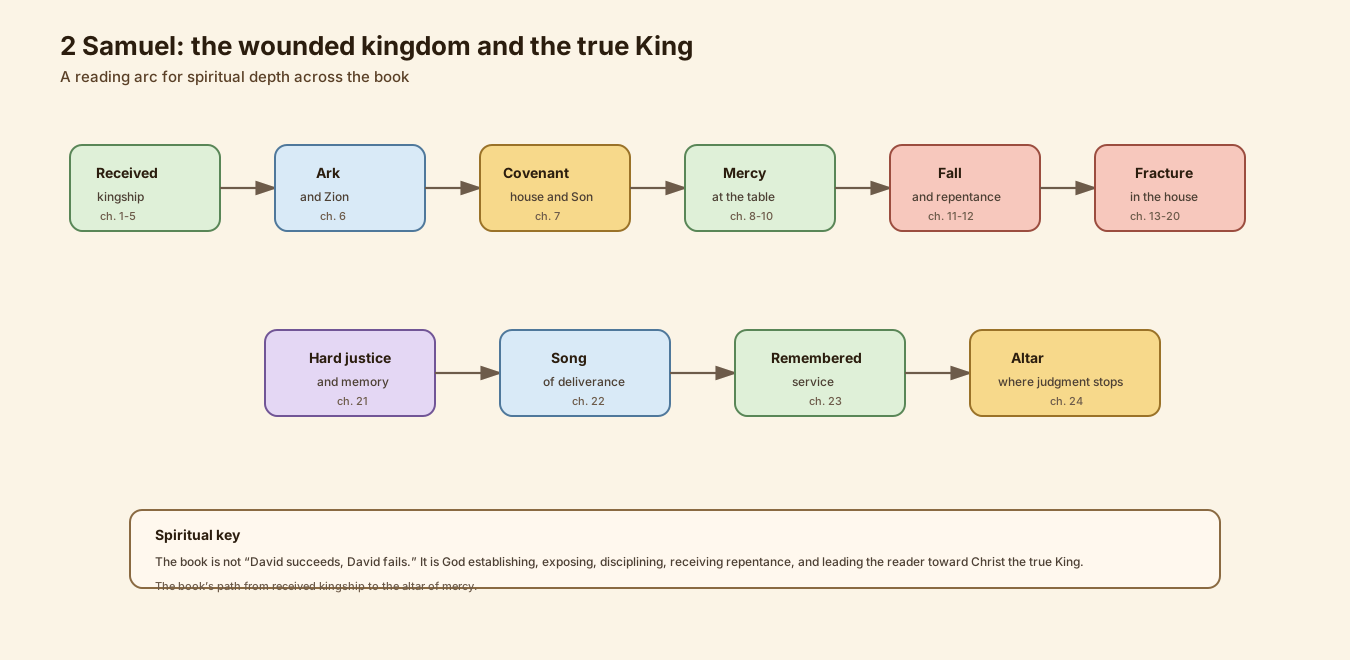 The book’s path from lament and kingship to the altar of mercy.
Teacher's Notes
Where to linger
Linger over 2 Samuel 7, chapters 11 and 12, chapters 13 and 14, chapters 15 through 18, and chapter 24. These are the theological and pastoral weight-bearing sections. They need time, silence, and careful application.
Where to compress
Military summaries and administrative details can be compressed when they do not carry the main burden. Do not skip them entirely, but do not let lists of victories replace the spiritual arc.
Key phrases to say slowly
- “The Bible does not protect David’s image. It protects the truth.”
- “God’s promise to David is not God’s permission for David.”
- “Repentance is not image repair. It is surrender to truth before God.”
- “The Son of David must be greater than David, because David cannot heal his own house.”
- “The book ends at an altar because the kingdom is saved by mercy, not measurement.”
Pastoral warnings
- Do not romanticize David’s sin with Bathsheba. The text involves power, sexual sin, deception, and the arranged death of Uriah.
- Do not use Tamar’s story as a generic lesson about modesty or family drama. Treat sexual violence, silence, and failed protection with sobriety.
- Do not imply that repentance removes all earthly consequences. Scripture shows forgiveness and consequences together.
- Do not turn Absalom into a simple villain. He is responsible for rebellion, but the family system around him is deeply wounded.
- Do not politicize the kingdom narratives into modern partisan commentary. The text judges all power under God.
Visual / teaching aid
- Show: Begin the series with the spiritual arc, then return to it at 2 Samuel 7, 11-12, 18, 21, and 24 so the class sees the book as one theological movement.
Translation and Source Notes
The studies follow NKJV chapter and verse numbering and print Brenton’s English Septuagint. Where the editions differ in wording or order, a short note before the relevant reading explains the difference. Brenton’s printed verse labels remain visible. New Testament connections are cited by reference, with only brief quoted phrases.
Sources
Primary sources
Scripture: 2 Samuel, Psalms 51 (LXX 50), 89 (LXX 88), Luke 1:32-33, Acts 2:29-36, Acts 13:22-23, Acts 13:34, Romans 1:3-4, Romans 5:8-10, Hebrews 1:5, Revelation 22:16.
Coptic Synaxarium, 23 Kiahk, the departure of David, the prophet and king.
Footnotes
-
Coptic Reader, Special / Consecrations / Oil / Myron / Preparation; Special / Consecrations / Church / Part 2. Reader. The appointments are explicit in Reader; their application to this study is the guide’s interpretation. ↩
-
Coptic Reader, Readings / Liturgy / Synaxarion (selected date 2026-01-01). Reader. ↩