


This narration was recorded before the latest revision. The text on this page is current.
2 Samuel opens with grief, not triumph. David receives the news that Saul and Jonathan are dead, and the first thing Scripture shows us is not David claiming the throne but David tearing his garments, fasting, weeping, judging opportunistic violence, and teaching Judah how to lament. This is a hard word against spiritual ambition: the promise of God does not give us permission to rejoice when rivals fall. David’s first kingly act in 2 Samuel is not conquest. It is holy mourning.
Previous: 2 Samuel - General Introduction · Next: 2 Samuel 2-4 - A Divided Kingdom and the Cost of Ambition
Historical and Scriptural Context
Where in Scripture
1 Samuel ends with Saul defeated by the Philistines on Mount Gilboa, wounded, and dead with his sons. 2 Samuel begins immediately after that catastrophe. David has just returned from defeating the Amalekites and recovering what had been taken from Ziklag. Israel is shattered, Saul’s house is wounded, Jonathan is dead, and David has every political reason to benefit from Saul’s fall.
That is why this chapter matters. The kingdom will eventually come to David, but Scripture first tests what kind of heart will receive it. Will he treat Saul’s death as an opportunity, or as a tragedy? Will he build the throne by exploiting bloodguilt, or will he wait for God?
Where in history
The chapter stands at the transition between Saul’s failed monarchy and David’s rise. Ancient Near Eastern succession often involved assassination, purges, public display of royal objects, and opportunistic loyalty shifts. The Amalekite messenger appears to understand this world. He brings Saul’s crown and bracelet, likely expecting reward. David rejects the logic completely.
Geographical Significance ⛰️
The places matter.
- Ziklag / Sekelac is where David has been living among the Philistines while hunted by Saul. He returns there after striking Amalek.
- Mount Gilboa / Gelbue is the mountain of Israel’s defeat, where Saul and Jonathan fall.
- Gath / Geth and Ashkelon / Ascalon are Philistine cities. David’s lament asks that the news not be proclaimed there, not because truth should be hidden forever, but because covenant tragedy should not become enemy entertainment.
The movement is spiritually charged: David is in exile-like distance from Israel, yet his heart still belongs to Israel’s grief.
The Characters 👥
David
David is the Lord’s anointed, but he is not yet king over all Israel. In this chapter he appears as mourner, judge, poet, and teacher. What is at stake for him is whether he will receive the kingdom as gift or grasp it through another man’s blood.
Saul
Saul is the fallen king. He hunted David, resisted the word of the Lord, and ended tragically. Yet David refuses to speak of him with contempt. Saul remains “the anointed of the Lord,” and David honors what God once gave even when Saul failed.
Jonathan
Jonathan is Saul’s son and David’s covenant friend. His death is the deepest personal wound in the chapter. David’s grief for Jonathan is not political theater. It is the grief of a holy friendship broken by death.
The Amalekite messenger
The messenger claims to have killed Saul and brings royal symbols to David. Whether he is telling the truth or lying to gain favor, he confesses participation in killing the Lord’s anointed. His mouth becomes witness against him.
🕯️ Light from the Word
1. The messenger brings the crown and bracelet, 2 Samuel 1:1-10
1 And it came to pass after Saul was dead, that David returned from smiting Amalec, and David abode two days in Sekelac. 2 And it came to pass on the third day, that, behold, a man came from the camp, from the people of Saul, and his garments were rent, and earth was upon his head: and it came to pass when he went in to David, that he fell upon the earth, and did obeisance to him.
3 And David said to him, Whence comest thou? and he said to him, I have escaped out of the camp of Israel. 4 And David said to him, What is the matter? tell me. And he said, The people fled out of the battle, and many of the people have fallen and are dead, and Saul and Jonathan his son are dead.
5 And David said to the young man who brought him the tidings, How knowest thou that Saul and Jonathan his son are dead? 6 And the young man that brought the tidings, said to him, I happened accidentally to be upon mount Gelbue; and, behold, Saul was leaning upon his spear, and, behold, the chariots and captains of horse pressed hard upon him. 7 And he looked behind him, and saw me, and called me; and I said, Behold, here am I. 8 And he said to me, Who art thou? and I said, I am an Amalekite. 9 And he said to me, Stand, I pray thee, over me, and slay me, for a dreadful darkness has come upon me, for all my life is in me. 10 So I stood over him and slew him, because I knew he would not live after he was fallen; and I took the crown that was upon his head, and the bracelet that was upon his arm, and I have brought them hither to my lord.
Literal sense
A messenger arrives from Saul’s camp with torn garments and earth on his head, signs of mourning. He reports Israel’s defeat and the deaths of Saul and Jonathan. Then he adds a claim: Saul was wounded and asked him to kill him, so he did. He brings Saul’s crown and bracelet to David.
The report conflicts with the account at the end of 1 Samuel, where Saul falls on his own sword after his armor-bearer refuses to kill him. The messenger may be lying, telling a story designed to make him look useful to David. Or he may be reporting some involvement not included in the prior account. Either way, David judges him by his own confession.
LXX and textual insight
Brenton uses Sekelac for Ziklag, Gelbue for Gilboa, Geth for Gath, and Ascalon for Ashkelon. These forms remind us that we are reading the story through the Septuagint tradition.
The messenger identifies himself as an Amalekite, which is not a neutral detail. David has just returned from striking Amalek, and Saul’s earlier failure with Amalek was one of the decisive signs of his disobedience. The appearance of an Amalekite at Saul’s death therefore carries deep irony. Saul’s unfinished obedience haunts the end of his story.
Ascetical reading
The Church often reads David as a man who reveals both the greatness of repentance and the danger of sin. In this first chapter, the point is not yet David’s repentance but his refusal to rejoice over another man’s fall. Proverbs says the same plainly: “Do not rejoice when your enemy falls” (Proverbs 24:17, NKJV).
David acts with reverence toward God’s anointing and restraint toward a dead enemy. He does not let personal suffering become permission for revenge.
Christological and typological reading
David refuses a kingdom delivered by bloodguilt. Christ refuses the kingdoms of the world when Satan offers them without the Cross. David will not rejoice over Saul’s corpse. Christ weeps over Jerusalem even as Jerusalem rejects Him. David receives the crown only in God’s time. Christ receives the Kingdom through voluntary suffering, not grasping.
The lesson is not merely “be respectful.” It is deeper: the Kingdom of God is not built by opportunism, rivalry, and the celebration of another’s collapse. The true King does not need His enemies humiliated in order to reign.
2. David mourns and judges bloodguilt, 2 Samuel 1:11-16
11 And David laid hold of his garments, and rent them; and all the men who were with him rent their garments. 12 And they lamented, and wept, and fasted till evening, for Saul and for Jonathan his son, and for the people of Juda, and for the house of Israel, because they were smitten with the sword.
13 And David said to the young man who brought the tidings to him, Whence art thou? and he said, I am the son of an Amalekite sojourner.
14 And David said to him, How was it thou wast not afraid to lift thy hand to destroy the anointed of the Lord? 15 And David called one of his young men, and said, Go and fall upon him: and he smote him, and he died. 16 And David said to him, Thy blood be upon thine own head; for thy mouth has testified against thee, saying, I have slain the anointed of the Lord.
Literal sense
David and his men tear their garments, lament, weep, and fast until evening. David’s grief is not selective. He mourns Saul, Jonathan, Judah, and the house of Israel. Then he questions the messenger and condemns him for claiming to have killed the Lord’s anointed.
David’s phrase “How was it thou wast not afraid?” should be heard beside Saul’s armour-bearer, who “feared greatly” and would not strike him (1 Samuel 31:4). David himself had refused twice to stretch out his hand against the anointed. The messenger’s claim is the opposite of that fear. The judgment that follows is royal justice inside the Old Covenant, not a model for Christian punishment. The warning to receive is simpler: do not make yourself the executioner of God’s mysteries.
LXX and theological insight
David’s phrase “the anointed of the Lord” is the key. “Anointed” translates the root behind messiah. Saul is not morally innocent, but he was truly anointed. David honors the office and the divine act even when the man failed in it.
This protects the reader from a common spiritual sickness: once someone has wronged us, we feel permitted to erase every dignity God gave them. David refuses that. Saul was wrong. Saul was dangerous. Saul persecuted David. And still David will not treat his death as entertainment or advantage.
Ascetical reading
The Amalekite’s own words condemn him. The mouth reveals the heart, and the heart that boasts in death is already diseased. David’s restraint here is not yet the later repentance of Psalm 51 (LXX 50). It is reverence for what belongs to God, before his own fall.
Christological and typological reading
Christ teaches His disciples not to seize judgment for themselves. He rebukes the impulse to call down fire on a rejecting village. He commands love for enemies. David’s action belongs to the Old Covenant royal context, but the deeper trajectory points to Christ’s purification of zeal. The Christian does not imitate David by striking down enemies. The Christian imitates David’s refusal to profit from death and Christ’s refusal to answer hatred with hatred.
3. David teaches Judah how to lament, 2 Samuel 1:17-27
17 And David lamented with this lamentation over Saul and over Jonathan his son. 18 And he gave orders to teach it the sons of Juda: behold, it is written in the book of Right.
19 Set up a pillar, O Israel, for the slain that died upon thy high places: how are the mighty fallen! 20 Tell it not in Geth, and tell it not as glad tidings in the streets of Ascalon, lest the daughters of the Philistines rejoice, lest the daughters of the uncircumcised triumph. 21 Ye mountains of Gelbue, let not dew nor rain descend upon you, nor fields of first-fruits be upon you, for there the shield of the mighty ones has been grievously assailed; the shield of Saul was not anointed with oil. 22 From the blood of the slain, and from the fat of the mighty, the bow of Jonathan returned not empty; and the sword of Saul turned not back empty. 23 Saul and Jonathan, the beloved and the beautiful, were not divided: comely were they in their life, and in their death they were not divided: they were swifter than eagles, and they were stronger than lions. 24 Daughters of Israel, weep for Saul, who clothed you with scarlet together with your adorning, who added golden ornaments to your apparel. 25 How are the mighty fallen in the midst of the battle! O Jonathan, even the slain ones upon thy high places! 26 I am grieved for thee, my brother Jonathan; thou wast very lovely to me; thy love to me was wonderful beyond the love of women. 27 How are the mighty fallen, and the weapons of war perished!
Literal sense
David composes a lament and commands it to be taught to the sons of Judah. This is more than private grief. He forms communal memory, and he teaches his own tribe to mourn the king of the other house. That is the first act of healing the division the next chapters will describe. Israel must remember Saul and Jonathan not with mockery, not with political analysis, and not with triumphalist relief, but with lament.
The lament never names God, and it never names one sin of Saul. It is grief without self-vindication. David does not use the dead king’s failures to clear his own path. The repeated line “How are the mighty fallen” carries the weight of the chapter. Strength, beauty, weapons, royal dignity, friendship, and national hope have fallen. David does not deny Saul’s failures, but in lament he refuses to reduce a whole life to its worst chapters.
Jonathan’s love has texts, not a mood. Their souls were knit together, and they made a covenant (1 Samuel 18:1-3, 20:17, 23:18). Sirach 6:14-17 calls a faithful friend a strong defence. The lament should be taught as covenant friendship, not as a modern category imported into the verse.
The Book of Right
Brenton’s “book of Right” corresponds to what many English Bibles call the Book of Jashar, an ancient source also mentioned in Joshua 10:13. The title suggests a collection of heroic or upright songs and records. We do not possess this book. Scripture preserves the lament because it matters for Israel’s spiritual memory.
The displayed text also holds differences a name list would miss. Verse 18 does not mention a bow. The instruction is simply to teach the lament. Verse 19 begins, “Set up a pillar, O Israel,” where many Hebrew-based translations speak of Israel’s glory slain. Verse 9 has the messenger say, “a dreadful darkness has come upon me.” Verse 20 says, “tell it not as glad tidings.” The same glad-tidings language returns when David recalls this messenger in 4:10. Micah 1:10 returns to Gath and refuses enemy laughter, but Brenton does not repeat the lament’s sentence word for word.
Ascetical reading
The Psalms give language for grief, fear, betrayal, confession, and hope. David’s lament here is not despair. It is grief disciplined into speech that can be taught. It is not yet the tears of Psalm 51 (LXX 50). It is the refusal to let sorrow become mockery.
Christological and typological reading
David mourns Jonathan, the faithful friend. Christ weeps at the tomb of Lazarus, His friend (John 11:35). David grieves over Saul, the king who persecuted him. Christ weeps over Jerusalem, the city that will reject Him (Luke 19:41-44). David teaches Judah to lament the fallen. The apostle tells the Church not to sorrow as those who have no hope (1 Thessalonians 4:13). Christ has entered death and conquered it.
This lament also prepares us to understand the Cross. At Calvary, the mighty One appears fallen. The disciples see defeat. The enemies rejoice. But the fallen King is the victorious King. David says, “Tell it not in Geth.” The Gospel will later command the opposite: tell it to all nations, because the death of the Son of David is not shameful defeat but saving victory. Christ also refuses the kingdoms of the world when they are offered without the Cross (Matthew 4:8-10; Philippians 2:6-8).
The Church’s Voice in Worship
The grief of this chapter can be brought into the First Hour prayer of the Agpeya, where Psalm 3 teaches the believer to call on the Lord amid distress.1
The Synaxarium remembers the departure of David the prophet and king on 23 Kiahk.2
Iconography Connection 🖼️
The most useful iconographic connection is David the King and Prophet, often shown with harp or scroll. This icon does not merely show David as musician. It shows the king whose mouth becomes prayer for the Church. In 2 Samuel 1, David’s poetic gift is used not for self-display but for communal lament.
Visual reading aid
The spiritual arc begins with lament. David’s first public act in 2 Samuel is holy grief, not opportunism; the harp or scroll in an image of David belongs with words offered before God.
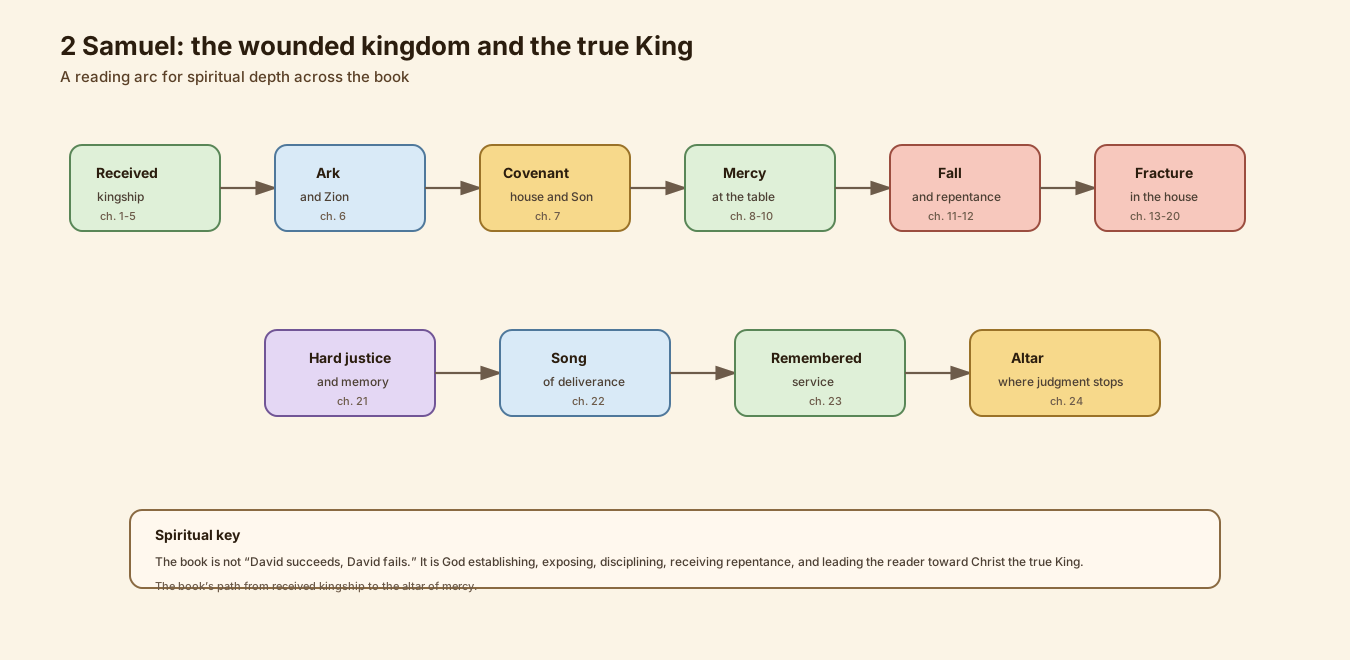 The book’s path from lament and kingship to the altar of mercy.
Spiritual Fruit 🍇
1. Do not rejoice when a rival falls
David had been hunted by Saul, yet he mourns Saul. This exposes the heart. It is possible to be technically innocent and still spiritually poisoned by secret satisfaction at another person’s collapse. A Christian should ask: whose failure am I quietly enjoying?
2. Let grief become prayer, not performance
The Amalekite wears the signs of grief, but his heart appears to seek advantage. David actually grieves. There is a difference between displaying sorrow and entering sorrow truthfully before God. In prayer, grief can become clean. Outside prayer, it often becomes manipulation, bitterness, or self-importance.
3. Reverence what God has touched, even when people fail
Saul failed terribly, but David still calls him the Lord’s anointed. This does not excuse Saul. It keeps David from becoming spiritually lawless in response. When leaders, parents, servants, friends, or institutions fail, we need truth and accountability. But we must not let disappointment make us contemptuous of everything God once gave.
4. Receive God’s promises without grasping
David could have interpreted Saul’s death as his moment to seize everything. Instead, he mourns and waits. The spiritual life often turns on this point. The thing God has promised can be corrupted if we grab it through impatience, manipulation, or another person’s ruin.
5. Teach your household how to lament
David commands the lament to be taught. Families and churches need language for grief. If we do not teach holy lament, people learn either denial or despair. The Christian home should know how to say, “This hurts,” while still standing before God.
Summary Table
| Element in the text | Spiritual meaning | Fulfillment in Christ / the Church |
|---|---|---|
| Saul’s crown brought to David | Temptation to receive promise through bloodguilt | Christ refuses worldly kingdoms apart from the Cross |
| David tears his garments | Grief before gain | The Church mourns truthfully, but with hope |
| “The anointed of the Lord” | Reverence for what God has consecrated | Christ is the true Anointed One, the Messiah |
| The lament taught to Judah | Communal memory shaped by prayer | The Church teaches the faithful to pray grief through Psalms and services |
| “How are the mighty fallen” | Human strength collapses | The Cross reveals divine strength hidden in apparent defeat |
Closing Meditation
A crown was placed before David, but he chose tears first. That is why the chapter still judges us. We often want resurrection without mourning, promise without patience, victory without reverence. The Son of David teaches a deeper way: blessed are those who mourn, for they shall be comforted.
Teacher's Notes
Passage teaching prompts 1
- Key phrases: “The crown arrives, but David does not reach for it.” “An opportunity can still be a temptation.”
- Emphasize: David’s restraint is a spiritual test of whether he trusts God’s promise.
- Avoid: Do not turn the Amalekite into only a villain. His role is also a mirror of ambition that thinks holy ends can be served by corrupted means.
Passage teaching prompts 2
- Key phrases: “David mourns more than his own loss.” “He refuses to let Saul’s sin cancel Saul’s sacred dignity.”
- Emphasize: Holy grief can purify ambition.
- Avoid: Do not present the execution as a direct model for Christian behavior. Distinguish Old Covenant royal justice from Christian spiritual application.
Passage teaching prompts 3
- Key phrases: “David does not merely feel grief. He teaches grief.” “Lament is memory purified by prayer.”
- Emphasize: Christian grief should become truthful, reverent, and prayerful, not cynical or performative.
- Avoid: Do not over-explain Jonathan’s love in a modern ideological frame. Teach it as covenant friendship, loyalty, and holy affection without importing foreign categories into the text.
Timing breakdown
- Opening and context: 8 minutes
- Messenger and crown, verses 1-10: 12 minutes
- Mourning and judgment, verses 11-16: 10 minutes
- David’s lament, verses 17-27: 15 minutes
- Spiritual fruit and discussion: 15 minutes
Where to linger
Linger over David’s refusal to rejoice over Saul. This is the spiritual hinge of the chapter. Also linger over lament as something taught, not merely felt.
Where to compress
Compress the textual-history question around Saul’s death unless the group asks. The key point is that David judges the messenger by his own confession.
Pastoral warnings
- Do not teach this as a call to excuse abusive leadership. David’s reverence for Saul does not erase Saul’s sin.
- Do not turn the execution of the Amalekite into a Christian model for handling enemies. Keep the Old Covenant royal context clear.
- Do not flatten Jonathan’s friendship with David into modern ideological categories. Let the text speak of covenant friendship and grief.
- Do not use grief language to pressure people into public emotional display. Holy lament can be quiet.
Accuracy notes
- Brenton’s “book of Right” corresponds to the Book of Jashar in many English Bibles.
- Brenton’s place names differ from common English forms: Sekelac / Ziklag, Gelbue / Gilboa, Geth / Gath, Ascalon / Ashkelon.
- No reading from 2 Samuel 1 appears in the consulted Coptic lectionary sources.
Visual / teaching aid
- Show: Use the spiritual arc to locate this chapter as the gateway into David’s kingship: he receives the kingdom through restraint and lament, not triumphalism.
Discussion Questions
- Why does David mourn Saul when Saul had caused him so much suffering?
- Where are you tempted to interpret another person’s fall as your opportunity?
- What is the difference between honest lament and performative grief?
- How does David’s treatment of Saul challenge the way we speak about failed leaders or people who hurt us?
- How does Christ fulfill and purify David’s restraint, grief, and kingship?
Glossary
- Anointed of the Lord: A person consecrated by God for a sacred role. In this chapter it refers to Saul as king, even after his failures.
- Jashar / Book of Right: An ancient source mentioned in Scripture. It is not extant, but biblical texts preserve some material associated with it.
- Lament: Prayerful grief expressed before God. In Scripture, lament tells the truth about sorrow without surrendering faith.
- Ziklag / Sekelac: David’s base among the Philistines before Saul’s death.
- Gilboa / Gelbue: The mountain where Saul and Jonathan died.
- Gath / Geth and Ashkelon / Ascalon: Philistine cities named in David’s lament.
Translation and Source Notes
Embedded Scripture is from Brenton’s English Septuagint (LXX). The study follows NKJV chapter and verse numbering; translation differences are explained beside the readings. Psalm references give the NKJV number first and the Septuagint number in parentheses.
Sources
No direct reading from 2 Samuel 1 is listed in the Coptic lectionary sources consulted for this study. The worship connections above use the named Psalms, New Testament readings, or rite texts.
Primary sources
- Scripture: 1 Samuel 31, 2 Samuel 1, Proverbs 24:17, Matthew 5:4, Luke 19:41-44, John 11:35.