


1 Samuel begins with a woman praying in anguish before it ever speaks of kings. Before the public struggle for a throne, Scripture brings us into the grief of a household and the prayer of a woman who cannot give herself the child she longs for. The gift she asks for is already being surrendered: in her vow, she promises the child to the Lord before she has received him (1 Samuel 1:11). The book moves from Samuel to Saul to David, but underneath the history is a spiritual contrast between outward appearance and the heart God sees. Israel wants visible security; God prepares hidden anointing.
This series will read 1 Samuel as Scripture for the Church, not only as ancient history. It is a book about prayer, priesthood, leadership, obedience, rejected power, holy friendship, mercy toward enemies, and the long preparation for Christ the true King.
Lesson Guide
- Key phrases: hidden prayer before visible kingship; God sees the heart; the king after God’s own heart.
- Emphasize: the monarchy story begins in the sanctuary, with Hannah, not in a palace.
- Avoid: reducing the book to leadership lessons or Davidic hero stories.
Historical and Scriptural Context
This study uses the familiar English book names. In the Septuagint, 1-2 Samuel and 1-2 Kings form the four books of Kingdoms, so this book is 1 Kingdoms there.
Where in Scripture
Ruth precedes 1 Samuel in the Greek Septuagint as well as in the usual English Old Testament order. Ruth ends with the genealogy of David; 1 Samuel shows how David emerges in Israel’s history. The book also continues the questions left by Judges. Judges ends with the refrain that Israel had no king and everyone did what was right in his own eyes. 1 Samuel answers that crisis, but with a warning: not every desire for a king is faithful, and not every anointed man remains obedient.
In the Septuagint tradition, 1 Samuel is 1 Kingdoms or Kings I. The four books of Kingdoms correspond to 1–2 Samuel and 1–2 Kings in familiar English titles; this study cites the familiar English names. That naming matters because the book is deeply concerned with kingship, but it teaches kingship through priesthood, prophecy, prayer, obedience, and judgment.
Samuel remembered in the rest of Scripture
The later Scriptures remember Samuel as a man whose prayer and public faithfulness belong together. Sirach 46:13–20 calls him the Lord’s prophet, recalls his anointing of rulers, his intercession when enemies pressed Israel, and his testimony that he had taken no one’s goods. Authority is measured here by what he gives and refuses to take. Sirach’s final verse remembers his prophecy after death, recalling the terrible end of Saul in 1 Samuel 28. That remembrance gives no permission to seek the dead: Saul’s resort to the medium belongs to his collapse, not to Samuel’s pattern of faithful prayer.1
Psalm 99:6 (LXX Psalm 98:6) places Samuel among those who call on the Lord’s name, beside Moses and Aaron. Jeremiah 15:1 names Moses and Samuel as intercessors whose standing is so great that even their pleading is used to express the gravity of the people’s judgment. Prayer does not make sin harmless; it brings the people before the holy God who hears and judges. In Acts 3:24, Peter places Samuel at the beginning of a succession of prophets who announce the days fulfilled in Christ. Paul, in Acts 13:20–23, passes from the judges and Samuel to Saul, then David, and then Jesus, the Saviour promised from David’s seed. Hebrews 11:32 remembers David and Samuel among the witnesses of faith. Their history belongs to the Church’s memory because the same Lord who heard Hannah brings His promise to its fulfilment in Christ.12
Where in history
The book sits at the transition from the tribal period of the judges to Israel’s monarchy. The sanctuary at Shiloh is central in the opening chapters. The Philistines are a major pressure on Israel. The priestly house of Eli is collapsing morally, Samuel rises as prophet and judge, Saul becomes Israel’s first king, and David is anointed while still hidden.
The historical world is not tidy. Israel’s desire for a king is partly understandable because the nation faces enemies and internal instability. Yet Samuel warns that their request also contains rejection of God as King. Scripture forces us to hold both truths: God can work through monarchy, and Israel’s grasping for visible power can still be spiritually diseased.
Lesson Guide
- Key phrases: transition from judges to monarchy; visible power versus hidden faithfulness.
- Emphasize: 1 Samuel is not anti-kingship in a flat sense. It is against kingship sought apart from obedience to God.
- Avoid: modern political analogies unless absolutely necessary. Let the text speak first.
Geographical Significance ⛰️
The book begins in the hill country of Ephraim and moves through Shiloh, Ramah, Mizpah, Gilgal, Bethlehem, Gibeah, the Valley of Elah, Nob, the wilderness, En-gedi, Ziklag, and Mount Gilboa. These places are not decorative. Shiloh exposes corrupt worship. Bethlehem hides the future king. The wilderness becomes David’s school of restraint. Gilboa becomes the place where Saul’s tragedy ends.
The opening movement to Shiloh is especially important. Hannah’s pain is carried into worship. She does not merely suffer privately; she brings her wounded soul before the Lord at the sanctuary. The book teaches from the beginning that geography can become theology when suffering is brought before God.
Lesson Guide
- Key phrases: Shiloh exposes worship; Bethlehem hides kingship; wilderness trains restraint.
- Emphasize: the book’s places reveal the state of the heart.
- Avoid: turning geography into trivia.
The Characters 👥
Hannah / Anna
Brenton gives the name as Anna. She is childless and deeply afflicted; her lips move in prayer while her voice remains unheard. Eli mistakes her for a drunken woman, and in Brenton it is his servant who voices the rebuke (1 Samuel 1:13–14). The Hebrew account also describes Phennana provoking her; Brenton 1:6–7 dwells instead on Hannah’s despondency. Hannah becomes the first sustained voice of prayer in the book. Her song in 1 Samuel 2 announces the Lord’s reversal of human fortunes and prepares us to hear the Theotokos’ Magnificat in Luke 1:46–55. Elkanah’s love is real: he gives her a special portion and tries to comfort her. Its limits are real too. His question about being better than ten children cannot remove the grief she brings before God (1:5, 8). We should neither blame him for loving her nor use his love to silence her sorrow. Infertility is no measure of a person’s faith, worth, or closeness to God.
Eli / Heli
Brenton gives the name as Heli. Eli is priest at Shiloh. He can still bless and speak truth, but his discernment is weak and his governance of his sons is negligent. His failure is especially grave because his sons injure the worshippers entrusted to them. The charge that he has “honoured thy sons above me” names disordered love: protecting those close to him has taken precedence over honouring God and protecting His people (1 Samuel 2:29).
Hophni and Phinehas / Ophni and Phinees
Eli’s sons are priests. They know the rituals but not the Lord: Scripture names their failure as “not knowing the Lord” (1 Samuel 2:12). Their sin reaches beyond private weakness. They corrupt sacrifice, abuse authority, and cause the people to stumble in worship.
Samuel
Samuel is the child asked of God and returned to God. The account of his naming recalls Hannah’s petition: she asked him from the Lord (1 Samuel 1:20). That narrative connection should not be confused with a settled dictionary meaning for the name. He grows in the presence of the Lord while the house of Eli decays around him. Hannah’s offering continues in the little garment she brings him from year to year (1 Samuel 2:19). Giving him to God does not end a mother’s care; her fidelity takes the ordinary form of something made, carried, and given. This contrast between quiet service and corrupt privilege is one of the book’s main spiritual patterns.
Saul
Saul begins with promise, stature, and public approval. His tragedy is not lack of gifting but lack of obedient depth. He becomes the king who looks impressive but cannot surrender his will.
David
David is introduced later as the hidden anointed one. He is beloved, gifted, persecuted, merciful, and flawed. He is never the final king. He points beyond himself to Christ, whose kingdom the Gospel identifies with the promised throne of David (Luke 1:32–33).
Lesson guide
- Key phrases: Hannah prays; Eli fades; Samuel listens; Saul grasps; David waits.
- Emphasize: Scripture judges by the heart, not the surface.
- Avoid: flattening Saul into only a villain or David into only a hero.
Light from the Word 🕯️
1. Prayer before monarchy, 1 Samuel 1-3
The book opens with Hannah’s anguish, Samuel’s birth, Hannah’s song, Eli’s corrupt sons, and Samuel’s call. This is not a preface to the real story. It is the foundation. Before Israel receives a king, God teaches His people what true prayer, true hearing, and true priesthood look like.
Hannah’s prayer becomes a pattern: she speaks in her heart, pours out her soul, receives peace, and gives back the child she asked for. Samuel’s call becomes another pattern: when the word of the Lord is rare, the servant learns to answer, “Speak, for thy servant hears” (1 Samuel 3:10, Brenton). Listening here means receiving a word that costs him something. He must tell Eli the judgment on Eli’s own house. Reverence does not allow him to conceal what God has spoken, and Eli’s acceptance of consequences is not the same as restored obedience.
2. The ark and false confidence, 1 Samuel 4-7
Israel tries to use the ark as a guarantee of victory while the people themselves remain unrepentant. This warns against treating a holy sign as a guarantee that makes repentance unnecessary. Holy things cannot be used to manipulate God. The ark is captured, the house of Eli falls, and the glory departs. Yet God vindicates His own holiness even in Philistine territory.
The Orthodox reader should hear this carefully. The sacraments are real, holy, and life-giving, but they are not magic objects detached from repentance, faith, and obedience.
3. The request for a king, 1 Samuel 8-12
Israel asks for a king “like all the nations.” The request grieves Samuel, and the Lord says they have rejected Him from reigning over them (1 Samuel 8:6–8). Samuel’s own sons have taken bribes and perverted judgment (8:1–5), so the people’s complaint about their judges is substantial. The wrong lies in seeking national likeness and military assurance as a substitute for obedient dependence on God. Yet God permits the monarchy and works through it. This is the paradox: God judges Israel’s motive while still guiding history toward David and ultimately Christ.
This section teaches discernment. A thing can be outwardly legitimate and inwardly corrupted by why we want it.
4. Saul’s disobedience and rejection, 1 Samuel 13-15
Saul’s failure is not one mistake. It is a pattern: impatience, fear of people, partial obedience, religious excuse-making, and inability to repent cleanly. Samuel places obedience above a sacrifice offered to justify disobedience (1 Samuel 15:22). Worship cannot cover disobedience when the heart refuses correction.
5. David hidden, tested, and restrained, 1 Samuel 16-31
David is anointed away from Saul’s court, defeats Goliath, suffers Saul’s jealousy, receives Jonathan’s covenant friendship, flees through wilderness and exile, and refuses vengeance. The book ends with Saul’s death; David’s lament comes in 2 Samuel 1. The true king is trained by waiting. David’s kingship is marked not only by courage against Goliath but by mercy toward Saul.
Christologically, David is a real type but not the fulfillment. Christ is the anointed King who defeats the greater enemy, refuses worldly grasping, suffers unjustly, shows mercy to enemies, and reigns through the Cross.
Lesson Guide
- Key phrases: holy things cannot replace repentance; obedience over sacrifice; the true king is trained by waiting.
- Emphasize: David’s restraint is as important as David’s courage.
- Avoid: using Goliath as a generic self-help metaphor.
Reading the Septuagint Text
The Septuagint title “Kings I” frames the book through kingship, but its distinctive wording matters beyond the title. Hannah’s song is longer in the Greek form represented by Brenton than in the usual Hebrew-based English text. At 1 Samuel 2:9 it speaks of God granting the petition of the praying person and blessing the years of the righteous. At 2:10 it adds the warning against boasting in wisdom, strength, and wealth, and places true boasting in knowing the Lord and practising justice. The thanksgiving of one woman becomes instruction for the whole people: gifts are received in prayer, and greatness is judged by knowing God rather than possessing power.3
At the other end of this comparison, Brenton’s account of David and Goliath is much shorter than the familiar Hebrew-based account. It has no corresponding text at 17:12–31, 41, 50, 55–58, or at 18:1–5, 9–11, 17–19, 30. These gaps include David’s journey from his father’s flock to the battlefield and the conversation about whose son he is after the victory. We should follow the words actually before us rather than silently insert remembered episodes. The Greek tradition itself is not uniform: NETS, translated principally from Rahlfs here, lists 18:1–5, 10–11, 17–19 among its omissions, without Brenton’s additional gaps at 18:9 and 30. The two English Septuagint editions must therefore be distinguished.4
Language insight: “asked”, “lent”, and “Saul”
Hannah’s child and Israel’s king are both associated with asking, but the requests reveal different relationships to God. The Hebrew root שׁאל, “ask” (sha’al), appears in Hannah’s explanation at 1:20, in her giving the child to the Lord at 1:28, and in the people’s asking for a king at 8:10 and 12:13. The form שָׁאוּל (sha’ul) in 1:28 echoes Saul’s name, שָׁאוּל (Sha’ul). This is a verbal connection, not a claim that Samuel’s name simply means “asked.” Fr Tadros Y. Malaty’s introduction explicitly distinguishes the asking language from the debated explanation of Samuel’s name.5
The difference is fruitful for prayer. Hannah receives what she asks and gives it into God’s service; the nation asks for a king to supply the visible security it fears it lacks. Asking itself is not the fault. A petition can open the hands in trust or tighten them around the answer. The Hebrew wording in 12:13 includes the king whom the people asked for; Brenton’s main line there is shorter, while his note records the corresponding addition in the Alexandrian text. This Hebrew comparison helps us hear the repeated question without pretending that every form appears in Brenton’s main text.5
Language insight: “his Christ”
Brenton’s “his Christ” at 2:10 renders the anointed one, the king consecrated to God. The Hebrew also has “his anointed”; the Septuagint did not create the messianic idea by adding a title absent from Hebrew. In the story, Saul and David are anointed kings. In the Church’s reading, the promise reaches its fullness in Jesus Christ. The royal language gains its final meaning from the whole scriptural witness, not from treating an English capital letter as proof by itself.3
Gems from the Fathers 💎
St Augustine reads Hannah’s song directly in The City of God XVII.4. Her thanksgiving reaches beyond the child she has received toward Christ and His Church. The song’s reversals, its lifting of the poor, and its proclamation of the Lord’s anointed reveal a kingdom that cannot be explained by human advantage. Augustine also attends to the giving of the vow: the very gift offered to God first comes from Him. He writes, “For no one could vow anything acceptable to God, unless he received from Him that which he might vow.”6 Hannah’s offering is therefore neither a purchase of God’s favour nor a claim that she can supply Him with something He lacks. She returns a gift she could never have produced for herself. The same truth steadies our service: thanksgiving begins where ownership yields to grace.
St Cyprian, in On the Lord’s Prayer §5, uses Hannah directly as an example of prayer from within the heart and as a type of the Church. “She spoke with hidden prayer, but with manifest faith.”7 Her unheard voice is heard by God. This comforts the person whose grief makes speech difficult, while also exposing the temptation to measure prayer by how impressive it sounds. Cyprian’s point concerns faith and reverence, not a promise that every faithful person will receive the same earthly answer Hannah received.
St John Chrysostom’s On the Priesthood, Book IV, brings Eli into an argument about accountability in office. Even a person who did not seek authority cannot treat that fact as an excuse for neglecting its responsibilities.8 This supports the warning already present in 1 Samuel: serving near holy things is not the same as knowing the Lord. It does not make every parent guilty for an adult child’s choices, nor turn Eli’s failure into an accusation against clergy as a whole. His own failure to act, and the harm suffered by the people, are what the narrative places before us.
Christological and Typological Reading
A type is an earlier person, event, or promise whose fuller meaning becomes clear in Christ. It honours the earlier history while refusing to make a sinful human figure identical with the sinless Lord.
Hannah’s song prepares the reader for the Gospel’s reversal of human pride. The mighty are weakened, the hungry are fed, and the lowly are lifted. The Theotokos’ Magnificat in Luke 1:46–55 takes up the same pattern: God scatters the proud, brings down the mighty, and exalts the lowly. Hannah’s voice remains her own, born from a particular grief and thanksgiving, while the Church hears a larger hope in it.32
The faithful priest promised in 1 Samuel 2:35 first answers the corruption of Eli’s house. The later account explicitly connects Abiathar’s removal with that judgment and names Zadok, Brenton’s Sadoc, as his replacement (1 Kings 2:27, 35). This historical answer should remain visible before we speak of fulfilment in Christ. The New Testament identifies Jesus as the faithful High Priest in Hebrews 2:17 and as the Apostle and High Priest of our confession in Hebrews 3:1–6. He brings His people into the obedience and communion that corrupt ministers betray.9
David’s anointing and suffering prepare us to recognise a king whose greatness is shown through trust and mercy. Yet the clearest bridge to Christ is God’s promise, not a resemblance we invent. In 2 Samuel 7:12–16, God promises David a descendant, a kingdom, and a throne established for ever. Psalm 89:3–4, 20–29 (LXX Psalm 88) remembers that covenant and God’s anointing of David, while its later lament exposes the pain of royal failure. Gabriel’s announcement in Luke 1:32–33 identifies the promised throne with Jesus and a kingdom without end.102
Matthew 12:3–4 also shows Christ Himself drawing on David’s history: He recalls the hungry David and his companions eating the showbread. David’s story is thus part of the Lord’s own teaching, not merely a later Christian comparison. In the fuller Gospel witness, Jesus conquers through the Cross and gives His life for His enemies. David’s restraint can prepare our eyes for that mercy, but Christ’s victory exceeds any earthly king’s achievement.2
The Church’s Voice in Worship ⛪
Hannah’s prayer is read among the prophetic prayers at the Coptic Bright Saturday Praises and Matins. The published order at Tasbeha.org gives its range as 1 Samuel 2:1–10. This is a fitting place to hear her words: “The Lord kills and makes alive; he brings down to the grave, and brings up” (1 Samuel 2:6, Brenton). The Church waits before the mystery of Christ’s burial and victory over death, and Hannah’s praise places life and death beneath the power of the Lord. Her thanksgiving becomes Paschal hope, without ceasing to be the prayer of a mother who received and offered a child.11
The Coptic Synaxarium also remembers the people of this book as saints: the righteous Hannah, mother of Samuel, on Baba 6; Samuel the Prophet on Paona 9; and David the Prophet and King on Kiahk 23.12 These commemorations join their history to the Church’s prayer. Hannah is remembered for prayer and offering, Samuel for hearing God and serving His people, and David for faith and restraint toward Saul. The saints are received with their scriptural histories, including the failures Scripture exposes, rather than converted into flawless heroes.
Four Motifs Holding the Book Together
A final way to read 1 Samuel is through four repeated spiritual motifs. Heart runs from Hannah pouring out her soul, to Saul receiving another heart, to David being chosen because the Lord sees the heart. Word begins as rare in the days of Eli, becomes established in Samuel, and is later resisted by Saul when obedience becomes costly. Glory and Presence appear in the ark narrative, in Ichabod, and in the terrifying truth that holy things cannot be used without repentance. Anointing and Kingship move from Hannah’s song and Samuel’s anointing of kings, to Saul’s real but squandered calling, to David’s hidden anointing, and finally beyond David to Christ the true King.
This also guards the book from a simplistic anti-monarchy reading. Deuteronomy 17 already anticipates a king, but a king under the Law: chosen by God, restrained, humble, and continually reading the commandments. Israel’s sin in 1 Samuel 8 is not merely that they ask for a king. It is that they ask for visible power like the nations, as a substitute for trusting the Lord as King. The same danger appears in the soul whenever a legitimate good is sought in an idolatrous way.
Iconography and Visual Teaching 🖼️
The visual aids distinguish the places, family lines, and loyalties that can otherwise blur together as we read. The map is a schematic orientation aid, not a claim to exact ancient boundaries. It traces how the story moves from sanctuary to battlefield, from hidden anointing to wilderness testing, and finally to Endor, Gilboa, and the longing for a better King.
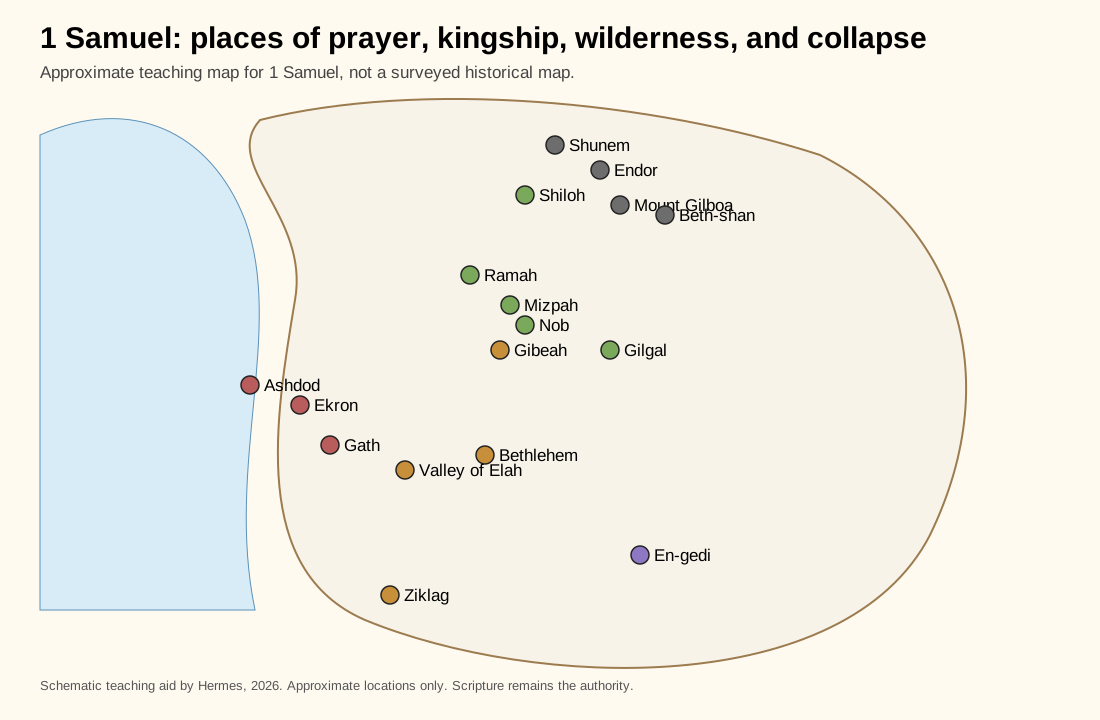 Generated schematic orientation map; not an ancient map or a reconstruction of exact territorial boundaries.
The genealogy chart carries a limited claim. Ruth closes by naming the line to David, but 1 Samuel reveals David first as the hidden shepherd chosen by God, not as a public dynasty-builder. Ruth 4:18–22 places David at the end of a genealogy rooted in God’s care for a widow and her family; the chart keeps that setting visible without making ancestry a substitute for faithfulness.
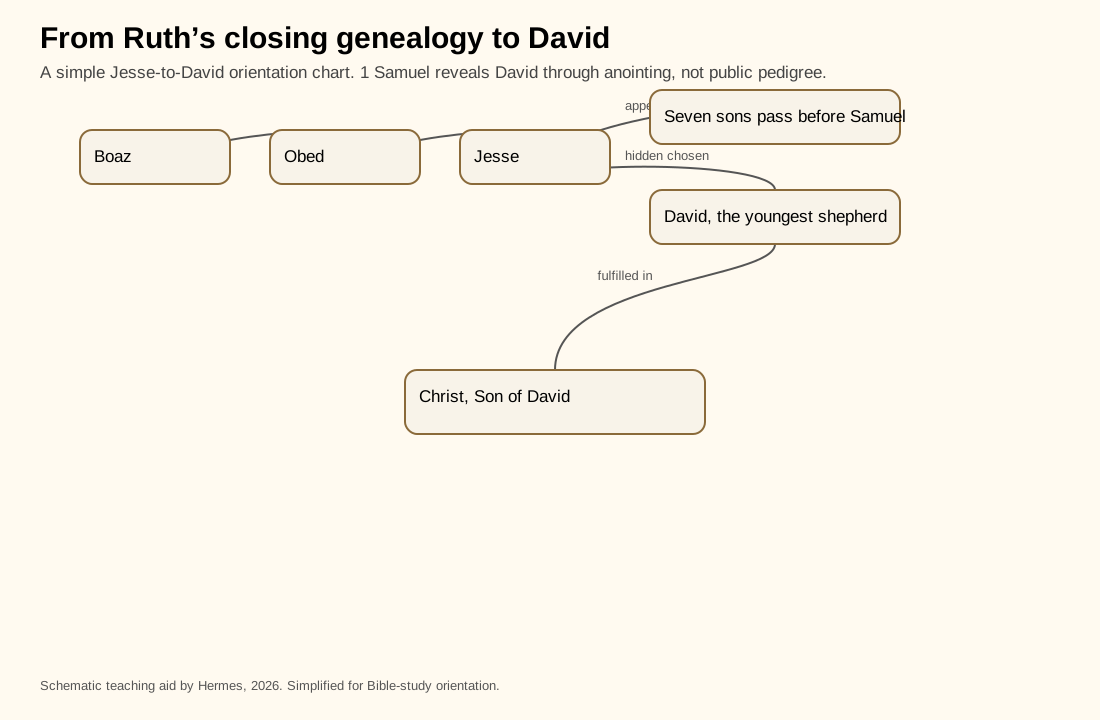 Generated schematic genealogy chart based on Ruth 4:18–22.
The relationship tree clarifies why Saul’s house becomes spiritually divided: Jonathan loves without rivalry, Michal is caught inside political pressure, Saul fears the future, and David must receive kingship without seizing it.
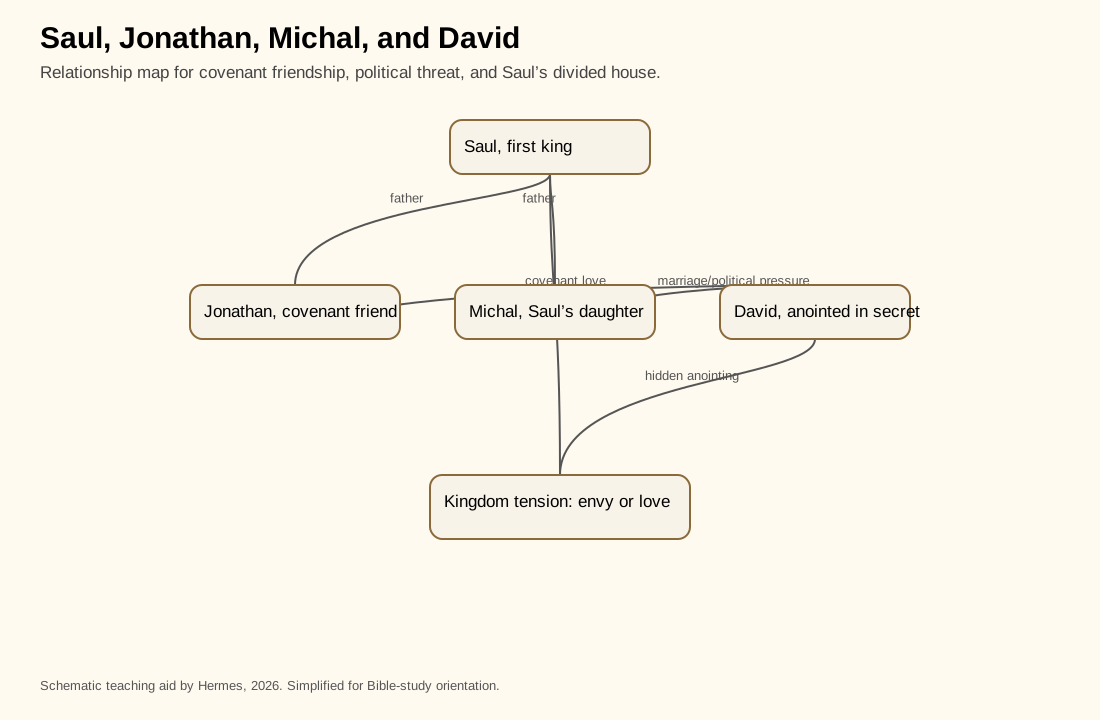 Generated schematic relationship chart of the principal figures in 1 Samuel.
The fresco of the Prophet Samuel in the Church of St Nicholas at Stavronikita Monastery, Mount Athos, belongs to Orthodox sacred art. It presents him among the prophets rather than reducing him to a figure in a royal chronicle. A fresco and a generated diagram have different authority: one belongs to a church’s iconographic setting, the other simply clarifies relationships or places.
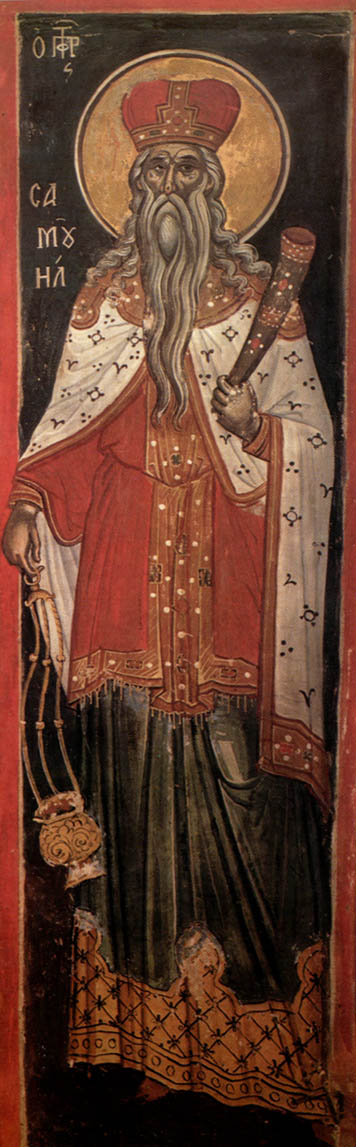 Source: 🔗 Prophet Samuel fresco, Stavronikita Monastery, Mount Athos.
Spiritual Fruit 🍇
-
Bring the real wound into prayer. Hannah carries the grief her husband cannot remove into the presence of the Lord. Name before God what you have learned to hide behind a polite answer. Her story gives the afflicted permission to pray truthfully; it gives no one permission to diagnose another person’s infertility or promise a child as the reward for sufficient faith.
-
Let service remain answerable to God. Eli’s sons take from worshippers instead of serving them, and their father’s loyalty to them becomes an excuse for failing the people. Examine one place where affection, reputation, or convenience has made you overlook harm. Honour for sacred office includes truthfulness about its responsibilities. Those injured by abuse need protection and care, not instructions to remain silent for the sake of appearances.
-
Do not confuse visibility with chosenness. Saul looks kingly before David appears. David is hidden before he is recognized. God often prepares His servants away from applause.
-
Let waiting train mercy. David’s greatness is not only that he fights Goliath. It is that he refuses to murder Saul when he has the chance. Before replying to someone who has threatened your standing or wounded your pride, let David’s refusal of vengeance interrupt the first impulse. Entrusting judgment to God can require boundaries and protection; it never requires becoming cruel in order to prove that you are strong.
-
Let Christ define kingship. Power in this book is judged by obedience, mercy, and surrender. Christ reigns from the Cross. Every other form of power must be examined under that light.
Hannah’s lips move, and God hears what others mistake. Samuel stands before a word he is afraid to deliver. David carries an anointing he must not turn into permission to seize the throne. Let the Lord receive our grief, correct our excuses, and teach our strength to become merciful.
Teaching Notes
- Suggested timing: 10 minutes for historical context, 15 minutes for Hannah and Samuel, 15 minutes for Saul and David, 10 minutes for Christological reading, 10 minutes for discussion and prayer.
- Where to linger: Hannah’s prayer, the danger of sacred office without repentance, and the contrast between Saul’s appearance and David’s hidden heart.
- Where to compress: Philistine background and route geography unless the specific guide needs it.
- Key phrases to say slowly: “The future of kingship begins with a barren woman praying.” “Holy things cannot be used to avoid repentance.” “The anointed one suffers before he reigns.”
- Pastoral warnings: Do not use Hannah to shame couples experiencing infertility. Do not use Eli’s failure to attack clergy broadly. Do not politicize the monarchy material. Keep the lesson spiritual, ecclesial, and Christ-centered.
- Show: Use the orientation map, genealogy chart, and relationship tree at the start so the class sees the movement from Shiloh to Bethlehem, wilderness, Endor, Gilboa, and the longing for Christ the true King.
Glossary
- 1 Kingdoms / Kings I: Septuagint title for 1 Samuel. This study cites 1 Samuel.
- Shiloh / Selom: sanctuary location in the opening chapters where Eli serves and Hannah prays.
- Lord God of Sabaoth: Lord of hosts, a title stressing divine authority over heavenly and earthly powers.
- Anointed / Christ:
Christosmeans anointed one; the Hebrew also speaks of the Lord’s anointed in 1 Samuel 2:10. The book’s anointed kings point ultimately to Christ.- Theocracy: God’s direct kingship over His people. Israel’s request for a king is judged because it seeks visible security like the nations.
Sources
Embedded Scripture is from Brenton’s English Septuagint (LXX). New Testament wording is from NKJV. Comparisons with the Hebrew text and NETS are identified where they affect the explanation.
Sir Lancelot C. L. Brenton, The Septuagint Version of the Old Testament: 🔗 1 Samuel 1, 🔗 2, 🔗 3, 🔗 17, and 🔗 18; 🔗 1 Samuel 8, 🔗 12, 🔗 15, and 🔗 16; 🔗 Ruth 4, 🔗 Judges 21, and 🔗 Deuteronomy 17. For the Hebrew comparison concerning Hannah’s rival, 🔗 1 Samuel 1:6.
Bernard A. Taylor, “To the Reader of the Old Greek Text of Reigns,” and 1 Reigns, in A New English Translation of the Septuagint (NETS), based principally on Alfred Rahlfs’s Greek edition. 🔗 NETS 1 Reigns.
St Augustine, The City of God, XVII.4, translated Marcus Dods, NPNF, First Series, volume 2. Direct interpretation of Hannah’s song. 🔗 Book XVII.
St Cyprian of Carthage, On the Lord’s Prayer, §5, translated Robert Ernest Wallis, ANF, volume 5. Direct use of Hannah’s silent prayer. 🔗 Treatise 4.
St John Chrysostom, On the Priesthood, Book IV, translated W. R. W. Stephens, NPNF, First Series, volume 9. Eli as an example in a discussion of responsibility for sacred office. 🔗 Book IV.
Fr Tadros Y. Malaty, First Samuel (2004), introduction, “Nomenclature” and “Topic”; translated Dr George Botros, English text revised Sameh Shafik and Ferial Moawad, Coptic Orthodox Christian Center, Orange, California. Modern Coptic commentary, distinguished from the ancient Fathers. 🔗 Commentary.
Tasbeha.org, Bright Saturday, “The Order the Praises and Matins”; Coptic Synaxarium notices for Hannah, Samuel, and David. See the worship footnotes for the individual notices.
Wikimedia Commons, Prophet Samuel Fresco, Church of St Nicholas, Stavronikita Monastery, Athos, the attribution page linked in the image caption.
Footnotes
-
Brenton, 🔗 Sirach 46:13–20; 🔗 Psalm 99:6 (LXX Psalm 98:6); 🔗 Jeremiah 15:1. Sirach’s remembrance of Samuel’s prophecy after death is not an instruction to imitate Saul’s resort to a medium. ↩ ↩2
-
NKJV, Acts 3:24; 13:20–23; Hebrews 11:32; Luke 1:32–33, 46–55; Matthew 12:3–4. 🔗 New Testament passages. ↩ ↩2 ↩3 ↩4
-
Brenton, 🔗 1 Samuel 2:9–10; Taylor, 🔗 NETS, 1 Reigns, 1 Samuel 2:9–10. For Hebrew “his anointed,” see 🔗 1 Samuel 2:10, Hebrew text. ↩ ↩2 ↩3
-
Brenton, 🔗 1 Samuel 17 and 🔗 18; Taylor, “1 Reigns,” in the 🔗 NETS introduction. The omission ranges above describe Brenton as displayed, not every Greek witness. ↩
-
Hebrew text: 🔗 1 Samuel 1:20, 🔗 1:28, 🔗 8:10, 🔗 12:13, and Saul’s name in 🔗 9:2. Compare Brenton’s note on 🔗 1 Samuel 12:13, and Malaty, introduction, “Nomenclature,” in 🔗 First Samuel. ↩ ↩2
-
St Augustine, The City of God, XVII.4, translated Marcus Dods, NPNF, First Series, volume 2. 🔗 Direct text. ↩
-
St Cyprian, On the Lord’s Prayer, §5, translated Robert Ernest Wallis, ANF, volume 5. 🔗 Direct text. ↩
-
St John Chrysostom, On the Priesthood, Book IV, opening discussion of responsibility, in the paragraph beginning “For (to leave the kingdom and to come to the priesthood…).” Translated W. R. W. Stephens, NPNF, First Series, volume 9. 🔗 Direct text. ↩
-
Brenton, 🔗 1 Kings 2:27, 35; NKJV, 🔗 Hebrews 2:17; 3:1–6. ↩
-
Brenton, 🔗 2 Samuel 7:12–16, and 🔗 Psalm 89 (LXX Psalm 88), especially 3–4, 20–29 and the lament beginning at 38. Biblical promise and Gospel fulfilment govern the typological reading. ↩
-
Tasbeha.org, Bright Saturday, “The Order the Praises and Matins,” gives the prayer of Hannah as 1 Samuel 2:1–10. 🔗 Published order. This reference identifies the song; Brenton’s closing narrative clause in 2:10 connects with 2:11. ↩
-
Coptic Synaxarium: 🔗 Hannah, Baba 6; Coptic Reader, Coptic Orthodox Metropolis of the Southern United States, “The Ninth Day of the Blessed Month of Paone,” “The Departure of Samuel the Prophet,” accessed through Readings > Liturgy > Synaxarion on Paone 9 (🔗 official app); 🔗 parallel Samuel notice, Paona 9; 🔗 David, Kiahk 23. The notices witness the commemorations and received remembrance; their retellings do not replace Brenton’s wording or settle Hebrew etymology. ↩