


The child who runs to Heli in the night will have to speak a word that Heli dreads to hear. Samuel’s calling begins with readiness, passes through guidance, and becomes a burden of truth. “Speak, for thy servant hears” is a beautiful prayer because it places the servant at God’s disposal, even before he knows what God will say. In a house where sacred service has been abused, the Lord prepares someone who will receive His word without turning it into an instrument of his own wishes.
Lesson Guide
- Key phrases: the lamp was burning before it was trimmed; Speak, for thy servant hears; none of his words fell to the ground
- Emphasize: hearing God requires humility, guidance, and obedience
- Avoid: making the chapter about private intuition or spiritual self-confidence
Historical and Scriptural Context
This study uses the familiar English book names. In the Septuagint, 1-2 Samuel and 1-2 Kings form the four books of Kingdoms, so this book is 1 Kingdoms there.
Hannah has entrusted her child to the Lord, and the warning against Heli’s house has already been pronounced in 1 Samuel 2:27-36. Chapter 3 brings these two stories together: the child offered in prayer receives a prophetic calling, while the judgment against the priestly house is confirmed. The opening describes a time when revelation was rare; the ending describes a prophet recognized throughout Israel. Between them lies the costly education of a listening servant.
Heli is Eli, and Selom is Shiloh. Those forms will appear together here so that readers can follow Brenton’s wording without losing the familiar names.
Geographical Significance ⛰️
The chapter remains at Shiloh, the sanctuary named in 1 Samuel 1:3. Samuel sleeps in the house where the ark of God is kept. The text gives no floor plan and does not say that he sleeps inside the most holy place. Its concern is God’s presence and initiative: the Lord calls a child who is already ministering there. Dan and Bersabee in verse 20 mark the northern and southern reach of Israel. A call heard at Shiloh becomes a word entrusted to the whole people.
The Characters 👥
Samuel is ready to serve before he understands the call. His repeated response shows willing attention, while verse 7 explains that the Lord’s word has not yet been revealed to him. He is being introduced to prophetic knowledge, not condemned as faithless.
Heli / Eli combines genuine discernment with grave failure. He finally recognizes the caller and gives Samuel sound instruction. Yet the truth he helps Samuel receive will expose his own negligence. His failing eyesight belongs first to the bodily circumstances of old age; it can suggest the wider spiritual crisis without making disability a sign of sin.
The Lord initiates, calls, reveals, judges, and remains with Samuel. The prophet’s authority begins in God’s gift, not in the child’s discovery of a special inward power.
The Rare Word and the Listening Child (1 Samuel 3:1-10)
- And the child Samuel ministered to the Lord before Heli the priest: and the word of the Lord was precious in those days, there was no distinct vision.
- And it came to pass at that time that Heli was sleeping in his place; and his eyes began to fail, and could not see.
- And the lamp of God was burning before it was trimmed, and Samuel slept in the temple, where was the ark of God.
- And the Lord called, Samuel, Samuel; and he said, Behold, here am I.
- And he ran to Heli, and said, Here am I, for thou didst call me: and he said, I did not call thee; return, go to sleep; and he returned and went to sleep.
- And the Lord called again, Samuel, Samuel: and he went to Heli the second time, and said, Behold here am I, for thou didst call me: and he said, I called thee not; return, go to sleep.
- And it was before Samuel knew the Lord, and before the word of the Lord was revealed to him.
- And the Lord called Samuel again for the third time: and he arose and went to Heli, and said, Behold, I am here, for thou didst call me: and Heli perceived that the Lord had called the child.
- And he said, Return, child, go to sleep; and it shall come to pass if he shall call thee, that thou shalt say, Speak, for thy servant hears: and Samuel went and lay down in his place.
- And the Lord came, and stood, and called him as before: and Samuel said, Speak, for thy servant hears.
“Precious” describes a word that is rare, as NETS also explains in its note on verse 1. The chapter places that scarcity beside the corruption of Heli’s household, but it does not state why the Lord has given few visions. We should feel the seriousness of the setting without pretending to know an unstated divine reason. Amos 8:11-12 later describes a famine of hearing the Lord’s word, a hunger that food cannot relieve. The comparison helps us recognize the gift of revelation: access to religious activity cannot compel God to speak, and a busy sanctuary may still need renewal.1
The lamp is a real sanctuary lamp before it becomes an image in Christian meditation. Exodus 27:20-21 and Leviticus 24:2-4 prescribe pure olive oil and the tending of the lamps from evening until morning. Brenton says that the lamp “was burning before it was trimmed.” This differs from the familiar Hebrew-based wording about the lamp not yet going out. The Lord’s call comes while sanctuary service continues. Read spiritually, the burning lamp may strengthen hope that God still cares for His people; its literal meaning does not by itself prove the holiness of everyone serving beside it.2
Samuel runs because he thinks Heli has called. He is not yet seeking a dramatic spiritual experience. The need he recognizes is the ordinary claim of an older person upon his service. After the first misunderstanding he returns to sleep; after the second he does the same; after the third Heli understands. God’s patience gives the child time to learn. The account frees beginners from the fear that an imperfect understanding means their service has been useless. Samuel’s readiness is real, and revelation is still God’s gift.
Verse 7 also protects an important distinction. Heli’s sons “knew not the Lord” in 2:12 while treating worship with contempt. Samuel has not yet known Him through the revelation now being granted. Fr. Tadros Y. Malaty makes this distinction explicitly in his commentary: Samuel’s knowledge through faith and daily service precedes his knowledge through the divine voice, whereas the sons’ failure concerns obedience and fellowship with God.3 Serving near holy things is not the same as knowing the Lord. Yet this warning must never erase Samuel’s faithful beginning, or teach children that years of worship and service mean nothing until they report an extraordinary experience. Their formation matters; it must continue into a personal, obedient response to God.
Heli’s counsel is short enough to carry into sleep: “Speak, for thy servant hears.” The servant first makes himself available. He does not specify a message, demand consolation, or bargain for an easier vocation. Guidance has helped him turn toward God. Heli’s genuine help also prevents a careless judgment that a flawed guide can never speak truth. At the same time, the chapter gives no permission for blind submission to harmful demands. Sound spiritual counsel leads toward the Lord’s commandments; it cannot excuse concealment of abuse or require a person to participate in sin.
Language insight: the repeated name and the Lord who stands
In the Rahlfs-based text translated by NETS, the doubled call “Samouel! Samouel!” appears explicitly in verses 4 and 6. Verse 8 describes the third call without printing the name twice, and verse 10 says that the Lord called as before. Brenton follows this same pattern. Repetition expresses the Lord’s persistent address, but the story should not be retold as though every call contains an explicit doubled name.4
“The Lord came, and stood” in verse 10 makes the encounter more than Samuel’s inward reflection. The narrative describes a divine manifestation, or theophany: God makes Himself known to His servant. It does not describe a bodily appearance in detail, nor say that Samuel sees the divine essence. In a Christian reading of this encounter, as of the Lord’s manifestations in Judges, we may contemplate the divine Word through whom God reveals Himself, whose coming in the flesh makes the Father’s love known. This is a Christological reading within the whole of Scripture, not a claim that this verse alone identifies the precise manner of the appearance or names a pre-incarnate Person.
From the servant’s ear to the incarnate Word
Isaiah 50:4-5 presents the servant whose ear is opened and who does not disobey. Samuel’s listening helps us approach that obedience, but Christ is infinitely more than another prophet learning to recognize a message. The one incarnate Word obeys the Father in the flesh He made His own. In John 8:28 and 12:49-50, He speaks what the Father has given Him to speak. John 5:19 also says that whatever the Father does, the Son does in like manner: His union with the Father includes the divine works, not the incapacity of a lesser god. The obedience of His saving life belongs to the eternal Son Himself, not to a separate human subject alongside Him. Samuel receives the Lord’s word; Christ is the Word who has come among us and brings our life into communion with the Father.5
Malaty’s chapter 3 likewise turns from Samuel hearing a voice to the divine Word coming incarnate so that believers may know and abide in Him. This is the direction of Christian listening. We open Scripture to meet Christ and be changed by Him, not to collect experiences that make us feel spiritually important.3
The Church’s Voice in Worship ⛪
The Agpeya, the Coptic Book of Hours, gives this listening a concrete form in its Introduction to Midnight. It asks: “Grant us sobriety, O Lord, that we may know how to stand before You at times of prayer”.6 Sobriety here means spiritual wakefulness and steadiness before God. Like Samuel, the worshipper stands ready to receive rather than control. This is a connection in the life of prayer, not an assertion that Samuel’s chapter is an Agpeya reading. The prayer also asks forgiveness: wakefulness before God is joined to repentance, not to confidence in one’s spiritual sensations.
Lesson Guide
- Key phrases: the lamp was burning before it was trimmed; listening is learned in humility
- Emphasize: discernment needs obedience and guidance
- Avoid: turning this into a vague lesson about following intuition
The First Word Samuel Must Carry Is Judgment (1 Samuel 3:11-18)
- And the Lord said to Samuel, Behold, I execute my words in Israel; whoever hears them, both his ears shall tingle.
- In that day I will raise up against Heli all things that I have said against his house; I will begin, and I will make an end.
- And I have told him that I will be avenged on his house perpetually for the iniquities of his sons, because his sons spoke evil against God, and he did not admonish them.
- And it shall not go on so; I have sworn to the house of Eli, the iniquity of the house of Eli shall not be atoned for with incense or sacrifices for ever.
- And Samuel slept till morning, and rose early in the morning, and opened the doors of the house of the Lord; and Samuel feared to tell Heli the vision.
- And Heli said to Samuel, Samuel, my son; and he said, Behold, here am I.
- And he said, What was the word that was spoken to thee? I pray thee hide it not from me: may God do these things to thee, and more also, if thou hide from me any thing of all the words that were spoken to thee in thine ears.
- And Samuel reported all the words, and hid them not from him. And Heli said, He is the Lord, he shall do that which is good in his sight.
The first message is severe enough to make both ears tingle. Samuel has been taught to hear, and now he learns that hearing may hurt. The warning confirms what the Lord has already spoken against Heli’s house. “I will begin, and I will make an end” leaves no room to reduce the earlier word to an unpleasant prediction that can be ignored. Heli’s household has treated God’s gifts as though they belonged to the household itself; the Lord declares His authority over His own sanctuary.
Verse 13 names both the sons’ evil and Heli’s failure. The sons are responsible for what they have done. Heli is responsible for failing to confront conduct entrusted to his oversight. The account does not make every parent guilty for every choice made by an adult child. It addresses known wrongdoing in a priestly household whose father has a real duty to act. In parish life, that distinction matters. Compassion for a struggling family must remain, while familiarity, status, or affection must never become reasons to leave others exposed to harm.
Language insight: “spoke evil against God”
NETS confirms that the Greek account in verse 13 makes God the object of the sons’ reviling. The received Hebrew text instead has wording commonly rendered “made themselves vile.” Brenton’s “spoke evil against God” is therefore a significant feature of the Greek text, not a loose paraphrase. Their contempt for sacrifice is an offense against the God to whom sacrifice belongs. The distinction sharpens the chapter’s burden: negligence toward worship and the people who come to worship is not a private matter within an influential family.7
The oath in verse 14 closes off incense and sacrifices as a means of averting this declared judgment. Sacred acts cannot be used to purchase protection for deliberate rebellion. Numbers 15:30-31 distinguishes the person acting with a presumptuous hand, despising the Lord’s word, from the person who sins unwittingly. Hebrews 10:26-31 gives a related warning about knowingly rejecting the sacrifice of Christ and treating the covenant as common. These passages expose defiance maintained against God’s truth, not every fall of a weak Christian who seeks mercy. The anxious penitent must not hear “there is no hope for me” in a sentence directed against hardened contempt. The same Hebrews passage has just called believers to draw near with a true heart and hold fast their confession in 10:19-23. Come to Christ, confess honestly, and accept correction; do not use ritual to keep a cherished wrong untouched.8
At morning Samuel opens the doors. Revelation has not relieved him of ordinary service. He continues the work already entrusted to him while carrying a word he fears to speak. This small detail is a strong test of vocation. A person who has received more responsibility still attends to the unnoticed task. A servant who feels spiritually stirred can return to the room that needs preparing, the child who needs attention, or the person who has been waiting for help. The gift is proved in faithfulness, not in exemption from humble work.
Heli calls him “my son” and asks for the whole message. Samuel’s fear is recorded, but the text does not tell us its precise motive. Love, dependence, and the severity of the warning make the conversation painful enough without inventing thoughts for him. He reports all the words and hides nothing. Truthfulness here is neither pleasure in another’s disgrace nor the protection of a beloved elder at God’s expense. It is the difficult service of allowing the Lord’s word to be heard intact.
Heli responds, “He is the Lord, he shall do that which is good in his sight.” The confession acknowledges God’s right to judge. Yet this chapter records no decisive correction of his sons, and the final verse still describes their evil. Acceptance of consequences is not the same as restored obedience. We can acknowledge that a rebuke is deserved while avoiding the actual repair it requires: restitution, truthful disclosure, a changed practice, or protection for those harmed. Reverent words must become a return to the Lord’s will.
Gems from the Fathers 💎
St. John Chrysostom addresses this difficulty directly when preaching on Acts 3:1 in Homily VIII on Acts. He asks why Heli is said not to have admonished his sons when chapter 2 records a rebuke. His answer is that a warning which leaves the wrong unchecked can still be a failure of responsibility. Turning the warning upon his own pastoral ministry, he says: “I fear we shall have to give an account at the coming Day of this excessive and unseasonable leniency.”9 He seeks his hearers’ salvation, not his own reputation. The passage calls responsible love to act while there is time to help. It must not be used to justify intimidation or cruelty; effective correction seeks healing and the safety of those affected, rather than control for its own sake.
Samuel announces a judgment he cannot remove. In Christ, the warning against empty sacrifice meets the gift of the true High Priest. Hebrews 10:10-14 proclaims His one offering, and 1 Peter 2:24 says that He bore our sins in His body on the tree so that we might live for righteousness. His Cross grants forgiveness that changes our allegiance. It is not permission to continue the contempt for which Heli’s house is judged.10
Lesson Guide
- Key phrases: the first prophetic word is heavy; truth is not flattery
- Emphasize: prophecy requires courage and fear of God
- Avoid: admiring Samuel as spiritually gifted while ignoring the burden of truth
The Lord Establishes the Prophet (1 Samuel 3:19-21)
- And Samuel grew, and the Lord was with him, and there did not fall one of his words to the ground.
- And all Israel knew from Dan even to Bersabee, that Samuel was faithful as a prophet to the Lord.
- And the Lord manifested himself again in Selom, for the Lord revealed himself to Samuel; and Samuel was accredited to all Israel as a prophet to the Lord from one end of the land to the other: and Heli was very old, and his sons kept advancing in wickedness, and their way was evil before the Lord.
Samuel grows, and the Lord is with him. “There did not fall one of his words to the ground” describes the dependable prophetic word God sustains through him. It is not a promise that every casual remark or personal opinion of a religious leader becomes revelation. Samuel’s calling is confirmed by the Lord’s faithfulness, and Israel learns to recognize him as a faithful prophet.
The opening scarcity has given way to renewed manifestation at Shiloh. The Lord who first addressed the child continues to reveal Himself. Recognition stretches from Dan to Bersabee, but the text places God’s presence before the nation’s recognition. A platform can spread a person’s words; it cannot make those words true. This distinction protects servants from measuring their calling by invitations, praise, or influence. Receive the duty already given, speak carefully, and let the fruit be tested over time.
Language insight: the longer ending
The Rahlfs-based NETS text confirms the longer ending preserved by Brenton in verse 21: Samuel is accredited throughout Israel, Heli is very old, and his sons keep advancing in an evil way. This fuller close matters to the reading. The rise of a faithful prophet does not mean that the sanctuary’s corruption has already been healed. Renewal and worsening evil stand beside one another as the account approaches the loss of the ark in chapter 4.4
The Lord’s presence with Samuel gives hope without pretending the crisis is over. We may be called to serve faithfully while an institution remains troubled, but faithfulness includes refusing its evil and protecting those affected. Samuel’s growth is neither flight from responsibility nor accommodation to wrongdoing. The word he carries belongs to the Lord and therefore has authority even over the house in which he was formed.
Christ brings the prophetic witness to its fullness. Hebrews 1:1-3 distinguishes God’s speech through the prophets from His speech in the Son, through whom He made the worlds. Samuel is a faithful bearer of a received word; the Son is the radiance of God’s glory. We listen to Samuel rightly when his truthful witness leads us to hear Christ, whose words endure (Matthew 24:35).11
Lesson Guide
- Key phrases: none of his words fell to the ground
- Emphasize: spiritual authority is established by God through faithfulness
- Avoid: equating recognition by people with holiness by itself
Iconography Connection 🖼️
The Prophet Samuel fresco presents the prophet within the Church’s remembrance. Read beside this chapter, his image directs attention to the servant who hears and then carries God’s word. His calling includes the fear and courage of truthful witness, as well as the quiet readiness of the night.
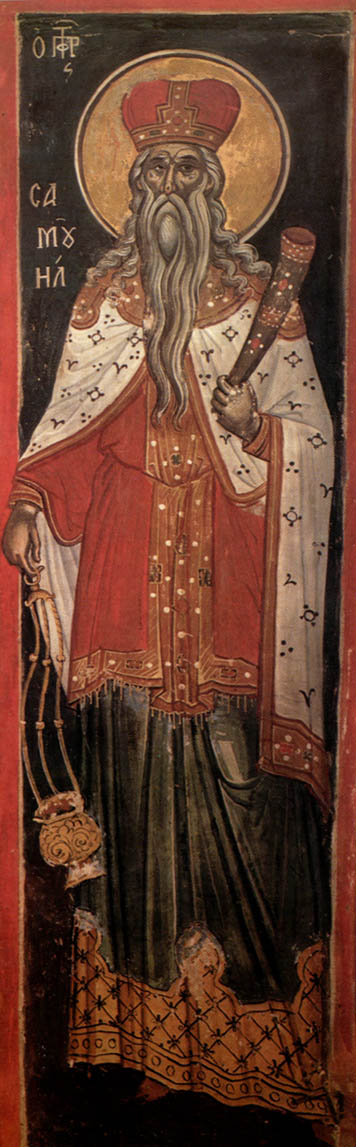 Source: 🔗 Prophet Samuel fresco, Stavronikita Monastery, Mount Athos.
| Passage | What the text makes visible | Response in life with Christ |
|---|---|---|
| 3:1-10 | The Lord calls patiently; Samuel learns with guidance. | Receive Scripture humbly and seek counsel that leads to obedience. |
| 3:11-18 | Revelation exposes tolerated evil; Samuel speaks truth and opens the doors. | Join confession to repair, and continue ordinary service without concealment. |
| 3:19-21 | The Lord sustains His prophet while corruption remains. | Test speech by truth and faithfulness, not popularity; hear the Son to whom the prophets witness. |
Spiritual Fruit 🍇
Prepare to hear before choosing the answer. Before reading Scripture, pray Samuel’s words: “Speak, for thy servant hears.” Then read attentively enough to name one command, warning, or promise that challenges your usual response. If your first impulse is to excuse yourself, remain with that sentence and ask Christ for an honest heart. Listening begins to bear fruit when the word is allowed to change what we do.
Seek guidance without surrendering conscience. Samuel’s repeated return to Heli teaches a humility that can learn. Bring a troubling interpretation or inner impression to a trustworthy spiritual father, and test it by Scripture and the Church’s faith. A counsel that asks you to hide harm, consent to sin, or neglect another person’s safety is not the obedience taught by this passage. The Lord who judges Heli’s negligence cannot be invoked to protect negligence now.
Make repentance more than agreement. Heli can acknowledge the Lord’s judgment; the sons still continue in wickedness. When a rebuke reveals something true, name the action that would make your acknowledgment honest. Apologize without defending the injury, restore what was taken, or change the conditions that let a wrong continue. The fearful Christian who wants to return should take this as a path toward healing, not as evidence that mercy has ended.
Open the doors. Samuel resumes his morning task before Israel knows his name as a prophet. Choose a neglected duty that love has already placed before you, and do it without seeking recognition. The quiet work does not compete with prayer. It can become the first place where the prayer “thy servant hears” is fulfilled.
Lord Jesus Christ, You are the Word who has come near to us. As Samuel returns to his place, teach me to lay aside the answers I have already decided to hear. When morning comes, let me open the doors entrusted to me and speak the truth I would rather avoid. Grant me a repentant heart, steady service, and the courage to receive Your mercy without hiding from Your word.
Teaching Notes
The Rare Word and the Listening Child (1 Samuel 3:1-10)
- Ask: What does Samuel do faithfully before he understands the call?
- Watch for: Claims that age or impaired eyesight prove spiritual failure, or that every inner impression is God’s voice. Guidance must not become cover for coercion or concealed harm.
The First Word Samuel Must Carry Is Judgment (1 Samuel 3:11-18)
- Ask: Why does Samuel’s opening of the doors matter after such a night?
- Watch for: Using verse 14 to drive a repentant person to despair or to deny the mercy received in confession. Numbers 15 and Hebrews 10 concern defiant contempt, not the ordinary penitent seeking Christ.
The Lord Establishes the Prophet (1 Samuel 3:19-21)
Ask: What establishes Samuel’s word before the nation recognizes him?
Watch for: Treating popularity as holiness or every statement of a spiritual leader as inspired prophecy.
Sources
Embedded Scripture is from Brenton’s English Septuagint (LXX).
Sir Lancelot Charles Lee Brenton, The Septuagint Version of the Old Testament, 1 Samuel, chapter 3. 🔗 Chapter text.
Bernard A. Taylor, 1 Reigns, in A New English Translation of the Septuagint, introduction and 1 Samuel 3:1-21. The translation identifies Rahlfs’s Greek edition as its basis. 🔗 1 Reigns.
St. John Chrysostom, Homilies on Acts, Homily VIII on Acts 3:1, concluding exhortation referring to Heli. 🔗 Direct passage.
Fr. Tadros Y. Malaty, The First Book of Samuel (2004), chapter 3, “The Call to Samuel,” especially subsection 1(c) on Samuel’s knowledge of the Lord. A modern Coptic commentary, distinguished here from the ancient patristic witness. 🔗 Commentary.
Agpeya, Introduction to Midnight. 🔗 Prayer text.
Prophet Samuel fresco, Stavronikita Monastery, Mount Athos. Attribution accompanies the image above.
Footnotes
-
NETS, 1 Reigns, 1 Samuel 3:1 and note; Amos 8:11-12. 🔗 NETS; 🔗 Amos. ↩
-
Exodus 27:20-21; Leviticus 24:2-4, Brenton. 🔗 Exodus; 🔗 Leviticus. ↩
-
Fr. Tadros Y. Malaty, The First Book of Samuel (2004), chapter 3, subsection 1(c), distinguishes Samuel’s lack of prophetic revelation from the sons’ lack of obedient fellowship, then turns to the incarnate Word. 🔗 Commentary. ↩ ↩2
-
Bernard A. Taylor, NETS, 1 Reigns, 1 Samuel 3:4, 6, 8, 10, 21, and introduction on the Greek text. NETS also includes “Lord” in Heli’s instruction at 3:9, where the Brenton text quoted here omits it; the response at 3:10 omits it in both. 🔗 Direct text. ↩ ↩2
-
Isaiah 50:4-5; John 5:19; 8:28; 12:49-50. 🔗 Isaiah; 🔗 John. ↩
-
Agpeya, Introduction to Midnight, prayer beginning “Arise O children of the light”. 🔗 Direct prayer. ↩
-
NETS, 1 Reigns, 1 Samuel 3:13; compare the received Hebrew wording in 1 Samuel 3:13. 🔗 NETS; 🔗 Hebrew text and analysis. ↩
-
St. John Chrysostom, Homilies on Acts, Homily VIII on Acts 3:1, concluding exhortation on Heli and pastoral correction; NPNF, First Series, vol. 11, translated by J. B. Morris and W. H. Simcox. 🔗 Direct passage. ↩