


This narration predates the current revision and may differ from the written study.
The chapter begins with a lamp tended through the night and bread set before the Lord week after week. It then follows a quarrel in which the holy Name is cursed. Sanctuary service and ordinary speech stand under the same divine holiness. The light must be kept, the gifts must be ordered, and anger must not be allowed to make God’s name an instrument of contempt.
Orientation
The lamp and the table stand outside the inner veil, in the sanctuary where Aaron and his sons serve the Lord. A narrated dispute then interrupts the instructions. Moses waits for the Lord’s command, and the ruling joins reverence for God to one judgment for native and stranger. The ancient penalty must be read plainly without making it a command for contemporary religious violence.
Iconography and Visual Teaching 🖼️
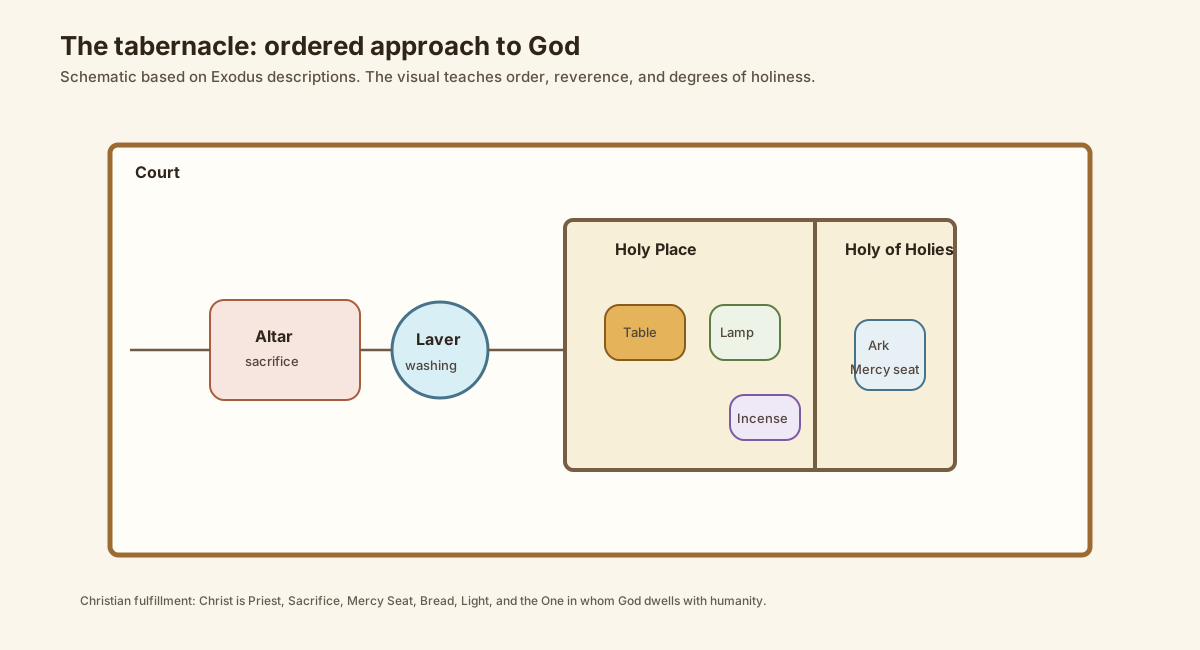 Source: Tabernacle plan schematic, based on Exodus 26–27.
The lampstand and table stand in the sanctuary outside the inner veil.
Oil and light before the Lord (Leviticus 24:1–4)
Brenton prints “beaten” olive oil and names Aaron and his sons; NKJV describes pressed olives and names Aaron. The same numbered unit is retained below without altering either detail in Brenton.1
1 And the Lord spoke to Moses, saying,
2 Charge the children of Israel, and let them take for thee pure olive oil beaten for the light, to burn a lamp continually,
3 outside the veil in the tabernacle of witness; and Aaron and his sons shall burn it from evening until morning before the Lord continually, a perpetual statute throughout your generations.
4 Ye shall burn the lamps on the pure lamp-stand before the Lord till the morrow.
The oil is not described vaguely. It is pure olive oil beaten for the light, brought by Israel for the lamp’s continual service. Aaron and his sons tend it from evening until morning outside the veil. The people provide the material, the priests serve, and the lamp burns before the Lord. The unbroken pattern depends on ordinary acts faithfully repeated.
Exodus 27:20-21 gives the same instruction within the tabernacle commands. Here it returns after the feast calendar: holy seasons do not replace the daily tending of the light. In John 8:12, Christ declares Himself the light of the world. He gives the light of life to those who follow Him, a fulfillment beyond an oil-fed flame. Matthew 5:14-16 describes His disciples’ light through good works that glorify the Father; their witness is received from Him, not manufactured for their own display.
The Church’s Voice in Worship ⛪
At the Sixth Hour of Tuesday in Holy Pascha the Gospel is John 8:12–20, where Christ declares Himself the light of the world.2 This related Gospel places the sanctuary lamp beside the true Light who saves through His Passion.
The Sunday Theotokia’s fifth part sings of the Theotokos: “You are the lampstand, made of pure gold, carrying, the ever-burning lamp.” It immediately identifies the Light as “The True God, out of True God, who was incarnate, of you without change.”3 The hymn does not identify Mary with the divine Light. She bears God the Word incarnate, who enlightens those sitting in darkness.
Lesson Guide
- Key phrases: “pure olive oil beaten”; “from evening until morning”; “before the Lord”
- Emphasize: Continual light involves the people’s provision and faithful priestly service before God.
- Avoid: Losing the specific olive oil or confusing the bearer of the Light with Christ Himself.
Twelve loaves, frankincense, salt, and covenant (Leviticus 24:5–9)
At verse 7 Brenton names frankincense and salt, while NKJV names frankincense without salt. Brenton’s complete sentence is printed below. The difference belongs to the editions’ wording, and no cause is asserted here.1
5 And ye shall take fine flour, and make of it twelve loaves; each loaf shall be of two tenth parts.
6 And ye shall put them in two rows, each row containing six loaves, on the pure table before the Lord.
7 And ye shall put on each row pure frankincense and salt; and these things shall be for loaves for a memorial, set forth before the Lord.
8 On the sabbath-day they shall be set forth before the Lord continually before the children of Israel, for an everlasting covenant.
9 And they shall be for Aaron and his sons, and they shall eat them in the holy place: for this is their most holy portion of the offerings made to the Lord, a perpetual statute.
Twelve loaves of fine flour are arranged in two rows of six on the pure table. They stand continually before the Lord for an everlasting covenant and are renewed on the Sabbath. Aaron and his sons then eat them in the holy place as their most holy portion. The ordered bread joins the people represented by its number, the Lord’s covenant, and the food given to His ministers.
Verse 7 names both pure frankincense and salt. These accompany the loaves as a memorial set before the Lord. The offering’s memorial is more than a reminder retained in someone’s mind: it is a consecrated presentation before God. Leviticus 2:13 names the salt of the covenant, giving the salt here a direct scriptural neighbor; verse 8 explicitly calls the arrangement an everlasting covenant. The salt belongs to this consecrated presentation. Its presence does not determine the composition of Coptic offering bread, which belongs to the Church’s received rite.
Hebrews 9:2 recalls the lampstand, table, and showbread in the first sanctuary. Matthew 12:1-8 places the holy bread within Christ’s teaching about David, hunger, mercy, and the One greater than the temple. The Lord’s defense of His disciples does not make the bread common; it reveals that the holy law must be understood before Him, with the mercy He commands.
Gems from the Fathers 💎: Bread of heaven
St. Cyril of Jerusalem, teaching the newly baptized about the Eucharist, distinguishes the old showbread from the new heavenly gift: “In the Old Testament also there was show-bread; but this, as it belonged to the Old Testament, has come to an end; but in the New Testament there is Bread of heaven, and a Cup of salvation, sanctifying soul and body; for as the Bread corresponds to our body, so is the Word appropriate to our soul.”4 His comparison leads beyond resemblance to the sanctification of the communicant’s whole person. Christ gives His Flesh for the world’s life in John 6:48-51. The sanctuary’s holy bread helps us understand the preparation; Christ Himself gives the fullness.
Lesson Guide
- Key phrases: “twelve loaves”; “pure frankincense and salt”; “a memorial”; “everlasting covenant”
- Emphasize: The memorial is presented before God, and its salt is read beside the covenant language.
- Avoid: Equating the showbread’s ingredients with the Coptic offering bread.
A quarrel and THE NAME (Leviticus 24:10–12)
Brenton describes the man as having “named THE NAME and cursed”; NKJV describes blaspheming the Lord’s name and cursing. The printed capitals below are retained. The narrative’s cursing remains essential to understanding the offense.1
10 And there went forth a son of an Israelitish woman, and he was son of an Egyptian man among the sons of Israel; and they fought in the camp, the son of the Israelitish woman, and a man who was an Israelite.
11 And the son of the Israelitish woman named THE NAME and cursed; and they brought him to Moses: and his mother’s name was Salomith, daughter of Dabri of the tribe of Dan.
12 And they put him in ward, to judge him by the command of the Lord.
A man whose mother is Israelite and whose father is Egyptian fights with an Israelite in the camp. The narrative identifies his family and his mother Salomith’s tribe of Dan, but it does not make ancestry the cause of his sin. During the quarrel he names THE NAME and curses. The capital letters preserve Brenton’s striking rendering: what is holy has been dragged into anger.
The man is brought to Moses and kept in ward while the Lord’s command is sought. The pause matters. A grave accusation is not permission for the nearest angry person to decide the punishment. The command against taking God’s name in vain in Exodus 20:7 stands behind the offense, while Sirach 23:7-14 teaches discipline of the mouth and warns against habitual swearing and misuse of the Holy One’s name.
The wrong is recognizable even without an ancient court. Anger can make a person’s most sacred words serve the desire to wound or win. Reverence must enter the quarrel, where the tongue is least willing to be governed.
Lesson Guide
- Key phrases: “named THE NAME and cursed”; “brought him to Moses”; “put him in ward”
- Emphasize: The offense is narrated in a quarrel, and judgment waits for the Lord’s command.
- Avoid: Blaming mixed ancestry or making the account an ethnic accusation.
Witnesses, the sentence, and Christ accused (Leviticus 24:13–16)
At verse 16 Brenton uses naming language, while NKJV explicitly names blasphemy. The cursing in verses 11 and 15 supplies the immediate context. Neither the wording difference nor the ancient sentence authorizes contemporary religious violence.1
13 And the Lord spoke to Moses, saying,
14 Bring forth him that cursed outside the camp, and all who heard shall lay their hands upon his head, and all the congregation shall stone him.
15 And speak to the sons of Israel, and thou shalt say to them, Whosoever shall curse God shall bear his sin.
16 And he that names the name of the Lord, let him die the death: let all the congregation of Israel stone him with stones; whether he be a stranger or a native, let him die for naming the name of the Lord.
The witnesses who heard the curse lay their hands on the accused man’s head outside the camp, and the congregation is commanded to stone him. Those who heard are publicly involved in the solemn act; the penalty is neither private revenge nor an unaccountable rumor. Verse 15 names responsibility for cursing God, and verse 16 applies the ruling to stranger and native alike.
Brenton’s “he that names the name of the Lord” is startling. Read within verses 11 and 15, it concerns the cursed Name of the narrated offense; NKJV explicitly uses blasphemy language. It cannot mean that reverent prayer to God is itself a capital crime. The chapter records an ancient covenant death sentence. It grants no Christian individual, parish, or state a mandate to kill someone for religious speech.
The blasphemy charge comes into the Passion in Matthew 26:63-66: the high priest declares Christ deserving of death after His confession concerning the Son of Man. John 10:33 also records an attempted stoning under the accusation that He makes Himself God. The Gospel reveals the tragedy of invoking God’s honor against God the Word incarnate. The cure for zeal without truth is to know and obey Christ, not to direct collective blame at Jewish people.
Gems from the Fathers 💎: The Name hallowed in a human life
St. Cyprian interprets the prayer in Matthew 6:9 as a petition for our sanctification: “After this we say, Hallowed be Your name; not that we wish for God that He may be hallowed by our prayers, but that we beseech of Him that His name may be hallowed in us.”5 The holy Name calls for a holy response in us. Philippians 2:9-11 sets confession and worship before the exalted name of Jesus, while Acts 4:12 announces salvation in no other name. Christian reverence comes to its proper expression in worship, repentance, and faithful confession.
Lesson Guide
- Key phrases: “all who heard”; “lay their hands”; “stranger or a native”
- Emphasize: The witnesses are publicly answerable, and the sentence belongs to this ancient covenant ruling.
- Avoid: Applying a modern death penalty or construing all reverent naming as blasphemy.
Measured justice and one judgment (Leviticus 24:17–22)
At verse 21 NKJV again mentions animal restitution alongside homicide; Brenton repeats the homicide sentence only. The animal-restoration command is already present in Brenton verse 18, which is retained within this complete unit.1
17 And whosoever shall smite a man and he die, let him die the death.
18 And whosoever shall smite a beast, and it shall die, let him render life for life.
19 And whosoever shall inflict a blemish on his neighbour, as he has done to him, so shall it be done to himself in return;
20 bruise for bruise, eye for eye, tooth for tooth: as any one may inflict a blemish on a man, so shall it be rendered to him.
21 Whosoever shall smite a man, and he shall die, let him die the death.
22 There shall be one judgment for the stranger and the native, for I am the Lord your God.
Homicide, the killing of an animal, and injury to a neighbor receive distinct judgments. The animal’s loss is repaired with life for life; the taking of a human life receives the death sentence in this ancient law. Injury is answered with a corresponding penalty, not an unlimited escalation. The chapter repeats the homicide ruling and then states one judgment for stranger and native. A stranger’s vulnerability must not become an excuse for a lesser justice.
Leviticus 19:34 joins this legal equality to love of the stranger as oneself. The same God who commands a protected judgment commands love. Such equality is demanding when sympathy naturally gathers around our own family, faction, or nation.
Gems from the Fathers 💎: Restraining the hand and healing the heart
St. John Chrysostom explains the older retaliation law while commenting on Matthew 5:38-42: “And besides, He commanded this, not that we might strike out one another’s eyes, but that we might keep our hands to ourselves.”6 He sees its measured threat as a restraint on violence, then follows Christ’s command into freedom from vengeance. Christ heals the heart that would answer every hurt by inflicting another.
Non-retaliation does not require remaining in abuse, concealing a crime, refusing lawful protection, or returning to an unsafe home. A victim can seek safety, report wrongdoing, and receive help without pursuing personal vengeance. Mercy and the protection of the vulnerable belong together. Otherwise the command intended to free the heart can be misused to protect an aggressor.
Lesson Guide
- Key phrases: “life for life”; “eye for eye”; “one judgment”
- Emphasize: The law distinguishes harms and limits escalation while applying one judgment to native and stranger.
- Avoid: Equating Christian non-retaliation with submission to continuing abuse.
The command carried out (Leviticus 24:23)
23 And Moses spoke to the children of Israel, and they brought him that had cursed out of the camp, and stoned him with stones: and the children of Israel did as the Lord commanded Moses.
Moses delivers the ruling, and the people carry it out. The chapter does not leave the death sentence as a literary figure: the man is taken outside the camp and stoned. That ending must be faced with the same honesty as the sanctuary’s bread and light. Israel’s covenant order treated profanation of the Name as a mortal offense.
The Church reads this ancient judgment through Christ, who receives the accusation of blasphemy and gives His life for our salvation. The serious character of speech remains; the path of Christian response is repentance and fidelity to Him. The believer must neither trivialize the Name nor use its holiness as a pretext to harm another person. The lamp is tended before the Lord, and the tongue must learn to stand before Him too.
Lesson Guide
- Key phrases: “out of the camp”; “stoned him”; “as the Lord commanded”
- Emphasize: The narrative records an actual execution within Israel’s ancient covenant setting.
- Avoid: Softening the penalty into metaphor or reviving it as a Christian command.
Glossary
- Beaten olive oil: The pure oil prepared for the light, as the verse describes it.
- Lampstand: The sanctuary stand bearing the lamps outside the inner veil.
- Tabernacle of witness: The sanctuary tent, associated with God’s covenant testimony.
- Veil: The curtain separating the inner holy place from the outer sanctuary.
- Fine flour: The flour used for the twelve loaves.
- Tenth part: The portion measure specified for each loaf.
- Frankincense: The aromatic substance placed with the bread as part of the memorial.
- Salt: The substance explicitly present in Brenton 24:7, read beside the salt of the covenant in 2:13.
- Memorial: The consecrated presentation set before God, not simply a private recollection.
- Everlasting covenant: The enduring covenant relationship invoked in the Sabbath arrangement of the loaves.
- Most holy portion: The bread assigned to Aaron and his sons to eat in the holy place.
- THE NAME: Brenton’s capitalized rendering in verse 11, identifying the holy Name used in the curse.
- Ward: Custody while the Lord’s command concerning judgment is sought.
- Blasphemy: Speech that dishonors God; the narrative includes cursing, and NKJV uses this term explicitly.
- Stranger: A non-native dwelling among Israel, subject to the same judgment as the native.
- Blemish: Here also an injury inflicted on a neighbor, not only an animal’s sacrificial defect.
- Eye for eye: The law’s proportionate judgment for injury, limiting escalation rather than licensing private revenge.
- Non-retaliation: Christ’s command to relinquish personal vengeance, without denying safety, protection, or lawful reporting.
- Theotokia: A hymn honoring the Theotokos and confessing the incarnation of God the Word through her.
- Theotokos: Mother of God, the Church’s title for St. Mary because the One born of her is God the Word incarnate.
Spiritual Fruit 🍇
Tend the light through an ordinary night. Faithfulness often depends on the small act repeated without an audience. Keep a short prayer when tired, fulfill a quiet responsibility, and let Christ’s light enter the hours that seem spiritually unremarkable.
Bring your speech before the Lord. Notice the moment when anger reaches for sacred language to exaggerate, threaten, or ridicule. Stop and pray the petition to hallow His name. If you have used God’s name to justify cruelty, repent of the cruelty as well as the words.
Practice one judgment. Before excusing someone close to you, ask whether you would excuse the same act in a stranger. Justice protects those with fewer friends. Refuse personal revenge while helping anyone at risk reach safety and truthful support.
The lamps are tended from evening until morning, and the bread is set before the Lord. The Name we invoke in prayer belongs to the same Lord who sees the quarrel outside. Christ, the true Light and Bread of heaven, receives us so that our whole life may be sanctified. Keep our words, Lord, and make Your mercy visible in our hands.
Teaching Notes
Oil and light before the Lord (Leviticus 24:1–4)
- Ask: Which quiet act of faithfulness needs tending after a major feast is over?
- Watch for: Using a lamp image to promise spiritual strength apart from following Christ.
Twelve loaves, frankincense, salt, and covenant (Leviticus 24:5–9)
- Ask: What changes when we see a holy gift as God’s provision rather than our possession?
- Watch for: Treating Cyril’s contrast as contempt for Israel’s worship or as a merely symbolic Eucharist.
A quarrel and THE NAME (Leviticus 24:10–12)
- Ask: What happens to our religious language when we are trying to win an argument?
- Watch for: Reading the detention as proof that any modern community may imprison an accused person.
Witnesses, the sentence, and Christ accused (Leviticus 24:13–16)
- Ask: How does Cyprian change our sense of what it means to defend God’s honor?
- Watch for: Making the Passion’s specific accusers into a charge against an entire people.
Measured justice and one judgment (Leviticus 24:17–22)
- Ask: Where do we demand stricter justice for outsiders than for our own people?
- Watch for: Letting the language of forgiveness prevent reporting a crime or seeking safety.
The command carried out (Leviticus 24:23)
- Ask: How can a grave warning produce repentance rather than contempt for someone else?
- Watch for: Ending with fear alone and losing the Gospel’s saving presence of Christ.
Sources
Embedded Scripture is from Brenton’s English Septuagint (LXX). Headings follow NKJV chapter and verse numbering; the complete Brenton readings retain their printed wording and boundaries.
Footnotes
-
Leviticus 24, NKJV, compared with the complete Brenton readings at verses 2–3, 7, 11, 16, and 21. ↩ ↩2 ↩3 ↩4 ↩5
-
Coptic Reader, Special / Pascha / Tuesday / Tuesday Day / 6th Hour, John 8:12–20, retained complete service for April 7, 2026, compared with @andraws/lectionary-data 1.3.1. This is a related Gospel, not a direct appointment of Leviticus 24. ↩
-
Coptic Reader, Special / Prostration / Praises, Sunday Theotokia (5), complete retained hymn context. This is the containing menu for the cited text; it is not an asserted ordinary Psalmody menu capture. ↩
-
St. Cyril of Jerusalem, Catechetical Lecture 22 (Mystagogical Lecture 4), §5, Nicene and Post-Nicene Fathers, Second Series, vol. 7, English translation by Edwin Hamilton Gifford, complete lecture. ↩
-
St. Cyprian of Carthage, On the Lord’s Prayer (Treatise 4), §12, Ante-Nicene Fathers, vol. 5, English translation by Robert Ernest Wallis, complete text. ↩
-
St. John Chrysostom, Homilies on Matthew, Homily 18, opening exposition of Matthew 5:38–40, Nicene and Post-Nicene Fathers, First Series, vol. 10, translated by George Prevost and revised by M. B. Riddle, complete homily. ↩