


This narration predates the current revision and may differ from the written study.
God does not surrender the life of His creatures to appetite or the worship of any power we choose. Leviticus 17 carries the blood and mercy of the Day of Atonement into the daily life of the camp. The altar, the hunter’s meal, and the stranger’s life all come under one confession: life belongs to the Lord. At the chapter’s center, the prohibition is joined to a gift. God gives blood on the altar for atonement.
Historical and Scriptural Context
Leviticus 16 concerns the annual cleansing of sanctuary and people; chapter 17 addresses sacrificial slaughter, rival worship, and the handling of blood. The holiness commands that follow are rooted in this same belonging to God. Covenant life cannot be divided into sacred ceremonies and a bodily life over which God has no claim.
Geographical Significance ⛰️
Camp, fields, tabernacle door, altar, and hunting ground form the chapter’s geography. The contrast is concrete: sacrifices come to the appointed altar rather than being offered in the fields to vain gods; hunted animals are eaten with their blood poured out and covered.
The Characters 👥
The Lord gives life and the appointed means of atonement. Moses speaks to Aaron, the priests, and all Israel. Priests receive the offerings and serve the Lord at His altar. Israelites, strangers, and proselytes share responsibility for undivided worship and reverence for life’s blood.
Life brought under God’s command (Leviticus 17:1–4)
Brenton explicitly includes strangers in verse 3, where NKJV names the house of Israel. Brenton’s verse 4 also expands the offering’s purpose and repeats the outside-slaughter condition. The verse order is unchanged; the complete Brenton wording is retained.
1 And the Lord spoke to Moses, saying, 2 Speak to Aaron and to his sons, and to all the children of Israel, and thou shalt say to them, This is the word which the Lord has commanded, saying, 3 Every man of the children of Israel, or of the strangers abiding among you, who shall kill a calf, or a sheep, or a goat in the camp, or who shall kill it out of the camp, 4 and shall not bring it to the door of the tabernacle of witness, so as to sacrifice it for a whole-burnt-offering or peace-offering to the Lord to be acceptable for a sweet-smelling savour: and whosoever shall slay it without, and shall not bring it to the door of the tabernacle of witness, so as to offer it as a gift to the Lord before the tabernacle of the Lord; blood shall be imputed to that man, he has shed blood; that soul shall be cut off from his people.
The Lord addresses Aaron, his sons, and every Israelite. The stranger living among them also comes within the command concerning the killing of calves, sheep, and goats. Whether the animal is killed inside or outside the camp, it must be brought to the tabernacle door for the appointed offering. Verse 4 gives the reason its sharpest expression: blood is imputed to the person who sheds it apart from God’s command.
“Imputed” means reckoned or charged to that person. The killing is not treated as morally neutral simply because the animal belonged to him. God claims the life of His creatures and orders the worship in which it is offered. The tabernacle is the place of witness to His presence; the gift is offered to Him, not to whatever spiritual power the worshiper prefers.
The later permission for ordinary slaughter away from the sanctuary in Deuteronomy 12:15–16 belongs to a different setting. Here the wilderness camp, sacrificial animals, and sanctuary door form the command’s concrete world. The passage’s demand is clear without making it a timeless instruction that every household meal must be killed beside a Christian altar. Worship and the taking of life come under God’s authority.
Lesson Guide
- Key phrases: “blood shall be imputed”; “a gift to the Lord”.
- Emphasize: The claim concerns accountable worship and life in Israel’s camp.
- Avoid: Turning verse 4 into a present permission to punish or harm others.
No sacrifice to vain gods (Leviticus 17:5–9)
Brenton prints “vain gods” in verse 7; NKJV prints “demons.” These translations express the rejection of rival worship with different wording. The reading and glossary here retain Brenton’s term without treating the powers behind idolatry as harmless.
5 That the children of Israel may offer their sacrifices, all that they shall slay in the fields, and bring them to the Lord unto the doors of the tabernacle of witness to the priest, and they shall sacrifice them as a peace-offering to the Lord. 6 And the priest shall pour the blood on the altar round about before the Lord by the doors of the tabernacle of witness, and shall offer the fat for a sweet-smelling savour to the Lord. 7 And they shall no longer offer their sacrifices to vain gods after which they go a whoring; it shall be a perpetual statute to you for your generations. 8 And thou shalt say to them, Whatever man of the children of Israel, or of the sons of the proselytes abiding among you, shall offer a whole-burnt-offering or a sacrifice, 9 and shall not bring it to the door of the tabernacle of witness to sacrifice it to the Lord, that man shall be destroyed from among his people.
Animals formerly slain in the fields are brought to the priest as peace-offerings. Their blood is poured around the altar and their fat offered for a sweet-smelling savour. The life is returned under God’s command, and the offering becomes communion with Him. The language of acceptance belongs to covenant mercy, not to an attempt to feed a hungry deity.
Verse 7 exposes the rival worship the command opposes: sacrifice to vain gods is covenant infidelity. The warning applies to Israelites and proselytes alike. Their worship cannot be offered partly to the Lord and partly to the powers from which He delivers them. Baruch 4:7 likewise names the provocation of sacrificing to devils rather than to the Maker. Its rebuke gives the sin a personal center: idolatry is betrayal of the One who gives life.
Paul’s argument in 1 Corinthians 10:14-22 continues this demand for undivided communion. Participation in the Lord’s cup and table excludes the table of demons. The lesson reaches beyond recognizable idols to the hidden bargains of the heart: seeking God’s blessing while deliberately reserving a place for cruelty, dishonest gain, or lust.
Gems from the Fathers 💎: The cup and undivided communion
Saint John Chrysostom, explaining 1 Corinthians 10:16, joins the Blood received in the cup with Christ’s self-giving on the Cross. In the surrounding argument, this gift is precisely the reason to withdraw from idol tables:
“For what he says is this: This which is in the cup is that which flowed from His side, and of that do we partake.”1
Lesson Guide
- Key phrases: “peace-offering”; “vain gods”; “no longer”.
- Emphasize: Exclusive worship concerns communion, not merely religious labels.
- Avoid: Letting intense spiritual experience replace obedience to the Lord.
Blood given on the altar for atonement (Leviticus 17:10–12)
Brenton says “the life of flesh is its blood” in verse 11; NKJV says it is “in the blood.” Both give blood on the altar for atonement. The study prints Brenton’s identification without converting it into a complete biological explanation.
10 And whatever man of the children of Israel, or of the strangers abiding among you, shall eat any blood, I will even set my face against that soul that eats blood, and will destroy it from its people. 11 For the life of flesh is its blood, and I have given it to you on the altar to make atonement for your souls; for its blood shall make atonement for the soul. 12 Therefore I said to the children of Israel, No soul of you shall eat blood, and the stranger that abides among you shall not eat blood.
The center of the chapter is God’s own statement: He has given the blood on the altar for the atonement of souls. Blood is guarded because life belongs to Him, and blood is given because He wills reconciliation. The command begins with His gift. Israel does not discover a substance powerful enough to control Him.
The prohibition includes the stranger, just as Genesis 9:4 places reverence for life’s blood within the covenant with Noah. God’s face set against the eating of blood gives the warning personal force. Treating life as a thing to consume without limit contradicts the Giver of life.
In Matthew 26:28, Christ gives His own Blood for the remission of sins; in John 6:53-56, He promises life, abiding communion, and resurrection through His Flesh and Blood. This is the incarnate Lord’s sacramental gift in the New Covenant, not ordinary blood consumed as food. Hebrews 9:22 locates blood and remission in the law’s sacrificial world. 1 Peter 1:18-19 identifies our redemption with the precious Blood of Christ, rather than a commodity that can be bought. The Cross is the Son’s voluntary self-offering for our life, not the Father’s hunger for violence.
Gems from the Fathers 💎: The Blood of the One who is Life
Saint Cyril of Alexandria, commenting on John 6:55, contrasts temporary wilderness nourishment with Christ’s gift of eternal life. His Blood is life-giving because it belongs to the incarnate Son, not because blood in general has a magical power:
“That too then was not true drink; but true Drink in truth is found to be the Precious Blood of Christ, Which uproots from the foundation all corruption, and dislodges death which dwelt in the flesh of man.”2
Lesson Guide
- Key phrases: “I have given it”; “on the altar”; “atonement for your souls”.
- Emphasize: Begin at God’s gift before explaining the prohibition.
- Avoid: Reducing Christ’s Blood either to a metaphor or to ordinary dietary blood.
The hunter covers the blood in dust (Leviticus 17:13–14)
13 And whatever man of the children of Israel, or of the strangers abiding among you shall take any animal in hunting, beast, or bird, which is eaten, then shall he pour out the blood, and cover it in the dust. 14 For the blood of all flesh is its life; and I said to the children of Israel, Ye shall not eat the blood of any flesh, for the life of all flesh is its blood: every one that eats it shall be destroyed.
The hunter who takes an edible animal or bird pours out its blood and covers it in dust. This is different from pouring sacrificial blood onto the altar. Even away from a sacrificial act, the life is not claimed as the hunter’s possession to consume. The dust covering gives a concrete form to reverence: the meal begins with an act of restraint.
The command again includes native and stranger, and verse 14 repeats its foundation: the life of all flesh is its blood. The hunter’s appetite cannot be separated from recognition of God’s ownership of life. Gratitude for food grows deeper when it includes restraint in obtaining and using it. Wastefulness and cruelty betray the thanksgiving we may speak over a meal.
The apostolic council addresses blood within the reception of Gentile believers. In Acts 15:20, James proposes abstaining from idol-polluted things, sexual immorality, things strangled, and blood; Acts 15:29 gives those commands in the letter sent to the churches. The council refuses to make circumcision and the whole Mosaic law a condition of salvation, while preserving concrete demands of holy fellowship. Christ’s Blood is His life-giving sacramental gift, not ordinary food or a rival offering. The Church’s present pastoral application of the dietary prohibition is a matter for priestly guidance; it is not decided by this comparison alone.
Lesson Guide
- Key phrases: “pour out the blood”; “cover it in the dust”.
- Emphasize: Distinguish hunted food from altar sacrifice while retaining reverence for life.
- Avoid: Deriving a current dietary ruling from the Eucharist or from this study.
Washing and responsibility after an unclean meal (Leviticus 17:15–16)
15 And every soul which eats that which has died of itself, or is taken of beasts, either among the natives or among the strangers, shall wash his garments, and bathe himself in water, and shall be unclean until evening: then shall he be clean. 16 But if he do not wash his garments, and do not bathe his body in water, then shall he bear his iniquity.
A person who eats an animal that died by itself or was taken by beasts washes garments, bathes, and remains unclean until evening. The command gives a way back to cleanness and applies equally to native and stranger. Verse 16 then distinguishes the condition from the refusal to respond: the person who will not wash bears iniquity. The remedy is appointed; disregarding it becomes accountable disobedience.
This distinction guards against collapsing every ritual condition into personal wickedness. The law takes bodily life seriously and provides cleansing, while calling people to obey what has been given. Its logic is far richer than either disgust at the body or casual indifference to holy things.
The contrast between clothing needing washing and the cleansing Christ gives may also be read beside Revelation 7:14, where the multitude’s robes are made white in the Blood of the Lamb. The connection is theological, not a claim that John repeats this washing rule: salvation comes through the Lamb’s self-giving and issues in a people able to stand before God.
Lesson Guide
- Key phrases: “then shall he be clean”; “if he do not wash”; “bear his iniquity”.
- Emphasize: Separate the stated condition, its remedy, and refusal of the remedy.
- Avoid: Equating ritual uncleanness with the worth of a person.
The Church’s Voice in Worship ⛪
On Friday of the second week of the Holy Fifty Days the Liturgy Gospel is John 6:54–58, proclaiming the life Christ gives through His Flesh and Blood.3 The risen Lord’s promise of resurrection gives Eucharistic reverence its horizon: the gift is communion in the life that death cannot conquer.
The Confession in the Liturgy of the Faithful names the life-giving Flesh taken from Saint Mary, united with His divinity “without mingling, without confusion, and without alteration.” It confesses His voluntary Passion: “He gave It up for us upon the holy wood of the Cross, of His own will, for us all.” The prayer then affirms that His divinity never parted from His humanity and that the gift is “given for us for salvation, remission of sins, and eternal life to those who partake of Him.”4 These words turn our gaze from blood as an ordinary substance to the one incarnate Lord who gives Himself.
Iconography and Visual Teaching 🖼️
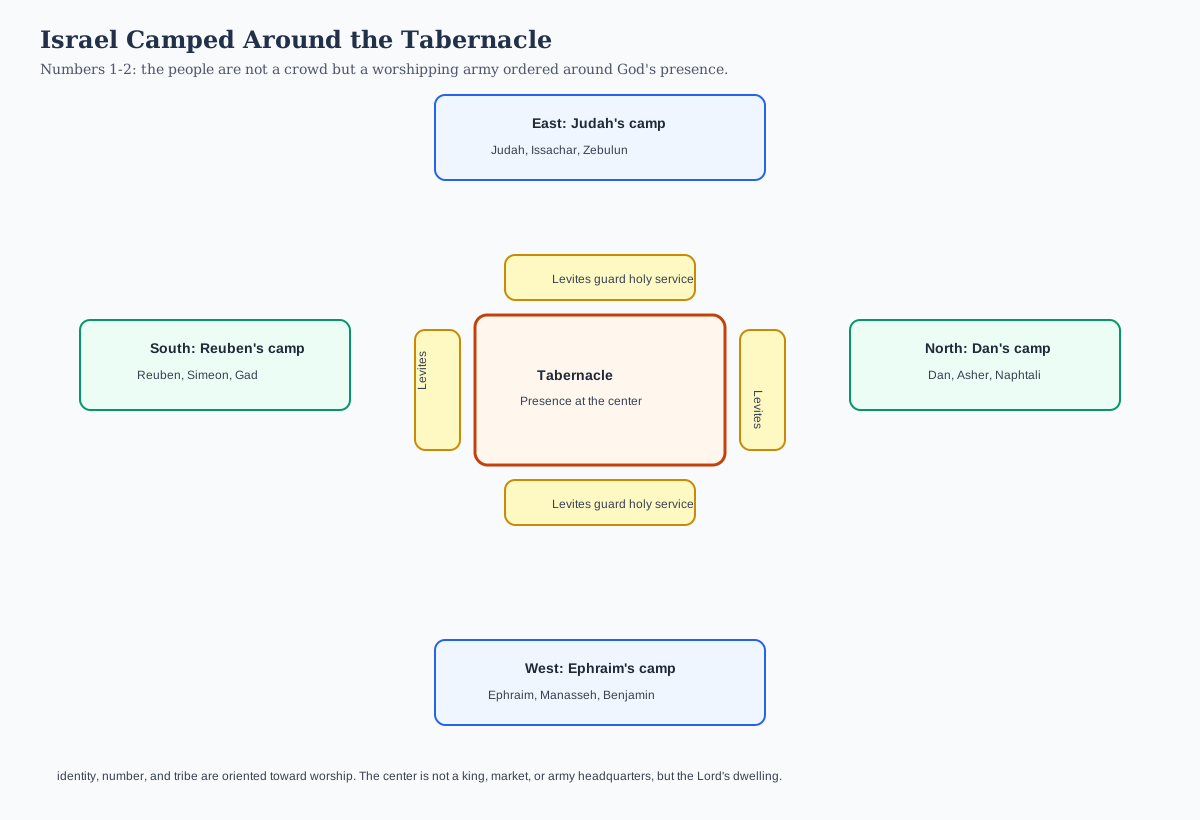 Source: Camp schematic, based on Numbers 1–2.
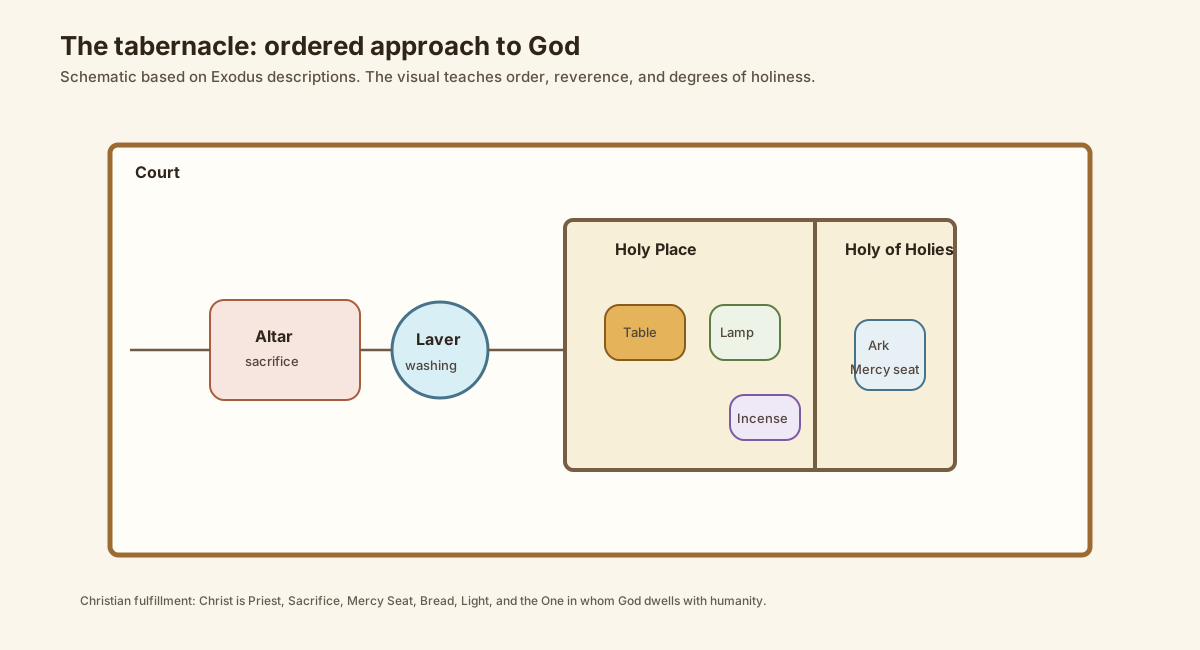 Source: Tabernacle plan schematic, based on Exodus 26–27.
Glossary
- Blood: the life of flesh as named by this chapter, guarded from ordinary eating and given on the altar for atonement.
- Life: the creature’s life received from God, rather than an object of unlimited human ownership.
- Imputed: reckoned or charged to the person responsible; verse 4 charges unauthorized shedding of blood.
- Atonement: the appointed restoration of communion for which God gives blood on the altar.
- Peace-offering: an offering brought to the Lord through the priest, with blood and fat assigned to the altar.
- Sweet-smelling savour: sacrificial language of acceptance before God, not His need for food.
- Vain gods: Brenton’s term for the objects of forbidden rival sacrifice in verse 7.
- Proselytes / strangers: people living among Israel and included in the chapter’s demands of worship and reverence for blood.
- Cover it in the dust: the hunter’s commanded handling of poured-out blood, distinct from altar sprinkling.
- Unclean until evening: the temporary condition named after eating an animal that died by itself or was taken by beasts.
- Bear his iniquity: be responsible for neglecting the washing and bathing God commands.
- Communion: participation in Christ’s life through His Body and Blood, with undivided fellowship rather than rival worship.
Spiritual Fruit 🍇
The hunter’s covered blood and the sacrifice brought to the altar resist the same impulse: treating life as ours to use without answer. Let thanksgiving before meals become less hurried, and let it extend into how food is obtained, shared, and wasted. Reverence for the Creator’s gift can restrain appetite without teaching contempt for the body.
The warning against vain gods reaches the hidden loyalties that survive beside religious words. A person may receive Communion while protecting a profitable dishonesty, nursing a grievance, or arranging life around admiration. Name the rival allegiance plainly in confession, and take one concrete step away from its table. Undivided worship is learned through undivided decisions.
The gift of Christ’s Blood is stronger than our shallow pictures of Communion. Approach with thanksgiving for the Lord who freely gives Himself, and ask that His life reshape the way you treat another person. Reverence belongs in the tongue that speaks after the chalice as well as in the hands that receive it.
Lord, You give life, and You have given Yourself for our life. Deliver us from the appetite that consumes without gratitude and from worship that keeps another master hidden. Let Your Blood cleanse the heart from which our words and choices come. Teach us to receive Your gifts as people who belong to You.
Teaching Notes
Life brought under God’s command (Leviticus 17:1–4)
- Ask: How does ownership differ from the authority to do whatever we want with a living creature?
- Watch for: Reading a wilderness command as an unqualified rule for every later setting.
No sacrifice to vain gods (Leviticus 17:5–9)
- Ask: What does participation at a table say about the fellowship a person chooses?
- Watch for: An indiscriminate accusation that unfamiliar peoples or all non-Christian cultural practices are demonic.
Blood given on the altar for atonement (Leviticus 17:10–12)
- Ask: How does “I have given it” change the picture of sacrifice as an attempt to bargain with God?
- Watch for: Language implying opposition between the Father’s will and the Son’s willing self-offering.
The hunter covers the blood in dust (Leviticus 17:13–14)
- Ask: What does a small act of restraint before eating train the heart to recognize?
- Watch for: Treating freedom from mandatory circumcision as freedom from the apostles’ demands of holiness.
Washing and responsibility after an unclean meal (Leviticus 17:15–16)
- Ask: Where does the text move from bodily condition to accountable neglect?
- Watch for: Using this law as an unsourced present Communion eligibility rule.
Sources
Embedded Scripture is from Brenton’s English Septuagint (LXX). The study follows NKJV chapter and verse organization; differences affecting this reading are noted beside the passage. New Testament references are to NKJV.
The worship sources are Coptic Reader texts and appointments compared with @andraws/lectionary-data 1.3.1. Related readings are not direct appointments of this Leviticus chapter. The consulted reverse index contains no current verse-addressed appointment of Leviticus 17.
Footnotes
-
St. John Chrysostom, Homilies on First Corinthians, Homily 24 §3, on 1 Corinthians 10:16. Hubert Kestell Cornish and John Medley translation, revised by Talbot W. Chambers, NPNF first series 12 (1889). Containing text. ↩
-
St. Cyril of Alexandria, Commentary on John, Book IV, chapter II, on John 6:55, pp. 421–422. P. E. Pusey translation, Library of the Fathers 43 (1874), Book IV, chapter II, pp. 421–423. Containing text. ↩
-
Coptic Reader, Coptic Orthodox Metropolis of the Southern United States, Readings / Liturgy / Psalm and Gospel, Friday of the second week of the Holy Fifty Days, John 6:54–58. Reader; @andraws/lectionary-data 1.3.1. ↩
-
Coptic Reader, Confession, containing service Special / Pascha / Saturday / Liturgy of the Faithful, Reader. The quotation is from this complete containing service, not a separate assertion about every special-service rubric. ↩