
The Lord speaks from the sanctuary Israel has just learned to build. Before the worshipper brings anything, God calls Moses. Leviticus begins with this gracious order: the holy God makes a way for His people to approach Him. Yet approach is costly. A living creature is brought, blood reaches the altar, and the offering passes wholly into fire. The chapter teaches both the seriousness of atonement and the surrender of a life to God; its final words are as gracious over a bird as over a calf.
God calls, and Israel brings gifts (Leviticus 1:1-2)
References follow NKJV chapter and verse numbering; the reading is Brenton’s Septuagint. In the opening sentence, Brenton places “Speak to the children of Israel” in 1:1, while NKJV places it in 1:2. The two verses are read together below.
1 And the Lord called Moses again and spoke to him out of the tabernacle of witness, saying, Speak to the children of Israel, and thou shalt say to them, 2 If any man of you shall bring gifts to the Lord, ye shall bring your gifts of the cattle and of the oxen and of the sheep.
The word “again” places this speech within God’s continuing dealings with Moses and Israel. The sanctuary belongs to the story of the Exodus, not to a people trying to invent access to an unknown deity. “Tabernacle of witness” is Brenton’s name for the sacred tent. God’s speech from it gives the gifts their setting and purpose: they are brought “to the Lord”. The opening instruction addresses Israel through Moses, while the conditional “If any man” introduces the worshipper’s particular offering. The cattle and sheep named here will be followed by birds at the chapter’s end.
Brenton’s repeated “gift” keeps the act personal. The worshipper brings something into God’s presence, rather than treating worship as an inward sentiment with no claim on possessions. This also makes evasion possible. In Mark 7:9-13, Christ condemns using a gift dedicated to God as an excuse to withhold help from parents. The sacred name of an offering cannot make lovelessness holy.
Language insight: “gift”
The Septuagint’s δῶρον, dōron, means a gift; its plural appears at Leviticus 1:2. Matthew 5:23 uses the same noun, and Mark 7:11 explains “Corban” as a gift. This shared vocabulary helps us hear the Gospels’ concern for the person who brings the gift. It does not establish an etymology for the Coptic offering bread.1
Lesson Guide
- Key phrases: called Moses again; gifts to the Lord.
- Emphasize: God’s call precedes the worshipper’s approach, and a dedicated gift still requires love for one’s family.
- Avoid: Turning “again” into an account of an unrecorded ceremony.
The unblemished gift and atonement (Leviticus 1:3-4)
3 If his gift be a whole-burnt-offering, he shall bring an unblemished male of the herd to the door of the tabernacle of witness, he shall bring it as acceptable before the Lord. 4 And he shall lay his hand on the head of the burnt-offering as a thing acceptable for him, to make atonement for him.
The herd offering is an unblemished male brought to the door, where it is presented as acceptable before the Lord. Its condition matters: worship may not be built around whatever the owner is glad to discard. The hand laid on its head joins the worshipper personally to the offered animal. Verse 4 explicitly names atonement, the God-given restoration of the worshipper’s relation to Him. Wholehearted consecration is therefore only part of the chapter’s meaning. The person approaching also needs acceptance and reconciliation. The verse does not itself explain every mechanism of the laying on of the hand; it should not be made to describe a visible transfer of a substance called sin.
1 Peter 1:18-19 takes the language of the unblemished lamb into the price of our redemption. Hebrews 9:14 brings the contrast to its fullness: Christ offers Himself without spot and cleanses the conscience for service to the living God. The animal’s soundness prepares a vocabulary for His sinlessness; it does not make the animal’s offering equal to His.
Gems from the Fathers 💎: The Priest who offers Himself
St. John Chrysostom, interpreting Hebrews 9 rather than giving a running exposition of Leviticus, gathers the Christian fulfillment into one sentence: “He is Himself then both victim and Priest and sacrifice.”2 The One who brings us near is also the One who gives Himself. Our confidence rests on Christ’s self-offering, not on the scale of a gift we can afford.
The Church’s Voice in Worship ⛪
In the Offering of the Lamb, the priest examines the loaves and wine before choosing the offering loaf. The Prayer of the Prothesis of the Bread and the Wine addresses Christ with these words: “and formerly made Yourself a lamb without spot for the life of the world—we ask and entreat Your goodness, O Lover of Mankind,”3 The prayer identifies the spotless Lamb with Christ and the life He gives to the world. Reverence in preparing the gifts expresses faith in Him, rather than confidence that careful preparation could manufacture holiness.
Gems from the Fathers 💎: The sinless Lord bears our sins
Origen takes up the offering described as “a calf without blemish from the herd as a whole burnt offering”4 and directs the unblemished offering toward Christ with the words “only he is ‘without blemish,’”5. The perfection of the animal becomes a sign of the Savior’s sinlessness, not a claim that an animal can cleanse conscience as He does. In his interpretation of the hand upon the head, Origen writes that “he placed the sins of the human race upon his own body”6. His reading brings the ritual into the mystery of Christ bearing our sins. It does not turn the hand’s touch into a mechanical action by which a worshipper can dispose of guilt without repentance.
Lesson Guide
- Key phrases: unblemished male; acceptable; make atonement.
- Emphasize: Acceptance and atonement belong together; Christ gives Himself as the spotless saving offering.
- Avoid: Explaining the hand as a mechanical transfer of sin or equating animal and Christian sacrifice.
Blood at the altar, the victim divided (Leviticus 1:5-6)
5 And they shall slay the calf before the Lord; and the sons of Aaron the priests shall bring the blood, and they shall pour the blood round about on the altar, which is at the doors of the tabernacle of witness. 6 And having flayed the whole burnt-offering, they shall divide it by its limbs.
The slaughter occurs before the Lord, and Aaron’s sons bring the blood and pour it around the altar at the sanctuary doors. The priestly action belongs to a defined place. Blood is directed to the altar rather than retained for the offerer’s use. The animal is then flayed and divided by its limbs. These verbs prevent a sentimental reading of sacrifice: an actual life has been given, and the offering involves the handling of an actual body.
Brenton uses plural agents for the slaughter and preparation, then explicitly names Aaron’s sons for bringing the blood. We should follow that wording rather than assign every action to one unnamed offerer. The flaying and division prepare the victim for the altar. These verses give no independent warrant for assigning a separate spiritual meaning to each cut. What the repeated bodily detail does make clear is that worship reaches beyond words. Romans 12:1-2 answers God’s mercies with the offering of our living bodies: hands that cease to injure, mouths that speak truth, and time made available for faithful service. That response shares in Christ’s grace; it does not add another saving death to His.
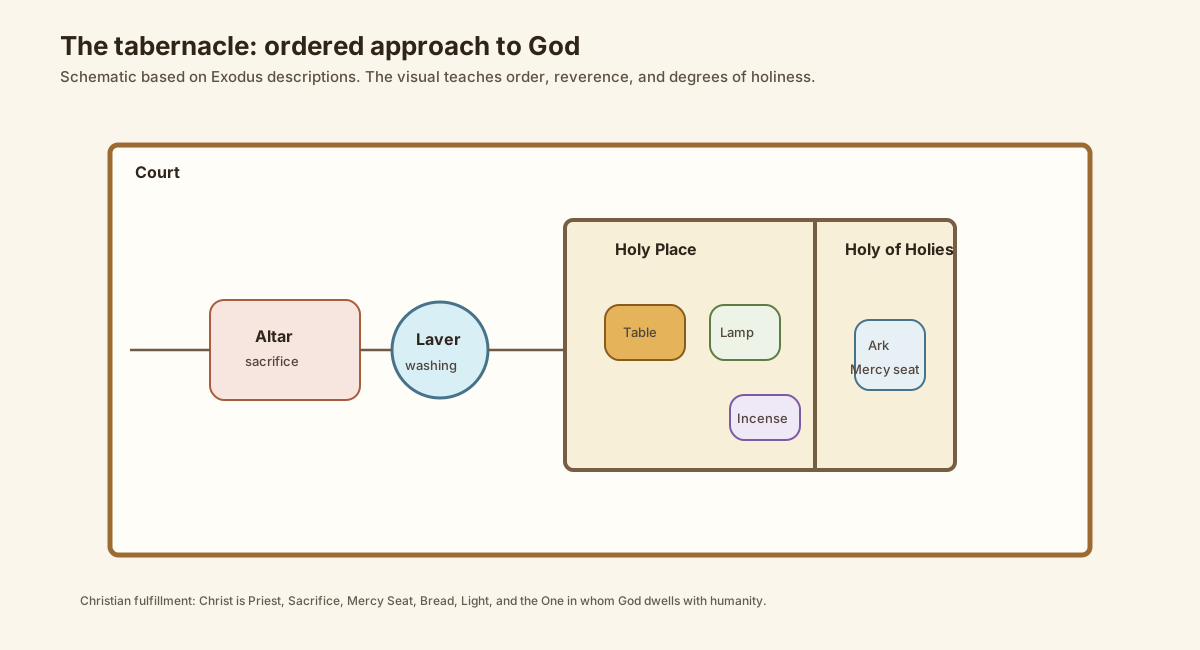 Tabernacle schematic: the altar stands in the court before the sanctuary.
Gems from the Fathers 💎: The word opened beneath its surface
In his spiritual reading of the flaying, Origen describes “the one who removes the veil of the letter from the word of God”7. The Christian reader seeks the saving meaning disclosed through the law, as well as understanding the commanded preparation of the animal. Such reading requires patient attention to Scripture. It is not permission to discard Israel’s actual worship or invent a secret meaning for every bodily detail.
Lesson Guide
- Key phrases: before the Lord; blood round about on the altar; divide it by its limbs.
- Emphasize: Distinguish the sanctuary from the court altar and notice the priestly handling of blood.
- Avoid: A speculative allegory of every anatomical detail.
Washed and wholly offered (Leviticus 1:7-9)
7 And the sons of Aaron the priests shall put fire on the altar, and shall pile wood on the fire. 8 And the sons of Aaron the priests shall pile up the divided parts, and the head, and the fat on the wood on the fire, the wood which is on the altar. 9 And the entrails and the feet they shall wash in water, and the priests shall put all on the altar: it is a burnt-offering, a sacrifice, a smell of sweet savour to the Lord.
The priests put fire and wood on the altar, then arrange the divided parts, head, and fat. The inward parts and feet are washed with water before all is placed on the altar. Preparation is ordered and concrete: combustible wood, arranged portions, and washed parts. The washing belongs to the treatment of the victim; it is not a statement that the offerer has already received Christian Baptism. Its devotional force lies in refusing to separate the offering’s visible presentation from what is handled within it. A life offered to God cannot protect dishonesty behind an impressive religious exterior.
The final phrase names acceptance: “a smell of sweet savour to the Lord.” Ephesians 5:2 applies this sacrificial fragrance to Christ’s loving self-gift and makes it the pattern of our walk in love. This is a more precise fulfillment than simply saying that Christians should try harder to surrender. We receive the love of the One who offered Himself, then let that love reach the parts of life we habitually reserve. Hebrews 10:5-10 joins the prepared body with obedience to the Father’s will; the whole passage locates our sanctification in His once-for-all offering.
Azariah prays from the loss of the ordinary means of Temple worship. In Greek Daniel 3:38-40, the Prayer of Azariah, a contrite heart and humble spirit are brought before God with the imagery of rams, bullocks, and fat lambs. The plea does not despise the sacrifices. It asks the merciful God to receive those who have no altar at which to bring them.
Origen also attends to “the inner parts together with the feet to be washed with water”8. The inward parts and the feet belong to the same prepared offering. In our response to Christ’s love, the hidden intention and the outward course of life likewise need to be brought together: prayer cannot protect a dishonest purpose while the body performs a show of devotion.
Lesson Guide
- Key phrases: wash in water; put all on the altar; smell of sweet savour.
- Emphasize: Let Ephesians 5:2 interpret the fragrance through Christ’s love and our response to it.
- Avoid: Treating ritual washing as an automatic prediction of Baptism.
The flock and the north side (Leviticus 1:10-13)
Brenton’s Septuagint includes laying the hand on the head in verse 11; NKJV does not include that clause. The study follows NKJV verse references and retains Brenton’s fuller reading.
10 And if his gift be of the sheep to the Lord, or of the lambs, or of the kids for whole-burnt-offerings, he shall bring it a male without blemish. 11 And he shall lay his hand on its head; and they shall kill it by the side of the altar, toward the north before the Lord, and the sons of Aaron the priests shall pour its blood on the altar round about. 12 And they shall divide it by its limbs, and its head and its fat, and the priests shall pile them up on the wood which is on the fire, on the altar. 13 And they shall wash the entrails and the feet with water, and the priest shall bring all the parts and put them on the altar: it is a burnt-offering, a sacrifice, a smell of sweet savour to the Lord.
A sheep, lamb, or kid may be brought instead of an animal from the herd. The requirement of an unblemished male remains. The printed text again places the hand on the animal’s head, followed by slaughter at the north side of the altar. Blood is poured around the altar, the limbs are divided and arranged, and the inward parts and feet are washed. A smaller victim receives the same serious treatment and the same declaration of sweet savour. The law changes the available animal without lowering the holiness of the approach.
The north is a stated ritual location. Leviticus gives no reason here for identifying it with darkness, evil, or a predetermined compass point of the Crucifixion.
Gems from the Fathers 💎: The Cross in Christ’s own time
St. Cyril of Alexandria actually brings Leviticus 1:10-11 into his interpretation of John 7:1. He reads the northward victim in relation to Christ’s presence in Galilee and the calling of the Gentiles. This is Cyril’s Christological reading, not a historical explanation supplied by the ritual law itself. His following sentence safeguards the Lord’s willing Passion: “For it beseemed Him not before His time, but in His own time to endure the Cross for all.”9 The Son’s withdrawal from danger expresses neither cowardice nor weakness. The offering fulfilled in Him is the free gift of divine love.
Lesson Guide
- Key phrases: male without blemish; toward the north; all the parts.
- Emphasize: The flock offering retains the herd rite’s demands; label Cyril’s northward reading as his interpretation.
- Avoid: Unfounded geographical certainty about the Cross.
A bird, and the same gracious acceptance (Leviticus 1:14-17)
14 And if he bring his gift, a burnt-offering to the Lord, of birds, then shall he bring his gift of doves or pigeons. 15 And the priest shall bring it to the altar, and shall wring off its head; and the priest shall put it on the altar, and shall wring out the blood at the bottom of the altar. 16 And he shall take away the crop with the feathers, and shall cast it forth by the altar toward the east to the place of the ashes. 17 And he shall break it off from the wings and shall not separate it, and the priest shall put it on the altar on the wood which is on the fire: it is a burnt-offering, a sacrifice, a sweet-smelling savour to the Lord.
The final option brings doves or pigeons. The sequence from herd to flock to birds widens the material possibilities for approaching God. This chapter does not explicitly name poverty as the reason for the bird offering, but Leviticus 5:7 will make the relation to limited means plain. The smaller gift has a carefully described rite of its own. The priest brings the bird to the altar, removes its head, and wrings out the blood at the bottom. The crop, the food-storage part of the bird’s digestive tract, and feathers are removed to the ash place east of the altar. The wing preparation leaves it unseparated, and it is placed on the burning wood. The details acknowledge its different body; they do not make it a second-class prayer.
The conclusion is “a sweet-smelling savour to the Lord.” God’s acceptance is not measured by the price of an ox. This guards the poor from shame and the prosperous from confusing expense with holiness. A costly offering can still conceal a closed heart, while a small gift may carry a person’s real trust.
The Church’s Voice in Worship ⛪
The Litany of the Oblations remembers differing means: “so also receive the thank offerings of Your servants—those in abundance or those in scarcity, hidden or manifest—”10 It also names “those who desire to offer to You but have none, and those who have offered these gifts to You this very day.”11 Desire itself is brought into the Church’s intercession when possessions cannot be brought. The prayer gives the person who has nothing a place before God and keeps the person who has much from claiming that place as a privilege of wealth.
Gems from the Fathers 💎: The bird belongs within the offering
Origen includes the birds in his account of the permitted gifts: “But if from birds, then turtledoves or young doves.”12 His wording differs from Brenton’s “doves or pigeons”, but both retain this distinct option. The provision becomes explicitly tied to limited means in Leviticus 5:7–13. The ritual care given to the bird makes room for attention and reverence without making the cost of a herd animal the measure of faithful worship.
Lesson Guide
- Key phrases: doves or pigeons; place of the ashes; sweet-smelling savour.
- Emphasize: Explain the bird’s distinct preparation and the unaltered language of acceptance.
- Avoid: Calling the bird gift inferior, or claiming chapter 1 explicitly names the offerer as poor.
Spiritual Fruit 🍇
Bring the part you usually withhold. The repeated placing of the whole prepared victim on the altar searches the divisions within our own obedience. Name one bodily habit that stays outside your prayer: angry speech at home, dishonest work, or a refusal to make time for someone entrusted to you. Bring it honestly to confession and choose one corresponding act of obedience. Wholehearted worship becomes visible in the next use of the mouth, the hands, and the hours.
Receive atonement before displaying dedication. Verse 4 names the need for acceptance. When guilt makes you bargain with God by offering extra work or money, turn instead to Christ, who gives Himself and cleanses the conscience. Let prayer begin with truthful repentance and trust in His mercy, then let generosity follow as thanksgiving.
Honor the gift beyond its price. The bird offering ends with the same gracious acceptance. Give according to your means without competing, and protect another person’s dignity by declining to publicize or compare donations. If money is scarce, offer faithful prayer and a small act of care without treating yourself as absent from the Church’s worship.
Stand in thought at the sanctuary door as the last bird is brought. Its offering is small, but the words of acceptance remain. Let the Lord’s call be stronger than your shame and His mercy stronger than your bargaining. Ask Him to receive your life in the love of Christ, and begin with the part that most needs cleansing.
Teaching Notes
Whole-study connections
- Show: Use the tabernacle schematic at Leviticus 1:5-6 to distinguish the court altar from the sanctuary; do not derive the north-side rite from a schematic’s orientation alone.
God calls, and Israel brings gifts (Leviticus 1:1-2)
- Ask: What changes when we begin worship by listening to God’s call rather than presenting our own achievements?
- Watch for: A religious gift used to excuse neglect of a dependent parent.
The unblemished gift and atonement (Leviticus 1:3-4)
- Ask: Why does the explicit mention of atonement prevent us from reading this offering as dedication alone?
- Watch for: The belief that generosity purchases a clean conscience.
Blood at the altar, the victim divided (Leviticus 1:5-6)
- Ask: How does this bodily preparation deepen Paul’s call to offer our bodies in Romans 12:1?
- Watch for: Applications that value inward sincerity while excusing bodily habits that harm others.
Washed and wholly offered (Leviticus 1:7-9)
- Ask: Which ordinary habit would become different if the love of Christ reached the whole of our day?
- Watch for: Surrender language used to demand exhaustion, self-harm, or concealment of abuse.
The flock and the north side (Leviticus 1:10-13)
- Ask: Why does Cyril’s insistence on Christ’s own time matter for our understanding of His Passion?
- Watch for: A speculative explanation of north presented as the plain meaning of Leviticus.
A bird, and the same gracious acceptance (Leviticus 1:14-17)
- Ask: What would change in parish life if those who desire to offer but have nothing were remembered without embarrassment?
- Watch for: Public comparisons of gifts that shame people with limited means.
Sources
Embedded Scripture is from Brenton’s English Septuagint (LXX).
Leviticus 1 has no appointed reading in the updated lectionary sources consulted for this study; the worship connections above concern the Offering of the Lamb and Litany of the Oblations, not an appointment of the chapter.13
The study follows NKJV chapter and verse references while printing Brenton. At 1:1-2, Brenton places the instruction to speak to Israel in verse 1, while NKJV begins it in verse 2. Brenton’s verse 11 also includes laying the hand on the head, unlike NKJV’s verse 11. The combined opening unit preserves the sentence without rearrangement.
St. John Chrysostom, Homilies on Hebrews, Homily XVII. The cited sentences explain Christian sacrifice through Hebrews.
St. Cyril of Alexandria, Commentary on John. The exact book, chapter, biblical setting, and edition are given in the quotation footnotes.
Coptic Reader, the named prayers and menu paths in the worship footnotes.
Origen, Homilies on Leviticus, the Homily 1 fragments cited below.
Footnotes
-
Septuagint gift vocabulary, Leviticus 1:2-3; Matthew 5:23; Mark 7:11. CCAT-derived Septuagint display; Matthew 5:23 Greek witnesses; Mark 7:11 Greek witnesses. ↩
-
St. John Chrysostom, Homilies on Hebrews, Homily XVII, §3, p. 447. T. Keble, trans., revised by Frederic Gardiner, NPNF 1.14 (1889), wording from New Advent. Text. ↩
-
Coptic Reader, Prayer of the Prothesis of the Bread and the Wine, inaudible to the Son. Menu path: Liturgies / St. Basil / Offering of the Lamb. Coptic Reader. ↩
-
Origen, Homilies on Leviticus, Homily 1.2, p. 32; G. W. Barkley, trans., Fathers of the Church 83 (Catholic University of America Press, 1990). Quoted fragment; its limits are retained. ↩
-
Origen, Homilies on Leviticus, Homily 1.2, p. 33; G. W. Barkley, trans., Fathers of the Church 83 (Catholic University of America Press, 1990). Quoted fragment; its limits are retained. ↩
-
Origen, Homilies on Leviticus, Homily 1.3, p. 33; G. W. Barkley, trans., Fathers of the Church 83 (Catholic University of America Press, 1990). Quoted fragment; its limits are retained. ↩
-
Origen, Homilies on Leviticus, Homily 1.4, p. 35; G. W. Barkley, trans., Fathers of the Church 83 (Catholic University of America Press, 1990). Quoted fragment; its limits are retained. ↩
-
Origen, Homilies on Leviticus, Homily 1.4, p. 36; G. W. Barkley, trans., Fathers of the Church 83 (Catholic University of America Press, 1990). Quoted fragment; its limits are retained. ↩
-
St. Cyril of Alexandria, Commentary on John, Book IV, chapter V, on John 7:1, p. 460. P. E. Pusey, trans., vol. 1, Library of the Fathers 43 (1874). Text. ↩
-
Coptic Reader, Litany of the Oblations. Menu path: Liturgies / St. Basil / Liturgy of the Word. Coptic Reader. ↩
-
Coptic Reader, Litany of the Oblations. Menu path: Liturgies / St. Basil / Liturgy of the Word. Coptic Reader. ↩
-
Origen, Homilies on Leviticus, Homily 1.2, p. 31; G. W. Barkley, trans., Fathers of the Church 83 (Catholic University of America Press, 1990). Quoted fragment; its limits are retained. ↩
-
Coptic Reader and the updated lectionary reference, @andraws/lectionary-data 1.3.1, generated 8 October 2026. No Leviticus 1 appointment appears in the consulted annual, Holy Pascha, or special-service entries. Coptic Reader. This does not exclude every historical manuscript or local rite. ↩