


This narration predates the current revision and may differ from the written study.
A person may offer a great promise and then discover how small his faithfulness is. Leviticus closes by bringing vows down to earth: a sum that can be paid, an animal that cannot be quietly exchanged, a field whose dedication must respect another family’s inheritance. Worship reaches the tongue, the household, and the handling of what we call our own.
The chapter orders devotion without forgetting poverty. Its valuation tables are followed by the priest’s duty to assess what the poor worshipper can afford. Its severe category of devoted things must also be faced without permitting religious violence. Truthful dedication honors God; reckless promises and coercion do not.
Historical and Scriptural Context
After the covenant warnings and remembered mercy of Leviticus 26, this final chapter regulates vows and holy portions. It distinguishes ordinary vowed gifts, which can sometimes be redeemed with an added fifth, from gifts that are already the Lord’s or have been devoted irrevocably. Persons, cattle, houses, inherited fields, purchased fields, firstborn animals, and tithes do not all follow the same rule.
Geographical Significance ⛰️
The sanctuary’s standard governs valuation, while fields remain subject to the year of release. The chapter reaches into household property without allowing a purchased field to lose its original family claim at Jubilee.
The Characters 👥
The Lord receives holy gifts. The worshipper makes a vow; the priest values persons and property; the poor person is assessed according to capacity. Owners, original landholders, and households are affected by the act of dedication. Reverence therefore requires attention to what a promise does to other people.
A vow and the means to fulfill it (Leviticus 27:1–8)
NKJV uses sanctuary shekels where Brenton prints “didrachms”; the readings retain the Greek translation’s terminology rather than replacing its units.
1 And the Lord spoke to Moses, saying, 2 Speak to the children of Israel, and thou shalt say to them, Whosoever shall vow a vow as the valuation of his soul for the Lord, 3 the valuation of a male from twenty years old to sixty years old shall be—his valuation shall be fifty didrachms of silver by the standard of the sanctuary. 4 And the valuation of a female shall be thirty didrachms. 5 And if it be from five years old to twenty, the valuation of a male shall be twenty didrachms, and of a female ten didrachms. 6 And from a month old to five years old, the valuation of a male shall be five didrachms, and of a female, three didrachms of silver. 7 And if from sixty years old and upward, if it be a male, his valuation shall be fifteen didrachms of silver, and if a female, ten didrachms. 8 And if the man be too poor for the valuation, he shall stand before the priest; and the priest shall value him: according to what the man who has vowed can afford, the priest shall value him.
The opening regulates a vow involving the valuation of a person. It gives silver amounts by age and sex, then a different procedure when the man is too poor. Verse 8 says twice that the priest shall value him, and states the governing measure: “according to what the man who has vowed can afford”. A table does not exhaust the law’s judgment.
The differing sums must be read honestly. They assign a monetary obligation within this sanctuary system, not a measure of the image of God in male and female, child and adult, young and old. The sums define sanctuary obligations; the chapter gives no complete explanation for their differences. It does explicitly prevent the ordinary amount from crushing someone who lacks the means. Human dignity cannot be inferred from a redemption sum.
Ecclesiastes 5:4-5 warns against making a vow and failing to pay; Matthew 5:33-37 calls the disciple to truthful speech rather than multiplying oaths. Serious devotion can be quiet. It becomes false when the promise is made to impress and the obligation is later evaded.
Gems from the Fathers 💎: Vow with dependence on God
St. Augustine, expounding the vow verse of Psalm 76:11 (LXX Ps 75:12), joins ability, fulfillment, and reliance on God: “Let each man vow what he is able, and pay it. Do not vow and not pay: but let every man vow, and pay what he can. Be not slow to vow: for you will accomplish the vows by powers not your own. You will fail, if on yourselves ye rely: but if on Him to whom you vow ye rely, you will be safe to pay. Vow ye, and pay to the Lord our God.”1
His larger argument includes duties common to all Christians as well as particular commitments. The promise must become obedience, and obedience depends on grace. Reliance on God is therefore a reason for faithful action, not for careless promises that others will have to bear.
The Church’s Voice in Worship ⛪
The Church’s Litany of the Oblations remembers those who offer and those who desire to offer but have none.2 Its prayer honors both the gift and the person whose means are small. Verse 8’s attention to capacity belongs beside the Church’s refusal to measure devotion only by the visible amount.
In the Basil liturgy contained in Bright Saturday, the prayer says: “Remember, O Lord, those who have brought to You these gifts, those on whose behalf they have been brought, and those by whom they have been brought. Give them all the heavenly reward.”3 The offering is held within prayer for real persons, rather than reduced to revenue.
Pope Shenouda III, in The Spiritual Means, chapter 40, “The oblations,” explains that the Church’s remembrance of those with nothing recognizes their intention to offer.4 This is a contemporary Coptic pastoral witness, distinct from the ancient Fathers above. The poor person must never be humiliated for a gift he cannot afford.
Lesson Guide
- Key phrases: “vow a vow”; “too poor for the valuation”; “can afford”.
- Emphasize: The priest’s adjustment belongs to the law itself, not an exception to reverence.
- Avoid: Do not rank human worth by sex, age, wealth, or the valuation sum.
A holy animal is not a disposable promise (Leviticus 27:9–13)
9 And if it be from the cattle that are offered as a gift to the Lord, whoever shall offer one of these to the Lord, it shall be holy. 10 He shall not change it, a good for a bad, or a bad for a good; and if he do at all change it, a beast for a beast, it and the substitute shall be holy. 11 And if it be any unclean beast, of which none are offered as a gift to the Lord, he shall set the beast before the priest. 12 And the priest shall make a valuation between the good and the bad, and accordingly as the priest shall value it, so shall it stand. 13 And if the worshipper will at all redeem it, he shall add the fifth part to its value.
An animal suitable for offering becomes holy when it is offered to the Lord. It cannot be exchanged either good for bad or bad for good. The point is more demanding than a ban on cheap substitutes: the worshipper cannot reopen the dedication at will. If he substitutes another animal, both become holy.
An unclean animal cannot be placed on the altar as a sacrificial gift. It is brought before the priest for valuation, and redemption requires the value plus a fifth. Dedication and sacrifice are therefore distinct: something can be handled as a vowed possession without becoming an acceptable sacrificial animal. The added fifth makes buying it back an accountable act rather than an invisible reversal.
Gems from the Fathers 💎: Free offering, truthful offering
St. John Chrysostom, in Homily 12 on Acts, explains Ananias’s deceit in Acts 5:1-11. The land did not have to be sold, and its proceeds did not have to be given. The fault concerned what he freely made sacred and then secretly withheld: “We neither obliged you to sell, the Apostle says, nor to give your money when you had sold; of your own free choice you did it; why have you then stolen from the sacred treasury?”5
Chrysostom’s distinction matters. A voluntary gift is not an excuse for financial coercion, and freedom to give is not freedom to lie about the gift. His homily also recalls Achan’s theft of a devoted thing. The gravity of sacred trust remains; no modern religious authority is licensed to reproduce the deaths narrated in Acts.
Lesson Guide
- Key phrases: “it shall be holy”; “it and the substitute”; “add the fifth part”.
- Emphasize: Dedication changes the status of the gift, while unclean animals follow valuation rather than sacrifice.
- Avoid: Do not turn Ananias’s voluntary offering into a command that everyone surrender all property.
A house consecrated and redeemed (Leviticus 27:14–15)
14 And whatsoever man shall consecrate his house as holy to the Lord, the priest shall make a valuation of it between the good and the bad: as the priest shall value it, so shall it stand. 15 And if he that has sanctified it should redeem his house, he shall add to it the fifth part of the money of the valuation, and it shall be his.
The priest assesses the consecrated house “between the good and the bad,” and that valuation stands. A home offered to God is not priced by the owner’s fervor or by a promise that later expands and contracts. If the person who sanctified it redeems it, he adds a fifth and it becomes his again.
The law gives devotion a defined route and a defined cost. A solemn act affecting a home reaches the lives of everyone who depends on it. The desire to give should therefore be joined to discernment about duties already owed. Christ exposes the misuse of dedication in Mark 7:9-13, where an appeal to a sacred gift becomes a means of evading care for parents. Reverence cannot be used to make neglect sound holy.
Lesson Guide
- Key phrases: “consecrate his house”; “so shall it stand”; “it shall be his”.
- Emphasize: A household gift is valued and its redemption is accountable.
- Avoid: Do not let religious generosity conceal the neglect of dependents.
An inherited field and the year of release (Leviticus 27:16–21)
16 And if a man should hallow to the Lord a part of the field of his possession, then the valuation shall be according to its seed, fifty didrachms of silver for a homer of barley. 17 And if he should sanctify his field from the year of release, it shall stand according to his valuation. 18 And if he should sanctify his field in the latter time after the release, the priest shall reckon to him the money for the remaining years, until the next year of release, and it shall be deducted as an equivalent from his full valuation. 19 And if he that sanctified the field would redeem it, he shall add to its value the fifth part of the money, and it shall be his. 20 And if he do not redeem the field, but should sell the field to another man, he shall not after redeem it. 21 But the field shall be holy to the Lord after the release, as separated land; the priest shall have possession of it.
A field of ancestral possession is valued according to its seed, using the stated amount for a homer of barley. Its dedication from the year of release begins at the full valuation. Dedication later in the cycle requires a reckoning of the remaining years and a corresponding deduction. The promise is placed inside the Jubilee calendar rather than outside it.
If the man redeems the field, he adds a fifth. If he does not redeem it but sells it to someone else, redemption is no longer open in the way it was before. At release the field becomes holy to the Lord as separated land, in the priest’s possession. The text names a serious loss; a worshipper cannot dedicate a field and then treat its future as though nothing had happened.
Leviticus 25 established the Lord’s ownership and the return of inheritance. Here a dedication affects that same land under a distinct rule. Zeal must attend to consequences across years and generations. A vow made in an afternoon can alter what a household will receive long afterward.
Lesson Guide
- Key phrases: “according to its seed”; “remaining years”; “separated land”.
- Emphasize: The Jubilee calendar governs the field’s valuation and final status.
- Avoid: Do not imply every dedication is reversible at the owner’s convenience.
A purchased field and holy weights (Leviticus 27:22–25)
The study follows NKJV numbering. Verse 25 gives shekels and gerahs in NKJV, but “didrachm” and “oboli” in Brenton. Each edition states its own twenty-unit standard; Brenton’s wording is retained without a modern currency conversion.
22 And if he should consecrate to the Lord of a field which he has bought, which is not of the field of his possession, 23 the priest shall reckon to him the full valuation from the year of release, and he shall pay the valuation in that day as holy to the Lord. 24 And in the year of release the land shall be restored to the man of whom the other bought it, whose the possession of the land was. 25 And every valuation shall be by holy weights: the didrachm shall be twenty oboli.
A purchased field is not the worshipper’s ancestral possession. The priest reckons its valuation in relation to release, and the amount is paid as holy to the Lord. At the year of release, the land returns to the man whose possession it originally was. A dedication cannot make another family’s inheritance permanently ours to dispose of.
Every valuation uses holy weights. Brenton’s “the didrachm shall be twenty oboli” preserves the source’s specified standard. The Greek names identify a translated monetary reckoning; they do not establish modern currency values or prove that later Greek coinage was used at Sinai.
Language insight: “didrachms” and “temple tax”
The Greek δίδραχμον (didrachmon) names a double-drachma denomination. Its plural appears in Matthew 17:24-27, where NKJV calls the payment “temple tax”. The shared denomination name gives a genuine link in sacred-payment vocabulary. The Gospel’s tax and Leviticus’s vow valuations are different legal contexts, and the name alone cannot equate their amounts or purposes.6 The shared vocabulary brings sacred payment into view without making religious valuations a matter of personal whim.
Lesson Guide
- Key phrases: “not of the field of his possession”; “restored”; “holy weights”.
- Emphasize: The dedication respects the original household’s claim at release.
- Avoid: Do not invent a conversion of didrachms and oboli into modern money.
Already the Lord’s (Leviticus 27:26–27)
26 And every first-born which shall be produced among thy cattle shall be the Lord’s, and no man shall sanctify it: whether calf or sheep, it is the Lord’s. 27 But if he should redeem an unclean beast, according to its valuation, then he shall add the fifth part to it, and it shall be his; and if he redeem it not, it shall be sold according to its valuation.
The firstborn calf or sheep is already the Lord’s. The prohibition “no man shall sanctify it” means that its existing holiness cannot be represented as a new voluntary gift. The worshipper must distinguish between acknowledging God’s claim and pretending to create it through personal generosity.
Exodus 13:2 gives the earlier firstborn command, and Luke 2:23 recalls it at the Lord’s presentation. The family brings the child according to the law’s claim, not as a bargain for divine favor. Firstborn belonging is received within God’s saving history.
The unclean animal follows a different route: redemption at its valuation plus a fifth, or sale at its valuation if it is not redeemed. It is not made fit for sacrifice merely by the worshipper’s desire to offer it. Truthful giving observes both what is already owed and what can actually be given.
Lesson Guide
- Key phrases: “no man shall sanctify it”; “it is the Lord’s”; “sold according to its valuation”.
- Emphasize: The firstborn’s existing claim is distinct from a new vow.
- Avoid: Do not turn an already owed duty into a boast of extraordinary generosity.
Devoted things and the irredeemable death sentence (Leviticus 27:28–29)
The study follows NKJV numbering. Where NKJV verse 29 describes a person under the ban and doomed to destruction, Brenton says “dedicated of men”. Both print the death sentence; neither is changed into an ordinary redeemable vow here.
28 And every dedicated thing which a man shall dedicate to the Lord of all that he has, whether man or beast, or of the field of his possession, he shall not sell it, nor redeem it: every devoted thing shall be most holy to the Lord. 29 And whatever shall be dedicated of men, shall not be ransomed, but shall be surely put to death.
The chapter now distinguishes a dedicated or devoted thing from the gifts that can be valued and redeemed. Whether person, beast, or field, the devoted thing may be neither sold nor redeemed; it is “most holy to the Lord.” Money cannot restore its ordinary status.
Verse 29 must be named directly: what is dedicated “of men” cannot be ransomed, “but shall be surely put to death.” This is a death sentence in the ancient legal-sacral category, not another item on the earlier valuation table. The printed words are severe. They should not be softened into a purely spiritual surrender or treated as though they describe the monetary redemption of verse 8.
The relationship to judgment is seen in Joshua 6:17-19 and Joshua 7, where devoted things and Achan’s appropriation stand within the conquest narrative. These passages help distinguish the category, but do not make every detail of verse 29 transparent. No private vow gives a person authority to kill another human being. Christians receive neither this verse nor those narratives as permission for human sacrifice, religious violence, or coercion. Irrevocable dedication demands sobriety; it cannot override the dignity and protection of persons.
Language insight: “devoted thing”
The Septuagint of verse 28 uses ἀνάθεμα (anathema), a thing devoted or set apart. The same noun occurs in Romans 9:3, 1 Corinthians 16:22, and Galatians 1:8–9 in contexts of being accursed or separated. The relationship is real, but the contexts are different. Apostolic language about separation and the defense of the Gospel is not a transfer of Mosaic capital penalties into the Church.7 The shared word should sharpen the gravity of sacred commitment without producing a false permission for violence.
Lesson Guide
- Key phrases: “shall not sell it, nor redeem it”; “most holy”; “surely put to death”.
- Emphasize: Name both irrevocability and the death sentence honestly.
- Avoid: Do not authorize human sacrifice, violence, coercion, or private judgments over another person’s life.
The tenth under the rod (Leviticus 27:30–33)
30 Every tithe of the land, both of the seed of the land, and of the fruit of trees, is the Lord’s, holy to the Lord. 31 And if a man should at all redeem his tithe, he shall add the fifth part to it, and it shall be his. 32 And every tithe of oxen, and of sheep, and whatsoever may come in numbering under the rod, the tenth shall be holy to the Lord. 33 Thou shalt not change a good for a bad, or a bad for a good; and if thou shouldest at all change it, its equivalent also shall be holy, it shall not be redeemed.
The tithe of seed and tree fruit is the Lord’s, holy to Him. If the person redeems this produce tithe, a fifth is added. The livestock tithe follows another rule: animals come in numbering under the rod, and the tenth is holy. The counting rod identifies the tenth in sequence; the owner may not choose a better or worse animal in its place. If he changes it, both it and its equivalent become holy, and the equivalent is not redeemed.
The actual order resists manipulation. A person cannot pretend to surrender the tenth while selecting whatever is least useful. The offering acknowledges the Lord’s claim over increase, and obedience reaches the unglamorous work of counting. Ezekiel 20:37 uses passing under the rod and being brought in by number within the Lord’s reckoning with His people; its connection is the image of accountable numbering, not the livestock tithe as an identical institution.
Brenton’s Sirach 32:8–10 says, “In all thy gifts shew a cheerful countenance, and dedicate thy tithes with gladness” (verse 9). This offering-and-tithe passage is numbered differently in other editions.8 Gladness belongs beside the fixed tenth: the holy portion should be given with a willing heart rather than a resentful calculation.
Christ names justice, mercy, and faith beside tithing in Matthew 23:23. St. Paul calls for cheerful giving without compulsion in 2 Corinthians 9:6-7. The Christian response is generosity governed by truth and love; this chapter alone does not settle every present pastoral rule about the amount or form of giving.
Lesson Guide
- Key phrases: “is the Lord’s”; “numbering under the rod”; “the tenth shall be holy”.
- Emphasize: The counted tenth and the ban on substitution prevent manipulation.
- Avoid: Do not let an exact payment excuse injustice, neglect, or financial pressure on the poor.
The final word at Sinai (Leviticus 27:34)
34 These are the commandments which the Lord commanded Moses for the sons of Israel in mount Sina.
The book closes where these instructions began: the Lord commands Moses for Israel on mount Sina. The regulations about promises and property belong to the same holy life as the altar, priesthood, purity, feasts, and covenant mercy. The ending is ordinary enough to expose whether worship reaches daily decisions.
Leviticus 26:46 closes the covenant laws; verse 34 here closes the commands about dedication. The two conclusions belong together. God’s mercy does not make truthful offering unnecessary, and truthful offering cannot purchase mercy.
St. Paul’s Romans 12:1 carries Christian offering to the whole person as “a living sacrifice”. The Lord receives our bodies and lives, not just something removable from them. In Mark 12:41-44, the widow’s small visible gift discloses a profound surrender. Neither passage gives another person permission to demand ruinous generosity from the poor. They turn our gaze toward the heart God sees, and the life offered freely to Him.
Lesson Guide
- Key phrases: “commandments”; “for the sons of Israel”; “mount Sina”.
- Emphasize: Ordinary decisions about promises and property belong to holiness.
- Avoid: Do not reduce the chapter’s conclusion to a fundraising appeal.
Iconography and Visual Teaching 🖼️
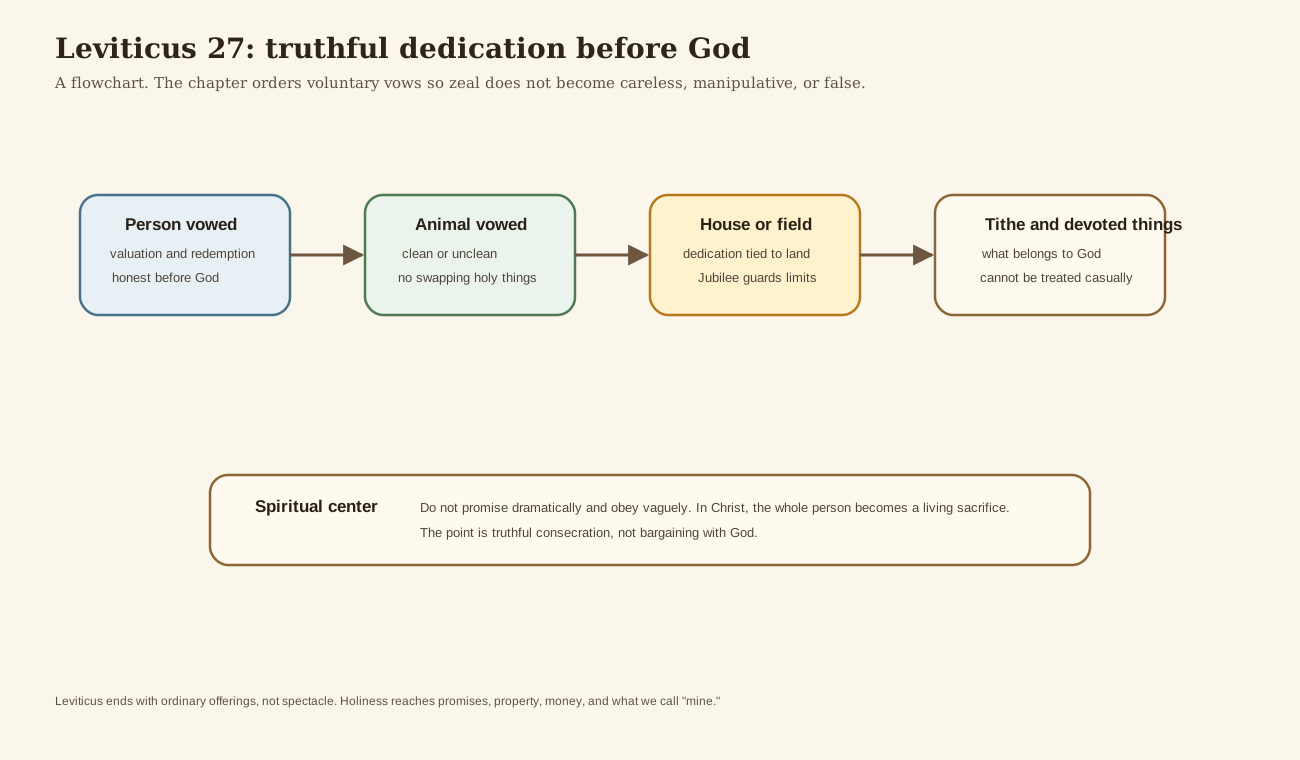 Source: Vows and dedication schematic, based on Leviticus 27.
Glossary
- Vow: A solemn commitment to God, here regulated through defined valuations and rules for dedicated gifts.
- Valuation: The monetary amount attached to a vowed person or property in this sanctuary system, not an assessment of intrinsic human dignity.
- Didrachms: The Greek denomination named in Brenton’s valuation amounts; its name also appears behind the temple-tax language in Matthew 17:24.
- Oboli: The units used in the source’s sacred standard, with twenty oboli stated for a didrachm in verse 25; no modern conversion is implied.
- Fifth part: The additional amount required when specified gifts or produce tithes are redeemed.
- Homer: The quantity of barley seed used as the field-valuation measure in verse 16.
- Year of release: The Jubilee boundary that governs the reckoning of field values and the return of purchased land to its original possessor.
- Field of possession: An inherited field, distinguished from land purchased from another household.
- Firstborn: An animal already belonging to the Lord and therefore not available to be presented as a new voluntary dedication.
- Dedicated / devoted thing: A thing placed irrevocably under the Lord’s claim in verses 28–29, beyond sale or ransom; the category includes the severe death sentence that Christians must never turn into permission for religious violence.
- Tithe: The tenth of land produce or livestock set apart as holy, with different redemption provisions for produce and animals.
- Numbering under the rod: Counting the animals in sequence so that the tenth is identified without selective substitution.
- Oblations: Offerings remembered in the Church’s prayer, together with the persons who give and those who desire to give but have nothing.
Spiritual Fruit 🍇
Give the tongue the same reverence as the altar. Before promising a new spiritual labor or financial gift, name what you can actually undertake and the obligations already entrusted to you. A quiet promise kept can be truer than a dramatic promise left for others to repair. Seek counsel when a proposed commitment affects your household or exceeds your strength.
Let mercy govern the assessment of means. The priest in verse 8 looks at what the worshipper can afford. Refuse comparisons that humiliate the poor. If your own means are small, bring the willing heart remembered in the Church’s prayer; if your means are large, give without purchasing influence over someone else’s conscience.
Keep dedication joined to existing duties. A gift cannot sanctify neglect of parents, children, debts, or entrusted responsibilities. Examine whether religious generosity has become a way to avoid an ordinary obedience that costs you pride rather than money. Make that neglected duty part of your offering to God.
Offer freely rather than bargain. The tithe’s honest count exposes the wish to retain control while appearing generous. Set aside a deliberate gift with gladness, and let it be joined to justice and mercy. God’s love is not for sale, and the recipient of your help is not yours to command.
Lord, receive the truth of my life, not the size of my words. Where I have promised carelessly, give me humility to confess and wisdom to repair. Where I have been afraid to give, free me from grasping. Make my body, speech, household duties, and possessions an offering of thanksgiving in Christ.
Teaching Notes
A vow and the means to fulfill it (Leviticus 27:1–8)
- Ask: How does verse 8 change the way the preceding table should be heard?
- Watch for: Pressuring someone into a donation or promise needed to prove devotion.
A holy animal is not a disposable promise (Leviticus 27:9–13)
- Ask: Why are both animals holy even when the substitution seems an improvement?
- Watch for: Using the fear of judgment to extract money from worshippers.
A house consecrated and redeemed (Leviticus 27:14–15)
- Ask: What responsibilities must be remembered before a house is promised away?
- Watch for: Treating the emotional intensity of a promise as sufficient evidence of wisdom.
An inherited field and the year of release (Leviticus 27:16–21)
- Ask: How does the field’s remaining productive time enter the value of the vow?
- Watch for: Smoothing away the seriousness of verses 20–21 with general talk of generosity.
A purchased field and holy weights (Leviticus 27:22–25)
- Ask: What prevents the purchaser’s generosity from taking someone else’s inheritance?
- Watch for: Treating the shared Greek coin name as proof that the temple tax is this chapter’s vow payment.
Already the Lord’s (Leviticus 27:26–27)
- Ask: Why can something belong to God before a person makes any promise about it?
- Watch for: Reading every dedicated animal as eligible for altar sacrifice.
Devoted things and the irredeemable death sentence (Leviticus 27:28–29)
- Ask: Why must the devoted category be distinguished from the valuation of persons in verses 1–8?
- Watch for: Suggesting that a vow becomes righteous merely because it is irreversible.
The tenth under the rod (Leviticus 27:30–33)
- Ask: What does an honest count reveal about the worshipper’s willingness to give?
- Watch for: Guaranteeing wealth in return for tithes or imposing rules beyond the sources.
The final word at Sinai (Leviticus 27:34)
- Ask: How does this chapter change what it means to offer the whole life to God?
- Watch for: Admiring another person’s costly gift while using it to impose a cost on someone vulnerable.
Sources
Embedded Scripture is from Brenton’s English Septuagint (LXX). Passage headings follow the NKJV chapter-and-verse frame; the readings retain Brenton’s complete source verses and printed labels.
Leviticus 27, Lancelot C. L. Brenton, The Septuagint Version of the Old Testament (1851).
Patristic works quoted below, each identified by its containing passage and edition. Their application here is thematic unless direct commentary is expressly named.
Coptic Reader, Coptic Orthodox Metropolis of the Southern United States; appointment and prayer locations are given in the notes below. Related readings are distinguished from assignments of Leviticus itself.
Footnotes
-
St. Augustine of Hippo, Exposition on Psalm 76, §11, translated by J. E. Tweed, NPNF, First Series, vol. 8. The work title is retained; its vow verse is Psalm 76:11 (LXX Ps 75:12). https://www.newadvent.org/fathers/1801076.htm. ↩
-
Coptic Reader, Clergy / Litanies, Litany of the Oblations, remembers those who desire to offer but have none. The @andraws/lectionary-data 1.3.1 reverse index has no current verse-addressed appointment of Leviticus 27; the connection here is the Church’s prayer, not an assignment of the chapter. https://copticreader.org/app/#/document. ↩
-
Coptic Reader, Special / Pascha / Saturday / Liturgy of the Faithful, Basil liturgy, Litany of the Oblations. The quoted English text says “gifts.” https://copticreader.org/app/#/document. ↩
-
Pope Shenouda III, The Spiritual Means, chapter 40, “The oblations,” St-Takla English web edition. Contemporary pastoral commentary. https://st-takla.org/books/en/pope-shenouda-iii/spiritual-means/oblations.html. ↩
-
St. John Chrysostom, Homilies on Acts, Homily 12, recapitulation on Acts 5:1–4, NPNF, First Series, vol. 11. https://www.newadvent.org/fathers/210112.htm. ↩
-
Septuagint Leviticus 27:25; Nestle 1904 Matthew 17:24; Thayer, “δίδραχμον.” https://biblehub.com/sepd/leviticus/27.htm, https://biblehub.com/text/matthew/17-24.htm, https://biblehub.com/greek/1323.htm. ↩
-
Septuagint Leviticus 27:28–29; Thayer, “ἀνάθεμα,” with its consecration and curse senses. https://biblehub.com/sepd/leviticus/27.htm, https://biblehub.com/greek/331.htm. ↩
-
Brenton, Sirach 32:8–10, especially verse 9. The corresponding offering-and-tithe passage is Sirach 35:10–12 in NRSVUE; the numbering should not be treated as uniform across editions. https://www.biblegateway.com/passage/?search=Sirach%2035&version=NRSVUE. ↩