


This narration predates the current revision and may differ from the written study.
Leviticus 16 stands at the center of the book. Once a year the high priest enters the inner sanctuary with blood. The sanctuary, the priesthood, and the people are cleansed. One goat is offered to the Lord. Another bears the declared sins of the people away into the wilderness. The chapter gathers sacrifice, priesthood, blood, uncleanness, confession, sanctuary, and mercy into one solemn day. Hebrews reads this rite as the shadow fulfilled in Christ, whose own self-offering accomplishes what repeated animal offerings could not.
Historical and Scriptural Context
Leviticus 16 begins by recalling the death of Nadab and Abihu. That opening is not incidental. The Day of Atonement is about access to the holy God, and access is not casual. Aaron may not enter the holy place at any time he chooses. Even the high priest enters by command, with sacrifice, incense, blood, washing, and the garments God appoints. The Lord’s gift of blood for atonement is explained in Leviticus 17:11.
Christ, unlike Aaron, needs no offering for His own sins. Yet He enters fully into priestly mediation as the High Priest who brings us into the presence of God. The fulfillment concerns both access and cleansing: mercy opens a way for the people whose sins have damaged communion.
Geographical Significance ⛰️
The tabernacle is the sacred geography of the chapter. Court, altar, holy place, veil, ark, and propitiatory mark degrees of nearness to the dwelling God. The wilderness receives the sent-away goat; the bodies of the sin-offerings are burned outside the camp. Nearness and removal belong together: sin is taken away from the dwelling where God gives His people life.
The Characters 👥
The Lord commands the rite and provides its mercy. Aaron stands under judgment and under mercy, offering for himself before he ministers for others. The two goats supply complementary signs within one act of atonement. The ready man carries out the entrusted departure, and the whole congregation, native and stranger, humbles its souls and rests.
Approach after Nadab and Abihu (Leviticus 16:1–2)
The study follows NKJV chapter and verse order and prints Brenton’s Septuagint. Brenton’s “propitiatory” here names what NKJV calls the “mercy seat”; Brenton itself uses “mercy-seat” in verses 13–15. The different English terms do not identify two different objects.
1 And the Lord spoke to Moses after the two sons of Aaron died in bringing strange fire before the Lord, so they died. 2 And the Lord said to Moses, Speak to Aaron thy brother, and let him not come in at all times into the holy place within the veil before the propitiatory, which is upon the ark of the testimony, and he shall not die; for I will appear in a cloud on the propitiatory.
The chapter opens by recalling the death of Nadab and Abihu. Access to the holy place is not casual. The high priest enters by command, not by personal initiative. The cloud on the propitiatory both reveals and conceals the presence of God. The Lord who warns Aaron also gives him a way to enter and live. Holiness and mercy speak in the same command.
The veil distinguishes the inner sanctuary from the place where the priests ordinarily serve. The propitiatory is the covering of the ark of the testimony. Aaron’s office does not entitle him to pass through the veil whenever he wishes. Hebrews 9:7 makes this restriction part of its argument: the high priest enters alone, once a year, with blood. Christian confidence before God grows from what Christ has accomplished, rather than from familiarity with sacred things.
Lesson Guide
- Key phrases: “not come in at all times”; “I will appear in a cloud”.
- Emphasize: God provides the approach He commands.
- Avoid: Confusing reverent confidence with unrestricted priestly access.
The priest himself stands under mercy (Leviticus 16:3–6)
3 Thus shall Aaron enter into the holy place; with a calf of the herd for a sin-offering, and having a ram for a whole-burnt-offering. 4 And he shall put on the consecrated linen tunic, and he shall have on his flesh the linen drawers, and shall gird himself with a linen girdle, and shall put on the linen cap, they are holy garments; and he shall bathe all his body in water, and shall put them on. 5 And he shall take of the congregation of the children of Israel two kids of the goats for a sin-offering, and one lamb for a whole-burnt-offering. 6 And Aaron shall bring the calf for his own sin-offering, and shall make atonement for himself and for his house.
Aaron must first atone for himself and his house. The high priest is not exempt from judgment. His calf for a sin-offering and ram for a whole-burnt-offering distinguish his preparation from the goats and lamb received from the congregation. Before he bears the people’s need into the sanctuary, he acknowledges his own.
Verse 4 clothes him entirely in consecrated linen: tunic, drawers, girdle, and cap. Compared with the richly adorned vestments of his consecration in Leviticus 8, the appointed clothing draws attention to washing and obedient service rather than outward splendor. These linen garments are still called holy. Plainness does not mean that Aaron’s office has ceased to matter; the office itself must submit to God’s command.
Philippians 2:6-8 gives a fitting, though not direct, Christological comparison: the Son’s humility is obedient self-giving. Christ’s sinlessness sets Him apart from Aaron, while His voluntary humility reveals the fullness toward which priestly service points. Spiritual leaders who forget their own need for mercy become dangerous; the first offering here gives no room for such forgetfulness.
Lesson Guide
- Key phrases: “consecrated linen”; “for himself and for his house”.
- Emphasize: The clothing is holy because it belongs to obedient service, not because it displays wealth.
- Avoid: Suggesting that Christ, like Aaron, needed a sin-offering for Himself.
Two goats before one Lord (Leviticus 16:7–10)
Brenton prints “scape-goat”; NKJV also uses “scapegoat,” while the ESV prints “Azazel” in verse 8. The ESV keeps the designation as a name; Brenton and NKJV render it as the sent-away goat. This English comparison does not settle the designation’s origin. Here the exposition follows Brenton’s wording and the goat’s stated purpose of being sent away, without assuming that a proper name settles its meaning.1
7 And he shall take the two goats, and place them before the Lord by the door of the tabernacle of witness. 8 And Aaron shall cast lots upon the two goats, one lot for the Lord, and the other for the scape-goat. 9 And Aaron shall bring forward the goat on which the lot for the Lord fell, and shall offer him for a sin-offering. 10 And the goat upon which the lot of the scape-goat came, he shall present alive before the Lord, to make atonement upon him, so as to send him away as a scape-goat, and he shall send him into the wilderness.
Both goats are placed before the Lord, and their different roles are assigned by lot. One is offered for sin; the other is presented alive for atonement and sent into the wilderness. The rite holds together offering to God and removal of sin. The living goat is not an independent source of salvation, and the chapter does not say that Israel worships it.
The pair prepares a Christian reading in which one Christ offers Himself and bears away sin. The signs are complementary; they do not divide the Savior. John 1:29 names Him as the Lamb who takes away the sin of the world. Typology, the recognition of a fulfilled biblical pattern, lets the older rite point beyond itself while retaining its actual sequence.
Gems from the Fathers 💎: One Christ, two appearances
Saint Justin Martyr reads the two goats in relation to the two appearances of the same Christ: His suffering and His coming again. This is a particular early Christian interpretation, not a claim that every detail has only one possible correspondence. He writes:
“And the two goats which were ordered to be offered during the fast, of which one was sent away as the scape [goat], and the other sacrificed, were similarly declarative of the two appearances of Christ: the first, in which the elders of your people, and the priests, having laid hands on Him and put Him to death, sent Him away as the scape [goat]; and His second appearance, because in the same place in Jerusalem you shall recognise Him whom you have dishonoured, and who was an offering for all sinners willing to repent, and keeping the fast which Isaiah speaks of, loosening the terms of the violent contracts, and keeping the other precepts, likewise enumerated by him, and which I have quoted, which those believing in Jesus do.”2
Justin speaks within an ancient polemical dialogue. His accusation against his interlocutor’s people does not authorize hostility toward Jewish people. His typology concerns the suffering and return of the one Christ.
Lesson Guide
- Key phrases: “one lot for the Lord”; “present alive before the Lord”.
- Emphasize: Keep both goats within the one commanded rite.
- Avoid: Assigning the living goat an independent saving power.
Blood and incense within the veil (Leviticus 16:11–15)
Brenton now prints “mercy-seat” for the covering called “propitiatory” in verse 2. NKJV also names the mercy seat. The vocabulary changes within Brenton, not the object being approached.
11 And Aaron shall bring the calf for his sin, and he shall make atonement for himself and for his house, and he shall kill the calf for his sin-offering. 12 And he shall take his censer full of coals of fire off the altar, which is before the Lord; and he shall fill his hands with fine compound incense, and shall bring it within the veil. 13 And he shall put the incense on the fire before the Lord, and the smoke of the incense shall cover the mercy-seat over the tables of testimony, and he shall not die. 14 And he shall take of the blood of the calf, and sprinkle with his finger on the mercy-seat eastward: before the mercy-seat shall he sprinkle seven times of the blood with his finger. 15 And he shall kill the goat for the sin-offering that is for the people, before the Lord; and he shall bring in of its blood within the veil, and shall do with its blood as he did with the blood of the calf, and shall sprinkle its blood on the mercy-seat, in front of the mercy-seat.
The high priest enters the inner sanctuary with blood and incense. The coals of fire are taken from the altar, and Aaron separately carries fine compound incense within the veil. The incense smoke covers the mercy-seat, and the command links this covering with Aaron’s remaining alive. The cloud is therefore more than atmosphere. Aaron approaches the divine presence by the protection God supplies.
The blood of Aaron’s calf is sprinkled eastward on the mercy-seat and seven times before it. The blood of the people’s goat follows the same pattern. The priest’s need and the people’s need reach the same place of mercy. The blood reaches where the people cannot go. In Hebrews 9:24-28, Christ appears in heaven itself for us and puts away sin by the sacrifice of Himself. The torn veil in Matthew 27:51 belongs beside this restricted access: the Cross is the opening of communion, not the lowering of God’s holiness.
Wisdom 18:21–24 remembers a priest standing between the living and the dead with prayer and incense. That passage recalls the wilderness crisis, not this annual rite; its connection is priestly intercession that protects the people. The incense here likewise belongs to God’s provision for life, not to a technique for compelling Him.
Language insight: “propitiatory” and “mercy-seat”
The Greek term ἱλαστήριον (hilastērion) appears in the Septuagint wording of Leviticus 16:2, 13 and in Hebrews 9:5, where it names the ark’s covering. Romans 3:25 applies the same term to Christ, rendered “propitiation” in NKJV. The shared word brings the place of atonement into view when Paul speaks of Christ and His Blood. Its range includes the propitiatory covering and expiatory sacrifice; the word alone does not settle every question about Paul’s imagery. The firm connection is that mercy and reconciliation come to their fullness in Christ.3
Lesson Guide
- Key phrases: “smoke of the incense”; “mercy-seat”; “seven times”.
- Emphasize: Explain incense as appointed protection and blood as the means of the rite’s cleansing.
- Avoid: Picturing God as nourished by smoke or blood.
Cleansing the dwelling among the people (Leviticus 16:16–19)
16 And he shall make atonement for the sanctuary on account of the uncleanness of the children of Israel, and for their trespasses in the matter of all their sins; and thus shall he do to the tabernacle of witness established among them in the midst of their uncleanness. 17 And there shall be no man in the tabernacle of witness, when he goes in to make atonement in the holy place, until he shall have come out; and he shall make atonement for himself, and for his house, and for all the congregation of the children of Israel. 18 And he shall come forth to the altar that is before the Lord, and he shall make atonement upon it; and he shall take of the blood of the calf, and of the blood of the goat, and shall put it on the horns of the altar round about. 19 And he shall sprinkle some of the blood upon it seven times with his finger, and shall purge it, and hallow it from the uncleanness of the children of Israel.
The sanctuary itself is cleansed because the people’s uncleanness and sins have affected the dwelling place of God. Verse 16 holds two facts together: the tabernacle is established among them, and they remain a people needing cleansing. God’s nearness does not make sin harmless; His mercy makes continued dwelling possible.
No other man may remain in the tabernacle while Aaron enters to make atonement. The people cannot crowd around him or add their own action to his appointed work. He acts for himself, his house, and the whole congregation, then comes out to cleanse the altar’s horns and hallow it with sevenfold sprinkling. The rite proceeds from the inner sanctuary toward the altar; the whole place of worship is restored.
The solitude is a fitting comparison with Hebrews 1:3, where the Son purges sins by Himself. Aaron’s limited mediation points toward the Savior’s sufficient work, although Aaron needs mercy for himself and Christ does not. We receive the salvation Christ accomplishes; humility begins when we stop trying to present our usefulness as its price.
Gems from the Fathers 💎: The Priest who offers Himself
Saint John Chrysostom, explaining Hebrews 9:25–26, contrasts the annual entrance with another creature’s blood and Christ’s once-for-all self-offering. The Priest and the gift are the same Lord:
“He is Himself then both victim and Priest and sacrifice.”4
Lesson Guide
- Key phrases: “in the midst of their uncleanness”; “no man”; “hallow it”.
- Emphasize: Follow cleansing from sanctuary to altar and include the whole congregation.
- Avoid: Treating ritual uncleanness and deliberate moral wrongdoing as identical categories.
Declared sins carried away (Leviticus 16:20–22)
Brenton includes “a cleansing for the priests” in verse 20, which NKJV’s verse 20 does not state. Brenton also says Aaron shall “declare” the sins and send the goat by “a ready man,” where NKJV says “confess” and “a suitable man.” The passage order is the same; the wording printed here follows Brenton.
20 And he shall finish making atonement for the sanctuary and for the tabernacle of witness, and for the altar; and he shall make a cleansing for the priests, and he shall bring the living goat; 21 and Aaron shall lay his hands on the head of the live goat, and he shall declare over him all the iniquities of the children of Israel, and all their unrighteousnesses, and all their sins; and he shall lay them upon the head of the live goat, and shall send him by the hand of a ready man into the wilderness. 22 And the goat shall bear their unrighteousnesses upon him into a desert land; and Aaron shall send away the goat into the wilderness.
Aaron declares all the people’s iniquities, unrighteousnesses, and sins over the living goat. The repeated words make concealment impossible: what has damaged communion is named before God and assigned to the sign He appoints for removal. Forgiveness is not an agreement to pretend nothing happened.
The goat is sent by the hand of a ready man. This entrusted servant must carry out the departure; willingness and practical readiness serve the mercy given to the whole people. The goat bears their unrighteousnesses into a desert land, away from the camp. The chapter does not report its death, and its destination should not be filled with imagined details.
Isaiah 53:6 and Isaiah 53:12 deepen the Christian reading: the Servant is given up for sins and bears the sins of many. Christ’s bearing of sin opens repentance, rather than excusing continued harm. A confession that names wrong honestly can begin the work of making restitution and protecting those who have been injured.
Lesson Guide
- Key phrases: “all their sins”; “a ready man”; “a desert land”.
- Emphasize: Connect truthful declaration with actual removal.
- Avoid: Inventing a death for the living goat from this text.
Return, washing, and the bodies outside the camp (Leviticus 16:23–28)
Brenton says the handlers wash and afterwards enter the camp in verses 26 and 28; NKJV also gives washing and re-entry. Neither reading here adds “unclean until evening.” The English wording of the return differs without adding that delay.
23 And Aaron shall enter into the tabernacle of witness, and shall put off the linen garment, which he had put on, as he entered into the holy place, and shall lay it by there. 24 And he shall bathe his body in water in the holy place, and shall put on his raiment, and shall go out and offer the whole-burnt-offering for himself and the whole-burnt-offering for the people: and shall make atonement for himself and for his house, and for the people, as for the priests. 25 And he shall offer the fat for the sin-offering on the altar. 26 And he that sends forth the goat that has been set apart to be let go, shall wash his garments, and bathe his body in water, and afterwards shall enter into the camp. 27 And the calf for the sin-offering, and the goat for the sin-offering, whose blood was brought in to make atonement in the holy place, they shall carry forth out of the camp, and burn them with fire, even their skins and their flesh and their dung. 28 And he that burns them shall wash his garments, and bathe his body in water, and afterwards he shall enter into the camp.
Aaron leaves the linen garment where he has served, bathes, and puts on his raiment before offering the whole-burnt-offerings. The fat of the sin-offering goes onto the altar. The sequence joins cleansing with renewed offering: communion restored before God is a life given to Him, not merely relief from fear.
The man who sends away the goat washes his garments and body before entering the camp. The bodies of the calf and goat whose blood entered the holy place are carried out of the camp and burned, including skins, flesh, and dung. The burner likewise washes and afterwards enters the camp. The text here promises re-entry after washing; it does not add an evening deadline.
Hebrews 13:11-13 explicitly develops the sacrificial bodies outside the camp: Jesus suffers outside the gate to sanctify the people with His own Blood, and believers are called to go to Him bearing His reproach. This is a direct biblical connection, not simply an association with wilderness loneliness. The rejected place becomes the place where Christ gives Himself for us. A desire for respectable religion can keep us far from Him when faithfulness costs approval.
Lesson Guide
- Key phrases: “put off the linen garment”; “out of the camp”; “afterwards”.
- Emphasize: Distinguish altar fat, outside-camp burning, and washing before re-entry.
- Avoid: Adding “unclean until evening” to Brenton’s verses 26 and 28.
Humbling the soul, native and stranger (Leviticus 16:29–31)
NKJV says “afflict your souls” in verse 29 where Brenton says “humble your souls.” NKJV calls verse 31 a “sabbath of solemn rest.” Brenton prints “a most holy sabbath, a rest,” not “a Sabbath of Sabbaths.” The wording differs, but both translations join cessation from work with humbling the soul.
29 And this shall be a perpetual statute for you; in the seventh month, on the tenth day of the month, ye shall humble your souls, and shall do no work, the native and the stranger who abides among you. 30 For in this day he shall make an atonement for you, to cleanse you from all your sins before the Lord, and ye shall be purged. 31 This shall be to you a most holy sabbath, a rest, and ye shall humble your souls; it is a perpetual ordinance.
The whole people humble their souls and cease from work on the tenth day of the seventh month. The stranger living among them shares the command with the native. Atonement is not a privilege kept within a small priestly circle; the community rests under the mercy ministered for it.
Humbling the soul means coming before God without the defense of pride. Fasting belongs to this biblical pattern, but an empty stomach can coexist with a heart full of accusation. The publican’s appeal for mercy in Luke 18:13 reveals the inner posture the proud religious person may lack. Rest also confesses dependence: the people cannot manufacture this cleansing through increased activity.
The day joins forgiveness with a wider restoration. In Leviticus 25:9, the Jubilee trumpet sounds on the Day of Atonement. Release in the land is proclaimed on the day of cleansing before God. Repentance cannot remain an inward feeling while we cling to every advantage over our neighbor.
Gems from the Fathers 💎: The soul’s fast
Saint Athanasius, in Festal Letter 1, first cites the atonement-calendar parallel in Leviticus 23:27, 29, then explains the inward fast. He is not quoting Leviticus 16 directly. His teaching gives substance to its command to humble the soul:
“Behold, my brethren, how much a fast can do, and in what manner the law commands us to fast. It is required that not only with the body should we fast, but with the soul. Now the soul is humbled when it does not follow wicked opinions, but feeds on becoming virtues.”5
Lesson Guide
- Key phrases: “humble your souls”; “the native and the stranger”; “a rest”.
- Emphasize: The common rest makes dependence on mercy visible.
- Avoid: Equating humility with self-hatred or the denial of human dignity.
Annual cleansing and the fulfillment of the promise (Leviticus 16:32–34)
32 The priest whomsoever they shall anoint shall make atonement, and whomsoever they shall consecrate to exercise the priestly office after his father; and he shall put on the linen robe, the holy garment. 33 And he shall make atonement for the most holy place, and the tabernacle of witness; and he shall make atonement for the altar, and for the priests; and he shall make atonement for all the congregation. 34 And this shall be to you a perpetual statute to make atonement for the children of Israel for all their sins: it shall be done once in the year, as the Lord commanded Moses.
The rite continues through the priest anointed and consecrated to succeed his father. He wears the holy linen garment and makes atonement for the holy place, tabernacle, altar, priests, and congregation. The concluding inventory gathers what the chapter has shown step by step. God’s dwelling and the whole people’s life are held together in the annual act of cleansing.
The repetition is also a limit. Hebrews 10:1-4 explains that the yearly sacrifices recall sins without accomplishing the final removal that Christ gives. Hebrews 9:24-28 announces His once-for-all offering and His appearance in God’s presence for us. Christian worship receives this completed work; it does not require another crucifixion. The contrast is fulfillment of a merciful sign, not contempt for Israel’s worship.
Sirach 45:16 remembers Aaron chosen to offer sacrifice and incense for reconciliation, while Sirach 50:5-21 describes the high priest emerging from the sanctuary and the people bowing in prayer and receiving blessing. These are fitting witnesses to priestly service and communal reverence; Sirach 50 is not a precise transcript of Leviticus 16’s ritual sequence.
Lesson Guide
- Key phrases: “all the congregation”; “once in the year”.
- Emphasize: Let the complete inventory show the breadth of cleansing and the annual limit.
- Avoid: Using Hebrews to deride Jewish people or worship.
The Church’s Voice in Worship ⛪
On Palm Sunday the Pauline reading is Hebrews 9:11–28, which proclaims Christ’s entrance into the holy place through His own blood.6 The Church hears the fulfillment of atonement as the Lord enters Jerusalem toward His Passion. His royal welcome and His priestly self-offering belong to the one saving work.
The Prayer of the Veil places confidence in mercy rather than achievement: “For we put no trust in our righteousness, but in Your mercy, whereby You have given life to our race.”7 This is the fitting prayer of people whom their High Priest brings near. It calls the Eucharistic offering “this awesome and bloodless sacrifice,” receiving the once-for-all work of Christ without imagining another crucifixion.
At the Sixth Hour of Great Friday, Fai Etafenf, the Hymn of the Cross, sings: “This is He who offered Himself up, as an acceptable sacrifice, on the Cross for the salvation of our race.” It continues: “His good Father smelled Him at the evening watch on Golgotha.”8 The language of acceptance belongs to Christ’s willing self-offering, not to a helpless Son forced against His will. The Sunday Theotokia likewise calls the Mercy Seat a symbol of God the Word incarnate without change and praises Him as the purification of sins.9
Iconography and Visual Teaching 🖼️
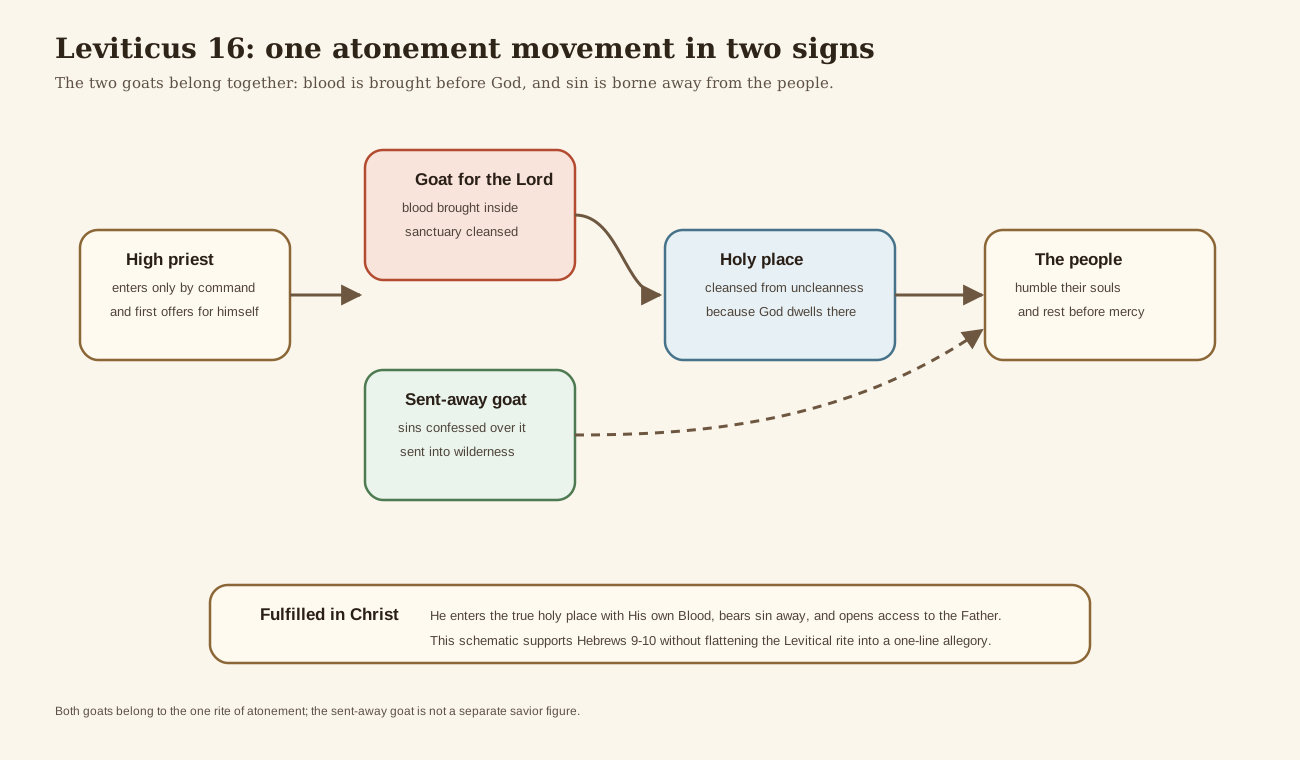 Source: Day of Atonement schematic, based on Leviticus 16.
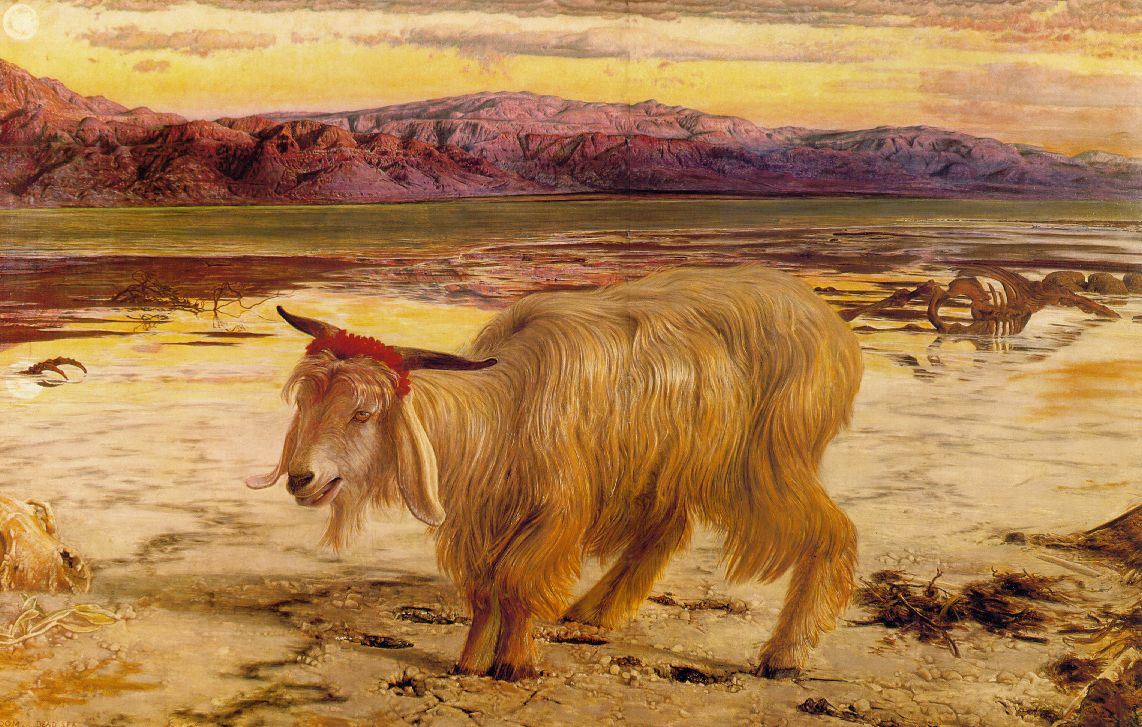 William Holman Hunt, The Scapegoat, public domain via Wikimedia Commons. Western biblical artwork, not Orthodox iconography or a reconstruction of the rite.
Glossary
- Atonement: the God-appointed priestly cleansing and restoration of communion; its fulfillment is Christ’s self-offering.
- Propitiatory / mercy-seat: the covering of the ark of the testimony; Brenton uses both terms in this chapter.
- Veil: the curtain marking the restricted inner sanctuary.
- Tabernacle of witness: the sanctuary established among the people as the place of God’s presence and testimony.
- Sin-offering: the sacrifice whose blood is used in cleansing from sin and uncleanness.
- Whole-burnt-offering: an offering wholly given on the altar, distinct from the sin-offering’s use of blood within the veil.
- Scape-goat / sent-away goat: the living goat that bears the declared unrighteousnesses into a desert land.
- Ready man: the person entrusted and prepared to carry out the goat’s departure.
- Hallow: set apart and cleanse for the Lord’s holy service.
- Humble your souls: come before God in repentance and lowliness, expressed in the fast and rest rather than pride.
- Most holy sabbath, a rest: Brenton’s description of the day’s solemn cessation from work.
- Stranger: a non-native living among Israel who shares the command to rest and humble the soul.
Spiritual Fruit 🍇
The Day of Atonement exposes the impulse to approach God while keeping our defenses intact. Aaron cannot offer only for everyone else. A servant preparing to speak, a parent correcting a child, or a person planning to confront a wrong must first remember his own need for mercy. Confession becomes more truthful when it names the sin rather than the admirable motive we use to explain it away.
The ready man carries out a task that allows sin’s removal to become visible. Repentance likewise needs readiness: ending a dishonest arrangement, returning what was taken, or relinquishing the conversation that nourishes resentment. God’s mercy supplies the beginning; obedience gives it a place in our actual life.
Resting and humbling the soul also free us from the need to prove our importance. Let the fast include abstinence from superiority, and let prayer for pardon become mercy toward someone whose debt we remember too eagerly. The Blood that opens communion cannot be received as an excuse to keep injuring others.
Lord Jesus Christ, our High Priest, You have entered for us where we could not enter for ourselves. Teach us to name what needs cleansing without hiding from Your mercy. Carry away the sins we keep trying to manage instead of surrendering. Bring our hearts to rest in Your completed offering, and make our lives truthful before You.
Teaching Notes
Approach after Nadab and Abihu (Leviticus 16:1–2)
- Ask: What does the warning reveal about the mercy of giving Aaron a way to enter?
- Watch for: A picture of God as arbitrary or unwilling to receive repentant people.
The priest himself stands under mercy (Leviticus 16:3–6)
- Ask: Why does the priest’s preparation begin with his own household?
- Watch for: Using the contrast in garments as a claim that beauty in worship is inherently wrong.
Two goats before one Lord (Leviticus 16:7–10)
- Ask: Why is it important that both goats first stand before the Lord?
- Watch for: Treating a later symbolic interpretation as a detail stated by Moses.
Blood and incense within the veil (Leviticus 16:11–15)
- Ask: How do the priest’s offering and the people’s offering meet at the same place?
- Watch for: Reducing the cloud to decorative ritual.
Cleansing the dwelling among the people (Leviticus 16:16–19)
- Ask: What does God’s dwelling among a people needing cleansing reveal about covenant mercy?
- Watch for: A suggestion that an individual priest is sufficient apart from Christ.
Declared sins carried away (Leviticus 16:20–22)
- Ask: What is the difference between admitting harm and merely wanting its consequences removed?
- Watch for: Using forgiveness to silence someone who has been wronged.
Return, washing, and the bodies outside the camp (Leviticus 16:23–28)
- Ask: Why does Hebrews turn the place of reproach into a call to follow Christ?
- Watch for: Making shame suffered for Christ equivalent to shame caused by wrongdoing.
Humbling the soul, native and stranger (Leviticus 16:29–31)
- Ask: How could a fast change the way a person treats someone over whom he has power?
- Watch for: Treating fasting as a payment that earns forgiveness.
Annual cleansing and the fulfillment of the promise (Leviticus 16:32–34)
- Ask: What does the contrast between repeated signs and completed redemption give a burdened conscience?
- Watch for: Confusing Eucharistic remembrance with a fresh crucifixion.
Visual guidance: Keep the two goats together as one rite; the painting is a meditation, not historical reconstruction. The schematic is an explanatory diagram, not an Orthodox icon.
Sources
Embedded Scripture is from Brenton’s English Septuagint (LXX). The study follows NKJV chapter and verse organization; differences affecting this reading are noted beside the passage. New Testament references are to NKJV.
The worship sources are Coptic Reader texts and appointments compared with @andraws/lectionary-data 1.3.1. Related readings are not direct appointments of this Leviticus chapter. The consulted reverse index contains no current verse-addressed appointment of Leviticus 16.
Footnotes
-
ESV, Leviticus 16:8, containing chapter. NKJV retains “scapegoat.” ↩
-
St. Justin Martyr, Dialogue with Trypho, chapter 40, two goats. Marcus Dods and George Reith, ANF 1 (1885), New Advent public transcription. Containing text. ↩
-
Septuagint, Leviticus 16; Nestle 1904, Romans 3:25 and Hebrews 9:5; Thayer, Greek-English Lexicon, ἱλαστήριον, sense 1 and its Romans 3:25 discussion. The public Greek Septuagint display is a comparison witness, not the authority for the English reading. ↩
-
St. John Chrysostom, Homilies on Hebrews, Homily 17 §3, on Hebrews 9:25–26. Thomas Keble translation, revised by John Keble and subsequently Frederic Gardiner, NPNF first series 14 (1889). Containing text. ↩
-
St. Athanasius of Alexandria, Festal Letter 1, §5, following atonement citation §4. Oxford Library of the Fathers translation revised by Miss Payne Smith, NPNF second series 4 (1892). Containing text. ↩
-
Coptic Reader, Coptic Orthodox Metropolis of the Southern United States, Readings / Liturgy / Pauline Epistle, Palm Sunday, Hebrews 9:11–28. Reader; @andraws/lectionary-data 1.3.1. ↩
-
Coptic Reader, Coptic Orthodox Metropolis of the Southern United States, Prayer of the Veil, menu Clergy / Prayer of the Veil, Reader. ↩
-
Coptic Reader, Hymn of the Cross (Fai Etafenf), menu Special / Pascha / Friday / 6th Hour, Reader. ↩
-
Coptic Reader, Sunday Theotokia, parts 3 and 6, containing menu Special / Prostration / Praises, Reader. ↩