


This narration accompanies an earlier version of the overview. The written study has been revised.

Israel has come out of Egypt, but deliverance has brought the people to something more demanding than freedom from Pharaoh. God has chosen to dwell among them. Exodus ends with His glory filling the tabernacle; Leviticus begins with His voice calling Moses from it. The question now is how a people still capable of sin can live near the Holy One.
That question holds the book together. An animal brought to the altar, a priest washed and anointed, a person restored after uncleanness, a worker paid honestly, a field allowed to rest: each belongs to a life reordered by God’s presence. Leviticus begins at the sanctuary door and reaches into the household, the harvest, and the dealings between neighbors. The reader who stays with its unfamiliar details discovers how much of life God wants to heal.
A place to begin
Leviticus is the third book of the Torah, the five books of Moses. Its setting is Sinai, before Israel’s settled life in the promised land. Redemption comes first; the laws describe the life of a people whom God has already delivered. Holiness begins as His gift and becomes their calling.
Moses receives and conveys God’s instruction. Aaron and his sons are consecrated for priestly service, but they remain accountable to the One they approach. The judgment upon Nadab and Abihu in Leviticus 10 gives priestly nearness its sobering weight. The whole congregation, meanwhile, receives the call to holiness. Worship concerns everyone, including those whose offering must be small.
The tabernacle gives these relationships a visible shape. The court, altar, holy place, veil, and innermost sanctuary distinguish kinds of access and service. Brenton’s word “propitiatory” means the mercy-seat over the ark; it is the place named in the opening command of Leviticus 16. The plan below is a schematic of sacred space, not an archaeological reconstruction.
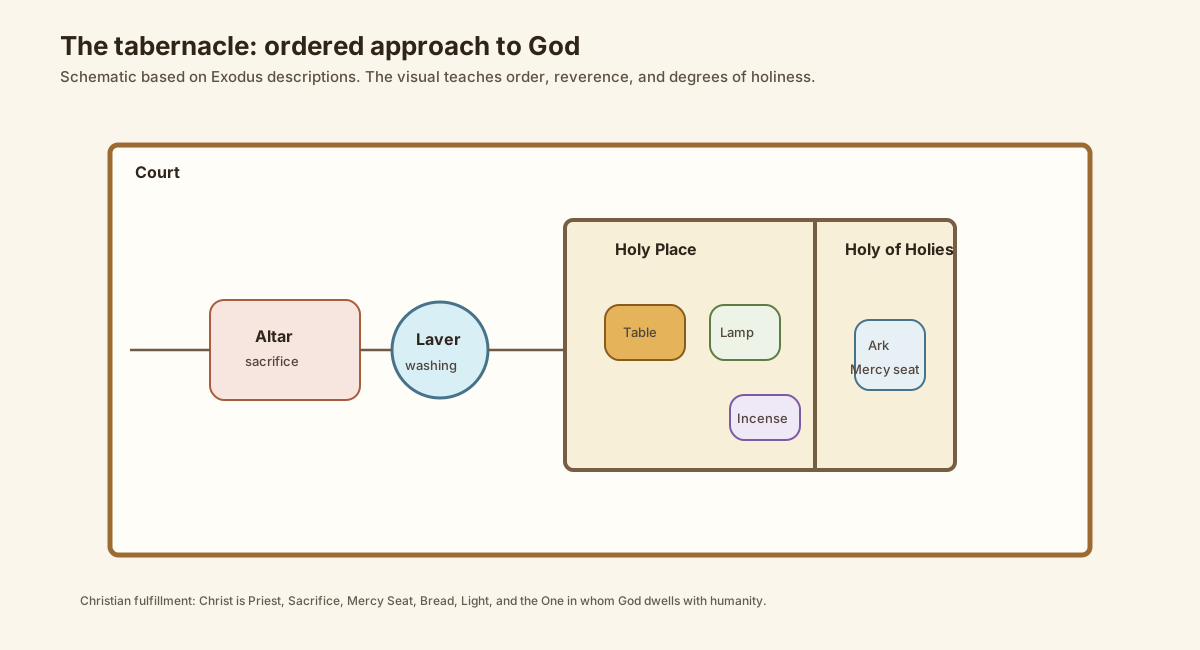 Source: Tabernacle teaching schematic, based on Exodus descriptions.
The studies follow NKJV chapter and verse numbering while printing Brenton’s English Septuagint, the ancient Greek Old Testament in English translation. Where their chapter divisions differ, the numbering note identifies the same passage in both. Brenton’s older English repays attention: “whole-burnt-offering” names an offering wholly given to God; “propitiatory” directs the eye toward the ark and the mercy-seat.
Light from the Word 🕯️
The promise behind the laws (Leviticus 26:11–12)
- And I will set my tabernacle among you, and my soul shall not abhor you;
- and I will walk among you, and be your God, and ye shall be my people.
The promise near the end of the book explains the labor of its beginning. God will dwell among His people and walk among them. The laws protect a communion He Himself has offered. Reverence matters because the One who comes near is holy; repentance matters because fellowship with Him can be wounded.
Leviticus 26 also places this promise within a covenant that includes warnings, confession, and God’s remembrance of His people. Its blessings are not a formula for securing comfort or wealth. The chapter brings obedience and refusal before the God who remembers His covenant even when His people have failed.
An offering at the door (Leviticus 1:3–4)
- If his gift be a whole-burnt-offering, he shall bring an unblemished male of the herd to the door of the tabernacle of witness, he shall bring it as acceptable before the Lord.
- And he shall lay his hand on the head of the burnt-offering as a thing acceptable for him, to make atonement for him.
The worshipper comes to a particular door with a particular gift. The animal is unblemished; the hand is laid upon its head; acceptance and atonement are explicitly named. “Atonement” concerns the dealing with sin that makes restored communion possible. Even the whole-burnt-offering, with its complete surrender, carries that concern.
The next offerings widen the picture. Grain brings the fruit of work; the peace offering has a shared meal whose fuller regulations appear in Leviticus 7; sin and trespass offerings attend to wrongdoing, confession, and what must be restored. The changing provisions for those of limited means keep poverty from becoming a closed sanctuary door. These differences deserve attention before any Christian comparison: each offering teaches something particular about approach to God.
Life given upon the altar (Leviticus 17:10–11)
- And whatever man of the children of Israel, or of the strangers abiding among you, shall eat any blood, I will even set my face against that soul that eats blood, and will destroy it from its people.
- For the life of flesh is its blood, and I have given it to you on the altar to make atonement for your souls; for its blood shall make atonement for the soul.
The prohibition and the gift belong together. Israel may not consume blood as ordinary food, because life belongs to God and He has given blood on the altar for atonement. Its significance rests upon His command and provision. Human beings receive the means of approach; they do not manufacture holiness by possessing ritual materials.
Hebrews 9:11–14 brings this language to Christ’s own self-offering and the cleansing of conscience. The Christian reader moves from the life of the animal offered to the Lord who freely gives Himself. The seriousness of blood in Leviticus helps us hear the cost and mercy of that gift.
Nearness through the veil (Leviticus 16:2–3)
- And the Lord said to Moses, Speak to Aaron thy brother, and let him not come in at all times into the holy place within the veil before the propitiatory, which is upon the ark of the testimony, and he shall not die; for I will appear in a cloud on the propitiatory.
- Thus shall Aaron enter into the holy place; with a calf of the herd for a sin-offering, and having a ram for a whole-burnt-offering.
Even Aaron may not enter whenever he chooses. The command gives both a boundary and a way of approach. The Day of Atonement gathers the book’s concerns: the high priest, blood, incense, the cleansing of the sanctuary, and the removal of the people’s sins.
Hebrews 9:7–10 describes the high priest’s recurring entrance and its limits; Hebrews 9:11–14 brings us to Christ’s once-for-all entrance by His own Blood. Hebrews 10:19–22 then joins access to a cleansed heart and a sincere drawing near. Christian confidence has this shape: gratitude for a way opened by Christ, accompanied by the desire to be cleansed.
Holiness in the company of others (Leviticus 19:1–2)
- And the Lord spoke to Moses, saying,
- Speak to the congregation of the children of Israel, and thou shalt say to them, Ye shall be holy; for I the Lord your God am holy.
The command addresses a people together. Leviticus 19 carries it into care for parents, rest, harvest gleanings for the poor, truthful speech, wages, judgment, and love of neighbor. The same Lord who orders the altar forbids the exploitation of a worker. Worship and justice have one source.
This communal call also guards the reading of the purity laws. Ritual uncleanness and personal wrongdoing are distinct: childbirth and bodily conditions can require purification without making a person morally guilty. Those distinctions matter wherever illness or weakness tempts others to despise someone. In Mark 1:40–45, Christ touches and cleanses the leper; the healing restores a person whom others could keep at a distance.
Gems from the Fathers 💎
St. John Chrysostom, explaining Hebrews 9:24–26, gathers the roles of priest and offering into Christ Himself. The Son gives His own life; the sacrifice is His willing act of love:
He is Himself then both victim and Priest and sacrifice.1
That unity helps us read Leviticus without reducing its different offerings to interchangeable symbols. The laws distinguish the worshipper, priest, and victim; Christ brings the priesthood and the gift to their fulfillment in His own Person. Chrysostom also explains Eucharistic offering in relation to the one sacrifice, rather than a succession of new crucifixions:
It is not another sacrifice, as the High Priest, but we offer always the same, or rather we perform a remembrance of a Sacrifice.2
St. Cyril of Alexandria, commenting on John 6:51, reads Christ’s self-sanctification in John 17:19 as His self-offering. Cyril’s interpretation joins spotless sacrifice, the sweet smell of an accepted offering, and the life-giving gift of Christ:
He here says, I sanctify Myself, for, I offer Myself and present Myself as a spotless Sacrifice for an odour of a sweet smell.3
These are explanations of the Gospel and Hebrews that illuminate the sacrificial language of Leviticus. Cyril’s sentence is his interpretation of Christ’s words, not a separate saying of Jesus. Together these witnesses direct our attention to the Lord who offers Himself and gives life, while leaving the individual laws their own meaning.
Patristic witnesses along the way
The chapter studies join the laws to healing, worship, mercy, and truthful dedication through these named witnesses. Their quoted words belong to the particular arguments developed in the linked studies; they are not interchangeable comments on every law.
| Witness and study | Work and location | Words from the source |
|---|---|---|
| St. John Chrysostom, Leviticus 16 | Homilies on Hebrews, Homily 17 §3, on Hebrews9:25–26 | “He is Himself then both victim and Priest and sacrifice.”4 |
| St. Cyril of Alexandria, Leviticus 19 | Commentary on Luke, Sermon68 (LXVIII), onLuke10:25–37, pp.315–316 | “But one of another race, a Samaritan, fulfilled the law of love.”5 |
| St. Athanasius of Alexandria, Leviticus 15 | Letter 48 to Amun, opening paragraph (unsectioned), before 354 per edition | “All things made by God are beautiful and pure, for the Word of God has made nothing useless or impure.”6 |
| St. Justin Martyr, Leviticus 14 | Dialogue with Trypho, chapter 41, opening sentence | “And the offering of fine flour, sirs, which was prescribed to be presented on behalf of those purified from leprosy, was a type of the bread of the Eucharist, the celebration of which our Lord Jesus Christ prescribed, in remembrance of the suffering which He endured on behalf of those who are purified in soul from all iniquity, in order that we may at the same time thank God for having created the world, with all things therein, for the sake of man, and for delivering us from the evil in which we were, and for utterly overthrowing principalities and powers by Him who suffered according to His will.”7 |
| St. Cyprian of Carthage, Leviticus 22 | On the Lord’s Prayer (Treatise 4), §12 | “After this we say, Hallowed be Your name; not that we wish for God that He may be hallowed by our prayers, but that we beseech of Him that His name may be hallowed in us.”8 |
| St. Gregory of Nazianzus, Leviticus 21 | Oration 2, §71 | “A man must himself be cleansed, before cleansing others: himself become wise, that he may make others wise; become light, and then give light: draw near to God, and so bring others near; be hallowed, then hallow them; be possessed of hands to lead others by the hand, of wisdom to give advice.”9 |
| St. Melito of Sardis, Leviticus 23 | On the Passover (On Pascha), §§67–69 | “This is the one who delivered us from slavery into freedom, from darkness into light, from death into life, from tyranny into an eternal kingdom, and who made us a new priesthood, and a special people forever.”10 |
| St. Cyril of Jerusalem, Leviticus 24 | Catechetical Lecture 22 (Mystagogical Lecture 4), §5 | “In the Old Testament also there was show-bread; but this, as it belonged to the Old Testament, has come to an end; but in the New Testament there is Bread of heaven, and a Cup of salvation, sanctifying soul and body; for as the Bread corresponds to our body, so is the Word appropriate to our soul.”11 |
| St. Basil the Great, Leviticus 25 | Second Homily on Psalm 14 (NKJV Psalm15), against usury, §1 of public selected transcription | “For in truth it is the last pitch of inhumanity that one man, in need of the bare necessities of life, should be compelled to borrow, and another, not satisfied with the principal, should seek to make gain and profit for himself out of the calamities of the poor.”12 |
| St. Augustine of Hippo, Leviticus 27 | Exposition on Psalm76, §11 (source title Psalm76; inline source references Psalm75:11) | “Let each man vow what he is able, and pay it. Do not vow and not pay: but let every man vow, and pay what he can. Be not slow to vow: for you will accomplish the vows by powers not your own. You will fail, if on yourselves ye rely: but if on Him to whom you vow ye rely, you will be safe to pay. Vow ye, and pay to the Lord our God.”13 |
The Church’s Voice in Worship ⛪
Leviticus is heard in the preparation of the Holy Myron. Coptic Reader appoints Leviticus 8:1–36, the consecration of Aaron and his sons, under Special / Consecrations / Oil / Myron / Preparation.14 The reading brings washing, vesting, anointing, and consecration into view as the Church prepares the holy oil. The ancient priestly rite and the Church’s rite remain distinct, yet the reading makes the holiness of consecration audible.
The Church also hears the fulfillment of sacrifice and release in the apostolic and Gospel readings. On Palm Sunday the Pauline reading is Hebrews 9:11–28, proclaiming the eternal redemption accomplished by Christ’s own blood. At Nayrouz, the first day of Thoout, Luke 4:14–30 opens the Church’s year with the Lord’s proclamation of the acceptable year. At Pentecost the Church reads Acts 2:1–21, from the descent of the Holy Spirit into St. Peter’s proclamation; its Vespers Gospel, John 7:37–44, brings the Lord’s promise of living water at the feast into the celebration of the Spirit. These are related readings that illuminate Leviticus, distinct from an appointment of the Leviticus chapters themselves.15
The Ottawa Holy Pascha book preserves Leviticus 23:5–12 at the Eleventh Hour of Good Friday, but Coptic Reader appoints Exodus 12:1–14 at that hour; the Leviticus passage is therefore a historical witness, not a current Reader appointment.16
The Liturgy of St. Basil also gives sacrificial language a living place in prayer. After the preparation of the gifts, the priest asks for acceptance while naming both his own sins and the people’s ignorance:
Grant, O Lord, that our sacrifice may be accepted before You for my own sins and for the ignorance of Your people.17
This prayer stands close to the concerns of Leviticus 4 and Hebrews 9:7. The priest’s service before the Lord includes repentance for himself; sacred office does not remove his need for mercy. The Litany of the Oblations, meanwhile, remembers even those who have nothing material to bring:
those who desire to offer to You but have none, and those who have offered these gifts to You this very day.18
Leviticus makes provision for the poor person’s offering. The Church’s prayer remembers both the gifts and the desire of someone unable to offer them. Poverty must never be treated as spiritual unworthiness.
The book, study by study
Twenty-seven standalone chapter studies follow Leviticus from its first offering to its final word about dedication. The sequence moves from offerings and priesthood through purification to the Day of Atonement, then into the holiness of bodies, relationships, time, and land. The final chapters place dedication within the seriousness and mercy of the covenant.
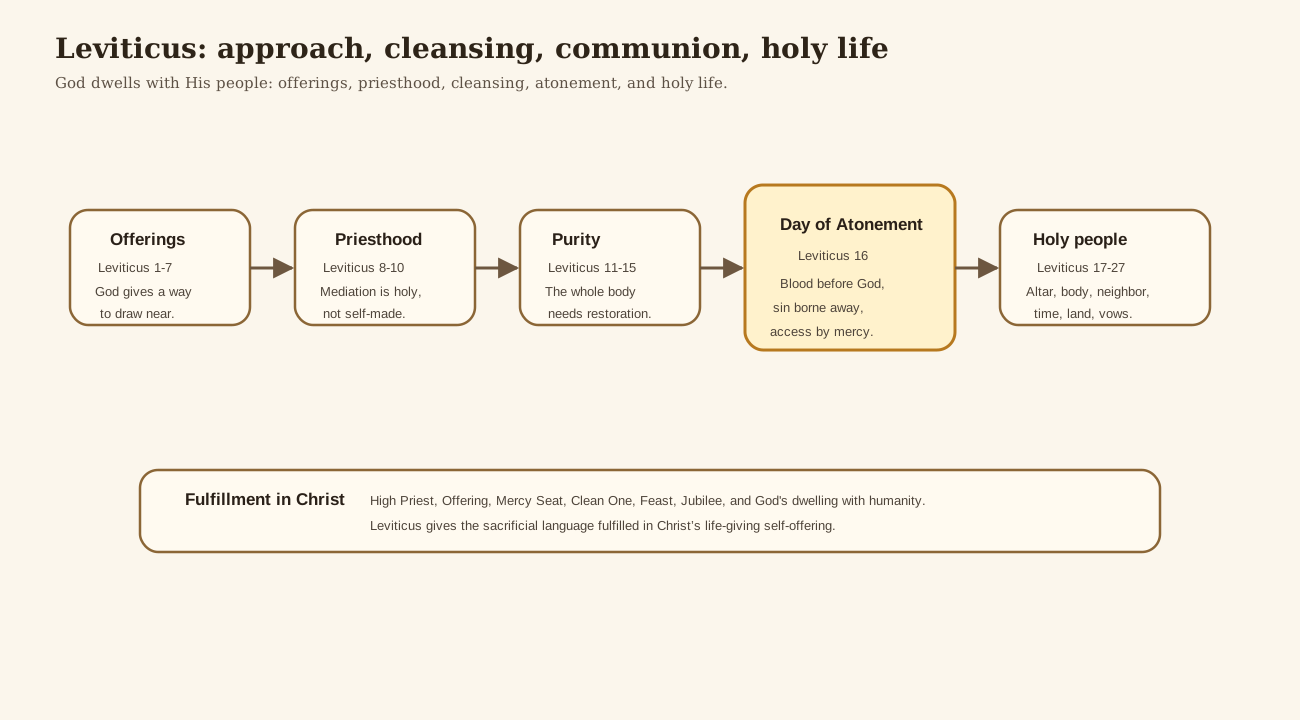 Source: Leviticus book-arc schematic, based on Leviticus 1–27.
Offerings and priestly service
- Leviticus 1: The Whole-Burnt Offering: the unblemished gift, atonement, and offerings from herd, flock, and birds.
- Leviticus 2: The Grain Offering: the memorial, holy portions, leaven, honey, salt, and first-fruits.
- Leviticus 3: The Peace Offering: the portion belonging to the Lord and the prohibition of fat and blood.
- Leviticus 4: The Sin Offering: the priest, the congregation, the ruler, and an individual of the people.
- Leviticus 5: Confession and the Trespass Offering: NKJV 5:1–19, including declaration of sin, provision for the poor, and trespass in holy things.
- Leviticus 6: Restitution, the Altar Fire, and the Priest’s Portion: restitution, the altar fire, and the priest’s portions. NKJV Leviticus 6:1–7 (Brenton Leviticus 5:20–26), the neighbor-restitution case, opens this standalone study.
- Leviticus 7: The Sacrifice of Praise and Priestly Portions: the peace-offering of praise, its shared meal, priestly portions, and the prohibition of fat and blood.
- Leviticus 8: The Consecration of Aaron and His Sons: washing, vesting, anointing, and the consecration of Aaron and his sons; the chapter is read at the preparation of the Holy Myron.
- Leviticus 9: The First Service and the Glory of the Lord: Aaron’s offerings for himself and the people, his blessing, and the appearance of the Lord’s glory.
- Leviticus 10: Strange Fire and Holy Discernment: the judgment of strange fire, sobriety, holy discernment, and priestly responsibility.
Purification and atonement
- Leviticus 11: Clean and Unclean Animals: the animal distinctions, carcasses, vessels, and the call to holiness in embodied life.
- Leviticus 12: Childbirth Purification and the Offering of the Poor: childbirth purification, circumcision, and the birds offered by those who cannot afford a lamb.
- Leviticus 13: Skin Disease and the Unclean Garment: patient examination, exclusion, and the limits of human judgment.
- Leviticus 14: Cleansing and Return: the priest goes outside the camp, the two birds, and restoration through blood and oil.
- Leviticus 15: Bodily Discharges and Cleansing: bodily uncleanness, cleansing, and reverence for the sanctuary without contempt for the body.
- Leviticus 16: The Day of Atonement: entrance within the veil, purification of the sanctuary, and sins borne away.
A holy people in worship and daily life
- Leviticus 17: Blood, Life, and True Worship: the altar, the life in the blood, and worship belonging to the Lord.
- Leviticus 18: Sexual Holiness and Covenant Boundaries: the boundaries that protect family and covenant life.
- Leviticus 19: Be Holy, for I the Lord Am Holy: justice, mercy, truthful dealings, and love of neighbor.
- Leviticus 20: Covenant Penalties and a Holy People: the stated penalties, the call to holiness, and a people set apart for the Lord.
- Leviticus 21: The Holiness of the Priests: priestly reverence, grief, marriage, and bodily restrictions without loss of personal dignity.
- Leviticus 22: Holy Gifts and Acceptable Offerings: receiving holy gifts, offering what is sound, and hallowing the Lord’s name.
- Leviticus 23: The Feasts of the Lord: rest and the appointed celebrations of the year.
- Leviticus 24: Lamp, Bread, and the Holy Name: continuing sanctuary service and the seriousness of speech before God.
- Leviticus 25: Sabbath Year, Jubilee, and Redemption: rest for the land, release, and the protection of the poor brother.
- Leviticus 26: Blessings, Warnings, Exile, and Covenant Mercy: obedience, refusal, confession, and God’s remembrance of His covenant.
- Leviticus 27: Vows, Dedications, and What Belongs to the Lord: truthful devotion and the responsibilities of dedication.
Spiritual Fruit 🍇
Come before God truthfully. The worshipper in Leviticus brings a gift and names what needs atonement. Before prayer or Communion, pause over the actual state of your heart. Bring the resentment you have defended, the careless promise, or the wrong you have concealed into repentance and confession. God’s provision gives courage to approach honestly.
Let repentance reach the injured neighbor. Restitution gives repentance a visible consequence. Where a wrong has involved money, reputation, or trust, seek the repair that is possible: return what was taken, correct what was falsely said, or acknowledge the harm without demanding immediate reconciliation. An apology becomes more truthful when it costs us the advantage the wrong secured.
Keep worship and mercy together. The call to holiness reaches the worker’s wages and the poor person’s portion. Give one ordinary dealing this attention: pay promptly, speak honestly, leave room for another person’s need. The neighbor encountered after prayer belongs to the same life offered before God.
At the sanctuary door, the worshipper waits with a gift. The way of approach has been given by God. Christ has opened the way to the Father through His own self-offering. Come with reverence, and with the hope that the One who calls you near can cleanse what you cannot cleanse yourself.
Teaching Notes
Reading the whole book
- Ask: What changes when the laws are read after Israel’s deliverance rather than as a way to earn it?
- Emphasize: Follow each offering’s actual provisions before drawing its Christian connection; priesthood, blood, cleansing, and access receive explicit treatment in Hebrews 9:7–10 and Hebrews 9:11–14 and Hebrews 10:19–22.
- Watch for: Ritual impurity does not always mean personal guilt. Ancient Israel’s civil penalties are not instructions to impose those penalties in parish life.
- Connect: The Myron reading is a current appointment; the prayers of St. Basil are worship connections, not evidence that Leviticus 1–5 are appointed readings.
- Show: Read Hebrews as fulfillment without contempt for Israel; use the book arc to connect ritual provisions with worship, repentance, reverence, and communion with God. The tabernacle plan clarifies the veil and restricted access in Leviticus 16; the book-arc chart locates that chapter between purification and holy daily life.
Sources
Embedded Scripture is from Brenton’s English Septuagint (LXX). Study references follow NKJV numbering; the outline identifies the chapter-boundary difference at Leviticus 6:1–7.
The Christian connections above draw on Hebrews 9:7–10 and Hebrews 9:11–14, Hebrews 9:24–26, Hebrews 10:19–22, John 6:51, John 17:19, and Mark 1:40–45. The quotations from St. John Chrysostom and St. Cyril of Alexandria are cited below with their actual works and locations.
Coptic Reader supplies the Myron reading and the prayers of St. Basil, at the menu paths given in the notes. The Myron appointment is distinct from a thematic connection to a prayer in the Divine Liturgy.
Footnotes
-
St. John Chrysostom, Homilies on Hebrews, Homily XVII, §3, NPNF First Series 14, p. 447; Oxford translation by T. Keble, revised by Frederic Gardiner (1889). Text. ↩
-
St. John Chrysostom, Homilies on Hebrews, Homily XVII, §6, NPNF First Series 14, p. 449; Oxford translation by T. Keble, revised by Frederic Gardiner (1889). Text. ↩
-
St. Cyril of Alexandria, Commentary on John, Book IV, chapter II, on John 6:51, p. 410; P. E. Pusey, trans., vol. 1, Library of the Fathers 43 (1874). Text. ↩
-
St. John Chrysostom, Homilies on Hebrews, Homily 17 §3, on Hebrews9:25–26. Text. ↩
-
St. Cyril of Alexandria, Commentary on Luke, Sermon68 (LXVIII), onLuke10:25–37, pp.315–316. Text. ↩
-
St. Athanasius of Alexandria, Letter 48 to Amun, opening paragraph (unsectioned), before 354 per edition. Text. ↩
-
St. Justin Martyr, Dialogue with Trypho, chapter 41, opening sentence. Text. ↩
-
St. Cyprian of Carthage, On the Lord’s Prayer (Treatise 4), §12. Text. ↩
-
St. Melito of Sardis, On the Passover (On Pascha), §§67–69. Text. ↩
-
St. Cyril of Jerusalem, Catechetical Lecture 22 (Mystagogical Lecture 4), §5. Text. ↩
-
St. Basil the Great, Second Homily on Psalm 14 (NKJV Psalm15), against usury, §1 of public selected transcription. Text. ↩
-
St. Augustine of Hippo, Exposition on Psalm76, §11 (source title Psalm76; inline source references Psalm75:11). Text. ↩
-
Coptic Reader, Special / Consecrations / Oil / Myron / Preparation, “Preparation of the Holy Myron,” reading headed Leviticus 8:1–36. ↩
-
St. Mary Coptic Orthodox Church, Ottawa, Holy Pascha, Lent 1734 A.M./2018 A.D., printed p. 627, includes Leviticus 23:5–12. Coptic Reader, Special / Pascha / Friday / 11th Hour, for Great Friday, April 10, 2026, appoints Exodus 12:1–14; the complete retained service contains no Leviticus reading. The two witnesses should not be conflated. Coptic Reader. ↩
-
Coptic Reader, Liturgies / St. Basil / Offering of the Lamb, “The Prayer after Preparation.” ↩
-
Coptic Reader, Liturgies / St. Basil / Liturgy of the Word, “Litany of the Oblations.” ↩