


This narration predates the current revision and may differ from the written study.
Before Leviticus 18 names a forbidden relation, it gives a promise: those who keep the Lord’s ordinances shall live in them. Israel’s bodily life is to grow from belonging to Him, rather than from Egypt’s remembered customs or Chanaan’s surrounding practices. The boundaries protect family, marriage, children, and the trust through which people live together. Moral seriousness belongs with reverence for persons: the command that restrains exploitation must never be used to crush someone already wounded by it.
Historical and Scriptural Context
The chapter follows the blood and life commands of Leviticus 17. Its repeated declaration, “I am the Lord your God,” places sexual conduct within the same covenant allegiance as worship. The list proceeds from near kin to wider family bonds, marriage, offspring, and acts named as abominations, then gathers everything into a warning about the defiled land.
Geographical Significance ⛰️
Egypt and Chanaan frame the choices before Israel. The people have left one land and are entering another, but neither place supplies their moral rule. The land itself becomes aggrieved with corruption; receiving it is therefore a responsibility, not a license.
The Characters 👥
The Lord speaks as Israel’s God. Households contain persons whose relationships must be honored: parents, children, siblings, spouses, and wider kin. Native and stranger share the command. The nations’ wrongs warn Israel against presumption, and those harmed by wrongdoing must never be confused with its perpetrators.
The Lord’s ordinances are a way of life (Leviticus 18:1–5)
1 And the Lord spoke to Moses, saying, 2 Speak to the children of Israel, and thou shalt say to them, I am the Lord your God. 3 Ye shall not do according to the devices of Egypt, in which ye dwelt: and according to the devices of the land of Chanaan, into which I bring you, ye shall not do; and ye shall not walk in their ordinances. 4 Ye shall observe my judgments, and shall keep my ordinances, and shall walk in them: I am the Lord your God. 5 So ye shall keep all my ordinances, and all my judgments, and do them; which if a man do, he shall live in them: I am the Lord your God.
“I am the Lord your God” frames the commands before the first prohibited relation appears. Israel stands between Egypt, the land of former bondage, and Chanaan, the land it will enter. Neither remembered custom nor the surrounding culture can define its holiness. Verse 4 makes the alternative positive: observe the Lord’s judgments, keep His ordinances, and walk in them.
Verse 5 supplies the promise that gives the chapter its purpose: the person who does these things shall live in them. God gives boundaries for life, not a catalogue designed to humiliate His people. Bodily holiness belongs to the communion He establishes.
Paul cites this sentence in Romans 10:5 and Galatians 3:12 while explaining the relation of law, faith, and righteousness. His argument exposes the failure of sinful people to secure righteousness by the law and directs them to Christ; it does not change God’s commands into an evil gift. In Luke 10:28, Christ tells the man who has named love of God and neighbor to do this and live. The connection prevents sexual holiness from becoming a self-contained concern: the body, the heart, and love of the neighbor belong to one life before God.
Lesson Guide
- Key phrases: “I am the Lord your God”; “walk in them”; “live in them”.
- Emphasize: Read the promise of life before the list of prohibitions.
- Avoid: Treating commandments as either arbitrary cruelty or a way to earn redemption independently of Christ.
Near kindred and the protection of trust (Leviticus 18:6–11)
6 No man shall draw nigh to any of his near kindred to uncover their nakedness; I am the Lord. 7 Thou shalt not uncover the nakedness of thy father, or the nakedness of thy mother, for she is thy mother; thou shalt not uncover her nakedness. 8 Thou shalt not uncover the nakedness of thy father’s wife; it is thy father’s nakedness. 9 The nakedness of thy sister by thy father or by thy mother, born at home or abroad, their nakedness thou shalt not uncover. 10 The nakedness of thy son’s daughter, or thy daughter’s daughter, their nakedness thou shalt not uncover; because it is thy nakedness. 11 Thou shalt not uncover the nakedness of the daughter of thy father’s wife; she is thy sister by the same father: thou shalt not uncover her nakedness.
The general prohibition in verse 6 governs the relations that follow: nearness of kin is not permission for sexual access. “Uncover their nakedness” names the forbidden sexual relation. Mother, father’s wife, sister, granddaughter, and half-sister are protected by stated family bonds, including a sister born at home or abroad. Distance of residence does not erase kinship.
Verse 8 calls the father’s wife’s nakedness the father’s nakedness. Sexual wrongdoing here injures a network of relations, not only two isolated persons. 1 Corinthians 5:1 shows the continuing seriousness of this relation when Paul confronts the man who has his father’s wife. Familiarity and access within a household must serve protection rather than exploitation.
These commands place responsibility on the person seeking forbidden access. A child or adult who has suffered coercion is not guilty of the violation inflicted by another. Abuse does not make its victim morally defiled. Protection requires listening, securing safety, and refusing to shield an offender through the family’s reputation or religious standing.
Lesson Guide
- Key phrases: “near kindred”; “born at home or abroad”; “it is thy father’s nakedness”.
- Emphasize: Family nearness creates responsibility to protect trust.
- Avoid: Implying that survivors share the guilt of an abuser.
The wider household and marriage bonds (Leviticus 18:12–16)
12 Thou shalt not uncover the nakedness of thy father’s sister, for she is near akin to thy father. 13 Thou shalt not uncover the nakedness of thy mother’s sister, for she is near akin to thy mother. 14 Thou shalt not uncover the nakedness of thy father’s brother, and thou shalt not go in to his wife; for she is thy relation. 15 Thou shalt not uncover the nakedness of thy daughter-in-law, for she is thy son’s wife, thou shalt not uncover her nakedness. 16 Thou shalt not uncover the nakedness of thy brother’s wife: it is thy brother’s nakedness.
The prohibitions widen from parents, sisters, and descendants to aunts, an uncle’s wife, a daughter-in-law, and a brother’s wife. Each relation carries its own reason: near kinship, relation by marriage, or the marriage belonging to the son or brother. The list refuses to treat a person as available simply because direct parentage is absent.
The repeated naming of another person’s relationship also exposes the lie that desire has no obligations beyond itself. A sexual act can betray a spouse, a brother, a child, and the trust that allows a family to live together. John the Baptist’s rebuke in Mark 6:18, concerning Herod’s brother’s wife, belongs directly beside verse 16. Rank and political power do not turn forbidden possession into lawful marriage.
For a Christian household, the practical fruit includes clear boundaries in conversation, touch, privacy, and authority. Holiness is not suspicion of every affectionate bond; it is the faithful care that allows affection to remain safe.
Lesson Guide
- Key phrases: “near akin”; “thy relation”; “thy son’s wife”; “thy brother’s nakedness”.
- Emphasize: Show how kinship and marriage create concrete obligations.
- Avoid: Making power or family permission sufficient to justify a prohibited relation.
Generations and rivalry within the home (Leviticus 18:17–18)
17 The nakedness of a woman and her daughter shalt thou not uncover; her son’s daughter, and her daughter’s daughter, shalt thou not take, to uncover their nakedness, for they are thy kinswomen: it is impiety. 18 Thou shalt not take a wife in addition to her sister, as a rival, to uncover her nakedness in opposition to her, while she is yet living.
Verse 17 forbids taking a woman and her daughter, or her granddaughter, into the same sexual relation. The law names the kinship and calls the act impiety. The generations are not a field in which one person may collect partners. Familial trust must not be converted into power over successive members of the same household.
Verse 18 forbids taking a wife’s sister as a rival while the wife lives. Its wording brings the injury of rivalry into view: one woman is not to be set against another inside the most intimate bond. The command addresses the stated ancient arrangement; the fuller Christian vision of marriage is read through Christ’s return to creation in Matthew 19:4-6 and the self-giving love of Ephesians 5:25-32.
Tobit 8:5-8 gives that vision a voice of prayer. Tobias and Sara recall Adam and Eve and ask to grow old together in uprightness rather than lust. Marriage receives another person as a companion before God, not as property or a remedy for every desire. A spouse’s dignity remains a responsibility even when affection is strained.
Gems from the Fathers 💎: Marriage without contempt for the body
Saint Athanasius, writing to Amun about purity, distinguishes lawful marriage from licentious or adulterous use. His praise of virginity does not make marriage impure. He writes:
“He is blessed who, being freely yoked in his youth, naturally begets children.”1
Lesson Guide
- Key phrases: “they are thy kinswomen”; “it is impiety”; “as a rival”.
- Emphasize: Explain both the generational boundary and the harm of manufactured rivalry.
- Avoid: Presenting ancient plural marriage arrangements as the Christian ideal.
Bodily boundaries, adultery, and children (Leviticus 18:19–21)
Brenton prints “serve a ruler” in verse 21 where NKJV names “Molech.” Brenton itself prints “Moloch” in Leviticus 20:2. These editions differ in how the designation is rendered here; the precise history of that difference is not settled by these English readings. The command’s link to offspring and the profaning of God’s name remains visible.
19 And thou shalt not go in to a woman under separation for her uncleanness, to uncover her nakedness. 20 And thou shalt not lie with thy neighbour’s wife, to defile thyself with her. 21 And thou shalt not give of thy seed to serve a ruler; and thou shalt not profane my holy name; I am the Lord.
Verse 19 belongs to the ancient law of separation and ritual uncleanness. An involuntary bodily condition is not a moral fault; the command addresses conduct during that condition. It does not establish a present pastoral rule by itself. Verse 20 then forbids intercourse with the neighbor’s wife, naming the betrayal as self-defilement. Another person’s marriage creates a boundary that desire must honor.
Verse 21 links the surrender of offspring with profaning the Lord’s holy name. Children must not be handed over as the price of belonging to an idolatrous power. Leviticus 20:2 makes the associated warning explicit with Brenton’s “Moloch.” The wording here does not justify a blanket judgment against every form of civil service, nor does it allow reconstruction of an otherwise unstated ritual.
Wisdom 14:12, 22–27 joins idolatry, the sacrificing of children, and disorder in marriages. It illuminates this connection between distorted worship and betrayed bodily life. Christ’s teaching in Matthew 5:27-30 reaches the heart that cultivates adultery before acting upon it. Watchfulness begins with what we choose to nourish: secret messages, fantasies, and habits that teach us to use persons rather than love them.
Lesson Guide
- Key phrases: “under separation”; “thy neighbour’s wife”; “serve a ruler”.
- Emphasize: Keep involuntary bodily conditions distinct from chosen betrayal.
- Avoid: Assigning moral guilt to menstruation or deriving a current sacramental rule.
Moral clarity and reverence for every person (Leviticus 18:22–23)
22 And thou shalt not lie with a man as with a woman, for it is an abomination. 23 Neither shalt thou lie with any quadruped for copulation, to be polluted with it: neither shall a woman present herself before any quadruped to have connexion with it; for it is an abomination.
Verse 22 especially requires sober handling. The Orthodox Church receives this verse, together with the wider scriptural witness, as a real moral prohibition and not as a discarded curiosity. Same-sex sexual acts are not blessed by the Church, just as adultery, fornication, and other sexual acts outside holy marriage are not blessed. But this clarity must never become mockery, contempt, or a pretext for shaming persons. Every human being bears the image of God. No one should be reduced to a temptation, a label, or a talking point. The Church speaks the truth about chastity because she believes every person is called to holiness, repentance, and communion with Christ.
Verse 23 also forbids sexual intercourse with an animal, calling it pollution and abomination. Both verses name conduct rather than offering permission to despise persons. The severity must be read with the chapter’s whole list, including family exploitation and adultery, so that selective outrage does not replace repentance.
Romans 1:24-27 places disordered sexual conduct within the exchange of the Creator for the creature. 1 Corinthians 6:9-11 joins its moral warning to the assurance that people once living in many forms of sin have been washed and sanctified. 1 Thessalonians 4:3-8 calls believers to bodily holiness and forbids taking advantage of another. The Church’s call is therefore neither indulgence nor despair: bring the body to Christ and let repentance become a real change in life.
Gems from the Fathers 💎: Belonging to Christ and free obedience
Saint John Chrysostom explains 1 Corinthians 6:15-20 through the dignity of the body as Christ’s member and the Spirit’s temple. Belonging to the Lord calls for willing holiness, not the destruction of freedom. He says:
“And here again, writing, You are not your own; he makes no infringement upon freedom of choice, but he leads away from vice and indicates the guardian care of the Lord.”2
Lesson Guide
- Key phrases: “lie with a man as with a woman”; “quadruped”; “abomination”.
- Emphasize: Read both prohibitions within the whole chapter and the apostolic call to sanctification.
- Avoid: Making persons objects of ridicule or dividing the room into targets and judges.
The land is aggrieved (Leviticus 18:24–28)
NKJV describes the land as “vomiting out” its inhabitants in verses 25 and 28; Brenton says it is “aggrieved.” The study keeps NKJV verse order while printing and explaining Brenton’s image of an injured land under divine judgment. The comparison identifies the different images without settling their textual history.
24 Do not defile yourselves with any of these things; for in all these things the nations are defiled, which I drive out before you, 25 and the land is polluted; and I have recompensed their iniquity to them because of it, and the land is aggrieved with them that dwell upon it. 26 And ye shall keep all my statutes and all my ordinances, and ye shall do none of these abominations; neither the native, nor the stranger that joins himself with you: 27 (for all these abominations the men of the land did who were before you, and the land was defiled,) 28 and lest the land be aggrieved with you in your polluting it, as it was aggrieved with the nations before you.
The chapter now gathers its prohibitions into a communal warning. The nations have defiled themselves, the land is polluted, and God recompenses their iniquity. Brenton describes the land as aggrieved with its inhabitants. The place meant to sustain human life bears the consequences of the lives lived upon it.
Israel receives the same warning. Native and stranger alike must keep the commands; election is no shelter for deliberate corruption. The land is not pictured as a deity with its own independent anger. Its grief belongs to the Lord’s judgment on the wrong done within His world.
This warning cannot be converted into a claim that every catastrophe reveals the particular guilt of its victims. Nor does it authorize a household or church to punish a survivor in the name of communal purity. The text charges those who do the prohibited acts. A community concerned for holiness must confront wrongdoing and protect those it has harmed, rather than making the injured carry its shame.
Lesson Guide
- Key phrases: “the land is polluted”; “aggrieved”; “neither the native, nor the stranger”.
- Emphasize: Accountability is shared, and belonging to Israel does not make wrongdoing safe.
- Avoid: Turning the judgment language into a diagnosis of every disaster.
Keep the ordinances of the Lord (Leviticus 18:29–30)
29 For whosoever shall do any of these abominations, the souls that do them shall be destroyed from among their people. 30 And ye shall keep mine ordinances, that ye may not do any of the abominable practices, which have taken place before your time: and ye shall not be polluted in them; for I am the Lord your God.
The final warning names the exclusion of the souls who do these abominations and ends where the chapter began: the Lord is their God. The command to keep His ordinances is a charge to remember who has formed and claimed them. The inherited practices of others cannot become an excuse for repeating them.
For Christians, the apostolic witness gives both accountability and healing. Acts 15:20 includes sexual immorality among the concrete renunciations asked of Gentile believers. Hebrews 13:4 honors marriage and warns against adultery and fornication. Neither text transfers Israel’s national penalties into private Christian hands. Discipline in the Church seeks repentance; it does not authorize assault, coercion, or humiliation.
Sexual holiness grows through truthful confession, guarded habits, fidelity, and the protection of others. A person who has chosen sin can return without calling the sin good. A person harmed by another can seek safety and healing without accepting responsibility for that other’s act. Christ’s mercy is strong enough for both truth and restoration.
Lesson Guide
- Key phrases: “whosoever shall do”; “keep mine ordinances”; “I am the Lord your God”.
- Emphasize: End with belonging to the Lord and a concrete path of repentance.
- Avoid: Treating Israel’s penalties as authorization for present violence.
The Church’s Voice in Worship ⛪
On Monday of the third week of Great Lent the Pauline reading is 1 Corinthians 5:9–6:5, setting the Church’s call to holiness within apostolic correction rather than transferring Israel’s civil penalties into Christian practice.3 The reading calls the community to examine its own life instead of making the surrounding world the sole object of accusation.
The Crowning rite reads Matthew 19:1–6 and asks in the Third Matrimonial Prayer: “Confirm their union, guard their bed in purity. Cover them and their home with Your unconquerable Right Hand.”4 Chastity within marriage is therefore spoken as a blessing to be guarded, not a contempt for sexual union. The home is placed under God’s care so that husband and wife may grow in faithful love.
The Prayer of Absolution Addressed to the Father says: “O God, who takes away the sin of the world, hasten to accept the repentance of Your servants, for the light of knowledge and forgiveness of sins.”5 Moral clarity serves that return to light. The prayer does not ask us to rename wrongdoing; it asks God to accept repentance and forgive.
Iconography and Visual Teaching 🖼️
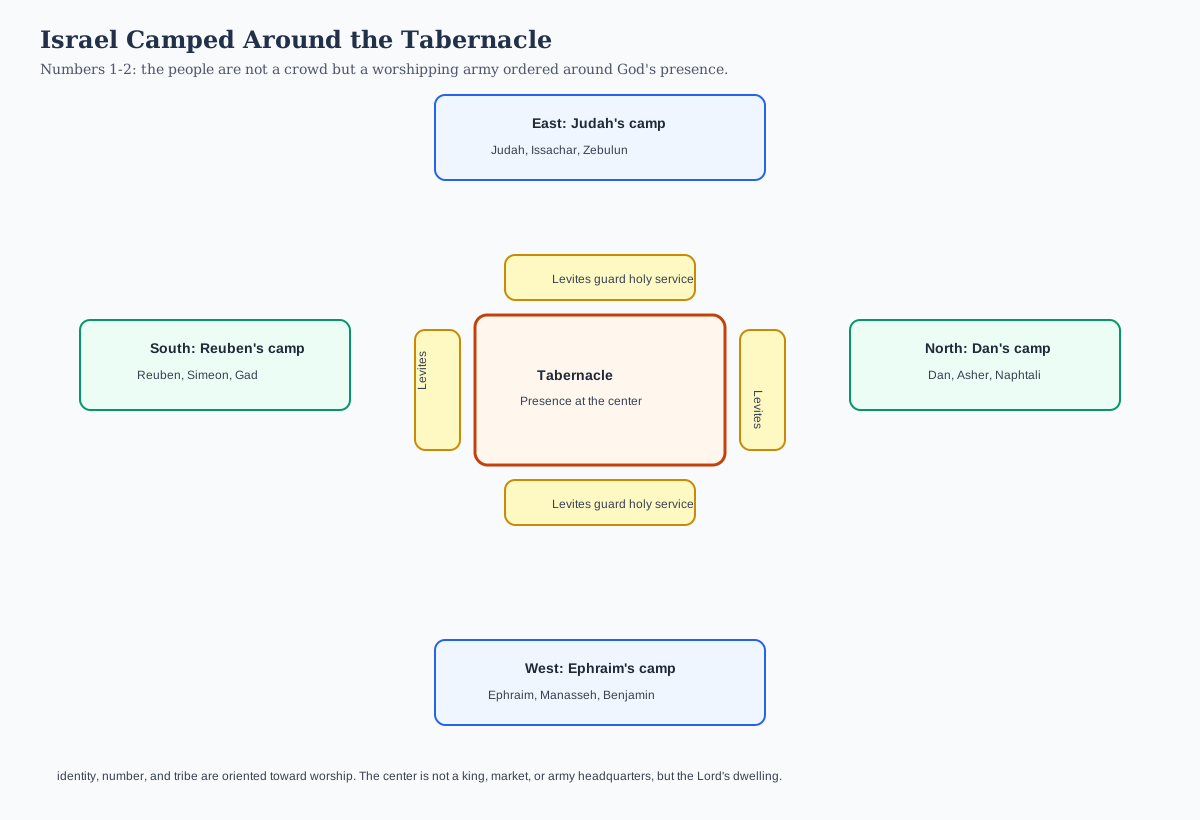 Source: Camp schematic, based on Numbers 1–2.
Glossary
- Ordinances and judgments: the Lord’s commands by which Israel is to walk and live.
- Uncover nakedness: the chapter’s expression for forbidden sexual relations, especially within stated kinship bonds.
- Near kindred: family relations whose nearness entails protection, not permission for sexual access.
- Impiety: grave wrongdoing against the holy order God gives, named in verse 17.
- Rival: the sister set in opposition to a living wife by the relation forbidden in verse 18.
- Separation: the bodily and ritual condition referenced in verse 19, not a judgment on a woman’s dignity.
- Serve a ruler / Moloch: Brenton’s wording in 18:21 and its named form in 20:2; NKJV names Molech in 18:21.
- Abomination: conduct the chapter condemns as gravely contrary to holy life; the term does not authorize contempt for persons.
- Quadruped: a four-footed animal, named in the prohibition of verse 23.
- The land is aggrieved: Brenton’s image of the land affected by its inhabitants’ corruption and God’s judgment.
- Chastity: bodily and inward faithfulness ordered to God, expressed in celibacy or faithful holy marriage.
- Repentance: truthful return from chosen sin to God, involving changed conduct and repair rather than despair or denial.
Spiritual Fruit 🍇
Chastity begins with honoring the persons desire is tempted to turn into objects. The body is meaningful, and family nearness calls for care. In a household, make privacy and trust reliable; in friendship, refuse the secrecy that prepares betrayal; in authority, never use spiritual confidence as access to someone vulnerable. Holiness makes people safer.
For someone who has chosen sexual sin, repentance can begin with one honest confession and one changed habit: ending a hidden relationship, removing access to pornography, or seeking accountable help before another fall. Shame that says change is impossible is no more truthful than desire that says the act is harmless. Christ can restore a life that has become divided.
For a survivor of abuse, the wrong belongs to the person who inflicted it. Seeking protection and competent help is not a failure of forgiveness. No demand for religious appearances, family unity, or a quick reconciliation should require exposure to further harm. The Church’s call to holy communion includes the responsibility to protect those who have been wounded.
Lord Jesus Christ, guard the trust we have been given. Heal what another’s sin has wounded, and forgive what we ourselves have chosen against love. Give us courage to set truthful boundaries and humility to seek help. Make our bodies and our homes places where Your mercy and holiness dwell together.
Teaching Notes
The Lord’s ordinances are a way of life (Leviticus 18:1–5)
- Ask: How does the promise of life change the way we hear a boundary?
- Watch for: Reducing Paul’s distinction between law and faith to permission for sexual wrongdoing.
Near kindred and the protection of trust (Leviticus 18:6–11)
- Ask: Why do household bonds make exploitation especially destructive?
- Watch for: An invitation to disclose personal abuse experiences publicly during discussion.
The wider household and marriage bonds (Leviticus 18:12–16)
- Ask: Which relationships besides the couple can be betrayed by sexual infidelity?
- Watch for: Confusing ordinary family affection with the conduct prohibited here.
Generations and rivalry within the home (Leviticus 18:17–18)
- Ask: How does praying to grow old together differ from seeking possession of another person?
- Watch for: Treating fidelity as a claim of entitlement over a spouse’s body.
Bodily boundaries, adultery, and children (Leviticus 18:19–21)
- Ask: What early choices can train a heart toward betrayal before any outward act?
- Watch for: Speculation that makes “serve a ruler” a prohibition of all civic obligations.
Moral clarity and reverence for every person (Leviticus 18:22–23)
- Ask: How does Paul’s “such were some of you” keep a moral warning open to hope?
- Watch for: Assuming that a temptation or an unwanted thought is identical to a chosen act.
The land is aggrieved (Leviticus 18:24–28)
- Ask: What changes when a community admits that its own conduct can wound the place it inhabits?
- Watch for: Victim-blaming disguised as a concern for communal holiness.
Keep the ordinances of the Lord (Leviticus 18:29–30)
- Ask: What would repentance repair besides a person’s private feeling of guilt?
- Watch for: Promises that restored trust must be immediate or that forgiveness requires unsafe contact.
Sources
Embedded Scripture is from Brenton’s English Septuagint (LXX). The study follows NKJV chapter and verse organization; differences affecting this reading are noted beside the passage. New Testament references are to NKJV.
The worship sources are Coptic Reader texts and appointments compared with @andraws/lectionary-data 1.3.1. Related readings are not direct appointments of this Leviticus chapter. The consulted reverse index contains no current verse-addressed appointment of Leviticus 18.
Footnotes
-
St. Athanasius of Alexandria, Letter 48 to Amun, opening paragraph, lawful and licentious use. Archibald Robertson, NPNF second series 4 (1892), New Advent public transcription. Containing text. ↩
-
St. John Chrysostom, Homilies on First Corinthians, Homily 18 §3, on 1 Corinthians 6:19–20. Hubert Kestell Cornish and John Medley translation, revised by Talbot W. Chambers, NPNF first series 12 (1889). Containing text. ↩
-
Coptic Reader, Coptic Orthodox Metropolis of the Southern United States, Readings / Liturgy / Pauline Epistle, Monday of the third week of Great Lent, 1 Corinthians 5:9–6:5. Reader; @andraws/lectionary-data 1.3.1. ↩
-
Coptic Reader, Crowning Prayer, Third Matrimonial Prayer and Gospel Matthew 19:1–6, menu Special / Crowning / Crowning Prayer, Reader. ↩
-
Coptic Reader, Prayer of Absolution Addressed to the Father, menu Clergy / Confession, Reader. ↩