
Israel’s camp has many banners, but one center. Numbers 1 counted the fighting men and distinguished the Levites’ charge; Numbers 2 now places the tribes around the tabernacle and gives their order of march. The chapter deserves attention on its own because its most important verse stands between the tribal groups: the tabernacle travels among them. God’s dwelling orders their life when they are at rest and when they are on the road.
Numbers 3 will name the Levitical families and their positions close to the sanctuary. The camp described here is neither a modern town plan nor a claim that every Christian must occupy one fixed social station. It gives Israel a received order for a real wilderness journey, and gives the Church a searching image of many gifts held together around Christ.
Judah toward the east, Reuben toward the south (Numbers 2:1-16; Greek/Brenton 2:1-16)
A note on numbering and wording. The study follows NKJV numbering and retains Brenton’s verse labels. The verse boundaries in Numbers 2 correspond in both editions. Brenton’s Juda, Ruben, Symeon, and Zabulon are Judah, Reuben, Simeon, and Zebulun.
Numbers 2 (Brenton).
1: And the Lord spoke to Moses and Aaron, saying, 2: Let the children of Israel encamp fronting each other, every man keeping his own rank, according to their standards, according to the houses of their families; the children of Israel shall encamp round about the tabernacle of witness. 3: And they that encamp first toward the east shall be the order of the camp of Juda with their host, and the prince of the sons of Juda, Naasson the son of Aminadab. 4: His forces that were numbered, were seventy-four thousand and six hundred. 5: And they that encamp next shall be of the tribe of Issachar, and the prince of the sons of Issachar shall be Nathanael the son of Sogar. 6: His forces that were numbered, were fifty-four thousand and four hundred. 7: And they that encamp next shall be of the tribe of Zabulon, and the prince of the sons of Zabulon shall be Eliab the son of Chælon. 8: His forces that were numbered, were fifty-seven thousand and four hundred. 9: All that were numbered of the camp of Juda were a hundred and eighty thousand and six thousand and four hundred: they shall move first with their forces. 10: This is the order of the camp of Ruben; their forces shall be toward the south, and the prince of the children of Ruben shall be Elisur the son of Sediur. 11: His forces that were numbered, were forty-six thousand and five hundred. 12: And they that encamp next to him shall be of the tribe of Symeon, and the prince of the sons of Symeon shall be Salamiel the son of Surisadai. 13: His forces that were numbered, were fifty-nine thousand and three hundred. 14: And they that encamp next to them shall be the tribe of Gad; and the prince of the sons of Gad, Elisaph the son of Raguel. 15: His forces that were numbered, were forty-five thousand and six hundred and fifty. 16: All who were numbered of the camp of Ruben, were a hundred and fifty-one thousand and four hundred and fifty: they with their forces shall proceed in the second place.
The people camp by their standards and fathers’ houses, around the tabernacle. A standard is an identifying banner for the company, not an alternative center of allegiance. Their family identities remain visible, but the Lord’s dwelling determines where those identities belong. Israel is gathered without becoming faceless.
Judah, Issachar, and Zebulun stand toward the east and move first. Reuben, Simeon, and Gad stand toward the south and move second. The numbers repeat chapter 1’s census, with Reuben here explicitly given as 46,500. The eastward position of Judah anticipates its prominence in the book’s order, while the larger biblical story will give Judah a royal significance through David and ultimately Christ. Revelation 5:5 names Christ as the Lion of the tribe of Judah. This is a canonical connection, not a claim that the direction east alone proves a messianic prophecy.
The southward camp has an appointed place without losing dignity. The chapter does not make first in the march equivalent to best before God. The Christian temptation is familiar: to treat another person’s prominence as a verdict against one’s own worth. The Lord gives a people work that must be done together. Gratitude for another’s gift belongs to the same obedience as faithfulness in one’s own.
The dwelling of God between the camps (Numbers 2:17; Greek/Brenton 2:17)
A note on numbering and wording. Numbers 2:17 corresponds in NKJV and Brenton. The complete verse is printed here as its own unit because it places the tabernacle within the order of march.
Numbers 2 (Brenton).
17: And then the tabernacle of witness shall be set forward, and the camp of the Levites shall be between the camps; as they shall encamp, so also shall they commence their march, each one next in order to his fellow according to their companies.
The tabernacle and the Levitical camp set out ‘between the camps’. This one sentence prevents the plan from becoming merely a diagram of Israel at rest. The people carry their worship-centered life into the journey. When the camps move, they do not leave God’s dwelling behind as a religious site visited during leisure.
The sentence also joins encamping and marching: ‘as they shall encamp, so also shall they commence their march’. The order received in stillness is to govern action. Prayer and work cannot be divided into two unrelated lives. The heart that has confessed Christ in worship must not adopt a different lord when business, family conflict, or fatigue begins.
John 1:14 reveals the Word made flesh dwelling among us, and Colossians 1:18 names Him as the Head of the Church. Christian reflection finds the center of Israel’s camp fulfilled personally in Christ. He is neither a sacred object we transport nor a useful blessing added to our plans. We belong to Him, and through the Holy Spirit our common life is built into God’s dwelling (Ephesians 2:19-22). The Eucharistic assembly gathers around His gift; the work after the Liturgy must answer to the same Lord.
Every camp keeps its charge (Numbers 2:18-34; Greek/Brenton 2:18-34)
A note on numbering and wording. Numbers 2:18-34 has corresponding verse boundaries in NKJV and Brenton. Ephraim’s camp moves third; Dan’s moves last. Levi is distinguished from the military count, not removed from the people’s life.
Numbers 2 (Brenton).
18: The station of the camp of Ephraim shall be westward with their forces, and the head of the children of Ephraim shall be Elisama the son of Emiud. 19: His forces that were numbered, are forty thousand and five hundred. 20: And they that encamp next shall be of the tribe of Manasse, and the prince of the sons of Manasse, Gamaliel the son of Phadassur. 21: His forces that were numbered, were thirty-two thousand and two hundred. 22: And they that encamp next shall be of the tribe of Benjamin, and the prince of the sons of Benjamin, Abidan the son of Gadeoni. 23: His forces that were numbered, were thirty-five thousand and four hundred. 24: All that were numbered of the camp of Ephraim, were one hundred and eight thousand and one hundred: they with their forces shall set out third. 25: The order of the camp of Dan shall be northward with their forces; and the prince of the sons of Dan, Achiezer the son of Amisadai. 26: His forces that were numbered, were sixty-two thousand and seven hundred. 27: And they that encamp next to him shall be the tribe of Aser; and the prince of the sons of Aser, Phagiel the son of Echran. 28: His forces that were numbered, were forty-one thousand and five hundred. 29: And they that encamp next shall be of the tribe of Nephthali; and the prince of the children of Nephthali, Achire son of Ænan. 30: His forces that were numbered were fifty-three thousand and four hundred. 31: All that were numbered of the camp of Dan, were a hundred and fifty-seven thousand and six hundred: they shall set out last according to their order. 32: This is the numbering of the children of Israel according to the houses of their families: all the numbering of the camps with their forces, was six hundred and three thousand, five hundred and fifty. 33: But the Levites were not numbered with them, as the Lord commanded Moses. 34: And the children of Israel did all things that the Lord commanded Moses; thus they encamped in their order, and thus they began their march in succession each according to their divisions, according to the houses of their families.
Ephraim, Manasseh, and Benjamin stand westward; Dan, Asher, and Naphtali stand northward. The chapter closes by repeating that Israel did what the Lord commanded. The last camp has a real responsibility in the ordered journey. No tribe must seize the place of another in order to belong.
Numbers 3:23-38 adds the inner positions of those guarding the sanctuary. The relationship can be seen without inventing distances, banner designs, or the shape of an archaeological settlement:
| Side of the tabernacle | Tribal camp in Numbers 2 | Nearer service in Numbers 3 |
|---|---|---|
| East | Judah, Issachar, Zebulun | Moses, Aaron, and Aaron’s sons |
| South | Reuben, Simeon, Gad | Kohath |
| West | Ephraim, Manasseh, Benjamin | Gershon |
| North | Dan, Asher, Naphtali | Merari |
This is a textual plan, not a reconstruction of scale. It makes the chapter’s claim visible: identity and responsibility remain distinct while all are related to the Lord’s dwelling. In the Church, 1 Corinthians 12:18-27 gives the corresponding safeguard. Different members belong to one body, and the members considered weaker are necessary. A received charge should protect communion, never give contempt a religious costume.
Gems from the Fathers 💎
St. Clement of Rome appeals to Israel’s priestly and Levitical order while correcting a divided church. His application is thanksgiving with a clear conscience, rather than ambition for another person’s ministry: ‘Let every one of you, brethren, give thanks to God in his own order, living in all good conscience, with becoming gravity, and not going beyond the rule of the ministry prescribed to him.’1 The word ‘thanks’ matters. A holy place is received gratefully before it is defended against others. This is Clement’s thematic use of Israel’s worship, not a direct explanation of Numbers 2.
The Church’s Voice in Worship ⛪
No verse-addressed reading of Numbers 2 is identified in the Coptic lectionary sources used for this study. Its worship-centered camp can illuminate our life around Christ, but that reflection should not be mistaken for an appointed reading.
Iconography and Visual Teaching 🖼️
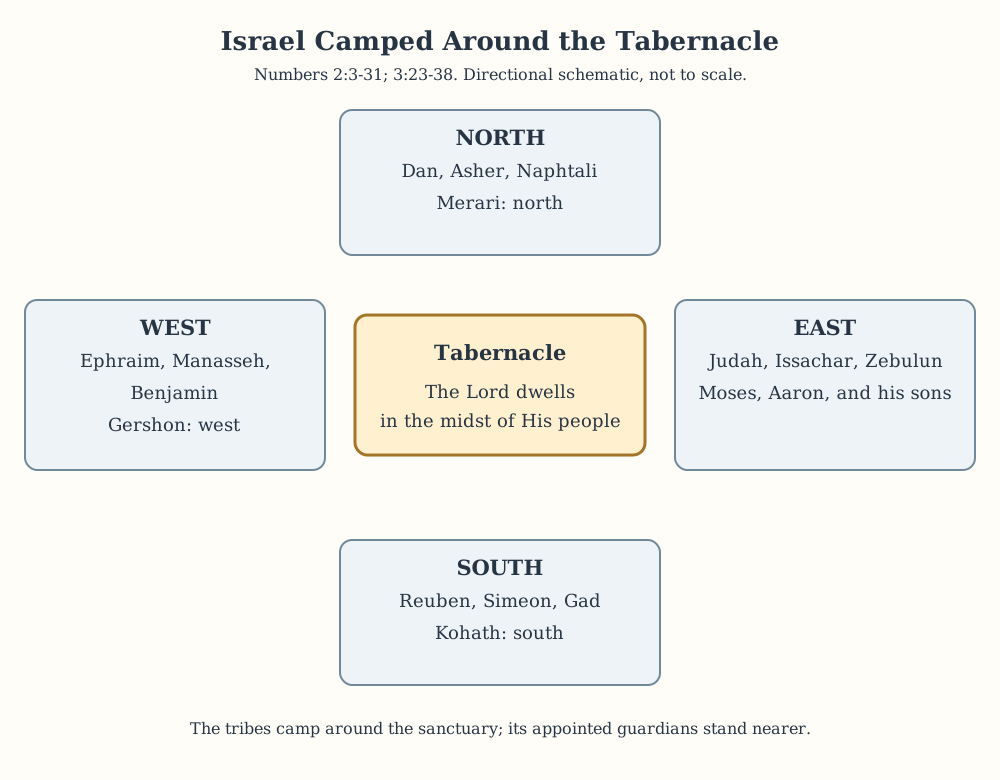
Teaching schematic, Orthodox Bible Study, 2026. Based on Numbers 2:3-31; 3:23-38. A directional or narrative aid, not a geographical survey.
Spiritual Fruit 🍇
Keep the same Lord at rest and in action. Choose one ordinary task after worship and begin it with a short prayer. Let the words shape the task: honest payment, patient speech, or a decision that refuses resentment. The tabernacle travels between the camps; Sunday worship must have a recognizable consequence on Monday.
Give thanks for another person’s place. Name before God one gift you have been comparing with your own. Pray for the person who carries it, and do one act that helps that person serve the Lord. Gratitude loosens envy more truthfully than pretending the difference does not exist.
Honor the last camp. Notice a hidden responsibility that makes a common task possible. Thank the person who bears it without flattery, and take a share when help is needed. The chapter’s ordered march needs more than its first visible company.
Lord Jesus Christ, dwell in the midst of Your people. Gather our divided desires around You. Let us carry the peace received in worship into every place where You send us.
Teaching Notes
Discuss: Judah toward the east, Reuben toward the south (Numbers 2:1-16; Greek/Brenton 2:1-16)
- Ask: How does retaining tribal names and banners differ from making a tribe the center?
- Watch for: Making geographic direction or march order into an unsupported ranking of spiritual worth.
Discuss: The dwelling of God between the camps (Numbers 2:17; Greek/Brenton 2:17)
- Ask: What difference does ‘between the camps’ make when Israel is marching rather than resting?
- Watch for: Reducing Christ to a sacred possession, or separating worship from the conduct of ordinary life.
Discuss: Every camp keeps its charge (Numbers 2:18-34; Greek/Brenton 2:18-34)
- Ask: How can different responsibilities strengthen communion rather than create competition?
- Watch for: Treating an assigned task as unchangeable personal status, or using order to silence correction.
Glossary
- Standard: a banner identifying a camp or company.
- Ecclesial: belonging to the Church’s common life in Christ.
- Kohath, Gershon, Merari: the three Levitical family groups, called Caath, Gedson, and Merari in Brenton.
Sources
Embedded Scripture is from Brenton’s English Septuagint (LXX).
Brenton Numbers 2 🔗; Numbers 3:23-38 for the inner positions.
John 1:14; Colossians 1:18; Ephesians 2:19-22; 1 Corinthians 12:18-27; Revelation 5:5 for the canonical reflections.
St. Clement of Rome, First Epistle to the Corinthians, chapters 40-41.