
As Israel prepares to settle the land, it must also prepare to shelter a person whose hand has shed blood unintentionally. Numbers 35 makes that provision without denying the life that has been lost. Refuge restrains vengeance, a hearing distinguishes intention, and release waits for the death of the anointed high priest. After the boundaries and allotment leaders of Numbers 34, this chapter considers the holiness of life within the gift. It deserves a separate study because its legal care and its Christological promise cannot be compressed into a passing note before Numbers 36’s final inheritance ruling.
Numbers 35:1-8; Greek/Brenton 35:1-8 | Holy service is given a place to live
Numbering note: NKJV and Brenton share the chapter and verse labels. At 35:4, Brenton gives “two thousand cubits” for the suburbs measured outward from the city wall, while NKJV gives “one thousand cubits.” Both give two thousand in verse 5. The edition difference is preserved without inventing a geographical or manuscript solution.
Numbers 35 (Brenton) 1: And the Lord spoke to Moses to the west of Moab by Jordan near Jericho, saying, 2: Give orders to the children of Israel, and they shall give to the Levites cities to dwell in from the lot of their possession, and they shall give to the Levites the suburbs of the cities round about them. 3: And the cities shall be for them to dwell in, and their enclosures shall be for their cattle and all their beasts. 4: And the suburbs of the cities which ye shall give to the Levites, shall be from the wall of the city and outwards two thousand cubits round about. 5: And thou shalt measure outside the city on the east side two thousand cubits, and on the south side two thousand cubits, and on the west side two thousand cubits, and on the north side two thousand cubits; and your city shall be in the midst of this, and the suburbs of the cities as described. 6: And ye shall give the cities to the Levites, the six cities of refuge which ye shall give for the slayer to flee thither, and in addition to these, forty-two cities. 7: Ye shall give to the Levites in all forty-eight cities, them and their suburbs. 8: And as for the cities which ye shall give out of the possession of the children of Israel, from those that have much ye shall give much, and from those that have less ye shall give less: they shall give of their cities to the Levites each one according to his inheritance which they shall inherit.
Light from the Word 🕯️
The Levites receive towns and surrounding land from the inheritance of the tribes. Their towns are homes, and the surrounding enclosures provide for their animals. The Lord who appoints holy service also makes provision for the servants’ ordinary life. The Levites’ lack of a tribal territory does not mean that their bodily needs are irrelevant.
Six refuge cities and forty-two other cities make up the forty-eight towns. The refuge cities are included in the whole, not added to forty-eight. The giving is proportionate: those who have much give much; those who have less give less. The community shares the cost of sustaining service to the Lord according to the gift it has received. Provision becomes a form of acknowledgment rather than a competition in visible generosity.
The law places places of refuge among the homes of those entrusted with holy service. The chapter does not yet name the six cities; Deuteronomy and Joshua will supply names in their own accounts. Here the emphasis falls on the provision itself. Israel must have places where a life can be protected while justice is discerned.
There is a Christian resonance in sustaining those who serve the Lord while remembering that holy service brings responsibility toward vulnerable people. It should remain a resonance, not a one-to-one equation between Levite towns and parish buildings. A church does not become a place of refuge simply by having a sacred name. Its people must be willing to hear the frightened person, protect the endangered, and seek truth without offering secrecy as a substitute for justice.
Numbers 35:9-15; Greek/Brenton 35:9-15 | Refuge before judgment
Numbering note: NKJV and Brenton share the labels 35:9-15. The six cities are divided equally across the Jordan, with three on each side.
Numbers 35 (Brenton) 9: And the Lord spoke to Moses, saying, 10: Speak to the children of Israel, and thou shalt say to them, Ye are to cross over Jordan into the land of Chanaan. 11: And ye shall appoint to yourselves cities: they shall be to you cities of refuge for the slayer to flee to, every one who has killed another unintentionally. 12: And the cities shall be to you places of refuge from the avenger of blood, and the slayer shall not die until he stands before the congregation for judgment. 13: And the cities which ye shall assign, even the six cities, shall be places of refuge for you. 14: Ye shall assign three cities on the other side of Jordan, and ye shall assign three cities in the land of Chanaan. 15: It shall be a place of refuge for the children of Israel, and for the stranger, and for him that sojourns among you; these cities shall be for a place of refuge, for every one to flee thither who has killed a man unintentionally.
Light from the Word 🕯️
The initial purpose of the refuge cities is precise: protection for someone who has killed unintentionally. The “avenger of blood” is the person associated with avenging the slain. In the face of that threat, the fugitive must not die before standing before the congregation for judgment. Refuge creates the possibility of a hearing. It is neither an immediate declaration of innocence nor permission to make the life lost unimportant.
The refuge is provided on both sides of the Jordan. The eastern tribes remain within the concern of this law. Israelite, stranger, and sojourner can flee there; protection is not reserved to the person with the strongest family standing. The hearing must examine the act rather than decide the outcome by the fugitive’s social identity.
The Christian reflection is especially valuable wherever anger demands a verdict before facts can be heard. Protecting a person from immediate harm is compatible with investigating what happened. Refusing revenge need not silence the bereaved. The chapter protects the conditions in which truth can be sought, and that is a genuine mercy to the whole community.
Hebrews 6:18 speaks of those who have fled for refuge to lay hold of the hope before them. The epistle then names Jesus as the forerunner and High Priest who has entered within the veil (6:19-20). Read beside Numbers, the words direct us toward a greater refuge: God’s faithful promise and the living Christ. Hebrews does not explicitly name this chapter at that point, so the connection is a Christian reflection rather than a claim of an identified direct quotation from Numbers 35.
Numbers 35:16-29; Greek/Brenton 35:16-29 | The hearing and the death of the high priest
Numbering note: NKJV and Brenton share the labels 35:16-29. Brenton 35:25 calls the priest “the high-priest, whom they anointed with the holy oil.” This full description is retained.
Numbers 35 (Brenton) 16: And if he should smite him with an iron instrument, and the man should die, he is a murderer; let the murderer by all means be put to death. 17: And if he should smite him with a stone thrown from his hand, whereby a man may die, and he thus die, he is a murderer; let the murderer by all means be put to death. 18: And if he should smite him with an instrument of wood from his hand, whereby he may die, and he thus die, he is a murderer; let the murderer by all means be put to death. 19: The avenger of blood himself shall slay the murderer: whensoever he shall meet him he shall slay him. 20: And if he should thrust him through enmity, or cast any thing upon him from an ambuscade, and the man should die, 21: or if he have smitten him with his hand through anger, and the man should die, let the man that smote him be put to death by all means, he is a murderer: let the murderer by all means be put to death: the avenger of blood shall slay the murderer when he meets him. 22: But if he should thrust him suddenly, not through enmity, or cast any thing upon him, not from an ambuscade, 23: or smite him with any stone, whereby a man may die, unawares, and it should fall upon him, and he should die, but he was not his enemy, nor sought to hurt him; 24: then the assembly shall judge between the smiter and the avenger of blood, according to these judgments. 25: And the congregation shall rescue the slayer from the avenger of blood, and the congregation shall restore him to his city of refuge, whither he fled for refuge; and he shall dwell there till the death of the high-priest, whom they anointed with the holy oil. 26: But if the slayer should in any wise go out beyond the bounds of the city whither he fled for refuge, 27: and the avenger of blood should find him without the bounds of the city of his refuge, and the avenger of blood should kill the slayer, he is not guilty. 28: For he ought to have remained in the city of refuge till the high-priest died; and after the death of the high-priest the slayer shall return to the land of his possession. 29: And these things shall be to you for an ordinance of judgment throughout your generations in all your dwellings.
Light from the Word 🕯️
The legal cases require attention to the instrument, its capacity to kill, enmity, ambush, anger, and the intention to harm. Iron, stone, and wood are not merely incidental objects in the account. They help distinguish a lethal assault from an unintentional act. The congregation must judge between the slayer and the avenger according to these judgments. We should not simplify the cases into the rule that only an openly admitted motive establishes murder.
These are ancient capital penalties, not instructions for Christians to execute private vengeance or reenact Israel’s judgments. The hearing and refuge provisions restrain the avenger, yet the law does permit lethal action in circumstances it defines. Honest Christian reception must name both features. In our own response to harm, we obey Christ’s command against revenge, protect those in danger, and use lawful means for truth and accountability.
When the congregation finds the unintentional case, it rescues the slayer and restores him to the city of refuge. Protection continues there until the high priest’s death. Leaving its bounds before that event exposes him again to the avenger. Refuge is therefore a real protected life, but also a restricted life. The act was unintentional, yet the death has changed his relation to his home and land.
The release comes through an event the fugitive cannot purchase or arrange: the death of the high priest anointed with holy oil. The law states the condition; it does not explain here why that death releases him. We should not invent an account of an automatic transfer of guilt, a ritual enacted at the priest’s death, or the feelings of the victim’s family. The legal sequence itself is enough to open the Christian reflection.
Christ is the Anointed One and the true High Priest. Hebrews 9:14-15 sets His freely offered death within the redemption of transgressions and the receiving of eternal inheritance. Numbers ties a return to one’s land to the high priest’s death; the Gospel announces the priestly self-offering that brings sinners to life with God. The correspondence is not exact in every detail: the city protects the unintentional slayer, while Christ calls sinners with many kinds of guilt to repentance. His mercy goes beyond the legal case without making that case meaningless.
The Lord’s priesthood also surpasses mortal succession. Hebrews 7:23-25 teaches that He lives forever and intercedes for those who come to God through Him. The risen High Priest is not replaced after His death. The One who offered Himself remains our refuge, and we return to Him in confession because His mercy tells the truth about sin while freeing us from its dominion.
Gems from the Fathers 💎: Hope held by the living High Priest
St. John Chrysostom, in Homilies on Hebrews 11.3-4, explains the hope of Hebrews 6 as an anchor that reaches into heaven, where Jesus has entered before us. “For there is no great interval between the forerunner and those who follow: otherwise he would not be a forerunner; for the forerunner and those who follow ought to be in the same road, and to arrive after [each other].”1 His point is that Christ’s entry gives a real destination to those who follow Him. This is a New Testament witness on refuge, hope, and the High Priest, not a claim that Chrysostom directly explains Numbers’ release rule. It preserves the positive center of our reflection: we flee toward a living Savior who opens the way to the Father.
Numbers 35:30-34; Greek/Brenton 35:30-34 | Blood cannot be priced away
Numbering note: NKJV and Brenton share the labels 35:30-34. Brenton’s final declaration is “I am the Lord dwelling in the midst of the children of Israel.”
Numbers 35 (Brenton) 30: Whoever kills a man, thou shalt slay the murderer on the testimony of witnesses; and one witness shall not testify against a soul that he should die. 31: And ye shall not accept ransoms for life from a murderer who is worthy of death, for he shall be surely put to death. 32: Ye shall not accept a ransom to excuse his fleeing to the city of refuge, so that he should again dwell in the land, until the death of the high-priest. 33: So shall ye not pollute with murder the land in which ye dwell; for this blood pollutes the land, and the land shall not be purged from the blood shed upon it, but by the blood of him that shed it. 34: And ye shall not defile the land whereon ye dwell, on which I dwell in the midst of you; for I am the Lord dwelling in the midst of the children of Israel.
Light from the Word 🕯️
One witness cannot establish a capital verdict. Deuteronomy 17:6 and 19:15 provide the wider scriptural rule requiring more than one witness. Matthew 18:16 and 2 Corinthians 13:1 carry the principle into Church discipline and apostolic correction. Their contexts differ from this capital law, but the concern remains recognizable: a person’s life and standing must not depend on one untested accusation. A hearing requires evidence, not confidence amplified by anger.
The law refuses ransom both for a murderer liable to death and for an early return of the refuge dweller. Wealth cannot buy a different moral reality. The bereaved life is not a price the rich can absorb, and the protected slayer cannot purchase the release the law ties to the high priest’s death. The two cases must remain distinct even though both prohibit payment as an escape.
Christ’s giving of His life as a ransom in Mark 10:45 offers a deliberate Christian contrast. He is not a wealthy offender paying to avoid judgment. He freely gives Himself to deliver others. The refusal to price away bloodshed prepares the reader to feel the depth of a salvation accomplished by the self-offering of the Son, not by a bargain that makes human life cheap.
Blood pollutes the land. Genesis 4:10 gives the corresponding image of Abel’s blood crying from the ground. Violence cannot be hidden from the God who gives the ground and inhabits the people’s midst. Hebrews 12:24 directs us to the blood of Jesus that speaks better than Abel’s. The Cross answers bloodshed without telling us that bloodshed never mattered. In Christ, repentance and reconciliation become possible because sin is dealt with by His saving self-offering.
The final sentence gives the foundation of the chapter’s law: the Lord dwells among His people. Numbers began with the tribes ordered around the tabernacle; here the holiness of the shared land is governed by the same divine presence. John 1:14 and Revelation 21:3 carry this promise toward its fullness: the Word dwells among us, and God’s dwelling is with His people. Justice and mercy are therefore not optional decorations around worship. A life cherished by God must not be treated as expendable among those who confess His presence.
The Church’s Voice in Worship ⛪
Numbers 35 has no direct verse-addressed appointment in the Coptic readings consulted for this study. The Christological reflection rests on Hebrews’ teaching of refuge, priesthood, sacrifice, and inheritance. No separate Coptic rite or hymn is claimed for the high priest’s death or the release of the slayer.
Iconography and Visual Teaching 🖼️
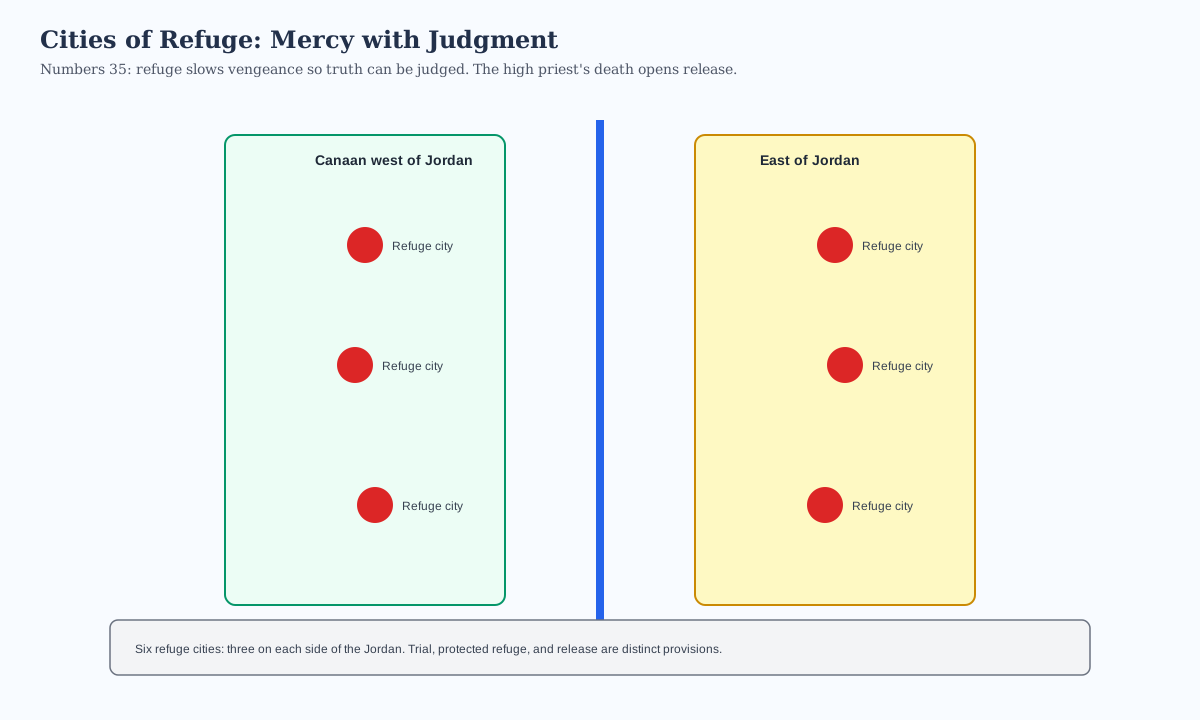
Teaching schematic, Orthodox Bible Study, 2026. Based on Numbers 35:9-15. A directional or narrative aid, not a geographical survey.
Spiritual Fruit 🍇
Protect the hearing from haste. When a serious accusation reaches you, resist passing it on as a settled verdict. Preserve evidence, seek appropriate help, and protect anyone in immediate danger. Mercy gives truth room to be heard; it does not demand that a harmed person remain silent.
Seek refuge with an honest account. In confession, name the act and the intention as truthfully as you can. Do not exaggerate to punish yourself or minimize to escape correction. Christ’s mercy can meet the truth you bring before Him.
Refuse to turn money into moral exemption. Compensation can be part of repair, but a donation does not erase abuse, dishonesty, or the need to restore what can be restored. Let repentance change conduct as well as what you give.
Hold hope by the living High Priest. When guilt makes you feel permanently barred from home, return to the Christ who died and lives for you. Receive His correction and His mercy together. The refuge He gives is a beginning of restored communion, not a place to remain unchanged.
Lord Jesus Christ, our High Priest and refuge, receive me without allowing me to hide the truth. Protect those who are threatened, comfort those who mourn, and free my heart from vengeance. By Your willing self-offering and Your risen life, bring us into the inheritance of Your peace.
Teaching Notes
Numbers 35:1-8; Greek/Brenton 35:1-8
Discuss
- Ask: What does proportionate provision for the Levites teach about responsibility within a received gift?
- Emphasize: Six refuge cities belong within the forty-eight, and the chapter does not name them individually.
- Watch for: Turning the Levite towns into an exact blueprint for parish institutions.
- Connect: Holy service directed to the Lord, with responsible care for material needs.
Numbers 35:9-15; Greek/Brenton 35:9-15
Discuss
- Ask: Why is protection before a hearing different from an automatic verdict of innocence?
- Emphasize: Refuge is open to stranger and sojourner as well as Israelite.
- Watch for: Silencing victims in the name of mercy or calling the related language of Hebrews an explicit quotation of this chapter.
- Connect: Hebrews 6:18-20.
Numbers 35:16-29; Greek/Brenton 35:16-29
Discuss
- Ask: Which facts does the congregation have to examine before restoring the slayer to refuge?
- Emphasize: Preserve the legal distinction between murder and unintentional killing, then make the High Priest reflection carefully.
- Watch for: Invented rituals at the priest’s death, modern enactment of the ancient penalties, or treating the Christological correspondence as identical in every detail.
- Connect: Hebrews 7:23-25; 9:14-15.
Numbers 35:30-34; Greek/Brenton 35:30-34
Discuss
- Ask: Why do evidence and the refusal of ransom belong beside the declaration that the Lord dwells in the land?
- Emphasize: Wealth must not alter the law’s treatment of bloodshed or buy an early release.
- Watch for: Interpreting Christ’s ransom as a financial escape from responsibility.
- Connect: Genesis 4:10; Mark 10:45; Hebrews 12:24; Revelation 21:3.
Sources
Embedded Scripture is from Brenton’s English Septuagint (LXX). New Testament references are read in NKJV. The release through the anointed high priest’s death is offered as a Christian reflection through Hebrews, without attributing it to an unlocated ancient commentary.
Numbers 35 and the biblical parallels discussed above; the NKJV contrast at 35:4 🔗.
St. John Chrysostom, Homilies on Hebrews 11.3-4, primary text 🔗.
“Christ” means the Anointed One, Strong’s Greek 5547 🔗, for the title used in the reflection on 35:25.
Coptic Orthodox reading appointments consulted through lectionary-data 1.3.3 🔗.
Footnotes
-
St. John Chrysostom, Homilies on Hebrews 11.4, on Hebrews 6:19-20, NPNF1, vol. 14, 🔗. ↩