


Outside Eden, both brothers still approach God with gifts. Cain’s face falls when his offering is not received, and God speaks to him before he raises a hand against Abel. Genesis 4 follows that refused conversation from altar to field, then follows Abel’s blood from the field into God’s hearing. Cain can deny responsibility for his brother, but he cannot make the brother disappear. The chapter ends with Seth and a renewed hope of calling upon the Lord, not with murder’s last word.
Why this passage matters
This chapter matters because it reveals how sin matures. The distrust of Genesis 3 becomes the murder of Genesis 4. Resentment at the altar becomes violence in the field. The passage therefore teaches that worship cannot be separated from the inner state of the heart. One cannot draw near to God while consenting to jealousy, contempt, or hatred of the brother.
It also matters because Abel becomes one of Scripture’s earliest figures of righteous suffering. His blood cries from the ground, and the New Testament later places him in relation to Christ, whose blood speaks a better word. Genesis 4 is therefore essential for understanding sacrifice, envy, violence, conscience, judgment, and the difference between blood that accuses and blood that redeems.
Visual teaching aid: worship and the brother
This locally generated teaching diagram is meant to help the reader keep the chapter’s spiritual movement in view. It is not decorative clip art. It summarizes the chapter’s main theological sequence: offering, warning, envy, blood, and severe mercy.
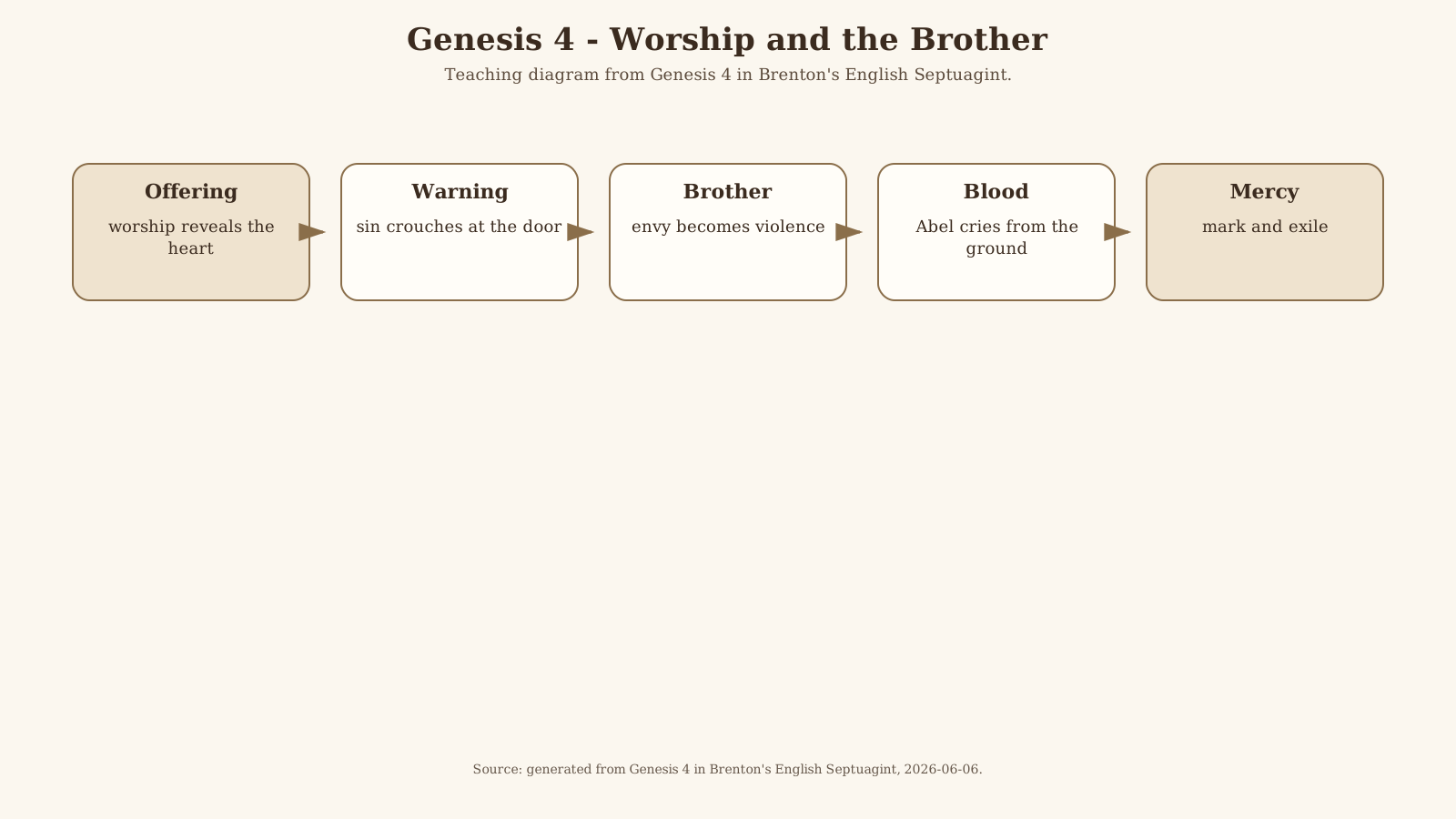 Source: generated for this Genesis audit from Genesis 4 worship and brother in Brenton’s English Septuagint, 2026-06-06.
Historical and Scriptural Context
Genesis 4 follows immediately after expulsion from Eden. Humanity is now east of the garden, living under the burdens announced in Genesis 3. Yet worship has not disappeared. Both brothers bring offerings. This matters greatly. Fallen man still lives before God. The question is not whether worship continues, but whether worship is offered with a heart that can bear God’s light.
The chapter also shows how quickly the wound of the fall spreads through human relationships. In Genesis 3, communion with God and within the first couple is fractured. In Genesis 4, the next generation carries that fracture into fratricide. The rest of the chapter traces how violence then grows socially, reaching Lamech’s proud escalation and preparing the reader for the flood narrative.
Orthodox reading therefore approaches Genesis 4 as a theology of worship, conscience, brotherhood, and unmastered passion. It is not merely a record of the first homicide. It is a revelation of what happens when the heart refuses correction before God.
Two brothers, two offerings (Genesis 4:1-5)
1 And Adam knew Eve his wife, and she conceived and brought forth Cain and said, I have gained a man through God. 2 And she again bore his brother Abel. And Abel was a keeper of sheep, but Cain was a tiller of the ground. 3 And it was so after some time that Cain brought of the fruits of the earth a sacrifice to the Lord. 4 And Abel also brought of the firstborn of his sheep and of his fatlings, and God looked upon Abel and his gifts, 5 but Cain and his sacrifices he regarded not, and Cain was exceedingly sorrowful and his countenance fell.
Cain tills the ground, and Abel keeps sheep. Both bring sacrifice; the passage does not condemn crops or require an animal offering. It specifies Abel’s firstborn and fatlings, while describing Cain’s gift without a comparable qualification. More importantly, God looks upon Abel and his gifts, but not upon Cain and his sacrifices. The worshipper cannot hide behind the thing offered. Hebrews 11:4 sees Abel’s offering through faith, not through a rule about the material of the gift.
Cain’s fallen face does not yet make murder inevitable. His sorrow becomes dangerous when he treats another person’s acceptance as an injury to himself. There is still a chance to hear God’s question rather than rehearse the grievance. That is the searching point for anyone who comes to church with a gift while quietly resenting a brother.
God warns before sin flowers into murder (Genesis 4:6-7)
6 And the Lord God said to Cain, Why art thou become very sorrowful and why is thy countenance fallen? 7 Hast thou not sinned if thou hast brought it rightly, but not rightly divided it? be still, to thee shall be his submission, and thou shalt rule over him.
Cain’s countenance falls, and the Lord speaks to him before the murder, not after it. This is one of the chapter’s most searching features. God addresses the sinner while there is still room to turn.
Brenton’s Septuagint asks whether Cain has brought his offering rightly but failed to divide it rightly, then says, “be still.” This wording differs materially from the familiar Hebrew-based rendering about sin crouching at the door. Neither version tells us to diagnose Cain from the crop alone; the Lord interrupts his fallen countenance and summons a different response before any blood is shed. Chrysostom, preaching on Hebrews 11:4, uses the Septuagint’s “rightly offered” and “rightly divided” to contrast Abel’s faith with Cain’s act.1 For the hearer, the command to be still can mean refusing to let a grievance become the next word or deed.
Jealousy becomes violence in the field (Genesis 4:8)
8 And Cain said to Abel his brother, Let us go out into the plain; and it came to pass that when they were in the plain Cain rose up against Abel his brother, and slew him.
Cain draws Abel into the plain and kills him. What began as inward sorrow now becomes outward bloodshed. Sin rarely remains an interior mood. What is nursed in secret eventually seeks embodied action.
The first murder in Scripture is between brothers. That fact gives Genesis 4 its abiding power for families, churches, ministries, and communities. Some of the deepest human wounds occur where there should have been love and protection. For anyone facing real violence, this passage calls for safety and truthful intervention, not a demand to remain near a dangerous person in order to demonstrate forgiveness.
Where is Abel thy brother? (Genesis 4:9-10)
9 And the Lord God said to Cain, Where is Abel thy brother? and he said, I know not, am I my brother’s keeper? 10 And the Lord said, What hast thou done? the voice of thy brother’s blood cries to me out of the ground.
God’s question is judicial, but it is also revelatory. Cain’s answer, “Am I my brother’s keeper?” exposes the heart of murder. He denies responsibility for the very relationship he has violated most directly.
Then comes one of the most terrible lines in Scripture: “the voice of thy brother’s blood cries to me out of the ground.” Innocent blood is not mute before God. The earth itself becomes witness. Abel’s blood therefore becomes a biblical image of truth that cannot be buried. The Lord remembers what man tries to hide.
The curse, the mark, and the restless life of Cain (Genesis 4:11-16)
11 And now thou art cursed from the earth which has opened her mouth to receive thy brother’s blood from thy hand. 12 When thou tillest the earth, then it shall not continue to give its strength to thee: thou shalt be groaning and trembling on the earth. 13 And Cain said to the Lord God, My crime is too great for me to be forgiven. 14 If thou castest me out this day from the face of the earth, and I shall be hidden from thy presence, and I shall be groaning and trembling upon the earth, then it will be that any one that finds me shall slay me. 15 And the Lord God said to him, Not so, any one that slays Cain shall suffer seven-fold vengeance; and the Lord God set a mark upon Cain that no one that found him might slay him. 16 So Cain went forth from the presence of God and dwelt in the land of Nod over against Edem.
Cain is cursed from the earth he worked. The ground that received Abel’s blood will no longer yield its strength to him as before. The tiller becomes a groaning and trembling wanderer.
Cain says, “My crime is too great for me to be forgiven.” Brenton’s wording voices despair, though it does not tell us that God declared forgiveness impossible. Cain then fears being killed; God marks him to restrain vengeance. The mark is protection, not a license to sin and not a description of skin color or a lineage. No racial reading of this sign has any warrant in this text. The God who hears Abel’s blood does not authorize anyone to take Cain’s life in revenge.
Civilization advances while violence deepens (Genesis 4:17-24)
17 And Cain knew his wife, and having conceived she bore Enoch; and he built a city; and he named the city after the name of his son, Enoch. 18 And to Enoch was born Gaidad; and Gaidad begot Maleleel; and Maleleel begot Mathusala; and Mathusala begot Lamech. 19 And Lamech took to himself two wives; the name of the one was Ada, and the name of the second Sella. 20 And Ada bore Jobel; he was the father of those that dwell in tents, feeding cattle. 21 And the name of his brother was Jubal; he it was who invented the psaltery and harp. 22 And Sella also bore Thobel; he was a smith, a manufacturer both of brass and iron; and the sister of Thobel was Noëma. 23 And Lamech said to his wives, Ada and Sella, Hear my voice, ye wives of Lamech, consider my words, because I have slain a man to my sorrow and a youth to my grief. 24 Because vengeance has been exacted seven times on Cain’s behalf, on Lamech’s it shall be seventy times seven.
Cain builds a city. His descendants develop herding, music, and metalwork. These skills are named without being condemned. But Lamech then addresses his wives with a boast of disproportionate vengeance: he turns the sevenfold restraint God pronounced over Cain into “seventy times seven” for himself. A limit intended to prevent murder becomes, in his mouth, permission to magnify it.
The juxtaposition is deliberate: a society can become more skilled without becoming more merciful. The solution is not contempt for city, music, or craft, but repentance from using achievement to conceal a wounded conscience. The boast ends; the next verses return to a bereaved mother and the gift of another child.
Seth and calling on the name of the Lord (Genesis 4:25-26)
25 And Adam knew Eve his wife, and she conceived and bore a son, and called his name Seth, saying, For God has raised up to me another seed instead of Abel, whom Cain slew. 26 And Seth had a son, and he called his name Enos: he hoped to call on the name of the Lord God.
The chapter does not end with Cain. Eve names the loss directly, “instead of Abel, whom Cain slew,” even as she receives Seth. Enos then “hoped to call on the name of the Lord God” in Brenton’s wording. The line of worship is not extinguished, but neither is Abel replaced as though he had not mattered.
This ending is essential. Genesis 4 is severe, but not hopeless. Violence spreads, yet God preserves a people who still invoke His name. The chapter therefore closes not in despair, but in the guarded continuation of worship.
Gems from the Fathers 💎
St. John Chrysostom gives Genesis 4 a sharp pastoral edge by linking Cain’s act with envy, refused correction, and the deeper sickness of hatred toward the brother. In his homily on Hebrews 11, he stresses that Abel’s offering was not accidental piety. Abel offered with discernment and reverence. Chrysostom presses both the offering and the suffering together: “So then Abel both rightly offered, and rightly divided. Nevertheless for this, what recompense did he receive? He was slain by his brother’s hand. And that sentence which his father endured on account of sin, this he first received who was upright.”1 That makes Abel’s witness significant to the reader: true worship may expose the heart of the worshipper and provoke the envy of the unrepentant.
In Homily LIV on Acts, Chrysostom also cites the voice of Abel’s blood and Hebrews’ word that Christ’s blood speaks better things than Abel’s. His point is not that murder is harmless; it is that malice cannot finally erase the righteous one before God. He names providence sharply: “always through the things which seem to be against us, all things turn out for us,” and then presses the paradox further: “not by the things which seem to be for our security, but by their very opposites, all comes to be for us.”2 This helps the reader see Abel’s death not as divine neglect, but as righteous witness kept alive before God.
This helps the teacher keep two truths together. Cain’s violence is fully evil, and Abel’s witness is not lost. The chapter is therefore not only about the danger of anger. It is about the God who hears hidden blood, sees the wounded brother, and exposes the lie, “Am I my brother’s keeper?”
St. Ephrem the Syrian helps readers notice the widening contrast between two lines in Genesis 4. On one side, violence hardens and boasts. On the other, the name of the Lord continues to be called upon. That perspective keeps the teacher from treating the chapter as a detached moral anecdote.
Orthodox tradition therefore reads Abel with particular tenderness. He is righteous, offered, and slain by a brother’s jealousy. Christ does not silence Abel’s cry by ignoring it. Christ fulfills and surpasses it: Abel’s blood cries for truth, while Christ’s blood brings truth, mercy, and reconciliation.
Spiritual Fruit 🍇
- Notice the fallen face before it hardens. Cain still hears God before the field. If another person’s recognition has made your own service feel worthless, name the resentment in prayer and seek counsel before it governs your words.
- Bring your brother into worship. God looks upon the person with the gift. Before offering service or prayer, consider whether someone you have wounded needs a truthful apology or a practical act of repair. Do not use a religious gift to cover harm.
- Answer the question Cain evades. “Where is Abel thy brother?” asks for the life of the person, not Cain’s defense of himself. Take one concrete step for a vulnerable neighbor rather than explaining why that person is someone else’s responsibility.
- Refuse despair and retaliation together. Cain fears that his crime cannot be forgiven, yet God protects his life without calling the murder good. Seek repentance rather than hopelessness; when harmed, seek safety and justice without making vengeance a virtue.
- Hear the better blood. Abel’s blood witnesses to a real wrong. Christ’s blood, named in Hebrews 12:24, does not silence that truth; it opens a path by which guilty people may confess and be reconciled.
Teaching Notes
Two brothers, two offerings (Genesis 4:1-5)
- Ask: Why does Genesis place distorted worship before murder?
- Emphasize: Cain’s problem is not only anger at Abel; it is refusal to receive correction before God.
- Watch for: Do not speculate beyond the text about the offerings while missing the named danger: sin crouching at the door.
- Connect: Orthodox repentance begins before sin flowers into outward violence.
- Show: Use the worship-and-brother diagram to trace offering, warning, envy, blood, and severe mercy.
God warns before sin flowers into murder (Genesis 4:6-7)
- Ask: What does God do between Cain’s fallen face and his violence?
- Emphasize: Brenton’s “rightly divided” and “be still” are not the Hebrew-based “sin crouching” wording; distinguish translation from interpretation.
- Watch for: Neither a vegetable offering nor Cain’s ethnicity explains his rejection.
Jealousy becomes violence in the field (Genesis 4:8)
- Ask: Where does Cain take Abel, and what does that change about his concealed anger?
- Emphasize: Refused correction becomes deliberate harm to a brother.
Where is Abel thy brother? (Genesis 4:9-10)
- Ask: What does God’s question, “Where is Abel thy brother?” reveal about responsibility for the other person?
- Emphasize: Scripture refuses Cain’s lie that brotherhood can be denied after harm is done.
- Watch for: Do not romanticize Cain’s city-building as progress without moral cost.
- Connect: Hebrews contrasts Abel’s blood with Christ’s better-speaking blood, moving from witness and judgment toward redemption.
- Show: Keep any visual treatment sober. The point is repentance and responsibility, not fascination with violence.
The curse, the mark, and the restless life of Cain (Genesis 4:11-16)
- Ask: Why does God protect Cain even after judging the murder?
- Watch for: The mark’s form is unspecified; reject any racialized interpretation.
- Connect: Justice for Abel and restraint of vengeance must both be heard.
Civilization advances while violence deepens (Genesis 4:17-24)
- Ask: What do Lamech’s words do with the sevenfold warning about Cain?
- Emphasize: The text names real arts but exposes pride that makes violence its glory.
Seth and calling on the name of the Lord (Genesis 4:25-26)
- Ask: Why end this chapter with Eve’s naming and Enos’s calling on God?
- Emphasize: The line of prayer continues after bloodshed; hope does not excuse Cain.
Sources
Scripture and apostolic witnesses
Embedded Scripture is from Brenton’s English Septuagint (LXX).
- Public-domain Brenton edition: https://archive.org/details/septuagintversio00bren
- Matthew 5:21-24; Hebrews 11:4; Hebrews 12:24; 1 John 3:11-15.
Patristic and Orthodox sources
- St. John Chrysostom, Homilies on Hebrews, Homily XXII, for Abel’s offering as rightly offered and rightly divided: https://www.ccel.org/ccel/schaff/npnf114.v.xxvi.html#v.xxvi-p33
- St. John Chrysostom, Homily LIV on Acts, especially his use of Genesis 4:10 and Hebrews 12:24 on Abel’s blood and Christ’s better-speaking blood: https://www.ccel.org/ccel/schaff/npnf111.vi.liv.html
- St. Ephrem the Syrian, Commentary on Genesis, for the contrast between the line of violence and the calling on the name of the Lord: https://archive.org/details/selectedprosewor0000ephr
- St. Ambrose and other early Christian moral readings of Cain and Abel where accessible.
Secondary academic sources
- Gordon J. Wenham, Genesis 1-15.
- Victor P. Hamilton, The Book of Genesis: Chapters 1-17.
- Kenneth A. Mathews, Genesis 1-11:26.
- Claus Westermann, Genesis 1-11.
Coptic Orthodox / pastoral sources
- The Orthodox Study Bible, notes on Genesis 4 and Hebrews 12.
- Fr. Tadros Yacoub Malaty, commentary on Genesis.
- Pope Shenouda III on repentance, anger, and reconciliation.
- Fr. Bishoy Kamel on worship, purity of heart, and brotherly love.
Visual sources
Genesis 4 worship and brother diagram, created for this guide from Genesis 4 in Brenton’s English Septuagint. No external visual-source URL exists for this schematic.
Footnotes
-
St. John Chrysostom, Homily XXII on Hebrews 11:3-4, https://www.ccel.org/ccel/schaff/npnf114.v.xxvi.html#v.xxvi-p33. ↩ ↩2
-
St. John Chrysostom, Homily LIV on Acts, https://www.ccel.org/ccel/schaff/npnf111.vi.liv.html. ↩