


The earth God called good is now filled with violence. Genesis 6–8 neither hides the lives lost in the flood nor leaves judgment as its last word. Noah finds grace before he builds anything; God gives him a way to preserve his household and living creatures; and after the waters have covered the earth, God remembers those inside the ark. The narrative moves through obedience and terrible loss toward dry ground, an altar, and a promise of continuing seasons. It asks us to face corruption truthfully and to receive mercy without pretending the world has already been healed.
Why this passage matters
The New Testament receives this hard story through Christ. First Peter 3:20–21 explicitly connects the few saved through water with baptism, while distinguishing baptism from the mere removal of dirt: its force is bound to the resurrection of Jesus Christ. The ark can therefore be read as a figure of refuge in Christ and His Church, but the type is not a claim that drowning people were spiritually better off. Nor does the rainbow appear in these chapters: it belongs to the covenant in Genesis 9. Genesis 8 ends instead with an altar and God’s promise that the earth’s rhythms will continue despite the persistence of evil in the human heart.
Visual teaching aid: ark, waters, and new creation
This teaching diagram is meant to help the reader keep the chapter’s spiritual movement in view. It is not decorative clip art. It summarizes the chapter’s main theological sequence: corruption, ark, waters, dove, and altar.
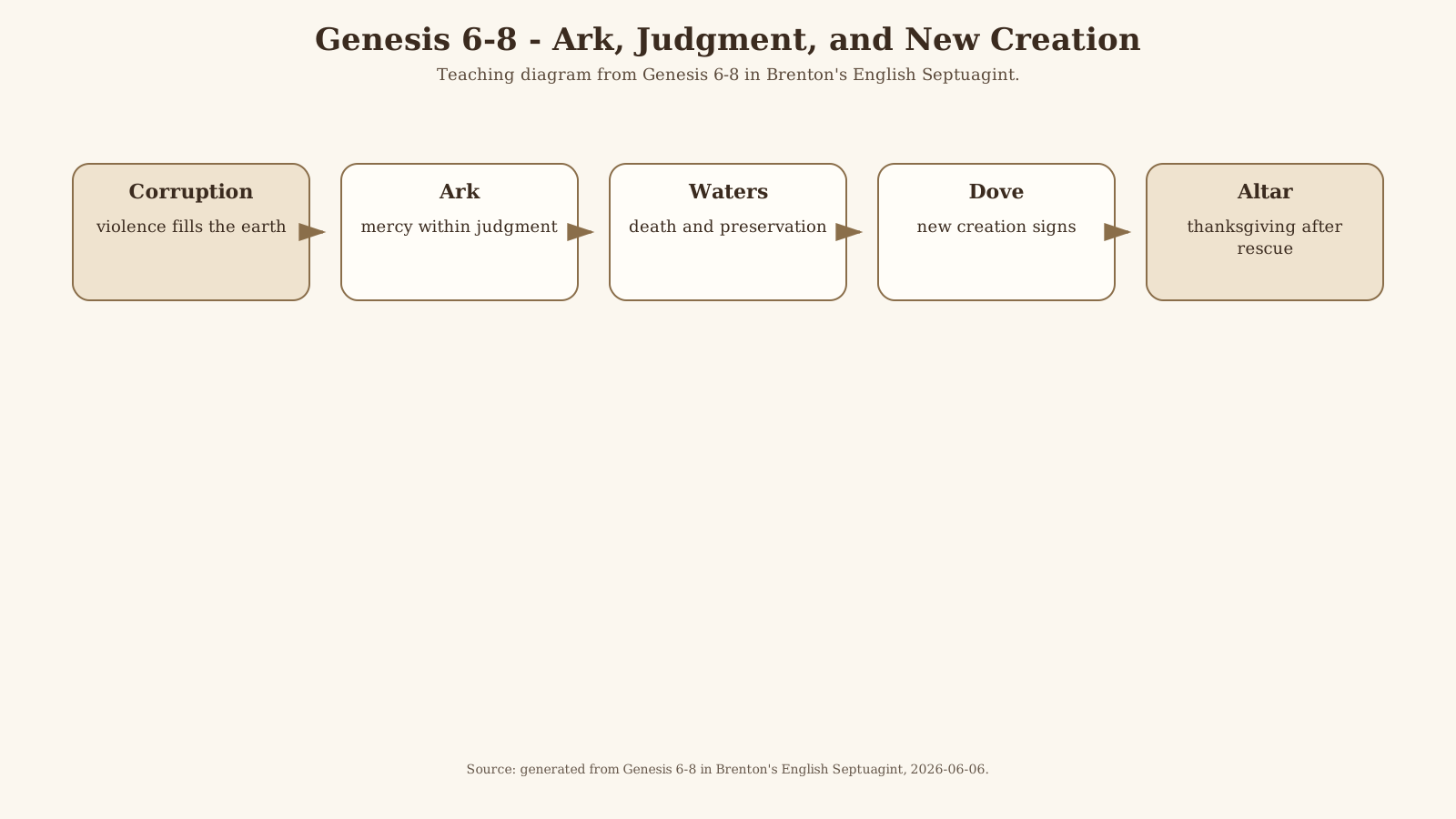 Source: created for this guide from Genesis 6-8 ark and new creation in Brenton’s English Septuagint, 2026-06-06.
A second visual helps here. The schematic shows the theological sequence of the chapter, but an actual public-domain painting helps the reader imagine the scale of preservation: one refuge carrying a remnant of life through judgment. Simon de Myle’s work is not a documentary reconstruction, but it is a strong contemplative aid for the ark as a place of mercy amid corruption and flood.
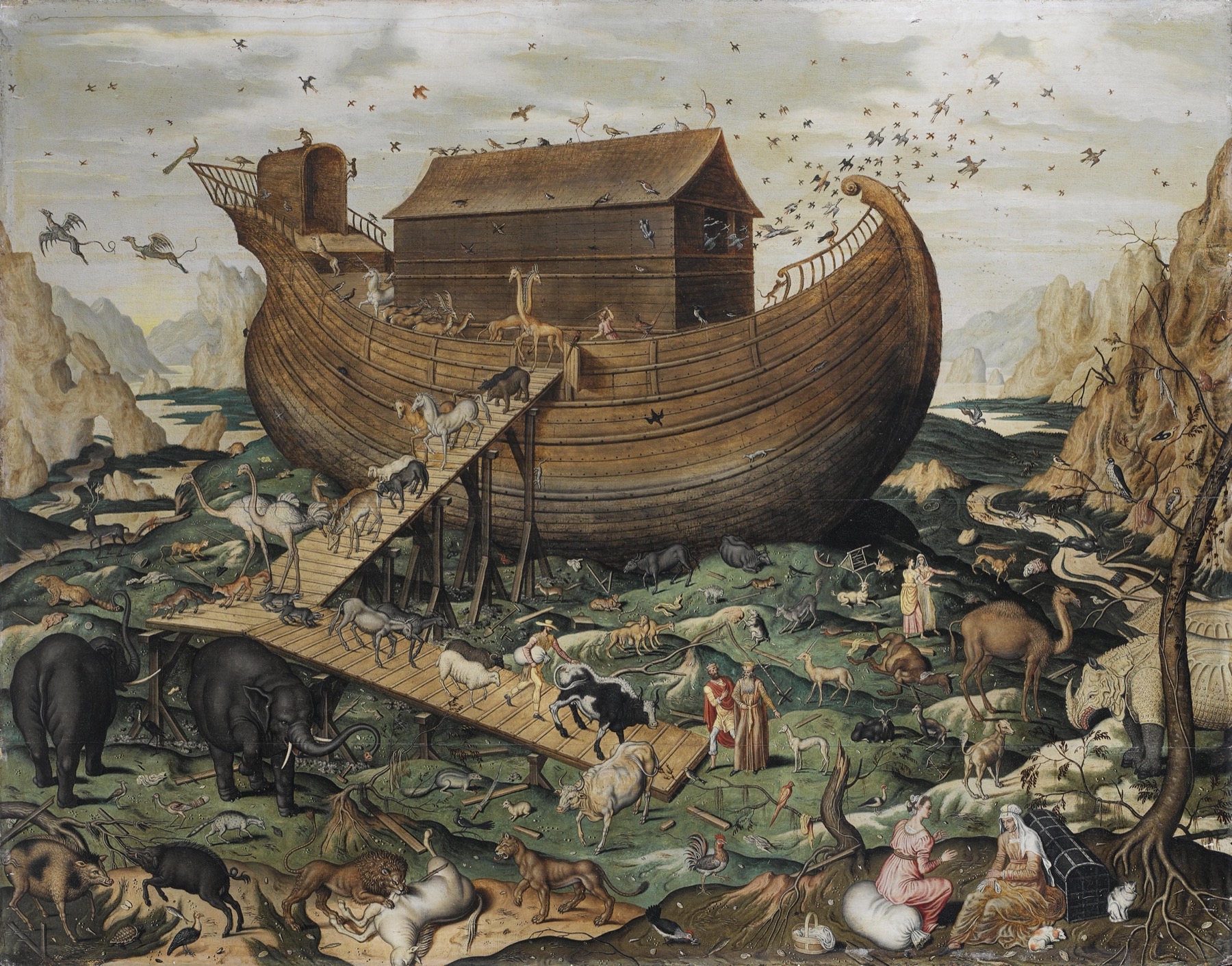 Source: Simon de Myle, Noah’s Ark on Mount Ararat, Wikimedia Commons, public domain, https://commons.wikimedia.org/wiki/File:Noah%27s_Ark_on_Mount_Ararat_by_Simon_de_Myle.jpg
Historical and Scriptural Context
Genesis 6–8 follows Cain’s escalation of violence and the generations of Genesis 5. The “sons of God,” “daughters of men,” and “giants” in 6:1–4 have received differing ancient interpretations. Their precise identity remains disputed, but the text’s own judgment becomes explicit in 6:5 and 6:11–13: human wickedness multiplies, the heart broods on evil, and the earth is corrupted. Whatever one concludes about the opening figures, their presence cannot distract from the violence that brings the narrative to the flood.
Noah stands in that world as a righteous exception, not because he is naturally superior, but because he “found grace before the Lord God.” Grace comes first, then obedience. Hebrews 11 and 2 Peter 2 later remember Noah as a man of faith and a preacher of righteousness. That is important for Orthodox teaching: Noah is not merely a survivor. He is a witness.
Corruption ripens, but Noah finds grace (Genesis 6:1-8)
1 And it came to pass when men began to be numerous upon the earth, and daughters were born to them, 2 that the sons of God having seen the daughters of men that they were beautiful, took to themselves wives of all whom they chose. 3 And the Lord God said, My Spirit shall certainly not remain among these men for ever, because they are flesh, but their days shall be an hundred and twenty years. 4 Now the giants were upon the earth in those days; and after that when the sons of God were wont to go in to the daughters of men, they bore children to them, those were the giants of old, the men of renown.
5 And the Lord God having seen that the wicked actions of men were multiplied upon the earth, and that every one in his heart was intently brooding over evil continually, 6 then God laid it to heart that he had made man upon the earth, and he pondered it deeply. 7 And God said, I will blot out man whom I have made from the face of the earth, even man with cattle, and reptiles with flying creatures of the sky, for I am grieved that I have made them.
8 But Noe found grace before the Lord God.
The opening moves from multiplication and grasping in verses 1–4 to God’s sight of the heart in verse 5. “Took to themselves wives of all whom they chose” sits uneasily beside a world where desire takes without restraint. Still, neither the identity of the “sons of God” nor the exact meaning of the 120 years can be settled by the verses printed here alone. The explicit indictment is the inward rehearsal of evil and the corrupted earth. God’s grief in verses 6–7 speaks to us of the moral weight of violence; it does not mean the Creator discovered facts He had missed.
The decisive turn comes in verse 8: “But Noe found grace before the Lord God.” The whole flood narrative rests on that “but.” Judgment is deserved, but mercy has not vanished.
Noah obeys the impossible command (Genesis 6:9-22)
9 And these are the generations of Noe. Noe was a just man; being perfect in his generation, Noe was well-pleasing to God. 10 And Noe begot three sons, Sem, Cham, Japheth. 11 But the earth was corrupted before God, and the earth was filled with iniquity. 12 And the Lord God saw the earth, and it was corrupted; because all flesh had corrupted its way upon the earth. 13 And the Lord God said to Noe, A period of all men is come before me; because the earth has been filled with iniquity by them, and, behold, I destroy them and the earth. 14 Make therefore for thyself an ark of square timber; thou shalt make the ark in compartments, and thou shalt pitch it within and without with pitch. 15 And thus shalt thou make the ark; three hundred cubits the length of the ark, and fifty cubits the breadth, and thirty cubits the height of it. 16 Thou shalt narrow the ark in making it, and in a cubit above thou shalt finish it, and the door of the ark thou shalt make on the side; with lower, second, and third stories thou shalt make it. 17 And behold I bring a flood of water upon the earth, to destroy all flesh in which is the breath of life under heaven, and whatsoever things are upon the earth shall die. 18 And I will establish my covenant with thee, and thou shalt enter into the ark, and thy sons and thy wife, and thy sons’ wives with thee. 19 And of all cattle and of all reptiles and of all wild beasts, even of all flesh, thou shalt bring by pairs of all, into the ark, that thou mayest feed them with thyself: male and female they shall be. 20 Of all winged birds after their kind, and of all cattle after their kind, and of all reptiles creeping upon the earth after their kind, pairs of all shall come in to thee, male and female to be fed with thee. 21 And thou shalt take to thyself of all kinds of food which ye eat, and thou shalt gather them to thyself, and it shall be for thee and them to eat. 22 And Noe did all things whatever the Lord God commanded him, so did he.
Noah is called just, perfect in his generation, and well-pleasing to God. Yet the preceding sentence says he “found grace.” The order matters: the ark is God’s provision before it is Noah’s achievement. Its dimensions, compartments, covering, and provisions make the preservation of life concrete rather than magical. The repeated command to bring and feed the creatures widens the story beyond a single family’s survival.
That is spiritually instructive. The ark is not human genius saving itself from divine wrath. It is God’s provision received through faithful labor. St. John Chrysostom praises Noah’s perseverance here because he builds for a judgment not yet visible. Faith often looks like this: long obedience to a word the world does not yet respect.
Entering the ark and being shut in (Genesis 7:1-16)
1 And the Lord God said to Noe, Enter thou and all thy family into the ark, for thee have I seen righteous before me in this generation. 2 And of the clean cattle take in to thee sevens, male and female, and of the unclean cattle pairs male and female. 3 And of clean flying creatures of the sky sevens, male and female, and of all unclean flying creatures pairs, male and female, to maintain seed on all the earth. 4 For yet seven days having passed I bring rain upon the earth forty days and forty nights, and I will blot out every offspring which I have made from the face of all the earth. 5 And Noe did all things whatever the Lord God commanded him. 6 And Noe was six hundred years old when the flood of water was upon the earth. 7 And then went in Noe and his sons and his wife, and his sons’ wives with him into the ark, because of the water of the flood. 8 And of clean flying creatures and of unclean flying creatures, and of clean cattle and of unclean cattle, and of all things that creep upon the earth, 9 pairs went in to Noe into the ark, male and female, as God commanded Noe. 10 And it came to pass after the seven days that the water of the flood came upon the earth. 11 In the six hundredth year of the life of Noe, in the second month, on the twenty-seventh day of the month, on this day all the fountains of the abyss were broken up, and the flood-gates of heaven were opened. 12 And the rain was upon the earth forty days and forty nights. 13 On that very day entered Noe, Sem, Cham, Japheth, the sons of Noe, and the wife of Noe, and the three wives of his sons with him into the ark. 14 And all the wild beasts after their kind, and all cattle after their kind, and every reptile moving itself on the earth after its kind, and every flying bird after its kind, 15 went in to Noe into the ark, pairs, male and female of all flesh in which is the breath of life. 16 And they that entered went in male and female of all flesh, as God commanded Noe, and the Lord God shut the ark outside of him.
When the time comes, Noah enters with his household, the clean and unclean creatures, and the food needed for the hidden season ahead. Genesis 6 speaks of pairs; Genesis 7 specifies sevens for clean animals and birds alongside pairs of the unclean. Do not flatten those instructions into a single “two of each” image. Then comes a tender and frightening line: “the Lord God shut the ark outside of him.” God secures those within, while the shut door also makes the judgment outside impossible to ignore.
Noah does not control the waters by doing everything correctly. He enters, prepares, and cares for those with him; God keeps them through what they cannot master. The Christian reading of the ark as refuge must never turn that assurance into the claim that people who suffer disaster lacked Noah’s obedience.
The waters of judgment cover the earth (Genesis 7:17-24)
17 And the flood was upon the earth forty days and forty nights, and the water abounded greatly and bore up the ark, and it was lifted on high from off the earth. 18 And the water prevailed and abounded exceedingly upon the earth, and the ark was borne upon the water. 19 And the water prevailed exceedingly upon the earth, and covered all the high mountains which were under heaven. 20 Fifteen cubits upwards was the water raised, and it covered all the high mountains. 21 And there died all flesh that moved upon the earth, of flying creatures and cattle, and of wild beasts, and every reptile moving upon the earth, and every man. 22 And all things which have the breath of life, and whatever was on the dry land, died. 23 And God blotted out every offspring which was upon the face of the earth, both man and beast, and reptiles, and birds of the sky, and they were blotted out from the earth, and Noe was left alone, and those with him in the ark. 24 And the water was raised over the earth an hundred and fifty days.
The flood is described almost as an undoing of the ordered world. The fountains of the abyss break open and the flood-gates of heaven pour down; waters overrun the boundaries within which land creatures had lived. The repeated “water prevailed” is followed by a repeated accounting of deaths. Scripture does not offer those lives as scenery for an inspiring survival story. It forces us to hear judgment on a violent world as a terrible loss, even while the ark is borne up on the water.
Peter’s baptismal interpretation should deepen this sobriety, not erase it. Baptism is union with Christ’s death and resurrection, not a celebration of others’ destruction or a mechanism in which water works apart from Him. In teaching the flood, leave room to lament the human and creaturely loss and to ask how a community becomes so habituated to violence that its life together is corrupted.
God remembered Noah (Genesis 8:1-14)
1 And God remembered Noe, and all the wild beasts, and all the cattle, and all the birds, and all the reptiles that creep, as many as were with him in the ark, and God brought a wind upon the earth, and the water stayed. 2 And the fountains of the deep were closed up, and the flood-gates of heaven, and the rain from heaven was withheld. 3 And the water subsided, and went off the earth, and after an hundred and fifty days the water was diminished, and the ark rested in the seventh month, on the twenty-seventh day of the month, on the mountains of Ararat. 4 And the water continued to decrease until the tenth month. 5 And in the tenth month, on the first day of the month, the heads of the mountains were seen. 6 And it came to pass after forty days Noe opened the window of the ark which he had made. 7 And he sent forth a raven; and it went forth and returned not until the water was dried from off the earth. 8 And he sent a dove after it to see if the water had ceased from off the earth. 9 And the dove not having found rest for her feet, returned to him into the ark, because the water was on all the face of the earth, and he stretched out his hand and took her, and brought her to himself into the ark. 10 And having waited yet seven other days, he again sent forth the dove from the ark. 11 And the dove returned to him in the evening, and had a leaf of olive, a sprig in her mouth; and Noe knew that the water had ceased from off the earth. 12 And having waited yet seven other days, he again sent forth the dove, and she did not return to him again any more. 13 And it came to pass in the six hundred and first year of the life of Noe, in the first month, on the first day of the month, the water subsided from off the earth, and Noe opened the covering of the ark which he had made, and he saw that the water had subsided from the face of the earth. 14 And in the second month the earth was dried, on the twenty-seventh day of the month.
Chapter 8 begins, “And God remembered Noe,” and immediately names the beasts, cattle, birds, and reptiles with him. God’s remembering is saving attention expressed in action, not recovery from forgetfulness. A wind comes, the sources of water close, and the ark rests. Mercy here has a long timetable: even when Noah sees dry ground, he waits for God’s word before leaving the ark.
The wind over the waters invites comparison with the beginning of Genesis, though Brenton renders Genesis 1:2 “Spirit” and 8:1 “wind”; the echo does not make them the same event. Noah sends a raven and then a dove. The dove first returns without rest, then with an olive sprig, then does not return. These small observations, separated by waiting, teach him that life is returning. Yet visible signs do not replace the command in 8:15–16 to come out. The ark’s patient household must learn when to wait and when to step onto the land.
Dry ground, altar, and a new beginning (Genesis 8:15-22)
15 And the Lord God spoke to Noe, saying, 16 Come out from the ark, thou and thy wife and thy sons, and thy sons’ wives with thee. 17 And all the wild beasts as many as are with thee, and all flesh both of birds and beasts, and every reptile moving upon the earth, bring forth with thee: and increase ye and multiply upon the earth. 18 And Noe came forth, and his wife and his sons, and his sons’ wives with him. 19 And all the wild beasts and all the cattle and every bird, and every reptile creeping upon the earth after their kind, came forth out of the ark.
20 And Noe built an altar to the Lord, and took of all clean beasts, and of all clean birds, and offered a whole burnt-offering upon the altar. 21 And the Lord God smelled a smell of sweetness, and the Lord God having considered, said, I will not any more curse the earth, because of the works of men, because the imagination of man is intently bent upon evil things from his youth, I will not therefore any more smite all living flesh as I have done. 22 All the days of the earth, seed and harvest, cold and heat, summer and spring, shall not cease by day or night.
Noah does not leave the ark until God tells him to come out. The creatures go with the family, and the command to multiply recalls Genesis 1. His first recorded act on dry ground is an altar. The clean animals taken in greater numbers now have a role in worship, a detail that joins the entrance instructions to the end of the voyage.
The Lord receives the offering and promises the persistence of seed and harvest, cold and heat, day and night. Yet verse 21 still says that the human imagination inclines toward evil from youth. God’s patience is not founded on the illusion that the flood has cured the heart. The worshipper can begin again in thanksgiving, but Noah and his descendants remain in need of the deeper renewal Christ gives.
Gems from the Fathers 💎
The apostolic reading of Noah governs the Church’s interpretation: 1 Peter 3:20–21 calls the passage through water a figure of baptism and grounds its saving force in Christ’s resurrection. The flood’s human cost remains real. In baptism, Christ brings the old life to death and joins the baptized to His risen life; the type serves that Gospel, not an appetite for judgment.
St. John Chrysostom, preaching on Hebrews 11:7, emphasizes the hiddenness of Noah’s obedience. Noah prepared the ark when the rain was still unseen and when ordinary life continued around him. That gives the flood narrative an ascetical edge: faith obeys God before visible circumstances make obedience look reasonable. Chrysostom makes the hiddenness vivid: “Reason indeed suggested nothing of this sort; for ‘they were marrying and being given in marriage’; the air was clear, there were no signs [of change]: but nevertheless he feared.”1
St. Cyril of Jerusalem deepens the baptismal reading by gathering the biblical pattern of water: creation begins with the Spirit over the waters, Israel passes through the sea, Noah receives covenant after the flood, and baptism joins water with the Spirit’s saving work. Cyril also treats the dove of Noah as a partial figure that opens toward the Spirit’s descent at Christ’s baptism. This keeps the ark from becoming only moral example; it belongs to the Church’s sacramental memory. Cyril gives the baptismal typology its own voice: “For as in his time by means of wood and of water there came salvation to themselves, and the beginning of a new generation…thus, say they, the Holy Ghost also descended upon the true Noe, the Author of the second birth, who draws together into one the wills of all nations.”2
Orthodox reading therefore holds together judgment, obedience, sacrament, and mercy. The ark exists because God provides refuge in the very place where judgment is real. The faithful are not saved by denying corruption, but by entering the refuge God gives and passing through water toward new creation.
Spiritual Fruit 🍇
- Do not become at home with violence. God sees the earth filled with corruption in 6:11–13. Examine what harm your household or community has learned to dismiss, and take a safe, truthful step to protect someone exposed to it.
- Build before you see the rain. Noah’s obedience follows a word about things not yet visible. Keep a small, sustained practice of prayer, repentance, or care for others before a crisis makes it feel urgent. Faith prepares food and shelter as well as words.
- Remember those inside the ark with Noah. Genesis 8:1 names the animals in God’s saving attention. Receive responsibility for vulnerable life as part of mercy, not as an afterthought to your own survival.
- Wait for God’s word amid encouraging signs. The olive sprig matters, but Noah does not leave until commanded. Resist forcing a premature resolution when a grief or danger still calls for patience and discernment.
- Leave the ark with thanksgiving, not triumph over the lost. Noah’s first recorded act is an altar, while the heart remains wounded in 8:21. Bring relief to God with humility; in baptism, seek the risen Christ’s renewal rather than treating the flood as a simple happy ending.
Teaching Notes
Corruption ripens, but Noah finds grace (Genesis 6:1-8)
- Ask: What makes Noah different from the violence around him?
- Emphasize: Grace appears before the ark is built; salvation begins with God seeing and calling.
- Watch for: Do not make Noah merely moralistic; the passage is about grace in a corrupt world.
- Connect: Connect Noah finding grace to the Church as refuge in Christ.
- Show: Use the ark diagram to show corruption and grace before the flood begins.
Noah obeys the impossible command (Genesis 6:9-22)
- Ask: What kind of faith builds before there is visible rain?
- Emphasize: Chrysostom highlights obedience before visible evidence.
- Watch for: Avoid presenting obedience as control over outcomes.
- Connect: Connect Noah to Hebrews 11 and faith in things not yet seen.
- Show: Point to the ark section of the diagram as embodied faith.
Entering the ark and being shut in (Genesis 7:1-16)
- Ask: Why does Scripture stress entering the ark and God shutting the door?
- Emphasize: Refuge is received by obedience, not invented by Noah.
- Watch for: Do not soften the seriousness of judgment.
- Connect: Connect the ark to baptism and life inside Christ.
- Show: Show the movement from exposed world to enclosed refuge.
The waters of judgment cover the earth (Genesis 7:17-24)
- Ask: How can the same waters judge and carry the ark?
- Emphasize: The flood is judgment on corruption and passage into new creation.
- Watch for: Avoid treating the flood as either sentimental or merely catastrophic.
- Connect: Connect to 1 Peter 3:20-21 and baptism.
- Show: Trace the waters around the ark on the visual.
God remembered Noah (Genesis 8:1-14)
- Ask: What does it mean that God remembered Noah?
- Emphasize: God’s remembrance is covenant action, not recovery from forgetfulness.
- Watch for: Do not imply God was absent during the flood.
- Connect: Connect divine remembrance to mercy in the middle of judgment.
- Show: Show the turning point from waters covering to waters receding.
Dry ground, altar, and a new beginning (Genesis 8:15-22)
- Ask: Why is Noah’s first act worship?
- Emphasize: Salvation matures into thanksgiving and offering.
- Watch for: Do not treat the new beginning as if sin has vanished.
- Connect: Connect the altar to life reordered around sacrifice and communion.
- Show: Use the final part of the diagram to show dry ground, altar, and new creation.
Sources
Primary sources
Embedded Scripture is from Brenton’s English Septuagint (LXX).
- Public-domain Brenton edition: https://archive.org/details/septuagintversio00bren
- 1 Peter 3:18-22, for the canonical baptismal reading of Noah and the ark.
- Hebrews 11:7, for Noah’s faith-filled obedience.
- Matthew 24:37-39 and Luke 17:26-27, for Christ’s use of the days of Noah.
- 2 Peter 2:5, for Noah as a preacher of righteousness.
- St. Ephrem the Syrian, Commentary on Genesis, for sober and spiritually alert reading of the flood narrative.: https://archive.org/details/selectedprosewor0000ephr
- St. John Chrysostom, Homilies on Hebrews, on Hebrews 11:7 for Noah’s faith before visible evidence, and Homilies on Genesis for Noah’s obedience, righteousness, and perseverance.: https://www.ccel.org/ccel/schaff/npnf114.v.xxx.html
- St. Cyril of Jerusalem, Catechetical Lectures, for baptismal use of Noah, water, covenant, the dove, and the Spirit.: https://www.newadvent.org/fathers/3101.htm
Patristic direct quote anchors
St. John Chrysostom, Homilies on Hebrews, Homily XXVII on Hebrews 11:7: https://www.ccel.org/ccel/schaff/npnf114.v.xxvii.html#v.xxvii-p3
St. Cyril of Jerusalem, Catechetical Lectures, on Noah, the dove, water, and the Spirit: https://www.ccel.org/ccel/schaff/npnf207.ii.xxi.html#ii.xxi-p66
Secondary academic sources
- Gordon J. Wenham, Genesis 1-15.
- Victor P. Hamilton, The Book of Genesis: Chapters 1-17.
- Kenneth A. Mathews, Genesis 1-11:26.
- Claus Westermann, Genesis 1-11.
Coptic Orthodox / pastoral sources
- The Orthodox Study Bible, notes on Genesis 6-9 and 1 Peter 3.
- Fr. Tadros Yacoub Malaty, commentary on Genesis and the flood as type.
- Pope Shenouda III on repentance, obedience, and spiritual renewal after judgment.
- Fr. Bishoy Kamel on perseverance, the Church as refuge, and new life in Christ.
Visual sources
assets/genesis-6-8-ark-new-creation-diagram-lxx.svg: schematic created for this guide from the cited Genesis passage in Brenton’s English Septuagint; no external visual-source URL exists.
Simon de Myle, Noah’s Ark on Mount Ararat, Wikimedia Commons, public domain: https://commons.wikimedia.org/wiki/File:Noah%27s_Ark_on_Mount_Ararat_by_Simon_de_Myle.jpg
Footnotes
-
St. John Chrysostom, Homilies on Hebrews, Homily XXIII on Hebrews 11:7, https://www.ccel.org/ccel/schaff/npnf114.v.xxvii.html#v.xxvii-p3. ↩
-
St. Cyril of Jerusalem, Catechetical Lectures, Lecture XVII.10 on Noah, the dove, and baptism, https://www.ccel.org/ccel/schaff/npnf207.ii.xxi.html#ii.xxi-p66. ↩