


Content note: This chapter includes a threat of violence against a child. Read at your own pace; a trusted priest or qualified professional can offer support. If you are in immediate danger, seek safety and emergency help. No participant should be pressed to disclose personal experiences.
“Having worshipped we will return to you.” Abraham says this before he has seen the ram. The son through whom God has promised a future walks beside him toward an offering Abraham cannot yet understand. Genesis 22 brings faith to the place where the gift and the promise seem about to disappear together. Yet its outcome is life: the hand is stopped, Isaac is spared, and God supplies the offering. The Church hears this account on Great Thursday as she approaches Christ’s Passion. Through the beloved son, the wood, and the gift received back, she learns to look toward the Son who freely enters death and rises, carrying God’s promise beyond the reach of the grave.
The promised son and the unfinished future
Isaac has been born in Genesis 21, after the long waiting of Abraham and Sarah. God has identified him as the son through whom Abraham’s descendants will be named. Ishmael also remains Abraham’s son, and the preceding chapter has shown God’s care for him and Hagar. Isaac’s distinctive place in the covenant does not erase another child’s existence or dignity. The test concerns the particular son through whom God has pledged to carry His promise forward.
The chapter moves from command to journey, from Isaac’s question to the binding, from intervention to provision, and finally from renewed blessing to news of another family. That last news matters: Rebekah, Brenton’s Rebecca, enters the account before she becomes Isaac’s bride in Genesis 24. The future that seemed endangered on the mountain is already being prepared elsewhere. Brenton’s Abraam, Nachor, Melcha, and Bathuel correspond to Abraham, Nahor, Milcah, and Bethuel. The explanation uses familiar names while preserving the Scripture’s wording.
The test and the beloved son (Genesis 22:1-2)
1 And it came to pass after these things that God tempted Abraam, and said to him, Abraam, Abraam; and he said, Lo! I am here. 2 And he said, Take thy son, the beloved one, whom thou hast loved—Isaac, and go into the high land, and offer him there for a whole-burnt-offering on one of the mountains which I will tell thee of.
The narrator gives the reader a word Abraham has not been given: this is a test. Brenton says “tempted,” using an older English sense that includes putting someone to the proof. The chapter must be read through its complete account, including God’s intervention. James 1:13 rejects the different meaning of temptation as enticement to evil: “for God cannot be tempted by evil, nor does He Himself tempt anyone.” God does not cultivate wickedness in His servant. Here faith is brought into the open under a terrible command whose final outcome remains hidden from Abraham.
The command names love before it names sacrifice: “thy son, the beloved one, whom thou hast loved.” Abraham’s fatherly affection is acknowledged by God. Isaac is neither an interchangeable possession nor a distraction from an otherwise pure religious life. He is a loved person and the bearer of a divine promise. A whole-burnt-offering is an offering consumed entirely upon the altar. The demand therefore seems to reach beyond Abraham’s feelings to the future God Himself has announced.
This unique narrated test gives no parent or religious leader permission to act on a private impression, dream, or supposed revelation to harm a child. A claim of divine command cannot sanctify religious abuse. In the chapter God Himself stops the act; Christian obedience is governed by Christ’s truth and love, not by a person’s certainty that an inner voice must be obeyed.
Language insight: “tempted”, “beloved”, and “high land”
The Septuagint’s verb in verse 1 is a form of πειράζω (peirazō), to test or put to proof. The outcome and James’ teaching distinguish this testing from enticement to evil. The older English word remains visible, but the complete narrative governs its meaning.
In verse 2 the Septuagint calls Isaac ἀγαπητός (agapētos), “beloved,” where the Hebrew text uses the designation commonly translated “only” or “only son.” These are distinct emphases, not grounds for disparaging either scriptural tradition. The Greek makes the son’s belovedness especially audible to Christian readers who know the Gospel’s language for Jesus. Hebrews 11:17-18 explains the “only begotten” designation through Isaac’s unique place in the promise. Ishmael has not ceased to be Abraham’s son.
Brenton also reads “high land,” reflecting the Greek, while Hebrew-based translations name the land of Moriah. We should distinguish those renderings rather than insert Moriah into the quotation. Within this account the particular mountain still awaits God’s indication. Faith begins with a word, before Abraham can survey the place where the word will be fulfilled.
The third day and the promise of return (Genesis 22:3-5)
3 And Abraam rose up in the morning and saddled his ass, and he took with him two servants, and Isaac his son, and having split wood for a whole-burnt-offering, he arose and departed, and came to the place of which God spoke to him, 4 on the third day; and Abraam having lifted up his eyes, saw the place afar off. 5 And Abraam said to his servants, Sit ye here with the ass, and I and the lad will proceed thus far, and having worshipped we will return to you.
The account gives actions rather than an explanation of Abraham’s inner life. He rises, saddles the animal, takes companions, splits wood, and goes. Scripture’s restraint lets the weight of the command stand. It does not say that obedience was painless, nor that silence meant emotional indifference. On the third day he sees the place afar off. Faith must endure the distance between receiving God’s word and seeing what God will do.
Then Abraham speaks of worship and return. His sentence includes both himself and Isaac: “we will return to you.” Hebrews 11:17-19 supplies the inspired interpretation. Abraham offers the very son concerning whom God has said that his descendants will be named, “concluding that God was able to raise him up, even from the dead.” Command and promise seem incompatible, but Abraham refuses to make death the measure of God’s power. The God who gave Isaac can give him back.
This is more substantial than vague confidence that everything will somehow improve. Abraham’s hope rests on a particular promise from a particular Giver. He reasons from God’s faithfulness toward God’s power, even when he cannot describe the means. Hebrews says that he received Isaac back “in a figurative sense”: Isaac was delivered from threatened death, not actually raised from a completed death. The distinction lets the event point truthfully toward Christ’s actual death and Resurrection.
The third day belongs first to the journey in Genesis. In the Church’s Paschal reading, its place beside the son’s deliverance adds resonance to the Resurrection. Typology means that a real earlier event becomes a sign of the greater reality in Christ. The sign retains its own history; the two accounts need not have identical timetables.
Gems from the Fathers 💎: Faith holds command and promise together
St. John Chrysostom, preaching on Hebrews 11:17-19, attends to the precise difficulty. Abraham believes the promise about Isaac and also receives a command that appears to undo it. Chrysostom explains that the opposition lies in human calculation, while faith looks toward God’s power to raise the dead. He writes: “For they were in harmony; being opposed indeed according to human calculations, but in harmony [when viewed] by Faith.”1
The same homily explains why testing does not imply that God has been ignorant of Abraham’s heart. The trial manifests the servant’s faith: “Not that He might Himself learn, but that He might show to others, and make his fortitude manifest to all.”2 This gives consolation without promising an easy life. Difficulty need not mean abandonment. The faithful person may still pray, lament, and seek help while holding to the Lord whose promise death cannot defeat.
The wood and the unanswered question (Genesis 22:6-8)
6 And Abraam took the wood of the whole-burnt-offering, and laid it on Isaac his son, and he took into his hands both the fire and the knife, and the two went together. 7 And Isaac said to Abraam his father, Father. And he said, What is it, son? And he said, Behold the fire and the wood, where is the sheep for a whole-burnt-offering? 8 And Abraam said, God will provide himself a sheep for a whole-burnt-offering, my son. And both having gone together,
“The two went together.” The phrase appears before and after the conversation. Between its repetitions Isaac addresses Abraham as father, and Abraham answers him as son. Their relationship remains present at the center of the account. Isaac’s question comes from what he can see: fire and wood have been brought, while the animal is missing. The narrative lets him speak. His question is part of the sacred story, not an interruption of it.
Abraham answers with God’s provision. He does not name the ram that will shortly appear, and the narrator does not say that Abraham has already been told how the outcome will occur. The answer therefore expresses trust beyond visible arrangements. It turns attention from the completeness of human preparation to the God who can supply what is lacking. The son has the wood; the father has the other means; the offering remains God’s to provide.
In Christ the Church recognizes the greater beloved Son bearing the wood of His Cross. The comparison arises from the actual action of verse 6, but Christian reading must honor what Genesis leaves unspoken. Isaac’s age is not given here. His bearing the wood does not establish a precise age, and the account does not explicitly narrate his willing assent to being bound. Received Christological interpretations may contemplate obedient sonship, but they must be identified as typology rather than added to the historical narrator’s words.
Christ’s freedom is explicit in the Gospel. In John 10:17-18 He says, “I lay down My life that I may take it again,” and “No one takes it from Me, but I lay it down of Myself.” His human obedience is real, His suffering is real, and His purpose is life. The Son goes to the Cross in loving unity with the Father. The Christian fulfillment cannot be pictured as a vicious Father forcing an unwilling Son to suffer.
Gems from the Fathers 💎: Carrying the wood after Christ
St. Irenaeus connects Isaac’s wood with Christian discipleship while insisting that the God of Abraham is the Father revealed by Christ. The earlier story belongs to the same saving work in which the apostles follow the Word. He writes: “Righteously also do we, possessing the same faith as Abraham, and taking up the cross as Isaac did the wood, follow Him.”3
The image becomes a call to follow a Person. For us, taking up the cross may mean keeping a costly truth, serving when recognition is absent, or remaining merciful under provocation. Its source is the love of the crucified and risen Lord. Seeking injury or imposing suffering on someone weaker would betray that love. We bear the cost of fidelity ourselves; we do not assign another person a cross to secure our religious importance.
The binding and the voice that stops the hand (Genesis 22:9-12)
9 came to the place which God spoke of to him; and there Abraam built the altar, and laid the wood on it, and having bound the feet of Isaac his son together, he laid him on the altar upon the wood. 10 And Abraam stretched forth his hand to take the knife to slay his son. 11 And an angel of the Lord called him out of heaven, and said, Abraam, Abraam. And he said, Behold, I am here. 12 And he said, Lay not thine hand upon the child, neither do anything to him, for now I know that thou fearest God, and for my sake thou hast not spared thy beloved son.
The binding gives the chapter its traditional name, the Binding of Isaac, often called the Akedah. The preparation reaches the point of threatened death, and heaven interrupts it. Abraham’s name is called twice, as at the beginning; he answers with the same readiness. The servant who responded to the command must now respond to the prohibition. “Neither do anything to him” leaves no room to imagine that some lesser injury would complete the offering.
Here the command to stop belongs to the account’s theological center. Fear of God has been manifested in Abraham’s costly readiness, and God’s word preserves Isaac alive. We should never make obedience to the earlier word an excuse for ignoring the later one. To teach the binding as a method of parenting or a model of a leader’s control would be religious abuse. A child must be protected; no one may reproduce this act on the authority of private spiritual certainty.
“Now I know” expresses the test’s result in the language of encounter. Abraham’s faith has become visible in action. With Chrysostom, we can understand the disclosure without suggesting that the Creator needed new information to discover His servant’s character. The story concerns a faith enacted in history, not a theory of divine ignorance. Abraham’s answer has been given with his whole life, and the Lord declares what that answer shows.
James 2:21-24 turns to this altar to explain living faith: “Do you see that faith was working together with his works, and by works faith was made perfect?” Abraham’s obedience brings his trust to expression and maturity. The promise preceded his achievement; his response does not purchase God’s goodness. Yet a faith that never governs action would remain barren. In the Church, belief bears fruit through repentance, mercy, truthful conduct, and patient love, sustained by grace.
The provided ram and the Lord who sees (Genesis 22:13-14)
13 And Abraam lifted up his eyes and beheld, and lo! a ram caught by his horns in a plant of Sabec; and Abraam went and took the ram, and offered him up for a whole-burnt-offering in the place of Isaac his son.
14 And Abraam called the name of that place, The Lord hath seen; that they might say to-day, In the mount the Lord was seen.
Abraham lifts his eyes again. Earlier he saw the place afar off; now he sees the animal supplied there. The ram is offered “in the place of Isaac his son.” Substitution is the chapter’s own description: the animal occupies the sacrificial place from which Isaac is delivered. Sabec belongs to Brenton’s wording for the plant or thicket in which the horns are caught. The event is specific and bodily. Isaac survives; the ram is killed.
Both can point to Christ in different respects. Isaac gives the pattern of the beloved son carrying the wood and being received back from threatened death. The ram gives the pattern of the offering provided by God that dies in another’s place. Neither figure contains the whole mystery. Christ is the beloved Son who actually dies, rises, and delivers us; He is also the saving offering whom God gives. Typology gathers the signs without confusing their historical differences.
Romans 8:32 brings the language of sparing into the fullness of the Gospel: “He who did not spare His own Son, but delivered Him up for us all, how shall He not with Him also freely give us all things?” Genesis has twice said that Abraham has not spared his beloved son, first “for my sake” in verse 12, then “on my account” in verse 16. In Abraham’s case the hand is stopped and the son lives. In Christ the giving reaches actual death, and actual Resurrection conquers it.
Paul’s purpose is assurance of divine generosity. The Father’s giving and the Son’s self-offering belong to one saving love. In the Nicene faith, the Son is of one essence with the Father: He shares the divine life and purpose, rather than standing over against a hostile deity. John 10 guards the freedom of His offering; Romans 8 announces its gift to us. The Cross reveals the depth of God’s love for endangered humanity, and the Resurrection reveals that this love is stronger than death.
Language insight: “provide”, “hath seen”, and “was seen”
Verse 8 and verse 14 are related, but their renderings should remain distinct. In verse 8 the Greek says that God “will see” for Himself the sheep, rendered by Brenton as “will provide himself.” In verse 14 Brenton preserves “The Lord hath seen” and “the Lord was seen.” The Greek moves from the Lord’s seeing to His being seen or appearing. The familiar Hebrew-based wording, “The Lord will provide,” emphasizes provision; it should not replace the words of this Septuagint quotation.
God’s seeing becomes effective care: the necessary offering is supplied. There the Lord’s action becomes recognizable, and Abraham names the mountain after what God has done. Faith remembers provision before the next uncertainty. This does not promise that every loss will be reversed within our lifetime; the final assurance is the life God gives in His risen Son.
Iconography and Visual Teaching 🖼️
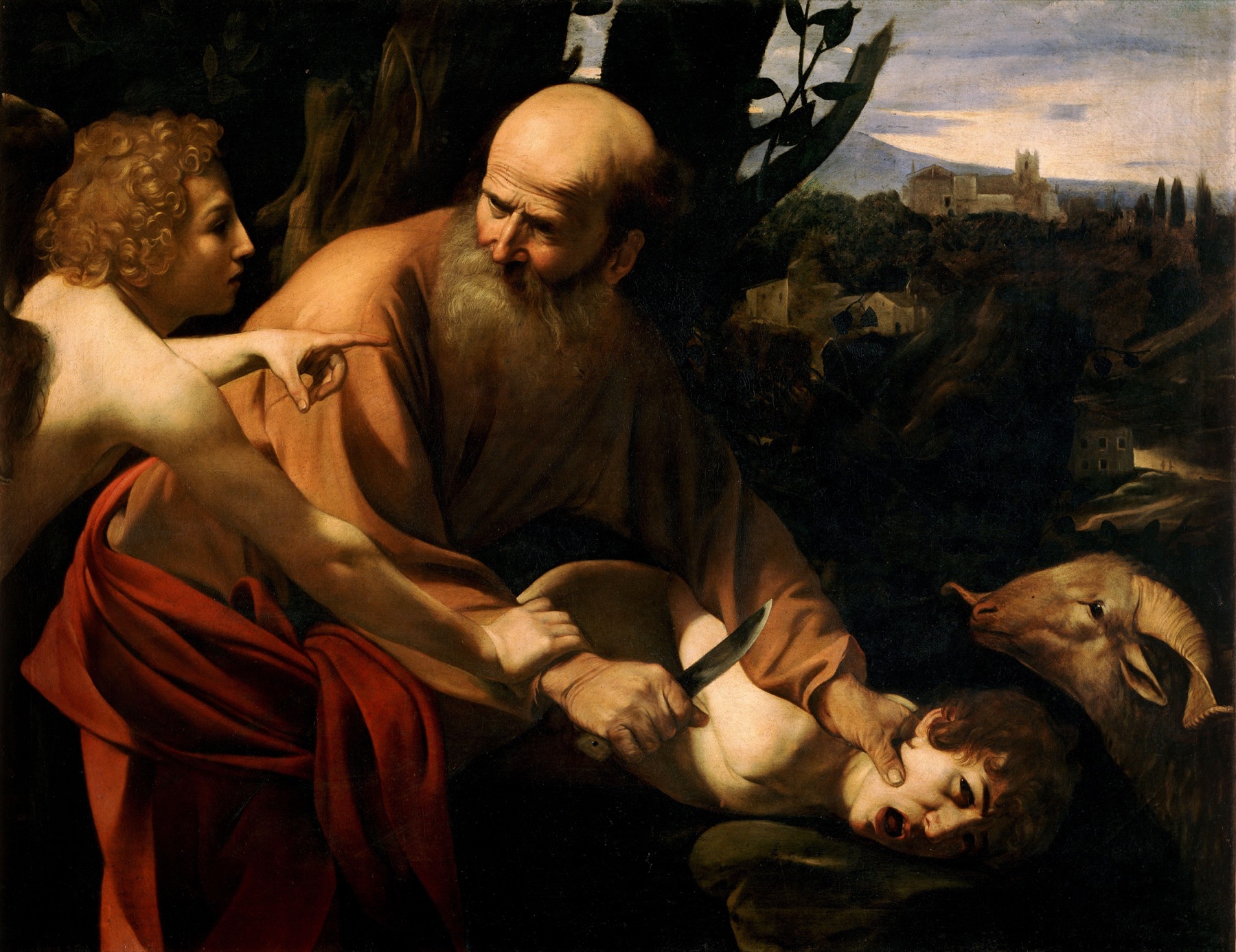 Source: Caravaggio, Sacrifice of Isaac, Uffizi; Western biblical art, public domain, Wikimedia Commons 🔗.
The restrained wrist and the finger pointing toward the ram concentrate the chapter’s turn from threatened death to God’s provision. Caravaggio’s portrayal of Isaac’s distress is an artistic interpretation; the biblical account leaves his response unspoken.
The Church’s Voice in Worship ⛪
The Coptic Holy Pascha lectionary sets Genesis 22:1-19 as the first prophecy of the Ninth Hour of Great Thursday, also called Covenant Thursday. The St. Mary Ottawa Katameros of Holy Pascha prints the reading on pages 406-408.4 This placement brings the wood, the beloved son, and God’s provided offering into the Church’s contemplation of Christ’s Passion on the day of the Mystical Supper. The scriptural sign is heard where the Church receives the greater Gift.
The Eucharist is communion in the Body and Blood of the Lord who freely offered Himself and rose. We come as receivers of His saving life, bringing thanksgiving and the offering of our own lives. The ram supplied on the mountain helps us remember that worship begins with God’s generosity. Sacrifice reaches its Christian truth through Christ’s self-giving love; our fasting, prayer, service, and repentance become responses to that gift. The Great Lent Katameros cycle also includes Genesis 22:1-18, while the Great Thursday reading extends through Abraham’s return in verse 19.
The oath and blessing for the nations (Genesis 22:15-19)
15 And an angel of the Lord called Abraam the second time out of heaven, 16 saying, I have sworn by myself, says the Lord, because thou hast done this thing, and on my account hast not spared thy beloved son, 17 surely blessing I will bless thee, and multiplying I will multiply thy seed as the stars of heaven, and as the sand which is by the shore of the sea, and thy seed shall inherit the cities of their enemies. 18 And in thy seed shall all the nations of the earth be blessed, because thou hast hearkened to my voice. 19 And Abraam returned to his servants, and they arose and went together to the well of the oath; and Abraam dwelt at the well of the oath.
The second call gives an oath. God swears by Himself, placing the assurance of blessing upon His own faithfulness. The promise has survived the test and now receives a renewed solemnity. Abraham’s obedience is acknowledged; the descendants are compared to stars and sand; the horizon opens again toward the nations. The son has been preserved for a future larger than his father’s household.
“In thy seed shall all the nations of the earth be blessed.” The promise cannot be taught as though election licenses contempt for those outside the chosen family. Particularity serves a universal blessing. In the Christian fulfillment, Abraham’s history leads toward Christ, through whom God’s saving gift reaches the peoples of the earth. Gratitude for belonging to Him should therefore enlarge intercession and mercy. A faith that becomes narrower and more contemptuous has forgotten the breadth of this promise.
The promised victory over enemies belongs to the covenant’s historical future. It is no authorization for private vengeance or a modern religious campaign against people we dislike. Read through Christ, the Church’s hope reaches the defeat of sin and death, while her people are commanded to love. The Lord who blesses the nations teaches us to desire their salvation, not their humiliation.
Verse 19 brings Abraham back to the servants and the well of the oath, commonly called Beersheba. Isaac is not individually named in this sentence; the renewed promise and subsequent narrative establish that he lives. After the mountain comes ordinary life, in which the promise must still be remembered and lived.
Rebekah and the future prepared elsewhere (Genesis 22:20-24)
20 And it came to pass after these things, that it was reported to Abraam, saying, Behold, Melcha herself too has born sons to Nachor thy brother, 21 Uz the first-born, and Baux his brother, and Camuel the father of the Syrians, and Chazad, and 22 Azav and Phaldes, and Jeldaph, and Bathuel, and Bathuel begot Rebecca; 23 these are eight sons, which Melcha bore to Nachor the brother of Abraam. 24 And his concubine whose name was Rheuma, she also bore Tabec, and Taam, and Tochos, and Mocha.
After the oath comes family news. Abraham hears that his brother Nahor has children through Milcah; another branch comes through Rheuma. The names extend the family beyond the one household with which we have been absorbed. Scripture records these people within the history rather than treating the promise as an idea floating above human relationships.
Within the list, one sentence looks ahead: “Bathuel begot Rebecca.” Rebekah is the daughter of Bethuel and will become Isaac’s wife in Genesis 24. Her introduction here prepares that later account. The son preserved on the mountain will receive a bride from the family now named. Before Abraham sends anyone to seek her, the reader learns that the future has already acquired a human face.
This quiet ending changes the scale of our attention. Abraham’s crisis has occupied the chapter, but God’s care has not been confined to what Abraham can see. Other households have continued to grow. The promise will unfold through lives whose significance is only beginning to appear. Rebekah’s own words and decisions will matter when her story comes forward; here her name keeps us from imagining that Isaac’s preservation is the end of God’s work.
We can bring the future to God without demanding advance possession of it. His faithfulness does not require us to know every person through whom help will come. After a severe trial, ordinary relationships may become the setting of the next gift.
Spiritual Fruit 🍇
Distinguish God’s promise from the outcome you have chosen. Abraham’s hope concerns God’s own word about Isaac. We often give the same certainty to an imagined career, a child’s achievement, or a particular answer to prayer. Name the expectation that most unsettles you, and ask whether God has promised it or you have simply wanted it deeply. Bring the answer honestly to prayer and confession. Christ’s Resurrection gives lasting hope without making every personal plan a divine pledge.
Return the gift without withdrawing love. Abraham’s love for Isaac is named at the beginning and the son is preserved at the end. Entrusting a child or another loved person to God means serving that person’s good without trying to possess the future. Pray for them by name, listen without rehearsing your reply, and release one demand for control. Surrender can never mean forcing another person’s death, accepting preventable harm, or eradicating healthy parental affection. God’s grace frees love from possession so that it can become more faithful care.
Let faith take one costly, truthful form. James points to trust working through action. Choose the obedience already clear in your life: correct a dishonest report, restore what you withheld, keep a responsibility when praise has disappeared, or apologize without defending the wrong. Ask Christ for strength before acting. We are not saved by manufacturing dramatic trials; grace matures faith in the concrete duties we would rather postpone.
Receive worship as a gift before making it an achievement. Isaac’s question and the supplied ram uncover the limits of what human preparation can provide. Prepare for the Eucharist through prayer, repentance, and the guidance of your father of confession, then come with gratitude for the Lord’s life rather than anxiety to prove spiritual worth. Let thanksgiving continue in an act of mercy after the Liturgy. What we receive from Christ becomes fruitful as we give ourselves in love.
Allow hope to include people outside your immediate concern. The nations are blessed and Rebekah is named after the crisis on the mountain. Pray for someone whose needs have become invisible beside your own, and offer one proportionate help. If you are exhausted, accept help yourself without shame. The promise rests upon God’s faithfulness; its fulfillment does not require your control of every household, decision, or coming day.
Abraham looks up and sees what he did not bring. The son lives, and the promise continues beyond the mountain toward a bride whose name has just entered the story. Before the crucified and risen Christ, we can bring both our fear and our love without pretending to know the future. Lord Jesus Christ, strengthen our faith, protect those entrusted to us, and free our love from the desire to possess. Teach us to hear Your word, receive Your gift with thanksgiving, and bear the fruit of Your Resurrection in mercy. Amen.
Teaching Notes
The test and the beloved son (Genesis 22:1-2)
- Ask: How do Isaac’s belovedness and his place in God’s promise deepen the difficulty of the command?
- Watch for: Explain Brenton’s “tempted” through testing and James 1:13. No private impression authorizes harm to a child; preserve the distinction between Hebrew “only” and LXX “beloved” without disparaging Jewish readers.
The third day and the promise of return (Genesis 22:3-5)
- Ask: What does Hebrews 11:17-19 add to our understanding of “we will return to you”?
- Watch for: Isaac is received back from threatened death; he is not actually resurrected. The third-day resonance must retain the journey’s historical meaning.
The wood and the unanswered question (Genesis 22:6-8)
- Ask: What does Isaac’s question reveal about the limit of the preparations they have brought?
- Watch for: Neither a precise age nor willing assent to the binding is given by this narrator. John 10:17-18 establishes Christ’s free offering explicitly.
The binding and the voice that stops the hand (Genesis 22:9-12)
- Ask: Why must attentive obedience include the command that stops Abraham’s hand?
- Watch for: Protect children and vulnerable participants. Do not demand personal disclosures or turn the binding into a parenting model; “now I know” need not imply divine ignorance.
The provided ram and the Lord who sees (Genesis 22:13-14)
- Ask: How do Isaac and the ram each point to Christ while remaining different from Him?
- Watch for: Keep Romans 8:32 together with John 10:17-18 and the unity of Father and Son. The Pascha witness covers Genesis 22:1-19, not the genealogy; the Lent witness separately covers Genesis 22:1-18.
- Show: Offer the Caravaggio image only when helpful, identify it as Western art, and attend to the restrained wrist and indicated ram. The painter’s portrayal of Isaac is not additional biblical evidence.
The oath and blessing for the nations (Genesis 22:15-19)
- Ask: How does the renewed promise widen the meaning of Isaac’s preservation beyond one household?
- Watch for: Election does not license contempt or vengeance; the brevity of the return sentence does not imply Isaac’s death.
Rebekah and the future prepared elsewhere (Genesis 22:20-24)
- Ask: Why does the narrator introduce Rebekah immediately after the test and renewed oath?
- Watch for: Preserve the genealogy as part of the chapter; do not bury Rebekah’s name or speculate about unreported motives in these households.
Sources
Embedded Scripture is from Brenton’s English Septuagint (LXX). New Testament quotations are from NKJV.
Genesis 22; Septuagint Greek, Swete text 🔗, with Hebrew wording at Genesis 22:2 🔗 for the translation comparison.
Hebrews 11:17-19; James 1:13 and 2:21-24; Romans 8:32; John 10:17-18. These passages govern the study’s account of testing, resurrection hope, living faith, and Christ’s free self-offering.
St. John Chrysostom, Homilies on Hebrews, Homily XXV 🔗, §§1-3; Oxford translation revised by Frederic Gardiner, Nicene and Post-Nicene Fathers, first series, volume 14 (1889).
St. Irenaeus of Lyons, Against Heresies IV.5.3-5 🔗, translated by Alexander Roberts and William Rambaut, Ante-Nicene Fathers, volume 1 (1885).
St. Mary Coptic Orthodox Church, Ottawa, Katameros of Holy Pascha 🔗, Great Thursday Ninth Hour, pp. 406-408. The Great Lent Katameros cycle additionally lists Genesis 22:1-18 for Friday of the sixth week; this is a separate reading witness, not an extension of the Pascha range.
Caravaggio, Sacrifice of Isaac, Uffizi, Wikimedia Commons file record 🔗, public-domain Western biblical art.
Footnotes
-
St. John Chrysostom, Homilies on Hebrews, Homily XXV, §2, Oxford translation revised by Frederic Gardiner, NPNF1 14 (1889), 🔗. ↩
-
St. John Chrysostom, Homilies on Hebrews, Homily XXV, §2, Oxford translation revised by Frederic Gardiner, NPNF1 14 (1889), 🔗. ↩
-
St. Irenaeus of Lyons, Against Heresies IV.5.4, translated by Alexander Roberts and William Rambaut, ANF 1 (1885), 🔗. ↩
-
St. Mary Coptic Orthodox Church, Ottawa, Katameros of Holy Pascha, Great Thursday Ninth Hour, pp. 406-408, 🔗. ↩