


Isaac hears Jacob’s voice and feels Esau’s hands. The son before him has brought a familiar meal, borrowed clothes, and a false name. Everything has been arranged to obtain the father’s blessing; almost everything conceals who is asking for it. Yet when the deception is discovered, Isaac says, “he shall be blessed.” Genesis 27 holds those two realities together: the promise continues, and a family has been grievously wounded. The Church must learn to receive God’s faithfulness without calling falsehood holy, and to seek the Father’s blessing without hiding from His truth.
A promise within a divided household
Before the twins were born, God told Rebekah that the elder would serve the younger (Genesis 25:23). Genesis also records divided affections: Isaac loved Esau, whose game he ate, and Rebekah loved Jacob. Esau subsequently sold his birthright under oath. Now Isaac intends to bless Esau, and Rebekah arranges for Jacob to receive it. The earlier sale and this deception are distinct acts.
God does not speak directly in Genesis 27. People invoke Him, bless before Him, and claim His assistance. His earlier word remains the horizon of the story, while human voices fill the room. The narrator does not tell us that Isaac knows and deliberately rejects the oracle, or that Rebekah is consciously acting from its memory. We can judge the words and actions reported without inventing their private thoughts.
A father prepares to bless (Genesis 27:1-4)
1 And it came to pass after Isaac was old, that his eyes were dimmed so that he could not see; and he called Esau, his elder son, and said to him, My son; and he said, Behold, I am here. 2 And he said, Behold, I am grown old, and know not the day of my death. 3 Now then take thy weapons, both thy quiver and thy bow, and go into the plain, and get me venison, 4 and make me meats, as I like them, and bring them to me that I may eat, that my soul may bless thee, before I die.
Isaac names uncertainty: he is old and does not know the day of his death. He wishes to bless his elder son while he can. Isaac will live on to be buried by both sons in Genesis 35:28-29. The blessing looks beyond his life toward his son’s future.
The exchange begins with ordinary tenderness. “My son” receives the ready answer, “Behold, I am here.” Then Isaac asks for the meal he enjoys. Hunting, cooking, eating, and blessing are joined in a familiar relationship. Genesis 25:28 has already connected his love for Esau with the food Esau supplies. That background allows us to notice the influence of preference without reducing Isaac’s entire faith to appetite. A parent can love sincerely and still need to examine how habit shapes judgment.
His dimmed sight makes him vulnerable to manipulation. Physical blindness is neither described as divine punishment nor presented as proof of moral blindness. The wrong lies with those who exploit his condition. Later he listens, asks questions, touches, tastes, and smells in an effort to recognize his son. Disability does not diminish his dignity or cancel his authority. This household’s duty is to answer its vulnerable father truthfully.
A mother commands and a son consents (Genesis 27:5-17)
5 And Rebecca heard Isaac speaking to Esau his son; and Esau went to the plain to procure venison for his father. 6 And Rebecca said to Jacob her younger son, Behold, I heard thy father speaking to Esau thy brother, saying, 7 Bring me venison, and prepare me meats, that I may eat and bless thee before the Lord before I die. 8 Now then, my son, hearken to me, as I command thee. 9 And go to the cattle and take for me thence two kids, tender and good, and I will make them meats for thy father, as he likes. 10 And thou shalt bring them in to thy father, and he shall eat, that thy father may bless thee before he dies. 11 And Jacob said to his mother Rebecca, Esau my brother is a hairy man, and I a smooth man. 12 Peradventure my father may feel me, and I shall be before him as one ill-intentioned, and I shall bring upon me a curse, and not a blessing. 13 And his mother said to him, On me be thy curse, son; only hearken to my voice, and go and bring them me. 14 So he went and took and brought them to his mother; and his mother made meats, as his father liked them. 15 And Rebecca having taken the fine raiment of her elder son Esau which was with her in the house, put it on Jacob her younger son. 16 And she put on his arms the skins of the kids, and on the bare parts of his neck. 17 And she gave the meats, and the loaves which she had prepared, into the hands of Jacob her son.
Rebekah hears Isaac’s plan and repeats it to Jacob. Isaac’s words in verse 4 name blessing before death; Rebekah’s report adds “before the Lord” in verse 7. That phrase makes the stakes explicit: the desired gift belongs within the family’s life before God. Her answer, however, is a sequence of commands to secure it through concealment. “Hearken to me” in verse 8 becomes “only hearken to my voice” in verse 13. Jacob is being asked to obey one parent by misleading the other.
Rebekah knows the food Isaac likes and has access to Esau’s clothing. Knowledge that could nourish the family becomes a means of control. The kids supply meat and a false covering; borrowed garments supply another son’s appearance and smell.
Jacob’s spoken objection concerns discovery and a curse. He mentions the difference between his smooth skin and his brother’s hair, then imagines how his father might regard him. The text gives us that objection, not an exhaustive account of his conscience. Still, the danger he names is telling: he fears being found out, while the question of telling the truth remains unspoken. Rebekah’s offer to bear the curse removes his stated obstacle. It cannot transfer his personal responsibility for the answers he is about to give.
“On me be thy curse” expresses her determination; Scripture does not report a divine agreement accepting such an exchange. Nor does a parent’s willingness to carry the consequences make a command righteous. Christian obedience honors parents within fidelity to God. When a loved person asks us to conceal injury, falsify an account, or manipulate someone weaker, love must find truthful words of refusal. Reverence need not become collusion.
God’s purpose preceded this planning; the chapter never says the promise required a disguise. Anxiety for a child or a parish work can likewise turn hope into a demand that everyone cooperate with our method. Prayer loosens that demand while leaving us responsible for our means. In verse 14 Jacob brings the animals. The scheme has become an action he owns.
The borrowed identity before the father (Genesis 27:18-25)
18 And he brought them to his father, and said, Father; and he said, Behold I am here; who art thou, son? 19 And Jacob said to his father, I, Esau thy first-born, have done as thou toldest me; rise, sit, and eat of my venison, that thy soul may bless me. 20 And Isaac said to his son, What is this which thou hast quickly found? And he said, That which the Lord thy God presented before me. 21 And Isaac said to Jacob, Draw nigh to me, and I will feel thee, son, if thou art my son Esau or not. 22 And Jacob drew nigh to his father Isaac, and he felt him, and said, The voice is Jacob’s voice, but the hands are the hands of Esau. 23 And he knew him not, for his hands were as the hands of his brother Esau, hairy; and he blessed him, 24 and he said, Art thou my son Esau? and he said, I am. 25 And he said, Bring hither, and I will eat of thy venison, son, that my soul may bless thee; and he brought it near to him, and he ate, and he brought him wine, and he drank.
“Father” is Jacob’s first word when he enters. Isaac answers and asks who he is. The relationship is real even while the answer is false. Jacob does not have to become Esau in order to be Isaac’s son; he chooses to impersonate Esau in order to obtain the particular blessing intended for him. His claim combines identity and obedience: “I, Esau thy first-born, have done as thou toldest me.” In fact, he has carried out his mother’s instructions while claiming his father’s command.
Isaac’s question about speed creates a further test. Jacob attributes the provision to “the Lord thy God.” Rebekah prepared the food; he speaks as though God furnished the hunt. He gravely misuses God’s name as an apparent witness for his story. At Bethel his own vow will answer this distance: “then shall the Lord be for a God to me” (Genesis 28:21).
Isaac then seeks confirmation through touch. His statement, “The voice is Jacob’s voice, but the hands are the hands of Esau,” brings the conflict into one sentence. Hearing preserves a trace of the truth; the arranged covering supplies contrary evidence. Verse 23 explains that he fails to recognize Jacob because the hands are hairy. In verse 24 he asks again, and Jacob answers again. The narrator slows the exchange so that the act cannot dissolve into the vague description of a clever trick.
The meal completes the impersonation. Isaac eats and drinks, accepting the claim about the son before him. Jacob receives his father’s trust. Selective evidence and pious language can likewise make someone consent to what they would reject if told the truth.
Ephesians 4:25 gives the Christian reason for truthfulness: “for we are members of one another.” A lie changes what another member of Christ’s body can know and decide. Confession begins to reverse this pattern when I name the act instead of presenting an improved version of myself. The heavenly Father already knows His child.
The blessing opens toward the nations (Genesis 27:26-29)
26 And Isaac his father said to him, Draw nigh to me, and kiss me, son. 27 And he drew nigh and kissed him, and smelled the smell of his garments, and blessed him, and said, Behold, the smell of my son is as the smell of an abundant field, which the Lord has blessed. 28 And may God give thee of the dew of heaven, and of the fatness of the earth, and abundance of corn and wine. 29 And let nations serve thee, and princes bow down to thee, and be thou lord of thy brother, and the sons of thy father shall do thee reverence; accursed is he that curses thee, and blessed is he that blesses thee.
The father asks for a kiss, and Jacob draws near. An expression of filial intimacy becomes part of the concealment. Isaac smells the garments and speaks of a field blessed by the Lord. What reaches his senses is Esau’s clothing; what comes from his mouth is a prayer whose source exceeds either son’s ingenuity: “may God give thee.” Isaac invokes a Giver. He cannot produce dew or fertile earth by his own authority.
Heaven’s dew and earth’s richness sustain life. “Corn” means grain, not specifically maize; grain and wine express agricultural abundance. Food has served deception, yet remains God’s good gift. Disordered appetite is healed through grateful reception and right use, not contempt for creation.
Verse 29 widens the scene from a field to peoples and rulers, then returns to the brother and the father’s sons. Authority and familial priority are given a future shape. Finally, the blessing-and-curse formula echoes God’s word to Abraham in Genesis 12:3. Isaac’s speech belongs within that larger promise; its significance cannot be exhausted by which brother has won the immediate contest. The Abrahamic blessing will reach beyond one family to the nations.
Romans 9:10-12 recalls the word given before the twins had done good or evil. Paul identifies God’s calling as prior to merit. Jacob’s deception therefore cannot be made the achievement that earned election. God’s freedom is the ground of hope for sinners who could never construct an adequate claim of their own. It also removes their excuse for boasting. The chosen son still owes truth and mercy to the people he has injured.
Language insight: “the sons of thy father”
Brenton’s verse 29 says “the sons of thy father,” following the Septuagint form, while the Hebrew text represented in many translations says “your mother’s sons.” The difference should remain visible.1 Both place the blessing within kinship. Augustine reads the father’s sons as Abraham’s children by faith who worship Christ, Himself Abraham’s son according to the flesh.2 The household language opens toward the family Paul names in Galatians 3:29: those who belong to Christ are Abraham’s seed and heirs of the promise.
Gems from the Fathers 💎: The fruitful field of Christ
St. Augustine reads the blessing in The City of God XVI.37 as prophecy of Christ and the Church. The fragrance reaches the world, the heavenly dew becomes divine words, the earth’s fruitfulness becomes the gathering of peoples, and grain and wine receive Eucharistic meaning. His controlling sentence is: “The blessing of Jacob is therefore a proclamation of Christ to all nations.”2 His reading carries the reader beyond rivalry toward the Lord whom nations worship and in whose Body and Blood the Church receives life.
Augustine reads the disguise as prophetic mystery rather than ordinary fraud; he even sees the kid-skins as an image of one “bearing the sins of others.”2 His reading illuminates Christ’s taking up our burden without giving Christians permission to deceive. Typology means that an earlier person or event points toward fulfillment in Christ; it does not make every historical action a rule for our conduct.
Galatians 3:27 gives a firmer sacramental connection: “For as many of you as were baptized into Christ have put on Christ.” The comparison with Jacob’s clothing is a contrast as well as a resemblance. Jacob wears another son’s clothes without that son’s consent; Christ freely clothes the baptized with Himself. The Father is deceived by no one. In His true Son He receives us truthfully, and Galatians 3:29 names those who belong to Christ as Abraham’s seed and heirs according to the promise. We receive sonship as a gift that calls us to become what we have received.
The discovery and the bitter cry (Genesis 27:30-38)
30 And it came to pass after Isaac had ceased blessing his son Jacob, it even came to pass, just when Jacob had gone out from the presence of Isaac his father, that Esau his brother came in from his hunting. 31 And he also had made meats and brought them to his father; and he said to his father, Let my father arise and eat of his son’s venison, that thy soul may bless me. 32 And Isaac his father said to him, Who art thou? And he said, I am thy first-born son Esau. 33 And Isaac was amazed with very great amazement, and said, Who then is it that has procured venison for me and brought it to me? and I have eaten of all before thou camest, and I have blessed him, and he shall be blessed. 34 And it came to pass when Esau heard the words of his father Isaac, he cried out with a great and very bitter cry, and said, Bless, I pray thee, me also, father. 35 And he said to him, Thy brother has come with subtlety, and taken thy blessing. 36 And he said, Rightly was his name called Jacob, for lo! this second time has he supplanted me; he has both taken my birthright, and now he has taken my blessing; and Esau said to his father, Hast thou not left a blessing for me, father? 37 And Isaac answered and said to Esau, If I have made him thy lord, and have made all his brethren his servants, and have strengthened him with corn and wine, what then shall I do for thee, son? 38 And Esau said to his father, Hast thou only one blessing, father? Bless, I pray thee, me also, father. And Isaac being troubled, Esau cried aloud and wept.
The timing is painfully close. Jacob has just left when Esau arrives with his own meal. Isaac’s repeated question, “Who art thou?”, now receives a truthful answer from the person he expected earlier. The entire scene must be understood again. Brenton describes Isaac as “amazed with very great amazement.” The shock does not silence the word he has spoken.
Isaac recounts the meal, recognizes that he has blessed another, and then declares, “he shall be blessed.” His confirmation is a turning point. Augustine marvels that Isaac confirms the blessing instead of answering with an angry curse, and sees prophecy within this unexpected response.2 Isaac’s word stands within God’s continuing purpose. Discovering deceit does not make him turn the blessing into a curse.
Esau’s “great and very bitter cry” follows immediately. He asks to be blessed too, and repeats the plea until he weeps aloud. The son is addressing his father, not arguing an abstract theory of inheritance. His anguish deserves to be heard. The earlier sale of his birthright does not make the deception against him unreal, and Jacob’s place in the promise does not make his brother’s pain negligible. Christian interpretation must retain the person whom its theological account is tempted to hurry past.
Esau describes being supplanted twice. Genesis 25 distinguishes what his cry compresses: he sold the birthright under oath, while Jacob obtained this blessing by impersonation. His words carry genuine injury and an incomplete account of his agency. Compassion can hear both without validating every accusation or denying the injury.
Isaac has assigned lordship and the brothers’ service to Jacob. Esau asks whether any blessing remains. The next verses answer with a different future rather than silence.
Gems from the Fathers 💎: Faith speaks beyond what it can see
Hebrews 11:20 supplies an inspired interpretation that moral discussion often overlooks: “By faith Isaac blessed Jacob and Esau concerning things to come.” Both sons are named. Scripture remembers Isaac’s faith in God’s future even within this bewildering household history. It neither praises Jacob’s impersonation nor erases the painful differences between the brothers’ futures.
St. John Chrysostom, preaching on that verse in Homily XXVI on Hebrews, asks how Isaac could promise such great blessings. He answers, “Entirely from his having faith in God.”3 In the same homily he follows Jacob through service, danger, and fear, and finds the blessing’s fulfillment in his descendants and in the age to come. Its deepest hope is larger than immediate comfort: the promised future includes life with God beyond death. This gives hope to a reader who has received grace and yet lives through hardship: the difficulty of the road cannot by itself measure God’s faithfulness.
A different future for Esau (Genesis 27:39-40)
39 And Isaac his father answered and said to him, Behold, thy dwelling shall be of the fatness of the earth, and of the dew of heaven from above. 40 And thou shalt live by thy sword, and shalt serve thy brother; and there shall be a time when thou shalt break and loosen his yoke from off thy neck.
Isaac does speak to Esau. In Brenton the first promise shares the language of earth’s richness and heaven’s dew. The distinction lies especially in the future described next: life by the sword, service to the brother, and a time when the yoke is broken. Esau’s story will continue; the blessing given to Jacob has not emptied the rest of the world of gifts or history.
Language insight: “of the fatness” and “away from”
This verse requires care when translations are compared. Brenton reads “of the fatness of the earth,” while several Hebrew-based translations render the phrase “away from” the earth’s richness and heaven’s dew. The Hebrew preposition is construed differently across those translations.1 In the Septuagint, Esau too receives earth’s richness and heaven’s dew; the difference lies in the sword, the service, and the yoke that will one day break.
The earlier oracle named two nations within Rebekah’s womb. Accordingly, the words reach beyond two individuals toward their descendants. Esau is associated with Edom, and 2 Kings (4 Kingdoms) 8:20-22 records Edom’s revolt from Judah and appointment of its own king. That later history helps explain the yoke and its loosening as a national relationship. It does not turn the sword into a divine command authorizing Esau’s private revenge on Jacob.
Hebrews 11:20 remembers both sons. God’s work through Jacob leaves Esau a person deserving compassion, with a blessing that must actually be read. Another’s vocation need not be evidence that the Father has no care for me. Rivalry makes gifts appear scarce before we have listened.
The threat and the hoped-for return (Genesis 27:41-46)
41 And Esau was angry with Jacob because of the blessing, with which his father blessed him; and Esau said in his mind, Let the days of my father’s mourning draw nigh, that I may slay my brother Jacob. 42 And the words of Esau her elder son were reported to Rebecca, and she sent and called Jacob her younger son, and said to him, Behold, Esau thy brother threatens thee to kill thee. 43 Now then, my son, hear my voice, and rise and depart quickly into Mesopotamia to Laban my brother into Charran. 44 And dwell with him certain days, until thy brother’s anger 45 and rage depart from thee, and he forget what thou hast done to him; and I will send and fetch thee thence, lest at any time I should be bereaved of you both in one day. 46 And Rebecca said to Isaac, I am weary of my life, because of the daughters of the sons of Chet; if Jacob shall take a wife of the daughters of this land, wherefore should I live?
Esau’s grief now takes a murderous direction. He anticipates his father’s mourning and resolves to kill Jacob. The threat is real and must be taken seriously. Injury does not become unreal because the injured person sins in response; neither does injury authorize violence. Rebekah acts to remove Jacob from danger. Repentance and eventual reconciliation cannot be required to begin by leaving someone exposed to a credible threat.
Her command, “hear my voice,” repeats the language of the earlier scheme. Then it sent Jacob into his father’s room; now it sends him away toward Laban in Charran. The sought blessing remains, while the security of the house has been lost. Haran in Mesopotamia is the place of Rebekah’s relatives, and Laban is her brother. Geography now gives visible form to the distance created within the family.
Rebekah expects “certain days” and promises to fetch Jacob. She names “what thou hast done to him,” acknowledging the deed she directed. Genesis 31:41 will report twenty years with Laban; here she expects a short stay. The contrast shows how little she controls. In Laban’s household, Jacob himself will be deceived about a bride, and Laban will invoke the priority of the elder over the younger (Genesis 29:25-26). The old family reversal returns from the other side, giving Jacob a painful education in what concealment does to another person.
Her fear of losing both sons is plain. Verse 46 returns to the wives from the daughters of Heth, whose marriages already distressed both parents (Genesis 26:34-35). Rebekah’s appeal prepares Jacob’s departure to find a wife. The appeal joins real household grief to a way of moving Jacob out of danger.
Genesis will carry these wounds into a longer history of mercy. Isaac will bless Jacob openly with Abraham’s blessing (28:1-4), and at Bethel the Lord Himself will promise to be with him (28:13-15). After his years with Laban, Jacob will hear another question, “What is thy name?”, and answer “Jacob” before receiving the name Israel (32:28-29 in Brenton). The false name in his father’s room gives way to his own name before God. Esau will embrace and kiss him, and both will weep (33:4); the brothers will eventually bury Isaac together (35:29). Hope grows through a history in which fear, prayer, humble preparation, and unexpected mercy all have their place.
Gems from the Fathers 💎: Bitter tears and true repentance
Hebrews 12:16 recalls the sale of the birthright, then gives the hard warning: “For you know that afterward, when he wanted to inherit the blessing, he was rejected, for he found no place for repentance, though he sought it diligently with tears” (12:17). Genesis lets us see the blessing Esau seeks through those tears: Isaac confirms what he has already given instead of reversing it. This real loss must never be turned into a doctrine that God permanently refuses every sinner who returns to Him.
St. John Chrysostom addresses that danger directly in Homily XXXI on Hebrews: “Doth he indeed exclude repentance? By no means.”4 He then reads Esau’s resolve against Jacob as evidence that the sorrow has not become the repentance it should. His comparison with Cain uses severe language about murder, but he immediately specifies that Esau slew Jacob “in intention.” Genesis reports the intention, not a completed killing. The homily also recalls Peter’s forgiven denial, making the call to repent a source of hope rather than a sentence of despair.
Grief can be honored while hatred is resisted. No one should be shamed for needing time to mourn. Yet a plan to destroy another through violence or humiliation must be refused. Christ receives our sorrow and heals our wounded will, turning us away from vengeance. A first step may be seeking protection, telling a trustworthy priest the truth, and refusing to rehearse retaliation. The same chapter of Hebrews leads beyond the warning to “the church of the firstborn” and to Jesus, Mediator of the new covenant (Hebrews 12:22-24). In Him the faithful receive an inheritance guarded through holiness and shared in His Body, rather than a scarce blessing seized from a brother.
The Church’s Voice in Worship ⛪
The Coptic lectionary appoints Genesis 27:1-41 among the Matins prophecies on Monday of the fourth week of Great Lent.5 The reading reaches Esau’s murderous resolve; it does not include the flight instructions in verses 42-46. In the midst of fasting, the Church brings appetite, disguise, blessing, and anger before the conscience. Abstaining from food should teach us to receive God’s gifts without enslaving ourselves to desire, and to speak truth rather than dress a demand in holy language.
At the Liturgy on that same day, Romans 8:12-26 gives another cry to set beside Jacob’s borrowed identity and Esau’s plea: the Spirit of adoption teaches us to cry “Abba, Father,” and bears witness that we are God’s children (8:15-16). We approach the Father through the Son’s freely given life. In confession we name the disguise; in prayer we consent to be known; at the Eucharist we receive Christ’s life as gift.
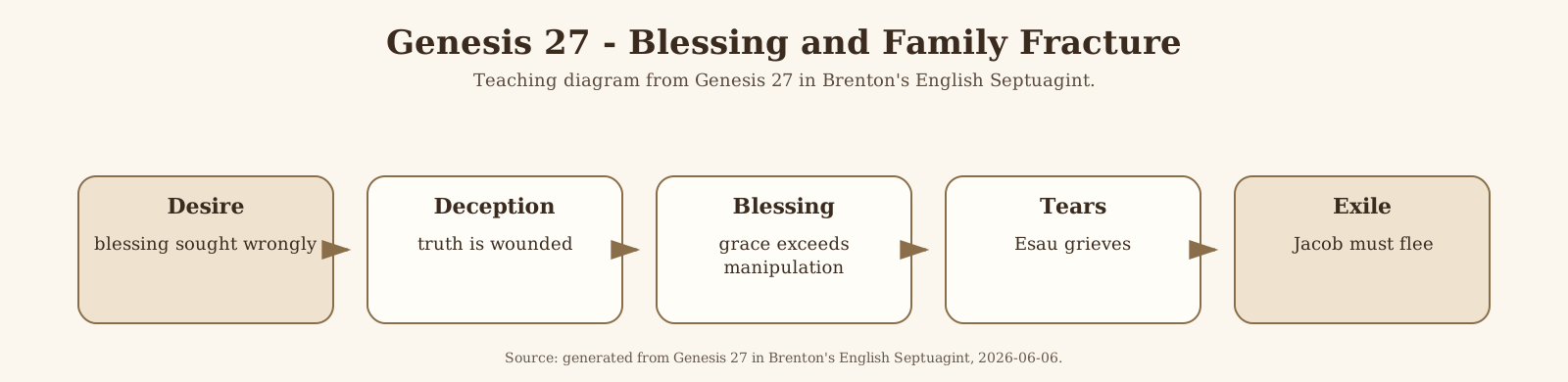 Source: original schematic based on Genesis 27, 2026-06-06.
Spiritual Fruit 🍇
Confess the act without borrowing a better identity. Give the true name of the act and the person it injured, without dressing it as necessary service to a good cause. “I misled him about the decision” is more truthful than “mistakes were made.” If God’s name was used to make someone comply, name that too. Ask your father of confession how to begin repair, and receive absolution as mercy for the person actually present.
Let affection become fair attention. Examine whom you listen to most easily, whose fault you explain away, and whose contribution you scarcely notice. Begin with one deliberate act: hear the overlooked person’s account without asking the favored person to interpret it first. Love grows truthful when it stops arranging conversations to preserve a preferred outcome. One child’s good need not require another’s humiliation.
Repair what a favorable result cannot repair. Jacob receives the blessing, while his brother and father remain injured. When a project succeeds after wrongdoing, resist using success as a verdict of innocence. Correct the false account, return what can be returned, and apologize without requiring immediate reconciliation. Some consequences outlast the apology. Accepting that limitation leaves the injured person free and entrusts the longer healing to God.
Bring grief to Christ before it becomes a weapon. Esau’s bitter cry should make us patient with another person’s pain, especially when their own earlier failures are also known. If the grief is yours, describe the loss in prayer and seek wise company rather than feeding an imagined punishment for the offender. Refusing vengeance does not require unsafe contact or abandonment of lawful protection. If you have threatened someone, stop the threatening behavior and seek immediate help to keep them safe. Mercy begins to take bodily form in the action you refrain from taking and the assistance you accept.
Receive the Son’s gift and live openly in it. The baptized have put on Christ without tricking the Father into loving them. Stand before Him with the sin that needs cleansing, the grief that needs comfort, and the obedience that needs strength. Ask for a truthful word to speak today and a hidden good to do without securing a superior place. Sonship by grace frees us from rivalry for a blessing imagined too small for anyone else. At the Jabbok Jacob will finally give his own name before receiving a new one; confession also begins with the person truly present, not a borrowed account of someone better.
Isaac’s room has held a false name, a blessing, and a bitter cry. Before the Father of our Lord Jesus Christ, the true name of His child can be spoken without disguise. Let the borrowed garment fall away from the conscience, and let the wounded brother remain a person we are called to love. Lord Jesus Christ, clothe us with Your life, teach us to tell the truth, and make the blessing we receive fruitful in mercy.
Teaching Notes
Orientation: Brenton’s Rebecca, Charran, and Chet correspond to Rebekah, Haran, and Heth. The naming exchange at the Jabbok is Genesis 32:28-29 in Brenton, one verse later than the familiar Hebrew-based references. Hebrew-based 2 Kings corresponds to Brenton IV Kings (4 Kingdoms).
A father prepares to bless (Genesis 27:1-4)
- Ask: How can Isaac’s affection help us examine parental preference?
- Watch for: Blindness is not moral failure; exploiting it is wrong.
A mother commands and a son consents (Genesis 27:5-17)
- Ask: What responsibility remains Jacob’s after his mother’s offer?
- Watch for: Neither parent’s conscious attitude toward the oracle is stated.
The borrowed identity before the father (Genesis 27:18-25)
- Ask: What harm does invoking “the Lord thy God” add?
- Watch for: Obedience cannot justify manipulating a vulnerable person.
The blessing opens toward the nations (Genesis 27:26-29)
- Ask: What do the gifts and Abrahamic echo reveal?
- Watch for: Augustine defends the prophetic act; baptism is grace, not righteous impersonation.
The discovery and the bitter cry (Genesis 27:30-38)
- Ask: Why does Hebrews 11:20 remember both sons?
- Watch for: The birthright was sold; this blessing was obtained by deception.
A different future for Esau (Genesis 27:39-40)
- Ask: What does Edom’s later revolt clarify?
- Watch for: Brenton’s positive wording is not barrenness; the sword does not authorize revenge.
The threat and the hoped-for return (Genesis 27:41-46)
- Ask: Where does the mother’s repeated “hear my voice” now send Jacob?
- Watch for: Chrysostom reads Esau’s murderous intent as hatred still resisting repentance. Later reunion does not make unsafe contact an obligation.
- Show: Follow the schematic, distinguishing blessing from approval of deceit. “Exile” anticipates the departure prepared here.
Sources
Embedded Scripture is from Brenton’s English Septuagint (LXX). New Testament quotations are from NKJV.
Brenton’s English Septuagint, Genesis 27; context: Genesis 12:2-3; 25:23-34; 26:34-35; 28:1-4, 13-21; 29:25-26; 31:41; 32:28-29 (Brenton); 33:4; 35:28-29; 4 Kingdoms (IV Kings) 8:20-22, called 2 Kings in Hebrew-based Bibles.
NKJV: Hebrews 11:20; 12:16-17, 22-24; Romans 9:10-12; Galatians 3:26-29; Ephesians 4:25; Romans 8:12-26.
St. John Chrysostom, Homilies on Hebrews, Homilies XXVI §1 and XXXI §§3-5; see direct footnotes below. The title page identifies the Oxford Translation revised by Frederic Gardiner. Printed homily numbers differ from the web-address numerals.
St. Augustine, The City of God XVI.37, Marcus Dods translation; see direct footnote below. His distinctive prophetic defense is acknowledged; his polemical identification of peoples gives no permission for hostility toward Jewish people.
CopticChurch.net, March 9, 2026, Monday of the fourth week of Great Lent. This confirms the stated placement, not every possible liturgical use.
Bible Hub, Genesis 27:29 Hebrew interlinear and Genesis 27:39 translation comparison.
Footnotes
-
Brenton’s Genesis 27:29 and 39 compared with the Hebrew interlinear, 27:29 and parallel translations, 27:39. The study retains the Septuagint forms “sons of thy father” and “of the fatness.” ↩ ↩2
-
St. Augustine, The City of God XVI.37, Marcus Dods translation, NPNF1, vol. 2, p. 332, direct text. ↩ ↩2 ↩3 ↩4
-
St. John Chrysostom, Homilies on Hebrews, Homily XXVI, §1, Oxford Translation revised by Frederic Gardiner, NPNF1, vol. 14, p. 482, direct passage. ↩
-
St. John Chrysostom, Homilies on Hebrews, Homily XXXI, §3, Oxford Translation revised by Frederic Gardiner, NPNF1, vol. 14, pp. 506-507, direct passage. His comparison with Cain immediately specifies Esau’s killing as “in intention.” ↩
-
CopticChurch.net, March 9, 2026, printed occasion “Monday of the fourth week of Great Lent,” Matins prophecies, Genesis 27:1-41. The cycle placement covers verses 1-41, not the entire forty-six-verse study. ↩