


Content note: This chapter includes sexual violence, family incest, and intoxication. Read at a pace that is safe for you; a trusted priest or qualified professional can offer support. If you are in immediate danger, seek safety and emergency help. No reader or participant should be pressed to disclose personal experiences.
At the end of Genesis 18, Abraham stands before the Lord and pleads for a city he cannot save. Genesis 19 takes us inside that city. Two strangers arrive, a door closes against a violent crowd, and before morning a household must leave everything behind. Yet the sentence that finally interprets the rescue is quieter than the fire: “God remembered Abraam.” The chapter brings together the cry of those endangered by evil and the prayer of one who seeks mercy. God hears both. Its severity should deepen our reverence for His justice; its tenderness should teach us how dearly He regards lives that others treat as disposable.
From Abraham’s prayer to Lot’s doorway
Abraham’s question in Genesis 18 concerns the righteousness of the Judge of all the earth. Lot’s situation makes it concrete. He has settled in Sodom and sits at its gate, yet the people surrounding his house still call him a sojourner. Their acceptance disappears when he protests against violence.
The New Testament calls Lot righteous and describes his distress at surrounding lawlessness (2 Peter 2:6–9). Conscience remains alive in him, although his conduct is far from flawless. Scripture lets virtue, failure, and dependence on mercy remain visible together. A favorable description of a person cannot excuse every action.
Brenton’s English Septuagint is retained below, including its forms “Abraam,” “Gomorrha,” “Segor,” and “Amman.” Segor is the city commonly called Zoar; Amman corresponds to Ammon. The chapter proceeds through hospitality, threatened assault, urgent rescue, judgment, and a terrible family aftermath. Its final scene belongs to the account and cannot be passed over as though reaching safety had completed the story.
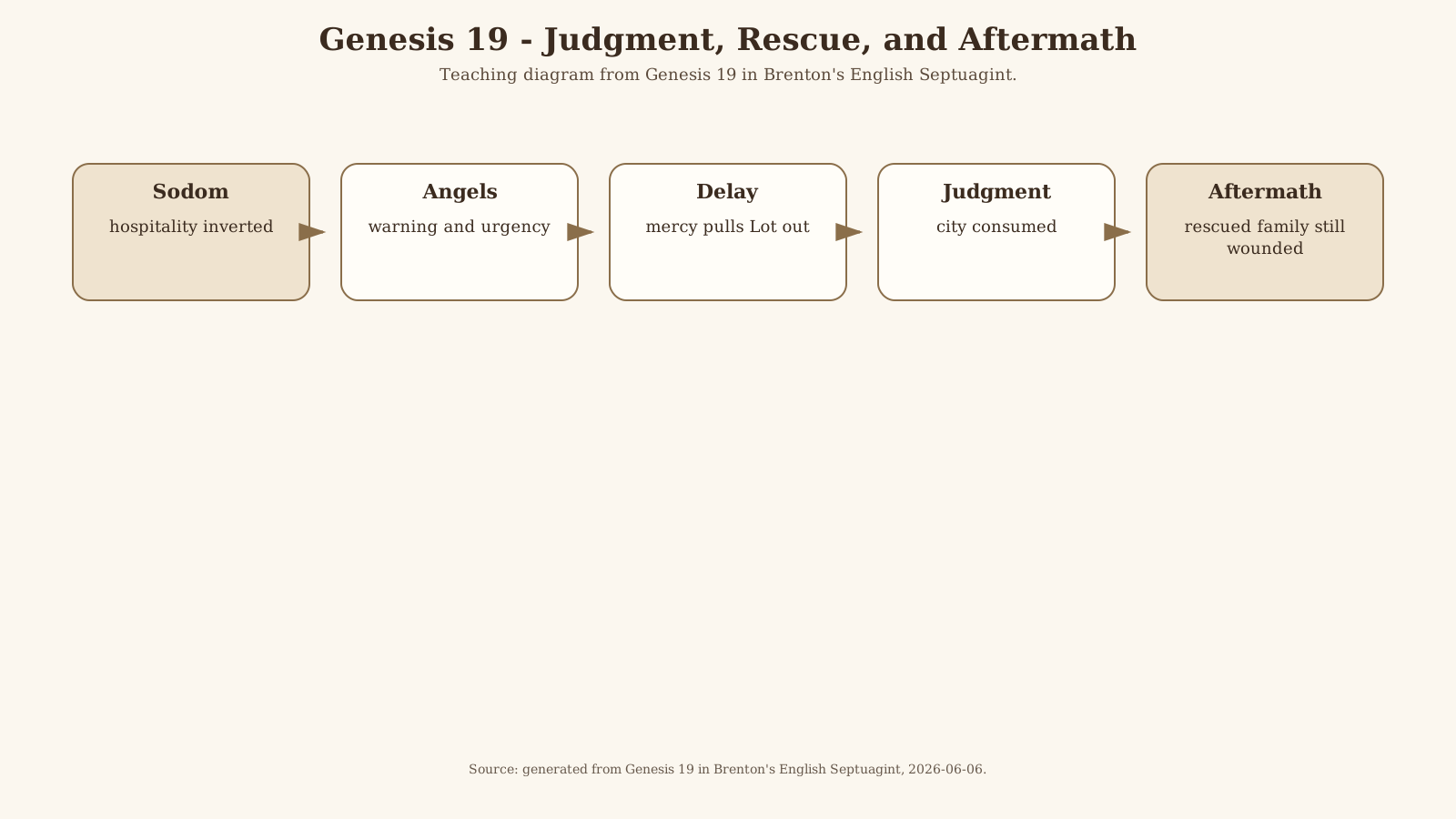 Source: teaching schematic based on Genesis 19, Brenton’s English Septuagint, 2026-06-06.
A house opened to strangers (Genesis 19:1-3)
1 And the two angels came to Sodom at evening. And Lot sat by the gate of Sodom, and Lot having seen them, rose up to meet them, and he worshipped with his face to the ground, and said, 2 Lo! my lords, turn aside to the house of your servant, and rest from your journey, and wash your feet, and having risen early in the morning ye shall depart on your journey. And they said, Nay, but we will lodge in the street. 3 And he constrained them, and they turned aside to him, and they entered into his house, and he made a feast for them, and baked unleavened cakes for them, and they did eat.
The visitors reach Sodom at evening. Lot rises to meet them, bows, offers water for their feet, and proposes a night’s rest before an early departure. These small acts give hospitality a bodily form. A stranger needs a place to sleep, food, and protection before he needs a speech about generosity. The resemblance to Abraham’s welcome in the previous chapter is deliberate in the narrative: both men rise to receive visitors and prepare a meal. Lot’s house becomes a place of welcome within a city that will soon surround it with threats.
The angels initially propose to lodge in the street. Lot presses them to enter his house. The next scene makes the danger of remaining outside plain, although these verses do not disclose every thought behind his insistence. His welcome begins before the visitors have identified their mission to him. He does not first establish that they are important enough to merit care. That order matters for the Christian household. The dignity of a guest is already present before usefulness, reputation, or shared background is discovered.
Gems from the Fathers 💎: Seeking the stranger
St. John Chrysostom, preaching on Romans 12:13, recalls both Lot and Abraham as examples of active hospitality. He reads Paul’s command as a pursuit of opportunities to serve, not a grudging response after repeated pleading. He explains that Paul teaches us “not to wait for those that shall ask it, and see when they will come to us, but to run to them, and be given to finding them.”1 His principal elaboration then turns to Abraham’s welcome. This is a sermon on Romans drawing upon Genesis, rather than a commentary on every action in Lot’s household.
The door besieged and the daughters endangered (Genesis 19:4-11)
4 But before they went to sleep, the men of the city, the Sodomites, compassed the house, both young and old, all the people together. 5 And they called out Lot, and said to him, Where are the men that went in to thee this night? bring them out to us that we may be with them. 6 And Lot went out to them to the porch, and he shut the door after him, 7 and said to them, By no means, brethren, do not act villanously. 8 But I have two daughters, who have not known a man. I will bring them out to you, and do ye use them as it may please you, only do not injury to these men, to avoid which they came under the shelter of my roof. 9 And they said to him, Stand back there, thou camest in to sojourn, was it also to judge? Now then we would harm thee more than them. And they pressed hard on the man, even Lot, and they drew nigh to break the door. 10 And the men stretched forth their hands and drew Lot in to them into the house, and shut the door of the house. 11 And they smote the men that were at the door of the house with blindness, both small and great, and they were wearied with seeking the door.
Before the guests sleep, the crowd surrounds the house. The narration gathers young and old into the same action. Their demand to have the visitors brought out is followed by threats against Lot and an attempt to break the door. This is an attempted sexual assault, carried by collective intimidation. Whatever familiarity the language of verse 5 might suggest in isolation, verses 8–9 make the sexual and coercive character of the demand clear. The strangers are being treated as bodies the crowd may seize.
Lot closes the door behind him and names their conduct villainous. His next proposal, however, betrays the very duty he is trying to fulfill. In verse 8 he offers his daughters to the crowd. A father has a duty to protect his daughters as fully as his guests; he cannot secure one person’s safety by surrendering another to sexual violence. The daughters’ dignity is equal to that of the men inside. Sexual violence is evil regardless of the sex of those harmed or those committing it. Peter’s description of righteous Lot does not vindicate this offer. The account records a grievous failure within a real act of hospitality.
The crowd attacks Lot’s right to protest. He came to live among them; how dare he judge? Belonging is offered only if he accepts their behavior. Such pressure persists wherever a group mocks objections to humiliation or abuse. Christian courage may require losing approval to protect someone whose dignity is being denied.
Ezekiel 16:49–50 describes Sodom’s pride, abundance of food, comfortable idleness, failure to strengthen the poor and needy, haughtiness, and abomination before God. Jude 7 explicitly recalls sexual immorality and the pursuit of strange flesh. Together these witnesses preserve the breadth and gravity of the evil: prosperity without mercy and sexual wrongdoing belong within a larger refusal to honor God’s order and other people. Reducing the scene to a failure of courtesy empties it of violence; using it to stigmatize a present-day group evades its summons to examine our own conduct. The text exposes acts of domination and lawlessness, not a license to assign collective guilt to people by identity.
The rescuing hands first appear at the doorway. The guests pull Lot inside, shut the door, and strike the assailants with blindness. Those who demanded possession of the strangers now cannot find the entrance. Even then they wear themselves out seeking it. Their persistence gives the scene its terrible force: frustration alone has not produced repentance. A thwarted desire can remain as disordered as a successful one. Christian repentance asks Christ to change what we want, so that restraint becomes willing righteousness rather than anger at an obstacle.
Hands held in the morning of mercy (Genesis 19:12-22)
12 And the men said to Lot, Hast thou here sons-in-law, or sons or daughters, or if thou hast any other friend in the city, bring them out of this place. 13 For we are going to destroy this place; for their cry has been raised up before the Lord, and the Lord has sent us to destroy it. 14 And Lot went out, and spoke to his sons-in-law who had married his daughters, and said, Rise up, and depart out of this place, for the Lord is about to destroy the city; but he seemed to be speaking absurdly before his sons-in-law. 15 But when it was morning, the angels hastened Lot, saying, Arise and take thy wife, and thy two daughters whom thou hast, and go forth; lest thou also be destroyed with the iniquities of the city. 16 And they were troubled, and the angels laid hold on his hand, and the hand of his wife, and the hands of his two daughters, in that the Lord spared him. 17 And it came to pass when they brought them out, that they said, Save thine own life by all means; look not round to that which is behind, nor stay in all the country round about, escape to the mountain, lest perhaps thou be overtaken together with them. 18 And Lot said to them, I pray, Lord, 19 since thy servant has found mercy before thee, and thou hast magnified thy righteousness, in what thou doest towards me that my soul may live,—but I shall not be able to escape to the mountain, lest perhaps the calamity overtake me and I die. 20 Behold this city is near for me to escape thither, which is a small one, and there shall I be preserved, is it not little? and my soul shall live because of thee. 21 And he said to him, Behold, I have had respect to thee also about this thing, that I should not overthrow the city about which thou hast spoken. 22 Hasten therefore to escape thither, for I shall not be able to do anything until thou art come thither; therefore he called the name of that city, Segor.
The angels’ warning reaches beyond the people currently inside the house. Lot is to bring out sons-in-law, sons, daughters, or any other friend. Mercy opens a way of escape that he must communicate. He goes to the sons-in-law whom Brenton describes as having married his daughters. They hear the announcement of destruction as absurd. The narrator does not explain the household arrangements connecting them with the two daughters who leave; we should not silently replace the wording with a different translation’s description of men merely betrothed to them.
The warning rests on a cry raised before the Lord, recalling Genesis 18. People who appear unanswerable within their city stand accountable before the God who hears. For the oppressed, this promises justice; for the comfortable, it demands attention before indifference becomes complicity.
At dawn the angels hasten the family. Brenton says, “And they were troubled,” then describes hands taken and lives led out “in that the Lord spared him.” Divine compassion meets human distress. The wife and daughters are particular persons held in mercy alongside Lot.
Language insight: “they were troubled”
Many translations of the Hebrew text describe Lot as lingering or hesitating in verse 16. Brenton’s Septuagint instead gives a plural expression, “they were troubled.”2 That difference changes the emphasis: the family is distressed at the moment the angels act. The text before us does not say that they are delaying because they cherish wealth or secretly prefer Sodom. Fear and attachment may be considered in a broader spiritual reading, but they must not be smuggled into this wording as an established motive. Someone frozen or hesitant in danger may be overwhelmed; such a response does not make that person responsible for the threat or unworthy of rescue.
Lot then states his fear plainly. He has found mercy, but believes he cannot reach the mountain before calamity overtakes him. He asks to enter the nearby small city. The answer accommodates his request and promises that the city will be spared. The word about doing nothing until he arrives in verse 22 belongs to this announced rescue, rather than to a general limitation on God’s power. Judgment waits while refuge is provided.
Mercy here is attentive to frailty. The Lord does not require Lot to pretend that he feels brave before he can live. Lot’s prayer names the life he has received as a gift, even while his confidence remains small. We can bring the same mixture of gratitude and fear to Christ: enough trust to ask, enough honesty to admit that the next step feels beyond us. The angels’ extraordinary intervention does not authorize clergy, parents, or leaders to impose force under the name of mercy. Human care must protect dignity, respond responsibly to immediate danger, and help people receive support without taking possession of their lives.
Segor is a concrete refuge to which the family must go. God’s initiative makes a real response possible. Confession, prayer, and Holy Communion strengthen us to live differently: to speak truth, relinquish a destructive practice, or accept responsible help. The threatened household teaches care for endangered people, not accusations that escaping danger should have been easy.
Judgment, the backward look, and Abraham remembered (Genesis 19:23-29)
23 The sun was risen upon the earth, when Lot entered into Segor. 24 And the Lord rained on Sodom and Gomorrha brimstone and fire from the Lord out of heaven. 25 And he overthrew these cities, and all the country round about, and all that dwelt in the cities, and the plants springing out of the ground. 26 And his wife looked back, and she became a pillar of salt. 27 And Abraam rose up early to go to the place, where he had stood before the Lord. 28 And he looked towards Sodom and Gomorrha, and towards the surrounding country, and saw, and behold a flame went up from the earth, as the smoke of a furnace. 29 And it came to pass that when God destroyed all the cities of the region round about, God remembered Abraam, and sent Lot out of the midst of the overthrow, when the Lord overthrew those cities in which Lot dwelt.
The sun rises as Lot enters Segor. Morning brings refuge to him and destruction to Sodom and Gomorrah. Verse 25 names the cities, their inhabitants, the surrounding country, and even the plants springing from the ground. The scale is sobering. The fertile plain once attractive to Lot is overthrown. Scripture makes us face a divine judgment against entrenched evil whose consequences encompass a whole place.
This account gives no permission to declare every disaster a punishment, or to label every sufferer wicked. Here the narrator explicitly identifies God’s action; we do not possess that knowledge about another city’s earthquake, a family’s illness, or someone’s bereavement. The proper response to sufferers is mercy, not speculation about guilt. The seriousness of judgment should begin in our own repentance. If God hears the outcry against violence, then we must resist violence wherever our choices give it cover.
Lot’s wife looks back and becomes a pillar of salt. The command in verse 17 had forbidden the backward look. The narrative states the act and consequence without opening her thoughts to us. Christ gives the Church its governing application in Luke 17:28–33. He recalls the ordinary buying, selling, planting, and building of Lot’s days, then warns the person on the housetop against going down to retrieve goods and the person in the field against turning back. Within that urgent context He commands the remembrance of Lot’s wife. The issue for disciples is the attempt to secure life by returning to what must now be surrendered.
That teaching searches divided loyalty. A person may begin to confess dishonesty while keeping the arrangement that makes it profitable, or renounce resentment while preserving the stories that keep it warm. Christ calls us to entrust our lives to Him when obedience costs something. Yet this application does not establish that we know exactly why Lot’s wife looked back. Love for lost people, grief after catastrophe, and involuntary responses to trauma must not automatically be branded sinful attachment. Her story warrants watchfulness, not confident diagnoses of another person’s mourning.
Abraham also looks toward the cities, from the place where he had stood before the Lord. His looking is distinct from the forbidden turning back during escape. He sees smoke like a furnace. Genesis does not tell us what he says or feels at this moment. It gives instead the divine explanation: God remembered Abraham and brought Lot out. The earlier prayer remains present in an outcome Abraham cannot inspect from where he stands. Intercession can bear fruit beyond the intercessor’s sight.
God’s remembrance means faithful regard and action; it does not suggest that He had forgotten a name until someone reminded Him. Abraham’s prayer is received within God’s mercy. It gives us reason to bring others before the Lord, while leaving their lives in His hands. We neither control God by repeated prayers nor carry the impossible burden of guaranteeing that those we love will be safe. The Christian fulfillment lies in Christ Himself: Hebrews 7:25 grounds our confidence in the living Lord who makes intercession for those coming to God through Him. Abraham stands before the Lord for others; the incarnate Son gives Himself for us and lives forever as our Savior.
Gems from the Fathers 💎: “The Lord” and “the Lord”
St. Justin Martyr reads Genesis 19:24 within the whole encounter of Genesis 18–19. In Dialogue with Trypho 56, he distinguishes the divine Lord who appears and acts from the Father, while maintaining their unity of will. After quoting the judgment, Justin identifies the Lord of the two angels as the One “who is both God and Lord.”3 His argument concerns the identity of the divine speaker, not an identification of either created angel as the Son.
This reading recognizes the Son’s presence in God’s revelation before His birth from the Virgin. We receive it within the Church’s full confession: He is begotten of the Father, of one essence with Him, and fully God. Justin’s earlier terminology must not imply a lesser deity. The Savior’s compassion and judgment belong to one divine goodness; He delivers us from evil rather than declaring it harmless.
The Church’s Voice in Worship ⛪
The Katameros Great Lent cycle joins Genesis 18:17–33 to Genesis 19:1–29 at Matins on Thursday of the third week. Abraham’s intercession and Lot’s rescue are therefore heard together. The joining teaches the worshipper to pray for a world endangered by evil and to receive the warning personally. Lent’s fasting belongs with generosity, truthful confession, and protection of the vulnerable; Ezekiel’s indictment of abundance without help for the needy makes comfortable self-denial insufficient.
The Lenten reading ends with God’s remembrance of Abraham, placing the worshipper before mercy that hears prayer. Verses 30–38 belong to this study but fall outside that verified reading. No separate Holy Week placement is asserted here.
The cave, violated trust, and a future beyond the tragedy (Genesis 19:30-38)
30 And Lot went up out of Segor, and dwelt in the mountain, he and his two daughters with him, for he feared to dwell in Segor; and he dwelt in a cave, he and his two daughters with him. 31 And the elder said to the younger, Our father is old, and there is no one on the earth who shall come in to us, as it is fit in all the earth. 32 Come and let us make our father drink wine, and let us sleep with him, and let us raise up seed from our father. 33 So they made their father drink wine in that night, and the elder went in and lay with her father that night, and he knew not when he slept and when he rose up. 34 And it came to pass on the morrow, that the elder said to the younger, Behold, I slept yesternight with our father, let us make him drink wine in this night also, and do thou go in and sleep with him, and let us raise up seed of our father. 35 So they made their father drink wine in that night also, and the younger went in and slept with her father, and he knew not when he slept, nor when he arose. 36 And the two daughters of Lot conceived by their father. 37 And the elder bore a son, and called his name Moab, saying, He is of my father. This is the father of the Moabites to this present day. 38 And the younger also bore a son, and called his name Amman, saying, The son of my family. This is the father of the Ammanites to this present day.
Lot leaves Segor for the mountain he had feared to seek earlier. Now he fears remaining in the spared city, though verse 30 does not explain why. The surviving household lives in a cave, facing a future the daughters believe cannot continue through ordinary marriage.
The elder daughter’s assertion that there is no one on earth to come to them is her belief, not a narrator-endorsed fact. Segor has just been spared, and Abraham remains alive. Their perceived lack of a future becomes the premise for a plan to obtain offspring through their father by deliberately making him drink wine.
Twice the narrative stresses Lot’s unawareness. He does not know the lying down or rising up. The actions described are incestuous sexual violations of a man made incapable of consent, not a mutually chosen sexual relationship. Calling this only drunken impropriety obscures what is being done to him. Lot’s earlier failure to protect his daughters remains wrong; it does not make him deserving of later violation. Each wrong must be named in its own place without treating one act of harm as repayment for another.
The daughters’ stated aim is preserving offspring. Catastrophe and their father’s earlier offer may lead a reader to wonder about fear, damaged trust, or trauma. Such possibilities remain interpretations; the narrator does not give a complete account of their inner lives. We can acknowledge the household’s suffering without making suffering itself a sin or assuming that people subjected to abuse become abusers. Nor does the desire for a future justify the means chosen here. Desperation requires compassionate help and truthful boundaries, not permission to use someone else’s body.
The children are named as ancestors of Moab and Ammon. Neither the babies nor their descendants are guilty of these acts. The origin account supplies no warrant for racial contempt or for treating ancestry as inherited moral worthlessness among present-day peoples.
Scripture later gives Moab another place in salvation’s history. Ruth, a Moabite, becomes mother of Obed and ancestor of David; Matthew 1:5 includes her in Christ’s genealogy. Her fidelity prevents this chapter from becoming the final moral word over her people. God redeems histories without approving their wrongs. The children of the cave are persons with a future, not a shameful remainder.
Rescued lives still need restoration. Physical safety can precede the patient work of healing, dependable relationships, and freedom from shame. The Church joins prayer and the sacraments with practical protection and qualified care. Repentance addresses the wrongdoer’s deeds; healing addresses the sufferer’s wounds. Confusing them burdens the harmed with guilt and leaves actual evil unaddressed.
Spiritual Fruit 🍇
Make hospitality protective. Lot’s meal is good; his offer of his daughters shows how tragically hospitality can be severed from justice. Give help that preserves everyone’s dignity. In a parish this means welcoming newcomers while keeping safeguarding responsibilities clear, refusing humiliating jokes, and taking a report of harm seriously. A generous community must be safe for those who have the least power to object.
Repent where the crowd has become comfortable. The crowd’s indignation at Lot’s protest exposes our own temptation to resent correction more than wrongdoing. Examine one place where approval has kept you silent: dishonesty at work, cruelty in a family conversation, or contempt directed at a stranger. Bring your own complicity to confession and take one proportionate step toward truth. Courage may begin with refusing to laugh, declining to repeat the story, or helping a threatened person obtain responsible support.
Receive mercy without performing strength. The troubled household is led out by hands held in compassion. When fear overwhelms you, pray honestly and accept trustworthy help. Where you are helping someone else, let that same mercy govern your manner: explain options, preserve dignity, and avoid demanding quick disclosures or a timetable for recovery. Christ’s care reaches frightened people before their lives look composed.
Pray for others without trying to possess the outcome. Abraham is remembered even while he can see only smoke. Name before God one person whose choices or suffering you cannot resolve. Ask for protection, repentance where it is needed, and healing where harm has been suffered. Then offer the concrete help that is yours to give and entrust what exceeds your power to Christ, who lives to intercede. Prayer frees us from indifference and from the fantasy that everything depends on us.
Let hope refuse inherited shame. Ruth’s place in Christ’s genealogy prevents the cave from becoming the last word over a people’s future. A painful family history does not determine a person’s dignity before God. Resist speaking as though a child, a survivor, or an entire family is permanently stained by someone else’s acts. Support the slow work of restoration while holding wrongdoers responsible. God can cultivate fidelity where human history has supplied sorrow.
At morning the angels hold four hands that cannot yet hold a secure future. Abraham stands at the place of prayer, unable to see all that God has done. We stand before Christ with the endangered, the guilty, and the wounded, asking for justice and life. Lord Jesus Christ, hear the cry of those who suffer, protect the vulnerable, bring us to truthful repentance, and heal what violence has broken. Keep our hope in Your mercy, and teach us to become trustworthy servants of it. Amen.
Teaching Notes
A house opened to strangers (Genesis 19:1-3)
- Ask: What does Lot offer before knowing the visitors’ mission?
- Watch for: Do not allow praise of this welcome to excuse the offer in verse 8.
- Show: Trace the opening welcome on the schematic before following the warning and rescue.
The door besieged and the daughters endangered (Genesis 19:4-11)
- Ask: How does verse 9 expose the crowd’s demand for unquestioning conformity?
- Watch for: Identify attempted sexual assault without graphic elaboration, identity-based stigma, or personal-disclosure prompts.
Hands held in the morning of mercy (Genesis 19:12-22)
- Ask: What reason does verse 16 give for the rescuing hands?
- Watch for: The schematic’s “Delay” follows a common Hebrew-based reading; Brenton says “they were troubled.” Neither permits blaming trauma responses or licensing coercive leadership.
Judgment, the backward look, and Abraham remembered (Genesis 19:23-29)
- Ask: How does verse 29 answer the intercession of Genesis 18?
- Watch for: Luke 17:28–33 concerns urgent surrender, including retrieval of possessions; it does not disclose Lot’s wife’s precise motive or authorize condemning ordinary grief.
The cave, violated trust, and a future beyond the tragedy (Genesis 19:30-38)
- Ask: Why does the account’s repeated statement of Lot’s unawareness matter?
- Watch for: The daughters’ stated fear about the future is not narrator-endorsed geography. Do not speculate confidently about trauma, blame survivors, or assign ethnic guilt.
Sources
Embedded Scripture is from Brenton’s English Septuagint (LXX).
Lancelot C. L. Brenton, The Septuagint Version of the Old Testament, Genesis 19; preceding context in Genesis 18. 🔗.
Scripture cross-references: Ezekiel 16:49–50; Jude 7; 2 Peter 2:6–9; Luke 17:28–33; Hebrews 7:25; Ruth 1:4 and 4:13–17; Matthew 1:5. 🔗 and 🔗.
St. John Chrysostom, Homilies on Romans, Homily XXI, on Romans 12:13, using Abraham and Lot as hospitality examples. 🔗.
St. Justin Martyr, Dialogue with Trypho, chapter 56, on the divine Lord in Genesis 18–19 and His distinction from the Father. 🔗.
Genesis 19:16, 🔗, distinguishing Brenton’s Septuagint from Hebrew-based translations.
Katameros, Matins prophecies for Thursday of the third week of Great Lent: Genesis 18:17–33 with 19:1–29, alongside Proverbs 2:16–22 and 3:1–4, Isaiah 11:10–16 and 12:1–2. The dated cycle witness is 9 March 2023 🔗.
Existing teaching schematic based on Genesis 19 in Brenton’s English Septuagint, created for this study, 2026-06-06.
Footnotes
-
St. John Chrysostom, Homilies on Romans, XXI, on Romans 12:13; trans. J. Walker, J. Sheppard, and H. Browne, revised George B. Stevens, NPNF, first series, vol. 11. 🔗. ↩
-
Genesis 19:16: Brenton’s Septuagint compared with translations of the Hebrew text. 🔗. ↩
-
St. Justin Martyr, Dialogue with Trypho, 56; trans. Marcus Dods and George Reith, ANF, vol. 1. The quoted words are spoken by Justin in the dialogue after his extended citation of Genesis 18–19. 🔗. ↩