


This narration is from a previous version of the study and may include a combined recording of multiple chapters.
Ruth is a small book with a large spiritual weight. It teaches that God often works salvation through hidden faithfulness rather than public power: a grieving widow returns home, a foreign daughter-in-law refuses to abandon her, a righteous man protects the vulnerable, and a child is born who becomes part of the line of David and Christ. The book belongs after Judges because it answers Judges’ darkness with quiet covenant mercy. Where Judges repeats, “everyone did what was right in his own eyes,” Ruth shows what happens when ordinary people do what is right in God’s eyes.
This is not a romance story with religious coloring. It is a book about return, poverty, chastity, mercy, kinship, and redemption. Its deepest movement is from emptiness to fullness, from exile to Bethlehem, from widowhood to birth, from Moab to Messiah.
Lesson Guide
- Key phrases: return; costly kindness; belonging; the ancestry of Christ.
- Emphasize: Ruth is spiritually tender but theologically serious.
- Avoid: turning Ruth into only a love story, a Mother’s Day lesson, or a generic sermon on loyalty.
How to Read Ruth Orthodoxly
Ruth places the reader beside people whose future seems to have disappeared. Naomi has buried her husband and sons. Ruth has lost her husband and must decide whether to leave her mother-in-law. The book asks what faithful love can do when it cannot undo death. Its answer comes through companionship, food, protection, a public undertaking, and finally a child. Each gift restores something that loss has threatened; none makes the dead cease to matter.
An Orthodox reading follows this history toward Christ without making every detail an allegory. The book’s closing genealogy gives the direction. Its family story belongs to Israel’s preparation for David, and Matthew names Ruth among the ancestors of the incarnate Son. A Gentile woman becomes kin within Israel. The nations’ gathering into the Church is foreshadowed through her reception, not through a claim that Israel has been discarded.
Historical and Scriptural Context
Between Judges and David
Ruth opens, “And it came to pass when the judges ruled” (Ruth 1:1, Brenton). Its events belong to the era before Israel’s monarchy, when the violence and disorder narrated in Judges threatened household and communal life. Yet the fear of God has not disappeared. Ruth shows an agrarian community in which workers exchange blessings, the poor glean, and elders witness commitments at the gate. These ordinary institutions can serve righteousness when people accept their responsibilities.
The setting within the story should be distinguished from the date of its composition, which the book does not identify. Its ending looks back toward the origins of David’s family. The genealogy lists ten names from Perez to David: Perez, Hezron, Ram, Amminadab, Nahshon, Salmon, Boaz, Obed, Jesse, and David. Boaz stands seventh and David tenth in this literary sequence. The arrangement does not prove an uninterrupted historical chronology or solve Deuteronomy’s exclusion by counting generations. Matthew carries this ancestry forward to Christ.
Moab and the question of belonging
Moab’s biblical history makes Ruth’s reception more demanding than an agreeable lesson about welcoming strangers. Genesis 19:30-38 traces Moab’s origin to Lot and his elder daughter after the destruction of Sodom. Numbers 22-24 recounts Balak’s attempt to have Balaam curse Israel. Numbers 25 describes Israel’s entanglement with Moabite women and the worship of Baal of Peor. Deuteronomy 23:3-6 names the assembly exclusion and recalls the refusal of bread and water and the hiring of Balaam. Kinship through Lot and hostility toward Israel belong to the same history.
Ruth bears the name of this people, but the narrative allows her own words and deeds to be heard. Her pledge joins Naomi’s people and God; her work sustains a bereaved household. Deuteronomy’s assembly restriction is not identical to a blanket statement about every possible marriage. St Ambrose answers the theological difficulty through her righteous conduct and spiritual kinship in his Exposition of the Gospel according to Luke, 3.30. His reading honors her allegiance to Israel’s God without making it the sole historical explanation of the law.1
Lesson Guide
- Key phrases: the days of the judges; Moab’s remembered hostility; Ruth’s confessed allegiance.
- Emphasize: distinguish the story’s historical setting from its composition date, and assembly exclusion from marriage legislation.
- Avoid: treating Ruth’s ethnicity as a moral fault or claiming that grace makes Israel’s history irrelevant.
Geographical Significance ⛰️
Moab lies east of the Dead Sea; Bethlehem of Judah lies to the west. Famine takes Elimelech’s family away from their home, and news of provision brings Naomi back. The book gives no secure route for their journey and no explicit verdict that the departure caused their bereavement. Hunger is enough to explain the pressure under which the family travels. Their losses must not become a convenient proof that God punishes migration.
Bethlehem’s name, conventionally understood as “house of bread,” sharpens the irony of famine and the hope of renewed provision. The locality has a further scriptural thread. Ruth 1:2 identifies the family as Ephrathites of Bethlehem, and the blessing in 4:11 joins Ephrathah with Bethlehem again. Micah 5:2 names Bethlehem Ephrathah in the promise of a ruler; Matthew 2:6 brings that promise into the account of Christ’s birth. Ruth establishes the Davidic family’s connection with this place. The explicit prophetic promise comes in Micah, and the Gospel announces its fulfillment.
Lesson Guide
- Key phrases: Bethlehem and Ephrathah; famine and return; David’s town.
- Emphasize: the map gives orientation, not an exact itinerary or a judgment on Elimelech’s motives.
- Avoid: presenting every geographical detail as an independent prophecy.
The Characters 👥
Naomi / Noemin
Brenton calls her Noemin. The Hebrew name Naomi is associated with pleasantness; her request to be called Bitter in chapter 1 makes loss painfully personal. She speaks as someone who still addresses her life to God, yet experiences His hand as against her. Her lament is part of the story, not its final explanation. She can recognize provision and seek Ruth’s security even while her own sorrow remains unfinished.
Ruth
Ruth is a Moabite widow whose allegiance takes her beyond the protections of her birthplace. The narrative does not require a speculative meaning for her name. Her confession, endurance, and labor disclose her character. She can illuminate the convert’s costly entrance into a new people, but she is first a woman caring for another woman under the threat of hunger. Her faith is heard in her pledge and made visible in the work of the field.
Orpha
Orpha kisses Naomi and returns home after Naomi urges her to do so. The narrative gives no condemnation of her and does not make her departure a license to judge those whose circumstances differ from Ruth’s. Ruth’s exceptional commitment can be honored without inventing wickedness in the woman who leaves.
Boaz
Boaz has resources and standing, and he is related to Elimelech’s family. His character emerges in the way he treats workers, notices Ruth, and accepts obligations before witnesses. In Matthew 1:5, Boaz is Rahab’s son. Matthew thus allows a Christian reader to place the reception of Rahab beside Boaz’s reception of Ruth. Ruth itself does not name his mother, and neither book says that memories of Rahab caused his hospitality. The parallel concerns God’s welcome across family histories, not an invented motive.2
Obed, Jesse, David, and Christ
Obed is Ruth’s child and Jesse’s father, hence David’s grandfather. The neighbors’ declaration that a son has been born to Naomi expresses the renewal of her household; it does not change the child’s maternity. The genealogy widens the reader’s view beyond the immediate family. A child held by a bereaved grandmother belongs to the ancestry through which Christ will take our humanity.
Lesson guide
- Key phrases: a wounded believer; confessed allegiance; accountable authority; a household renewed.
- Emphasize: let the characters’ words and actions establish their significance.
- Avoid: speculative name meanings, guessed motives, or promises that faithful carers must receive visible compensation.
Light from the Word 🕯️
Road, field, threshing floor, and gate give each chapter a dominant setting. They are a way to remember the story, not an exhaustive list of its locations.
The road: private grief and costly return (Ruth 1)
“And it came to pass when the judges ruled, that there was a famine in the land: and a man went from Bethleem Juda to sojourn in the land of Moab, he, and his wife, and his two sons.” (Ruth 1:1)
Famine leads to migration, and migration is followed by the deaths of Naomi’s husband and sons. News that the Lord has given His people bread opens the possibility of return. Ruth refuses separation and joins Naomi’s people and God, while Naomi reaches Bethlehem still speaking out of bitterness. The arrival at barley harvest leaves hope beside lament without making Naomi pretend that she already feels restored. The Ruth 1 study follows this road closely, including the Hebrew language of attachment and Brenton’s language of following.
The field: practical mercy and daily bread (Ruth 2)
Ruth gleans under the provisions of the Torah, especially Deuteronomy 24:19-22. Boaz makes that access safe: he restrains his workers, provides water, shares food, and arranges grain for her to gather. The chapter moves from Ruth’s need to Naomi’s renewed recognition that kindness has reached their household. In the Ruth 2 study, protection and provision are examined as acts that honor the recipient’s dignity, while the blessing of refuge beneath God’s wings prepares the request in the next chapter.
The threshing floor: hidden integrity and a request for kinship (Ruth 3)
Naomi seeks lasting security for Ruth, who approaches Boaz at night and asks him to spread his garment over her because he is a near kinsman. The scene is vulnerable: Ruth’s future depends on a powerful man’s response. Boaz blesses her, acknowledges the prior claim of another relative, and undertakes to resolve the matter. He also sends barley to Naomi. The Ruth 3 study attends to the scene’s risk, the wing-and-garment connection, and the restraint that leads private hope toward a public commitment.
The gate: public redemption and a household’s future (Ruth 4)
Before elders and witnesses, Boaz accepts the responsibility the nearer kinsman declines. Marriage, conception, and Obed’s birth follow; Naomi receives the child into her care, and the genealogy leads to David. The ending does more than reward generous behavior. It shows a threatened family participating in the history of God’s promise. The Ruth 4 study explains the legal setting, the women’s blessing, and the genealogy that Matthew later carries into Christ’s ancestry.
Lesson Guide
- Key phrases: the road; the field; the threshing floor; the gate.
- Emphasize: private grief, practical mercy, hidden integrity, and public redemption belong to one story.
- Avoid: letting the overview replace close reading of the four chapter studies.
Bread, Birth, Harvest, and the Meaning of Fullness
Two statements frame the narrative’s account of provision. At 1:6, Naomi hears that the Lord has visited His people by giving them bread; at 4:13, the narrative says that the Lord gave Ruth conception. The first is an embedded report, the second a direct narrative statement. Together they explicitly attribute sustenance and new life to God. This is not a claim that He acts only twice. Between them, His providence is discerned through human decisions: Ruth works, Boaz protects, Naomi counsels, and the community witnesses. Trust in God makes these responsibilities weightier, not optional.
Bread and birth also open a Christian typological reading. The Lord who sustains life will take flesh in Bethlehem and give Himself as the Bread of Life. Incarnation and Eucharist are the fulfillment toward which Christian readers look; they are not terms the book of Ruth itself uses. The visitation language of Ruth 1:6 also recalls the blessing of Zacharias in Luke 1:68, where God’s visitation and redemption meet. The Gospel gives this family history a horizon greater than immediate relief.
The harvest dates supply a distinct frame. Ruth 1:22 marks the beginning of barley harvest, and 2:23 follows gleaning through barley and wheat harvest. This is the spring season broadly associated with Passover through the Feast of Weeks: Leviticus 23:10-17 orders the firstfruits sheaf and the count to the new-grain offering, and Deuteronomy 16:9-10 counts seven weeks from the first cutting. The later marriage, conception, and birth are not dated to that same interval. Jewish custom reads Ruth at Shavuot, the Feast of Weeks.3 A Christian meditation can set the foreign woman’s reception beside Pascha and Pentecost, when Acts 2 announces the gathering of people from many nations. This comparison does not appoint Ruth for a Coptic feast or turn the whole book into a seven-week chronology.
Naomi’s account of leaving full and returning empty in 1:21 is answered in stages. Ruth stands beside her even before Naomi can recognize that companionship as a gift. Grain begins to sustain them; in 3:17 Boaz explicitly refuses to send Ruth back empty to her mother-in-law. Finally, the child lies in Naomi’s bosom in 4:16. Food, kinship, and renewed family life answer different dimensions of deprivation. Fullness does not mean that her husband and sons have been replaced, or that bereavement has become good. It means that loss no longer has the sole right to describe her life.
Language insight: “Wings” and “Skirt” (Ruth 2:12; 3:9)
Boaz blesses Ruth for seeking refuge beneath the Lord’s wings in 2:12; Ruth asks him to spread his skirt over her in 3:9. Hebrew uses forms of the same word, “kanaph” (כָּנָף), which can mean a wing or the corner of a garment. The Rahlfs-based Greek has “pterygas” (πτέρυγας), wings, in 2:12 and “pterygion” (πτερύγιον), a garment flap or fold, in 3:9. The related vocabulary preserves the link while naming the actual covering she requests. Ruth asks Boaz to give concrete expression to the shelter for which he has prayed.4
In Ezekiel 16:8, the Lord spreads His covering over Jerusalem and enters a covenant with her. That marriage image offers a scriptural comparison for Ruth’s request, though the books are not describing the same event. Christ’s desire to gather Jerusalem’s children beneath His wings in Matthew 23:37 gives Christian readers a further image of His protective love. Divine refuge does not excuse indifference: the person who prays for another’s shelter may also be called to provide it.
Gems from the Fathers 💎
St John Chrysostom: the poor stranger received
In Homilies on the Gospel of Matthew, 3.5, St John Chrysostom reads Ruth’s reception as an image of Christ receiving the Church. Poverty and foreign origin are no grounds for contempt. His interpretation turns the genealogy against pride in ancestry and toward the generosity of the Bridegroom:
For she was both of a strange race, and reduced to the utmost poverty, yet Boaz when he saw her neither despised her poverty nor abhorred her mean birth, as Christ having received the Church, being both an alien and in much poverty, took her to be partaker of the great blessings.5
The Church receives this reading as a summons to humility and communion. Ruth’s Gentile origin is not itself a sin, and her reception gives no warrant to despise the people of Israel. Christ’s ancestry joins us to their history of promise. No family prestige can supply the holiness that must be lived, and no disadvantaged ancestry can prevent a person from receiving His grace.
St Ambrose: kinship of faith and conduct
St Ambrose directly asks how Ruth’s marriage and her place in Christ’s genealogy can be understood alongside the law’s restrictions. In Exposition of the Gospel according to Luke, 3.30, he appeals to 1 Timothy 1:9 and reads her conduct as surpassing the restriction. He describes her as received into Israel through kinship of mind rather than body, and as a figure of those gathered from the nations into the Lord’s Church. His interpretation is paraphrased here.1
Ambrose’s answer does not make confession or conduct dispensable. Ruth’s allegiance bears fruit in care for Naomi and reverence for God. Nor does his theological reading settle every historical question about the scope of Deuteronomy 23. It shows why the Church hears Ruth as more than an exception in an ancient legal history: her reception speaks to our own entry into a people whose life we did not create and whose Lord we must learn to serve.
St Jerome: a reading that depends on another form of Isaiah
In Letter 53 to Paulinus, 8, St Jerome joins Ruth to Isaiah 16:1 through the lamb-and-ruler wording he cites. His compressed reading places her within Scripture’s preparation for Christ, but it depends on that Hebrew-related, Latin form of the verse. Brenton’s Septuagint instead speaks of reptiles sent upon the land and a desolate rock at Zion; it does not contain the lamb image. Jerome’s sentence therefore belongs to the form of Isaiah he quotes, not to an exposition of Brenton’s wording.6
Christological and Typological Reading
Boaz is a restrained type of Christ, not a correspondence in every legal detail. The connection rests on kinship accepted as responsibility: he approaches a vulnerable household, undertakes cost, and restores its future. Hebrews 2:11-17 supplies the Christian fulfillment independently of any wordplay. The Son shares flesh and blood, calls His people brethren, and enters death to deliver them. Our Redeemer does not save humanity from a safe distance. He becomes truly one of us without sin, and His Cross and Resurrection accomplish what no family transaction could achieve.
Ruth’s entrance into Israel can also illuminate baptismal belonging. She joins a people through confessed allegiance, then lives that allegiance in costly love. Christian initiation joins us to Christ and His Body through baptism, chrismation, and Eucharistic communion. This is a Christian comparison, not a claim that Ruth underwent these sacraments. The fruit of belonging is neither superiority to outsiders nor forgetfulness of one’s neighbors. It is a life in which another person’s need becomes a claim upon our love.
The Church’s Voice in Worship ⛪
Matthew’s genealogy names Ruth among Christ’s ancestors. The Coptic lectionary package records Matthew 1:1-17 as the Vespers Gospel of the Nativity Paramoun, the preparation before the feast of Christ’s birth. This gives Ruth a precise Gospel bridge into the Church’s hearing: the widow’s story leads into the proclamation of the incarnate Son’s ancestry, even though Ruth itself is not the appointed reading.7
Psalm 45:10-11 (LXX 44:11-12), with its call to leave one’s people and father’s house, supplies another connection. Chrysostom explicitly brings this psalm into his reading of Ruth and the Church in Homilies on Matthew, 3.5. The same lectionary package records these Psalm verses for the Annunciation and the second Sunday of Kiahk. The connection is allegiance to the Lord, not permission to abandon family responsibilities: Ruth leaves her homeland precisely while refusing to abandon Naomi.57
No reading from Ruth itself was found in the Coptic lectionary sources checked, and the packaged Synaxarium lists no separate commemoration of Ruth, Boaz, Naomi, or Obed. The Gospel and Psalm appointments above are package-attested; confirmation in a qualified Coptic Reader record remains pending.7
Iconography and Visual Teaching 🖼️
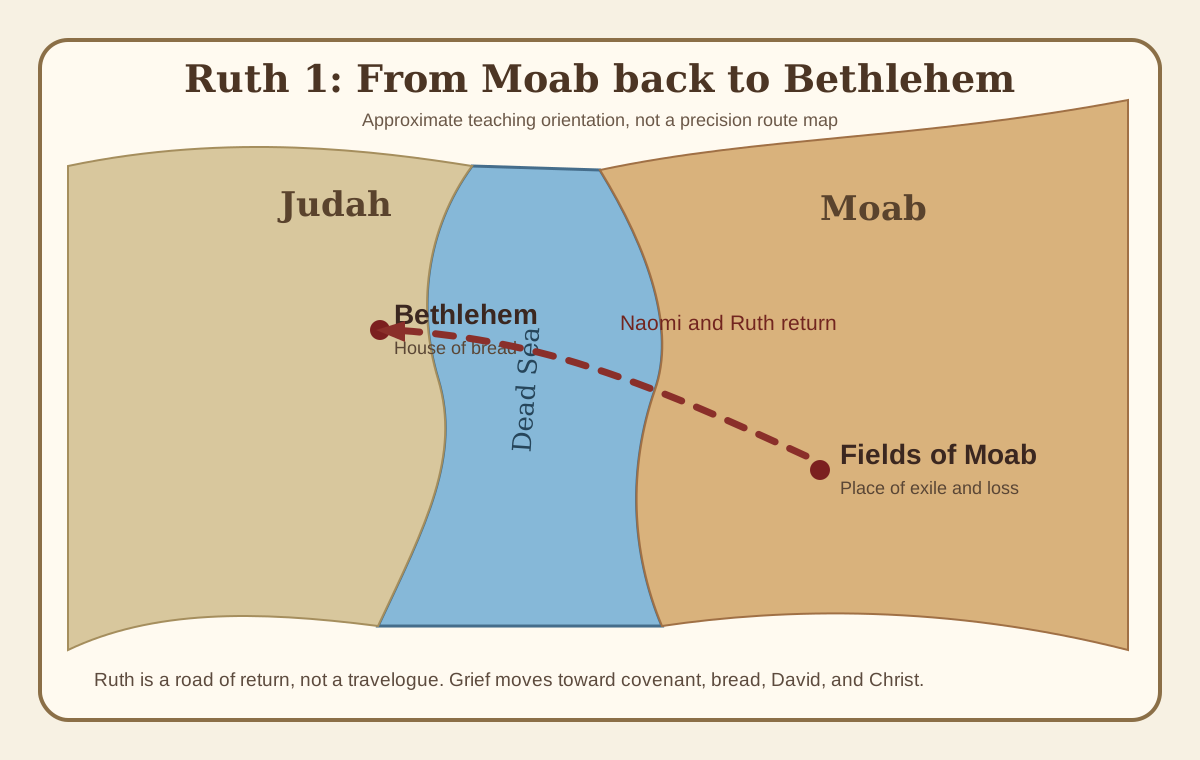 Source: Hermes original orientation map, 2026-06-19, reader-facing generated schematic. Approximate geography, not a precision archaeological route map.
The map places the famine migration and the return beside the Dead Sea. Its purpose is orientation: the story crosses between Moab and Judah, while the family’s losses and Ruth’s allegiance give the journey its meaning.
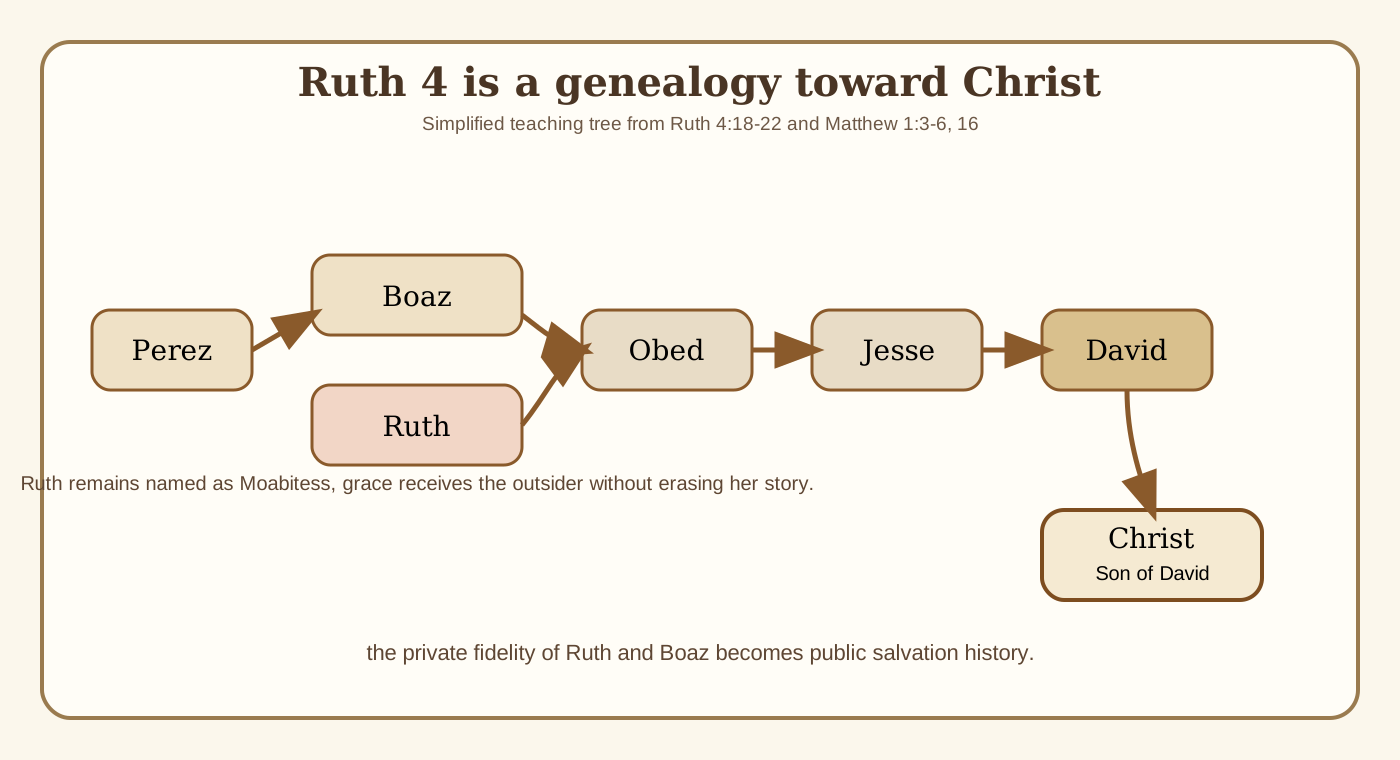 Source: Hermes original genealogy chart, 2026-06-19, reader-facing generated schematic based on Ruth 4:18-22 and Matthew 1:3-6, 16.
The chart connects the family restored in Ruth with David and the genealogy of Christ. The two biblical lists carry the connection; the image gives it a visible form. Maps and diagrams are orientation aids rather than icons. A Tree of Jesse icon, considered in the Ruth 4 study, belongs to a different visual tradition in which ancestry is contemplated in relation to the Incarnation.
Summary Table
| Scene or promise | What changes in the story | Christian horizon |
|---|---|---|
| The road and the news of bread | Return becomes possible before grief is healed | God’s visitation calls us toward hope |
| The field | A poor widow receives food and protection | Communion with Christ bears fruit in care for the hungry |
| The threshing floor | A request for shelter becomes a commitment to act | Christ’s pure love protects rather than exploits |
| The gate | Responsibility becomes public and witnessed | The Redeemer truly shares our humanity |
| The child and the genealogy | A threatened household receives a future within Israel’s promise | Matthew names Ruth in the ancestry of the incarnate Son |
Spiritual Fruit 🍇
Return without disguising grief
Naomi arrives before she can speak hopefully about her life. When sorrow has made prayer difficult, her return offers a modest beginning: stand again before God and say what is true. A short prayer spoken through tears is better than staying away until feeling becomes respectable. For those accompanying the bereaved, Ruth offers the other side of this mercy. Stay near without explaining the death, demanding gratitude, or using future hope to silence present pain.
Make mercy dependable
Boaz’s field exposes the weakness of sympathy that leaves conditions unchanged. In a household or parish, a person can be praised for endurance while still having no food, transport, safe work, or dependable companion. Mercy becomes structure when provision and protection are reliable enough to be trusted. One regular delivery, one clear safeguard, or one promise kept may serve a vulnerable person better than many admiring words. Authority becomes answerable to God in these details.
Receive belonging without pride
Ruth does not enter the story with the advantages of birth or security. Christ’s Church likewise lives from a gift no member can claim to have earned through family standing. Long familiarity with parish life can quietly become a sense of ownership. Ruth calls that pride into question. The newly arrived person needs more than permission to remain at the edge: someone must learn the name, share the work, and make room at the table without treating welcome as a favor owed back.
Serve without bargaining for an outcome
Ruth cannot foresee David or the Gospel genealogy. Her obligation is the woman beside her and the work before her. That protects service from becoming a bargain in which God must reward goodness with a visible success. Some faithful carers remain poor; some grieving families never receive an equivalent earthly restoration. Christ sees the love that remains faithful, and resurrection, not the reproduction of Ruth’s circumstances, is the Church’s final hope.
At Bethlehem’s edge, Naomi carries a grief she cannot yet interpret. Ruth remains beside her, and the harvest has begun. Later there will be grain for their table and a child in Naomi’s arms, but no command to forget the dead. Before Christ, we too may receive today’s mercy without pretending that every wound has closed.
Teaching Notes
Suggested timing for a 50-minute study
- Opening and historical context: 8 minutes.
- Geography and characters: 8 minutes.
- Four-place outline and bread, birth, and harvest: 18 minutes.
- Fathers, Christology, and worship: 7 minutes.
- Spiritual fruit and discussion: 9 minutes.
Discussion and pastoral care
- Ask: What can Ruth give Naomi that she cannot give herself, and what remains beyond Ruth’s power?
- Ask: Why does Boaz’s responsibility need to move from private intention to public witness?
- Watch for: promises that piety prevents bereavement or guarantees a restored family. The narrative describes God’s gift here, not a formula for every sufferer.
- Watch for: pressure to remain in unsafe relationships. Ruth’s allegiance is joined to truth and protection; it is not a general demand to endure exploitation.
- Connect: Hebrews 2:10-18 gives the foundation for the kinship comparison with Christ. Redemption is fulfilled through His real humanity, Cross, and Resurrection.
Accuracy and scope
- Emphasize: the four places are dominant settings, not the only locations in each chapter.
- Compress: detailed family-redemption and marriage customs here; reserve them for the chapter 3 and 4 studies.
- Watch for: turning the spring harvest frame into exact dates for marriage, conception, or birth.
- Watch for: treating Ambrose’s theological answer as the sole historical solution to the assembly restriction.
- Emphasize: the Nativity Paramoun Vespers and Psalm appointments are package-attested, not freshly Coptic Reader-confirmed.
- Avoid: expanding Jerome’s Isaiah comparison into a conjectured translation or manuscript history.
Visual teaching aids
- Show: use the map for the relation of Moab and Judah, without tracing an exact route.
- Show: use the genealogy chart as orientation, then let Ruth 4 unfold the meaning of the ending.
- Show: reserve the Tree of Jesse icon for the chapter 4 genealogy discussion.
- Avoid: calling Western biblical paintings, manuscript illustrations, or original diagrams Orthodox icons without a basis in their actual tradition.
Glossary
- Gleaning: gathering grain left after the main harvest, with access for the poor and stranger protected by Torah.
- Kinsman-redeemer: a near relative with responsibilities involving family property and its future; Ruth brings these duties together with marriage and preservation of a name.
- Hesed: a Hebrew word for kindness or loyal love. In Ruth, its meaning is disclosed by care that accepts responsibility, rather than by a single English formula.
- Levirate marriage: the duty in Deuteronomy 25:5-10 by which a deceased man’s brother provides for the continuation of his name. Ruth’s situation is related but not identical: Boaz is a kinsman, not Ruth’s late husband’s brother.
- Typology: reading earlier scriptural persons and events in relation to their fuller fulfillment in Christ, while preserving their own historical meaning.
- Paramoun: the preparatory observance before the Nativity or Theophany feast; the appointment named here is specifically Nativity Paramoun Vespers.
Translation and Source Notes
Embedded Scripture is from Brenton’s English Septuagint (LXX). New Testament connections are cited by reference; the Greek comparison uses the CCAT Rahlfs-based electronic text. Ambrose’s argument is paraphrased from his Latin text, with section 3.30 confirmed in the printed French edition listed below. Jerome’s Isaiah comparison concerns the form he cites, which differs from Brenton.
Sources
Scripture and verified sources used
- Ruth, Brenton Septuagint; Matthew 1:1-17; Matthew 23:37; Matthew 2:6; Hebrews 2:11-17; Luke 1:68; Acts 2.
- Moab’s background: Genesis 19:30-38; Numbers 22-25; Deuteronomy 23:3-6.
- Gleaning and harvest: Leviticus 19:9-10; 23:10-17, 22; Deuteronomy 16:9-10; Deuteronomy 24:19-22. Marriage background: Deuteronomy 25:5-10.
- Bethlehem and covering: Micah 5:2; Ezekiel 16:8.
- St John Chrysostom, Homilies on the Gospel of Matthew, 3.5, NPNF First Series, vol. 10.5
- St Ambrose, Exposition of the Gospel according to Luke, 3.30; Latin text and Gabriel Tissot’s French translation, Traité sur l’Évangile de S. Luc, Sources Chrétiennes 45, printed pp. 136-137.1
- St Jerome, Letter 53 to Paulinus, 8, NPNF Second Series, vol. 6; Brenton, Isaiah 16:1.6
- CCAT Rahlfs-based Greek Ruth; Hebrew wing/garment forms and lexical meanings.4
- @andraws/lectionary-data 1.3.1, Coptic lectionary and Synaxarium; the feast comparisons here use the recorded Psalm and Gospel appointments, with the confirmation limit stated above.7
- Jewish Shavuot custom, included as comparative history, not Coptic practice.3
Further reading, not sources used for this revision
Robert L. Hubbard Jr., The Book of Ruth, New International Commentary on the Old Testament.
Edward F. Campbell Jr., Ruth, Anchor Bible.
Daniel I. Block, Judges, Ruth, New American Commentary.
Katharine Doob Sakenfeld, Ruth, Interpretation.
Footnotes
-
St Ambrose, Exposition of the Gospel according to Luke, Book 3, section 30, Latin text. Section confirmed in Gabriel Tissot, trans., Traité sur l’Évangile de S. Luc, Sources Chrétiennes 45 (1956), printed pp. 136-137. English here is paraphrase, not a published translation quotation. ↩ ↩2 ↩3
-
Matthew 1:5; Greek interlinear presentation of Matthew 1. Matthew names Rahab; Ruth 4:21 does not. ↩
-
“Reading Megillat Ruth on Shavuot”, witness to the Jewish custom, not to a Coptic appointment. ↩ ↩2
-
Ruth 2:12; 3:9, CCAT Rahlfs-based Greek; Hebrew Ruth 2 and Ruth 3; BDB, “kanaph”; LSJ, “pterygion”, garment flap/fold at Ruth 3:9. ↩ ↩2
-
St John Chrysostom, Homilies on the Gospel of Matthew, Homily 3, section 5, NPNF First Series, vol. 10. Direct Ruth paragraph; parallel NPNF mirror. The quotation concerns Boaz’s reception of Ruth and Christ’s reception of the Church. ↩ ↩2 ↩3
-
St Jerome, Letter 53 to Paulinus, section 8, NPNF Second Series, vol. 6; Brenton, Isaiah 16:1. The forms of Isaiah differ; the precise historical mechanism is not established here. ↩ ↩2
-
@andraws/lectionary-data 1.3.1, reverse lectionary index and Synaxarium. The Nativity Paramoun Vespers Gospel and Annunciation/second-Sunday-of-Kiahk Psalm appointments derive from its public-current-practice references. Their underlying dated witnesses include Nativity Paramoun, Annunciation, and second Sunday of Kiahk. Qualified Coptic Reader confirmation of these particular appointments remains pending. Psalm 45:10-11 corresponds to Brenton LXX 44:11-12. ↩ ↩2 ↩3 ↩4