


This narration is from a previous version of the study and may include a combined recording of multiple chapters.
Ruth 2 moves from the road of return to the field of mercy. Ruth, a Moabite widow with no security, goes to glean, and by what the text calls chance she comes to the field of Boaz. Yet the chapter teaches that providence often hides inside ordinary obedience: Ruth works, Boaz notices, the vulnerable are protected, and bread begins to answer bitterness.
The spiritual force of the chapter is practical mercy. Boaz does not only feel kindly toward Ruth. He creates conditions where the poor foreign widow can gather food safely. In Christian terms, mercy becomes structure, and the field becomes an icon of what the Church must be.
Lesson Guide
- Key phrases: providence disguised as chance; practical protection; Boaz uses authority to protect.
- Emphasize: Ruth’s humility and Boaz’s righteous authority belong together.
- Avoid: reducing the chapter to romance or charity from above.
Historical and Scriptural Context
Ruth 2 follows Naomi’s bitter return to Bethlehem at the beginning of barley harvest. The timing matters. Ruth and Naomi have no obvious means of support, but Israel’s law had already made provision for people like them. Leviticus 19:9-10 and 23:22 reserve gleanings for the poor and the stranger. Deuteronomy 24:19-22 includes the orphan and widow, and grounds this care in Israel’s memory of slavery in Egypt.
Gleaning means gathering grain left behind after the reapers. Ruth enters a field where that command must become food she can actually gather. A landowner’s obedience affects her body: whether she eats, whether she can drink, whether anyone drives her away. Boaz’s generosity will go beyond leaving the edges of his field untouched, but it grows from the mercy already commanded to Israel.
Geographical Significance ⛰️
The field is the chapter’s main geography. It is not named as a sacred site, yet it becomes holy by obedience. Ruth’s survival depends on how the field is governed. A field can be a place of exploitation, harassment, and humiliation, or it can become a place where mercy has been organized.
Bethlehem remains important. Ruth is no longer on the road from Moab, but she is not yet secure at home. The field is the transition space between return and redemption.
The Characters 👥
Ruth
Ruth takes initiative. She asks Naomi permission to glean and enters the field as a poor foreign widow. Her humility is not passivity. She works hard, receives kindness with gratitude, and carries food home.
Naomi / Noemin
Naomi is absent from the field, but present in the meaning of everything Ruth does. Ruth’s work is for both of them. Naomi begins to interpret mercy again when she hears Boaz’s name.
Boaz / Booz
Brenton gives Boaz as Booz. He is introduced as a mighty man connected to Elimelech’s family. His resources give him the power to help, and his conduct shows how he uses that power. His first words bless the workers: “The Lord be with you.”
Matthew 1:5 identifies Boaz as Rahab’s son. Matthew thus lets a Christian reader place Rahab’s reception by faith beside Ruth’s reception in Boaz’s field. Ruth does not tell us that memories of his mother motivated Boaz; the relationship belongs to the Gospel’s genealogy, not to an explanation of his unspoken thoughts.
The reapers and overseer
They show the social world around Ruth. Boaz’s command matters because vulnerable women in fields could easily be shamed, excluded, or harmed. The overseer also testifies to Ruth’s diligence.
Ruth goes to glean (Ruth 2:1-3)
1 And Noemin had a friend an acquaintance of her husband, and the man was a mighty man of the kindred of Elimelech, and his name was Booz. 2 And Ruth the Moabitess said to Noemin, Let me go now to the field, and I will glean among the ears behind the man with whomsoever I shall find favour: and she said to her, Go, daughter. 3 And she went; and came and gleaned in the field behind the reapers; and she happened by chance to come on a portion of the land of Booz, of the kindred of Elimelech.
Boaz is introduced before Ruth meets him. The reader already knows that a man connected to Elimelech’s family lives near Naomi’s emptiness. Ruth does not yet know whose field will receive her. She asks permission to work behind someone with whom she may find favor, then goes out to gather food.
Verse 3 says she “happened by chance” to come to Boaz’s portion. Her ordinary search for grain brings her into the household connection that will later matter for redemption. Providence becomes visible through the story’s unfolding, without canceling her labor or turning every accident into a message that we can decipher at once.
Ruth’s allegiance to Naomi’s God has brought her to Bethlehem; it has not removed her poverty. She still needs someone to let her work. Faith can be costly before its fruit is visible. The field begins to show that her foreign origin will not prevent her reception among God’s people.
Boaz notices the stranger (Ruth 2:4-7)
4 And, behold, Booz came from Bethleem, and said to the reapers, The Lord be with you: and they said to him, The Lord bless thee. 5 And Booz said to his servant who was set over the reapers, Whose is this damsel? 6 And his servant who was set over the reapers answered and said, It is the Moabitish damsel who returned with Noemin out of the land of Moab. 7 And she said, I pray you, let me glean and gather among the sheaves after the reapers: and she came and stood from morning till evening, and rested not even a little in the field.
Boaz arrives blessing: “The Lord be with you.” His workers answer, “The Lord bless thee.” Their labor is spoken of in God’s presence. That greeting will be tested by what happens to the stranger standing among them.
His question, “Whose is this damsel?”, asks about Ruth’s household connection. The overseer identifies her as the Moabite woman who returned with Naomi. He also reports her request and her work. Boaz learns both where she came from and what she has been doing; her foreignness remains visible, but so does her faithfulness.
The displayed Brenton text describes strenuous labor with scarcely any rest. Ruth’s diligence belongs to this particular account, not to a rule that hungry people must prove themselves worthy before receiving protection. Boaz’s prohibition against touching or shaming her will guard her dignity as a person.
The Church’s Voice in Worship ⛪
At the opening of the Coptic anaphora, the Eucharistic thanksgiving, the priest says, “The Lord be with you all,” and the congregation answers, “And with your spirit.”1 The related greeting in Ruth 2:4 lets the reader hear work and worship together: invoking God’s presence bears consequences for how we treat the people before us. The workers’ actual answer is a blessing, not the liturgical response, and the resemblance does not establish that the anaphora dialogue came from Ruth.
Boaz protects and provides (Ruth 2:8-16)
8 And Booz said to Ruth, Hast thou not heard, my daughter? go not to glean in another field; and depart not thou hence, join thyself here with my damsels. 9 Let thine eyes be on the field where my men shall reap, and thou shalt go after them: behold, I have charged the young men not to touch thee: and when thou shalt thirst, then thou shalt go to the vessels, and drink of that which the young men shall have drawn. 10 And she fell upon her face, and did reverence to the ground, and said to him, How is it that I have found grace in thine eyes, that thou shouldest take notice of me, whereas I am a stranger?
11 And Booz answered and said to her, It has fully been told me how thou hast dealt with thy mother-in-law after the death of thy husband; and how thou didst leave thy father and thy mother, and the land of thy birth, and camest to a people whom thou knewest not before. 12 The Lord recompense thy work: may a full reward be given thee of the Lord God of Israel, to whom thou hast come to trust under his wings. 13 And she said, Let me find grace in thy sight, my lord, because thou hast comforted me, and because thou hast spoken kindly to thy handmaid, and behold, I shall be as one of thy servants.
14 And Booz said to her, Now it is time to eat; come hither, and thou shalt eat of the bread, and thou shalt dip thy morsel in the vinegar: and Ruth sat by the side of the reapers, and Booz handed her meal, and she ate, and was satisfied, and left.
15 And she rose up to glean; and Booz charged his young men, saying, Let her even glean among the sheaves, and reproach her not. 16 And do ye by all means carry it for her, and ye shall surely let fall for her some of that which is heaped up; and let her eat, and glean, and rebuke her not.
Boaz calls Ruth “my daughter” and gives her a place with his women workers. He provides water already drawn by the young men and explicitly forbids them to touch her. At the meal he seats her beside the reapers and hands her food. Afterward he commands that she may glean among the sheaves, with extra grain left for her and no rebuke. Each instruction removes a particular danger or obstacle.
His blessing and his orders belong together. He prays for the Lord to reward Ruth, then uses what is in his hands to shelter her. Authority becomes righteous through such decisions: who has access to water, who can eat without humiliation, whose misconduct is forbidden, and whether the prohibition is enforced. A parish that speaks tenderly to the vulnerable while tolerating harassment contradicts the welcome it proclaims.
Ruth bows to the ground and asks why he has noticed her, “whereas I am a stranger?” Boaz answers with her loyalty to Naomi and her departure from parents and homeland. He recognizes what her allegiance has cost. His reception of the Moabite widow can be set beside Matthew’s identification of him as Rahab’s son, without assigning him a motive the narrative never states.
Language insight: “under his wings”
In verse 12 the Greek phrase “ὑπὸ τὰς πτέρυγας αὐτοῦ” means “under His wings.” The image is God’s shelter, not merely the promise of a successful harvest. It also prepares for Ruth 3:9, where Ruth asks Boaz to spread his garment over her. Hebrew uses the same wing-or-garment word in both passages; the Greek keeps related terms, “πτέρυγας” for wings and “πτερύγιον” for the garment flap. Ruth will ask the man who blessed her with shelter to undertake the family responsibility through which that shelter can become lasting.
Christ Himself uses the wings image in Matthew 23:37, expressing His desire to gather Jerusalem’s children as a hen gathers her young. Boaz’s blessing leads a Christian reader toward the Lord whose shelter is personal and costly. Ruth’s departure from her former home is already an act of allegiance to Him, expressed now in work and care for Naomi.
Language insight: “was satisfied, and left”
Verse 14 can mislead an English reader: “and left” means that Ruth left food over, not that she departed. The Greek “κατέλιπεν” is clarified by verse 18, where she gives Naomi what remained from her meal. She receives enough to be satisfied and enough to share. The meal does not end her responsibility to Naomi; it gives her something to carry home.
This belongs beside the biblical pattern of food received with abundance remaining: Elisha’s barley loaves in 2 Kings 4:42-44, the satisfaction and fragments in Matthew 14:20, and the barley loaves and gathered leftovers in John 6:9-13. These are related acts of provision, not identical phrases or a claim that Boaz multiplied food. In the Gospel the sign leads toward Christ, the Bread of Life. Bread received from His mercy is never permission to forget another person’s hunger.
The Church’s Voice in Worship ⛪
The Agpeya’s Sixth Hour remembers Christ nailed to the Cross. Its psalms pray repeatedly for shelter beneath God’s wings: Psalm 57:1 (LXX 56:2), Psalm 61:4 (LXX 60:5), Psalm 63:7 (LXX 62:8), and Psalm 91:4 (LXX 90:4).2 They move from seeking refuge to dwelling in shelter and rejoicing beneath His wings. The worshipper prays related biblical words of refuge, rather than literally repeating Boaz’s blessing over Ruth. Remembering the Crucifixion while praying them lets the Christian contemplate the shelter of the Savior whose arms are stretched out for us.
Psalm 45:10-11 (LXX 44:11-12), with its call to leave one’s people and father’s house, also recalls Ruth’s costly departure. St John Chrysostom joins this psalm to Ruth and the Church in his Homilies on Matthew, Homily 3.5. The Coptic lectionary package records the psalm at the Annunciation and the second Sunday of Kiahk.3 Ruth’s allegiance can thus be heard beside the Church’s preparation to receive the incarnate Lord, without treating Ruth 2 as an appointed reading.
Ruth brings abundance home (Ruth 2:17-23)
17 So she gleaned in the field till evening, and beat out that she had gleaned, and it was about an ephah of barley.
18 And she took it up, and went into the city: and her mother-in-law saw what she had gleaned, and Ruth brought forth and gave to her the food which she had left from what she had been satisfied with. 19 And her mother-in-law said to her, Where hast thou gleaned to-day, and where hast thou wrought? blessed be he that took notice of thee. And Ruth told her mother-in-law where she had wrought, and said, The name of the man with whom I wrought to-day is Booz. 20 And Noemin said to her daughter-in-law, Blessed is he of the Lord, because he has not failed in his mercy with the living and with the dead: and Noemin said to her, The man is near akin to us, he is one of our relations. 21 And Ruth said to her mother-in-law, Yea, he said also to me, Keep close to my damsels, until the men shall have finished all my reaping.
22 And Noemin said to Ruth her daughter-in-law, It is well, daughter, that thou wentest out with his damsels; thus they shall not meet thee in another field. 23 And Ruth joined herself to the damsels of Booz to glean until they had finished the barley-harvest and the wheat-harvest.
Ruth works until evening, beats out the grain, and brings home about an ephah of barley. She also brings the food left from her own meal. Naomi receives both the harvest of Ruth’s labor and the surplus of Boaz’s hospitality. The day that began with an uncertain search ends with food placed before another widow.
Naomi asks who has taken notice of Ruth. Before learning his name she blesses him; after hearing it she recognizes the family connection. Her grief remains, but it no longer supplies the only account she can give of God. Where she had spoken of emptiness, she now speaks of mercy.
Language insight: “with the living and with the dead”
In verse 20 Naomi blesses Boaz “of the Lord” and speaks of one who “has not failed in his mercy with the living and with the dead.” The subject of that mercy can be understood as the Lord or Boaz. The wording allows both God’s continuing kindness and the kinsman’s faithful conduct to be heard; it should not be made to decide between them without qualification.
The immediate scene concerns Naomi and Ruth, together with the deceased family whose name and inheritance remain at stake. Kindness to the widows honors a household that death has wounded. Naomi’s recognition of near kin now opens the possibility of family redemption, beyond the provision of one day’s bread.
Christ’s words in Luke 20:38, that all live to God, give a further Christian horizon to this remembrance. In the Divine Liturgy the Church commemorates the departed before the Lord. That is a worshipful resonance with mercy that remembers the dead, not a doctrine of prayer for the departed established by this verse. Naomi’s family history is concrete; the Christian hope rests in the God of the living and in Christ’s victory over death.
Ruth remains with Boaz’s women through barley and wheat harvest. This is the spring harvest season broadly associated with Passover through the Feast of Weeks, as the firstfruits and counting laws in Leviticus 23:10-17 and Deuteronomy 16:9-10 help explain. The General Introduction develops that seasonal frame. Verse 23 dates Ruth’s gleaning, not every later event in the book or the conception and birth of Obed.
Gems from the Fathers 💎
St John Chrysostom reads Boaz’s reception of Ruth as an image of Christ receiving the Church. In Homilies on Matthew, Homily 3.5, he attends to precisely the facts this chapter makes visible: she is foreign, she is poor, and Boaz receives her without contempt.
For she was both of a strange race, and reduced to the utmost poverty, yet Boaz when he saw her neither despised her poverty nor abhorred her mean birth, as Christ having received the Church, being both an alien and in much poverty, took her to be partaker of the great blessings.4
The comparison turns the reader from admiration of Boaz toward gratitude to Christ. We enter His household as people in need of mercy. Neither respectable ancestry nor material security earns that reception. Ruth’s foreign origin is a fact of her story, not a moral fault; the Church drawn from the nations is received through the Bridegroom’s love.
St Ambrose, On Widows, chapter 6, section 33, draws attention to Naomi, supported through Ruth’s gleaning and companionship. He sees care given within a household returning as consolation in sorrow:
So that Naomi, deprived of her husband and her two sons, having lost the offspring of her fruitfulness, lost not the reward of her pious care, for she found both a comfort in sorrow and a support in poverty.5
Ruth brings home more than grain. Her loyalty gives Naomi companionship within bereavement. Such care is precious without becoming a promise that every faithful widow will receive the same outward relief.
Christological and Typological Reading
Boaz is a restrained type of Christ: his welcome, protection, and feeding point toward the Redeemer without making every action an allegory. Christ brings the stranger into His own Body and gives Himself as the Bread of Life. The field’s mercy prepares the Christian imagination to recognize a welcome far greater than permission to collect grain.
The Church receives that mercy before she extends it. At the Eucharist, gratitude for the Lord’s gift must deepen our willingness to share food, defend the vulnerable, and honor those who arrive without social standing. Ruth’s place beside the reapers gives visible form to belonging: a person once gathering behind others is now fed beside them. Our common life should bear witness to the Lord who has brought us near.
Iconography and Visual Teaching 🖼️
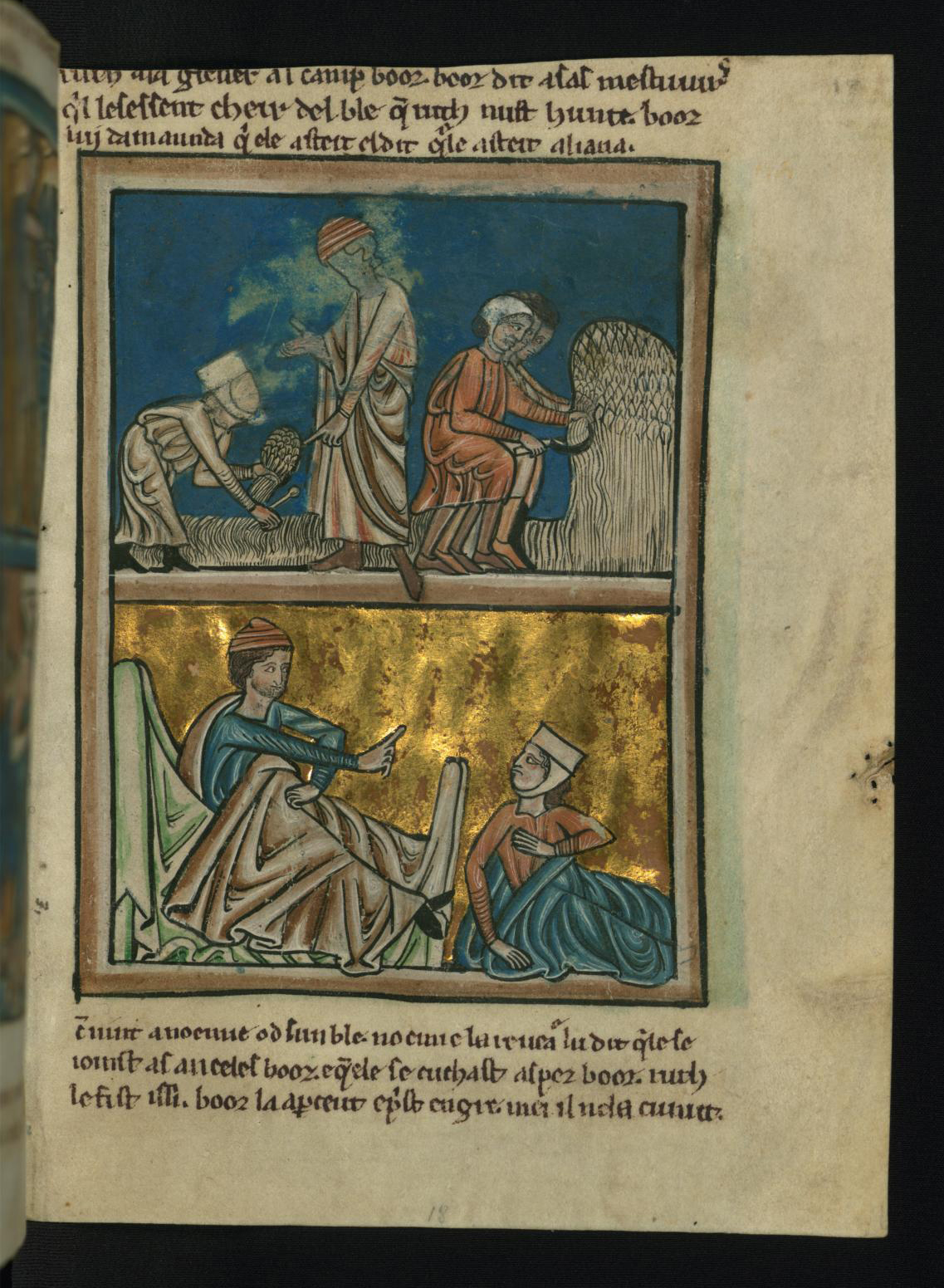 Source: William de Brailes, Ruth Meets Boaz as she gleans, Walters Art Museum manuscript leaf, public domain via Wikimedia Commons.
This Western manuscript illumination keeps the field visible: workers, grain, Ruth, and Boaz belong to one scene. Their proximity makes the chapter’s concrete relationships easier to see. The image accompanies Scripture; it does not establish details beyond the text.
Summary Table
| Element in Ruth 2 | Spiritual meaning | Fulfillment in Christ / the Church |
|---|---|---|
| Ruth gleans | Faithful work amid poverty | Those in need are received with dignity |
| Boaz notices and protects | Attention made effective through authority | Christ brings the stranger near; His people must guard the vulnerable |
| Refuge under God’s wings | Allegiance joined to shelter | Christ gathers His people; the Church prays for refuge |
| Ruth is satisfied and shares what remains | Provision carried home to another | The Bread of Life teaches gratitude and mercy |
| Naomi recognizes a kinsman | Grief begins to see continuing kindness | Hope remembers persons and households before God |
Spiritual Fruit 🍇
1. Work faithfully without demanding a sign
Ruth goes out to glean before she knows whose field will receive her. When tomorrow’s security is uncertain, her conduct gives us a sober form of trust: pray, seek honest work, accept help, and perform the duty already before you. Quiet providence need not be decoded at every step to be received with gratitude afterward.
2. Put protection into practice
Boaz’s care has enforceable words: the young men must not touch Ruth, and the workers must not shame her. Examine the authority entrusted to you at home, at work, or in parish service. A kind manner cannot excuse ignoring someone’s misconduct. Make it possible for a vulnerable person to speak, be believed, and receive practical protection. Mercy may require confronting the person whose behavior everyone else prefers to overlook.
3. Receive mercy without calling yourself worthless
Ruth bows in gratitude, yet Boaz honors her loyalty and gives her a place beside his workers. Humility receives a gift without denying the dignity of the one who receives it. If need has made you ashamed, let Christ’s reception of the Church correct that shame. Give thanks for help, and resist the thought that poverty makes you a burden whom God merely tolerates.
4. Carry something home
Ruth saves what remains of her meal for Naomi. Remember the person whose need is less visible because he or she stays at home: an elderly relative, a grieving friend, a sick parishioner. Set aside food, time, or a visit before convenience consumes what could have been shared. Gratitude becomes complete when another person receives its fruit.
5. Let mercy enter your account of God
Naomi can bless before all her losses are repaired. Her husband and sons remain dead, but Ruth returns with food and the name of a kinsman. Receive a present kindness without feeling obliged to pretend that grief has ended. Give thanks for the person through whom help has come, and commend both the living and the departed to the Lord. Hope can begin with a truthful blessing spoken through tears.
At evening the grain has been gathered and beaten out. Ruth carries it into the city, together with food saved for Naomi. A command given to workers, water shared with a stranger, and a place offered at a meal have reached this wounded home. Lord Jesus Christ, who received us in our poverty, let what we receive from You become mercy in another person’s hands.
Teaching Notes
Suggested timing for a 55-minute study
- Context and gleaning laws: 8 minutes.
- Ruth’s initiative, verses 1-3: 8 minutes.
- Boaz’s arrival and attention, verses 4-7: 8 minutes.
- Boaz’s protection and provision, verses 8-16: 18 minutes.
- Naomi’s recognition of mercy, verses 17-23: 7 minutes.
- Spiritual fruit and discussion: 6 minutes.
Ruth goes to glean (Ruth 2:1-3)
- Ask: How can Ruth’s work and God’s providence both be real in verse 3?
- Watch for: Treating “chance” as permission to claim that every coincidence has a decipherable divine meaning.
- Compress: Explain enough of the gleaning laws to make Ruth’s request intelligible, then return to the field.
Boaz notices the stranger (Ruth 2:4-7)
- Ask: How does the greeting between Boaz and his workers prepare us to hear his response to Ruth?
- Watch for: Inferring Boaz’s private motivation from Matthew’s naming of Rahab as his mother.
Ruth 2:8-16
- Ask: Which of Boaz’s instructions protects Ruth’s body, and which protects her dignity?
- Linger: Compare the blessing under God’s wings with the concrete help Boaz supplies.
- Watch for: Making protection conditional on a poor person’s productivity or gratitude.
- Clarify: Verse 14’s “and left” concerns food remaining; verse 18 supplies the explanation.
- Connect: The Sixth Hour psalms pray related refuge imagery. They do not literally repeat Boaz’s blessing, and the greeting at the anaphora is a resonance, not a demonstrated borrowing from Ruth.
Ruth 2:17-23
- Ask: What changes in Naomi’s speech, and what losses remain unchanged?
- Watch for: Resolving verse 20’s Lord-or-Boaz subject ambiguity by typological preference.
- Watch for: Treating mercy toward the dead as a direct proof of later liturgical doctrine, or making the harvest season the duration of the entire story.
Pastoral warnings
- Keep Ruth’s hunger and vulnerability concrete; avoid turning either woman into an abstract example.
- Do not let the lesson become political commentary. Keep the focus on Israel’s commanded mercy and its Christian fruit.
- Present the selected patristic reception readings without importing the adjacent anti-Jewish polemic in Chrysostom’s homily.
Visual teaching aids
- Show: Use the de Brailes manuscript illumination to keep the discussion tied to the field, workers, grain, and Ruth’s vulnerability.
- Ask: Where does mercy become concrete in the scene? Return each answer to an actual instruction in verses 8-16.
- Identify: This is Western biblical manuscript art, not an Orthodox icon or a source for unrecorded narrative details.
Glossary
- Gleaning: Gathering leftover grain after reapers, protected by Torah for the poor and stranger.
- Booz: Brenton’s LXX form of Boaz.
- Favor / grace: Unearned kindness received by Ruth as a stranger.
- Wings of the Lord: Biblical image of divine shelter and refuge.
- Providence: God’s hidden guidance through ordinary events.
Translation and Source Notes
- Embedded Scripture is from Brenton’s English Septuagint (LXX).
- Greek comparisons use the CCAT Rahlfs-based electronic Septuagint, not an independently collated critical apparatus. They clarify the preserved Brenton text without replacing it.
- Psalm citations give the NKJV numbering first and the verified Brenton LXX verse counterpart in parentheses. Superscriptions cause different verse offsets in the wing psalms.
- No reading from Ruth itself was found in the Coptic lectionary sources checked in @andraws/lectionary-data 1.3.1. The packaged Synaxarium lists no separate entry titled for Ruth, Boaz, Naomi, or Obed. This is a scoped finding, not a claim that Ruth is absent from every worship text.
- Sixth Hour and feast psalm placements are attested in that package; separate Coptic Reader confirmation of those specific lists and appointments remains pending. The opening anaphora greeting is verified in the cited St Basil service book, not from an ordinary-Liturgy Reader capture. The commemoration of the departed is used here as thematic resonance.
Sources
Ruth, Brenton Septuagint; preserved chapter text above.
Matthew 1:5; Matthew 23:37; Luke 20:38; 2 Kings 4:42-44; Matthew 14:20; John 6:9-13, for the genealogical, shelter, remembrance, and food-abundance comparisons.
Leviticus 19:9-10; 23:10-22; Deuteronomy 24:19-22; Deuteronomy 16:9-10, for gleaning and the harvest season.
St John Chrysostom, Homilies on the Gospel of Matthew, Homily 3.5, NPNF First Series, volume 10, direct text.
St Ambrose, On Widows, chapter 6, section 33, NPNF Second Series, volume 10, direct text.
CCAT Rahlfs-based Greek Ruth; Hebrew Ruth 2 interlinear, for the wing vocabulary, food remaining, and mercy language.
@andraws/lectionary-data 1.3.1, reverse lectionary index, daily-hours references, and Synaxarium, with the scope and authority limits stated above.
The Liturgy of St. Basil, Reference Book, Preparatory Edition, edited by Fr Abraam D. Sleman, Part III, “The Anaphora,” service book.
Agpeya, Sixth Hour, for the Cross remembrance and psalms of refuge; Psalm 57:1 (LXX 56:2), Psalm 61:4 (LXX 60:5), Psalm 63:7 (LXX 62:8), and Psalm 91:4 (LXX 90:4), with links to Brenton.
Robert L. Hubbard Jr., The Book of Ruth, NICOT; Edward F. Campbell Jr., Ruth, Anchor Bible; Katharine Doob Sakenfeld, Ruth, Interpretation, for further historical, philological, and literary study.
William de Brailes, Ruth Meets Boaz as she gleans, Walters Art Museum manuscript leaf, public domain, image record.
Footnotes
-
The Liturgy of St. Basil, Reference Book, Preparatory Edition, edited by Fr Abraam D. Sleman, Part III, “The Anaphora,” “The Lord Is With you,” service book. ↩
-
Agpeya, Sixth Hour; psalm placement attested in @andraws/lectionary-data 1.3.1, daily-hours references. The Sixth Hour litany remembers Christ nailed to the Cross; the psalms use the refuge image independently of Ruth. ↩
-
@andraws/lectionary-data 1.3.1 records Psalm 45:10-11 (LXX 44:11-12) at the Annunciation and the second Sunday of Kiahk. The Brenton counterpart is Psalm 45:10-11 (LXX 44:11-12). St John Chrysostom joins the psalm to Ruth in Homilies on Matthew 3.5, direct text. ↩
-
St John Chrysostom, Homilies on the Gospel of Matthew, Homily 3.5, NPNF First Series, volume 10, Ruth’s poverty and reception. ↩
-
St Ambrose, On Widows, chapter 6, section 33, NPNF Second Series, volume 10, Naomi and Ruth. ↩