


The promised son is about to be born, and Abraham is afraid enough to endanger his wife. After Sodom’s judgment, Genesis turns to a household that has received God’s word but still needs its conduct healed. The Lord protects Sarah, acknowledges Abimelech’s integrity, and gives Isaac at the appointed time. Then a child’s cry rises from the wilderness. The God who keeps His promise also hears that cry. Will receiving His gifts make us more truthful, grateful, and attentive to those whose lives touch ours?
From the threatened wife to the well of the oath
Genesis 17 named Sarah as the mother of Isaac; Genesis 18 renewed the promise within her hearing. After the judgment and rescue of Genesis 19, Abraham moves south and sojourns in Gerar. Chapter 20 recalls his earlier sister-wife strategy in Genesis 12. The repetition exposes an old fear surviving within a life of faith. Chapter 21 gives the promised birth, the painful separation of Hagar and Ishmael, and a public covenant with Abimelech.
Abimelech’s return at the end gives the two chapters a natural unity. The king first needs Abraham to tell the truth about Sarah; later he seeks an oath that Abraham will deal rightly with his descendants and country. Between those encounters, God gives life within the household and preserves life outside it. Genesis 22 will test Abraham’s trust in the very son whose birth is narrated here.
Brenton’s Abraam, Sarrha, Agar, Gerara, and Pharan correspond to Abraham, Sarah, Hagar, Gerar, and Paran. The explanation uses familiar spellings while preserving the biblical text. The Well of the Oath is the place commonly called Beersheba.
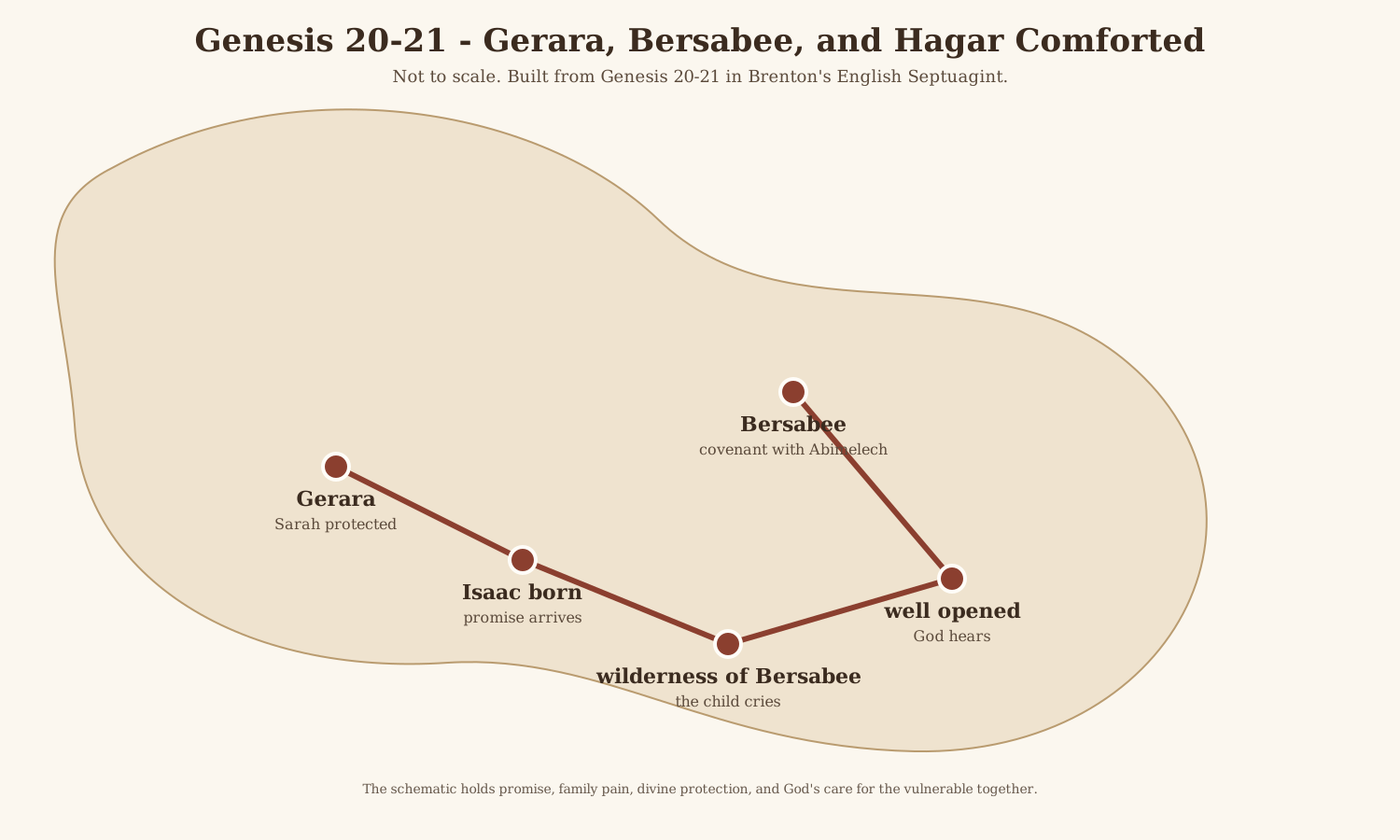 Source: teaching schematic from Genesis 20-21, Brenton’s Septuagint; not to scale.
God restrains harm and calls for restoration (Genesis 20:1-7)
1 And Abraam removed thence to the southern country, and dwelt between Cades and Sur, and sojourned in Gerara. 2 And Abraam said concerning Sarrha his wife, She is my sister, for he feared to say, She is my wife, lest at any time the men of the city should kill him for her sake. So Abimelech king of Gerara sent and took Sarrha. 3 And God came to Abimelech by night in sleep, and said, Behold, thou diest for the woman, whom thou hast taken, whereas she has lived with a husband. 4 But Abimelech had not touched her, and he said, Lord, wilt thou destroy an ignorantly sinning and just nation? 5 Said he not to me, She is my sister, and said she not to me, He is my brother? with a pure heart and in the righteousness of my hands have I done this. 6 And God said to him in sleep, Yea, I knew that thou didst this with a pure heart, and I spared thee, so that thou shouldest not sin against me, therefore I suffered thee not to touch her. 7 But now return the man his wife; for he is a prophet, and shall pray for thee, and thou shalt live; but if thou restore her not, know that thou shalt die and all thine.
Abraham fears that the men of the city may kill him to obtain Sarah, so he conceals their marriage. The danger becomes immediate when Abimelech takes her. God’s intervention protects Sarah from violation. Her place in the promise matters, but she is also a person whose bodily dignity cannot be surrendered to secure another person’s safety.
The dream begins with a terrifying warning: Abimelech faces death because the woman is married. Yet he has not touched her. He appeals to what Abraham and Sarah told him and to the purity of his heart and hands. God answers, “Yea, I knew.” Divine judgment distinguishes ignorance from deliberate wrongdoing. Abimelech’s integrity is acknowledged by God Himself, not merely claimed in his defense.
God also says that He restrained the king from touching Sarah. Innocent intention and divine protection stand together. Providence, God’s attentive care for His creatures, can reach us before we recognize the danger. When a warning or interruption prevents a harmful choice, thanksgiving belongs beside examination of conscience.
Knowledge now requires a response: return the wife. A person may enter an arrangement in good faith and later discover that it harms someone else. The original intention cannot justify continuing it. Abimelech must release Sarah rather than rest in the assurance that he meant no harm.
God names Abraham a prophet and appoints his prayer for the king’s healing. A prophet is God’s servant entrusted with His word; here his ministry includes intercession, prayer for another. The title gives Abraham responsibility, not immunity from correction. The man who brought danger is still called to pray for those affected. Grace sustains his vocation while exposing the failure that contradicts it.
Sarah’s restoration must accompany the prayer. We cannot ask Christ to heal a relationship while insisting that its harmful arrangement remain unchanged. Correcting a lie and relinquishing an unjust claim can be the first acts of a person learning to intercede honestly.
The fearful excuse meets truthful repair (Genesis 20:8-18)
8 And Abimelech rose early in the morning, and called all his servants, and he spoke all these words in their ears, and all the men feared exceedingly. 9 And Abimelech called Abraam and said to him, What is this that thou hast done to us? Have we sinned against thee, that thou hast brought upon me and upon my kingdom a great sin? Thou hast done to me a deed, which no one ought to do. 10 And Abimelech said to Abraam, What hast thou seen in me that thou hast done this? 11 And Abraam said, Why I said, Surely there is not the worship of God in this place, and they will slay me because of my wife. 12 For truly she is my sister by my father, but not by my mother, and she became my wife. 13 And it came to pass when God brought me forth out of the house of my father, that I said to her, This righteousness thou shalt perform to me, in every place into which we may enter, say of me, He is my brother. 14 And Abimelech took a thousand pieces of silver, and sheep, and calves, and servants, and maid-servants, and gave them to Abraam, and he returned him Sarrha his wife. 15 And Abimelech said to Abraam, Behold, my land is before thee, dwell wheresoever it may please thee. 16 And to Sarrha he said, Behold, I have given thy brother a thousand pieces of silver, those shall be to thee for the price of thy countenance, and to all the women with thee, and speak the truth in all things. 17 And Abraam prayed to God, and God healed Abimelech, and his wife, and his women servants, and they bore children. 18 Because the Lord had fast closed from without every womb in the house of Abimelech, because of Sarrha Abraam’s wife.
Abimelech rises early, gathers his servants, and communicates the warning. Their fear contrasts with Abraham’s assumption that the place has no worship of God. The king asks what Abraham has done to them and what he has seen in Abimelech to justify it. God’s correction reaches the chosen man through someone whose conscience he had discounted.
Abraham admits his fear of murder and explains that Sarah is his father’s daughter, though not his mother’s. Their arrangement began when God brought him from his father’s house: this is an established strategy. Its partial factual basis does not remove its deceptive purpose. Saying that Sarah is his sister conceals the relationship Abimelech needs to know. Truthfulness concerns what another person is being led to believe, not only whether each sentence can be defended separately.
The chapter overturns Abraham’s sweeping judgment about Gerar. Abimelech listens, fears, restores, and rebukes a deed no one ought to do. Religious belonging cannot replace evidence about a neighbor. The person we presumed godless may be the one who asks us to act justly.
Language insight: “This righteousness” and “speak the truth”
Abraham calls the requested sister claim “This righteousness” in verse 13. The phrase belongs to his account of the favor requested from Sarah, not the narrator’s endorsement of concealment. Brenton also uses righteousness for Abimelech’s hands in verse 5 and his fair dealing in Genesis 21:23. Context distinguishes the claims. Labeling an act loyal or righteous cannot settle whether it deals truthfully with another person.
Verse 16 addresses Sarah with the difficult expression “the price of thy countenance,” then ends, “speak the truth in all things.” The silver belongs to the king’s public response alongside restoring Sarah and offering Abraham a place to dwell. The precise force of the expression about her countenance remains difficult; it should not be made into an instruction that she must conceal herself. The wording preserves compensation and an admonition about truth, not permission to buy a woman’s dignity.
The king offers substantial gifts, including enslaved persons within the ancient household order. These gifts are recorded, not prescribed as Christian repair. Returning Sarah is the indispensable act. His generosity does not make Abraham’s strategy wise; grace has prevented its feared consequences from becoming catastrophe.
Abraham prays, and God heals the household. The narrator identifies a particular divine restraint: its wombs had been closed because of Sarah, Abraham’s wife. This knowledge concerns this episode. A couple’s inability to conceive cannot be diagnosed as evidence of hidden guilt. Here healing restores life after the threatened violation has been stopped.
Abimelech needs Abraham’s prayer; Abraham has needed Abimelech’s rebuke. Receiving correction and praying for the person who corrected us can become one act of humility. We seek the other’s good while relinquishing the story that we alone possess it.
The Lord gives Sarah a new laughter (Genesis 21:1-8)
1 And the Lord visited Sarrha, as he said, and the Lord did to Sarrha, as he spoke. 2 And she conceived and bore to Abraam a son in old age, at the set time according as the Lord spoke to him. 3 And Abraam called the name of his son that was born to him, whom Sarrha bore to him, Isaac. 4 And Abraam circumcised Isaac on the eighth day, as God commanded him. 5 And Abraam was a hundred years old when Isaac his son was born to him. 6 And Sarrha said, The Lord has made laughter for me, for whoever shall hear shall rejoice with me. 7 And she said, Who shall say to Abraam that Sarrha suckles a child? for I have born a child in my old age. 8 And the child grew and was weaned, and Abraam made a great feast the day that his son Isaac was weaned.
The opening sentence repeats the bond between God’s speech and action: the Lord visited Sarah as He said, and did to Sarah as He spoke. “Visited” describes His effective, gracious regard. The promise becomes a child conceived, born, named, circumcised, nursed, and weaned. God’s word enters the bodily work and ordinary days of family life.
“At the set time” places the birth under the promise rather than Abraham’s ingenuity. His fearful scheme could not secure it. God preserves Sarah and gives Isaac; Abraham answers by naming and circumcising the child as commanded in Genesis 17. The gift carries a responsibility to obey.
Sarah now names the Lord as the source of her laughter. In Genesis 18 she laughed inwardly and denied it in fear; here she speaks openly and expects others to rejoice with her. Gratitude has become shareable. Her astonishment is tender and bodily: who would have announced that Sarah would nurse a child? She is a mother suckling her son, not an abstract illustration of promise.
Hebrews 11:11-12 remembers Sarah’s faith in the One who promised. Her whole history lets us see faith formed through exposure, waiting, and fulfillment. Christ can heal distrust; our failure need not become the only story we tell about ourselves.
Sarah received a particular promise. Her story does not guarantee conception to every faithful couple or make parenthood the measure of a woman’s fulfillment before God. Those grieving infertility deserve companionship without predictions He has not given. Christian hope rests in the Lord who gives communion with Himself and life beyond death, even when an earthly petition remains unanswered.
Luke 2:21 records the Saviour’s circumcision and naming on the eighth day. Colossians 2:11-13 carries this covenant history toward circumcision without hands, burial and rising with Christ in baptism, and forgiveness. Christians receive fulfillment in the Lord who makes us alive with Him, rather than repeating Isaac’s bodily sign as a condition of belonging.
Gems from the Fathers 💎: Promise and baptismal birth
St. John Chrysostom, explaining Romans 9:6-9 in Homily XVI, distinguishes God’s effective promise from ordinary bodily possibility, then turns to baptism: “Since in the pool of water it is the words of God which generate and fashion us. For it is by being baptized into the Name of the Father and of the Son and of the Holy Ghost that we are gendered.”1 “Gendered” means begotten or brought to birth. Sarah truly bears Isaac; the divine promise makes this birth possible.
The comparison gives the Church grounds for gratitude and repentance. Ancestry, reputation, and exertion cannot manufacture baptismal life. God brings us into communion with Christ; confession, fasting, mercy, and the Eucharist nourish our faithful response. Abraham’s feast celebrates a real gift, while the next scene reveals wounds still needing care. Thanksgiving should deepen attention to those beside the feast.
The promised heir and the son still loved (Genesis 21:9-13)
9 And Sarrha having seen the son of Agar the Egyptian who was born to Abraam, sporting with Isaac her son, 10 then she said to Abraam, Cast out this bondwoman and her son, for the son of this bondwoman shall not inherit with my son Isaac. 11 But the word appeared very hard before Abraam concerning his son. 12 But God said to Abraam, Let it not be hard before thee concerning the child, and concerning the bondwoman; in all things whatsoever Sarrha shall say to thee, hear her voice, for in Isaac shall thy seed be called. 13 And moreover I will make the son of this bondwoman a great nation, because he is thy seed.
Sarah sees Hagar’s son “sporting with Isaac her son” and demands their removal. Her stated reason concerns inheritance: the bondwoman’s son must not inherit with Isaac. “Bondwoman” names Hagar’s enslaved condition, which exposes her to decisions made by others. Abraham finds the demand very hard “concerning his son.” Ishmael is his child, not an inconvenient arrangement.
Brenton’s “sporting with Isaac” does not specify the acts a reader might imagine as bullying. Galatians 4:29 interprets the earlier conflict as persecution of the one born according to the Spirit by the one born according to the flesh. Paul’s apostolic reading gives a further covenantal understanding; it cannot justify inventing what Ishmael said or did. Genesis’ recorded dispute concerns the heir.
God Himself tells Abraham to heed Sarah, grounding the instruction in His promise: the covenant line will be called through Isaac. Verse 13 immediately promises a great nation from Hagar’s son because he too is Abraham’s seed. Election, God’s choosing for a purpose, does not exhaust His care.
The instruction belongs to this disclosed covenant purpose. It makes neither every future demand of Sarah binding nor abandonment of a child acceptable for parents and parishes. Abraham’s distress and God’s promise preserve Ishmael’s identity as a son. Our responsibility for children remains protection and provision through family conflict. The next scene directs us toward God’s attention to an endangered mother and child, rather than furnishing an excuse to look away or exclude a single mother.
Galatians 4:21-31 develops a specific contrast: Hagar corresponds to Sinai and the present Jerusalem in bondage; the free Jerusalem above is the mother of believers, who are children of promise. Paul resists making subjection to the law the basis of their inheritance. Typology reads earlier persons and events as figures within God’s later saving work. Their further meaning never abolishes their humanity or licenses contempt for Jewish people or Hagar’s descendants.
Gems from the Fathers 💎: Isaac’s unique place without erasing Ishmael
In Homily XXV on Hebrews 11:17-19, Chrysostom explains why Isaac can be called “only-begotten” although Ishmael exists. He asks, “What then? Of whom was Ishmael sprung?” and answers that the description applies “so far as relates to the word of the promise.”2 Isaac’s unique place concerns the promise, not denial of Abraham’s other son.
This prepares us for Genesis 22. Abraham cannot offer Isaac while assuming Ishmael will simply replace him as the promised heir. The gift through which God pledged the future will be entrusted to Him again. Here we learn to distinguish one child’s vocation without turning another child into someone worthless.
God hears from the place where the child is (Genesis 21:14-21)
14 And Abraam rose up in the morning and took loaves and a skin of water, and gave them to Agar, and he put the child on her shoulder, and sent her away, and she having departed wandered in the wilderness near the well of the oath. 15 And the water failed out of the skin, and she cast the child under a fir tree. 16 And she departed and sat down opposite him at a distance, as it were a bow-shot, for she said, Surely I cannot see the death of my child: and she sat opposite him, and the child cried aloud and wept. 17 And God heard the voice of the child from the place where he was, and an angel of God called Agar out of heaven, and said to her, What is it, Agar? fear not, for God has heard the voice of the child from the place where he is. 18 Rise up, and take the child, and hold him in thine hand, for I will make him a great nation. 19 And God opened her eyes, and she saw a well of springing water; and she went and filled the skin with water, and gave the child drink. 20 And God was with the child, and he grew and dwelt in the wilderness, and became an archer. 21 And he dwelt in the wilderness, and his mother took him a wife out of Pharan of Egypt.
Abraham sends Hagar away with loaves and a skin of water. Soon the water is gone. Provision at departure has not secured life in the wilderness. Hagar places the child under a fir tree and sits a bow-shot away because she cannot bear to see his death. The account lets us hear despair without demanding a performance of composure.
Verse 14 says Abraham put the child on her shoulder. This sits awkwardly beside the earlier chronology: Genesis 17:25 presents Ishmael as thirteen before Isaac’s birth, and this separation follows Isaac’s weaning. We must preserve the Septuagint’s wording without silently making him an infant or replacing it with another translation’s arrangement of the bread and water. The passage does not explain the carrying. Exhaustion is a possible inference, not a fact supplied by the text.
Brenton identifies the one who cries aloud and weeps as the child. Hagar’s grief is unmistakable, but the cry in verse 16 belongs to Ishmael. Twice verse 17 stresses where God hears him: from the place where he is. Distance from Abraham and exclusion from the household have not put him beyond divine attention.
The angel addresses Hagar by name and tells her not to fear because God has heard. Reassurance rests on His action before hers. She is told to rise, take the child, and hold him; the promised nation gives him a future beyond the death she anticipates. God’s word renews her capacity to care when she can no longer see how care could save him.
God opens her eyes to a well of springing water. The emphasis falls on restored sight, rather than a statement that a new well has just been created. Hagar goes, fills the skin, and gives the child drink. Mercy reaches a thirsty body. Christian prayer for a frightened family belongs with food, safe accommodation, medical care, or responsible help obtaining them.
The ending extends mercy beyond rescue. God is with the child; he grows and becomes an archer. His mother takes him a wife “out of Pharan of Egypt,” Brenton’s geographical wording. Ishmael receives maturity and a family future under God’s care, rather than surviving merely as evidence that Isaac has been distinguished.
Gems from the Fathers 💎: Water given to the perishing
St. Gregory of Nyssa reads this rescue in On the Baptism of Christ, a sermon for the Day of the Lights, the celebration of Christ’s baptism. Among scriptural figures of baptism he says, “Behold, then, a sacramental type: how from the very first it is by the means of living water that salvation comes to him that was perishing”.3 A sacramental type is an earlier saving event disclosing something of the life God gives through a sacrament.
His surrounding paragraph allegorizes Hagar as the synagogue, accounts for Sarah’s anger from a lawful wife’s position, and calls Ishmael a babe. These are features of Gregory’s exposition, not a modern protest against the household or a solution to its chronological tension. We receive the baptismal insight without importing contempt for Jewish people: water saves the perishing.
Earlier in the sermon Gregory attributes baptism’s gift to God’s command and the visitation of the Spirit, rather than water acting independently. His interpretation leads to Christ, who enters the Jordan and grants renewal through water and the Spirit. Remembering baptism should make another person’s thirst harder to ignore.
Truth, water, and worship before the neighbors (Genesis 21:22-34)
22 And it came to pass at that time that Abimelech spoke, and Ochozath his friend, and Phichol the chief captain of his host, to Abraam, saying, God is with thee in all things, whatsoever thou mayest do. 23 Now therefore swear to me by God that thou wilt not injure me, nor my seed, nor my name, but according to the righteousness which I have performed with thee thou shalt deal with me, and with the land in which thou hast sojourned. 24 And Abraam said, I will swear. 25 And Abraam reproved Abimelech because of the wells of water, which the servants of Abimelech took away. 26 And Abimelech said to him, I know not who has done this thing to thee, neither didst thou tell it me, neither heard I it but only to-day. 27 And Abraam took sheep and calves, and gave them to Abimelech, and both made a covenant. 28 And Abraam set seven ewe-lambs by themselves. 29 And Abimelech said to Abraam, What are these seven ewe-lambs which thou hast set alone? 30 And Abraam said, Thou shalt receive the seven ewe-lambs of me, that they may be for me as a witness, that I dug this well. 31 Therefore he named the name of that place, The Well of the Oath, for there they both swore. 32 And they made a covenant at the well of the oath. And there rose up Abimelech, Ochozath his friend, and Phichol the commander-in-chief of his army, and they returned to the land of the Phylistines. 33 And Abraam planted a field at the well of the oath, and called there on the name of the Lord, the everlasting God. 34 And Abraam sojourned in the land of the Phylistines many days.
Abimelech returns with his friend Ochozath and his military commander Phichol. Recognizing God’s presence with Abraham leads immediately to a request: swear not to injure the king, his descendants, or his name, and show the righteousness he has shown Abraham in this land. Remembering chapter 20 gives the request weight. God’s blessed servant must become dependable to those who have treated him well.
Abraham agrees, then raises a concrete wrong: Abimelech’s servants have taken wells of water. The king says he had not known or been told. The account records his answer without disclosing a secret motive. Abraham seeks peace while bringing an injury into the open. Reconciliation becomes more durable when disputed facts are addressed rather than buried under goodwill.
The sheep and calves establish the covenant; the seven ewe-lambs set apart attest specifically that Abraham dug the well. Distinguishing the agreement from that testimony gives the settlement clarity. Water sustains households and flocks. The oath concerns a resource through which people live, not a ceremony detached from justice.
The place is named the Well of the Oath because both men swear there. A covenant is a binding agreement; this one joins human neighbors under an appeal to God. It belongs to Abraham’s life within the promise but is distinct from God’s covenant appointing Isaac. Divine favor does not exempt His servant from honoring agreements outside his household.
In chapter 20 Abraham sought safety by concealment. Here he states the wrong, swears openly, and provides a witness. Faith learns truthful relations rather than making others bear the risks of deception.
Abraham then “planted a field” and invoked the Lord, the everlasting God. Brenton’s planting is a field, not the tamarisk tree found in other translations. Work and worship stand beside continued sojourning. Abraham has a son and an acknowledged well but still lives in land belonging to others. Fulfillment has begun without giving him control of the future.
The everlasting God exceeds the years of waiting, the brief feast, and the oath’s concern for descendants. Abraham places settled work and unsettled hope under His faithfulness. Christian worship likewise reaches contracts, wages, shared resources, and promises at home. Our neighbors should encounter truth in the lives of those who call on Christ. The chapter ends with Abraham remaining in the land, before the trial of Genesis 22.
Spiritual Fruit 🍇
Name the fear beneath a practiced excuse. Abraham’s concealment had a history. Before confession, identify one familiar way you protect yourself at someone else’s expense: leaving out a decisive fact, making your spouse carry a difficult explanation, or assuming a colleague’s bad faith before hearing them. Tell Christ what you fear losing. Then make the truthful, proportionate repair that belongs to you. A technically defensible sentence can still wound trust; repentance seeks the other person’s good rather than a verdict that you were clever enough to avoid lying.
Receive correction without surrendering to shame. Abraham remains called to pray after his conduct is exposed. If someone has fairly corrected you, resist both self-justification and the claim that you can never serve again. Acknowledge the wrong plainly, accept appropriate accountability, and pray for those affected without expecting them to restore confidence immediately. Christ’s mercy gives courage to change. It does not ask the injured person to pretend that repair is already complete.
Let gratitude make room for another person’s sorrow. Sarah’s joy deserves shared rejoicing, while Hagar’s grief deserves attention in the same chapter. When your family receives a blessing, give thanks without assuming that everyone nearby can celebrate easily. Speak gently to someone whose longed-for child, healing, or reconciliation has not come. Offer companionship without predicting their future. Gratitude becomes generous when it frees us from needing another person’s life to resemble ours before we can love them.
Hear a cry before demanding a polished request. God hears Ishmael where he is, and Hagar’s next act is to give him water. Ask one family under strain what help is wanted and can actually be used. Offer a meal, a ride, a practical contribution, or time to arrange trustworthy support. Parents must remain responsible for children through conflict; parish belonging should strengthen that responsibility. Those received into Christ’s life through baptism are called to become attentive servants of life, including beyond their accustomed circle.
Make worship credible in ordinary agreements. Abimelech’s request and the disputed well bring faith into public dealings. Review one commitment involving money, work, care, or shared property. If its terms are unclear, clarify them; if you owe something, arrange to meet the obligation; if there is a dispute, state the facts without attacking a person’s entire character. Call on the everlasting God before making the next promise, and ask for grace to keep it. Truthful conduct gives our neighbors a reason to trust the words with which we speak of Him.
At the well, Hagar fills a skin and gives her child drink; later, Abraham stands by another well and speaks an oath. God’s faithfulness is received in the body and answered through human words. Lord Jesus Christ, bring our fears into truth, our gifts into thanksgiving, and our prayers into mercy. Open our eyes to the lives needing care, and make us faithful in the promises others depend on. Amen.
Teaching Notes
God restrains harm and calls for restoration (Genesis 20:1-7)
- Ask: Why does God’s acknowledgment of Abimelech’s pure heart lead to a command to restore Sarah?
- Watch for: Abraham’s prophetic calling neither excuses his conduct nor makes Sarah expendable for the promise.
- Show: Trace protection, birth, wilderness mercy, and the public covenant on the schematic; its lines show narrative sequence, not measured travel routes.
The fearful excuse meets truthful repair (Genesis 20:8-18)
- Ask: How does Abimelech’s conduct challenge Abraham’s assumption about the place?
- Watch for: “This righteousness” belongs to Abraham’s request, not God’s approval of concealment; this particular closing of wombs supplies no general explanation of infertility.
The Lord gives Sarah a new laughter (Genesis 21:1-8)
- Ask: What has changed between Sarah’s laughter in Genesis 18 and the laughter she names here?
- Watch for: Her particular promise is no guarantee of conception for others; Chrysostom’s baptismal comparison preserves the reality of her maternity.
The promised heir and the son still loved (Genesis 21:9-13)
- Ask: How do God’s words about Isaac and Ishmael distinguish vocation while preserving care?
- Watch for: Distinguish Brenton’s “sporting” from Paul’s covenantal reading as persecution; neither the ancient command nor Galatians licenses abandonment or ethnic contempt.
God hears from the place where the child is (Genesis 21:14-21)
- Ask: What changes when Hagar hears that God has already heard the child’s voice?
- Watch for: Brenton puts the child on her shoulder and the cry in his mouth; the age tension remains unexplained. Gregory’s baptismal type does not settle it.
Truth, water, and worship before the neighbors (Genesis 21:22-34)
- Ask: Why does recognition that God is with Abraham lead Abimelech to request fair dealing?
- Watch for: This human covenant is distinct from God’s covenant purpose through Isaac; the seven lambs attest the well, and Brenton’s planting is a field.
Sources
Embedded Scripture is from Brenton’s English Septuagint (LXX). New Testament references are discussed with reference to NKJV.
Genesis 20-21, Brenton text: chapter 20 🔗 and chapter 21 🔗; preceding contexts in Genesis 12, 16-19, and the following trial in Genesis 22.
Galatians 4:21-31; Romans 9:6-9; Hebrews 11:11-12, 17-19; Luke 2:21; Colossians 2:11-13: covenantal interpretation, faith, the Saviour’s circumcision, and baptismal fulfillment.
St. John Chrysostom, Homilies on Romans, Homily XVI, Romans 9:6-9, on Isaac and baptismal birth; NPNF, First Series, vol. 11 (1889) 🔗. Edition title page 🔗.
St. John Chrysostom, Homilies on Hebrews, Homily XXV, §3, on Hebrews 11:17-19; NPNF, First Series, vol. 14 (1889) 🔗. Edition title page 🔗.
St. Gregory of Nyssa, On the Baptism of Christ, “A Sermon for the Day of the Lights,” paragraph beginning “Hagar, the handmaid of Abraham”; NPNF, Second Series, vol. 5 (1893), trans. H. A. Wilson 🔗. The baptismal connection is his interpretation, not an asserted Coptic lectionary assignment for these chapters.
Existing teaching schematic from Genesis 20-21 in Brenton’s Septuagint, created for this study in 2026; its child-cry label follows Genesis 21:16.
Footnotes
-
St. John Chrysostom, Homilies on Romans, Homily XVI, Romans 9:6-9; NPNF 1.11, trans. J. B. Morris and W. H. Simcox, revised George B. Stevens. 🔗. ↩
-
St. John Chrysostom, Homilies on Hebrews, Homily XXV, §3; NPNF 1.14, Oxford translation revised by Frederic Gardiner. 🔗. ↩
-
St. Gregory of Nyssa, On the Baptism of Christ, Hagar and Ishmael paragraph; NPNF 2.5, trans. H. A. Wilson. The surrounding paragraph also contains his synagogue allegory and his account of Sarah’s anger. 🔗. ↩