


The brothers come to Egypt looking for grain. Before they return, they will remember a voice they once refused to hear. Joseph recognizes them; they see only the ruler who can keep their families alive. Between those unequal kinds of knowledge, the old betrayal begins to come into speech. Genesis 42-43 holds the two journeys together: conscience awakens on the first, Judah accepts responsibility on the second, and the men who ate beside Joseph’s pit are brought into his house to eat with him. The reunion is still ahead. These chapters prepare it by showing truth beginning to replace evasion and kindness reaching people who are frightened to receive it.
Joseph has risen from prison to authority in Egypt, while famine has reached Chanaan, the land commonly called Canaan. Jacob still believes the son sold in Genesis 37 is dead. Benjamin, Joseph’s brother through Rachel, remains at home. The family must now depend on the man it expelled, although it cannot yet recognize him.
Geographical Significance ⛰️
The journeys between Canaan and Egypt make dependence visible. Jacob’s household cannot feed itself from the land where it lives; it must seek provisions abroad. Egypt is first the place of Joseph’s exile and now the place where his family finds food. Its role will change again in Exodus. Scripture lets a land offer shelter in one generation and become a place of oppression in another, without turning either fact into a verdict on all its people.
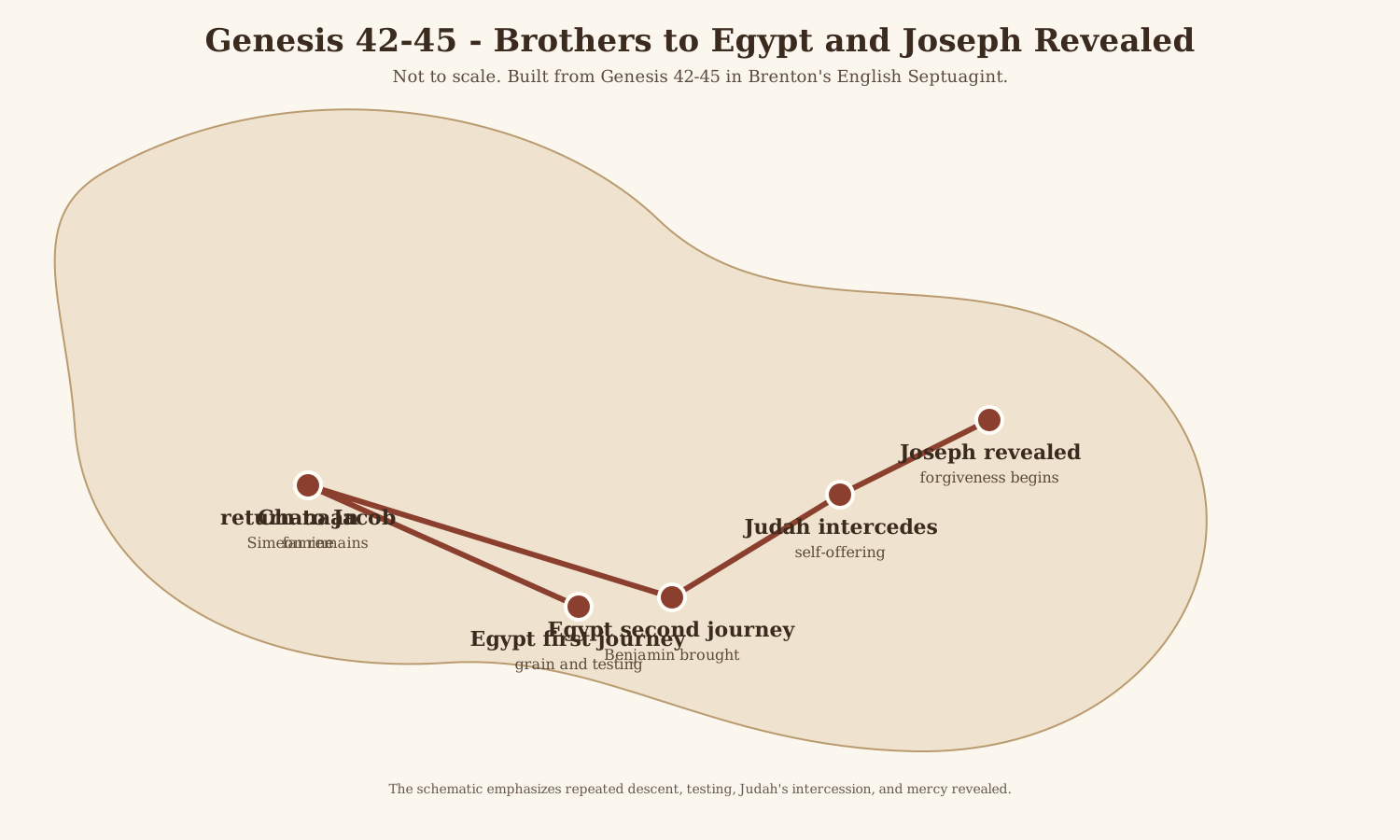 Source: narrative schematic of Genesis 42-45; not to scale. The later scenes belong to the continuation of these journeys.
Known by the brother they do not recognize (Genesis 42:1-17)
1 And Jacob having seen that there was a sale of corn in Egypt, said to his sons, Why are ye indolent? 2 Behold, I have heard that there is corn in Egypt; go down thither, and buy for us a little food, that we may live, and not die. 3 And the ten brethren of Joseph went down to buy corn out of Egypt. 4 But Jacob sent not Benjamin, the brother of Joseph, with his brethren; for he said, Lest, haply, disease befal him. 5 And the sons of Israel came to buy with those that came, for the famine was in the land of Chanaan. 6 And Joseph was ruler of the land; he sold to all the people of the land. And the brethren of Joseph, having come, did reverence to him, bowing with the face to the ground. 7 And when Joseph saw his brethren, he knew them, and estranged himself from them, and spoke hard words to them; and said to them, Whence are ye come? And they said, Out of the land of Chanaan, to buy food. 8 And Joseph knew his brethren, but they knew not him. 9 And Joseph remembered his dream, which he saw; and he said to them, Ye are spies; to observe the marks of the land are ye come. 10 But they said, Nay, Sir, we thy servants are come to buy food; 11 we are all sons of one man; we are peaceable, thy servants are not spies. 12 And he said to them, Nay, but ye are come to observe the marks of the land. 13 And they said, We thy servants are twelve brethren, in the land of Chanaan; and, behold, the youngest is with our father to-day, but the other one is not. 14 And Joseph said to them, This is it that I spoke to you, saying, ye are spies; 15 herein shall ye be manifested; by the health of Pharao, ye shall not depart hence, unless your younger brother come hither. 16 Send one of you, and take your brother; and go ye to prison, till your words be clear, whether ye speak the truth or not; but, if not, by the health of Pharao, verily ye are spies. 17 And he put them in prison three days.
Jacob’s question is followed by a purpose: buy food so that the household may live. The brothers enter Egypt among other hungry travelers. Joseph’s authority has become service on a scale his family could never have imagined: he sells grain to the people of the land, and his brothers join those dependent on him. Their faces bowed to the ground recall the dreams they once hated. Verse 9 expressly says that Joseph remembers his dream. The threatened promise has survived the pit and prison.
The narrator gives Joseph’s recognition before describing his hard words. That order places the reader beside a knowledge the brothers lack. Their insistence that they are men of peace is true concerning the accusation of spying, but the family history makes it painfully incomplete as an account of who they have been. “The other one is not” conceals a brother in a phrase, even while that brother stands before them. They have not yet told this ruler how Joseph disappeared.
Joseph demands Benjamin and puts the ten men in prison. The demand makes their account answerable to a living person; it also reaches directly into Jacob’s remaining fear. The narrative does not disclose every intention Joseph has at each step. His later tears and provision show tenderness, and the sequence eventually brings a changed response to a threatened brother. Yet his accusation is an accusation of a crime they have not committed. We can recognize the story’s searching disclosure of conscience without making deception or coercive tests a model for pastoral care. A wronged person may seek safety and evidence of change through honest boundaries, rather than recreating harm.
The cry they once refused to hear (Genesis 42:18-24)
18 And he said to them on the third day, This do, and ye shall live, for I fear God. 19 If ye be peaceable, let one of your brethren be detained in prison; but go ye, and carry back the corn ye have purchased. 20 And bring your younger brother to me, and your words shall be believed; but, if not, ye shall die. And they did so. 21 And each said to his brother, Yes, indeed, for we are in fault concerning our brother, when we disregarded the anguish of his soul, when he besought us, and we hearkened not to him; and therefore has this affliction come upon us. 22 And Ruben answered them, saying, Did I not speak to you, saying, Hurt not the boy, and ye heard me not? and, behold, his blood is required. 23 But they knew not that Joseph understood them; for there was an interpreter between them. 24 And Joseph turned away from them, and wept; and again he came to them, and spoke to them; and he took Symeon from them, and bound him before their eyes.
On the third day Joseph changes the arrangement. One brother will remain; the others may carry food home. “For I fear God” connects his use of authority to accountability beyond Pharaoh. The families’ need for grain remains before him even while the men’s story is being examined. Symeon, commonly called Simeon, will bear the confinement, but the household is not left without provisions.
Then the brothers speak about Joseph. Their words introduce a detail Genesis 37 did not narrate: he pleaded with them. They had heard the anguish of his soul and refused to listen. The earlier chapter showed their meal beside the pit; this confession lets us hear what that meal had silenced. Their wrongdoing was committed against a person calling for mercy. Remembered suffering breaks through the safe distance of “the other one is not.”
Reuben’s response recalls his warning against harming the boy and adds, “his blood is required.” The language recalls God’s declaration in Genesis 9:5: “I will require the life of man at the hand of his brother man.” The command already places responsibility for a human life in the hands of a brother. The brothers cannot make violence morally harmless by removing the victim from sight. Reuben had tried to rescue Joseph in Genesis 37; here his remembered protest stands beside the group’s shared guilt. Being able to say that one objected does not by itself repair what has happened.
An interpreter stands between them and Joseph, so they believe this conversation is private. Joseph understands. He turns away and weeps. The ruler has become a silent hearer of his own suffering being acknowledged. Scripture gives us those tears, not a speech explaining all they mean. They allow wounded love and exercised authority to be seen in one person.
Gems from the Fathers 💎: Confession after the long silence
St. John Chrysostom names these very brothers in Homily XII on Acts, while warning his hearers against lying and false oaths. He notices that many years passed before danger brought their sin to remembrance. The interval had not made the wrong disappear. His exhortation is direct: “Confess thou; since they also confessed, and were saved.”1 In his argument, the brothers’ confession teaches the hearer to stop relying on present impunity and begin repentance.
That appeal is an examination of our own conduct, not permission to diagnose someone else’s illness or misfortune as punishment. Christ rejects that inference in Luke 13:1-5 while calling all His hearers to repent. When conscience remembers a real wrong, we may name it before God without claiming to understand every cause of our present distress. The remembered cry becomes an opening for mercy when we answer it with truth.
Returned money and a father’s fear (Genesis 42:25-38)
25 And Joseph gave orders to fill their vessels with corn, and to return their money to each into his sack, and to give them provision for the way; and it was so done to them. 26 And having put the corn on the asses, they departed thence. 27 And one having opened his sack to give his asses fodder, at the place where they rested, saw also his bundle of money, for it was on the mouth of his sack. 28 And he said to his brethren, My money has been restored to me, and behold this is in my sack. And their heart was wonder-struck, and they were troubled, saying one to another, What is this that God has done to us? 29 And they came to their father, Jacob, into the land of Chanaan, and reported to him all that had happened to them, saying, 30 The man, the lord of the land, spoke harsh words to us, and put us in prison as spies of the land. 31 And we said to him, We are men of peace, we are not spies. 32 We are twelve brethren, sons of our father; one is not, and the youngest is with his father to-day in the land of Chanaan. 33 And the man, the lord of the land, said to us, Herein shall I know that ye are peaceable; leave one brother here with me, and having taken the corn ye have purchased for your family, depart. 34 And bring to me your younger brother; then I shall know that ye are not spies, but that ye are men of peace: and I will restore you your brother, and ye shall trade in the land. 35 And it came to pass as they were emptying their sacks, there was each man’s bundle of money in his sack; and they and their father saw their bundles of money, and they were afraid. 36 And their father Jacob said to them, Ye have bereaved me. Joseph is not, Symeon is not, and will ye take Benjamin? all these things have come upon me. 37 And Ruben spoke to his father, saying, Slay my two sons, if I bring him not to thee; give him into my hand, and I will bring him back to thee. 38 But he said, My son shall not go down with you, because his brother is dead, and he only has been left; and suppose it shall come to pass that he is afflicted by the way by which ye go, then ye shall bring down my old age with sorrow to Hades.
Joseph orders grain, journey provisions, and the return of each man’s money. The reader knows who has arranged the money; the brothers do not. They ask what God has done to them. A gift they cannot explain becomes a threat because the charge of spying and the loss of Simeon remain unresolved. We should hear their question as fear expressed by the characters, rather than as the narrator’s verdict that God is punishing every event they encounter.
At home, they repeat the ruler’s demand. All the money is found as the sacks are emptied. Jacob hears the story as another bereavement: Joseph is gone, Simeon is gone, and Benjamin may be taken. His conclusion arises from genuine grief and incomplete knowledge. Joseph is alive, Simeon is held rather than dead, and the money was returned at Joseph’s command. The reader can see mercy Jacob cannot yet see. Faith sometimes requires us to admit that our account of the facts is incomplete, while allowing sorrow to be spoken honestly.
Reuben offers the lives of his two sons as a guarantee for Benjamin’s return. The promise is desperate, and Jacob refuses it. Killing two grandsons could never restore a lost son. It would multiply the suffering entrusted to Reuben’s care. The contrast with Judah in the next chapter is decisive: Reuben puts other lives at stake; Judah will accept lasting responsibility himself.
Jacob’s “he only has been left” concerns Rachel’s remaining son, not the literal absence of all his other children. The sons listening to him are themselves part of this wounded household. Love and fear have again gathered around a favored child. Its healing will require brothers who can protect that child without resenting the father’s attachment to him.
Judah accepts the responsibility (Genesis 43:1-14)
1 But the famine prevailed in the land. 2 And it came to pass, when they had finished eating the corn which they had brought out of Egypt, that their father said to them, Go again; buy us a little food. 3 And Judas spoke to him, saying, The man, the lord of the country, positively testified to us, saying, Ye shall not see my face, unless your younger brother be with you. 4 If, then, thou send our brother with us, we will go down, and buy thee food; 5 but if thou send not our brother with us, we will not go: for the man spoke to us, saying, Ye shall not see my face, unless your younger brother be with you. 6 And Israel said, Why did ye harm me, inasmuch as ye told the man that ye had a brother? 7 And they said, The man closely questioned us about our family also, saying, Does your father yet live, and have ye a brother? and we answered him according to this question: did we know that he would say to us, Bring your brother? 8 And Judas said to his father Israel, Send the boy with me, and we will arise and go, that we may live and not die, both we and thou, and our store. 9 And I engage for him; at my hand do thou require him; if I bring him not to thee, and place him before thee, I shall be guilty toward thee for ever. 10 For if we had not tarried, we should now have returned twice. 11 And Israel, their father, said to them, If it be so, do this; take of the fruits of the earth in your vessels, and carry down to the man presents of gum and honey, and frankincense, and stacte, and turpentine, and walnuts. 12 And take double money in your hands, and the money that was returned in your sacks, carry back with you, lest peradventure it is a mistake. 13 And take your brother; and arise, go down to the man. 14 And my God give you favour in the sight of the man, and send away your other brother, and Benjamin, for I accordingly as I have been bereaved, am bereaved.
The grain runs out. Jacob’s command to buy more meets Judah’s plain statement of what makes the journey possible: Benjamin must come. Delay cannot change the ruler’s condition, and the whole household needs food. Judah’s appeal widens the concern beyond a single son to those whose survival depends on the brothers’ return.
“I engage for him” gives that appeal personal weight. Judah accepts accountability to his father and promises to bring Benjamin back into his presence. He does not offer the lives of his children. Jacob’s eventual decision follows both this pledge and the pressure of famine; Scripture does not isolate a single reason for his consent. Yet the contrast between the two brothers’ guarantees shows what responsible love looks like. Judah places his own standing under obligation to the one entrusted to him.
Jacob sends gifts and double money. The gifts include aromatic products, recalling the caravan’s spices, resin, and myrrh in Genesis 37:25. The lists are not identical. Their resemblance brings the road of Joseph’s sale into the road now traveled by his brothers: goods once accompanied a son being carried away, and now gifts accompany sons seeking food from that same son. Jacob also insists that the returned money be carried back, because it may have been a mistake. Honest uncertainty leads to restitution rather than exploitation.
His prayer asks God to give favor and release both Simeon and Benjamin. “As I have been bereaved, am bereaved” leaves the possibility of loss unresolved. Jacob acts while grief remains. Trust here takes the form of prayer, provision, and a necessary journey whose outcome he cannot secure.
Language insight: “I engage for him” and the earlier “pledge”
The Hebrew of Genesis 43:9 uses a form of עָרַב (ʿarav), to become surety or guarantee; the noun עֵרָבוֹן (ʿeravon), “pledge,” occurs in the Tamar episode in Genesis 38:17-18.2 This is a relationship between a verb and a related noun, not the repetition of an identical word. In Brenton, the earlier objects were an “earnest,” while here Judah personally undertakes responsibility. The man whose ring and staff once exposed his failure now commits himself to keeping another person safe. The connection gains its force from the changed conduct, not from etymology alone.
Hebrews 7:14 identifies our Lord’s descent from Judah, and 7:22 says that “Jesus has become a surety of a better covenant.” Judah’s promise is limited and will be tested; Christ’s priesthood rests on the power of an endless life. The family resemblance prepares us to value faithful self-giving, while the Gospel gives us a Savior whose commitment can sustain what ours cannot.
Fear at the threshold, kindness within (Genesis 43:15-25)
15 And the men having taken these presents, and the double money, took in their hands also Benjamin; and they rose up and went down to Egypt, and stood before Joseph. 16 And Joseph saw them and his brother Benjamin, born of the same mother; and he said to the steward of his household, Bring the men into the house, and slay beasts and make ready, for the men are to eat bread with me at noon. 17 And the man did as Joseph said; and he brought the men into the house of Joseph. 18 And the men, when they perceived that they were brought into the house of Joseph, said, We are brought in because of the money that was returned in our sacks at the first; even in order to inform against us, and lay it to our charge; to take us for servants, and our asses. 19 And having approached the man who was over the house of Joseph, they spoke to him in the porch of the house, 20 saying, We pray thee, Sir; we came down at first to buy food. 21 And it came to pass, when we came to unlade, and opened our sacks, there was also this money of each in his sack; we have now brought back our money by weight in our hands. 22 And we have brought other money with us to buy food; we know not who put the money into our sacks. 23 And he said to them, God deal mercifully with you; be not afraid; your God, and the God of your fathers, has given you treasures in your sacks, and I have enough of your good money. And he brought Symeon out to them. 24 And he brought water to wash their feet; and gave provender to their asses. 25 And they prepared their gifts, until Joseph came at noon, for they heard that he was going to dine there.
Joseph sees Benjamin and orders a meal. The brothers see the house and imagine enslavement. The two accounts of the same arrival reveal how fear can determine the meaning of a welcome before anyone has heard the host’s intention. Their anxiety is intelligible: a powerful stranger has detained their brother, and money has inexplicably reappeared in their sacks. The text asks us to notice their mistaken interpretation without mocking frightened people.
They speak to the steward at the porch, before entering fully. Their account is concrete: money was found, the same weight has been brought back, and more money is available for the new grain. They refuse to claim knowledge they do not have. “We know not who put the money into our sacks” is more truthful than an invented explanation designed to sound innocent.
The steward answers with mercy and reassurance. He speaks of their God and the God of their fathers, then says he has their good money. The question they asked in terror on the road, “What is this that God has done to us?”, receives an answer at the porch: the unexplained money is named as a gift. The reader knows Joseph arranged its return; the steward receives that human provision within God’s care. He brings Simeon to them. Water for their feet and food for the animals complete the welcome. Words of peace are joined to observable provision. The prisoners’ feared fate has given way, for the moment, to hospitality.
In the Christian life, confession concerns what we have actually done. It does not require us to accept a false accusation to prove humility. The brothers are guilty of betraying Joseph; they are not guilty of stealing the returned money. Truthfulness must hold both facts together. Receiving grace becomes freer when we cease defending a real wrong and cease inventing responsibility for one we did not commit.
Tears behind the meal (Genesis 43:26-34)
26 And Joseph entered into the house, and they brought him the gifts which they had in their hands, into the house; and they did him reverence with their face to the ground. 27 And he asked them, How are ye? and he said to them, Is your father, the old man of whom ye spoke, well? Does he yet live? 28 And they said, Thy servant our father is well; he is yet alive. And he said, Blessed be that man by God;—and they bowed, and did him reverence. 29 And Joseph lifted up his eyes, and saw his brother Benjamin, born of the same mother; and he said, Is this your younger brother, whom ye spoke of bringing to me? and he said, God have mercy on thee, my son. 30 And Joseph was troubled, for his bowels yearned over his brother, and he sought to weep; and he went into his chamber, and wept there. 31 And he washed his face and came out, and refrained himself, and said, Set on bread. 32 And they set on bread for him alone, and for them by themselves, and for the Egyptians feasting with him by themselves, for the Egyptians could not eat bread with the Hebrews, for it is an abomination to the Egyptians. 33 And they sat before him, the first-born according to his seniority, and the younger according to his youth; and the men looked with amazement every one at his brother. 34 And they took their portions from him to themselves; but Benjamin’s portion was five times as much as the portions of the others. And they drank and were filled with drink with him.
Joseph asks after the father, blesses him, and sees Benjamin. “God have mercy on thee, my son” is followed by emotion so strong that Joseph leaves to weep in his chamber. The brother once treated as disposable is now the man whose tenderness fills the scene. His affection has not been extinguished by the intervening years. He washes his face and returns to the meal while his identity remains concealed.
The diners sit separately. The narrator explains that the Egyptians present regard eating with Hebrews as an abomination. That is the reported boundary of this meal, not a Christian judgment on Egyptian people. Joseph’s position between groups will soon become a means of preserving the family. God’s saving work can take place amid divisions whose final healing remains ahead.
The brothers marvel at being seated in birth order. Benjamin receives five times the others’ portion. The chapter records their drinking together and reports no protest against his favor. It does not describe all their private feelings. Their decisive response will be shown when Benjamin is threatened in Genesis 44. Here they remain at the table with a favored brother; later they will have to choose whether to stand with him at a cost.
The meal contrasts with Genesis 37, where the brothers ate while Joseph was in the pit. Joseph now supplies the table at which they sit. Christian readers can perceive the larger pattern of the rejected brother becoming a giver of life. Its fullness is Christ, who says in John 6:35, “I am the bread of life.” His gift is more than grain that carries a household through famine: He gives communion with Himself and life that death cannot destroy. The Eucharist, the Church’s thanksgiving and reception of His Body and Blood, calls those who receive Him toward truthful brotherly love. Joseph’s banquet is a narrative anticipation of life received from the rejected one, not an institution of the sacrament.
Spiritual Fruit 🍇
Listen again to the plea you dismissed. The brothers remember words they heard and ignored. In examination of conscience, name the person whose need you made inconvenient: the child interrupted, the colleague belittled, the relative asking for help. Bring the actual failure to Christ in the sacrament of repentance and confession with your father of confession. Where contact is appropriate, an apology should acknowledge that person’s suffering without making the person comfort you for your guilt.
Make your promise answerable to your conduct. Judah’s pledge concerns bringing Benjamin safely home. Choose one entrusted responsibility that your words have treated more seriously than your habits: care for a dependent, a promised task, a duty of honesty. Give it time and attention before announcing another large intention. Ask the Lord for the patience to keep a promise when it costs something.
Let fear speak, but let evidence answer. Jacob grieves, the brothers tremble, and the steward opens the door with reassurance and Simeon’s release. When anxiety makes a kindness appear threatening, seek the facts and receive trustworthy help. Christian faith does not demand gullibility; it can teach us to distinguish a remembered danger from a present act of care.
Receive Christ’s gift without competing for the portion. Benjamin’s abundance need not diminish the brothers’ meal. Give thanks for a gift another person has received, especially when comparison troubles you. Before Holy Communion, ask for peaceable speech and a heart ready to serve those with whom you share the Church’s life. The Lord’s generosity makes us brothers and sisters, not rivals at His table.
Lord Jesus Christ, hear the cries I have passed by. Give me courage to confess my own sin and freedom from blame that is not mine. Teach me to keep faith with those entrusted to me. As I receive Your mercy, make me capable of another person’s joy. Amen.
Teaching Notes
Known by the brother they do not recognize (Genesis 42:1-17)
- Ask: How does the reader’s knowledge of Joseph change the meaning of the brothers’ claim to be men of peace?
- Watch for: The narrative’s testing does not authorize fabricated accusations or coercive pastoral methods.
The cry they once refused to hear (Genesis 42:18-24)
- Ask: What does the remembered pleading add to the earlier account of the brothers’ meal beside the pit?
- Watch for: Chrysostom’s summons to self-examination must not become a diagnosis of another person’s suffering as punishment.
Returned money and a father’s fear (Genesis 42:25-38)
- Ask: What does Reuben’s proposed guarantee reveal about the difference between dramatic promises and responsible care?
- Watch for: Jacob’s grief is real even though his account of the three brothers’ situations is incomplete.
Judah accepts the responsibility (Genesis 43:1-14)
- Ask: How does Judah’s pledge differ from the offer of Reuben’s two sons?
- Watch for: The Hebrew connection is between related forms; it does not prove a deliberate verbal allusion in the displayed Greek translation.
Fear at the threshold, kindness within (Genesis 43:15-25)
- Ask: Which actions, as well as words, make the steward’s reassurance concrete?
- Watch for: Confession requires owning real wrongdoing, not accepting guilt for every accusation.
Tears behind the meal (Genesis 43:26-34)
- Ask: How does the meal in Joseph’s house reverse the meal beside the pit without yet completing the story?
- Watch for: The text reports no envious protest, but it does not reveal every brother’s interior thoughts.
Sources
Embedded Scripture is from Brenton’s English Septuagint (LXX). New Testament quotations are from NKJV.
Brenton, The Septuagint Version of the Old Testament, Genesis 9, 37-38, and 42-43 🔗. The narrative schematic spans Genesis 42-45 and supplies sequence, not surveyed geography.
St. John Chrysostom, Homily XII on Acts, direct use of Genesis 42:21.
Luke 13:1-5; Hebrews 7:14-22; John 6:35, for repentance, Christ’s surety, and the life-giving Lord. No exact lectionary assignment is asserted here.
Footnotes
-
St. John Chrysostom, Homilies on Acts, Homily XII, concluding exhortation, p. 80, Nicene and Post-Nicene Fathers, first series, vol. 11 (1889), translated by J. Walker and J. Sheppard, corrected by H. Browne, revised by George B. Stevens 🔗. ↩
-
Hebrew Genesis 43:9 🔗, Genesis 38:17 🔗, and the Brown-Driver-Briggs entry for “pledge” 🔗. Swete’s Greek Genesis 43:9 has ἐκδέχομαι, “I undertake” 🔗; this note identifies a Hebrew relationship, not an identical Greek root. ↩