


Abraham dies, and God blesses Isaac. The man who received the promise can be buried; the God who gave it remains. Yet the household inheriting this blessing has no immunity from sorrow or sin. Isaac and Rebekah wait for children, then favor different sons. Esau exchanges his birthright for a meal; Jacob secures it through his brother’s need. Famine comes, and wells are filled with earth. Desire, fear, and family habits must learn to answer His grace.
Genesis 23-24 brought Sarah’s burial and Rebekah’s arrival; now Abraham joins Sarah, and Isaac’s marriage becomes the household of two nations. The chapters are not arranged as a continuous calendar: genealogies close one branch before returning to another, and chapter 26 gathers Isaac’s history around the oath. Isaac’s life is told through places of dependence: the well of the vision, the contested wells, and the well of the oath.
A father buried, a promise still living (Genesis 25:1-11)
1 And Abraam again took a wife, whose name was Chettura. 2 And she bore to him Zombran, and Jezan, and Madal, and Madiam, and Jesboc, and Soie. 3 And Jezan begot Saba and Dedan. And the sons of Dedan were the Assurians and the Latusians, and Laomim. 4 And the sons of Madiam were Gephar and Aphir, and Enoch, and Abeida, and Eldaga; all these were sons of Chettura. 5 But Abraam gave all his possessions to Isaac his son. 6 But to the sons of his concubines Abraam gave gifts, and he sent them away from his son Isaac, while he was yet living, to the east into the country of the east. 7 And these were the years of the days of the life of Abraam as many as he lived, a hundred and seventy-five years. 8 And Abraam failing died in a good old age, an old man and full of days, and was added to his people. 9 And Isaac and Ismael his sons buried him in the double cave, in the field of Ephron the son of Saar the Chettite, which is over against Mambre: 10 even the field and the cave which Abraam bought of the sons of Chet; there they buried Abraam and Sarrha his wife. 11 And it came to pass after Abraam was dead, that God blessed Isaac his son, and Isaac dwelt by the well of the vision.
Keturah’s descendants are named before Abraham’s death. Isaac’s particular inheritance does not make the other children disappear: Abraham gives gifts to the sons of his concubines and sends them east while he is living. This distribution distinguishes the household’s heir. Verse 11 supplies the deeper continuity: God Himself blesses Isaac, who dwells by the well of the vision, the well mentioned as Rebekah approached him in Genesis 24:62. Wells will continue to mark his life under the promise. Property can be transferred by a father; the covenant’s future depends on the living Lord.
Abraham is “full of days,” yet fullness does not cancel death. The purchased cave returns us to Sarah’s burial in the land where he lived as a stranger. He is “added to his people” before his burial is described. The expression reaches beyond the mere placement of a body in a family tomb, allowing us to hear death as gathering to those gone before. In Christ, the Church honors the body and prays for the departed because death does not erase a person before God.
Isaac and Ishmael bury their father together. This is shared filial honor after a painful history, not proof that every old wound has healed. Even where family relationships remain difficult, love for the departed can bring people to perform a good work together. A funeral need not become another battlefield for inheritance or remembered slights. And the blessing after Abraham’s death directs grief toward the God he trusted: Isaac must now pray and obey before Him, rather than merely preserve an admired memory.
The Church’s Voice in Worship ⛪
The Coptic Synaxarium commemorates the holy patriarchs Abraham, Isaac, and Jacob on 28 Mesra.1 Their shared remembrance gives thanks for God’s fidelity across generations. In the Liturgy of St. Basil, the Church asks repose for the departed “in the bosom of our holy fathers Abraham, Isaac, and Jacob.”2 Abraham’s grave is held within that living hope. Christ Himself teaches that the God of Abraham, Isaac, and Jacob is “not the God of the dead, but of the living” (Matthew 22:32). The God who blesses Isaac after his father’s burial has not ceased to be Abraham’s God.
Ishmael also receives a remembered promise (Genesis 25:12-18)
12 And these are the generations of Ismael the son of Abraam, whom Agar the Egyptian the hand-maid of Sarrha bore to Abraam. 13 And these are the names of the sons of Ismael, according to the names of their generations. The firstborn of Ismael, Nabaioth, and Kedar, and Nabdeel, and Massam, 14 and Masma, and Duma, and Masse, 15 and Choddan, and Thæman, and Jetur, and Naphes, and Kedma. 16 These are the sons of Ismael, and these are their names in their tents and in their dwellings, twelve princes according to their nations. 17 And these are the years of the life of Ismael, a hundred and thirty-seven years; and he failed and died, and was added to his fathers. 18 And he dwelt from Evilat to Sur, which is opposite Egypt, until one comes to the Assyrians; he dwelt in the presence of all his brethren.
Twelve princes are named “according to their nations,” fulfilling God’s promise concerning Ishmael in Genesis 17:20. There Abraham’s plea for his son was heard; here names, dwellings, and settlement give the promise a human and geographical shape. The child of Hagar is remembered rather than treated as expendable once Isaac is identified.
Ishmael’s death also receives its age and its gathering to his fathers. Scripture does not measure humanity by whether a genealogy carries the central covenant line. God’s particular purpose through Isaac serves the blessing of the nations; it warrants no ethnic superiority or contempt toward peoples associated with Ishmael. This branch closes so the account can return to Isaac, not so readers may close their hearts to everyone outside it.
In parish life, a particular responsibility or tradition likewise makes us servants of what we received, not judges of everyone else’s value. God’s gifts elsewhere should enlarge our gratitude.
Prayer, a troubled pregnancy, and two nations (Genesis 25:19-26)
19 And these are the generations of Isaac the son of Abraam. 20 Abraam begot Isaac. And Isaac was forty years old when he took to wife Rebecca, daughter of Bathuel the Syrian, out of Syrian Mesopotamia, sister of Laban the Syrian. 21 And Isaac prayed the Lord concerning Rebecca his wife, because she was barren; and the Lord heard him, and his wife Rebecca conceived in her womb. 22 And the babes leaped within her; and she said, If it will be so with me, why is this to me? And she went to enquire of the Lord. 23 And the Lord said to her, There are two nations in thy womb, and two peoples shall be separated from thy belly, and one people shall excel the other, and the elder shall serve the younger. 24 And the days were fulfilled that she should be delivered, and she had twins in her womb. 25 And the first came out red, hairy all over like a skin; and she called his name Esau. 26 And after this came forth his brother, and his hand took hold of the heel of Esau; and she called his name Jacob. And Isaac was sixty years old when Rebecca bore them.
Isaac was forty when he married and sixty when the twins were born: twenty years stand between marriage and birth. The bride whose arrival brought comfort cannot yet bear the next generation of the promise. Isaac prays “concerning Rebecca his wife”; her sorrow belongs within his prayer rather than becoming a reason to blame her. The family’s continuation comes as a heard petition and gift.
This answer gives no formula by which sufficient faith guarantees conception. Infertility is not evidence of spiritual failure. People enduring childlessness are beloved by God, not unfinished families whose worth awaits a child. Isaac teaches us to carry another’s sorrow before the Lord without claiming control of its timing.
Rebekah conceives, then brings her bewilderment to God. The gift has not made experience clear. “Why is this to me?” is spoken by a woman who seeks the Lord rather than concealing distress behind a pious appearance. The answer reaches beyond her immediate experience: two nations, two peoples, and the elder serving the younger. Customary priority of birth will not dictate God’s promise.
Esau emerges red and hairy; Jacob comes holding his brother’s heel. The naming preserves that first relation between them. In Genesis 27:36 Esau will hear Jacob’s name through his bitter experience of being supplanted. Much later, when Jacob is asked his name before God, he will speak it truthfully and receive the name Israel (Genesis 32:28-29 in Brenton). A life that begins by grasping a brother must learn to seek blessing from the Lord.
Language insight: “leaped” and “two nations”
Brenton reads “the babes leaped.” The Septuagint’s ἐσκίρτων, from skirtaō, describes leaping; Hebrew-based translations commonly give “struggled together.”3 Rebekah’s distress and the oracle prepare us for division. “Two nations,” δύο ἔθνη, keeps the corporate horizon visible: peoples’ histories begin within this household.
Romans 9:6-16 returns to the scene while defending God’s faithful word. Paul stresses that the children had not been born or done good or evil when the oracle was given: God’s purpose rests on the One who calls. Grace precedes achievement; Jacob’s place cannot be credited to later bargaining. Orthodox reading keeps this primacy of mercy together with the seriousness of human response. Paul then quotes Malachi: “Jacob I have loved, but Esau I have hated” (Romans 9:13; Malachi 1:2-3). Malachi addresses the histories of Israel and Edom, the peoples named in the oracle. This severe contrast cannot be made a prenatal verdict of eternal damnation upon an infant. The One who calls knows the whole history hidden from us; His gift precedes achievement and summons a faithful response.
Gems from the Fathers 💎: One God across the generations
St. Irenaeus reads Rebekah’s children through Paul’s use of the oracle in Against Heresies IV.21.2. His concern is the unity of God’s saving work: the patriarchs’ God is the Christians’ God. Recognizing the two peoples and divine foreknowledge, he declares, “Our God, one and the same, is also their God, who knows hidden things, who knoweth all things before they can come to pass”.4
His sentence continues by relating “Jacob have I loved, but Esau have I hated” to that divine foreknowledge. He thus holds together the freedom of God’s calling and His knowledge of what is yet to come. The passage does not make grace a wage. Irenaeus develops a symbolic reading of elder and younger peoples in the surrounding chapter. Its fulfillment must be heard with Paul’s baptismal teaching: Jew and Greek belonging to Christ are one in Him and heirs of Abraham’s promise (Galatians 3:26-29). No ancestry warrants contempt. The blessing widens without changing the identity of the God who spoke it.
Two sons loved in a divided household (Genesis 25:27-28)
27 And the lads grew, and Esau was a man skilled in hunting, dwelling in the country, and Jacob a simple man, dwelling in a house. 28 And Isaac loved Esau, because his venison was his food, but Rebecca loved Jacob.
Esau hunts and lives in the country; Jacob is “a simple man, dwelling in a house.” Their differences need not have become a competition for love. Verse 28 names the danger: Isaac loves Esau because his game is his food, while Rebekah loves Jacob. A motive is given for Isaac’s preference, but not Rebekah’s. The narrative lets the effects of their divided affection become visible in the sons’ lives.
Language insight: “simple” and “house”
The Greek ἄπλαστος, aplastos, stands behind “simple.” Its range includes natural or unaffected character; it is not a claim of absolute sinlessness. Jacob’s dwelling is explicitly a “house,” οἰκία, in this Septuagint text.5 The domestic contrast sets the two brothers beside each other before the bargain reveals how each handles the inheritance. The coming bargain must be judged on its own terms rather than excused by this description.
Isaac prefers the child who provides something he enjoys. Affection can begin measuring people by the satisfaction they bring: the child who resembles us or makes us proud becomes the one whose presence matters most. Rebekah’s opposite preference divides the home further, preparing alliances that will make deception possible.
A family can pray and still need to repent of how it loves. Hear the quieter child, stop comparing siblings, and refuse to make a child an ally in a marital disagreement. In parish service, attend to the person who brings no prestige or useful connection. Love matures when another person need not earn attention by satisfying us.
An inheritance exchanged for a meal (Genesis 25:29-34)
29 And Jacob cooked pottage, and Esau came from the plain, fainting. 30 And Esau said to Jacob, Let me taste of that red pottage, because I am fainting; therefore his name was called Edom. 31 And Jacob said to Esau, Sell me this day thy birthright. 32 And Esau said, Behold, I am going to die, and for what good does this birthright belong to me? 33 And Jacob said to him, Swear to me this day; and he swore to him; and Esau sold his birthright to Jacob. 34 And Jacob gave bread to Esau, and pottage of lentiles; and he ate and drank, and he arose and departed; so Esau slighted his birthright.
Esau comes faint from the plain and asks for the red pottage, whose color links this episode to his name Edom. Jacob answers the need with a demand for the birthright, the firstborn’s family standing and inheritance privileges. He requires an oath before giving bread and lentils. The enduring inheritance becomes negotiable under the pressure of immediate need.
Esau’s question, “for what good does this birthright belong to me?”, reveals his valuation. Whatever the exact danger of his exhaustion, relief now eclipses what he has received. The closing verbs hurry through the meal: he eats, drinks, rises, and departs. Then comes the judgment: “Esau slighted his birthright.” Contempt precedes the later sorrow.
That verdict does not endorse Jacob’s method. Desiring the inheritance and exploiting a brother’s need are different acts. We must never use his eventual place in God’s purpose to sanctify a bargain against the vulnerable. The person in urgent need should receive mercy, not an agreement designed for our advantage.
Hebrews 12:14-17 places Esau’s sale within an exhortation to peace, holiness, care for others, and freedom from bitterness. A “profane person” treats holy things as disposable. Baptized readers cannot place themselves safely above Esau: Christ’s inheritance is despised when fidelity, forgiveness, or communion with Him is surrendered for immediate satisfaction. Food is good; weakness calls for care. The Church’s fast trains desire to receive an enduring inheritance without despising the food that sustains life; a fainting person needs nourishment and care.
Hebrews looks ahead to tears over Isaac’s blessing in Genesis 27. This sale of the birthright and the later loss of blessing are related, distinct events. Tears do not undo that outcome, but the warning must not become a declaration that God forever refuses a repentant sinner. Some consequences cannot simply be reversed; the heart can still turn toward mercy.
Gems from the Fathers 💎: Vigilance without despair
St. John Chrysostom’s Homily XXXI on Hebrews explains Esau’s profanity as selling spiritual goods for pleasure. Asked whether the apostle excludes repentance, he answers, “By no means.” He later concludes, “He does not then exclude repentance; but makes them careful not to fall”.6 The fuller argument contrasts sorrow joined to murderous anger with Peter’s repentance after denial. He warns the careless without leaving the fallen hopeless.
St. Cyril of Jerusalem gives the same warning within instruction on chastity, after affirming the body’s goodness and calling to become the Spirit’s temple: “For you, brethren, a great crown is laid up: barter not away a great dignity for a petty pleasure”.7 Dignity comes first. In the same lecture, Cyril asks that the body be nourished so it may live and serve, and describes fasting as preparation for “a spiritual and intellectual feast” (IV.26-27).7 We learn to prefer communion with Christ to immediate gratification while caring for the body He created. Ascetical struggle answers the life already given; when we wound it, we seek cleansing.
The promise heard amid famine and fear (Genesis 26:1-11)
1 And there was a famine in the land, besides the former famine, which was in the time of Abraam; and Isaac went to Abimelech the king of the Phylistines to Gerara. 2 And the Lord appeared to him and said, Go not down to Egypt, but dwell in the land, which I shall tell thee of. 3 And sojourn in this land; and I will be with thee, and bless thee, for I will give to thee and to thy seed all this land; and I will establish my oath which I swore to thy father Abraam. 4 And I will multiply thy seed as the stars of heaven; and I will give to thy seed all this land, and all the nations of the earth shall be blest in thy seed. 5 Because Abraam thy father hearkened to my voice, and kept my injunctions, and my commandments, and my ordinances, and my statutes. 6 And Isaac dwelt in Gerara. 7 And the men of the place questioned him concerning Rebecca his wife, and he said, She is my sister, for he feared to say, She is my wife, lest at any time the men of the place should slay him because of Rebecca, because she was fair. 8 And he remained there a long time, and Abimelech the king of Gerara leaned to look through the window, and saw Isaac sporting with Rebecca his wife. 9 And Abimelech called Isaac, and said to him, Is she then thy wife? why hast thou said, She is my sister? And Isaac said to him, I did so, for I said, Lest at any time I die on her account. 10 And Abimelech said to him, Why hast thou done this to us? one of my kindred within a little had lain with thy wife, and thou wouldest have brought a sin of ignorance upon us. 11 And Abimelech charged all his people, saying, Every man that touches this man and his wife shall be liable to death.
Famine brings Isaac to Gerar, where the Lord commands him to remain rather than descend to Egypt. The promised land has become a place of shortage. Reassurance begins with presence: “I will be with thee.” Land, descendants, and blessing for all nations follow. Inherited faith becomes living faith when Isaac hears and obeys the same Lord his father followed.
Verse 5 honors Abraham’s obedience: voice, injunctions, commandments, ordinances, and statutes. Genesis has shown his failures, yet God names the fidelity through which he answered. Grace and obedience belong together. God’s generosity summons response; the oath is no commercial contract guaranteeing comfort to obedient descendants. Isaac must sojourn, dwelling in dependence before complete possession is his.
Galatians 3:16 identifies the promised Seed as Christ; verses 26-29 join faith, baptism into Him, and Abrahamic inheritance. To put on Christ is to receive a life gathering people across ancestral and social divisions. The blessing repeated to Isaac opens toward communion, not private success guarded against others.
Isaac nevertheless calls Rebekah his sister, fearing death on account of her beauty. God’s promise and the old family evasion stand painfully close. Fear asks him to sacrifice truth, exposing his wife and others to danger. Abimelech sees their marital intimacy, conveyed by “sporting,” and calls Isaac to account: someone might have taken her and incurred sin. Isaac explains his fear but does not thereby justify the concealment. Protection comes through rebuke and the ruler’s prohibition against harming them. Someone outside the covenant household speaks necessary truth to its bearer.
Isaac’s life repeatedly echoes Abraham’s: famine and a dangerous claim about a wife, disputed wells, and an oath of peace with Abimelech and Phichol. The opening names Abraham’s famine, while God now tells Isaac to remain rather than go down to Egypt. Most deeply, the oath of descendants and blessing for the nations recalls Genesis 22:16-18: the promise spoken after the offering of Isaac is now entrusted to Isaac himself. Inheritance calls him to grow beyond his father’s fear while receiving his father’s faith. He needs correction as well as protection. When God preserves us after a frightened lie, gratitude should become confession rather than a belief that the lie worked.
Blessing that provokes envy (Genesis 26:12-17)
12 And Isaac sowed in that land, and he found in that year barley an hundred-fold, and the Lord blessed him. 13 And the man was exalted, and advancing he increased, till he became very great. 14 And he had cattle of sheep, and cattle of oxen, and many tilled lands, and the Phylistines envied him. 15 And all the wells which the servants of his father had dug in the time of his father, the Phylistines stopped them, and filled them with earth. 16 And Abimelech said to Isaac, Depart from us, for thou art become much mightier than we. 17 And Isaac departed thence, and rested in the valley of Gerara, and dwelt there.
Isaac receives barley a hundredfold that year. Flocks, herds, and tilled lands follow, yet increase brings envy rather than secure belonging. The Philistines fill Abraham’s wells with earth, and Abimelech demands that Isaac leave because he has become mightier than they are. His wealth increases while the space allowed to him contracts.
Stopping a well damages the means by which people and animals live. Envy has become an act making the land less hospitable: rather than rejoice in your fruitfulness, I will spoil what sustains it. A parish suffers similar damage when rivalry chokes fruitful service or withholds resources because someone else will receive thanks.
Isaac leaves for the valley. He has just been called powerful; departure need not mean inability to respond. He refuses to turn every resource into a weapon. This restraint never requires a vulnerable person to stay exposed to abuse, abandon lawful protection, or deprive dependents of necessities. Here leaving allows life to continue.
The harvest is a particular gift, not a promise that believers will become wealthy. Increase and dispossession coexist. God’s presence cannot be measured by material security. What blessing makes of our hearts appears when others resent it: thanksgiving can become patience and generosity, or harden into entitlement.
Digging again until there is room (Genesis 26:18-22)
18 And Isaac dug again the wells of water, which the servants of his father Abraam had dug, and the Phylistines had stopped them, after the death of his father Abraam; and he gave them names, according to the names by which his father named them. 19 And the servants of Isaac dug in the valley of Gerara, and they found there a well of living water. 20 And the shepherds of Gerara strove with the shepherds of Isaac, saying that the water was theirs; and they called the name of the well, Injury, for they injured him. 21 And having departed thence he dug another well, and they strove also for that; and he named the name of it, Enmity. 22 And he departed thence and dug another well; and they did not strive about that; and he named the name of it, Room, saying, Because now the Lord has made room for us, and has increased us upon the earth.
Isaac reopens Abraham’s wells and restores their names. Memory becomes useful through labor: an inherited source must be cleared to give water again. New digging brings a new dispute. Shepherds claim the water, and two wells receive names telling the truth: Injury and Enmity. Patience has no need to rename hostility as kindness.
Isaac moves and digs until no one quarrels over the next well. “Room” names the gift: the Lord has made room and increased them. The injuries remain wrong, but they do not determine the whole future. His strength is sustained labor without making vengeance his occupation. Sometimes faithful endurance means seeking mediation, sharing a resource, or leaving a fruitless dispute to continue service elsewhere. The measure is love and truth, not eventually acquiring larger possessions.
Language insight: “living water”
“Living water” here means water from a fresh, flowing source, Greek ὕδατος ζῶντος.8 This actual well also offers Christians a typological connection, a pattern read in light of fulfillment, with John 7:37-39. John identifies Christ’s gift of living water with the Holy Spirit. The household’s provision helps us understand the image Christ brings to fullness. Water sustains the household’s bodies, while the Spirit renews life in communion with God.
This gift should make us hospitable. Speaking of living water while denying mercy to a weary neighbor reverses the direction of the image. Wells invite shared dependence; baptismal grace and life in the Spirit deepen our care for those who thirst.
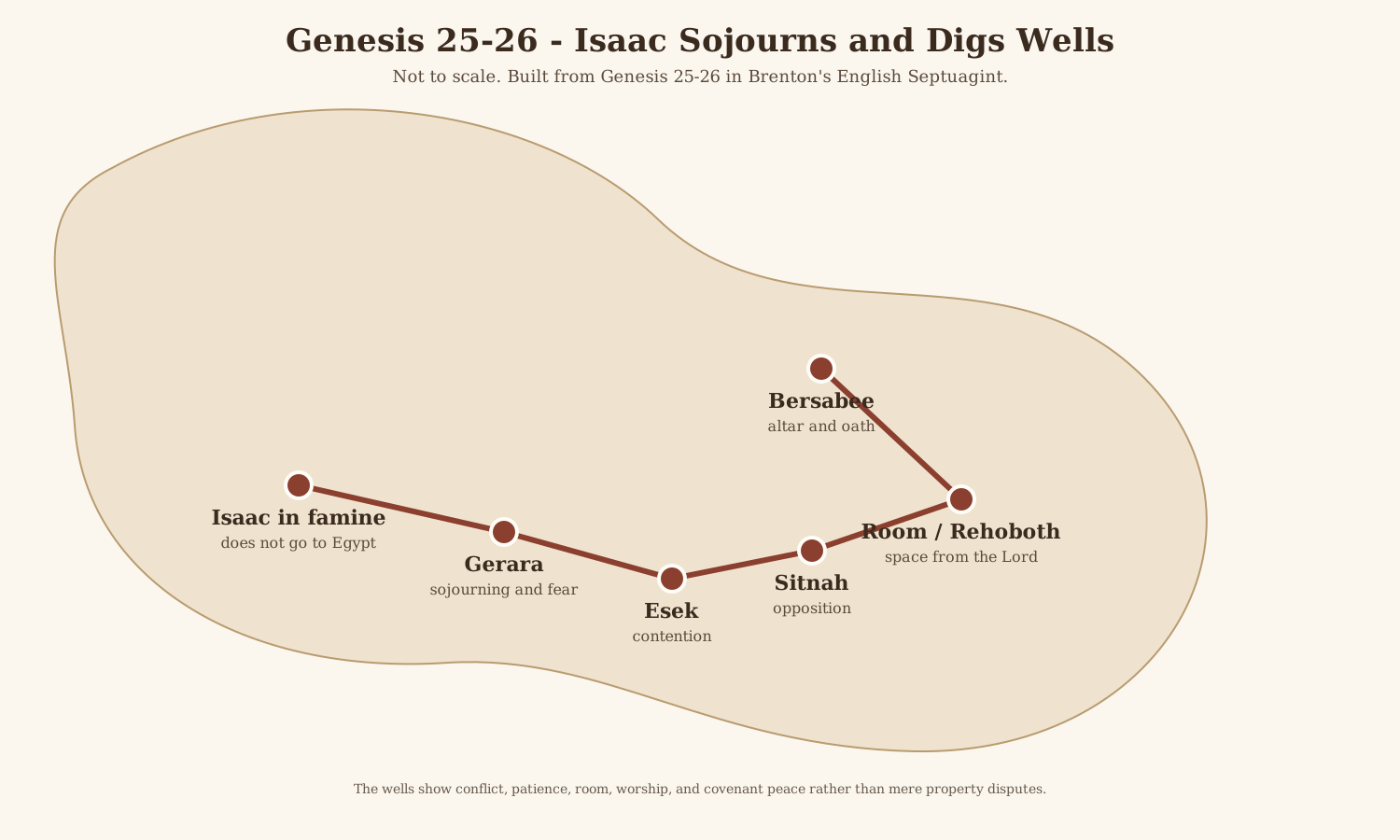 Source: schematic created for this guide from Genesis 25-26, 2026-06-06; not to scale.
An altar, an honest question, and an oath (Genesis 26:23-33)
23 And he went up thence to the well of the oath. 24 And the Lord appeared to him in that night, and said, I am the God of Abraam thy father; fear not, for I am with thee, and I will bless thee, and multiply thy seed for the sake of Abraam thy father. 25 And he built there an altar, and called on the name of the Lord, and there he pitched his tent, and there the servants of Isaac dug a well in the valley of Gerara. 26 And Abimelech came to him from Gerara, and so did Ochozath his friend, and Phichol the commander-in-chief of his army. 27 And Isaac said to them, Wherefore have ye come to me? whereas ye hated me, and sent me away from you. 28 And they said, We have surely seen that the Lord was with thee, and we said, Let there be an oath between us and thee, and we will make a covenant with thee, 29 that thou shalt do no wrong by us, as we have not abhorred thee, and according as we have treated thee well, and have sent thee forth peaceably; and now thou art blessed of the Lord. 30 And he made a feast for them, and they ate and drank. 31 And they arose in the morning, and swore each to his neighbour; and Isaac sent them forth, and they departed from him in safety. 32 And it came to pass in that day, that the servants of Isaac came and told him of the well which they had dug; and they said, We have not found water. 33 And he called it, Oath: therefore he called the name of that city, the Well of Oath, until this day.
At the well of the oath, God speaks in the night: Abraham’s God is with Isaac, who need not fear. Isaac builds an altar, calls on the Lord, pitches his tent, and his servants dig. Worship, habitation, and labor stand together. Neither prayer that despises work nor work that excludes God receives the promise whole.
Abimelech arrives with his friend and commander. Isaac preserves the injury in his first question: why come after hating him and sending him away? The delegation says it has seen God with him and wants a covenant against harm. Its favorable account of its own conduct, claiming to have treated him well and sent him away peaceably, stands in tension with that question and the earlier expulsion. This is a negotiating party’s speech, not the narrator’s acquittal of every wrong.
Isaac gives a feast, exchanges oaths next morning, and sends them away safely. Esau’s eating accompanied contempt and Jacob’s advantage; here eating serves hospitality and a settlement. Peace takes an accountable shape, a mutual oath against harm. Isaac need not erase his honest question to offer generosity, and the text does not claim perfect inward healing. Christian peacemaking joins mercy to truth: forgiveness requires no repetition of another person’s denial.
Language insight: “We have not found water”
The servants’ report stands plainly: “We have not found water.” Greek has Οὐχ εὕρομεν ὕδωρ; Hebrew-based versions report finding water.9 In Brenton, the final well is no newly discovered source celebrated as a reward for the treaty. Isaac names it “Oath”; the city is the “Well of Oath.” The naming emphasizes the oath while the search remains unsuccessful.
Thus peace and the altar are followed by an unsuccessful search. The Lord promises presence, yet honest work can return without its desired result. We may give thanks for peace while still asking for water. Worship does not require announcing that every difficulty has been resolved.
Peace outside, grief inside (Genesis 26:34-35)
34 And Esau was forty years old; and he took to wife Judith the daughter of Beoch the Chettite, and Basemath, daughter of Helon the Chettite. 35 And they were provoking to Isaac and Rebecca.
Esau marries at forty, the age at which Isaac married Rebekah. The marriages’ effects differ: Judith and Basemath are named, and they are “provoking to Isaac and Rebecca.” Peace with the ruler has not removed sorrow at home. This ending prepares the coming conflict over the blessing.
The women are daughters of Hittite fathers in Brenton. Isaac’s marriage and the coming concern over Jacob’s wife place marriage within covenant responsibility. These verses nevertheless give no account of their particular actions. They warrant neither invented charges nor a doctrine of inferior blood. Christian marriage calls for shared faith and fidelity, not ethnic separation.
Parental grief deserves attention without licensing control of an adult child or contempt for a spouse. The household needs discernment, prayer, and repentance. Years later, Esau will run to meet Jacob, embrace and kiss him, and weep with him (Genesis 33:4). The story continues beyond this troubled household toward a reunion neither brother can yet see.
Spiritual Fruit 🍇
Carry sorrow into prayer. Isaac prays concerning Rebekah, who brings her bewilderment to God. Choose a household burden you have been commenting on more than praying about. Bring the person by name before Christ without assigning blame or demanding a timetable. Let intercession become gentle presence and practical help, especially through infertility, illness, or grief. Hope waits without making the sufferer’s body answer for our disappointment.
Recognize your recurring bargain. Esau dismisses the inheritance; Jacob uses need as leverage. Before confession, name one corresponding act: a frightened lie, resentment cherished for its satisfaction, prayer surrendered to distraction, or another’s weakness used for gain. Ask Christ’s mercy and make a concrete repair. Confession turns us from regret over consequences toward a changed relationship with God and the neighbor harmed.
Receive your family faithfully and repent honestly. Isaac inherits a promise and repeats a deception. What is handed down can contain both blessing and injury. Thank God for received faith, then refuse the familiar comparison or evasive explanation that wounds someone at home. Attend to the person you overlook. A family pattern loosens when one person tells the truth and loves without demanding a return.
Join peace to generosity. Isaac names his expulsion before offering a feast. In conflict, distinguish actual harm from imagined motives. Seek a safe, proportionate response: apology, restitution, shared resources, or mediated boundaries. Pray for the other’s good before speaking. The Eucharistic life calls us to carry Christ’s self-giving love into these dealings, seeking neither a satisfying victory nor a false appearance of harmony.
Keep hope beside the dry well. Isaac’s altar remains after the unsuccessful report. Thank God for a real gift without claiming every need is met. Continue your ordinary work, accept help, and ask for what is lacking. The risen Christ frees us to acknowledge disappointment without surrendering ourselves to it.
At the well of the oath, the altar stands beside the tent. Visitors have departed safely, but the servants have brought no water. Isaac cannot manufacture a spring; he can receive the word of the God who is with him. Stand there in prayer: grateful for peace, honest about thirst, willing to work again. Lord Jesus Christ, teach us to receive without grasping and to wait without hardening our hearts.
Teaching Notes
Orientation: Brenton spells Abraham, Ishmael, Rebekah, and Gerar as Abraam, Ismael, Rebecca, and Gerara. The “well of the oath” is Beersheba. Chapter 26 need not follow the preceding genealogy and birthright episode in strict chronological order; repeated royal names alone do not settle the rulers’ identities.
A father buried, a promise still living (Genesis 25:1-11)
- Ask: How does verse 11 change the way we hear Abraham’s death?
- Watch for: Shared burial does not establish complete reconciliation.
Ishmael also receives a remembered promise (Genesis 25:12-18)
- Ask: Why does naming twelve princes matter here?
- Watch for: Isaac’s covenant role warrants no ethnic superiority.
Prayer, a troubled pregnancy, and two nations (Genesis 25:19-26)
- Ask: What does Rebekah do with bewilderment?
- Watch for: The long wait leads to intercession, not an equation between sufficient faith and conception. Romans 9 grounds calling before works.
Two sons loved in a divided household (Genesis 25:27-28)
- Ask: When does affection become a demand that a child satisfy us?
- Watch for: Isaac’s love is linked to the food his son supplies; compare Esau’s valuation of food and inheritance in verse 34.
An inheritance exchanged for a meal (Genesis 25:29-34)
- Ask: How do both brothers fail toward the inheritance?
- Watch for: Distinguish birthright from blessing; repentance remains open, while food and bodily needs deserve care.
The promise heard amid famine and fear (Genesis 26:1-11)
- Ask: Why is the king’s rebuke a mercy?
- Watch for: Avoid guaranteed prosperity and unsupported chronology.
Blessing that provokes envy (Genesis 26:12-17)
- Ask: What shared good can envy damage?
- Watch for: Restraint does not require remaining in abuse or abandoning protection.
Digging again until there is room (Genesis 26:18-22)
- Ask: Why retain the names Injury and Enmity after receiving Room?
- Watch for: The John 7 connection is typology, not an exact prediction.
- Show: Optionally trace the schematic through contested wells, Room, and the altar; it is not measured geography.
An altar, an honest question, and an oath (Genesis 26:23-33)
- Ask: How can Isaac offer hospitality while telling the truth?
- Watch for: Keep the unfavorable well report and the delegation’s self-exoneration visible.
Peace outside, grief inside (Genesis 26:34-35)
- Ask: Why end with grief after public peace?
- Watch for: Invent neither the women’s actions nor ethnic marriage rules.
Sources
Embedded Scripture is from Brenton’s English Septuagint (LXX). New Testament wording cited in the explanation is from NKJV.
Genesis 25-26, with Genesis 17:20 for Ishmael’s descendants, 22:16-18 for the oath, 24:62 for the well of the vision, 33:4 for the brothers’ reunion, and Malachi 1:2-3; Matthew 22:31-32; Romans 9:6-16; Galatians 3:16, 26-29; Hebrews 12:14-17; John 7:37-39.
Greek translation comparison: H. B. Swete’s Septuagint, Genesis 25 🔗 and Genesis 26 🔗. Hebrew comparison: Genesis 25:22 🔗 and Genesis 26:32 🔗. These comparisons explain particular wording differences; Brenton remains the embedded text.
Coptic Synaxarium, 28 Mesra: the holy patriarchs Abraham, Isaac, and Jacob 🔗.
Footnotes
-
Coptic Synaxarium, 28 Mesra, “Our father Abraham,” “Our father Isaac,” and “The father of the Tribes Jacob.” Commemoration, not a Genesis 25-26 reading assignment. 🔗 ↩
-
Coptic Liturgy of St. Basil, commemoration of the departed, prayer for repose in the bosom of Abraham, Isaac, and Jacob. 🔗 ↩
-
Swete’s Septuagint, Genesis 25:22-23, ἐσκίρτων and δύο ἔθνη. 🔗 Compare the Hebrew-based “struggled together” at Genesis 25:22. 🔗 ↩
-
St. Irenaeus of Lyons, Against Heresies IV.21.2, Ante-Nicene Fathers, vol. I; the introductory translation notice identifies W. H. Rambaut as furnishing the groundwork for Book III and this volume’s portion of Book IV. Passage 🔗 Translation notice 🔗 ↩
-
Swete’s Septuagint, Genesis 25:27, ἄπλαστος and οἰκῶν οἰκίαν; compare LSJ, “natural, unaffected,” with this verse expressly cited. 🔗 LSJ lexical entry for ἄπλαστος. 🔗 ↩
-
St. John Chrysostom, Homilies on the Epistle to the Hebrews, Homily XXXI, §§2-5, especially §3; Nicene and Post-Nicene Fathers, First Series, vol. XIV, Oxford Translation revised, with introduction and notes, by Frederic Gardiner. Homily 🔗 Title page 🔗 ↩
-
St. Cyril of Jerusalem, Catechetical Lectures IV.24, read with IV.22-23 and IV.25-27; Nicene and Post-Nicene Fathers, Second Series, vol. VII, revised translation by Edwin Hamilton Gifford. Passage 🔗 Title page 🔗 ↩ ↩2
-
Swete’s Septuagint, Genesis 26:19, φρέαρ ὕδατος ζῶντος. 🔗 John 7:37-39 explicitly identifies Christ’s living-water gift with the Spirit. ↩
-
Swete’s Septuagint, Genesis 26:32, Οὐχ εὕρομεν ὕδωρ. 🔗 Compare the Hebrew report of finding water. 🔗 ↩