


Joseph’s brothers eat bread beside the pit where they have thrown him. That meal reveals the household’s sickness: envy has made a brother’s suffering easy to ignore. Genesis 37 follows the beloved son from his father’s home toward slavery in Egypt, holding human betrayal beside a purpose of God that no one in the scene can yet understand. Joseph will later feed the men who now sell him. Read in the light of Christ, his rejection prepares us to recognize the beloved Son who freely gives His life for those He comes to save.
This chapter begins the account of Jacob’s family through Joseph after the genealogy of Esau. Its promises will unfold through famine, reunion, confession, and forgiveness. Here we must stay with the pit, the bargain, and the father’s tears long enough to see what envy does.
A beloved son in a divided household (Genesis 37:1-4)
1 And Jacob dwelt in the land where his father sojourned, in the land of Chanaan. 2 And these are the generations of Jacob. And Joseph was seventeen years old, feeding the sheep of his father with his brethren, being young; with the sons of Balla, and with the sons of Zelpha, the wives of his father; and Joseph brought to Israel their father their evil reproach. 3 And Jacob loved Joseph more than all his sons, because he was to him the son of old age; and he made for him a coat of many colours. 4 And his brethren having seen that his father loved him more than all his sons, hated him, and could not speak anything peaceable to him.
Joseph’s story begins inside Jacob’s family, with a seventeen-year-old tending sheep beside the sons of Balla and Zelpha, known in many English Bibles as Bilhah and Zilpah. His report of their “evil reproach” already places him between his brothers and their father. Genesis gives neither the report’s contents nor Joseph’s motive. We should resist making him either a malicious informer or an infallible judge on the strength of this line. The report belongs to the household’s tension, and the brothers remain responsible for the violence they choose.
Jacob makes his preference visible in a coat of many colours. The father who has lived through rivalry now helps to create another rivalry among his children. Affection becomes dangerous when one child is publicly distinguished and the others are left to measure their worth against him. Parents can repent of unequal treatment without accepting blame for every later choice their children make.
The brothers’ first failure is heard in their speech: they cannot say anything peaceable to Joseph. A household can continue working together after charity has begun to die. Contempt in conversation, the withheld greeting, and the pleasure of hearing a sibling criticized deserve attention before they become settled habits. The son who will later feed these men first has to live among men who cannot speak kindly to him.
Dreams that intensify envy (Genesis 37:5-11)
5 And Joseph dreamed a dream, and reported it to his brethren. 6 And he said to them, Hear this dream which I have dreamed. 7 I thought ye were binding sheaves in the middle of the field, and my sheaf stood up and was erected, and your sheaves turned round, and did obeisance to my sheaf. 8 And his brethren said to him, Shalt thou indeed reign over us, or shalt thou indeed be lord over us? And they hated him still more for his dreams and for his words. 9 And he dreamed another dream, and related it to his father, and to his brethren, and said, Behold, I have dreamed another dream: as it were the sun, and the moon, and the eleven stars did me reverence. 10 And his father rebuked him, and said to him, What is this dream which thou hast dreamed? shall indeed both I and thy mother and thy brethren come and bow before thee to the earth? 11 And his brethren envied him; but his father observed the saying.
The sheaves bow, and then the sun, moon, and eleven stars bow. The brothers immediately translate the dreams into a contest for power. Their question about Joseph reigning reveals what they fear losing. Yet the sheaves already place food inside the promise. When the brothers bow before Joseph in Genesis 42:6, they will be coming to buy grain during famine. The authority they resent will become the means by which they survive.
Jacob rebukes Joseph and still “observed the saying.” He can be troubled by a claim without discarding it. The reference to Joseph’s mother also warns against turning every feature of a dream into a rigid timetable, especially after Rachel’s death in Genesis 35. The narrative will disclose God’s purpose through events, and its opening leaves questions unanswered.
Acts 7:9 names envy as the cause of the sale and places God’s presence beside it. Matthew 27:18 likewise identifies envy behind the handing over of Jesus. Envy is more than wanting another person’s possession. It can become a wish that the other person’s good should cease to exist. Prayer for the person we resent, spoken honestly even while the heart resists, begins to loosen that captivity.
The obedient son sent by his father (Genesis 37:12-17)
12 And his brethren went to feed the sheep of their father to Sychem. 13 And Israel said to Joseph, Do not thy brethren feed their flock in Sychem? Come, I will send thee to them; and he said to him, Behold, I am here. 14 And Israel said to him, Go and see if thy brethren and the sheep are well, and bring me word; and he sent him out of the valley of Chebron, and he came to Sychem. 15 And a man found him wandering in the field; and the man asked him, saying, What seekest thou? 16 And he said, I am seeking my brethren; tell me where they feed their flocks. 17 And the man said to him, They have departed hence, for I heard them saying, Let us go to Dothaim; and Joseph went after his brethren, and found them in Dothaim.
Israel sends Joseph to discover whether his brothers and the flock are well. Joseph’s “Behold, I am here” becomes obedience on foot: he goes from Chebron, or Hebron, to Sychem, or Shechem, and follows the brothers onward to Dothaim, or Dothan. He keeps seeking after his first destination proves empty. The unnamed man’s directions are a small human event with enormous consequences. Scripture lets such ordinary encounters carry the story without identifying the man as an angel.
Joseph seeks the welfare of those who hate him. Here the beloved son sent by the father begins to foreshadow Christ. The comparison becomes clearer as rejection follows, while its limits remain essential. Joseph is a vulnerable young man who knows his brothers’ hostility; the text never says he knows their present murder plot. Jesus knows and freely accepts His Passion, laying down His life by His own authority (John 10:17-18). In Philippians 2:6-8, the Son’s humility reaches death on the Cross. Christ’s obedience is the voluntary self-giving of the incarnate Lord.
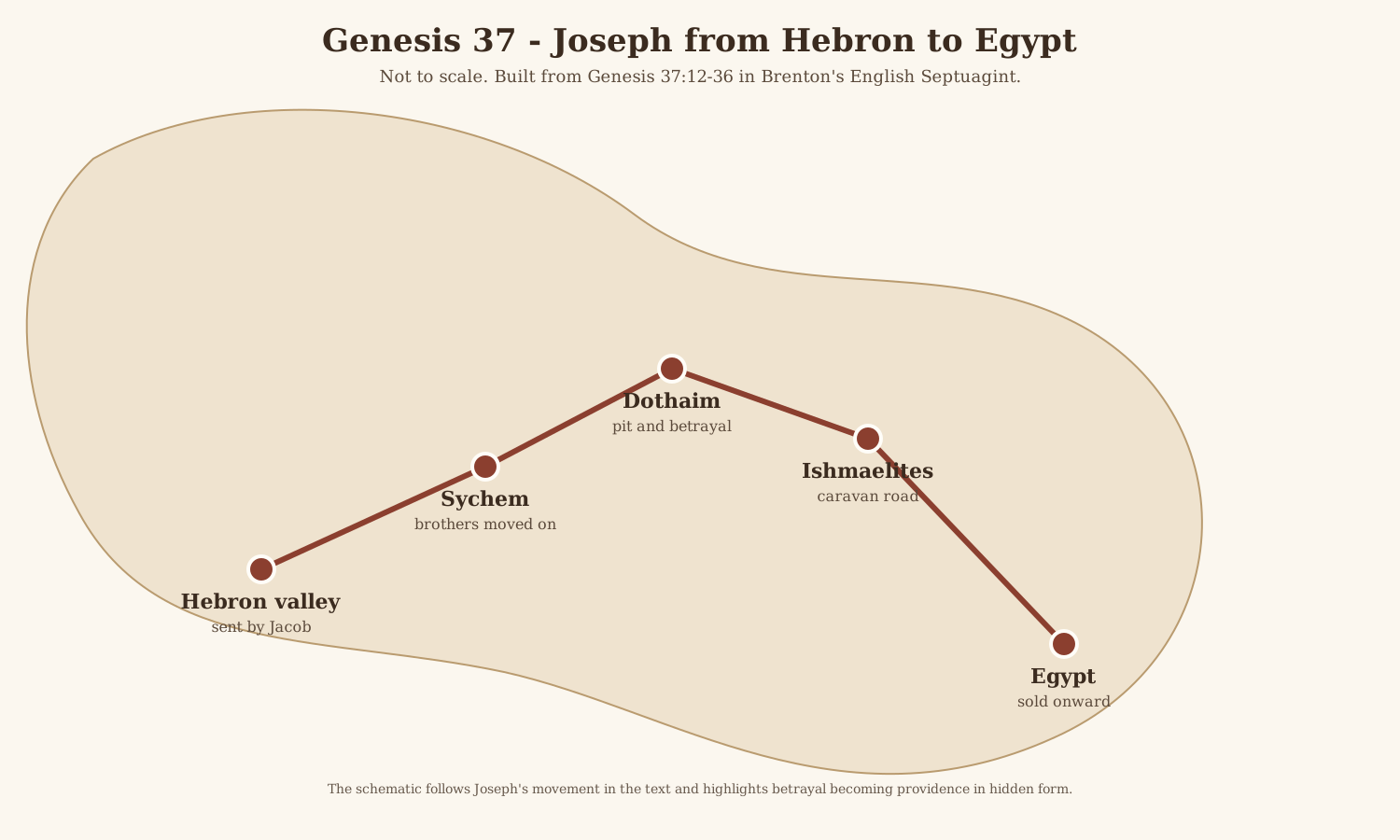 Source: schematic based on Genesis 37:12-36; not to scale.
The pit and the stripping (Genesis 37:18-24)
18 And they spied him from a distance before he drew nigh to them, and they wickedly took counsel to slay him. 19 And each said to his brother, Behold, that dreamer comes. 20 Now then come, let us kill him, and cast him into one of the pits; and we will say, An evil wild beast has devoured him; and we shall see what his dreams will be. 21 And Ruben having heard it, rescued him out of their hands, and said, Let us not kill him. 22 And Ruben said to them, Shed not blood; cast him into one of these pits in the wilderness, but do not lay your hand upon him; that he might rescue him out of their hands, and restore him to his father. 23 And it came to pass, when Joseph came to his brethren, that they stripped Joseph of his many-coloured coat that was upon him. 24 And they took him and cast him into the pit; and the pit was empty, it had not water.
Before Joseph reaches them, the brothers plan his death and rehearse the explanation they will give their father. “We shall see what his dreams will be” turns murder into a challenge against the promise. Removing Joseph appears to them a way of removing the future they fear.
The Greek wording sharpens a Gospel connection. Genesis 37:20 has “δεῦτε ἀποκτείνωμεν αὐτόν,” meaning “come, let us kill him.” The same words appear in Matthew 21:38, where the tenants plot against the owner’s son and heir. The shared phrase joins two scenes of a sent son rejected by men who want to secure what they consider theirs. It supports reading Joseph in the light of Christ without making every detail identical.1
Ruben, or Reuben, intervenes. The narrator tells us his purpose: to rescue Joseph and restore him to his father. His proposal averts immediate murder, but leaves Joseph in the brothers’ power. Good intention needs a completed act of protection. A person in danger needs more than the assurance that someone privately means well.
The coat is stripped away, and Joseph is thrown into a pit without water. Zechariah 9:11 later speaks of prisoners released from a waterless pit by the blood of the covenant. This is a fitting scriptural resonance of rescue from death-like captivity, rather than a claim that Zechariah is narrating Joseph’s imprisonment. Wisdom 10:13-14 gives a more direct interpretation of Joseph’s story: wisdom stays with the righteous man when he is sold, descends with him into the pit, and does not abandon him in bonds. God’s presence reaches a place where Joseph can see no way out.
Bread beside the pit (Genesis 37:25-28)
25 And they sat down to eat bread; and having lifted up their eyes they beheld, and lo, Ismaelitish travellers came from Galaad, and their camels were heavily loaded with spices, and resin, and myrrh; and they went to bring them to Egypt. 26 And Judas said to his brethren, What profit is it if we slay our brother, and conceal his blood? 27 Come, let us sell him to these Ismaelites, but let not our hands be upon him, because he is our brother and our flesh; and his brethren hearkened. 28 And the men, the merchants of Madian, went by, and they drew and lifted Joseph out of the pit, and sold Joseph to the Ismaelites for twenty pieces of gold; and they brought Joseph down into Egypt.
The brothers sit down to eat while Joseph is trapped below. Genesis 42:21 will reveal what this chapter leaves unspoken: they saw his distress when he pleaded with them and refused to listen. Their meal exposes how ordinary life can continue around a person whose suffering has been deliberately shut out.
Judas, the Brenton form of Judah, proposes a sale. He acknowledges Joseph as “our brother and our flesh,” yet uses that bond to justify keeping their hands free of blood while giving him away for profit. Mercy would have returned Joseph to safety. Judah’s bargain removes the victim and preserves an appearance of restraint.
The name “Ἰούδας” is also the Greek name of Judas Iscariot in Matthew 26:14. The name and the sale invite a measured comparison with the betrayal of Christ. They do not make the two men interchangeable: Judah will confess and later offer himself for Benjamin, whereas Matthew tells a different end for Iscariot.2
Brenton prints “twenty pieces of gold”; the Hebrew-based NKJV prints twenty shekels of silver. The displayed text should be read as it stands. Verse 28 is compressed: Midianite merchants pass by, and “they” draw Joseph out and sell him to the Ishmaelites. The pronoun does not by itself settle whether the brothers or the passing traders perform each action. Acts 7:9 and Joseph’s own words, “whom ye sold into Egypt” (Genesis 45:4), place responsibility for the sale with the brothers. Verse 36 names Midianites selling him in Egypt, while Genesis 39:1 identifies the Ishmaelites from whose hands Petephres, usually called Potiphar, bought him. The narrative does not explain every transfer. Reuben returns afterward and finds the pit empty. Where he went, and why he was absent during the sale, are left unstated.
Gems from the Fathers 💎: The truth exceeds the type
St. Ambrose considers Joseph’s sale within a theological argument in On the Holy Spirit III.17, §§124-126. His argument includes a comparison of Joseph’s betrayal with Christ’s Passion. His central insight is that the suffering patriarch points beyond himself to the incarnate Son, whose saving gift exceeds the pattern. Ambrose sets Joseph’s twenty pieces beside the thirty paid for Christ, then refuses to let either sum measure the Lord’s worth. Ambrose writes, “for the Truth is of more value than the type, Grace is more generous than training, the Presence is better than the Law, for the Law promised the Coming, the Coming fulfilled the Law.”3 Neither price measures Christ, whose worth, Ambrose says, cannot be limited.
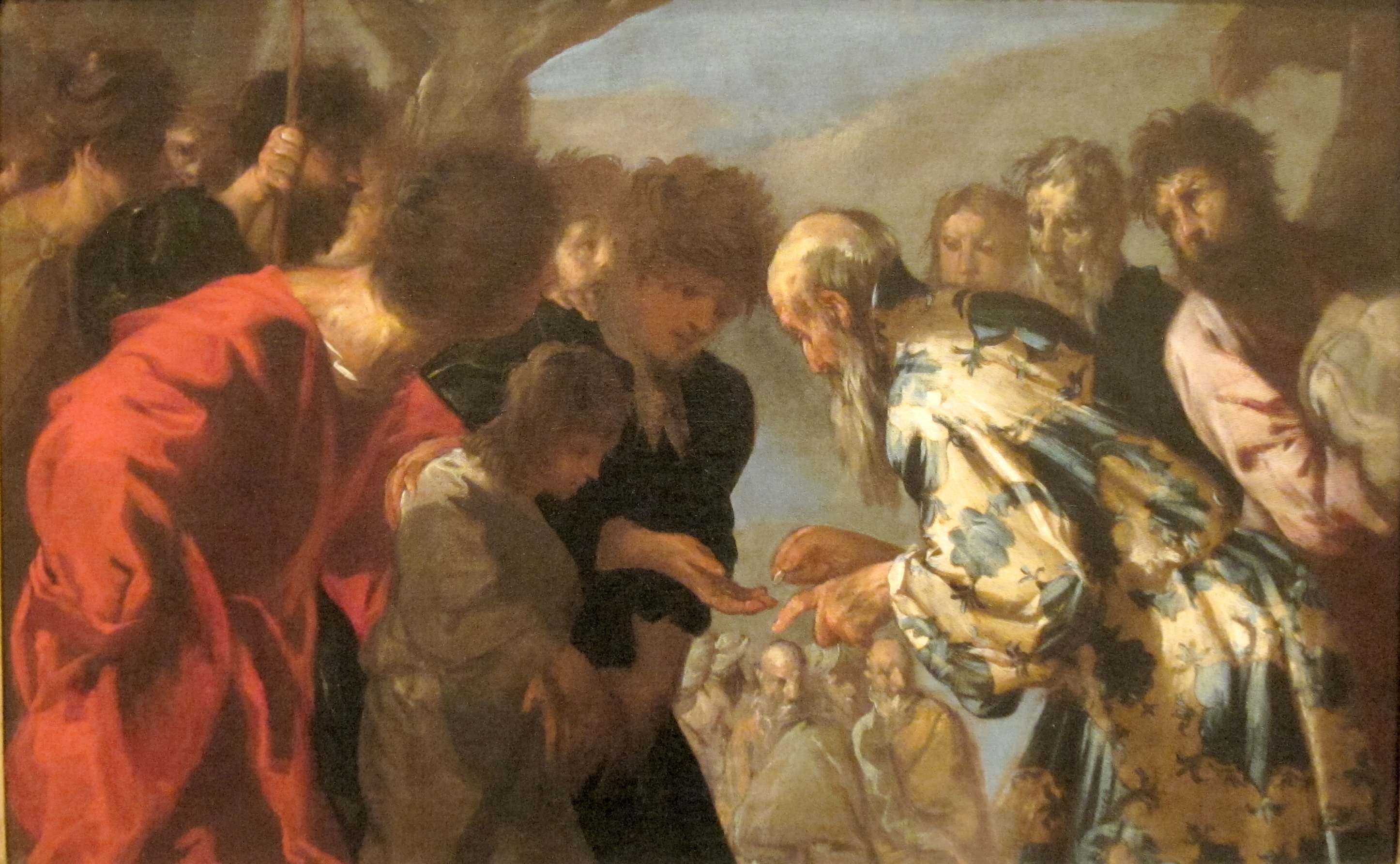 Source: Francesco Maffei, Joseph Sold by his Brothers, San Diego Museum of Art; Western biblical painting, CC0. 🔗
The bloodied coat and the father’s grief (Genesis 37:29-36)
29 And Ruben returned to the pit, and sees not Joseph in the pit; and he rent his garments. 30 And he returned to his brethren and said, The boy is not; and I, whither am I yet to go? 31 And having taken the coat of Joseph, they slew a kid of the goats, and stained the coat with the blood. 32 And they sent the coat of many colours; and they brought it to their father, and said, This have we found; know if it be thy son’s coat or no. 33 And he recognised it, and said, It is my son’s coat, an evil wild beast has devoured him; a wild beast has carried off Joseph. 34 And Jacob rent his clothes, and put sackcloth on his loins, and mourned for his son many days. 35 And all his sons and his daughters gathered themselves together, and came to comfort him; but he would not be comforted, saying, I will go down to my son mourning to Hades; and his father wept for him. 36 And the Madianites sold Joseph into Egypt; to Petephres, the eunuch of Pharao, captain of the guard.
Reuben tears his clothes, and the brothers stain Joseph’s coat with a kid’s blood. They then ask Jacob to identify it, leaving him to supply the terrible conclusion. Their question pretends to be a request for knowledge while directing him toward a lie. Even their attempt to comfort him is compromised by the truth they withhold.
Goats and garments connect three family scenes. In Genesis 27:9-16, Rebecca prepares kids and clothes Jacob in Esau’s raiment and goatskins to deceive Isaac. Here a goat’s blood and Joseph’s garment deceive Jacob. In Genesis 38:17-26, Judah promises a kid, gives personal tokens as security, and must recognize them when Tamar sends them back and asks him to identify them. The recognition wording is especially close: Genesis 37:32-33 and 38:25-26 use the same Greek command “ἐπίγνωθι,” “recognize,” and response “ἐπέγνω,” “he recognized.” The evidence used to hide the truth in one chapter becomes evidence that brings the truth out in the next.4
Jacob’s mourning is allowed to remain mourning. He expects to descend sorrowfully to Hades, the realm of the dead, while the reader knows Joseph is still alive. The Christian horizon reaches beyond Jacob’s fear: Acts 2:27-31 proclaims that Christ was not abandoned to Hades and that His flesh did not see corruption. The risen Lord brings victory where Jacob sees only loss. That hope gives us reason to accompany the grieving patiently, without treating their tears as unbelief.
Genesis 37 closes with Joseph sold into a powerful Egyptian household. Psalm 105:17-19 (LXX Ps 104:17-19) will remember the fetters and the testing that precede his vindication. Only later will Joseph say that God sent him ahead to preserve life (Genesis 45:5-8). In Genesis 50:20, he distinguishes the brothers’ evil counsel from God’s good purpose. Providence means God’s wisdom can bring life from what people intended for death. It gives no permission to harm, and imposes no duty on a wounded person to remain in danger.
Gems from the Fathers 💎: Providence amid intended harm
In Homily 49 on Acts, on Acts 23, St. John Chrysostom uses Joseph as an example of God’s providence. His Joseph discussion is a substantial moral excursus, not a homily on Genesis 37. Chrysostom considers the brothers alongside Potiphar’s wife in Genesis 39, whose schemes also fail to ruin Joseph. He observes that their effort to destroy him cannot control God’s purpose: “So that while they and she were severally seeking to compass their own ends, far other were the mighty consequences working out by the Providence of God for that just man.”5 Chrysostom speaks with the whole Joseph story in view. At this chapter’s close, neither Jacob nor Joseph can yet see those consequences. Hope in God’s providence belongs with protection, truth, and patient care.
Glossary
- Joseph: Jacob’s seventeen-year-old son, sold into Egypt and later the means of preserving his family during famine.
- Sychem / Shechem; Chebron / Hebron; Dothaim / Dothan: the successive places in Joseph’s search for his brothers.
- Judas / Judah; Ruben / Reuben: Brenton’s forms for the brothers who propose the sale and attempt a rescue.
- Ishmaelites / Midianites: the traders named at different points in Joseph’s transfer to Egypt; the chapter leaves some details of their relationship unexplained.
- Hades: the realm of the dead in Jacob’s lament, distinct from a statement that Joseph has actually died.
- Type: a person or event that anticipates a fuller reality in Christ, without matching it in every detail.
- Providence: God’s wise care and direction of history, which can overrule evil purposes without making evil righteous.
Spiritual Fruit 🍇
- Recover peaceable speech. Name before God the person whose success irritates you. Pray for that person’s good, and replace one habitual sarcastic remark or withheld greeting with a truthful act of kindness. Where contact is unsafe, seek peace without abandoning protective boundaries.
- Make protection concrete. Reuben’s intended rescue remained unfinished. If someone is being mistreated in a family or parish, take an appropriate action: interrupt the harm, find responsible support, or help the person reach safety. Private sympathy alone may leave the pit occupied.
- Confess the bargain that hides cruelty. Judah calls Joseph his flesh while selling him. Examine a decision that benefits you by passing suffering to someone else, and amend what can actually be amended.
- Accompany grief without explaining it away. Jacob cannot see Egypt’s future grain. Offer presence, prayer, and useful help to the grieving before offering an account of providence.
Lord Jesus Christ, You freely entered the suffering we inflict on one another. Keep me from making another person’s gift my grievance. Be near those whose distress is ignored, and teach me to serve them while Your purpose remains hidden.
Teaching Notes
A beloved son in a divided household (Genesis 37:1-4)
- Ask: What does the evil report reveal, and what does the narrator leave unknown?
- Watch for: Avoid assigning Joseph motives or blaming him for the brothers’ violence.
Dreams that intensify envy (Genesis 37:5-11)
- Ask: How does the sheaf dream look different once the brothers come seeking grain in Genesis 42?
- Watch for: Avoid forcing every dream detail, including the reference to Joseph’s mother, into a timetable; let the unfolding narrative disclose the fulfillment.
The obedient son sent by his father (Genesis 37:12-17)
- Ask: What does Joseph do when his first search fails, and how does Christ’s willing Passion exceed this pattern?
- Watch for: Joseph knows hostility; his knowledge of the present plot is unstated. Do not describe him as entirely unaware of danger.
The pit and the stripping (Genesis 37:18-24)
- Ask: What separates Reuben’s intention to rescue from completed protection?
- Watch for: Typology must not displace the immediate duty to protect a person being harmed.
Bread beside the pit (Genesis 37:25-28)
- Ask: How does Judah use the language of brotherhood to make the sale acceptable?
- Watch for: Keep gold in the printed Brenton text, distinguish silver in Hebrew-based translations, and leave the unexplained transfers and Reuben’s whereabouts unexplained.
The bloodied coat and the father’s grief (Genesis 37:29-36)
- Ask: How do recognition, garments, and goats connect the deception here with Judah’s exposure in chapter 38?
- Watch for: Let Jacob grieve. Chrysostom speaks retrospectively; providence is no reason to demand that a victim remain unsafe.
Sources
Embedded Scripture is from Brenton’s English Septuagint (LXX).
Lancelot C. L. Brenton, The Septuagint Version of the Old Testament, Genesis 37; biblical connections include Genesis 27:9-16; 38:17-26; 42:6, 21; 45:4-8; 50:20; Wisdom 10:13-14; Psalm 105:17-19 (LXX Ps 104:17-19); and Zechariah 9:11. 🔗
New Testament connections: Matthew 21:33-39; 26:14-16; 27:18; John 10:17-18; Acts 2:27-31; 7:9-10; Philippians 2:6-8.
St. Ambrose, On the Holy Spirit III.17, §§124-126, NPNF, second series, vol. 10. The quotation is from a Joseph comparison in an anti-Arian argument. Its surrounding collective anti-Jewish polemic is not adopted here. 🔗
St. John Chrysostom, Homily 49 on Acts, on Acts 23:6-8, Joseph excursus, NPNF, first series, vol. 11. 🔗
Greek comparisons: Swete’s Septuagint, Genesis 37 and 38; New Testament Greek, Matthew 21:38 and 26:14. The NKJV price in Genesis 37:28 is the Hebrew-based comparative rendering. 🔗 🔗 🔗 🔗 🔗
Francesco Maffei, Joseph Sold by his Brothers, San Diego Museum of Art, CC0 image at Wikimedia Commons. The other visual is a schematic of the chapter’s journey. 🔗
Footnotes
-
Genesis 37:20 in Swete’s Septuagint and Matthew 21:38 in the Greek text, “δεῦτε ἀποκτείνωμεν αὐτόν.” 🔗 🔗 ↩
-
Genesis 37:26 and Matthew 26:14, the name “Ἰούδας.” 🔗 🔗 ↩
-
St. Ambrose, On the Holy Spirit III.17.125, translated by H. de Romestin with E. de Romestin and H. T. F. Duckworth, NPNF, second series, vol. 10. 🔗 ↩
-
Genesis 37:32-33 and 38:25-26 in Swete’s Septuagint. Both have “ἐπίγνωθι” and “ἐπέγνω.” 🔗 🔗 ↩
-
St. John Chrysostom, Homily 49 on Acts, Joseph excursus; translated by J. Walker, J. Sheppard, and H. Browne, revised with notes by George B. Stevens, NPNF, first series, vol. 11. 🔗 ↩